
Smart Parcel Delivery Locker Market Trends and Analysis by 2034
Coverage: By Type (Standard Smart Locker and Temperature Controlled Smart Locker), Component (Hardware and Software), and Application (Retail, Residential, University, Office, and Others), and Geography
- Status : Data Released
- Report Code : TIPRE00010330
- Category : Electronics and Semiconductor
- No. of Pages : 150
- Available Report Formats :


- Last update date : August 27, 2026


2025 Market Size
US$ 1.12 Bn
Base year value
2034 Forecast
US$ 3.51 Bn
Projected by 2034
CAGR 2024-2034
13.5 %
Growth rate
Addressable Market
US$ 20.02 Bn
(2024-2034)
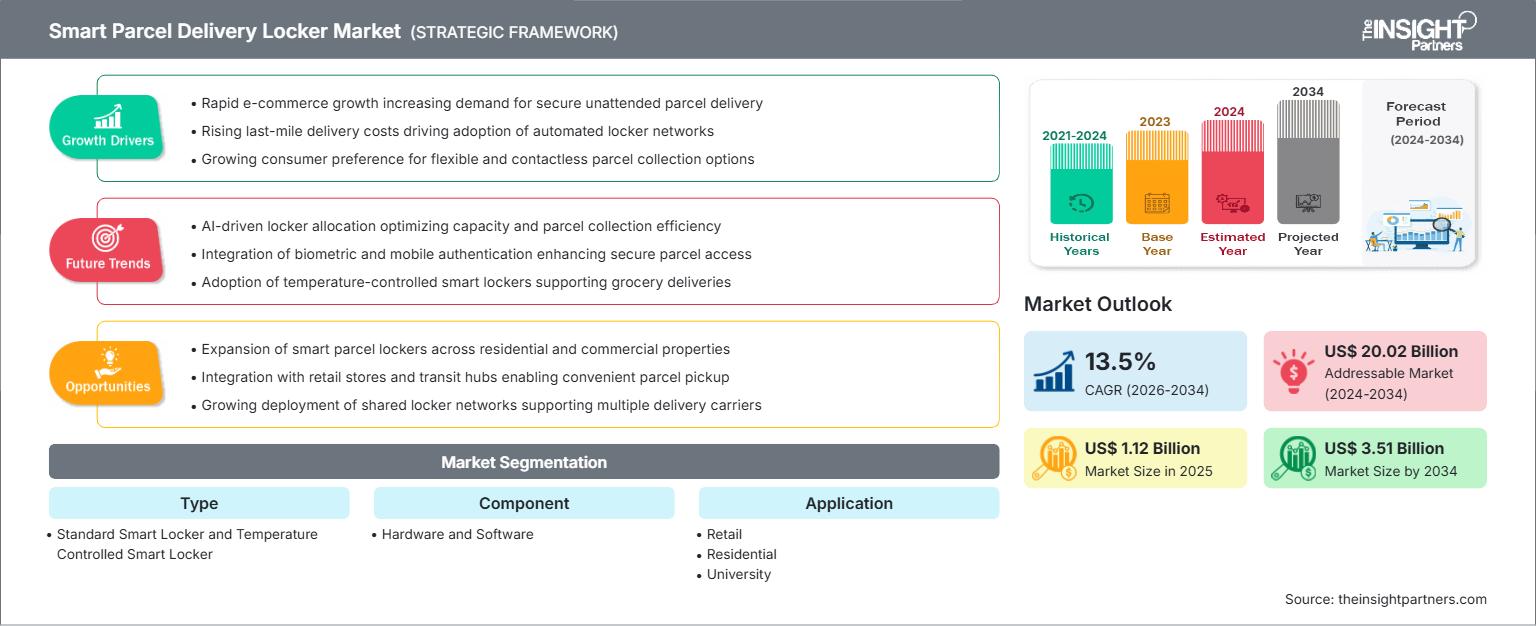
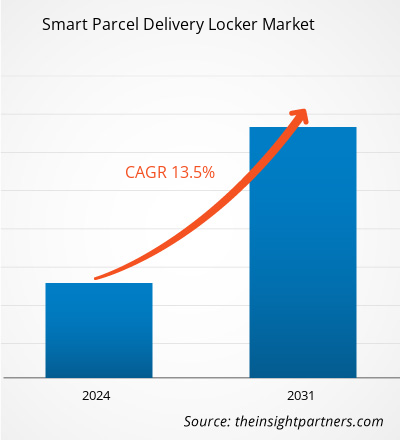
The Smart Parcel Delivery Locker Market size was valued at US$ 1.12 billion in 2025 and is projected to reach US$ 3.51 billion by 2034, registering a CAGR of 13.5% from 2026 to 2034. This growth is underpinned by the rapid expansion of e-commerce and the corresponding need for efficient, secure, and contactless last-mile delivery solutions across residential, retail, and commercial sectors.
North America is estimated to account for a significant share of the global Smart Parcel Delivery Locker Market, with a projected CAGR of 12–14% during the forecast period. The region's market is driven by high e-commerce penetration, the presence of advanced logistics infrastructure, and a robust consumer preference for convenient and secure delivery options. Increasing urbanization and the proliferation of smart city initiatives are further accelerating the deployment of automated parcel lockers across the region.
Smart Parcel Delivery Locker Market Assessment and Insights
- North America: Estimated to hold the largest Smart Parcel Delivery Locker Market share of 33–36% in 2025, growing at a CAGR of 12–14% from 2026 to 2034. Market growth is driven by advanced logistics networks and high e-commerce adoption across the region.
- US: Projected to account for 85–88% of the North American market share in 2025, with a CAGR of 12–14% from 2026 to 2034. The market is propelled by a high volume of parcel deliveries and strong consumer demand for automated pickup solutions.
- Europe: Estimated to hold a 24–27% share of the global market in 2025, growing at a CAGR of 12–14% from 2026 to 2034. Germany, the UK, and France are leading countries, with growth driven by stringent delivery regulations and a mature e-commerce sector.
- Asia Pacific: Projected as the fastest-growing region, estimated to hold a 21–24% market share in 2025, with a CAGR of 15–17% from 2026 to 2034. China and India are key markets, driven by rapid urbanization and expanding e-commerce infrastructure.
- Largest Segment (Type): The Standard Smart Locker segment is estimated to hold the largest market share of 65–70% in 2025, with a CAGR of 12–14% from 2026 to 2034. Its dominance is attributed to broad applicability across residential and retail settings.
- High Growth Segment (Type): The Temperature Controlled Smart Locker segment is projected as the high-growth segment, estimated to hold a 30–35% share in 2025, with a CAGR of 15–17% from 2026 to 2034. Growth is fueled by the rising demand for fresh and frozen grocery deliveries and pharmaceutical shipments.
- Key companies analyzed in detail: Cleveron, DeBourgh, KEBA, KernPack, Package Nexus, Patterson Pope, RENOME SMART, Smartbox Ecommerce Solutions Private Limited, Snaile Inc., TZ Limited, Quadient, InPost, Luxer One.
Source: The Insight Partners' analysis based on proprietary research, government publications, company annual reports, investor presentations, industry databases, and expert interviews.
The trajectory of growth of the Smart Parcel Delivery Locker Market is characterized by the evolution from basic metal containers to technologically-advanced IoT-driven lockers. The modern lockers are equipped with advanced software to enable real-time tracking and remote management features, as well as the ability to integrate with e-commerce websites and logistics company networks. Such changes have resulted in more efficient and modular products designed to meet the needs of different environments ranging from multi-story buildings to university campuses. The manufacturing process has also changed; manufacturers have increasingly focused on durable materials and energy efficiency.
In terms of future Smart Parcel Delivery Locker Market trends, it should be noted that the market will be further impacted by new geographies due to the spread of e-commerce in developing countries. At the moment, there are significant investments being made to develop new functions of lockers, including route optimization algorithms based on AI and automated package verification systems. Besides, favorable regulations in many countries supporting contactless delivery and environmentally-friendly logistics in cities provide strong tailwinds for the market.
Smart Parcel Delivery Locker Market Report Scope
| Report Attribute | Details |
|---|---|
| Market size in 2025 | US$ 1.12 Billion |
| Market Size by 2034 | US$ 3.51 Billion |
| Global CAGR (2026 - 2034) | 13.5% |
| Historical Data | 2021-2024 |
| Forecast period | 2024-2034 |
Smart Parcel Delivery Locker Market Analysis
According to the Smart Parcel Delivery Locker Market report, main drivers of growth are related to the growing number of B2C e-commerce deliveries and the necessity of improving the efficiency of last-mile deliveries. Inefficient logistics of the classic delivery approach often lead to missed deliveries, package theft, and costly re-deliveries, which increase the overall expenses of the companies working in this sphere. Smart parcel lockers become the means of consolidating deliveries and making them safer and easier to organize and control for supply chain participants. The value chain includes hardware producers, software developers, network operators, and users.
There are both traditional hardware companies and tech firms active in this market. Some of the biggest companies are Cleveron, KEBA, and TZ Limited; other notable firms in the industry are Package Nexus and Snaile Inc. The investments tend to go into development of software solutions aimed at improvement of user experience and operational analysis. Strategic positioning implies the provision of full-scale solutions including not only the hardware for parcel locker, but also cloud-based management system, mobile apps and additional solutions like automated returns. This strategic decision gives companies an advantage as a result of vertical integration.
● REPORT CUSTOMIZATION
Tailor This Report To Align With Your Specific Business Requirements
This report can be customized to align precisely with your business objectives, scope, and target markets. Customization options include tailored segmentation, geography, competitive analysis, and strategic insights to support informed decision-making.
Customize This Report →WHAT YOU CAN ADJUST
- ● Segmentations
- ● Geography
- ● Competitive Analysis
- ● Language Preferences
Smart Parcel Delivery Locker Market: Strategic Insights
Regional Insights
North America Smart Parcel Delivery Locker Market
The Smart Parcel Delivery Locker Market forecast indicates that North America is estimated to be the largest regional market for smart parcel delivery lockers, accounting for 33–36% of the global share in 2025. The market is projected to grow at a robust CAGR of 12–14% from 2026 to 2034. The United States leads the market, being propelled by its huge market in e-commerce and acceptance of automatic deliveries. An important structural factor here is the growing use of “buy online, pick up in-store” by the big retail players who need effective package management solutions to cope with the large number of returns. Additionally, real estate developers include smart lockers as an essential feature of their new construction projects to attract clients.
U.S. Smart Parcel Delivery Locker Market
The U.S. Smart Parcel Delivery Locker Market is a powerhouse, holding an estimated 85–88% share of the North American market in 2025. It is anticipated to expand at a CAGR of 12–14% during the forecast period. The market environment features stiff competition between logistic service providers and high technological integration, with much emphasis put on developing easy-to-use mobile applications and safe payment gateways. There has been massive investment in building independent networks of smart lockers by major retail chains and logistics service providers in order to minimize costs associated with deliveries and increase customer satisfaction. The inclusion of Luxer One and InPost in this market environment adds to the fact that it remains a leader globally in using this technology.
Europe Smart Parcel Delivery Locker Market
Europe represents a mature and well-established market for smart parcel lockers, estimated to hold a 24–27% global share in 2025, with a CAGR of 12–14%. The market is dominated by the dense population base, emphasis on environmental sustainability, and tough regulatory environment for urban logistics vehicles. In Europe, United Kingdom and Germany lead the market and major players such as Deutsche Post DHL and Royal Mail have invested significantly in infrastructure development. An increasing trend of open network where lockers can be accessed by multiple carriers without any redundancy is emerging. Other prominent markets include France, Italy, and Spain; these countries have government-supported projects for alleviating urban congestion through installing lockers at transit and residential locations.
APAC Smart Parcel Delivery Locker Market
The Asia Pacific region is identified as the fastest-growing market, with an estimated CAGR of 15–17% and is expected to hold a 21–24% share in 2025. The growth is largely due to the immense use of e-commerce in countries like China, India, and Japan, together with fast urbanization. China, being the biggest market in the world, uses millions of smart lockers all over the country. India is one of the emerging markets due to its fast-growing e-commerce industry and increasing middle class. Initiatives such as “Digital India” and smart cities are being established in India, thus providing a favorable environment. The dominant country, China, not only provides a market for the lockers but manufactures them too.
Middle East & Africa Smart Parcel Delivery Locker Market
The Middle East and Africa market is in a nascent but rapidly developing stage. The region is estimated to be the smallest market in 2025 but is expected to show a CAGR of 12–15% during the forecast period. Growth is mainly concentrated in oil-rich nations like the UAE and Saudi Arabia, which are investing heavily in smart infrastructure and tourism. The UAE, with its strong e-commerce sector and tech-savvy population, is a leading country. In South Africa, the market is driven by security concerns associated with home deliveries, making locked boxes a desirable solution. Energy and infrastructure projects, particularly in the Gulf region, provide the necessary digital backbone for widespread locker adoption.
Segmentation Analysis
Type
The Smart Parcel Delivery Locker Market is segmented by Type into Standard Smart Locker and Temperature Controlled Smart Locker. The Standard Smart Locker segment dominated the market in 2025, while the Temperature Controlled Smart Locker segment is projected to exhibit a higher CAGR from 2026 to 2034.
The Standard Smart Locker segment, estimated to hold a 65–70% market share in 2025, is the backbone of the industry. Its widespread adoption is driven by its versatility in handling a vast majority of e-commerce parcels. These lockers are deployed extensively in residential complexes, retail outlets, and office buildings, providing a cost-effective solution for automated package pickup and returns. They are the primary solution for reducing failed deliveries and improving customer convenience. The segment is projected to maintain steady growth with a CAGR of 12–14%.
- Standard Smart Locker: This sub-segment represents the conventional smart locker system equipped with electronic locks and software for parcel management. It is the most widely adopted solution across all applications, valued for its simplicity, durability, and cost-effectiveness in residential and retail settings. Its strategic importance lies in its role as the foundational technology enabling automated last-mile logistics.
- Temperature Controlled Smart Locker: This sub-segment represents a specialized and evolving solution designed to accommodate temperature-sensitive deliveries. These lockers feature integrated cooling and heating elements to ensure the integrity of perishable goods like groceries and pharmaceuticals. They are gaining strategic importance as online grocery shopping and prescription delivery services expand, representing a significant opportunity for market differentiation.
Component
The Smart Parcel Delivery Locker Market is segmented by Component into Hardware and Software. Both components are essential for the functionality and user experience of the system.
- Hardware: This sub-segment includes physical lockers, electronic locking mechanisms, touchscreens, scanners, and other physical infrastructure. It represents a significant portion of the initial capital expenditure and is crucial for the system's physical durability and security.
- Software: This sub-segment includes management platforms, mobile applications, and APIs that enable remote monitoring, user authentication, and integration with logistics networks. The strategic importance of software is increasing as it drives user engagement, operational efficiency, and data analytics.
Application
The market is segmented by Application into Retail, Residential, University, and Office. The Retail segment is a major driver, facilitated by the growth of BOPIS. The Residential segment is the largest application, driven by the need to secure packages for residents. The University and Office segments are growing due to high parcel volumes in these consolidated environments, with a focus on improving convenience and reducing administrative burden.
- Retail: This sub-segment focuses on in-store lockers for BOPIS and returns. It is critical for retailers to streamline omnichannel operations and reduce the cost of reverse logistics.
- Residential: This sub-segment includes lockers in apartment buildings, gated communities, and multi-family housing units. It addresses package theft and delivery inconvenience for residents, making it a key amenity for property managers.
- University: This sub-segment involves lockers on college campuses to manage the high volume of student packages. It reduces the burden on campus mailrooms and provides students with 24/7 access to their parcels.
- Office: This sub-segment involves lockers in corporate offices for employee package delivery and internal mail distribution. It helps organizations manage mail and reduce distractions in the workplace.
Opportunity Snapshot
| Application | Revenue Contribution | Trend Tag | Adoption Stage |
|---|---|---|---|
| Retail | High | BOPIS Integ. | Scaling |
| Residential | High | Last-Mile Hub | Mature |
| University | Medium | Campus Logistic | Scaling |
| Office | Medium | Mailroom Auto | Emerging |
Smart Parcel Delivery Locker Market Growth Drivers and Impact Analysis
Rapid E-Commerce Growth and Last-Mile Delivery Optimization
The explosive growth of the e-commerce sector is the primary catalyst for the Smart Parcel Delivery Locker Market. As online retail penetration increases globally, the volume of B2C parcel shipments has surged, placing immense pressure on traditional last-mile delivery networks. Logistics providers face challenges such as high failed delivery rates, escalating re-delivery costs, and the risk of package theft. Smart parcel lockers offer a strategic solution by enabling secure, consolidated deliveries to a single point of access. This model significantly reduces the number of delivery attempts required, thereby lowering operational costs and carbon emissions. Furthermore, it enhances customer satisfaction by providing flexibility and security in parcel collection, driving its adoption by major postal and courier services.
Rising Urbanization and Smart City Initiatives
The global trend towards urbanization is creating dense living and working environments where efficient logistics are essential. Cities are increasingly plagued by traffic congestion and space constraints, making traditional door-to-door parcel delivery inefficient and often unsustainable. Smart parcel lockers provide a space-efficient solution that can be integrated into public infrastructure, such as transit hubs, parking garages, and public squares. These installations align with the objectives of smart city initiatives, which aim to leverage technology to improve urban living. Governments are supporting this trend through policies that promote sustainable transport and reduce urban congestion, making lockers a key component of future urban logistics strategies.
Shift in Consumer Preferences for Contactless and Secure Delivery
Consumer behavior has undergone a permanent shift, with a pronounced preference for contactless and secure delivery options. Concerns about package theft, often referred to as "porch piracy," and the need for flexible pickup times have increased the demand for alternative delivery methods. Smart parcel lockers meet these expectations by providing a self-service, secure, and accessible solution available 24/7. They offer a hygienic alternative to traditional delivery, which became particularly relevant following the COVID-19 pandemic. As consumers become more accustomed to this convenience, the demand for lockers across residential, retail, and commercial settings continues to grow, making them an indispensable part of the modern shopping experience.
Smart Parcel Delivery Locker Market Future Trends
Integration of AI and IoT for Advanced Locker Network Management
The future of the Smart Parcel Delivery Locker Market lies in the deep integration of Artificial Intelligence and the Internet of Things. This will enable the creation of intelligent locker networks capable of predictive analytics and autonomous decision-making. AI algorithms will forecast parcel volumes, optimize locker space allocation, and predict maintenance needs, improving operational efficiency. IoT sensors will provide real-time data on locker status, temperature (for controlled units), and security, enabling proactive management. This move towards smart, connected systems will transform lockers from simple storage boxes into active nodes in the digital logistics infrastructure, enhancing the value proposition for operators and users.
Expansion of Locker Networks for Grocery and Pharmaceutical Deliveries
As online penetration in grocery and pharmaceutical sectors deepens, the demand for temperature-controlled lockers will surge, becoming a major trend. These specialized lockers, equipped with heating and cooling capabilities, will be increasingly deployed to maintain the cold chain for fresh produce, meal kits, and prescription drugs. This trend is driven by the growing consumer convenience of online grocery shopping and the need for secure, temperature-sensitive medication delivery. The strategic expansion of these locker networks will create new revenue streams and service models, partnering with grocery chains and pharmacies to offer a seamless and safe last-mile solution for perishable goods.
Smart Parcel Delivery Locker Market Opportunities
Integration with Autonomous Delivery Vehicles and Drones
A transformative opportunity lies in integrating smart parcel lockers with autonomous delivery vehicles and drones. As these technologies mature, they present a "last-yard" problem where lockers can serve as the final hand-off point. Drones or autonomous ground vehicles can deposit packages directly into the lockers, eliminating the need for human couriers. This would create a fully automated, highly efficient logistics ecosystem, reducing costs and delivery times. Investment in developing hardware and software interfaces to enable this interaction positions companies as leaders in the next generation of logistics, providing a significant competitive edge in an increasingly automated world.
Recycling and Returns Logistics Using Smart Lockers
Smart parcel lockers present a significant opportunity to revolutionize reverse logistics and product returns. By positioning lockers in convenient, high-traffic locations, retailers can offer a simple, automated returns process that reduces friction for consumers. This model is more efficient and cost-effective than mailing returns, as it consolidates returns for bulk shipment back to warehouses. Furthermore, lockers can be integrated with recycling programs, allowing consumers to return empty packaging or used products. This streamlines operations and aligns with sustainability goals by improving material recovery rates and reducing the carbon footprint of reverse logistics.
Recent Developments
- July 2026: The U.S. Postal Service has launched an offering that enables sellers to drop off packages at parcel lockers for customer pickup. Local XChange costs $5.51 per package, according to the agency’s website. Sellers can book the service through Click-N-Ship, which gives them the option to print a Local XChange shipping label at home or an agency smart locker location.
- November 2025: Autope Payment Solutions Ltd, a fintech company enabling seamless digital payments and services for India’s mass transit ecosystems, announced the successful launch of its innovative Smart Locker system across 12 Mumbai Metro One stations. The first of its kind initiative, in collaboration with Mumbai Metro One, introduces over 996 state-of-the-art digital lockers to the city's transit network.
- May 2023: SLG Storage has developed a smart locker storage system that provides a secure and hassle-free way of receiving packages for residents of apartments and condos. With the rising popularity of online shopping during the pandemic, the need for innovative delivery solutions has become increasingly important to ensure the safety and convenience of package delivery and returns.
Frequently Asked Questions

- Comprehensive Market Sizing and Forecast Analysis
- Detailed Segmentation Analysis
- In-Depth Market Dynamics Assessment
- Regional and Country-Level Insights
- Competitive Landscape and Company Benchmarking
- Strategic Business Intelligence
Recent Reports
Testimonials

The Insight Partners' SCADA System Market report is comprehensive, with valuable insights on current trends and future forecasts. The team was highly professional, responsive, and supportive throughout. We are very satisfied and highly recommend their services.
RAN KEDEM Partner, Reali Technologies LTDs
I requested a report on a very specific software market and the team produced the report in a few days. The information was very relevant and well presented. I then requested some changes and additions to the report. The team was again very responsive and I got the final report in less than a week.
JEAN-HERVE JENN Chairman, Future Analytica
We worked with The Insight Partners for an important market study and forecast. They gave us clear insights into opportunities and risks, which helped shape our plans. Their research was easy to use and based on solid data. It helped us make smart, confident decisions. We highly recommend them.
PIYUSH NAGPAL Sr. Vice President, High Beam Global
The Insight Partners delivered insightful, well-structured market research with strong domain expertise. Their team was professional and responsive throughout. The user-friendly website made accessing industry reports seamless. We highly recommend them for reliable, high-quality research services
YUKIHIKO ADACHI CEO, Deep Blue, LLC.
This is the first time I have purchased a market report from The Insight Partners.While I was unsure at first, I visited their web site and felt more comfortable to take the risk and purchase a market report.I am completely satisfied with the quality of the report and customer service. I had several questions and comments with the initial report, but after a couple of dialogs over email with their analyst I believe I have a report that I can use as input to our strategic planning process.Thank you so much for taking the extra time and making this a positive experience.I will definitely recommend your service to others and you will be my first call when we need further market data.
JOHN SUZUKI President and Chief Executive Officer, Board Director, BK Technologies
I wish to appreciate your support and the professionalism you displayed in the course of attending to my request for information regarding to infectious disease IVD market in Nigeria. I appreciate your patience, your guidance, and the fact that you were willing to offer a discount, which eventually made it possible for us to close a deal. I look forward to engaging The Insight Partners in the future, all thanks to the impression you have created in me as a result of this first encounter.
DR CHIJIOKE ONYIA MANAGING DIRECTOR, PineCrest Healthcare Ltd.Reason to Buy
- Informed Decision-Making
- Understanding Market Dynamics
- Competitive Analysis
- Identifying Emerging Markets
- Customer Insights
- Market Forecasts
- Risk Mitigation
- Boosting Operational Efficiency
- Strategic Planning
- Investment Justification
- Tracking Industry Innovations
- Aligning with Regulatory Trends





 Get Free Sample for