
Smart Personal Safety and Security Device Market Share, Size & Demand by 2034
Coverage: By Product (Finger wear, Head wear, Neck wear, Others); Technology (Networking, Positioning, Sensor, Speech recognition) , and Geography (North America, Europe, Asia Pacific, and South and Central America)
- Status : Data Released
- Report Code : TIPRE00020880
- Category : Electronics and Semiconductor
- No. of Pages : 150
- Available Report Formats :


- Last update date : August 26, 2026


2025 Market Size
US$ 6.92 Bn
Base year value
2034 Forecast
US$ 18.81 Bn
Projected by 2034
CAGR 2026-2034
11.75 %
Growth rate
Addressable Market
US$ 113.06 Bn
(2026-2034)
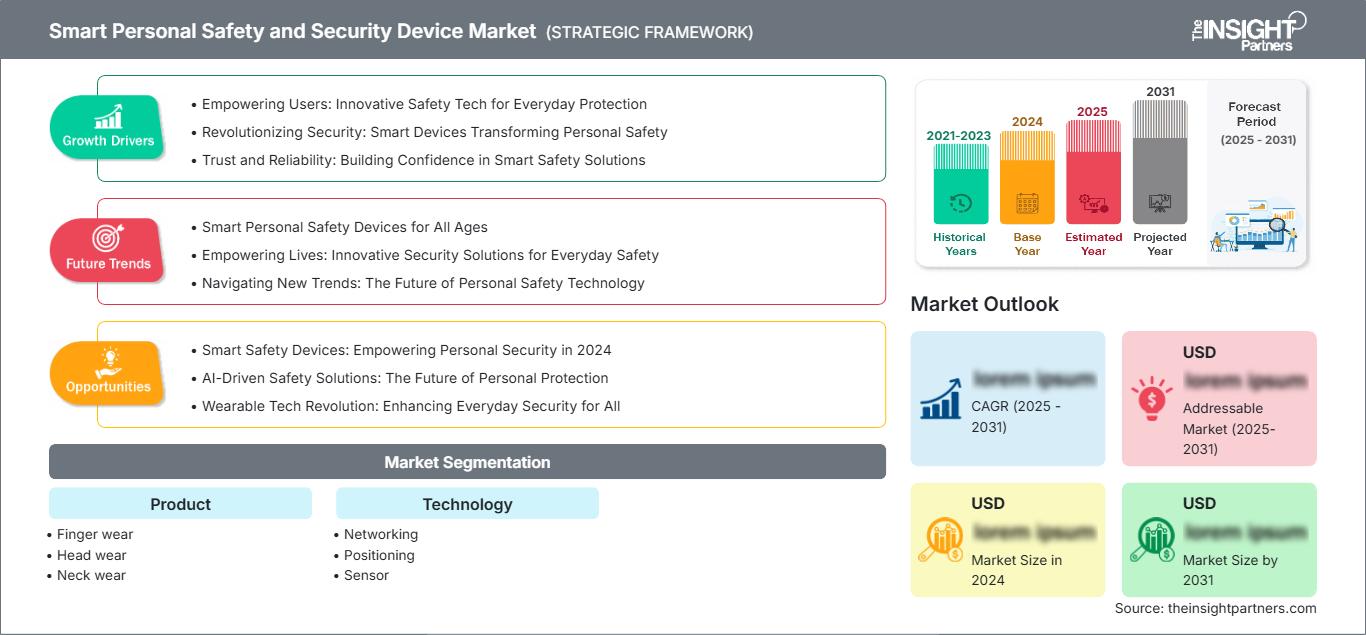
The Smart Personal Safety and Security Device Market size was valued at US$ 6.92 billion in 2025 and is projected to reach US$ 18.81 billion by 2034, registering a CAGR of 11.75% over the forecast period from 2026 to 2034. This growth is driven by rising crime rates, increasing awareness of personal security, and the proliferation of connected wearable technologies that integrate GPS tracking, sensors, and automated alert systems into compact, portable formats.
North America held a dominant 34-38% share of the global market in 2025, with a projected CAGR of 10-12% through 2034. The region's leadership is supported by advanced technology adoption, a robust ecosystem of wearable device manufacturers, and strong consumer demand for discreet, reliable safety solutions, particularly among women, seniors, and solo travelers.
Smart Personal Safety and Security Device Market Assessment and Insights
- North America – Estimated to hold 34-38% of the Smart Personal Safety and Security Device Market share in 2025, growing at a CAGR of 10-12% from 2026 to 2034. The region benefits from high consumer spending on personal safety solutions, a strong culture of independent living, and the presence of major device manufacturers.
- US – Represents approximately 85-90% of the North American market in 2025, with a CAGR of 10-12% projected through 2034. Market strength is reinforced by high smartphone penetration, which facilitates device connectivity, and significant demand for safety wearables among urban commuters and gig economy workers.
- Europe – Accounts for 22-26% of the global market in 2025, growing at an estimated CAGR of 10-12% during the forecast period. Germany and the UK are leading countries, driven by a growing elderly population requiring personal emergency response systems (PERS) and strict data privacy regulations under GDPR that influence device design.
- Asia Pacific – Captures 28-32% of global market share in 2025 and is projected to grow at the fastest CAGR of 12-14% through 2034. China leads the region with its large consumer electronics manufacturing base and rapid urbanization, followed by Japan, South Korea, and India, where rising safety concerns among women are fueling demand.
- Largest Segment – The finger wear product segment held the largest share with 35-40% of the market in 2025, growing at a CAGR of 11-13% through 2034. This includes smart rings and wristbands, which are favored for their discreet, always-on protection.
- High Growth Segment – The head wear product segment is projected as a high-growth segment with a CAGR of 12-14% from 2026 to 2034. Smart headwear, including helmets with built-in communication and alert systems, is gaining traction among cyclists, industrial workers, and outdoor enthusiasts.
- Key companies analyzed in detail – ADT Inc., FIT Inc., Fitbit, Inc., General Electric, Honeywell International Inc., Huawei Technologies Co., Ltd., Revolar, Safelet B.V., Telefonaktiebolaget LM Ericsson, and UnaliWear Inc.
Source: The Insight Partners' analysis based on proprietary research, government publications, company annual reports, investor presentations, industry databases, and expert interviews.
Smart Personal Safety and Security Device Market report indicates that the market has moved far beyond simple personal alarms to include smart systems which incorporate GPS, Bluetooth, cell-based connection, and sophisticated sensors. Such devices come equipped with functionalities like triggering of an SOS button, location sharing, two-way audio, fall detection, and emergency triggering through biometrics. In essence, this fusion of small sensors and cloud technology is bringing about a transformation in the field of personal safety into a data-driven ecosystem with predictive analytics and AI-led response decision making capabilities.
The development of new geographies such as those in the Asia-Pacific where increased urbanization brings up personal safety concerns within crowded cities, represents potential opportunities for future growth. Utilizing AI and machine learning for the differentiation of false alarms and actual emergencies, and the rise of smart cities that allow for device synchronization with municipal data and alerts nearby responders represents technological drivers in this space. Finally, tailwinds in the form of government support through subsidies for women safety as well as lone worker safety through compliance requirements represent market expansion enablers.
Smart Personal Safety and Security Device Market Report Scope
| Report Attribute | Details |
|---|---|
| Market size in 2025 | US$ 6.92 Billion |
| Market Size by 2034 | US$ 18.81 Billion |
| Global CAGR (2026 - 2034) | 11.75% |
| Historical Data | 2021-2024 |
| Forecast period | 2026-2034 |
Smart Personal Safety and Security Device Market Analysis
Rising crime rates and personal security awareness are the main drivers of the Smart Personal Safety and Security Device market. Urbanization leads to more people living in an environment where they cannot easily monitor everything around them. Therefore, they seek small and discreet solutions which would give them control over their safety and allow faster response in case of any emergencies. Rising crime rate is one of the drivers; thus, for example, according to Australian police there were 5% more victims of homicides in 2023 than in the previous year.
As proactive solutions, smart devices can help in surveillance of the environment, respond faster, and give individual people more opportunities to control their safety. The value chain includes suppliers of the components (sensors, GPS modules, communication chips), device manufacturers, software (apps, cloud solutions) developers, and services providers (monitoring centers, insurance companies).
ADT Inc., Honeywell International Inc., Huawei Technologies Co., Ltd., Fitbit, Inc. (Google), and other companies (Revolar, UnaliWear Inc.) are competing on the market. Main investment trends include focus on cloud solutions and AI in order to develop platform with proactive monitoring and behavioral analytics.
Strategic positioning increasingly emphasizes ecosystem compatibility, with manufacturers ensuring their products integrate seamlessly with smartphones and smart home platforms. The market is also witnessing a surge in partnerships between device makers and telecom operators, insurance companies, and mobile app developers to offer bundled services and proactive monitoring.
● REPORT CUSTOMIZATION
Tailor This Report To Align With Your Specific Business Requirements
This report can be customized to align precisely with your business objectives, scope, and target markets. Customization options include tailored segmentation, geography, competitive analysis, and strategic insights to support informed decision-making.
Customize This Report →WHAT YOU CAN ADJUST
- ● Segmentations
- ● Geography
- ● Competitive Analysis
- ● Language Preferences
Smart Personal Safety and Security Device Market: Strategic Insights
Regional Insights
North America Smart Personal Safety and Security Device Market
The Smart Personal Safety and Security Device Market forecast indicates that North America is estimated to hold 34-38% of the market in 2025, with a projected CAGR of 10-12% through 2034. The United States serves as the primary growth engine, supported by high consumer spending on personal safety, a strong culture of independent living, and a robust wearable technology ecosystem. The North American market was valued at approximately US$17.61 billion in 2025. The region benefits from advanced infrastructure and the early adoption of smart city technologies, with devices capable of syncing with municipal data and alerting nearby responders. The presence of key players and strong venture capital investment in safety technology startups accelerates innovation, with devices increasingly integrating AI for enhanced threat detection.
U.S. Smart Personal Safety and Security Device Market
The U.S. Smart Personal Safety and Security Device Market accounts for approximately 85-90% of North American revenue, with a CAGR of 10-12% projected through 2034. The market is driven by high smartphone penetration, facilitating device connectivity, and significant demand for safety wearables among women, seniors, and gig economy workers. The U.S. market is estimated at approximately US$3.9 billion in 2025. There is considerable demand for fashionable and covertly wearable safety devices, with manufacturers developing innovations in form factor to alleviate any stigma associated with wearing such devices. There is increasing corporate interest in such devices too, with employers in sectors such as hospitality, ride sharing, and health care issuing their employees with safety devices.
Europe Smart Personal Safety and Security Device Market
Europe is estimated to capture 22-26% of the global Smart Personal Safety and Security Device Market in 2025, growing at a CAGR of 10-12% through 2034. Germany leads the region, with the UK and France also significant markets, driven by a growing elderly population requiring Personal Emergency Response Systems (PERS) and strict data privacy regulations under GDPR. The European market is characterized by a strong focus on data security and user privacy, with companies ensuring compliance with regulations. The market is also driven by government initiatives promoting safety for women and the elderly. In 2025, the European market generated approximately US$0.30 billion, representing a notable share of the global landscape.
APAC Smart Personal Safety and Security Device Market
Asia Pacific accounted for 28-32% of global Smart Personal Safety and Security Device Market share in 2025 and is projected to grow at the fastest CAGR of 12-14% through 2034. China leads the region with its large consumer electronics manufacturing base and rapid urbanization, followed by Japan, South Korea, and India. China is forecast to reach a market size of approximately US$6.7 billion by 2032, trailing a CAGR of 15.7%. The region's growth is driven by rising disposable incomes, increasing awareness of personal safety among women, and government-backed smart city developments that integrate safety infrastructure. India's adoption is accelerating through government initiatives promoting women's safety, with devices being subsidized for students and employees.
Middle East & Africa Smart Personal Safety and Security Device Market
The MEA region exhibits emerging adoption of smart personal safety technologies, with a projected CAGR of 9-11% through 2034. Saudi Arabia and the UAE are leading the region, driven by significant investments in smart city, hospitality, and tourism infrastructure. The UAE's position as a global hub for tourism and business supports the demand for premium safety solutions. South Africa represents the largest African market, with growing commercial adoption driven by security concerns and infrastructure development. Government initiatives in Saudi Arabia, aligned with Vision 2030, are promoting the adoption of advanced technologies to enhance public safety.
Segmentation Analysis
Product
The product segment in the Smart Personal Safety and Security Device Market comprises Finger Wear, Head Wear, and Neck Wear. Smart Finger Wear dominates the segment, accounting for 35-40% of the market in 2025, driven by the discreet, always-on protection offered by smart rings and wristbands that are easy to wear and activate. The segment is growing at a CAGR of 11-13%. Smart Head Wear, including helmets and headbands with integrated communication and alert systems, represents the fastest-growing segment with a CAGR of 12-14%, gaining traction among cyclists, industrial workers, and outdoor enthusiasts.
- Finger Wear – Dominant product type, including smart rings and wristbands. Favored for their discreet design and easy access to SOS functionality. Continuous innovation in biometric sensors is enhancing their capabilities.
- Head Wear – Fastest-growing segment, including helmets and headbands with integrated communication and alert systems. Driven by demand from industrial safety and outdoor recreation sectors .
- Neck Wear – Includes smart pendants and necklaces. Popular among the elderly and individuals with medical conditions for fall detection and emergency alerts .
Technology
The technology segment includes Networking, Positioning, Sensor, and Speech Recognition technologies. Positioning Technology (GPS) dominates the segment, driven by the critical need for real-time location broadcasting during emergencies. Sensor Technology, including accelerometers and biometric sensors, is essential for motion-triggered alerts and fall detection. Speech Recognition is an emerging technology, enabling discreet voice-activated alerts and two-way communication in safety devices.
- Networking – Enables connectivity via BLE, Wi-Fi, and cellular networks. Essential for real-time data transmission and communication with emergency services .
- Positioning – Critical technology providing real-time GPS location tracking. Enables emergency services to locate users quickly during distress situations .
- Sensor – Includes accelerometers, gyroscopes, and biometric sensors. Supports motion-triggered alerts, fall detection, and heart rate-based stress analysis .
- Speech Recognition – Emerging technology enabling voice-activated alerts. Allows users to trigger emergency responses discreetly without pressing buttons .
Opportunity Snapshot
| Product | Revenue Contribution | Trend Tag | Adoption Stage |
|---|---|---|---|
| Finger Wear | High | Discreet SOS | Mature |
| Head Wear | Medium | Industrial Safety | Scaling |
| Neck Wear | Medium | Senior Care | Scaling |
Smart Personal Safety and Security Device Market Growth Drivers and Impact Analysis
Rising Crime Rates and Safety Concerns
The sustained increase in crime rates globally is a primary driver for the smart personal safety and security device market. As urban environments become denser and more anonymous, individuals are seeking portable, discreet solutions that offer greater control and faster emergency response . For instance, Australian police reported a 5% increase in homicide victims in 2023 compared to the previous year . Smart personal safety devices serve as proactive measures by increasing surveillance, enhancing response capabilities, and empowering individuals to take control of their safety . The rising incidence of gender-based violence has triggered government-backed subsidy programs and corporate partnerships distributing these devices to women employees and students, creating sustained demand .
Growth in Urban Solo Living and Gig Economy
The increasing trend of urban solo living and the expansion of the gig economy are significant drivers for the Smart Personal Safety and Security Device Market. As more people live alone and work independently in sectors like ride-sharing, delivery, and real estate, the need for reliable personal safety solutions has intensified . Employers are equipping gig workers and field staff with smart safety devices to mitigate liability, enhance duty of care, and comply with occupational safety standards . These wearables enable real-time check-ins, duress alerts, and automated escalation workflows in case of prolonged unresponsiveness, creating a growing institutional demand that complements consumer adoption .
Technological Advancements in Miniaturization and Connectivity
Advancements in miniaturized wearable technologies, enhanced battery efficiency, and improved wireless integration are significant Smart Personal Safety and Security Device Market trends. The technology stack, including GPS/GNSS modules, Bluetooth Low Energy (BLE), and cellular connectivity, enables real-time transmission of location and sensor data to emergency response systems . Ultra-low-power chipsets and energy harvesting modules address critical battery life challenges, ensuring week-long operation . The integration of machine learning models into cloud platforms differentiates between false alarms and genuine emergencies by assessing motion patterns and environmental context, enhancing device reliability and user trust .
Smart Personal Safety and Security Device Market Future Trends
Integration of AI-Powered Predictive Analytics
Artificial intelligence is becoming a core component of future smart safety devices, moving beyond basic automation to enable predictive analytics. Machine learning models are being integrated into cloud platforms to differentiate between false alarms and genuine emergencies by assessing motion patterns, speech tone, and environmental context . Cloud and edge analytics enable predictive modeling of dangerous zones, helping users avoid high-risk areas and plan safer routes . This technological evolution is transforming smart devices from simple alert systems into intelligent safety assistants capable of anticipating and mitigating risks before they escalate.
Convergence of Personal Safety and Health Monitoring
The Smart Personal Safety and Security Device Market is increasingly integrating safety functionalities with advanced health monitoring features. Devices are combining fall detection, heart rate monitoring, and emergency alerts with continuous vital sign tracking, enhancing holistic user well-being . For the elderly population, devices now include fall detection, inactivity alerts, and medication reminders, integrating with telemedicine platforms and caregiver dashboards . The Consumer Technology Association reported that U.S. consumer technology industry retail revenues were projected to grow in part due to increased health and fitness tech spending, highlighting the broad appeal of this convergence .
Smart Personal Safety and Security Device Market Opportunities
Elderly Care and Personal Emergency Response Systems (PERS)
In the Smart Personal Safety and Security Device Market, significant opportunities exist in the elderly care segment, driven by aging populations in developed economies. Devices for seniors often include fall detection, inactivity alerts, and medication reminders, integrating with telemedicine platforms or caregiver dashboards . These features are vital for aging-in-place populations, especially in markets like Japan, Germany, and the U.S. where the elderly often live alone . The growing demand for remote patient monitoring and assisted living solutions is creating substantial opportunities for companies that can offer reliable, easy-to-use PERS devices with professional monitoring services.
Corporate and Lone-Worker Safety Programs
Corporate adoption is emerging as a significant growth vertical, with employers in sectors like hospitality, ride-sharing, real estate, and healthcare equipping employees with smart safety devices . These devices enable real-time check-ins, duress alerts, and automated escalation workflows in case of prolonged unresponsiveness or deviation from approved routes . As regulations around workplace safety become more stringent globally, companies are prioritizing duty of care, creating a market for enterprise-grade safety solutions with centralized management platforms and detailed reporting capabilities.
Recent Developments
- July 2026: SABRE, a leader in personal safety solutions, announced the launch of the SABRE Smart Pepper Spray, a connected personal safety device that combines maximum-strength pepper spray with real-time GPS alert technology. Designed to enhance personal protection, the device automatically notifies trusted contacts with the user's live location when the alert button or pepper spray is deployed, helping ensure faster awareness and response in emergencies.
- January 2026: Smart Home Protection LLC announced the launch of Timeli, the first patented, portable smart personal safety system that combines a flashlight, video, alarm, GPS, and instant two-way communication with emergency dispatch in one intuitive device. Timeli is built to deter threats, document danger, and deliver help fast. Unlike traditional tools that rely on multiple steps or apps, Timeli compresses action into a single, intuitive motion. With one press and hold, the device activates HD video recording, live GPS tracking, and two-way emergency communication over cellular service.
- August 2026: Waterloo Regional Police are encouraging residents to be aware of smart tracking devices and their potential misuse following reports of unidentified trackers being discovered on personal property and vehicles. Bluetooth tracking devices are commonly used to help located personal items such as keys, wallets, luggage, and other valuables. By using Bluetooth technology and nearby mobile devices, these trackers can provide location updates and assist owners in recovering misplace property. While these devices offer many practical benefits, investigators have seen an increase in reports of tracking devices being places on vehicles and personal belongings without the owner's knowledge or consent.
Frequently Asked Questions

- Comprehensive Market Sizing and Forecast Analysis
- Detailed Segmentation Analysis
- In-Depth Market Dynamics Assessment
- Regional and Country-Level Insights
- Competitive Landscape and Company Benchmarking
- Strategic Business Intelligence
Recent Reports
Testimonials

The Insight Partners' SCADA System Market report is comprehensive, with valuable insights on current trends and future forecasts. The team was highly professional, responsive, and supportive throughout. We are very satisfied and highly recommend their services.
RAN KEDEM Partner, Reali Technologies LTDs
I requested a report on a very specific software market and the team produced the report in a few days. The information was very relevant and well presented. I then requested some changes and additions to the report. The team was again very responsive and I got the final report in less than a week.
JEAN-HERVE JENN Chairman, Future Analytica
We worked with The Insight Partners for an important market study and forecast. They gave us clear insights into opportunities and risks, which helped shape our plans. Their research was easy to use and based on solid data. It helped us make smart, confident decisions. We highly recommend them.
PIYUSH NAGPAL Sr. Vice President, High Beam Global
The Insight Partners delivered insightful, well-structured market research with strong domain expertise. Their team was professional and responsive throughout. The user-friendly website made accessing industry reports seamless. We highly recommend them for reliable, high-quality research services
YUKIHIKO ADACHI CEO, Deep Blue, LLC.
This is the first time I have purchased a market report from The Insight Partners.While I was unsure at first, I visited their web site and felt more comfortable to take the risk and purchase a market report.I am completely satisfied with the quality of the report and customer service. I had several questions and comments with the initial report, but after a couple of dialogs over email with their analyst I believe I have a report that I can use as input to our strategic planning process.Thank you so much for taking the extra time and making this a positive experience.I will definitely recommend your service to others and you will be my first call when we need further market data.
JOHN SUZUKI President and Chief Executive Officer, Board Director, BK Technologies
I wish to appreciate your support and the professionalism you displayed in the course of attending to my request for information regarding to infectious disease IVD market in Nigeria. I appreciate your patience, your guidance, and the fact that you were willing to offer a discount, which eventually made it possible for us to close a deal. I look forward to engaging The Insight Partners in the future, all thanks to the impression you have created in me as a result of this first encounter.
DR CHIJIOKE ONYIA MANAGING DIRECTOR, PineCrest Healthcare Ltd.Reason to Buy
- Informed Decision-Making
- Understanding Market Dynamics
- Competitive Analysis
- Identifying Emerging Markets
- Customer Insights
- Market Forecasts
- Risk Mitigation
- Boosting Operational Efficiency
- Strategic Planning
- Investment Justification
- Tracking Industry Innovations
- Aligning with Regulatory Trends





 Get Free Sample for