
Smart Refrigerator Market Growth, Trends & Demand by 2034
Coverage: By Type (Single Door, Double Door, Side by Side Door, French Door); Technology (WIFI, Touchscreen, Bluetooth Connectivity, Others); Application (Residential, Commercial) , and Geography (North America, Europe, Asia Pacific, and South and Central America)
- Status : Data Released
- Report Code : TIPRE00008876
- Category : Electronics and Semiconductor
- No. of Pages : 150
- Available Report Formats :


- Last update date : August 26, 2026


2025 Market Size
US$ 4.27 Bn
Base year value
2034 Forecast
US$ 12.14 Bn
Projected by 2034
CAGR 2026-2034
12.30 %
Growth rate
Addressable Market
US$ 71.76 Bn
(2026-2034)
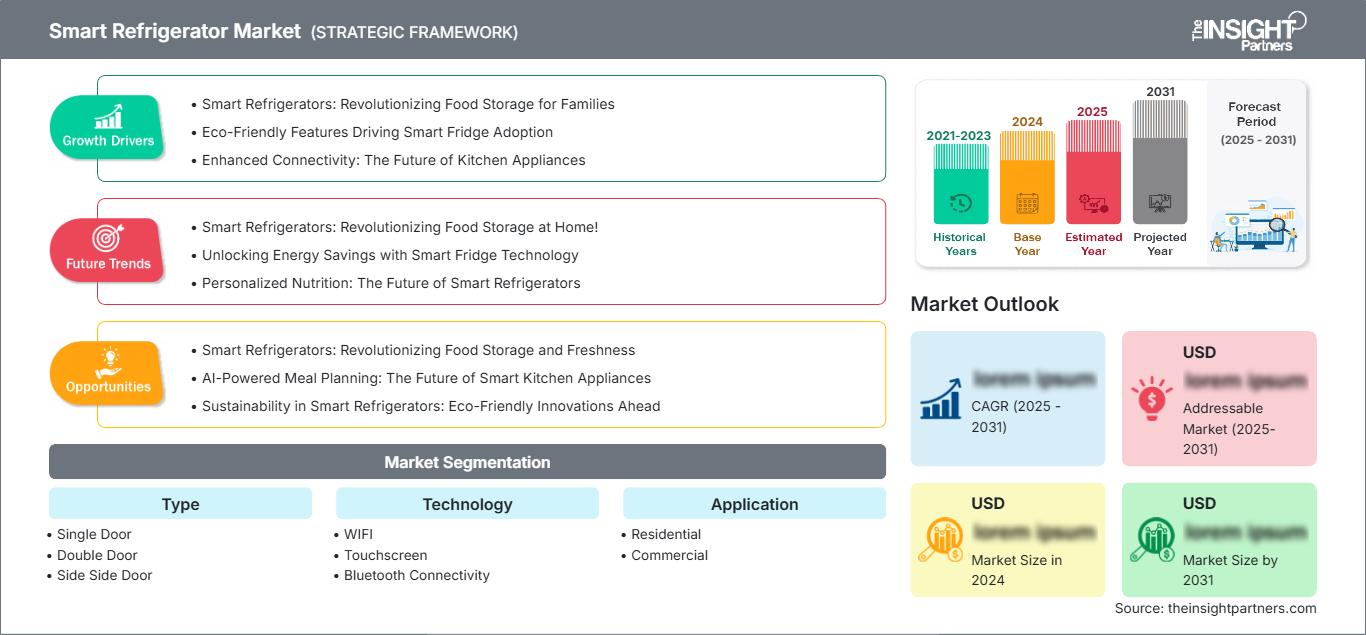
The global smart refrigerator market size was valued at US$ 4.27 billion in 2025 and is projected to reach US$ 12.14 billion by 2034, registering a compound annual growth rate (CAGR) of 12.30% from 2026 to 2034. This growth is underpinned by rapid advancements in sensor technologies, increasing consumer preference for connected home ecosystems, and the integration of artificial intelligence (AI) for enhanced food management and energy efficiency.
North America is estimated to account for a significant share of the global smart refrigerator market in 2025, with a projected CAGR of 10-12% from 2026 to 2034. Structural growth drivers in the region include high consumer disposable income and a strong early adopter culture for smart home technologies. The region's well-established retail and distribution channels further facilitate market penetration.
Smart Refrigerator Market Assessment and Insights
- North America: North America is a leading market, with a strong presence of key players and high consumer awareness. The region is estimated to hold a 28-32% smart refrigerator market share in 2025 and is projected to grow at a CAGR of 10-12% from 2026 to 2034.
- U.S.: The U.S. is the dominant market within North America, fueled by continuous technological innovations and high spending on home automation. It holds a 75-80% share of the North American market in 2025 and is expected to grow at a CAGR of 11-13% from 2026 to 2034.
- Europe: Europe holds a 25-29% share of the global market in 2025, with a projected CAGR of 10-12% from 2026 to 2034. Germany, France, and the UK are leading countries, driven by strong demand for energy-efficient appliances and a focus on sustainability.
- Asia Pacific: APAC is estimated to hold a 25-30% of the smart refrigerator market in 2025 and is projected to grow at the fastest CAGR of 12-14% from 2026 to 2034. China, Japan, South Korea, and India are key markets, driven by rapid urbanization and increasing disposable incomes.
- Largest Segment: The Residential segment is estimated to be the largest application segment, holding a 72-77% share in 2025 and projected to grow at a CAGR of 11-13% from 2026 to 2034.
- High Growth Segment: The Commercial segment is projected to be the fastest-growing application segment, driven by increasing adoption in the hospitality and retail sectors. It holds a 23-28% share in 2025 and is expected to grow at a CAGR of 13-15% from 2026 to 2034.
- Key companies analyzed in detail: BSH Hausgeräte GmbH, AB Electrolux, Frigidaire, GE Appliances, a Haier company, Hisense International, LG Electronics, Midea Group, Panasonic Corporation, Samsung, Whirlpool Corporation.
Source: The Insight Partners' analysis based on proprietary research, government publications, company annual reports, investor presentations, industry databases, and expert interviews.
There are substantial changes that have taken place in the global smart refrigerator market. The industry is moving towards advanced and connected devices for the kitchen as opposed to conventional cooling devices. These changes have come about due to technological developments in the IoT sector that facilitate such features as inventory and asset management. With machine learning and artificial intelligence integrated into smart refrigerators, features such as automated food orders and diet plans can be easily accessed.
In the coming years, the industry is expected to experience growth as more consumers join the market. This will come from countries where more people have become economically active in emerging economies. Research and development by the major players in the market will facilitate the development of cost-effective products with many features. The regulations favoring energy-efficient smart refrigerators will boost the industry.
Smart Refrigerator Market Report Scope
| Report Attribute | Details |
|---|---|
| Market size in 2025 | US$ 4.27 Billion |
| Market Size by 2034 | US$ 12.14 Billion |
| Global CAGR (2026 - 2034) | 12.30% |
| Historical Data | 2021-2024 |
| Forecast period | 2026-2034 |
Smart Refrigerator Market Analysis
Several significant demand-side drivers include the consumer preference for convenience, energy efficiency, and better food storage. Lifestyle changes have led to consumers preferring a home that integrates smart devices and therefore smart homes; the refrigerator is a core component of the same. The value chain consists of a reliable supply chain for components such as sensors and processors. Investments are being made in the supply chain to cater to increasing consumer demands.
Supply side factors consist of investments in increasing production capacity and resilient supply chains. Appliance manufacturing companies such as Whirlpool Corporation and LG Electronics have incorporated smart technology in their products as a strategy to remain competitive in the marketplace.
Competitive environment features stiff competition among both appliance manufacturing companies and technology companies that seek to integrate technology with appliance manufacturing. Strategic alliances between companies are increasingly prevalent. Smart refrigerator market trends include investment in efforts directed at developing improved user interface designs to increase the usability of the products.
● REPORT CUSTOMIZATION
Tailor This Report To Align With Your Specific Business Requirements
This report can be customized to align precisely with your business objectives, scope, and target markets. Customization options include tailored segmentation, geography, competitive analysis, and strategic insights to support informed decision-making.
Customize This Report →WHAT YOU CAN ADJUST
- ● Segmentations
- ● Geography
- ● Competitive Analysis
- ● Language Preferences
Smart Refrigerator Market: Strategic Insights
Regional Insights
North America Smart Refrigerator Market
North America held a significant share of the global market in 2025, estimated at 28-32%, and is expected to grow at a CAGR of 10-12% from 2026 to 2034. The region's market is driven by a high rate of adoption of smart home technologies and a strong consumer preference for premium, feature-rich appliances. The presence of major manufacturers with a history of innovation in the appliance sector further supports market expansion.
U.S. Smart Refrigerator Market
According to the smart refrigerator market forecast, the U.S. is the dominant market within North America, accounting for approximately 75-80% of the region's market share in 2025. The market is characterized by strong demand for high-end, connected appliances and the rapid rollout of new features, such as AI-powered food management and voice assistants. The U.S. market is projected to grow at a CAGR of 11-13% from 2026 to 2034, reflecting the country's continued leadership in tech adoption and its high consumer spending on home renovation and smart home ecosystems.
Europe Smart Refrigerator Market
Europe is estimated to hold a 25-29% share of the global market in 2025 and is projected to grow at a CAGR of 10-12% from 2026 to 2034. The UK and Germany are leading markets, driven by a strong focus on energy efficiency and environmental sustainability. France, Italy, and Spain are also significant markets, with demand fueled by a trend toward modernized kitchen spaces and an increasing interest in smart home technology. The region’s market is influenced by stringent energy labeling regulations, which encourage the adoption of more efficient appliances.
APAC Smart Refrigerator Market
The smart refrigerator market report indicates that the APAC region is estimated to hold a 25-30% share of the global market in 2025 and is projected to grow at the highest CAGR of 12-14% from 2026 to 2034. China, Japan, South Korea, and India are key markets, led by rapid urbanization, rising disposable incomes, and a growing consumer base for modern appliances. Industrial drivers include the strong presence of consumer electronics manufacturers and favorable government policies supporting manufacturing and energy efficiency. South Korea and China are particularly active in innovation and adoption.
Middle East & Africa Smart Refrigerator Market
The MEA region is estimated to hold a 5-8% share of the global smart refrigerator market in 2025, with a projected CAGR of 8-10% from 2026 to 2034. Saudi Arabia, the UAE, and South Africa are key markets, with growth driven by ongoing infrastructure development and increasing tourism. Energy efficiency and reliable cooling are important factors in the region, influencing the adoption of smart refrigerators. The market is expected to benefit from government initiatives promoting energy conservation and sustainable development .
Segmentation Analysis
Type
The type segment of the smart refrigerator market is categorized into Single Door, Double Door, Side by Side Door, and French Door. The French Door segment is expected to dominate due to its premium appeal and spacious capacity, offering a projected CAGR of 12-14% during the forecast period. Its design is favored in modern kitchens, and its higher price point supports the integration of advanced smart features, making it a top choice among consumers seeking both style and functionality.
- Single Door: Single door refrigerators are popular in smaller households and urban living spaces. Their compact design and lower energy consumption make them a practical choice for apartments and smaller kitchens, where space is a primary consideration.
- Double Door: Double door refrigerators provide a balanced solution for mid-sized families. They offer separate compartments for fresh and frozen foods, improving organization and energy efficiency compared to single-door models. They are a common choice in many households.
- Side by Side Door: Side by side refrigerators are known for their sleek, modern design and ease of access. They often come with advanced features like built-in water and ice dispensers, appealing to consumers looking for both aesthetics and convenience.
- French Door: French door refrigerators represent the premium segment in the market, combining elegance with practicality. Their spacious interiors and flexible storage options make them ideal for large families and frequent entertainers, and they are a primary platform for integrating cutting-edge smart technologies.
Technology
The technology segment in the smart refrigerator market includes WIFI, Touchscreen, and Bluetooth Connectivity. WIFI connectivity is the foundational technology for smart refrigerators, providing users with remote access and control. This segment is experiencing high growth with a projected CAGR of 12-14%, as it is the primary enabler for most smart features, such as remote diagnostics, energy monitoring, and integration with broader smart home ecosystems.
- WIFI: WIFI connectivity is the core technology for modern smart refrigerators. It enables remote monitoring, software updates, and integration with smart home platforms. This feature is essential for consumers who want to manage their appliance from their smartphones.
- Touchscreen: Touchscreen interfaces are becoming a popular value-added feature. They serve as the primary user interaction point for managing schedules, viewing cameras, and browsing recipes. They are often found on premium models and are growing in demand as consumers seek more intuitive controls.
- Bluetooth Connectivity: Bluetooth is a secondary technology that complements WIFI, facilitating easier setup and enabling quick data transfer. It is often used for connecting a refrigerator to a smartphone for initial configuration or for local syncing of data.
Application
The application segment in the smart refrigerator market is divided into Residential and Commercial. The Residential segment is the largest, holding an estimated 72-77% share of the global market in 2025, with a projected CAGR of 11-13%. This dominance is driven by the increasing desire for smart kitchens in homes, where convenience and energy management are key consumer priorities.
- Residential: The residential segment encompasses smart refrigerators installed in private households. The growth is driven by consumer demand for energy savings, food waste reduction, and enhanced convenience, as these appliances help manage grocery shopping and meal planning.
- Commercial: The commercial segment, including hotels, restaurants, and retail stores, is projected to be the fastest-growing. This is driven by the need to improve operational efficiency, manage food inventory more effectively, and ensure compliance with food safety regulations.
Opportunity Snapshot
| Application | Revenue Contribution | Trend Tag | Adoption Stage |
|---|---|---|---|
| Residential | High | AI Kitchens | Scaling |
| Commercial | Medium | Food Logistics | Emerging |
Smart Refrigerator Market Growth Drivers and Impact Analysis
Growing Demand for Energy-Efficient Appliances
Awareness regarding environmental sustainability worldwide and rising costs of energy are pushing consumers toward buying energy-efficient devices. The smart refrigerator is manufactured in such a way that it uses efficient compressors, better insulation, and advanced cooling systems, making them more energy-efficient. This aspect is becoming one of the major considerations while purchasing, particularly in those regions where energy efficiency norms are strict.
Increasing Integration of IoT and AI Technologies
The convergence of IoT and AI is helping to make smart refrigerators more than just devices that keep things cold; they have become smart kitchen appliances thanks to the capabilities offered by these technologies. Smart fridge features include remote monitoring, inventory management, auto grocery delivery, and preventive maintenance. The increasing consumer demand for automation and connectivity is one of the major factors influencing market adoption.
Rising Consumer Disposable Income and Urbanization
Faster rates of urbanization along with the rise in disposable incomes in developing countries of the Asia Pacific region and Latin America are contributing to an increase in the demand for premium appliances. With rising household incomes, people tend to be more willing to adopt new technologies that make their life convenient. These trends have led to several growth prospects for smart refrigerators.
Smart Refrigerator Market Future Trends
Advancements in Smart Sensors and Voice Control
Future developments in smart fridges will depend on innovations in sensors and voice commands. These sensors will be increasingly complex and enable efficient temperature and humidity controls, along with new functions like food recognition that can help keep track of the contents automatically. The voice command feature will be more deeply embedded and will allow customers to check the expiration date, put things on a shopping list, and get recipe ideas.
Shift Towards Sustainable and Eco-Friendly Refrigerants
A key trend in the smart refrigerator industry is the transition toward using sustainable and eco-friendly refrigerants, driven by stringent global environmental regulations. Manufacturers are increasingly adopting refrigerants with lower Global Warming Potential (GWP) and designing products that are more energy-efficient to meet sustainability standards. This trend is not only a response to regulatory mandates but also aligns with growing consumer preference for environmentally responsible products.
Smart Refrigerator Market Opportunities
Expansion of Direct-to-Consumer Services and App-Based Features
A significant opportunity lies in the expansion of direct-to-consumer (D2C) services and the development of comprehensive app-based ecosystems. Manufacturers can develop proprietary applications that offer features like diagnostic tools, maintenance alerts, and personalized content such as recipes. This approach builds a recurring revenue model through premium subscriptions for advanced services, enhances customer loyalty, and creates a continuous feedback loop for product improvement.
Untapped Growth in the Commercial Sector
The commercial sector, including hospitality, retail, and food service, presents substantial untapped growth opportunities. Smart refrigerators can offer significant operational benefits such as precise inventory management, real-time temperature monitoring to ensure food safety, and reduced energy costs. Developing tailored solutions for these industries can open a new, high-growth revenue stream for manufacturers, as businesses seek to improve efficiency and compliance.
Recent Developments
- April 2026: Electrolux Group announces that it has entered into agreements with Midea Group to establish a highly complementary long-term strategic partnership in Food Preservation (refrigeration) manufacturing and sales, and Fabric Care (laundry) manufacturing in North America. The partnership is designed to support long-term profitable growth and will contribute to Electrolux Group’s overarching efforts to transform the business in North America. It will strengthen the Group’s product offering in Food Preservation and Fabric Care through innovation, improved cost competitiveness and increased operational flexibility.
- May 2026: Samsung Electronics announced the rollout of a major software update for its Bespoke AI Refrigerator Family Hub sold in the U.S., bringing a new generation of AI-enhanced features to existing owners without the need for new hardware. The update is bringing an expanded version of the food recognition feature AI Vision built with Google Gemini, a significantly more capable version of Bixby voice control and an enriched suite of personalized daily widgets through Now Brief.
- January 2026: LG Electronics (LG) is presenting its latest AI-enabled solutions at CES 2026 under the theme “Innovation in tune with you.” The exhibition focuses on how LG integrates its Affectionate Intelligence with devices, solutions and environments across home, mobility and lifestyle spaces. At CES 2026, LG is demonstrating how its AI systems sense conditions, process data and execute actions in real environments – what the company describes as a Sense-Think-Act operating model. Rather than limiting AI to software interfaces, LG is applying it across robots, appliances, vehicles and TVs to enable adaptive, context-aware operations.
Frequently Asked Questions

- Comprehensive Market Sizing and Forecast Analysis
- Detailed Segmentation Analysis
- In-Depth Market Dynamics Assessment
- Regional and Country-Level Insights
- Competitive Landscape and Company Benchmarking
- Strategic Business Intelligence
Recent Reports
Testimonials

The Insight Partners' SCADA System Market report is comprehensive, with valuable insights on current trends and future forecasts. The team was highly professional, responsive, and supportive throughout. We are very satisfied and highly recommend their services.
RAN KEDEM Partner, Reali Technologies LTDs
I requested a report on a very specific software market and the team produced the report in a few days. The information was very relevant and well presented. I then requested some changes and additions to the report. The team was again very responsive and I got the final report in less than a week.
JEAN-HERVE JENN Chairman, Future Analytica
We worked with The Insight Partners for an important market study and forecast. They gave us clear insights into opportunities and risks, which helped shape our plans. Their research was easy to use and based on solid data. It helped us make smart, confident decisions. We highly recommend them.
PIYUSH NAGPAL Sr. Vice President, High Beam Global
The Insight Partners delivered insightful, well-structured market research with strong domain expertise. Their team was professional and responsive throughout. The user-friendly website made accessing industry reports seamless. We highly recommend them for reliable, high-quality research services
YUKIHIKO ADACHI CEO, Deep Blue, LLC.
This is the first time I have purchased a market report from The Insight Partners.While I was unsure at first, I visited their web site and felt more comfortable to take the risk and purchase a market report.I am completely satisfied with the quality of the report and customer service. I had several questions and comments with the initial report, but after a couple of dialogs over email with their analyst I believe I have a report that I can use as input to our strategic planning process.Thank you so much for taking the extra time and making this a positive experience.I will definitely recommend your service to others and you will be my first call when we need further market data.
JOHN SUZUKI President and Chief Executive Officer, Board Director, BK Technologies
I wish to appreciate your support and the professionalism you displayed in the course of attending to my request for information regarding to infectious disease IVD market in Nigeria. I appreciate your patience, your guidance, and the fact that you were willing to offer a discount, which eventually made it possible for us to close a deal. I look forward to engaging The Insight Partners in the future, all thanks to the impression you have created in me as a result of this first encounter.
DR CHIJIOKE ONYIA MANAGING DIRECTOR, PineCrest Healthcare Ltd.Reason to Buy
- Informed Decision-Making
- Understanding Market Dynamics
- Competitive Analysis
- Identifying Emerging Markets
- Customer Insights
- Market Forecasts
- Risk Mitigation
- Boosting Operational Efficiency
- Strategic Planning
- Investment Justification
- Tracking Industry Innovations
- Aligning with Regulatory Trends





 Get Free Sample for