
Smart Shelf Market Size, Share & Trends by 2034
Smart Shelf Market Size and Forecasts (2021 - 2034), Global and Regional Share, Trends, and Growth Opportunity Analysis Report Coverage : By Component (Hardware (IoT Sensors, RFID Tags and Readers, Electronic Shelf Labels, Cameras), Software, Service), Application (Inventory Management, Pricing Management, Content Management, Planogram Management)
- Status : Data Released
- Report Code : TIPRE00039634
- Category : Electronics and Semiconductor
- No. of Pages : 150
- Available Report Formats :


- Last update date : August 26, 2026


2025 Market Size
US$ 4.99 Bn
Base year value
2034 Forecast
US$ 35.28 Bn
Projected by 2034
CAGR 2026-2034
24.27 %
Growth rate
Addressable Market
US$ 155.04 Bn
(2026-2034)
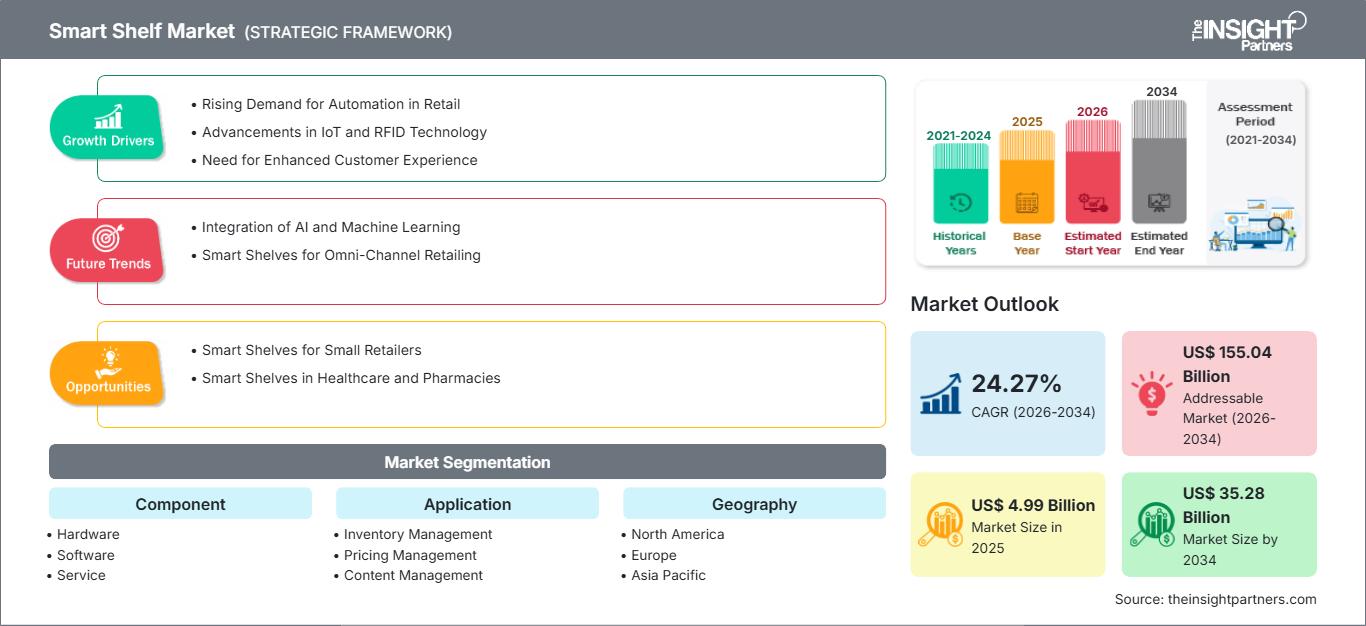
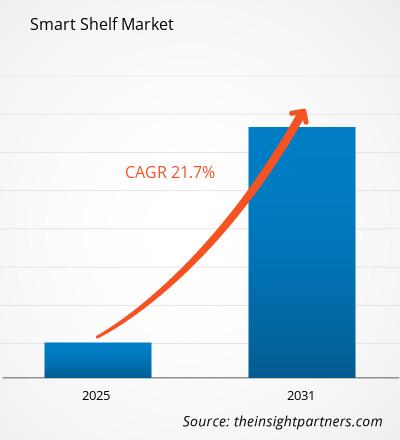
The global smart shelf market was valued at US$ 4.99 billion in 2025 and is projected to reach US$ 35.28 billion by 2034, registering a compound annual growth rate (CAGR) of 24.27% from 2026 to 2034. This growth trajectory is underpinned by the increasing adoption of retail automation, the integration of Internet of Things (IoT) sensors, and the growing demand for real-time inventory management across supermarket, hypermarket, and warehouse operations.
North America accounted for a substantial portion of the global smart shelf market size in 2025, estimated at 34.16%, and is projected to grow at a CAGR of approximately 21.51% from 2026 to 2034. Structural growth drivers in the region include rising retail labor costs, with average hourly wages in the United States rising 4.8% year-over-year in 2025, and the aggressive scaling of electronic shelf label (ESL) and RFID programs by major retailers like Walmart and Kroger.
Smart Shelf Market Assessment and Insights
- North America: North America is the leading regional market, driven by high labor costs and early technology adoption. It is estimated to hold a 34.16% share in 2025 and is projected to grow at a CAGR of 21.51% from 2026 to 2034 .
- U.S.: The U.S. dominates the North American market, accounting for a significant share driven by retail giants like Walmart and Kroger. The market is projected to reach US$ 1.05 billion by 2026 and is expected to grow at a CAGR of 21.51% from 2026 to 2034 .
- Europe: Europe holds a substantial share of the global market, with the UK and Germany being leading countries driven by a strong focus on automation and labor efficiency. The UK is expected to show the highest growth rate in the region, with the market size projected to reach US$ 393.2 million by 2026 .
- Asia Pacific: APAC is estimated to hold a notable market share and is projected to grow at the fastest CAGR of 24.55% from 2026 to 2034 . China, Japan, South Korea, India, and Australia are key markets, fueled by rapid urbanization, the expansion of modern retail formats, and technological advancements .
- Largest Segment: The Hardware component segment is estimated to be the largest, holding a 58.06% share in 2026 and projected to grow at a CAGR of approximately 22-23% from 2026 to 2034 .
- High Growth Segment: The Services component segment is projected to be the fastest-growing, driven by the shift toward recurring contracts that bundle analytics, maintenance, and software upgrades. It is expected to grow at a CAGR of 23.51% from 2026 to 2034 .
- Key companies analyzed in detail: SES-Imagotag, Pricer, Trax, Avery Dennison, Samsung, E Ink, Intel, Huawei, Honeywell, and Solum .
Source: The Insight Partners' analysis based on proprietary research, government publications, company annual reports, investor presentations, industry databases, and expert interviews.
The international smart shelf market has seen significant development and change; these shelves have transitioned from merely having electronic labels to become a system which incorporates artificial intelligence and can help provide data such as dynamic pricing and advanced analytics. These changes have been fueled through the adoption of RFID, computer vision, and edge AI technologies, which would help to automate stock-taking, cut out-of-stock situations and optimize operations . The production focus has moved towards creating inexpensive electronic shelf labels (ESLs) and sensor networks .
Looking at future prospects, the global smart shelf market is set for strong growth due to factors such as addressing labor shortages and enhancing omnichannel retail fulfillment. Significant funds are being invested in AI-driven analytics platforms and retail media systems, which could generate new revenues . Moreover, tailwinds such as the Legal Metrology Act introduced in India for mandating tamperproof digital pricing could help to fuel market growth in developing countries .
Smart Shelf Market Report Scope
| Report Attribute | Details |
|---|---|
| Market size in 2025 | US$ 4.99 Billion |
| Market Size by 2034 | US$ 35.28 Billion |
| Global CAGR (2026 - 2034) | 24.27% |
| Historical Data | 2021-2024 |
| Forecast period | 2026-2034 |
Smart Shelf Market Analysis
The global smart shelf market is propelled by the rising demand for retail automation to reduce operational costs, improve pricing accuracy, and enhance shelf visibility . The integration of IoT sensors, RFID tags, and AI-powered cameras enables real-time inventory tracking, automated planogram compliance, and proactive out-of-stock alerts, addressing critical pain points for retailers . The ecosystem comprises hardware manufacturers, software developers, and system integrators collaborating to deliver comprehensive solutions.
Supply-side dynamics are characterized by strategic partnerships and technology integrations. For instance, Pricer partnered with Focal Systems to combine ESLs with AI-driven shelf vision for automated stock detection . E Ink's collaboration with Himax on on-device AI has shifted image recognition from the cloud to the shelf, reducing bandwidth costs and latency .
The competitive landscape includes established players like SES-Imagotag and Pricer, alongside technology giants such as Intel and Huawei . Investment trends indicate a strong shift toward services-based models, where retailers convert one-time hardware purchases into recurring contracts for analytics, maintenance, and software upgrades .
● REPORT CUSTOMIZATION
Tailor This Report To Align With Your Specific Business Requirements
This report can be customized to align precisely with your business objectives, scope, and target markets. Customization options include tailored segmentation, geography, competitive analysis, and strategic insights to support informed decision-making.
Customize This Report →WHAT YOU CAN ADJUST
- ● Segmentations
- ● Geography
- ● Competitive Analysis
- ● Language Preferences
Smart Shelf Market: Strategic Insights
Regional Insights
North America Smart Shelf Market
North America is a dominant force in the global smart shelf market, generating an estimated 34.16% of 2025 revenue. The region's growth is underpinned by high labor costs and the aggressive scaling of ESL and RFID programs by major retailers. The U.S. leads the region, with Walmart connecting 2,300 stores by early 2026, cutting a full workday of label changes down to minutes while improving gross margin. Canadian pilots are also accelerating following Walmart Canada's requirement that suppliers tag apparel and home goods.
U.S. Smart Shelf Market
The U.S. holds the largest share of the North American market, with the market projected to reach US$ 1.05 billion by 2026. The market is characterized by significant investments from major retailers like Walmart and Kroger, which are deploying ESLs to manage dynamic pricing and improve margin. Kroger has extended RFID from apparel into the fresh bakery to automate expiry validation, validating use cases beyond hardlines.
Europe Smart Shelf Market
Europe is a significant market, with the UK showing the highest growth in the region. The UK market size is projected to reach US$ 393.2 million by 2026. Major retailers like Morrisons have synchronized millions of ESLs across their estate, eliminating checkout disputes and aligning with e-commerce prices. Waitrose is forecasting annual labor savings exceeding GBP 8 million (USD 10.1 million) once its UK rollout finishes in 2026. Co-op has also freed staff for online fulfillment after fitting 2,400 stores with ESLs.
APAC Smart Shelf Market
APAC is the fastest-growing region, projected at a 24.55% CAGR. China is a key market, with the market size projected to reach US$ 353.6 million by 2026. The region is driven by rapid urbanization, the expansion of modern retail formats, and strong government support for digital transformation.
Middle East & Africa Smart Shelf Market
The Middle East & Africa region is expected to experience moderate growth, driven by infrastructure development and the modernization of the retail sector. The UAE is a key market, with a focus on integrating advanced retail technologies in new developments. South Africa also shows potential for growth due to increasing automation demands in the retail industry. Energy and infrastructure context are important factors in the region's gradual adoption of smart shelf technologies.
Segmentation Analysis
Component
The component segment is categorized into Hardware, Software, and Services. The Hardware segment is estimated to be the largest, holding a 58.06% share in 2026, with a projected CAGR of approximately 22-23% from 2026 to 2034. Hardware includes ESLs, RFID tags, sensors, and digital displays, forming the essential foundation for any deployment. The smart shelf scope encompasses a wide range of hardware, software, and service solutions to meet diverse retail needs.
- Hardware: Hardware forms the backbone of smart shelf systems, comprising electronic shelf labels (ESLs), RFID tags, IoT weight sensors, and edge AI cameras. These components enable real-time inventory tracking, dynamic pricing, and automated shelf monitoring, with ESLs being the primary driver of large-scale retail deployments.
- Software: The software segment is expanding rapidly, with platforms charging USD 5,000-15,000 annually per store for dashboards that visualize shrinkage heat maps, planogram compliance, and retail-media bidding.
- Service: Services are projected to be the fastest-growing component, growing at a CAGR of 23.51% as retailers shift to managed programs that offload battery changes, firmware updates, and network monitoring to vendors, freeing internal IT capacity.
Application
The application segment is divided into Inventory Management, Pricing Management, Content Management, and Planogram Management. The Inventory Management segment is estimated to be the largest, driven by retailers' primary need for real-time stock accuracy to reduce out-of-stocks and improve shelf availability. This application is critical for both hypermarkets and warehouses.
- Inventory Management: This is the largest application segment, driven by the high demand for real-time stock accuracy. Smart shelves with RFID and weight sensors automatically detect shelf gaps and misplacements, reducing manual aisle walks and improving inventory visibility.
- Pricing Management: This segment utilizes ESLs for dynamic pricing, enabling retailers to quickly adjust prices based on demand, competition, and inventory levels. It also supports omnichannel pricing consistency.
- Content Management: The content management segment is projected to grow at the fastest rate with a CAGR of 23.63%, driven by increasing use of digital shelf displays for advertising and product promotion.
- Planogram Management: This segment uses cameras and AI to monitor shelf compliance, ensuring products are placed correctly and helping retailers optimize merchandising decisions.
Opportunity Snapshot
| Application | Revenue Contribution | Trend Tag | Adoption Stage |
|---|---|---|---|
| Inventory Management | High | Real-Time Tracking | Scaling |
| Pricing Management | High | Dynamic Pricing | Scaling |
| Content Management | Medium | In-Store Media | Emerging |
| Planogram Management | Medium | Shelf Compliance | Scaling |
Smart Shelf Market Growth Drivers and Impact Analysis
Rising Demand for Retail Automation and Cost Reduction
The increasing pressure on retailers to reduce operational costs and improve efficiency is a primary driver for the smart shelf market. With average hourly retail wages in the United States rising significantly, automation is becoming a necessity. Smart shelves automate labor-intensive tasks like price label changes, stock audits, and planogram compliance, allowing retailers to redeploy associates toward higher-value activities such as assisted checkout and e-commerce picking.
Moreover, retailers are increasingly seeking automated solutions that can minimize human errors and improve the consistency of store operations. Smart shelves can automatically detect inventory gaps, monitor product movement, and provide alerts when items require replenishment, reducing the time employees spend on routine shelf inspections. Automated electronic pricing also allows retailers to update prices quickly in response to promotions, demand fluctuations, or competitive pricing strategies. As retail businesses operate across larger store networks and face persistent labor challenges, smart shelf technologies are becoming increasingly attractive for improving workforce productivity, reducing operational inefficiencies, and achieving long-term cost savings.
Advancements in IoT, AI, and RFID Technologies
The growth of the Internet of Things (IoT), artificial intelligence (AI), and Radio Frequency Identification (RFID) technology is a significant driver for the smart shelf market. These technologies enable real-time inventory tracking, enhanced product visibility, and the ability to monitor shelf conditions, leading to improved shelf management and reduced operational costs. E Ink's collaboration with Himax on on-device AI has shifted image recognition from cloud to shelf, reducing bandwidth costs and latency.
In addition, the integration of sensors, connected displays, computer vision, and advanced analytics is making smart shelves more intelligent and responsive. RFID technology enables accurate identification and tracking of products, while AI algorithms can analyze purchasing patterns, shelf activity, and inventory data to support better replenishment decisions. IoT connectivity allows information collected from individual shelves to be integrated with broader retail management platforms, creating a unified view of store operations. These technological improvements are helping retailers reduce stock discrepancies, optimize inventory levels, and respond more quickly to changes in consumer demand while creating a foundation for increasingly automated retail environments.
Need for Enhanced Customer Experience and Omnichannel Fulfillment
Retailers are increasingly focusing on enhancing the customer experience to remain competitive. Smart shelves provide dynamic, personalized shopping experiences by offering real-time product information, promotions, and stock updates. They also connect in-store and online inventory, ensuring accurate stock levels and stronger coordination between digital and physical channels, which is essential for omnichannel retailing.
Smart shelves can also support interactive shopping by displaying product specifications, promotional offers, complementary product recommendations, and other relevant information at the point of purchase. Accurate shelf-level inventory data helps retailers improve services such as buy-online-pickup-in-store, click-and-collect, and same-day delivery by providing greater visibility into product availability. This reduces the likelihood of stockouts and inaccurate online inventory information, which can negatively affect customer satisfaction. As consumers increasingly expect seamless interactions across physical stores, websites, and mobile applications, smart shelves are becoming an important technology for connecting store operations with broader omnichannel strategies and delivering more convenient shopping experiences.
Smart Shelf Market Future Trends
Integration of AI and Predictive Analytics
A key future trend is the deep integration of artificial intelligence (AI) and predictive analytics into smart shelf systems. AI algorithms will enable retailers to anticipate stock levels, customer preferences, and trends in real time, further optimizing shelf management and improving sales forecasting. This represents a key smart shelf trend, transforming shelves from passive data collectors into active decision-support tools, accelerating efficiency and driving higher ROI on store digitization investments.
Expansion of Services and Managed Programs
The market is shifting toward managed services and recurring contracts, where retailers convert one-time purchases into comprehensive programs that bundle analytics, maintenance, and software upgrades. This trend reduces the burden on internal IT departments and provides vendors with predictable revenue streams. Services are already outpacing hardware growth, with a CAGR of 23.51%.
Smart Shelf Market Opportunities
Untapped Growth in Small and Medium-Sized Enterprises (SMEs)
A significant opportunity lies in the untapped SME segment, which represents a growing but currently smaller market. As technology costs decline, there is an opportunity to create cost-effective, scalable smart shelf solutions specifically designed for SMEs, offering them a chance to optimize inventory management and compete with larger retailers. This segment is expected to expand to a CAGR of 22.78%.
Expansion into Healthcare and Pharmacy Applications
Beyond traditional retail environments, there is an emerging opportunity to implement smart shelf solutions in healthcare and pharmacies, as highlighted in smart shelf market forecasts. Smart shelves can assist in managing pharmaceuticals, ensuring the proper storage of medications, and helping to monitor expiry dates. Weight-sensor shelves are already filling safety-critical niches such as pharmacy narcotics tracking, where instant removal alerts deter diversion.
Recent Developments
- July 2026: Spreetail, the leading ecommerce marketplace accelerator for durable goods, announced its Smart Shelf AI-powered operating system has won Silver in the 2026 Stevie Awards for Technology Excellence. Smart Shelf was honored in the Technical Innovation of the Year – Retail & E-Commerce Technology category, with judges rating it an “exceptional innovation that transforms traditional e-commerce acceleration.”
- October 2025: Morrisons announces that it is partnering with VusionGroup to roll out electronic shelf labels across all of its 497 supermarkets, becoming the first large UK supermarket group to adopt the technology across its entire supermarket estate.
- June 2023: Bibliotheca announced the global release of smartShelf borrow, an integrated intelligent-shelving return and borrow solution for libraries of all sizes. smartShelf borrow combines intelligent return shelving with the power of selfCheck to allow instant recirculation of recently returned items. Library users simply place returns on the shelf and technology does the rest – identifying the items, removing them from the user’s account, enabling security, and making them immediately available for borrowing through the integrated selfCheck self-service checkout solution.
Frequently Asked Questions

- Comprehensive Market Sizing and Forecast Analysis
- Detailed Segmentation Analysis
- In-Depth Market Dynamics Assessment
- Regional and Country-Level Insights
- Competitive Landscape and Company Benchmarking
- Strategic Business Intelligence
Recent Reports
Testimonials

The Insight Partners' SCADA System Market report is comprehensive, with valuable insights on current trends and future forecasts. The team was highly professional, responsive, and supportive throughout. We are very satisfied and highly recommend their services.
RAN KEDEM Partner, Reali Technologies LTDs
I requested a report on a very specific software market and the team produced the report in a few days. The information was very relevant and well presented. I then requested some changes and additions to the report. The team was again very responsive and I got the final report in less than a week.
JEAN-HERVE JENN Chairman, Future Analytica
We worked with The Insight Partners for an important market study and forecast. They gave us clear insights into opportunities and risks, which helped shape our plans. Their research was easy to use and based on solid data. It helped us make smart, confident decisions. We highly recommend them.
PIYUSH NAGPAL Sr. Vice President, High Beam Global
The Insight Partners delivered insightful, well-structured market research with strong domain expertise. Their team was professional and responsive throughout. The user-friendly website made accessing industry reports seamless. We highly recommend them for reliable, high-quality research services
YUKIHIKO ADACHI CEO, Deep Blue, LLC.
This is the first time I have purchased a market report from The Insight Partners.While I was unsure at first, I visited their web site and felt more comfortable to take the risk and purchase a market report.I am completely satisfied with the quality of the report and customer service. I had several questions and comments with the initial report, but after a couple of dialogs over email with their analyst I believe I have a report that I can use as input to our strategic planning process.Thank you so much for taking the extra time and making this a positive experience.I will definitely recommend your service to others and you will be my first call when we need further market data.
JOHN SUZUKI President and Chief Executive Officer, Board Director, BK Technologies
I wish to appreciate your support and the professionalism you displayed in the course of attending to my request for information regarding to infectious disease IVD market in Nigeria. I appreciate your patience, your guidance, and the fact that you were willing to offer a discount, which eventually made it possible for us to close a deal. I look forward to engaging The Insight Partners in the future, all thanks to the impression you have created in me as a result of this first encounter.
DR CHIJIOKE ONYIA MANAGING DIRECTOR, PineCrest Healthcare Ltd.Reason to Buy
- Informed Decision-Making
- Understanding Market Dynamics
- Competitive Analysis
- Identifying Emerging Markets
- Customer Insights
- Market Forecasts
- Risk Mitigation
- Boosting Operational Efficiency
- Strategic Planning
- Investment Justification
- Tracking Industry Innovations
- Aligning with Regulatory Trends





 Get Free Sample for