
Smart Traffic Management System Market Growth, Trends & Forecast by 2034
Coverage: by Product (Traffic Monitoring System, Traffic Signal Control System, Traffic Enforcement Camera, Intelligent Driver Information System, Integrated Corridor Management, Others); Application (Highway, Managed Lanes, Others), and Geography (North America, Europe, Asia Pacific, and South and Central America)
- Status : Data Released
- Report Code : TIPRE00013608
- Category : Electronics and Semiconductor
- No. of Pages : 150
- Available Report Formats :


- Last update date : August 27, 2026


2025 Market Size
US$ 14.97 Bn
Base year value
2034 Forecast
US$ 50.16 Bn
Projected by 2034
CAGR 2026-2034
14.38 %
Growth rate
Addressable Market
US$ 279.92 Bn
(2026-2034)
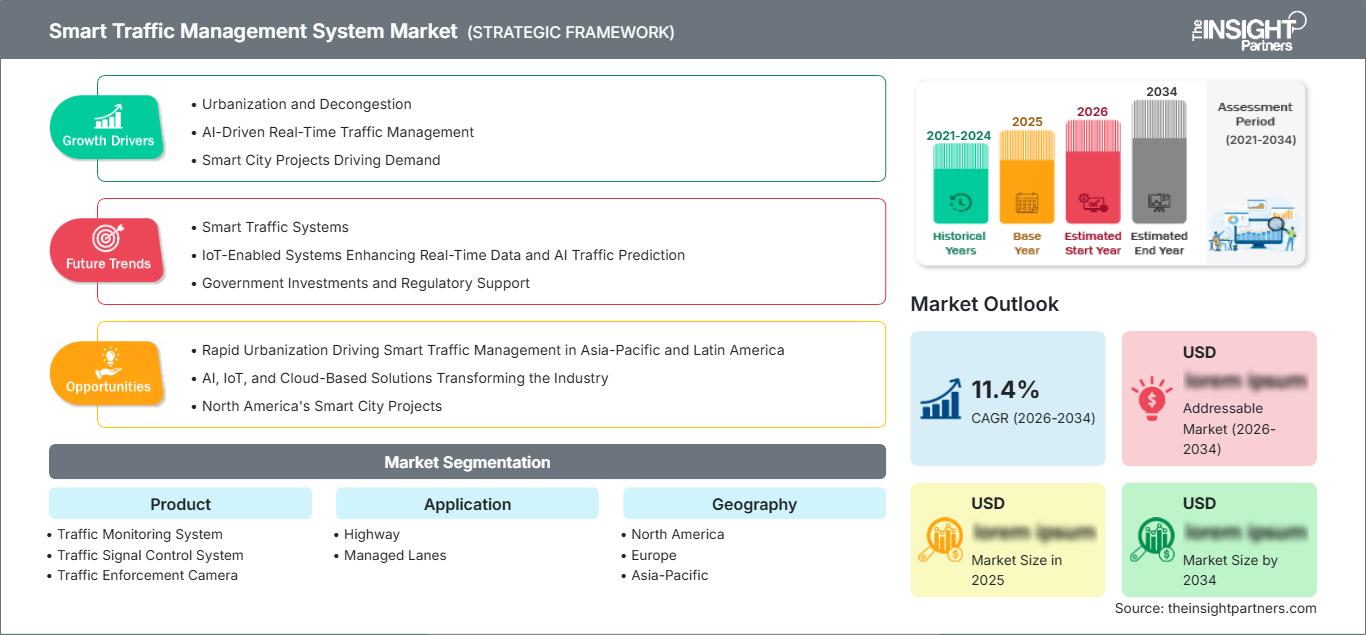
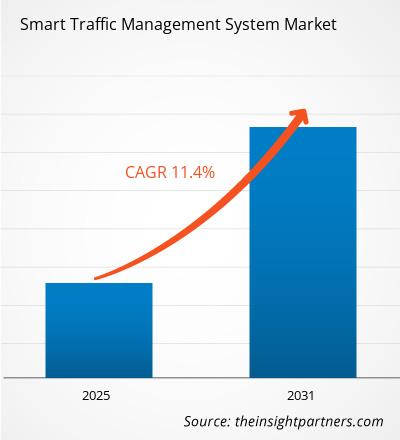
The global Smart Traffic Management System Market size was valued at US$ 14.97 billion in 2025 and is projected to reach US$ 50.16 billion by 2034, registering a compound annual growth rate of 14.38% from 2026 to 2034. This growth is underpinned by escalating urban congestion, rapid vehicle ownership expansion, and the imperative to reduce commute times and emissions through intelligent transportation infrastructure.
North America represents a dominant regional market, estimated to account for 32-36% of global share in 2025, with a growth trajectory of 13-15% during the forecast period. The regional market is propelled by well-established digital infrastructure, significant federal investments in smart city initiatives, and early adoption of connected mobility technologies. The presence of key technology innovators and a robust regulatory framework supporting intelligent transportation systems further reinforce North America's leadership position.
Smart Traffic Management System Market Assessment and Insights
- North America accounts for the largest Smart Traffic Management System Market share, estimated at 32-36% in 2025, growing at a CAGR of 13-15% from 2026 to 2034. The region benefits from advanced digital infrastructure, strong government funding for smart city projects, and high adoption of AI-enabled traffic optimization platforms.
- U.S. dominates the North American market, representing approximately 85-90% of regional share in 2025, with a growth rate of 13-15% through 2034. The U.S. market is driven by substantial federal infrastructure investments and the presence of leading technology providers.
- Europe holds a significant market share of 26-30% in 2025, with a projected CAGR of 12-14%. Leading countries include Germany, the U.K., and France, where strong regulatory focus on sustainability and environmental targets drives adoption of intelligent traffic solutions.
- Asia Pacific is projected to be the fastest-growing region, capturing a 25-29% market share in 2025 with a CAGR of 16-18%. Key markets include China, Japan, India, and South Korea, driven by rapid urbanization and massive smart city infrastructure investments.
- Largest Segment by product, the Traffic Monitoring System segment, held a dominant share of 30-34% in 2025 and is expected to grow at a CAGR of 12-14% through 2034, driven by the critical need for real-time data collection and analytics.
- High Growth Segment by application, the Highway segment, is projected to grow at the fastest CAGR of 15-17% during 2026-2034, reflecting increasing investments in interurban network management and automated incident detection.
- Key companies analyzed in detail: BioEnable Technologies Pvt. Ltd., Dynniq, ECONOLITE, IBI Group, Kapsch TrafficCom, Laser Navigation Technology, Onnyx Electronisys Pvt. Ltd., Siemens Mobility, Technolution, TransCore.
Source: The Insight Partners' analysis based on proprietary research, government publications, company annual reports, investor presentations, industry databases, and expert interviews.
The development of the market for Smart Traffic Management Systems occurs through integration of such cutting-edge technologies as artificial intelligence, IoT devices, and cloud computing, and offers real-time adaptive control of traffic. The systems use video analytics, connected vehicles, and forecasting tools for improved traffic management and greater road safety. The production landscape has become oriented to software-defined systems, which allows scaling up the systems and updating them via remote access, and thus increasing their lifespan while lowering costs for municipal authorities.
Future growth of the smart traffic management system market will be driven by investment in modernizing digital infrastructure that emerging economies make. Governments around the world are spending considerable money on intelligent transport systems within the framework of developing smart cities. Favorable regulatory environment in terms of reduction of emissions and improving road safety is driving adoption cycles. Also, development of 5G networks and edge computing helps to develop data-intensive solutions for traffic management.
Smart Traffic Management System Market Report Scope
| Report Attribute | Details |
|---|---|
| Market size in 2025 | US$ 14.97 Billion |
| Market Size by 2034 | US$ 50.16 Billion |
| Global CAGR (2026 - 2034) | 14.38% |
| Historical Data | 2021-2024 |
| Forecast period | 2026-2034 |
Smart Traffic Management System Market Analysis
Need for Intelligent Traffic Management Systems is essentially dependent on urbanization and the resultant problems of congestion, pollution, and traffic safety. As per the data from the United Nations, around 55 percent of the global population already lives in urban areas and the number is expected to reach 68 percent by 2050. This trend is forcing city administrations to adopt intelligent systems that will enable optimal traffic management and reduced carbon footprint. The value chain has grown to cover hardware suppliers (sensors, cameras, controllers), software providers (artificial intelligence, cloud platforms), and system integrators who take care of deployment of these systems. Supply factors are affected by the supply of semiconductor components and the adoption of open architecture communication systems.
The competitive environment in the Smart Traffic Management System Market includes the existence of well-established technology conglomerates and specialist traffic management companies. Prominent firms such as Siemens Mobility, Kapsch TrafficCom, and TransCore are rapidly diversifying their offerings through mergers and collaborations aimed at artificial intelligence (AI), vehicular-to-anything (V2X) communication, and cloud traffic management. There is an increasing trend of investments into SaaS subscriptions that help municipalities utilize advanced analytics and maintenance at low costs of capital. Firms such as ECONOLITE and Dynniq are involved in developing adaptive traffic signal control systems, while regional firms such as BioEnable Technologies and Onnyx Electronisys are concentrating on their geographical markets. Strategic positioning involves offering end-to-end platforms rather than hardware.
● REPORT CUSTOMIZATION
Tailor This Report To Align With Your Specific Business Requirements
This report can be customized to align precisely with your business objectives, scope, and target markets. Customization options include tailored segmentation, geography, competitive analysis, and strategic insights to support informed decision-making.
Customize This Report →WHAT YOU CAN ADJUST
- ● Segmentations
- ● Geography
- ● Competitive Analysis
- ● Language Preferences
Smart Traffic Management System Market: Strategic Insights
Regional Insights
North America Smart Traffic Management System Market
According to the Smart Traffic Management System Market forecasts, North America continues to lead the global market, holding a share of approximately 32-36% in 2025 and growing at a CAGR of 13-15% from 2026 to 2034. Market dominance in this region is driven by the significant investments being made by the government towards the modernization of infrastructure, including the Infrastructure Investment and Jobs Act that dedicates billions of dollars to intelligent transportation systems. The presence of technology centers in the U.S. and Canada encourages constant innovations in the field of traffic analysis based on AI, connected vehicles, and predictive congestion management systems. Also, efforts being made at the state level to cut down emissions and ensure safe driving encourage adaptive signaling systems.
U.S. Smart Traffic Management System Market
The U.S. market dominates North America, representing approximately 85-90% of the regional share in 2025 and growing at a CAGR of 13-15% through 2034. Traffic management solutions are necessary due to the wide network of highways in the state as well as vehicle congestion. Major organizations like Siemens Mobility, TransCore, and Econolite operate in the area with comprehensive systems that can be applied to the urban environment or highways. There is high demand for the development of traffic monitoring and enforcement camera systems as the safety of residents and data-based decision making in planning are essential.
Europe Smart Traffic Management System Market
The Smart Traffic Management System Market report shows that Europe represents a substantial market, holding a share of approximately 26-30% in 2025, with a projected CAGR of 12-14% through 2034. The leading country is Germany, which has a very robust automotive and technological industry and thus makes major investments in smart mobility and autonomous vehicles. In the second position is the U.K., which has major smart city pilots and projects that deal with integrated urban traffic management. Similarly, France, Italy, and Spain have developed intelligent transport systems with the help of financial support for sustainable urban mobility from the EU. The main driver behind this growth has been regulatory initiatives such as emission standards and road safety.
APAC Smart Traffic Management System Market
The Asia Pacific market is the fastest-growing region, capturing a share of 25-29% in 2025 and projected to grow at a remarkable CAGR of 16-18% during 2026-2034. Leading the region in terms of investment is China, with its huge investment in intelligent transportation infrastructure and AI-powered traffic management systems in its megacities. Other contributors to the region are India and Japan, with their cities adopting intelligent technology to deal with extreme congestion. The market environment is defined by factors such as rapid urbanization, rising middle classes, and government support for digital adoption.
Middle East & Africa Smart Traffic Management System Market
The Middle East & Africa region is an emerging market, projected to grow at a steady CAGR through 2034. The Kingdom of Saudi Arabia and the United Arab Emirates are the pioneers in investing in smart mobility solutions because of their high-profile infrastructure projects and their smart cities roadmap. The Saudi Arabian market is also fueled by its large-scale urban development projects, including NEOM, where traffic management forms an important part of the project. South Africa offers some prospects for the company, with its transport systems being upgraded in big cities.
Segmentation Analysis
Product
The Traffic Monitoring System segment is the largest product category, commanding a market share of 30-34% in 2025 and is projected to achieve a CAGR of 12-14% through 2034. These systems form the backbone of intelligent transportation infrastructure, providing the real-time data essential for all other traffic management functions. The segment includes advanced sensors, cameras, radar systems, and data analytics platforms that collect and process traffic flow, speed, and density information. The demand for these systems is fueled by the need for accurate traffic data to support incident detection, adaptive signal control, and traveler information systems.
- Traffic Monitoring System: These systems utilize a combination of inductive loops, radar, LiDAR, and video analytics to capture real-time traffic parameters. They are essential for urban and highway management, providing data for congestion analysis and incident response.
- Traffic Signal Control System: This sub-segment includes adaptive and pre-timed signal controllers that optimize traffic flow at intersections. Systems are increasingly integrated with AI to adjust signal timings dynamically based on real-time traffic conditions.
- Traffic Enforcement Camera: These cameras are deployed for automated enforcement of traffic laws, including red-light and speed violations. They contribute to road safety and are a significant source of data for traffic analytics, with installations expanding across urban and highway networks.
- Intelligent Driver Information System: These systems provide real-time traffic updates, route guidance, and traveler alerts through variable message signs and mobile applications. They enhance driver awareness and facilitate proactive route selection.
- Integrated Corridor Management: This solution integrates traffic management across multiple modes and jurisdictions within a transportation corridor. It promotes seamless mobility by coordinating signal timing, incident response, and traveler information.
Application
The Highway segment is the fastest-growing application area in the smart traffic management system market, projected to achieve a robust CAGR of 15-17% from 2026 to 2034. The growth is driven by increasing investments in interurban road networks, automated tolling systems, and incident management solutions. Highway applications require robust, reliable systems capable of high-speed data processing and real-time response to incidents. The focus is on improving safety, reducing congestion, and enhancing the efficiency of freight movement on major transport corridors.
- Highway: This application involves managing traffic on intercity roads and freeways. Solutions include incident detection, ramp metering, variable speed limits, and automated toll collection to ensure safe and efficient traffic flow.
- Managed Lanes: This involves managing high-occupancy vehicle lanes, toll lanes, and other priority lanes to optimize throughput. Smart systems are used for lane access control, dynamic pricing, and compliance monitoring.
Opportunity Snapshot
| Application Segment | Revenue Contribution | Trend Tag | Adoption Stage |
|---|---|---|---|
| Highway | High | Incident Detection | Scaling |
| Managed Lanes | Medium | Dynamic Pricing | Emerging |
Smart Traffic Management System Market Growth Drivers and Impact Analysis
Rapid Urbanization and Escalating Traffic Congestion
The accelerating rate of urbanization, with projections indicating 68% of the global population will reside in cities by 2050, is a primary driver for smart traffic management systems. Crowded cities result in crowded streets, which results in extreme congestion with enormous costs associated with them, ranging between 2-4% of GDP in many large cities. In such conditions, it is necessary for city administrations to shift away from conventional infrastructure development and focus on intelligent solutions to maximize current road infrastructure. Such solutions lie in the application of smart traffic management systems that make it possible to conduct dynamic signalization, traffic rerouting, and analysis. The need to decrease commuting time and reduce CO2 emissions is a good use case for this technology.
Government Investments in Smart City and ITS Infrastructure
Government investment in smart cities projects and ITS systems is an excellent catalyst for the industry. Many countries around the world are planning huge budgets for upgrading their transport infrastructure as it is seen as critical for competitiveness and sustainability. There are similar programs in the U.S. called the Infrastructure Investment and Jobs Act that is giving huge budgets for improvements in traffic management. Such policies create a good procurement scenario for suppliers of the systems. The initiative is also supported by regulations that have been introduced to lower road accidents and reduce carbon emissions.
Advancements in AI, IoT, and 5G Connectivity
Technological breakthroughs in Artificial Intelligence (AI), the Internet of Things (IoT), and 5G connectivity are fundamentally enabling the next generation of smart traffic management. AI provides the analytical power to process massive amounts of traffic data from sensors and cameras, enabling predictive congestion modeling and adaptive signal control. IoT networks provide the connectivity backbone for thousands of roadside sensors and connected vehicles. The emergence of 5G offers the low-latency, high-bandwidth communication required for Vehicle-to-Everything (V2X) applications and real-time control. These technologies collectively enhance system responsiveness, accuracy, and scalability. As component costs decline and processing power increases, the feasibility of large-scale, sophisticated deployments improves significantly.
Smart Traffic Management System Market Future Trends
Cloud-Based Traffic Management Platforms and SaaS Models
The smart traffic management system market trends show that there is a transition toward cloud-based platforms and Software-as-a-Service (SaaS) delivery models. This trend offers municipal authorities a cost-effective alternative to traditional on-premise systems, reducing the need for large capital outlays on dedicated hardware and data centers. Cloud platforms enable centralized management of traffic data from multiple locations, offering scalability and easy integration with other smart city systems. The SaaS model allows agencies to subscribe to AI-based analytical and maintenance services, lowering the entry barrier for smaller entities and enabling faster returns on investment. This shift is driving innovation, with vendors focusing on developing modular, interoperable platforms.
Integration of AI-Driven Predictive Analytics and V2X Communication
The convergence of AI-driven predictive analytics with Vehicle-to-Everything (V2X) communication is emerging as a transformative trend. AI algorithms are advancing from real-time monitoring to predicting traffic bottlenecks hours in advance, enabling proactive management rather than reactive response. This prediction is enhanced by V2X communication, where vehicles share their speed, location, and braking data with traffic management centers. This integration allows for advanced safety applications, such as collision avoidance warnings and automated emergency responses. The trend is aligned with the push for autonomous vehicle ecosystems, where smart traffic systems act as the critical infrastructure backbone for cooperative mobility and seamless data exchange.
Smart Traffic Management System Market Opportunities
Developing Modular and Cost-Effective Solutions for Tier-2 Cities
A significant opportunity lies in developing modular and cost-effective smart traffic management solutions tailored for tier-2 and tier-3 cities, which often lack the budgets for comprehensive, enterprise-grade systems. These smaller municipalities face similar congestion and safety challenges but are constrained by limited capital resources and technical expertise. Vendors can address this by offering scaled-down, plug-and-play systems that focus on specific pain points such as intersection management or incident detection, with options to scale and add features over time. The SaaS delivery model is particularly suited to this market, providing affordable subscription-based access to essential traffic analytics and control functions, thereby unlocking a previously underserved customer base.
Integrating Smart Traffic Systems with Autonomous and Electric Vehicle Infrastructure
The rise of autonomous vehicles (AVs) and electric vehicles (EVs) presents a major investment opportunity for smart traffic management system providers. As AVs and connected vehicles become more prevalent, they will require sophisticated infrastructure for navigation, safety, and traffic optimization. Smart systems can be developed to communicate with AVs to provide real-time guidance, prioritize them at intersections, and manage charging infrastructure for EVs. This opportunity involves creating integrated mobility platforms that serve both human-driven and autonomous traffic, facilitating a smooth transition to future mobility models. Strategic partnerships with automotive OEMs and technology firms will be key to capitalizing on this long-term growth sector.
Recent Developments
- August 2026: Hyundai Motor India Limited, in association with Radio Mirchi along with Innocean India & Havas Media, announced the launch of the Hyundai Traffic Quality Index (TQI) - an innovative real-time traffic intelligence platform designed to simplify the way commuters understand, anticipate and navigate urban traffic through a simple, standardised traffic rating system. Launched across Delhi, Mumbai, Bengaluru, Chennai, Hyderabad, Pune and Kolkata, the Hyundai Traffic Quality Index transforms complex traffic data into a simple, universally understandable colour-coded rating, enabling commuters to assess city traffic conditions before and during their journeys.
- February 2026: Iveda announced the launch of its new Traffic Management Module within IvedaAI, expanding the platform into real-time intersection monitoring, traffic optimization, and automated road safety analytics. The launch comes as Iveda is actively engaging with multiple American cities and transportation agencies for traffic and mobility pilot deployments in 2026, positioning traffic management as a significant new growth opportunity within the company’s smart city roadmap. Iveda’s reseller network has already expressed strong enthusiasm for bringing this new capability to their municipal and transportation customers.
- February 2026: In a major technological step to tackle Pune’s growing traffic congestion, the Pune City Traffic Police has launched a new traffic management software called ‘Trafficure’. The system has been developed through a joint collaboration between the Pune City Traffic Department, Google India and Lepton India.
Frequently Asked Questions

- Comprehensive Market Sizing and Forecast Analysis
- Detailed Segmentation Analysis
- In-Depth Market Dynamics Assessment
- Regional and Country-Level Insights
- Competitive Landscape and Company Benchmarking
- Strategic Business Intelligence
Recent Reports
Testimonials

The Insight Partners' SCADA System Market report is comprehensive, with valuable insights on current trends and future forecasts. The team was highly professional, responsive, and supportive throughout. We are very satisfied and highly recommend their services.
RAN KEDEM Partner, Reali Technologies LTDs
I requested a report on a very specific software market and the team produced the report in a few days. The information was very relevant and well presented. I then requested some changes and additions to the report. The team was again very responsive and I got the final report in less than a week.
JEAN-HERVE JENN Chairman, Future Analytica
We worked with The Insight Partners for an important market study and forecast. They gave us clear insights into opportunities and risks, which helped shape our plans. Their research was easy to use and based on solid data. It helped us make smart, confident decisions. We highly recommend them.
PIYUSH NAGPAL Sr. Vice President, High Beam Global
The Insight Partners delivered insightful, well-structured market research with strong domain expertise. Their team was professional and responsive throughout. The user-friendly website made accessing industry reports seamless. We highly recommend them for reliable, high-quality research services
YUKIHIKO ADACHI CEO, Deep Blue, LLC.
This is the first time I have purchased a market report from The Insight Partners.While I was unsure at first, I visited their web site and felt more comfortable to take the risk and purchase a market report.I am completely satisfied with the quality of the report and customer service. I had several questions and comments with the initial report, but after a couple of dialogs over email with their analyst I believe I have a report that I can use as input to our strategic planning process.Thank you so much for taking the extra time and making this a positive experience.I will definitely recommend your service to others and you will be my first call when we need further market data.
JOHN SUZUKI President and Chief Executive Officer, Board Director, BK Technologies
I wish to appreciate your support and the professionalism you displayed in the course of attending to my request for information regarding to infectious disease IVD market in Nigeria. I appreciate your patience, your guidance, and the fact that you were willing to offer a discount, which eventually made it possible for us to close a deal. I look forward to engaging The Insight Partners in the future, all thanks to the impression you have created in me as a result of this first encounter.
DR CHIJIOKE ONYIA MANAGING DIRECTOR, PineCrest Healthcare Ltd.Reason to Buy
- Informed Decision-Making
- Understanding Market Dynamics
- Competitive Analysis
- Identifying Emerging Markets
- Customer Insights
- Market Forecasts
- Risk Mitigation
- Boosting Operational Efficiency
- Strategic Planning
- Investment Justification
- Tracking Industry Innovations
- Aligning with Regulatory Trends





 Get Free Sample for