
Smart Warehousing Market Demand, Share & Growth by 2034
Smart Warehousing Market Size and Forecasts (2021 - 2034), Global and Regional Share, Trends, and Growth Opportunity Analysis Report Coverage : By Offering (Hardware, Software, Services), Technology (AI & Analytics, Robotics & Automation), Application (Inventory Management, Predictive Analytics)
- Status : Data Released
- Report Code : TIPRE00039635
- Category : Electronics and Semiconductor
- No. of Pages : 150
- Available Report Formats :


- Last update date : August 28, 2026


2025 Market Size
US$ 20.42 Bn
Base year value
2034 Forecast
US$ 68.44 Bn
Projected by 2034
CAGR 2026-2034
14.39 %
Growth rate
Addressable Market
US$ 382.02 Bn
(2026-2034)
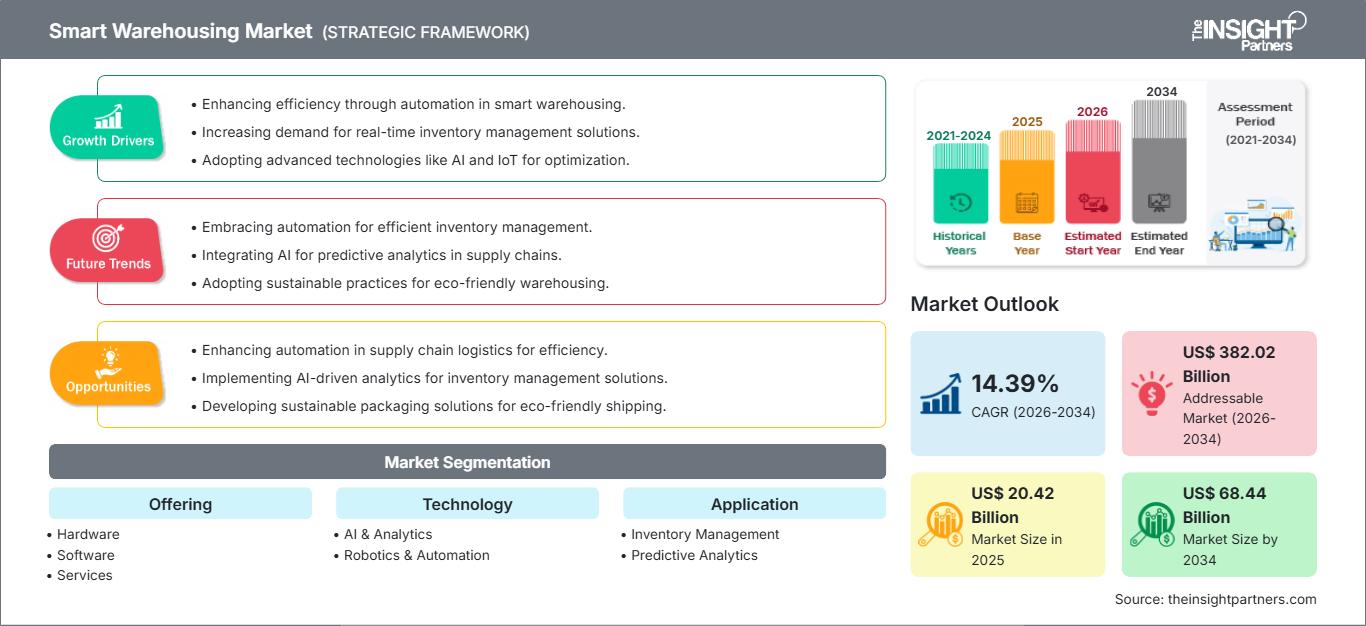
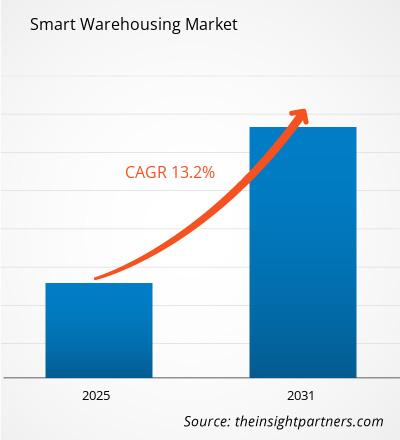
The global Smart Warehousing Market size was valued at US$ 20.42 billion in 2025 and is projected to reach US$ 68.44 billion by 2034, registering a compound annual growth rate of 14.39% from 2026 to 2034. This growth is underpinned by the rapid expansion of e-commerce and omnichannel retail, rising labor shortages in logistics, and the increasing need for real-time inventory visibility and operational efficiency.
North America represents a significant regional market, estimated to account for 33-37% of global share in 2025, growing at a CAGR of 13-15% during the forecast period. The regional market is propelled by early adoption of IoT, AI, and robotics, a strong presence of key market players, and a well-established logistics infrastructure. High e-commerce penetration and substantial investments in digital transformation and supply chain optimization further reinforce North America's market leadership.
Smart Warehousing Market Assessment and Insights
- North America accounts for the largest Smart Warehousing Market share, estimated at 33-37% in 2025, growing at a CAGR of 13-15% from 2026 to 2034. The region benefits from early automation adoption, strong e-commerce penetration, and significant government funding for supply chain modernization and robotics integration.
- U.S. dominates the North American market, representing approximately 85-90% of regional share in 2025, with a growth rate of 13-15% through 2034. The U.S. market is characterized by high robotics penetration exceeding 65% in large distribution centers and robust investments in AI-powered warehouse management systems.
- Europe holds a substantial market share of 24-28% in 2025, with a projected CAGR of 11-13%. Leading countries include Germany, the U.K., and France, where regulatory frameworks around sustainability and labor safety encourage innovation in energy-efficient and automated warehousing solutions.
- Asia Pacific is the fastest-growing region, capturing a 26-30% market share in 2025 with a CAGR of 16-18%. Key markets include China, India, Japan, and Australia, driven by booming e-commerce sectors, rapid urbanization, and increasing adoption of automation technologies.
- Largest Segment by offering, the Hardware segment, held a dominant share of 44-46% in 2025 and is expected to grow at a robust CAGR through 2034, driven by investments in AS/RS, robotics, drones, and IoT sensors.
- High Growth Segment by offering, the Services segment, is projected to grow at the fastest CAGR of 15-17% during 2026-2034, reflecting increasing demand for system integration, maintenance, and ongoing technical support.
- Key companies analyzed in detail: Manhattan Associates, Korber, Oracle, SAP, Tecsys, PSI Logistics, PTC, Reply, Infor, IBM.
Source: The Insight Partners' analysis based on proprietary research, government publications, company annual reports, investor presentations, industry databases, and expert interviews.
Smart Warehousing technology is progressing with the integration of AI, IoT sensing, and autonomous robotics to provide extremely efficient logistics operations that rely on data. Modern smart warehousing facilities utilize fleets of AMRs, AGVs, and robotic picking solutions which take care of routine operations, eliminate human error factor, and allow running processes round-the-clock. Production ecosystem is moving towards using WMS cloud platforms and scalability solutions which facilitate real-time visibility and predictive analytics for better storage and order fulfillment.
The smart warehousing market report indicates that growth in the near future will be influenced by developing markets of Asia Pacific and Latin American regions where investments in modern logistic solutions offer good opportunities. Investors start making more investments in AI native platforms, robotics-as-a-service approaches, and sustainability initiatives which aim at reducing carbon footprint and energy costs. Favorable regulatory winds including initiatives from governments to promote digitalization of logistics and strict cold chain regulations in the sphere of healthcare industry contribute to faster procurement cycle.
Smart Warehousing Market Report Scope
| Report Attribute | Details |
|---|---|
| Market size in 2025 | US$ 20.42 Billion |
| Market Size by 2034 | US$ 68.44 Billion |
| Global CAGR (2026 - 2034) | 14.39% |
| Historical Data | 2021-2024 |
| Forecast period | 2026-2034 |
Smart Warehousing Market Analysis
Demand for smart warehouses comes from the tremendous expansion in e-commerce and omnichannel retail, with online sales growing globally and the demands of consumers becoming increasingly high on faster and more precise deliveries. This leads to the necessity for logistics companies and retailers to automate their fulfillment centers and warehouse processes by implementing solutions that increase order picking accuracy and speeds. The value chain includes manufacturers of automation hardware such as sensors, robotics and automatic storage and retrieval systems, developers of automation software such as warehouse management systems and predictive analytics software, and service companies which offer system integration and support services. The supply chain takes into account semiconductors, supply chain risk and geopolitical aspects.
Competitive environment includes the presence of strong leaders in enterprise software applications along with automation specialists. Some of the key players in this space are Manhattan Associates, Korber, and SAP, which are integrating their existing WMS applications with the help of artificial intelligence-enabled analytics as well as cloud-based technology, whereas IBM and PTC are focused on IoT and industrial intelligence. Trends in investments clearly highlight a move toward service models and subscriptions based offerings as they minimize the high cost barrier related to capital expenditure required in the case of smaller enterprises. Some of the key companies that include Oracle, Infor, and Tecsys are leveraging their strength in integration and partnership within an ecosystem to offer smart warehousing solutions.
● REPORT CUSTOMIZATION
Tailor This Report To Align With Your Specific Business Requirements
This report can be customized to align precisely with your business objectives, scope, and target markets. Customization options include tailored segmentation, geography, competitive analysis, and strategic insights to support informed decision-making.
Customize This Report →WHAT YOU CAN ADJUST
- ● Segmentations
- ● Geography
- ● Competitive Analysis
- ● Language Preferences
Smart Warehousing Market: Strategic Insights
Regional Insights
North America Smart Warehousing Market
According to the smart warehousing market forecast, North America continues to lead the global market, holding a share of approximately 33-37% in 2025 and growing at a CAGR of 13-15% from 2026 to 2034. The strength of the market in the region stems from its early embrace of automation technologies, strong penetration of e-commerce that exceeds 65%, and mature logistics network. More than 70% of big distribution centers in the region use automated storage and retrieval systems, while the penetration of robots exceeds 65% in high-volume facilities. Digital transformation investments, federal support to improve supply chain operations, and presence of top-notch technology providers and system integrators play to the advantage of the United States.
U.S. Smart Warehousing Market
The U.S. market dominates North America, representing approximately 85-90% of the regional share in 2025 and growing at a CAGR of 13-15% through 2034. With such an elaborate logistical infrastructure and large number of orders placed on e-commerce websites, there is a need for advanced warehousing capabilities. Companies like Manhattan Associates, IBM, and Oracle dominate the industry by providing an integrated platform where hardware, software, and services come together to offer a complete solution to warehouse optimization. High demands are currently being witnessed for WMS that uses AI technology, robotic solutions, and automated inventory management systems. The industry is dominated by high implementation of AMR and robotic picking systems.
Europe Smart Warehousing Market
Europe represents a substantial market, holding a share of approximately 24-28% in 2025, with a projected CAGR of 11-13% through 2034. Germany takes the lead in the region, due to its well-established manufacturing industry and focus on quality engineering practices, with the market expected to grow to more than US$ 2.07 billion by 2026. The U.K., on the other hand, holds the second position, owing to considerable investments made in radio frequency identification (RFID)-based tracking systems and cloud-based warehouse management systems. Other countries, such as France, Italy, and Spain, have been increasingly implementing smart warehouses in the region, backed by European Union grants for sustainable urban mobility and logistics digitalization.
APAC Smart Warehousing Market
The Asia Pacific market is the fastest-growing region, capturing a share of 26-30% in 2025 and projected to grow at a robust CAGR of 16-18% during 2026-2034. China leads the region with a market projected at over US$ 2.13 billion by 2026, combining massive e-commerce volumes with rapid adoption of automation technologies. There are high volumes of growth due to the increasing middle class, increasing e-commerce sector, and government push toward digitizing logistics in India. Other regions that are key drivers include Japan, South Korea, and Australia, who concentrate on implementing robotics and IoT-based solutions due to their labor shortage. Growth in this market is fueled by government support of smart infrastructure along with the need to satisfy a rapidly growing customer base through efficient logistics services.
Middle East & Africa Smart Warehousing Market
The Middle East & Africa region is an emerging market for smart warehousing, projected to grow at a steady CAGR of 10-12% through 2034. It is propelled by fast urbanization, projects of upgrading infrastructure, and digitalization activities, especially in GCC countries such as Saudi Arabia and UAE, which are increasingly investing in the creation of smart cities and logistic centers. South Africa stands out as an important market in Africa, owing to the rise in the number of e-commerce platforms and automation in the warehouses of the country. The region's emphasis on efficient management of the supply chains, as well as cost savings, offers a favorable environment for the adoption of smart warehousing, as the demand is for cost-efficient solutions with basic automation and tracking functionalities.
Segmentation Analysis
Offering
The Hardware segment is the largest offering category, commanding a market share of 44-46% in 2025 and is projected to achieve a robust CAGR through 2034. These components form the physical backbone of smart warehouses, enabling automated material movement, storage, and retrieval. The demand for this segment is fueled by investments in automated storage and retrieval systems (AS/RS), autonomous mobile robots (AMRs), automated guided vehicles (AGVs), drones, and IoT sensors. The segment's growth is supported by the need to increase throughput, reduce labor costs, and enhance inventory accuracy in response to rising e-commerce volumes.
- Hardware: This segment includes physical automation equipment such as AS/RS, robotics, AGVs, AMRs, drones, and IoT sensors. These systems are essential for automating material movement, picking, and storage, significantly reducing human intervention and errors.
- Software: This sub-segment includes Warehouse Management Systems (WMS), inventory management, and order management platforms. Cloud-based WMS solutions are gaining traction for their scalability, real-time data access, and integration capabilities.
- Services: The fastest-growing sub-segment, comprising system integration, maintenance, and support services. The shift to cloud-based solutions and the complexity of implementing AI and robotics drive demand for ongoing technical expertise and customization.
Technology
The Robotics and Automation segment is expected to register the largest market share within the smart warehousing market, driven by its ability to significantly improve operational efficiency, reduce labor costs, and enhance accuracy in inventory management. The segment is projected to achieve a strong CAGR through 2034 as e-commerce and omnichannel retailing grow, demanding faster order fulfillment and real-time inventory tracking. Automated systems such as AMRs and robotic picking solutions streamline repetitive tasks, minimize human error, and enable continuous operations, making them indispensable for modern warehouses.
- AI and Analytics: This sub-segment includes AI-powered optimization for predictive demand planning, inventory slotting, picking routes, and workforce allocation. Machine learning models identify equipment failure risks and seasonal SKU surges, enabling proactive corrective action.
- Robotics and Automation: The dominant technology segment, encompassing autonomous mobile robots (AMRs), AGVs, robotic arms, and automated storage systems. These technologies are critical for automating repetitive tasks, improving throughput, and addressing labor shortages.
Application
The Inventory Management segment is projected to witness the highest CAGR within the application category, driven by the rising adoption of mobile-based tracking solutions and the need for real-time stock visibility. The segment's growth is fueled by the integration of IoT sensors, RFID, and barcode systems that provide accurate, real-time tracking of inventory and assets, reducing stock discrepancies and improving fulfillment accuracy. As warehouses handle increasing SKU complexity and omnichannel demands, the ability to manage inventory efficiently becomes a critical competitive differentiator.
- Inventory Management: The fastest-growing application, focused on real-time tracking, stock optimization, and reducing discrepancies. IoT sensors and RFID systems are widely deployed to provide accurate visibility of inventory movement.
- Predictive Analytics: This application uses AI and machine learning to forecast demand, anticipate disruptions, and optimize workforce scheduling. It enables data-driven decision-making to minimize errors and improve overall warehouse performance.
Opportunity Snapshot
| Application | Revenue Contribution | Trend Tag | Adoption Stage |
|---|---|---|---|
| Inventory Management | High | Real-Time Tracking | Scaling |
| Predictive Analytics | Medium | Demand Forecasting | Emerging |
Smart Warehousing Market Growth Drivers and Impact Analysis
Rapid E-Commerce Growth and Omnichannel Retail Expansion
The explosive growth of e-commerce and the shift toward omnichannel retail is a primary driver for the smart warehousing market. With the need for speed and precision becoming the new standard in order delivery, logistics companies and retailers are increasingly adopting automation in order to grow their capacity and make their processes more efficient. With the rise in the number of orders especially during peak periods, the conventional warehouses are under immense strain to process orders faster. Technologies such as the use of AMRs, robotic picking, and AI-driven warehouse management systems will allow firms to cope with the increased number of orders and deliver with speed and precision.
Advancements in AI, IoT, and Robotics Technologies
Technological breakthroughs in Artificial Intelligence (AI), the Internet of Things (IoT), and autonomous robotics are fundamentally enabling the next generation of smart warehouses. AI provides the analytical power for predictive demand planning, inventory optimization, and real-time operational decision-making. IoT sensors and connected systems enable real-time tracking of inventory, equipment, and workflows, improving operational visibility and responsiveness. Robotics and automation solutions, including AMRs and robotic arms, automate repetitive tasks, minimize human error, and enable 24/7 operations, making them indispensable for modern logistics. As these technologies become more accessible and cost-effective, they are increasingly adopted across a broader range of applications.
Labor Shortages and Rising Operational Costs
Increasing labor shortages and high operational costs in the logistics sector are significant drivers for smart warehousing adoption. Warehouses face challenges in recruiting and retaining workers for repetitive, physically demanding tasks such as picking, sorting, and packing. Automation technologies address these challenges by reducing reliance on manual labor, improving productivity, and minimizing errors. The shift toward robotics-as-a-service and outcome-based models further lowers the barrier to adoption for small and medium enterprises. As wages rise and labor pools tighten, the business case for smart warehousing becomes increasingly compelling, accelerating the transition toward highly automated, efficient distribution centers.
Smart Warehousing Market Future Trends
Rise of "Warehouse 4.0" and Digital-Physical Systems Integration
The smart warehousing market trends indicate that there is a significant shift toward the "Warehouse 4.0" paradigm, which seamlessly blends digital and physical systems to enhance overall operational efficiency. This trend is characterized by the adoption of advanced technologies such as IoT, big data analytics, augmented reality (AR), and robotics, which collectively optimize processes from product design to supply chain management. Companies are increasingly favoring voice-based and screen-directed inventory management to streamline training for new hires, along with multi-modal picking systems that utilize mobile devices for enhanced accuracy. The integration of AI-powered digital twins enables real-time simulation and optimization of warehouse workflows, driving productivity and operational excellence.
Growing Emphasis on Energy Efficiency and Sustainable Warehousing
Sustainability is a growing focus in the smart warehousing market, with companies adopting energy-efficient technologies and practices to reduce carbon footprints. This includes the use of LED lighting, renewable energy sources, and energy management systems. Regulatory pressures and corporate social responsibility initiatives are further driving this trend. By prioritizing sustainability, warehouses not only comply with environmental regulations but also achieve cost savings through reduced energy consumption and improved operational efficiency. The expansion of cold chain warehousing and healthcare storage is also catalyzing specialized smart warehousing applications with temperature monitoring and traceability.
Smart Warehousing Market Opportunities
Developing Robotics-as-a-Service (RaaS) and Outcome-Based Models
A significant investment opportunity lies in expanding Robotics-as-a-Service (RaaS) and outcome-based business models to lower the barrier to entry for small and medium enterprises. The high upfront capital expenditure required for automation remains a top obstacle for smaller companies, but RaaS models that charge on a per-pick or subscription basis can mitigate this challenge. This approach allows businesses to scale automation flexibly, access the latest technology without large capital outlays, and pay for performance outcomes rather than hardware. By offering modular, pay-as-you-go solutions, vendors can unlock a previously underserved customer segment and accelerate market expansion.
Expanding into Healthcare, Cold Chain, and Specialized Warehousing Applications
The healthcare and pharmaceutical sectors present a high-growth opportunity for smart warehousing, driven by stringent regulatory mandates, temperature-controlled storage needs, and traceability requirements. The expansion of cold chain logistics for food and pharmaceuticals necessitates specialized smart warehousing solutions with real-time temperature monitoring, environmental controls, and inventory visibility. Vendors can capitalize on this by developing tailored solutions for these verticals, integrating IoT sensors, blockchain for supply chain transparency, and advanced analytics to ensure compliance and reduce losses. This focus on specialized applications enables premium pricing and long-term customer relationships.
Recent Developments
- June 2026: Union Minister of Consumer Affairs, Food and Public Distribution, Pralhad Joshi, inaugurates the Smart Warehousing System for foodgrain storage in New Delhi. The Smart Warehousing System is being introduced as an integrated technology-led solution to strengthen warehouse management practices and enhance efficiency across food grain storage operations. The Ministry of Consumer Affairs, Food and Public Distribution said that the launch reflects the Government’s continued emphasis on strengthening India’s food security architecture through modern, technology-enabled and efficient public storage infrastructure. It added that the Warehousing system will incorporate advanced technologies, including Artificial Intelligence, Internet of Things, automation and analytics to improve warehouse operations and strengthen governance mechanisms. The initiative is aimed at contributing towards the creation of a modern warehousing ecosystem capable of supporting efficient foodgrain management and strengthening long-term food security outcomes. The Ministry further said that the initiative aligns with the Government’s vision under Digital India, India AI Mission, PM Gati Shakti and Atmanirbhar Bharat.
- November 2025: KENGIC, an end-to-end digital and intelligent solutions provider for manufacturing and distribution across all scenarios with its own core technologies and products, and Hiway, a trusted partner in the global automotive OEM intelligent cockpit industry, officially announced the launch of the Hiway Smart Warehouse 2.0. Hosted at Hiway’s headquarters, the launch marks a significant operational milestone. The project signals Hiway’s comprehensive transformation from a traditional, labor-intensive warehousing model to a fully intelligent, unmanned system. By deploying KENGIC’s advanced smart storage solutions, Hiway aims to redefine the standards of smart warehouse operations within the automotive supply chain.
- October 2025: In the third quarter of 2026 PepsiCo plans to open a new automated storage and retrieval system (AS/RS) in Grodzisk Mazowiecki (Poland) with Mecalux technology. Connected to the production area, the solution will accommodate potato crisps and other snacks. It was designed to increase PepsiCo’s logistics capacity and optimise workflows without expanding the existing building. The project involves implementing a comprehensive solution. It features six stacker cranes serving racking equipped with an automated pallet shuttle. A floor-mounted electric monorail system and automatic conveyors will link the warehouse with the production lines, enabling a continuous, round-the-clock pallet inflow. AS/RS operations will be overseen intelligently by Mecalux’s Easy WMS warehouse management system, which will be integrated with PepsiCo’s SAP eWM software. This two-way connection will precisely coordinate all logistics processes, from goods receipt to outbound shipments.
Frequently Asked Questions

- Comprehensive Market Sizing and Forecast Analysis
- Detailed Segmentation Analysis
- In-Depth Market Dynamics Assessment
- Regional and Country-Level Insights
- Competitive Landscape and Company Benchmarking
- Strategic Business Intelligence
Recent Reports
Testimonials

The Insight Partners' SCADA System Market report is comprehensive, with valuable insights on current trends and future forecasts. The team was highly professional, responsive, and supportive throughout. We are very satisfied and highly recommend their services.
RAN KEDEM Partner, Reali Technologies LTDs
I requested a report on a very specific software market and the team produced the report in a few days. The information was very relevant and well presented. I then requested some changes and additions to the report. The team was again very responsive and I got the final report in less than a week.
JEAN-HERVE JENN Chairman, Future Analytica
We worked with The Insight Partners for an important market study and forecast. They gave us clear insights into opportunities and risks, which helped shape our plans. Their research was easy to use and based on solid data. It helped us make smart, confident decisions. We highly recommend them.
PIYUSH NAGPAL Sr. Vice President, High Beam Global
The Insight Partners delivered insightful, well-structured market research with strong domain expertise. Their team was professional and responsive throughout. The user-friendly website made accessing industry reports seamless. We highly recommend them for reliable, high-quality research services
YUKIHIKO ADACHI CEO, Deep Blue, LLC.
This is the first time I have purchased a market report from The Insight Partners.While I was unsure at first, I visited their web site and felt more comfortable to take the risk and purchase a market report.I am completely satisfied with the quality of the report and customer service. I had several questions and comments with the initial report, but after a couple of dialogs over email with their analyst I believe I have a report that I can use as input to our strategic planning process.Thank you so much for taking the extra time and making this a positive experience.I will definitely recommend your service to others and you will be my first call when we need further market data.
JOHN SUZUKI President and Chief Executive Officer, Board Director, BK Technologies
I wish to appreciate your support and the professionalism you displayed in the course of attending to my request for information regarding to infectious disease IVD market in Nigeria. I appreciate your patience, your guidance, and the fact that you were willing to offer a discount, which eventually made it possible for us to close a deal. I look forward to engaging The Insight Partners in the future, all thanks to the impression you have created in me as a result of this first encounter.
DR CHIJIOKE ONYIA MANAGING DIRECTOR, PineCrest Healthcare Ltd.Reason to Buy
- Informed Decision-Making
- Understanding Market Dynamics
- Competitive Analysis
- Identifying Emerging Markets
- Customer Insights
- Market Forecasts
- Risk Mitigation
- Boosting Operational Efficiency
- Strategic Planning
- Investment Justification
- Tracking Industry Innovations
- Aligning with Regulatory Trends





 Get Free Sample for