
Smart Washing Machines Market Growth, Trends & Demand by 2034
Coverage: By Type (Front Load, Top Load); End user (Commercial, Residential) , and Geography (North America, Europe, Asia Pacific, and South and Central America)
- Status : Data Released
- Report Code : TIPRE00019795
- Category : Electronics and Semiconductor
- No. of Pages : 150
- Available Report Formats :


- Last update date : September 01, 2026


2025 Market Size
US$ 15.27 Bn
Base year value
2034 Forecast
US$ 101.5 Bn
Projected by 2034
CAGR 2026-2034
23.42 %
Growth rate
Addressable Market
US$ 454.23 Bn
(2026-2034)
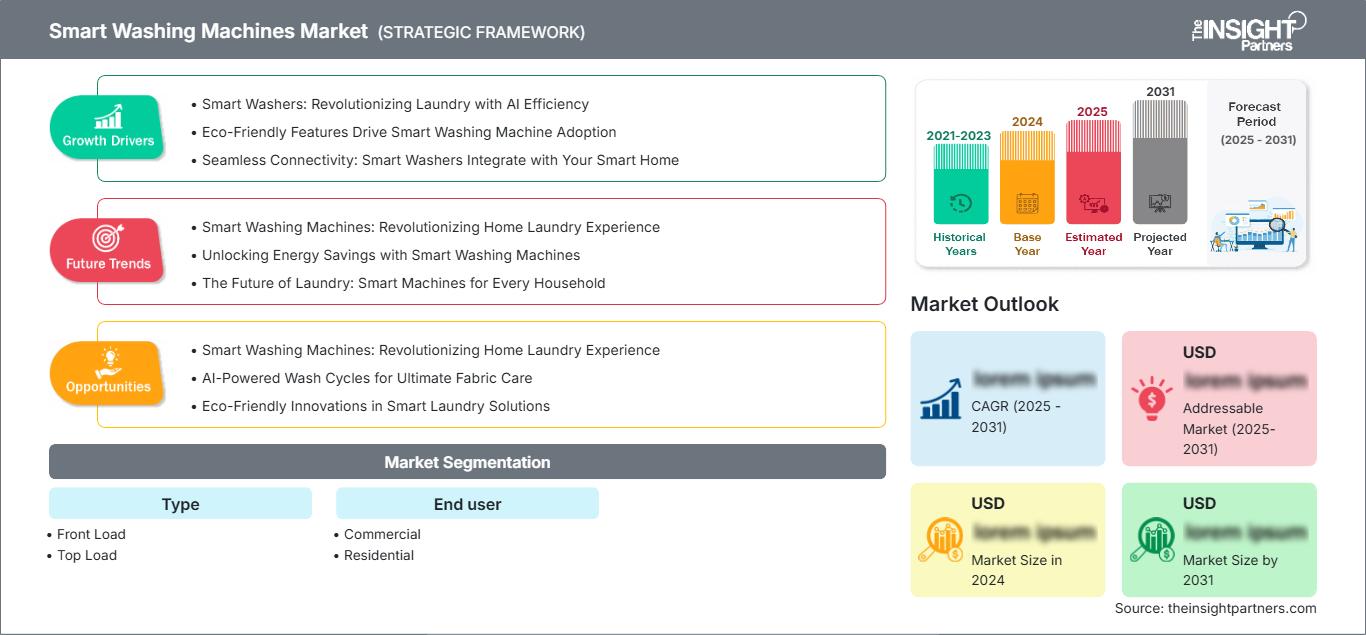
The Smart Washing Machines Market was valued at US$ 15.27 Billion in 2025 and is projected to reach US$ 101.5 Billion by 2034, expanding at a CAGR of 23.42% during 2026–2034. The market is being reshaped by connected-home adoption, artificial intelligence, automated cycle selection, remote monitoring, and energy-management capabilities. Manufacturers are increasingly integrating sensors, software, and cloud connectivity into washing appliances to improve convenience, fabric care, resource efficiency, and lifecycle service capabilities.
North America remains a structurally attractive market, supported by high smart-home penetration, premium appliance replacement, and consumer familiarity with connected ecosystems. The Smart Washing Machines Market size is further supported by demand for energy-efficient appliances, smartphone-based controls, voice integration, and automated laundry management. Commercial laundries, multifamily properties, and hospitality operators are also creating opportunities where remote diagnostics and usage monitoring can improve equipment utilization and maintenance planning.
Smart Washing Machines Market Assessment and Insights
- North America: North America is expected to represent 31–34% Smart Washing Machines Market share in 2025 and grow at a CAGR of 22.6–23.4% between 2026–2034, supported by premium appliances, connected homes, replacement demand, and energy-efficiency preferences.
- US: The US accounts for 72–76% of North American demand in 2025 and is projected to expand at 22.8–23.6% CAGR, led by connected-home adoption, premium laundry products, and replacement purchases.
- Europe: Europe is estimated at 23–26% share in 2025 and is expected to grow at 22.0–23.0% CAGR through 2034, with Germany, the UK, France, Italy, and Spain benefiting from efficiency standards and smart-appliance penetration.
- Asia Pacific: Asia Pacific holds a 40–46% share in 2025 and is forecast to expand at 24.0–25.2% CAGR, with China, Japan, South Korea, and India supported by manufacturing depth, urbanization, digital retail, and rising connected-appliance adoption.
- Largest Segment: Front Load represents a 54–59% market share in 2025 and is projected to grow at a CAGR of 22.8–23.6%, supported by efficiency and premiumization.
- High Growth Segment: Commercial end users hold a 14–18% market share in 2025 and are forecast to grow at a CAGR of 24.0–25.0%, supported by remote monitoring and operating-cost optimization.
- Key companies analyzed in detail: Candy S.p.A.; Samsung Electronics Co., Ltd.; LG Electronics Inc.; IFB Industries Limited; Whirlpool Corporation; General Electric Company; BSH Hausgeräte GmbH; Motorola Mobility LLC; Siemens AG; Xiaomi Corporation.
Source: The Insight Partners' analysis based on proprietary research, government publications, company annual reports, investor presentations, industry databases, and expert interviews.
Product development has moved from electrically controlled washing programs to Internet-connected products that are able to sense the features of the load, recommend cycles, perform diagnostics, and operate via software adjustments. Front-loading washing machines now make use of inverter motors, automatic dispensing, steam, application connectivity, and AI-driven cloth recognition technology. The production approach is also changing to common digital platforms that can serve several appliance families, allowing firms to amortize their software investments among larger product lines.
In the future, investments are expected to be directed at energy efficiency, predictive maintenance, interoperability, and appliance intelligence. Increasing efficiency and reparability requirements in Europe will favor premium connected products, while developing countries offer volume sales driven by increasing smartphone ownership and access to broadband connections. China and India will continue playing an important role since manufacturing capabilities and urban consumer market growth can help drive connected laundry solutions to market success.
Smart Washing Machines Market Report Scope
| Report Attribute | Details |
|---|---|
| Market size in 2025 | US$ 15.27 Billion |
| Market Size by 2034 | US$ 101.5 Billion |
| Global CAGR (2026 - 2034) | 23.42% |
| Historical Data | 2021-2024 |
| Forecast period | 2026-2034 |
Smart Washing Machines Market Analysis
Drivers behind the Smart Washing Machines Market include the demand from customers for automated, more resource-efficient, and easier-to-manage appliances. Value chain participants include vendors of motors and sensors, semiconductor producers, appliance assemblers, connectivity providers, software companies, retailers, installers, and service centers. Competition in the market is growing with the aid of such innovations as AI-assisted cycle selection, remote diagnostics capabilities, automatic detergent dispensation, and integration into larger smart home systems, which is now being done in addition to the competitive advantage provided by hardware.
Supply side in the Smart Washing Machines Market is expected to benefit suppliers with advantages in manufacturing of motors, electronics, software, and distribution. Major players including Samsung Electronics Co., Ltd. and LG Electronics Inc. are implementing artificial intelligence technologies in front-load and top-load products respectively, BSH Hausgeräte GmbH and Siemens AG are positioning their connected appliance ecosystems, while Xiaomi Corporation is extending interoperability of its smart home solutions via larger ecosystem of devices.
Competitive Analysis of the Smart Washing Machines Market suggests high levels of competition between diversified appliance manufacturers and technology companies. While Whirlpool Corporation benefits from investments in domestic manufacturing along with product innovations, General Electric Company competes by providing features of connected appliances and strong distribution network in the US. Candy S.p.A. complements Haier's range of appliances for Europe, while IFB Industries Limited represents strong India-centered brand.
Capital investments are more focused on automation, AI algorithms, networking capabilities, and factory modernization. Investment of Whirlpool Corporation in the manufacturing facilities of laundry appliances in the US shows the significance of local production, while Samsung Electronics Co., Ltd. and LG Electronics Inc. concentrate on development of AI-powered laundry appliances. Consequently, strategic differentiation moves from connectivity to intelligence, energy management, preventive maintenance, and interoperability with digital home ecosystem.
● REPORT CUSTOMIZATION
Tailor This Report To Align With Your Specific Business Requirements
This report can be customized to align precisely with your business objectives, scope, and target markets. Customization options include tailored segmentation, geography, competitive analysis, and strategic insights to support informed decision-making.
Customize This Report →WHAT YOU CAN ADJUST
- ● Segmentations
- ● Geography
- ● Competitive Analysis
- ● Language Preferences
Smart Washing Machines Market: Strategic Insights
Regional Insights
North America Smart Washing Machines Market
North America accounts for 31–34% share in 2025 and is expected to grow at 22.6–23.4% CAGR through 2034. The market has the advantage of mature appliance refresh cycles, strong broadband connectivity, high buying power, and wide usage of smart home technology. The main driver of demand is US households; Canada represents additional opportunities through premium connected appliances and efficient replacements.
Connected washers are becoming part of more complex home management ecosystems rather than stand-alone appliances. Remote washing cycle control, maintenance alerts, energy use tracking, and tailored washing recommendations are among key customer needs. Connected washers are also becoming available for commercial use in multifamily buildings, hotel laundry operations, and laundromats, helping to better plan for future usage. Investments in US laundry products made by Whirlpool Corporation prove the importance of production in the region.
U.S. Smart Washing Machines Market
The US represents 72–76% of North America's 2025 demand and is projected to grow at 22.8–23.6% CAGR through 2034. Adoption of premium appliances, smart home compatibility, and replacement needs fuel sales of connected washers especially to customers switching from regular appliances.
The industry consists of market leadership of Whirlpool Corporation and General Electric Company, along with Samsung Electronics Co., Ltd. and LG Electronics Inc. Front-loading appliances will continue to play an important role in premium appliance segment, while connected top-loading models extend smart appliance functionality to proven formats. Remote monitoring and diagnostic alerts are more valued by commercial buyers since these features can cut down downtime and facilitate maintenance scheduling.
Europe Smart Washing Machines Market
Europe represents 23–26% share in 2025 and is expected to grow at 22.0–23.0% CAGR. Germany is the leading player due to its efficient appliance manufacturing facilities, high penetration rate of premium front-loaders, and connected home. Other important players are UK, France, Italy, and Spain with efficiency, repairability, and connectivity becoming the main factors for appliance replacement and internet sales, respectively.
In the UK market, there is a trend emerging of customers wanting energy-efficient connected appliances that can be controlled through mobile applications. Germany is known for its high brand image of premium appliances and its Home Connect technology. France is marked by its sustainability and connected homes, while Italy and Spain provide opportunities through appliance replacement and internet sales, respectively.
APAC Smart Washing Machines Market
APAC holds 40–46% share in 2025 and is projected to grow at 24.0–25.2% CAGR, making it the leading region. China is the largest market, followed by Japan, South Korea, India, and Australia. Urbanization, digital retail, domestic manufacturing, and rising technology adoption underpin expansion.
China benefits from manufacturing scale and a large consumer base, while Japan and South Korea emphasize advanced appliance intelligence. India offers strong incremental demand as urban households upgrade laundry equipment. Australia supports premium efficiency-oriented adoption. Samsung Electronics Co., Ltd. has introduced AI-enabled top-load and laundry-combo products in India, illustrating how regional preferences are shaping connected product development.
Middle East & Africa Smart Washing Machines Market
Middle East & Africa is expected to grow at 19.8–21.0% CAGR, with Saudi Arabia and the UAE leading regional premium appliance adoption. South Africa stands out as an essential market in Africa, while the Rest of MEA will provide longer-term opportunities as penetration of household appliances and digital retail platforms increases.
The UAE and Saudi Arabia will gain due to their greater disposable income and constructions in housing and hospitality sector, whereas South Africa will provide the advantage of good distribution of appliances and urban demand for them. Energy efficiency will become especially important for markets located in a warm climate as electricity costs will be relatively high there.
Segmentation Analysis
Type
The Type segment is projected to expand at 23.1–23.9% CAGR during 2026–2034. Front-load machines maintain a strong premium position because of efficient washing performance, advanced cycle control, and compatibility with sophisticated sensing technologies. Top-load machines remain strategically important in markets where consumer familiarity, easier loading, and regional product preferences influence purchasing decisions. The Smart Washing Machines Market scope therefore spans distinct usage preferences rather than a single appliance format.
- Front Load: Front-load washers maintain strong demand among premium residential buyers because efficient drum movement, advanced sensors, and sophisticated cycle controls support differentiated performance. Connectivity and AI features increasingly reinforce their premium positioning.
- Top Load: Top-load machines retain broad appeal where convenient loading, familiar operation, and price considerations influence purchases. AI-enabled models are extending smart functionality into this established format, particularly across Asian markets.
End user
The End user segment is forecast to grow at 23.5–24.4% CAGR during 2026–2034. Residential households remain the principal demand base, but commercial adoption is developing rapidly as operators seek utilization visibility, remote diagnostics, and lower service interruptions. The strongest commercial opportunities are concentrated in laundromats, hospitality, healthcare, multifamily housing, and managed laundry facilities where equipment uptime directly influences operating performance.
- Commercial: Commercial users prioritize equipment uptime, remote monitoring, service alerts, and predictable operating costs. Connected systems can support centralized oversight across multiple machines and locations, making digital functionality strategically valuable.
- Residential: Residential demand is shaped by convenience, smart-home integration, energy awareness, and premium appliance replacement. Smartphone controls, personalized programs, automatic dosing, and AI-based cycle selection increasingly influence purchasing decisions.
Opportunity Snapshot
| End user | Revenue Contribution | Trend Tag | Adoption Stage |
|---|---|---|---|
| Commercial | Medium | Remote Monitoring | Scaling |
| Residential | High | AI Laundry | Mature |
Smart Washing Machines Market Growth Drivers and Impact Analysis
AI-Based Fabric Recognition Raises the Value of Connected Appliances
Artificial intelligence is changing washing machines from programmable appliances into adaptive systems. Samsung Electronics Co., Ltd. uses AI Wash capabilities to assess load characteristics and adjust washing parameters, while LG Electronics Inc. applies AI DD technology to identify fabric and load requirements. These capabilities create measurable differentiation beyond basic Wi-Fi connectivity because they automate decisions traditionally made by users. The commercial impact is strongest in premium appliances, where consumers accept higher prices for convenience and fabric-care benefits. AI also gives manufacturers additional opportunities to improve products through software updates after purchase. As algorithms become more accurate, machine learning can incorporate usage histories, detergent behavior, cycle preferences, and maintenance information, increasing the strategic value of connected hardware.
Energy Efficiency Is Increasingly Linked with Digital Appliance Intelligence
Energy performance is becoming a core purchasing criterion as households and commercial operators seek to control utility expenses. Smart washing machines can support this objective through optimized water temperatures, adaptive cycle durations, energy-aware scheduling, and user feedback. Samsung Electronics Co., Ltd. has introduced AI Energy Mode features designed to optimize consumption based on operating behavior, while LG Electronics Inc. continues to emphasize high-efficiency laundry technologies. European energy-label and ecodesign frameworks further strengthen demand for efficient products by raising performance expectations and supporting replacement of older machines. The impact extends into product design, encouraging manufacturers to combine efficient motors and heating systems with software that continuously optimizes operation. Connectivity consequently becomes an efficiency tool rather than simply a convenience feature.
Smart-Home Ecosystems Expand the Addressable Value of Washing Machines
Connected washing machines increasingly function within broader ecosystems that include smartphones, voice assistants, energy-management systems, and other household appliances. Samsung Electronics Co., Ltd. integrates laundry products with SmartThings, while LG Electronics Inc. uses ThinQ to provide connected control, updates, and care functions. This ecosystem approach increases switching costs because consumers may prefer products that work seamlessly with existing devices. Manufacturers can also use common software platforms to introduce new functions without redesigning physical hardware. For retailers, connected ecosystems create opportunities to bundle appliances with broader smart-home packages. For consumers, interoperability can reduce friction in daily routines through remote monitoring and notifications. As ecosystem compatibility improves, the purchasing decision increasingly considers platform continuity alongside appliance specifications.
Smart Washing Machines Market Future Trends
AI Laundry Platforms Will Evolve into Continuous Learning Systems
Smart Washing Machines Market trends are moving toward appliances that continuously learn from household usage rather than relying on fixed AI routines. Future machines are likely to combine fabric recognition, load sensing, detergent measurement, cycle history, and energy data to create increasingly personalized operating profiles. Software updates will become more important because manufacturers can refine algorithms after installation and introduce new programs without replacing hardware. Predictive maintenance should also become more sophisticated, using vibration, motor behavior, water flow, and cycle-duration anomalies to identify potential failures before breakdown. This evolution could shift competition toward software quality, data architecture, cybersecurity, and update policies. Appliance manufacturers with strong digital ecosystems will have greater opportunities to maintain customer engagement throughout the machine's service life.
Interoperable Laundry Appliances Will Become More Important in Connected Homes
The next generation of connected washers is likely to emphasize interoperability across manufacturers, platforms, energy systems, and household devices. Consumers increasingly expect appliances to work within unified digital environments rather than requiring separate applications for every product. Standardized connectivity can simplify installation, improve user experience, and encourage broader smart-home adoption. Energy-management integration may allow washing cycles to respond to electricity prices or household consumption conditions where utilities provide appropriate programs. Commercial operators could similarly connect equipment data with facility-management software and maintenance platforms. The resulting architecture will move value toward secure APIs, cloud services, device identity, and long-term software support. Manufacturers that provide compatibility while preserving differentiated AI functions should be better positioned to address fragmented connected-home environments.
Smart Washing Machines Market Opportunities
Premium Replacement Cycles Create Attractive Upgrade Opportunities
Smart Washing Machines Market Forecasts point toward substantial opportunities for manufacturers targeting consumers replacing conventional machines with connected premium models. Replacement campaigns can emphasize practical benefits such as automated cycle selection, remote alerts, energy monitoring, and predictive maintenance rather than connectivity alone. Retailers can strengthen conversion by demonstrating AI functions and integrating financing, installation, and extended service packages. Manufacturers should also localize product formats because preferences for front-load and top-load machines differ materially across regions. In mature markets, premium replacement offers can generate higher average selling prices, while emerging markets provide a pathway for progressively lower-cost connected models. Product strategies combining efficient hardware, intuitive software, and reliable after-sales support can therefore broaden the addressable customer base without depending exclusively on first-time appliance ownership.
Commercial Laundry Digitization Supports Recurring Technology Demand
Commercial laundry environments provide an investment opportunity because equipment performance can directly influence operating costs, service availability, and customer satisfaction. Laundromats, hotels, hospitals, student accommodation, and multifamily properties can benefit from centralized equipment monitoring, utilization analytics, maintenance alerts, and remote diagnostics. Vendors can develop subscription-oriented service models around fleet management, predictive maintenance, and performance reporting, creating recurring revenue alongside equipment sales. Commercial buyers may also prioritize rugged construction, cybersecurity, service-network coverage, and integration with payment or facility-management systems. Partnerships with property managers, hospitality groups, and commercial laundry operators can accelerate deployment by aggregating demand across multiple sites. As commercial operators seek measurable returns from connected equipment, suppliers capable of demonstrating uptime improvements and lower service costs should gain stronger procurement relevance.
Recent Developments
- July 2026: Samsung Electronics announced the launch of its new Bespoke AI Washer and Dryer lineup,1 designed to meet growing consumer demand for appliances that can reduce everyday effort, help manage energy consumption and integrate seamlessly into connected homes. Combining enhanced AI features, an intuitive Smart Screen experience and SmartThings-enabled3 energy management, the lineup helps users manage laundry more conveniently and efficiently.
- June 2026: Hisense, a leading global consumer electronics and home appliances brand, announced its entry into the Indian laundry segment with the launch of its new washing machine range. Marking a significant milestone in the company's growth journey in India, the launch expands Hisense's product portfolio beyond televisions and air conditioners into the laundry category, reinforcing its commitment to becoming a comprehensive home appliance brand for Indian consumers. The new lineup comprises Top Load and Semi-Automatic Washing Machines, offering capacities ranging from 7kg to 14kg to meet the diverse needs of Indian households. Built on Hisense's global home appliance expertise, the range combines intelligent technologies, premium design and dependable performance, bringing large-capacity washing solutions to consumers at accessible price points.
- September 2022: Panasonic Life Solutions India (PLSIND), a leading diversified technology company launched a new line-up of India’s truly smart washing machines this festive season. Powered by Panasonic’s connected living platform – Miraie, the new range of top-load smart washing machines come with unique smart features along with premium design. The new models come in multiple capacities ranging from 6.5 kg, 7kg to 8 kg starting at INR 19,690, and are available at all Panasonic brand shops, large format retail outlets across the country, and online platform Amazon. in.
Frequently Asked Questions

- Comprehensive Market Sizing and Forecast Analysis
- Detailed Segmentation Analysis
- In-Depth Market Dynamics Assessment
- Regional and Country-Level Insights
- Competitive Landscape and Company Benchmarking
- Strategic Business Intelligence
Recent Reports
Testimonials

The Insight Partners provided valuable market intelligence that supported our global go-to-market strategy. Their team was professional, responsive, and attentive to our feedback, providing thoughtful analysis and helpful methodological clarifications throughout the project.
Junmo Kim Chief Financial Officer (CFO), Enertech Co., Ltd.
The Insight Partners' SCADA System Market report is comprehensive, with valuable insights on current trends and future forecasts. The team was highly professional, responsive, and supportive throughout. We are very satisfied and highly recommend their services.
RAN KEDEM Partner, Reali Technologies LTDs
I requested a report on a very specific software market and the team produced the report in a few days. The information was very relevant and well presented. I then requested some changes and additions to the report. The team was again very responsive and I got the final report in less than a week.
JEAN-HERVE JENN Chairman, Future Analytica
We worked with The Insight Partners for an important market study and forecast. They gave us clear insights into opportunities and risks, which helped shape our plans. Their research was easy to use and based on solid data. It helped us make smart, confident decisions. We highly recommend them.
PIYUSH NAGPAL Sr. Vice President, High Beam Global
The Insight Partners delivered insightful, well-structured market research with strong domain expertise. Their team was professional and responsive throughout. The user-friendly website made accessing industry reports seamless. We highly recommend them for reliable, high-quality research services
YUKIHIKO ADACHI CEO, Deep Blue, LLC.
This is the first time I have purchased a market report from The Insight Partners.While I was unsure at first, I visited their web site and felt more comfortable to take the risk and purchase a market report.I am completely satisfied with the quality of the report and customer service. I had several questions and comments with the initial report, but after a couple of dialogs over email with their analyst I believe I have a report that I can use as input to our strategic planning process.Thank you so much for taking the extra time and making this a positive experience.I will definitely recommend your service to others and you will be my first call when we need further market data.
JOHN SUZUKI President and Chief Executive Officer, Board Director, BK Technologies
I wish to appreciate your support and the professionalism you displayed in the course of attending to my request for information regarding to infectious disease IVD market in Nigeria. I appreciate your patience, your guidance, and the fact that you were willing to offer a discount, which eventually made it possible for us to close a deal. I look forward to engaging The Insight Partners in the future, all thanks to the impression you have created in me as a result of this first encounter.
DR CHIJIOKE ONYIA MANAGING DIRECTOR, PineCrest Healthcare Ltd.Reason to Buy
- Informed Decision-Making
- Understanding Market Dynamics
- Competitive Analysis
- Identifying Emerging Markets
- Customer Insights
- Market Forecasts
- Risk Mitigation
- Boosting Operational Efficiency
- Strategic Planning
- Investment Justification
- Tracking Industry Innovations
- Aligning with Regulatory Trends





 Get Free Sample for