
Smartphone 3D Camera Market Growth, Share & Trends by 2034
Coverage: By Technology (Stereoscopy, Time of Flight TOF); Resolution (BELOW 8 MP, 8 16 MP, Above 16 MP) , and Geography (North America, Europe, Asia Pacific, and South and Central America)
- Status : Data Released
- Report Code : TIPRE00003715
- Category : Electronics and Semiconductor
- No. of Pages : 150
- Available Report Formats :


- Last update date : September 28, 2026


2025 Market Size
US$ 683.8 Mn
Base year value
2034 Forecast
US$ 5,624.39 Mn
Projected by 2034
CAGR 2026-2034
26.38 %
Growth rate
Addressable Market
US$ 23,666.58 Mn
(2026-2034)
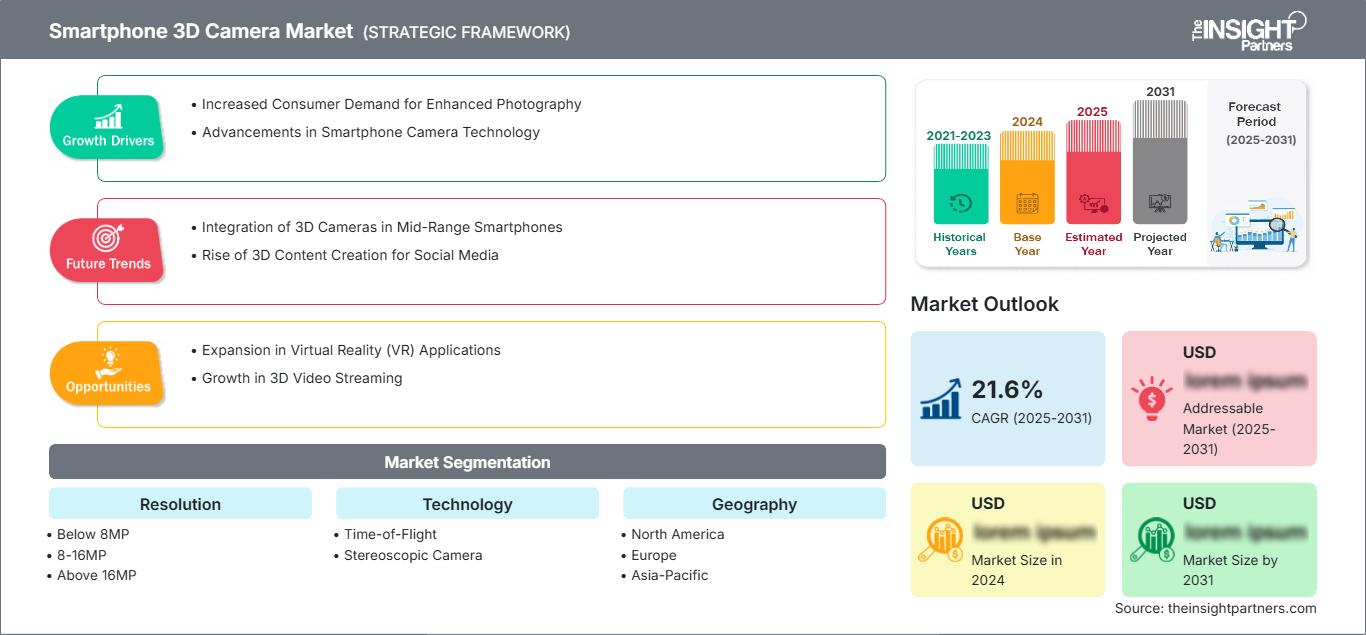
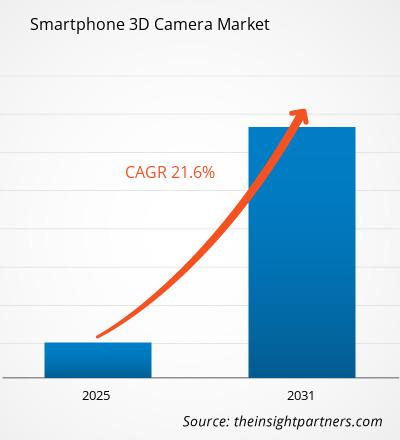
The Smartphone 3D Camera Market was valued at US$ 683.8 Million in 2025 and is projected to reach US$ 5,624.39 Million by 2034, expanding at a CAGR of 26.38% during 2026–2034. Market progression occurs because of integration of capabilities like depth sensing, computational photography, augmented reality, biometric sensing, and spatial interaction into more miniaturized cameras used in smartphones.
North America provides an ideal landscape for adoption due to the penetration of high-end smartphones, presence of semiconductor ecosystems, and continuous investments in spatial computing. The market growth of Smartphone 3D Camera Market size will be at a CAGR of 24-27% from 2026-2034.
Smartphone 3D Camera Market Assessment and Insights
- North America: The region is estimated to command a 2025 share of 28–32%, expanding at a CAGR of 24–27% between 2026–2034. Premium devices and spatial-computing applications support adoption.
- US: The US represents an estimated 2025 share of 21–25% globally, growing at a CAGR of 25–28% between 2026–2034, supported by premium smartphone demand and software innovation.
- Europe: Europe is estimated at a 2025 share of 20–24%, with a CAGR of 23–26% between 2026–2034. Germany, the UK, France, Italy, and Spain provide major demand centers.
- Asia Pacific: Asia Pacific holds an estimated 2025 share of 34–38%, growing at a CAGR of 28–31% between 2026–2034. China, Japan, South Korea, and India remain principal markets.
- Largest Segment: Above 16MP is estimated at a 2025 market share of 42–46%, expanding at a CAGR of 28–31% during 2026–2034.
- High Growth Segment: Time-of-Flight is estimated at a 2025 market share of 58–62%, advancing at a CAGR of 27–30% during 2026–2034.
- Key companies analyzed in detail: Infineon Technologies AG; LG Electronics Inc.; Microsoft Corporation; Samsung Electronics Co., Ltd.; Sharp Corporation; Sony Corporation; Toshiba Corporation; STMicroelectronics N.V.; ams-OSRAM AG; and Orbbec Inc.
Source: The Insight Partners' analysis based on proprietary research, government publications, company annual reports, investor presentations, industry databases, and expert interviews.
From conventional 2D imaging methods to technologies that employ RGB imaging, infrared detection, depth detection and algorithms that execute these operations, mobile imaging has come a long way. Functions like depth autofocus, portrait separation, face detection, spatial measurement and augmented reality have been enabled through technologies like Time of Flight sensors, stereovision, structured lighting and improved image signal processing. There have been modifications in the manufacturing process as well which have shifted towards smaller camera modules, low power consumption and optical accuracy.
Future deployment would increase because OEMs want differentiation through functions other than megapixels. Investments would be made on small depth sensors, silicon-level integration, AI-assisted reconstruction, and software that uses the depth perception data to provide end-user applications. Security issues with biometrics and device security would affect implementations especially face recognition. Emerging markets would greatly benefit from the reduced cost of the sensors and premium camera functionalities being used in mid-range smartphones.
Smartphone 3D Camera Market Report Scope
| Report Attribute | Details |
|---|---|
| Market size in 2025 | US$ 683.8 Million |
| Market Size by 2034 | US$ 5,624.39 Million |
| Global CAGR (2026 - 2034) | 26.38% |
| Historical Data | 2021-2024 |
| Forecast period | 2026-2034 |
Smartphone 3D Camera Market Analysis
The demand side of this type of products would depend on aspects such as premiumization, computational photography, augmented reality, biometrics security, and advanced mobile interfaces. The growth of the Smartphone 3D Camera Market will be strongly linked to the development of the market of the smartphone cameras, which includes imaging sensors, VCSEL/Infrared illumination, optics, processors, algorithms, operating systems, and producers of these phones. Competitiveness of suppliers in this business sphere depends on the parameters of accuracy, size, energy consumption, latency, and versatility of integration.
The value chain starts from the design and production of semiconductor devices and goes further with sensor packaging, optical elements, sources of illumination, camera modules' assembly, and integration in a final device. Wafer capacities, need for advanced packaging, optical tolerances, and availability of specialized infrared components influence the supply situation. Vertical integration or cooperation with the supply chain becomes increasingly popular due to inter-dependency of hardware and software optimization.
The competitive environment comprises of semiconductor companies, smartphones OEMs, imaging firms, and players in 3D-sensing technologies. Sony Corporation and Samsung Electronics Co., Ltd. have a good standing in the field of mobile imaging and devices integration, while Infineon Technologies AG and STMicroelectronics N.V. provide depth-sensing semiconductor know-how. LG Electronics Inc. and Sharp Corporation are involved via handsets and displays, while ams-OSRAM AG covers optical sensors area.
Competition analysis in the Smartphone 3D Camera Market report focus on ecosystem dominance and unique applications of the solutions. Microsoft Corporation offers spatial computing and computer vision technologies, while Toshiba Corporation remains relevant thanks to its imaging and semiconductors expertise. Orbbec Inc. represents the ranks of the specialist 3D-sensing competition. Investment in the market becomes oriented at small modules, AI-powered depth reconstruction, sophisticated infrared emitters and software support. Suppliers that are able to provide full sensing chain would be able to increase design wins.
● REPORT CUSTOMIZATION
Tailor This Report To Align With Your Specific Business Requirements
This report can be customized to align precisely with your business objectives, scope, and target markets. Customization options include tailored segmentation, geography, competitive analysis, and strategic insights to support informed decision-making.
Customize This Report →WHAT YOU CAN ADJUST
- ● Segmentations
- ● Geography
- ● Competitive Analysis
- ● Language Preferences
Smartphone 3D Camera Market: Strategic Insights
Regional Insights
North America Smartphone 3D Camera Market
North America is forecasted to hold Smartphone 3D Camera Market share of 28–32% in 2025, with an anticipated CAGR of 24–27% during 2034. It is favored by premium smartphone penetration, semiconductor research, and solid developer communities. Demand is limited to premium devices that use depth sensing technology in the purpose of authentication, photography, spatial computing, and computational imaging. The United States is the key market within the region, while Canada is a smaller but technically advanced one.
Regional market adoption is also driven by software development in areas of augmented reality, mixed reality, gaming, and e-commerce. Advanced camera technology can be monetized by means of positioning of a device itself rather than its hardware. Expectations concerning privacy and cybersecurity motivate companies to conduct a secure handling of depth data. Partnership between semiconductor vendors, handset makers, OS developers, and application providers will probably remain relevant due to a rising integration of cameras with AI and spatial interfaces.
U.S. Smartphone 3D Camera Market
It is anticipated that the United States will contribute 21-25% of the worldwide market revenue by 2025 and about 74-80% of North America market demand at a CAGR of 25-28% between 2026-2034. Adoption of premium smartphones, developer activity and user willingness to pay for advanced features contribute to demand growth. Apple's leadership in the spatial computing sector drives awareness of depth-enabling experiences in the ecosystem.
Samsung Electronics Co., Ltd., Microsoft Corporation, Sony Corporation, and Infineon Technologies AG possess technology or ecosystem exposure in the United States. Increasing applications in areas such as portrait segmentation, biometric authentication, AR interaction, spatial content creation, and computational photography are observed. Use cases for enterprises and developers present further possibilities due to the ability of depth data to enhance visualization and measurement.
Europe Smartphone 3D Camera Market
Europe is expected to make up 20-24% share by 2025 and achieve CAGRs of 23-26% to 2034. Germany is a leading national market owing to the country's imaging expertise and electronics manufacturing experience. The market in the UK is still important from software development and immersive applications perspective, whereas France, Italy, and Spain provide contributions via premium smartphones and digital content consumption.
In the example of the UK, development capabilities and demand for premium mobile technologies are crucial factors. Depth cameras may be used for AR applications, secure authentication, and advanced imaging. Privacy is also a concern because the depth map contains sensitive biometric data. European customers begin to consider processing architecture, data management, and interoperability along with camera quality.
Germany benefits from the experience in semiconductor, automotive, optics, and industrial technologies sectors that make expertise in depth sensing transferrable. France provides contributions through software, gaming, and immersive media development, whereas Italy and Spain do that via premium smartphones and digital content consumption. Such diversified markets constitute a good base of demand even though Germany is the leading market in Europe.
APAC Smartphone 3D Camera Market
The Asia Pacific region accounts for 34-38% in 2025 and is expected to register CAGR of 28-31% and thus will be the dominant regional market. China is the leader because of large-scale production of smartphones and components ecosystem. Advanced imaging capabilities are provided by Japan and South Korea, while India and Australia present increasing possibilities of premium phones.
Industrial policies, semiconductor investments, and smartphone manufacturing concentration make the region supply base stronger. China is the dominant country while South Korea and Japan contribute to technology development. India presents rising possibilities due to affordability of premium devices, and Australia is interesting due to its needs of complex mobile apps, photography, security, and space experience.
Middle East & Africa Smartphone 3D Camera Market
Middle East and Africa is estimated to grow at a CAGR of 22–25% over 2026-2034. The premium smartphone usage, digital transformation initiatives, and construction of smart cities drive growth for Saudi Arabia and the UAE, respectively. South Africa constitutes the main African segment, while Rest of MEA constitutes a fragmented and price-sensitive market.
The UAE offers an especially favorable ecosystem for premium smartphones, while the Saudi Arabia enjoys the technological push from infrastructure-related initiatives. South Africa comprises high mobile penetration with digital services. In the case of Rest of MEA, affordability becomes the barrier, yet reduced prices for sensors can open up the market. Camera-related innovations are likely to debut in flagships and upper mid-range devices first.
Segmentation Analysis
Resolution
Resolution is projected to expand at a CAGR of 25–28% during 2026–2034. Higher-resolution sensing increasingly supports detailed depth maps, accurate segmentation, immersive applications, and sophisticated computational photography. The Smartphone 3D Camera Market scope is therefore expanding from basic depth assistance toward richer spatial information, although power consumption, optical complexity, processing requirements, and module size remain important design constraints.
- Below 8MP: Below 8MP solutions remain relevant where compact dimensions, lower power consumption, and cost efficiency outweigh depth-map detail. They support selected authentication, autofocus, segmentation, and entry-level spatial applications.
- 8-16MP: 8-16MP solutions balance depth information, module complexity, and processing requirements. They are positioned for devices requiring stronger imaging capabilities without the full hardware burden associated with higher-resolution architectures.
- Above 16MP: Above 16MP solutions serve premium devices requiring detailed spatial capture and advanced computational imaging. Their strategic importance is increasing as OEMs differentiate flagship cameras through richer depth information.
Technology
Technology is expected to expand at a CAGR of 27–30% through 2034. The segment is shaped by the performance trade-off between direct distance measurement and multi-camera depth reconstruction. ToF offers robust depth estimation, while stereoscopic architectures can leverage multiple image streams and established camera hardware. Integration with AI processing is becoming central to both approaches.
- Time-of-Flight: Time-of-Flight remains the leading technology because it directly measures distance and can support accurate depth information under diverse conditions. It is strategically valuable for authentication, autofocus, AR, computational photography, and spatial interaction.
- Stereoscopic Camera: Stereoscopic cameras estimate depth from differences between multiple viewpoints. Their use remains relevant where OEMs can exploit existing camera arrays, computational processing, and software-based depth reconstruction while controlling module complexity.
Opportunity Snapshot
| Technology | Revenue Contribution (High/Medium/Low) | Trend Tag (MAX 2 words) | Adoption Stage (Emerging/Scaling/Mature) |
|---|---|---|---|
| Time-of-Flight | High | Depth Mapping | Scaling |
| Stereoscopic Camera | Medium | Dual Vision | Scaling |
Smartphone 3D Camera Market Growth Drivers and Impact Analysis
Premiumization Encourages Advanced Camera Hardware
Top-tier smartphone makers are increasingly leveraging their camera capabilities to increase the price point of their devices, thus creating a positive market for depth sensing technologies. People do not care anymore about the number of megapixels of the camera; rather, they judge imaging technology by portrait mode, shooting in darkness, focus capabilities, computational editing features, and immersive technologies. This makes procurement strategy for manufacturers different since 3D sensing enables OEMs to distinguish themselves without launching a new line of products. High-end phones have enough budget for additional hardware such as sensors, IR illuminators, and computational capabilities. Thus, there are more chances for the winning designs for those suppliers who will be able to prove their technology to be small-size, low-power-consuming, and accurate.
Spatial Computing Expands the Role of Mobile Depth Sensing
Spatial computing is providing more justification for smartphones to have an understanding of the real world in addition to the ability to take 2D pictures. Such data could help in measuring objects, mapping the environment, engaging with AR applications, placement of virtual items, and even spatial media production. Smartphone companies can leverage such capabilities to enhance the function of the cameras to be more like interfaces that bridge between digital data and the physical world. The influence is ecosystem-wide as the growing demand for such applications motivates developers to incorporate standardized sensing APIs. This gives semiconductor firms more business chances to provide sensors to devices where regular cameras were the only requirement before. As the maturity of spatial applications increases, camera modules might be assessed more on the basis of their capability of offering reliable depth data amid different illumination and motion scenarios.
AI-Based Computational Imaging Raises Depth-Sensing Value
The advent of artificial intelligence is making the utility of depth sensing possible by enabling smartphones to fuse multiple camera streams, motion, lighting cues, and AI models to compensate for deficiencies in the raw sensor data. AI algorithms will help achieve more accurate segmentation, background subtraction, object detection, face recognition, and depth generation from incomplete sensor data. This makes the business case for 3D sensors stronger, as the utility of the component is derived from the entire hardware-software stack. The OEMs can offer unique value propositions through their proprietary algorithms even when all competing devices employ the same sensor technology. The component makers are thus required to offer not only silicon but also development kits, reference designs, calibration, and software capabilities. The trend clearly favors the vendors that can collaborate through the entire design process.
Smartphone 3D Camera Market Future Trends
Depth Sensing Becomes More Tightly Integrated With AI Photography
Future camera architectures are likely to combine depth sensing and AI photography into unified imaging pipelines rather than treating them as separate functions. Depth maps can guide autofocus, exposure, segmentation, portrait rendering, object selection, and scene interpretation while AI models compensate for incomplete or noisy measurements. The Smartphone 3D Camera Market trends will therefore increasingly center on system-level performance instead of individual sensor specifications. Smartphone processors are expected to assume greater responsibility for reconstructing spatial information, enabling manufacturers to reduce dedicated hardware where algorithms can achieve comparable results. At the same time, specialized sensing will remain important for applications requiring dependable absolute distance measurement. This hybrid approach should encourage more flexible architectures in which ToF, stereoscopic inputs, RGB cameras, and software-generated depth are combined according to application requirements, lighting conditions, and device positioning.
Compact Modules Support Broader Smartphone Integration
Camera-module miniaturization is expected to remain a decisive technology direction as smartphone manufacturers continue pursuing thinner devices while adding more sensors. Smaller depth modules can create space for larger batteries, improved optics, or additional camera functions without substantially increasing device thickness. Advanced wafer stacking, backside illumination, compact infrared emitters, and integrated processing can help reduce the physical footprint of 3D sensing systems. Lower power consumption will become equally important because continuous depth acquisition can place pressure on battery performance. Vendors are likely to compete through integrated modules that combine sensing, illumination control, calibration, and signal processing. This could shorten OEM development cycles and reduce optical alignment challenges. As module integration improves, depth sensing should become technically feasible across a broader range of handset designs rather than remaining concentrated in flagship products.
Smartphone 3D Camera Market Opportunities
Expansion Into Upper-Midrange Smartphone Platforms
The migration of advanced camera technologies from flagship phones into upper-midrange models offers a significant investment opportunity. Component costs can decline as production volumes increase, while standardized software frameworks reduce the engineering burden associated with adding depth capabilities. Suppliers should target architectures that preserve core performance while minimizing module dimensions and power consumption. OEM partnerships can accelerate adoption when vendors demonstrate clear benefits for portrait photography, authentication, autofocus, and AR features. Smartphone 3D Camera Market Forecasts should therefore consider not only flagship replacement cycles but also the potential for broader penetration as sensor economics improve. Companies positioned around scalable manufacturing, reference designs, and flexible integration can capture opportunities across multiple handset tiers. This strategy may also diversify demand away from a relatively narrow premium-device customer base.
Partnerships Around Spatial Content and Developer Ecosystems
Strategic partnerships with application developers, operating-system providers, semiconductor companies, and spatial-content platforms can create additional value beyond hardware sales. Depth cameras become more useful when applications can access reliable depth information through consistent interfaces and development tools. Suppliers should therefore invest in software development kits, simulation environments, calibration utilities, and developer support alongside sensor hardware. Smartphone manufacturers can collaborate with gaming, commerce, education, design, and entertainment companies to demonstrate practical applications for spatial capture. These relationships can strengthen device differentiation and create feedback loops between application requirements and sensor design. Investors should favor businesses that control multiple layers of the sensing ecosystem because recurring software engagement can reduce dependence on individual hardware design wins. Standardized development environments may also accelerate adoption across competing smartphone platforms.
Recent Developments
- February 2026: Samsung introduced the Galaxy S26 series with expanded Galaxy AI capabilities and an advanced integrated camera system, reinforcing the convergence of computational photography, on-device intelligence, and camera hardware. The development illustrates how mobile imaging is increasingly positioned as an AI interface rather than a standalone capture function, creating demand for richer sensing inputs and processing capabilities.
- February 2025: Infineon announced that its REAL3 Time-of-Flight technology was being used in Roborock's Saros Z70 robotic vacuum, demonstrating continued miniaturization and integration of its depth-sensing portfolio. Although the application is outside smartphones, the development is relevant to the broader 3D-sensing supply chain because compact ToF technology increasingly transfers across consumer-electronics form factors and sensing applications.
- January 2025: Sony showcased XYN, an integrated software and hardware solution for spatial-content creation at CES 2025. The platform combines imaging, sensing, and proprietary algorithms to capture and reproduce real-world objects, motion, and environments for 3D production workflows, highlighting the broader expansion of Sony's sensing technologies toward spatial-content applications and immersive digital experiences.
Frequently Asked Questions

- Comprehensive Market Sizing and Forecast Analysis
- Detailed Segmentation Analysis
- In-Depth Market Dynamics Assessment
- Regional and Country-Level Insights
- Competitive Landscape and Company Benchmarking
- Strategic Business Intelligence
Recent Reports
Testimonials

The Insight Partners provided valuable market intelligence that supported our global go-to-market strategy. Their team was professional, responsive, and attentive to our feedback, providing thoughtful analysis and helpful methodological clarifications throughout the project.
Junmo Kim Chief Financial Officer (CFO), Enertech Co., Ltd.
The Insight Partners' SCADA System Market report is comprehensive, with valuable insights on current trends and future forecasts. The team was highly professional, responsive, and supportive throughout. We are very satisfied and highly recommend their services.
RAN KEDEM Partner, Reali Technologies LTDs
I requested a report on a very specific software market and the team produced the report in a few days. The information was very relevant and well presented. I then requested some changes and additions to the report. The team was again very responsive and I got the final report in less than a week.
JEAN-HERVE JENN Chairman, Future Analytica
We worked with The Insight Partners for an important market study and forecast. They gave us clear insights into opportunities and risks, which helped shape our plans. Their research was easy to use and based on solid data. It helped us make smart, confident decisions. We highly recommend them.
PIYUSH NAGPAL Sr. Vice President, High Beam Global
The Insight Partners delivered insightful, well-structured market research with strong domain expertise. Their team was professional and responsive throughout. The user-friendly website made accessing industry reports seamless. We highly recommend them for reliable, high-quality research services
YUKIHIKO ADACHI CEO, Deep Blue, LLC.
This is the first time I have purchased a market report from The Insight Partners.While I was unsure at first, I visited their web site and felt more comfortable to take the risk and purchase a market report.I am completely satisfied with the quality of the report and customer service. I had several questions and comments with the initial report, but after a couple of dialogs over email with their analyst I believe I have a report that I can use as input to our strategic planning process.Thank you so much for taking the extra time and making this a positive experience.I will definitely recommend your service to others and you will be my first call when we need further market data.
JOHN SUZUKI President and Chief Executive Officer, Board Director, BK Technologies
I wish to appreciate your support and the professionalism you displayed in the course of attending to my request for information regarding to infectious disease IVD market in Nigeria. I appreciate your patience, your guidance, and the fact that you were willing to offer a discount, which eventually made it possible for us to close a deal. I look forward to engaging The Insight Partners in the future, all thanks to the impression you have created in me as a result of this first encounter.
DR CHIJIOKE ONYIA MANAGING DIRECTOR, PineCrest Healthcare Ltd.Reason to Buy
- Informed Decision-Making
- Understanding Market Dynamics
- Competitive Analysis
- Identifying Emerging Markets
- Customer Insights
- Market Forecasts
- Risk Mitigation
- Boosting Operational Efficiency
- Strategic Planning
- Investment Justification
- Tracking Industry Innovations
- Aligning with Regulatory Trends





 Get Free Sample for