
Smartphone Camera Lenses Market Trends, Size & Forecast by 2034
Coverage: By Type (Wide Angle, Fisheye, Telephoto, Others); Compatibility (IPhone, Android, Others) , and Geography (North America, Europe, Asia Pacific, and South and Central America)
- Status : Data Released
- Report Code : TIPRE00014708
- Category : Electronics and Semiconductor
- No. of Pages : 150
- Available Report Formats :


- Last update date : September 28, 2026


2025 Market Size
US$ 7.57 Bn
Base year value
2034 Forecast
US$ 16.02 Bn
Projected by 2034
CAGR 2026-2034
8.69 %
Growth rate
Addressable Market
US$ 105.75 Bn
(2026-2034)
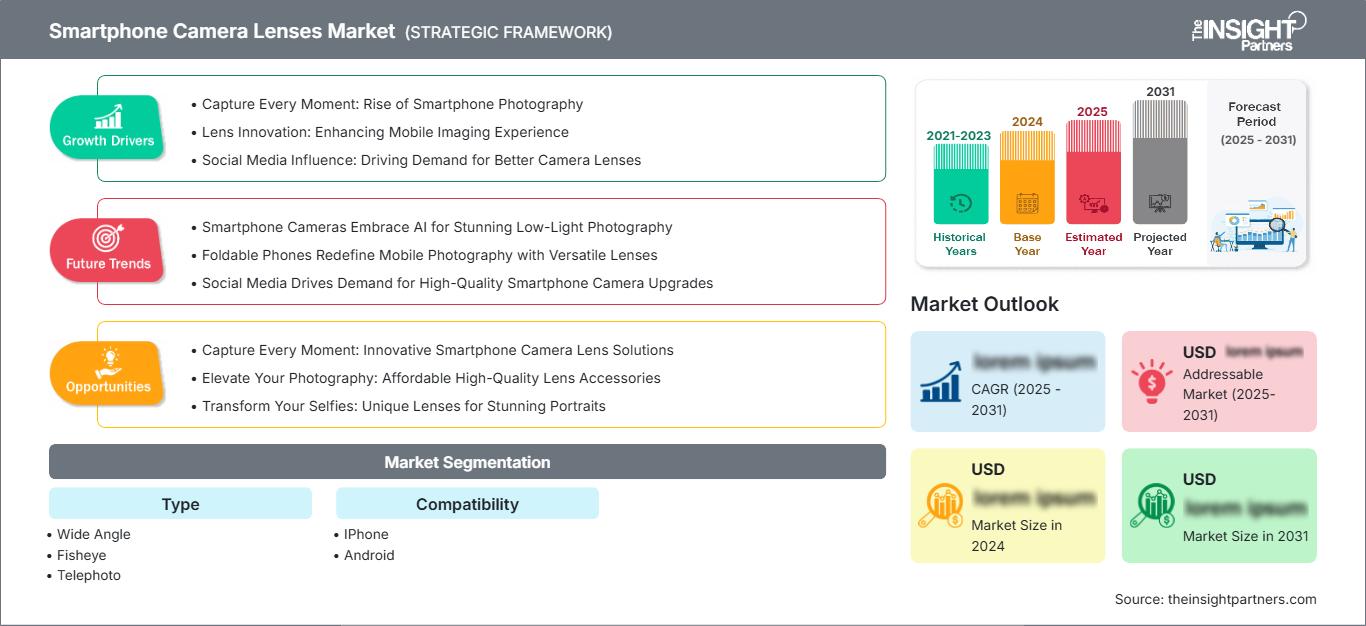
The Smartphone Camera Lenses Market stood at US$ 7.57 Billion in 2025 and is projected to reach US$ 16.02 Billion by 2034. The market is anticipated to register a CAGR of 8.69% during 2026–2034. Expansion is being shaped by multi-camera smartphone architectures, higher-resolution imaging systems, computational photography, and increasing optical-zoom capabilities. These factors are raising requirements for compact, high-precision optics across flagship, upper-mid-range, and selected mass-market devices.
North America is expected to maintain a structurally important position, supported by premium smartphone adoption, strong creator ecosystems, and consumer preference for advanced imaging capabilities. The Smartphone Camera Lenses Market size is estimated to expand at a CAGR of 8.9–9.5% during 2026–2034. Demand is further reinforced by rapid adoption of higher-quality telephoto and wide-angle accessories, alongside established retail and e-commerce channels serving photography-oriented consumers.
Smartphone Camera Lenses Market Assessment and Insights
- North America: North America is expected to account for a 25–29% share in 2025 and grow at a CAGR of 8.9–9.5% during 2026–2034, supported by premium-device penetration, creator demand, and mature specialty accessory distribution.
- US: The US is expected to represent 78–82% of North America’s 2025 share, with growth of 8.7–9.3% CAGR through 2034, led by premium iPhone adoption and creator-oriented photography use.
- Europe: Europe is projected to hold a 21–25% share in 2025 and expand at a CAGR of 8.0–8.6%, with the UK, Germany, France, Italy, and Spain supporting demand through premium handset ownership and established photography communities.
- Asia Pacific: Asia Pacific is estimated to capture a 43–47% share in 2025 and register a CAGR of 9.3–10.0%, led by China, Japan, South Korea, and India, where smartphone manufacturing and high-volume device adoption strengthen the optical ecosystem.
- Largest Segment: Wide Angle is expected to hold a 44–48% market share in 2025 and grow at a CAGR of 7.8–8.5%, reflecting broad use across smartphone camera configurations.
- High Growth Segment: Telephoto is estimated at a 22–26% market share in 2025 and is projected to expand at a CAGR of 10.0–11.0%, supported by optical-zoom adoption.
- Key companies analyzed in detail: Apexel; bitplay Store International; CamKix; Eastman Kodak Company; Eye Caramba Ltd.; Moment Inc.; Olloclip, LLC; ShiftCam Global Official; ULANZI; Xenvo.
Source: The Insight Partners' analysis based on proprietary research, government publications, company annual reports, investor presentations, industry databases, and expert interviews.
The Market for Smartphone Camera Lenses has changed from the simpler clip-on lenses designed to improve the performance of optical functions to a more sophisticated one that caters specifically to smartphone cameras. Improved sensors, computational corrections, stabilization, and multi-camera design have influenced the requirement for optical elements. Suppliers are differentiated depending on focal length control, distortion reduction, lens coatings, mounting precision, and compatibility design. The production of optics must be precise and fast in reacting to changes in smartphone camera geometry.
Future market growth will be influenced by new smartphone markets where the capability of their cameras plays a crucial role when buying them. Investments will be directed at producing smaller telephoto lenses, highly transmitting lenses, good quality coating lenses, and mounting solutions for the platform. There are legal issues such as product safety, materials employed, wireless accessory compatibility, and consumer electronics recycling that influence suppliers' designs.
Smartphone Camera Lenses Market Report Scope
| Report Attribute | Details |
|---|---|
| Market size in 2025 | US$ 7.57 Billion |
| Market Size by 2034 | US$ 16.02 Billion |
| Global CAGR (2026 - 2034) | 8.69% |
| Historical Data | 2021-2024 |
| Forecast period | 2026-2034 |
Smartphone Camera Lenses Market Analysis
The Smartphone Camera Lenses Market is being driven by the move from traditional single camera photography to a multi-perspective approach that involves wide, ultra-wide and telephoto. The supply chain ranges from the optical design to the processing of either glass or polymer, coating, mount mechanisms, packaging, phone compatibility, distribution, and aftermarket support. In addition, smartphone producers are beginning to demand image quality from accessory optics, as opposed to increased field of view.
Demand determinants consist of social content creation, travel photography, mobile filmmaking, and remote professional workflow. The supply is fragmented owing to the requirement for rapid mechanical adaptation of accessories' optics to the change of size of phones. Big manufacturers are capable of reducing the development time due to the use of a universal mounting system, while small manufacturers fight back through unique focal lengths and direct sales to customers.
Positioning within the Smartphone Camera Lenses Market report increasingly depends on optical performance, mountability, materials and range of devices. The market includes ShiftCam Global Official, Moment Inc., Olloclip, LLC, Apexel and ULANZI that belong to the creator-focused area. Among well-established brands in the field of imaging and accessories, Eastman Kodak Company and Eye Caramba Ltd. stand out. CamKix, Xenvo and bitplay Store International concentrate their efforts on consumer-focused solutions.
Current investment trends indicate growing interest towards premium optics that enhance rather than compete with computational photography. Recent camera architecture from Apple serves as an example of high-resolution sensors and several optical angles that increase the importance of lenses, which also applies to Samsung flagship products demonstrating the same trend. Optics vendors that will coordinate their accessories with changes in camera bump, cases, mounts and focal lengths will have a stronger protection of margins.
● REPORT CUSTOMIZATION
Tailor This Report To Align With Your Specific Business Requirements
This report can be customized to align precisely with your business objectives, scope, and target markets. Customization options include tailored segmentation, geography, competitive analysis, and strategic insights to support informed decision-making.
Customize This Report →WHAT YOU CAN ADJUST
- ● Segmentations
- ● Geography
- ● Competitive Analysis
- ● Language Preferences
Smartphone Camera Lenses Market: Strategic Insights
Regional Insights
North America Smartphone Camera Lenses Market
North America holds a Smartphone Camera Lenses Market share between 25–29% in 2025 and is projected to register a CAGR of 8.9–9.5% through 2034. The United States is the key driver for demand, driven by premium smartphone penetration, creator economy, and high use of mobile photography. Demand from Canada comes from its well-established market for consumer electronics and photography, while Mexico provides value-focused consumers.
The regional demand has been driven by consumer need for interchangeable views without requiring camera hardware separately. Wide-angle lenses are readily available across markets, while telephoto lenses are being adopted increasingly by consumers traveling and engaging in sports and content creation. E-commerce helps in increasing availability as well as allowing niche players to meet the demands of niche buyers.
U.S. Smartphone Camera Lenses Market
North America Smartphone Camera Lenses Market share held by the United States of America is expected to increase in 2025 with a CAGR of 8.7-9.3%, resulting in a 78–82% market share of North America from 2026-2034. The usage would be concentrated around iPhone and premium Android users who would find the utility that can be derived from optical versatility with regard to travel photography, portrait, social media and videography. This would be supported by specialized retailers and direct web.
It is going to be an environment which favors those companies that are able to remain compatible with the continuous release of new devices. With camera functionalities increasing at Apple, there would be a greater need for such accessories which could be used. As for Android fragmentation, the opportunity exists for universal lens mount. Telephoto and wide-angle lenses would demand extra thought from the content creators in controlling the frame. United States would provide a good testing ground for high end pricing and creator collaboration with regard to optical innovation.
Europe Smartphone Camera Lenses Market
In Europe, it is estimated that the market will have a share of 21–25% by 2025 and will be growing at a CAGR of 8.0–8.6%. Among key markets is the United Kingdom due to the presence of developed e-commerce, creative communities, and premium smartphones. In Germany, there is high purchasing power and consumer electronics distribution channels; whereas in France, there is high adoption of premium handsets and needs of photography from travel and lifestyle enthusiasts.
There are Italy and Spain with opportunities related to tourism, social content creation, and growing mobile photography. In Europe, buyers assess lens accessories based on compatibility, optical performance, compactness, and packaging. The leading countries will include the United Kingdom due to the presence of developed retailing networks and developed creative economy. European suppliers will also need to focus on packaging, durability, materials, and lifecycle of products.
APAC Smartphone Camera Lenses Market
The Asia Pacific region is expected to claim a 43–47% share in 2025 and exhibit a CAGR of 9.3–10.0%. China will drive regional demand. The Japanese and Korean economies will be aided by the presence of advanced consumer electronics systems, whereas the Indian and Australian economies will help expand the customer base.
The significance of China is that the manufacture of handsets, components, and accessories all takes place in the same region. The increase in the number of smartphones in India will drive demand, while South Korea and Japan will facilitate the adoption of advanced imaging technology.
Middle East & Africa Smartphone Camera Lenses Market
Middle East and Africa demand growth is projected to be 7.2–8.0% CAGR, with the UAE and Saudi Arabia taking lead in the premium segment. South Africa is a key southern market for the company, whereas the Rest of MEA holds future opportunities as smartphone penetration increases and e-commerce evolves.
The UAE gains from tourism and high premium devices use. Saudi Arabia features high consumer expenditure and digitalization projects. South Africa will be able to satisfy the demand of creators and photographers. Further infrastructure building, connectivity and brands' presence expansion should help to increase the addressable customer base in the region.
Segmentation Analysis
Type
Type segmentation defines the optical role performed by the accessory, with wide-angle products maintaining broad demand while telephoto solutions gain strategic relevance. Smartphone Camera Lenses Market scope is increasingly shaped by consumers seeking optical perspectives that complement built-in computational imaging. The type segment is projected to grow at a CAGR of 8.0–8.8% during 2026–2034 as suppliers diversify focal lengths and improve compatibility.
- Wide Angle: Wide-angle lenses retain broad market positioning because they expand framing for landscapes, architecture, interiors, and group photography. Their compatibility with common smartphone cameras supports recurring consumer demand.
- Fisheye: Fisheye lenses occupy a specialized creative position, appealing to users seeking pronounced perspective distortion, circular effects, and unconventional compositions for social content and artistic photography.
- Telephoto: Telephoto lenses address demand for greater subject reach, particularly in travel, sports, portraiture, and wildlife photography. Their strategic importance is increasing as smartphones emphasize optical-quality zoom.
Compatibility
Compatibility determines the addressable device base and strongly affects replacement cycles, mounting design, and inventory management. The Smartphone Camera Lenses Market increasingly favors adaptable products because handset camera placements change rapidly across generations. This segment is projected to expand at a CAGR of 8.4–9.1% during 2026–2034, supported by modular mounts and broader device coverage.
- IPhone: iPhone-compatible lenses benefit from a relatively concentrated device ecosystem and strong premium accessory demand. Stable model recognition allows suppliers to develop specialized mounts while targeting creator and enthusiast users.
- Android: Android compatibility provides a larger and more fragmented opportunity across manufacturers and price tiers. Universal mounts and adaptable cases are strategically important for managing frequent variations in camera geometry.
Opportunity Snapshot
| Compatibility | Revenue Contribution | Trend Tag | Adoption Stage |
|---|---|---|---|
| IPhone | High | Creator Optics | Mature |
| Android | High | Modular Mounts | Scaling |
Smartphone Camera Lenses Market Growth Drivers and Impact Analysis
Rising adoption of multi-camera smartphone architectures
More multiple camera systems lead to more optical options for the customers and an additional need for external lenses. Contemporary mobile phones tend to integrate primary, wide-angle, and telephoto cameras, which makes it possible for suppliers to focus on different focal lengths as opposed to providing one optical solution. This opens up possibilities in terms of designing high-end wide angle lenses and telephoto lenses. The implications on the market are far-reaching since every new batch of handsets needs new mounts or lens clearance. Accessory manufacturers who time their launches to coincide with handset releases will minimize obsolescence and have efficient inventory management.
Consumer demand for mobile content creation and visual storytelling
As users are utilizing smartphones more to create video content, record travel footage, live stream and make movies independently, there is more willingness on the part of people to buy specialist image accessories. Users are now more conscious of framing, perspective, optical reach, and separation of subjects, hence there is demand not only for taking pictures with the phone but also for advanced photography. This influences buying decision making as accessories can now be considered more as tools rather than fun devices. It is thus possible to justify differentiation based on optical consistency, ergonomic attachment and repeatability of the creative outcome. This trend is especially pronounced in telephoto and wide-angle segments, as users can get perspectives complementary to computation zoom and cropping.
Advances in smartphone sensor and computational imaging performance
With the advent of better resolution sensors and enhanced systems of computational photography, the bar for external optics is raised. With more detailed photographs being taken through smartphones, deficiencies in external optics like color fringing, glare, distortion, and soft corners become apparent. This puts accessory vendors under pressure to make improvements to their lenses in terms of glass quality, coatings, mechanical precision, and optical design. This has the commercial impact of a gradual move away from budget novelty lenses towards accessories that are developed around metrics of image quality. Premium optics become more strongly positioned when they support high-resolution sensors without causing deterioration of picture quality.
Smartphone Camera Lenses Market Future Trends
Optics designed specifically for computational photography workflows
Smartphone Camera Lenses Market trends are likely to shift toward optics engineered with computational imaging pipelines in mind. Future products may be calibrated for specific distortion correction profiles, computational zoom ranges, and multi-frame processing behavior rather than functioning as generic optical attachments. Manufacturers can increasingly pair lens geometry with software profiles that correct chromatic aberration, vignetting, and perspective distortion automatically. This approach could make external optics more consistent across lighting conditions and focal ranges. Suppliers may also develop lens systems that preserve metadata and camera stabilization behavior while attached. As computational photography becomes more sophisticated, the competitive advantage will move from adding visual effects toward delivering predictable optical inputs that algorithms can process efficiently.
Greater integration of modular and professional mobile optics
Professional-oriented mobile photography is expected to encourage more modular systems combining lenses, cases, filters, grips, and stabilization accessories. Instead of purchasing isolated attachments, advanced users may increasingly prefer standardized platforms that allow rapid switching between optical configurations. Premium telephoto and wide-angle modules could become central components of creator kits, particularly where smartphones replace secondary cameras for field production. Suppliers may also emphasize smaller footprints, stronger locking mechanisms, and improved alignment to accommodate high-resolution camera modules. This trend can support higher-value accessory ecosystems while reducing reliance on low-cost clip-on products. The most successful platforms are likely to balance optical performance with portability, compatibility, and rapid configuration.
Smartphone Camera Lenses Market Opportunities
Premium telephoto systems for creator and enthusiast users
Telephoto optics present a clear investment opportunity because smartphone users increasingly seek longer reach without carrying dedicated camera bodies and lenses. Suppliers can target sports, travel, wildlife, portrait, and event photography with products emphasizing optical clarity and secure mounting. Smartphone Camera Lenses Market Forecasts indicate a favorable environment for specialized optics as handset manufacturers continue improving native zoom capabilities. Investment should prioritize low-dispersion materials, robust alignment mechanisms, compact folded designs, and compatibility with premium camera systems. Partnerships with creator communities can help validate optical performance while demonstrating use cases. The opportunity is strongest where accessory makers can differentiate through genuine optical reach rather than relying on digital enlargement or novelty effects.
Universal mounting platforms across fragmented Android devices
Android fragmentation creates a substantial opportunity for suppliers that can solve compatibility without maintaining excessive device-specific inventory. Universal mounting systems can extend product life across handset generations and reduce purchasing friction for consumers. Investment should focus on adjustable alignment, secure attachment, case compatibility, and standardized optical interfaces. Manufacturers can also develop modular systems in which one mount supports multiple lenses, allowing users to upgrade optics without replacing the complete accessory. Smartphone Camera Lenses Market opportunities are particularly relevant in emerging markets, where Android devices represent a broad range of price points and form factors. A scalable platform strategy can therefore improve distribution efficiency while supporting premium and mass-market products simultaneously.
Recent Developments
- April 2026: ShiftCam introduced its V-Series mobile optics program, including 60mm telephoto and 16mm wide-angle products, positioning the portfolio around premium mobile photography and filmmaking. The launch reflects a move toward more specialized optics designed for newer smartphone cameras and creator workflows.
- September 2025: Apple introduced iPhone 17 Pro and iPhone 17 Pro Max with three 48MP Fusion cameras and a new 48MP telephoto system using tetraprism architecture. The company highlighted 4x optical zoom and 8x optical-quality zoom, reinforcing the continued emphasis on advanced optical perspectives in premium smartphones.
- February 2025: Kodak announced a reseller agreement with Kapoor Imaging for India, expanding its commercial channel presence in the market. The agreement strengthens distribution capabilities for Kodak imaging products and demonstrates continued investment in regional channel development across a major smartphone and photography market.
Frequently Asked Questions

- Comprehensive Market Sizing and Forecast Analysis
- Detailed Segmentation Analysis
- In-Depth Market Dynamics Assessment
- Regional and Country-Level Insights
- Competitive Landscape and Company Benchmarking
- Strategic Business Intelligence
Recent Reports
Testimonials

The Insight Partners provided valuable market intelligence that supported our global go-to-market strategy. Their team was professional, responsive, and attentive to our feedback, providing thoughtful analysis and helpful methodological clarifications throughout the project.
Junmo Kim Chief Financial Officer (CFO), Enertech Co., Ltd.
The Insight Partners' SCADA System Market report is comprehensive, with valuable insights on current trends and future forecasts. The team was highly professional, responsive, and supportive throughout. We are very satisfied and highly recommend their services.
RAN KEDEM Partner, Reali Technologies LTDs
I requested a report on a very specific software market and the team produced the report in a few days. The information was very relevant and well presented. I then requested some changes and additions to the report. The team was again very responsive and I got the final report in less than a week.
JEAN-HERVE JENN Chairman, Future Analytica
We worked with The Insight Partners for an important market study and forecast. They gave us clear insights into opportunities and risks, which helped shape our plans. Their research was easy to use and based on solid data. It helped us make smart, confident decisions. We highly recommend them.
PIYUSH NAGPAL Sr. Vice President, High Beam Global
The Insight Partners delivered insightful, well-structured market research with strong domain expertise. Their team was professional and responsive throughout. The user-friendly website made accessing industry reports seamless. We highly recommend them for reliable, high-quality research services
YUKIHIKO ADACHI CEO, Deep Blue, LLC.
This is the first time I have purchased a market report from The Insight Partners.While I was unsure at first, I visited their web site and felt more comfortable to take the risk and purchase a market report.I am completely satisfied with the quality of the report and customer service. I had several questions and comments with the initial report, but after a couple of dialogs over email with their analyst I believe I have a report that I can use as input to our strategic planning process.Thank you so much for taking the extra time and making this a positive experience.I will definitely recommend your service to others and you will be my first call when we need further market data.
JOHN SUZUKI President and Chief Executive Officer, Board Director, BK Technologies
I wish to appreciate your support and the professionalism you displayed in the course of attending to my request for information regarding to infectious disease IVD market in Nigeria. I appreciate your patience, your guidance, and the fact that you were willing to offer a discount, which eventually made it possible for us to close a deal. I look forward to engaging The Insight Partners in the future, all thanks to the impression you have created in me as a result of this first encounter.
DR CHIJIOKE ONYIA MANAGING DIRECTOR, PineCrest Healthcare Ltd.Reason to Buy
- Informed Decision-Making
- Understanding Market Dynamics
- Competitive Analysis
- Identifying Emerging Markets
- Customer Insights
- Market Forecasts
- Risk Mitigation
- Boosting Operational Efficiency
- Strategic Planning
- Investment Justification
- Tracking Industry Innovations
- Aligning with Regulatory Trends





 Get Free Sample for