
Smartphones Market Trends, Share & Demand by 2034
Coverage: By Distribution Channel (OEM, Retailer, E-commerce); Operating system (Android, IOS, Tizen, Sailfish) , and Geography (North America, Europe, Asia Pacific, and South and Central America)
- Status : Data Released
- Report Code : TIPRE00021302
- Category : Electronics and Semiconductor
- No. of Pages : 150
- Available Report Formats :


- Last update date : October 16, 2026


2025 Market Size
US$ 553.85 Bn
Base year value
2034 Forecast
US$ 745.98 Bn
Projected by 2034
CAGR 2026-2034
3.36 %
Growth rate
Addressable Market
US$ 5,901.70 Bn
(2026-2034)
The Smartphones Market was valued at US$ 553.85 Billion in 2025 and is projected to reach US$ 745.98 Billion by 2034, expanding at a CAGR of 3.36% during 2026–2034. The market covers smartphones supplied through OEM, retailer, and e-commerce channels and devices operating on Android, IOS, Tizen, and Sailfish platforms.
In North America, replacement demand is increasingly linked to premium devices, AI-enabled functionality, camera performance, ecosystem integration, and financing programs. The Smartphones Market size is also shaped by carrier-led upgrades and enterprise mobility requirements, while higher component costs are placing greater emphasis on product mix and pricing discipline. Foldable formats and on-device AI provide additional differentiation as vendors seek value beyond unit growth.
Smartphones Market Assessment and Insights
Regional Outlook
- North America: ~12% of the global market in 2025 | ~2% CAGR through 2034. Market position: North America remains a mature, premium-oriented regional market. High replacement values, carrier financing, strong ecosystem loyalty, and rapid uptake of flagship computing and AI features support its revenue contribution despite relatively modest unit expansion.
- US: ~85% of North American market revenue in 2025 | ~2% CAGR through 2034. Market position: The US is the largest country market in North America, supported by premium handset demand, extensive carrier distribution, strong Apple and Samsung presence, and enterprise use cases spanning productivity, security, communications, and field operations.
- Europe: ~17% of the global market in 2025 | ~2% CAGR through 2034. Market position: Europe is a mature replacement-driven market, with Germany, the UK, France, Italy, and Spain representing important demand centers. Premiumization, 5G replacement, sustainability requirements, and competition across Android and iOS shape vendor positioning.
- Asia Pacific: ~58% of the global market in 2025 | ~4% CAGR through 2034. Market position: Asia Pacific is the largest and fastest-growing regional market, supported by its large installed base, manufacturing ecosystem, expanding 5G coverage, and rising premium adoption. China, India, Japan, and South Korea anchor the region, while Australia contributes a mature premium market.
Segment Outlook
- Distribution Channel: ~100% market scope | ~3% CAGR through 2034. Market position: Distribution Channel remains fundamental to market monetization because smartphones reach consumers through OEM-operated channels, physical retailers, and digital commerce. The channel mix is shifting toward integrated online and offline journeys, direct promotions, trade-ins, and carrier-linked purchasing.
- Operating system: ~100% market scope | ~4% CAGR through 2034. Market position: Operating system architecture remains strategically important because it determines application access, device services, security, updates, ecosystem lock-in, and monetization opportunities. Android and IOS dominate commercial demand, while alternative platforms retain narrower strategic roles.
Competitive Coverage
Apple Inc., Huawei Device Co., Ltd., Lenovo, LG Electronics, OnePlus, OPPO, Samsung Electronics Co., Ltd., TCL Technology Group Corporation, vivo Mobile Communication Co., Ltd., and ZTE Corporation.
Methodology
The Insight Partners follows Data Collection & Secondary Research, Primary Research, Data Analysis, and Data Triangulation & Final Review to validate market estimates and insights.
Source: The Insight Partners' analysis based on proprietary research, government publications, company annual reports, investor presentations, industry databases, and expert interviews.
Development of smartphones has evolved from being defined by hardware differentiation to being an integrated computing experience including connectivity, imaging, computing power, software, security, and artificial intelligence. Manufacturing operations have become more complicated as major manufacturers control the supply of semiconductors, displays, cameras, batteries, assembly, software development, and logistics in specific regions. The world market shipments of smartphones have slightly grown in 2025 due to the high demand for premium smartphones and their replacement, whereas competition was concentrated on camera technologies, processor power, foldable design, and ecosystems. Therefore, the Smartphones Market has become dependent not only on shipments but also on value per unit.
In the coming period, the focus will be on the following factors: upgrades in developing countries, 5G, devices supporting AI, foldable design, and integration with connected products. The investments will also go into ensuring supply chain resilience and local manufacturing amid memory, semiconductor, display, and logistic constraints. Compliance with regulations related to reparability, software support, privacy, cybersecurity, and e-waste management will affect the design and lifecycle of the products.
Smartphones Market Report Scope
| Report Attribute | Details |
|---|---|
| Market size in 2025 | US$ 553.85 Billion |
| Market Size by 2034 | US$ 745.98 Billion |
| Global CAGR (2026 - 2034) | 3.36% |
| Historical Data | 2021-2024 |
| Forecast period | 2026-2034 |
Smartphones Market Analysis
Demand will be driven by the use of the smartphone as the main personal computer and communications device for consumer and business uses. Demand drivers include battery longevity, operating system, camera upgrades, availability of 5G, product robustness, financing arrangements, and advantages of newer artificial intelligence features. The Smartphones Market development is linked with a value chain comprising chipsets, displays, sensors, memory, cameras, batteries, contract manufacturing, software, and post-sales support. This means that supply factors may impact availability and ASP.
Increasingly, competition is based on platform capabilities rather than handset models alone. Apple Inc. offers a combination of hardware, software, services, and accessories; whereas Samsung Electronics Co., Ltd. relies on smartphone products combined with display technology, semiconductors, wearables, and other connected devices. Other competitors such as Huawei Device Co., Ltd., OPPO, vivo Mobile Communication Co., Ltd., OnePlus, and ZTE Corporation base their market positioning on imaging performance, charging technology, industrial design, connectivity, and regional product ranges.
Firms are spending in technologies such as on-device artificial intelligence (AI), computational photography, display performance, thermal performance, battery optimization, folding technology, and security. Other investments to look into are flexible manufacturing, component procurement, retailer collaborations, direct consumer offerings, and refurbishing programs.
According to The Smartphones Market report, vendors with wide integration of platforms generate value even outside the phone purchase transaction, while focused firms have to generate their value through technical specifications, price, geography, and/or channel strategy.
● REPORT CUSTOMIZATION
Tailor This Report To Align With Your Specific Business Requirements
This report can be customized to align precisely with your business objectives, scope, and target markets. Customization options include tailored segmentation, geography, competitive analysis, and strategic insights to support informed decision-making.
Customize This Report →WHAT YOU CAN ADJUST
- ● Segmentations
- ● Geography
- ● Competitive Analysis
- ● Language Preferences
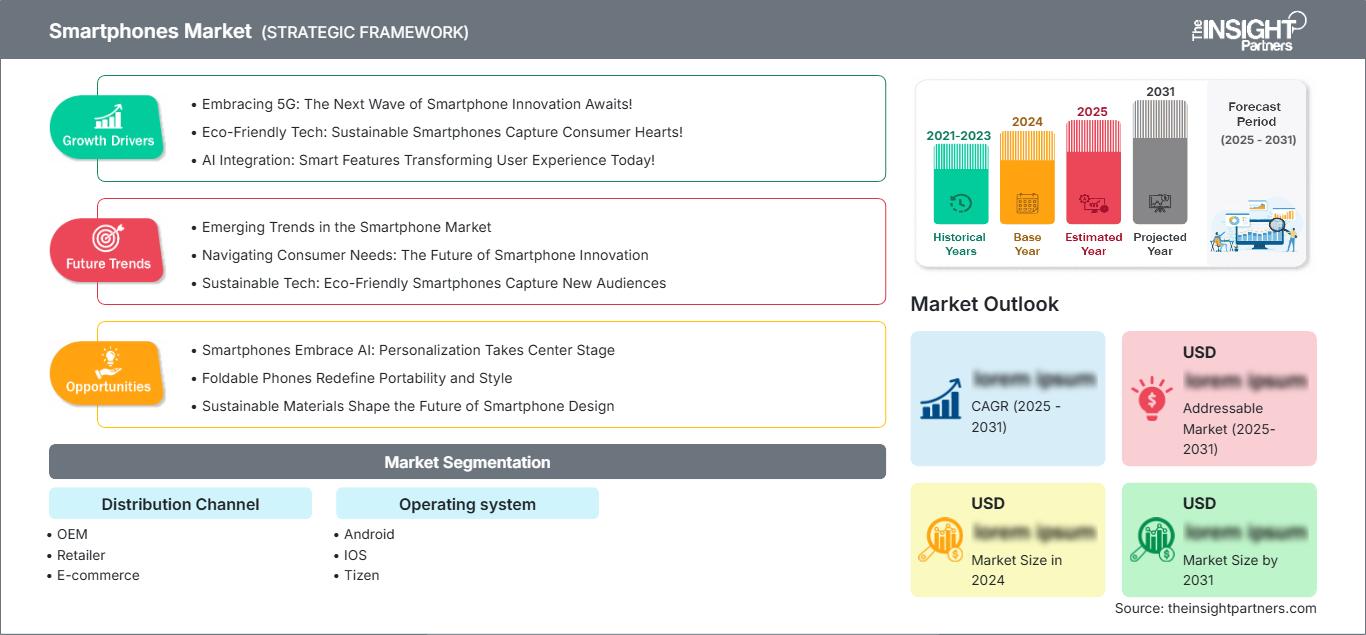
Smartphones Market: Strategic Insights
Regional Insights
North America Smartphones Market
North America is a mature smartphone market characterized by high device replacement values, extensive carrier participation, and strong demand for premium models. Its regional share is estimated at ~12% in 2025, with growth of ~2% CAGR through 2034. The region's economics favor premium hardware because consumers have established access to 5G networks, financing plans, trade-in programs, and mature application ecosystems. AI-enabled functions are becoming an additional consideration for upgrades.
The US represents about 85% of total revenue in North America and is projected to grow at around 2% CAGR. Canada makes up for the rest of the demand in the region and has similar carrier-led buying behavior but due to lower population levels compared to the US, its market size is not as large. Apple Inc. and Samsung Electronics Co., Ltd. are highly visible in the region.
U.S. Smartphones Market
The US is responsible for ~85% of North America revenues in 2025 and is expected to see growth of ~2% CAGR up to 2034. The presence of many high-end products allows market value despite limited unit growth. Carrier financing and trade-ins make flagship products cheaper and allow their faster refresh when the latest model offers significant progress in camera, processor, connectivity, or AI performance.
Apple Inc. is in the ecosystem of iPhones, and Samsung Electronics Co., Ltd. is a competitor in the premium and affordable Android segments. The enterprise mobility market generates further demand for secure and integrated products within productivity environments. In 2026, the scarcity of memory emerged as a critical issue in the industry, impacting shipping volumes, prices, specifications, and profit margins.
Europe Smartphones Market
Europe accounted for about 17% of global revenue in 2025 and will see growth of ~2% CAGR through 2034. The region is comprised of both the advanced Western European replacement markets and diverse purchasing power in the countries. Germany is the top country within Europe for market revenue owing to its size of economy, user-base, established retail structure, and premium/mid-range demand for devices. The UK, France, Italy, and Spain are also key markets, with their demand driven by operator bundles, retail offers, financing, and replacement.
Germany is noted for enterprise and industrial need for secure mobile connectivity, while the UK and France feature high relevance of consumer adoption and carrier and retail ecosystems. Italy and Spain are comparatively relevant for value-oriented consumers, e-commerce and prepaid/flexi-buying. In Europe, repairability, durability of devices, software, privacy and cybersecurity concerns, as well as sustainability factors impact product positioning.
APAC Smartphones Market
Asia Pacific accounts for ~58% of global revenue in 2025 and is expected to grow at ~4% CAGR through 2034, making it the fastest-growing major region in this assessment. China is the leading country in Asia Pacific, while India provides a major growth base because of its large addressable population, expanding 5G usage, manufacturing investments, and increasing smartphone replacement.
China’s manufacturing base has great depth coupled with stiff domestic competition whereas India has become progressively relevant in terms of consumption as well as production. Australia is still a developed premium market where there is active participation from operators and retailers alike. The regional market, therefore, has demand as well as supply support.
Middle East & Africa Smartphones Market
Middle East and Africa is a developing regional market with uneven purchasing power and network maturity. It is expected to expand at ~5% CAGR through 2034 as smartphone penetration, mobile broadband usage, digital payments, and connected services continue to broaden. Saudi Arabia is the leading country in the Middle East & Africa region where evidence supports a concentrated premium and digital-consumer opportunity.
UAE represents an important market for premium and distribution. South Africa offers a big market sub-Saharan market for demand. The RoMEA countries have different conditions based on affordability, currencies, imports, and investments in infrastructure. Vendors will therefore require varied pricing and channels for these markets.
Segmentation Analysis
Distribution Channel
The Smartphones Market scope includes the supplied channel categories, with Distribution Channel expected to expand at ~3% CAGR from 2026 to 2034. OEM-operated channels provide manufacturers with direct control over product presentation, customer data, promotions, trade-ins, and ecosystem services. Retailers remain important for physical demonstrations, financing, carrier bundles, and multi-brand comparison. E-commerce continues to change purchasing behavior by improving price transparency and geographic reach.
- OEM: Direct manufacturer channels are strategically important for premium launches, accessories, services, trade-in programs, and customer relationship management. They allow tighter control of merchandising and post-sale engagement while supporting direct promotion of ecosystem products and software services.
- Retailer: Physical and carrier-linked retailers remain important because smartphones are experience-led products that benefit from demonstrations, assisted selling, financing, and immediate fulfillment. Retail also supports multi-brand comparison and localized promotional strategies.
- E-commerce: Digital commerce provides broad geographic reach, rapid price comparison, online-exclusive promotions, and convenient fulfillment. Its strategic importance increases as consumers become comfortable researching specifications, comparing devices, completing trade-ins, and purchasing without visiting a physical store.
Operating system
Operating system segment in the Smartphones Market is projected to grow at ~4% CAGR through 2034. Platform competition is increasingly determined by the quality of AI services, application ecosystems, privacy controls, update policies, device interoperability, and developer support. Android provides broad vendor coverage and price-tier diversity, while IOS remains closely integrated with Apple's hardware and services. Alternative systems can serve specialized or regional requirements but face ecosystem and application constraints.
- Android: Android supports the broadest vendor and price-tier coverage in the supplied taxonomy. Its open ecosystem enables manufacturers to differentiate hardware while retaining access to established applications, services, developer tools, and connectivity features.
- IOS: IOS is closely tied to Apple's hardware, services, security architecture, and accessory ecosystem, reinforcing platform continuity across premium devices. Its strategic importance is reinforced by long-term software support, integrated device experiences, and premium consumer positioning across major developed markets.
- Tizen: Tizen has a narrower smartphone role but demonstrates how platform capabilities can support differentiated device ecosystems. Its strategic relevance is more closely associated with broader connected-device and software integration than mass smartphone competition.
- Sailfish: Sailfish serves a specialized operating-system position, emphasizing an alternative software environment and differentiated user control. Its relevance is strongest where ecosystem choice, privacy considerations, and specialized deployment requirements outweigh the application breadth of dominant platforms.
Opportunity Snapshot
| Distribution Channel | Revenue Contribution | Trend Tag | Adoption Stage |
| OEM | High | Direct selling | Scaling |
| Retailer | High | Assisted buying | Mature |
| E-commerce | Medium | Digital buying | Scaling |
Smartphones Market Growth Drivers and Impact Analysis
On-device AI is increasing the value proposition of replacement cycles
AI functionality is becoming a hardware differentiation mechanism rather than only a software feature. New smartphones increasingly pair neural-processing capability with cameras, voice interfaces, translation, search, content creation, personalization, and task automation. This changes replacement economics because buyers can evaluate a device according to what it can accomplish rather than only its processor, memory, or screen. For manufacturers, the shift creates demand for higher-performance chipsets, efficient thermal designs, larger or faster memory configurations, and stronger privacy controls for local processing. It also increases the importance of operating-system integration and developer access. The market can therefore capture value from AI-enabled upgrades even when total unit shipments grow slowly, provided vendors communicate tangible user benefits and maintain competitive pricing.
Premiumization is lifting revenue resilience amid moderate unit growth
Premiumization is allowing vendors to protect revenue through higher-value devices featuring advanced cameras, displays, processors, connectivity, materials, and software services. Consumers are increasingly evaluating smartphones as long-life computing products, making durability, update support, battery performance, and ecosystem compatibility more influential in purchase decisions. Financing and trade-in programs can reduce the initial price barrier and support upgrades to premium tiers. This dynamic benefits vendors with strong brand recognition, broad service ecosystems, and differentiated hardware. The resulting market structure rewards clear feature segmentation and disciplined portfolio management rather than indiscriminate specification escalation.
5G and digital-service expansion sustain smartphone relevance
The continued expansion of high-speed mobile networks supports smartphone replacement by enabling richer video, cloud applications, mobile gaming, digital payments, enterprise collaboration, and connected services. In emerging markets, the smartphone can be the primary gateway to internet-based services, making network expansion a direct demand catalyst. In mature markets, 5G availability provides a reason to replace older devices when combined with improved battery efficiency, cameras, security, and AI capabilities. Operators also influence adoption through installment plans, device bundles, and trade-in programs. This mechanism is particularly relevant where mobile connectivity continues to broaden the addressable user base. Manufacturers can benefit when network upgrades coincide with accessible device pricing and localized channel availability.
Smartphones Market Future Trends
AI-native smartphones will move toward proactive device assistance
Smartphones Market trends are moving toward proactive assistance as future smartphones are likely to shift from command-based AI features toward more integrated assistance across communication, search, scheduling, content, commerce, and device management. The distinction between application functions and operating-system intelligence is expected to become less clear as models are embedded into the device experience. Local processing can improve responsiveness and privacy for selected tasks, while cloud connectivity can provide broader computational capability. This trend will influence chipset design, memory requirements, battery management, software architecture, and developer interfaces. Vendors will increasingly need to demonstrate practical outcomes such as fewer steps to complete tasks, better contextual understanding, and more adaptive personalization.
Foldable and adaptive form factors will broaden premium differentiation
Foldable smartphones are evolving from niche hardware into a recurring premium product category, with manufacturers refining hinges, displays, thickness, battery packaging, multitasking software, and durability. Future development is likely to include more varied form factors and tighter integration between display modes and application interfaces. The commercial opportunity comes from offering larger usable screens without abandoning pocketable designs, while premium pricing can support the additional engineering complexity. Adoption will depend on durability perceptions, repair economics, software optimization, weight, and price. As more vendors participate, foldables can become a meaningful portfolio layer alongside conventional flagship devices. This trend may also encourage component suppliers to develop specialized displays, hinges, protective materials, batteries, and compact mechanical systems.
Smartphones Market Opportunities
Localized manufacturing and supply-chain diversification
Manufacturers and component suppliers have an opportunity to shape Smartphones Market Forecasts through localized production to expand production footprints in markets that combine growing domestic demand with industrial-policy support. India is particularly relevant because its consumer market and electronics manufacturing base can support both local sales and export-oriented production. Localization can reduce exposure to concentrated production risk while enabling faster regional customization. For vendors, the opportunity extends beyond final assembly to components, testing, repair, refurbishment, and lifecycle support. Investors should evaluate supplier depth, skilled labor, component availability, infrastructure, policy continuity, and proximity to demand rather than treating low-cost assembly alone as sufficient.
Refurbishment, trade-in, and lifecycle services
The installed base creates a substantial Smartphones Market Opportunities area beyond new-device sales. Trade-in programs can reduce effective purchase prices, encourage upgrades, and return used devices into structured refurbishment channels. Refurbished smartphones can then address price-sensitive consumers while extending product utilization and improving resource efficiency. Vendors, retailers, carriers, specialized refurbishers, and logistics providers can participate in grading, data wiping, component replacement, resale, and recycling. Better lifecycle services can also strengthen customer retention because the upgrade journey becomes an integrated process rather than a one-time transaction. As device prices and component costs rise, lifecycle economics become more important to both consumers and businesses, supporting investment in reverse logistics, diagnostics, repair networks, and certified resale channels.
Recent Developments
- September 2026: Apple Inc. — Apple introduced the iPhone 18 Pro and iPhone 18 Pro Max and separately unveiled iPhone Duo, extending its flagship portfolio with new hardware and AI-oriented experiences. The September product cycle reinforces premium-device competition and expands the range of form factors available within the iPhone ecosystem.
- August 2026: Samsung Electronics Co., Ltd. — Samsung expanded its Galaxy S26 portfolio with the Galaxy S26 FE, positioning a newer model around flagship-derived experiences and broader accessibility. The launch illustrates continued segmentation of premium technologies across multiple price points within the Galaxy ecosystem.
- June 2025: Huawei Device Co., Ltd. — Huawei launched the Pura 80 smartphone series with an emphasis on mobile imaging, including advanced camera hardware and XMAGE imaging capabilities. The launch strengthened Huawei's premium smartphone portfolio and highlighted imaging as a continuing area of hardware differentiation.
Frequently Asked Questions

- Comprehensive Market Sizing and Forecast Analysis
- Detailed Segmentation Analysis
- In-Depth Market Dynamics Assessment
- Regional and Country-Level Insights
- Competitive Landscape and Company Benchmarking
- Strategic Business Intelligence
Recent Reports
Testimonials

The Insight Partners provided valuable market intelligence that supported our global go-to-market strategy. Their team was professional, responsive, and attentive to our feedback, providing thoughtful analysis and helpful methodological clarifications throughout the project.
Junmo Kim Chief Financial Officer (CFO), Enertech Co., Ltd.
The Insight Partners' SCADA System Market report is comprehensive, with valuable insights on current trends and future forecasts. The team was highly professional, responsive, and supportive throughout. We are very satisfied and highly recommend their services.
RAN KEDEM Partner, Reali Technologies LTDs
I requested a report on a very specific software market and the team produced the report in a few days. The information was very relevant and well presented. I then requested some changes and additions to the report. The team was again very responsive and I got the final report in less than a week.
JEAN-HERVE JENN Chairman, Future Analytica
We worked with The Insight Partners for an important market study and forecast. They gave us clear insights into opportunities and risks, which helped shape our plans. Their research was easy to use and based on solid data. It helped us make smart, confident decisions. We highly recommend them.
PIYUSH NAGPAL Sr. Vice President, High Beam Global
The Insight Partners delivered insightful, well-structured market research with strong domain expertise. Their team was professional and responsive throughout. The user-friendly website made accessing industry reports seamless. We highly recommend them for reliable, high-quality research services
YUKIHIKO ADACHI CEO, Deep Blue, LLC.
This is the first time I have purchased a market report from The Insight Partners.While I was unsure at first, I visited their web site and felt more comfortable to take the risk and purchase a market report.I am completely satisfied with the quality of the report and customer service. I had several questions and comments with the initial report, but after a couple of dialogs over email with their analyst I believe I have a report that I can use as input to our strategic planning process.Thank you so much for taking the extra time and making this a positive experience.I will definitely recommend your service to others and you will be my first call when we need further market data.
JOHN SUZUKI President and Chief Executive Officer, Board Director, BK Technologies
I wish to appreciate your support and the professionalism you displayed in the course of attending to my request for information regarding to infectious disease IVD market in Nigeria. I appreciate your patience, your guidance, and the fact that you were willing to offer a discount, which eventually made it possible for us to close a deal. I look forward to engaging The Insight Partners in the future, all thanks to the impression you have created in me as a result of this first encounter.
DR CHIJIOKE ONYIA MANAGING DIRECTOR, PineCrest Healthcare Ltd.Reason to Buy
- Informed Decision-Making
- Understanding Market Dynamics
- Competitive Analysis
- Identifying Emerging Markets
- Customer Insights
- Market Forecasts
- Risk Mitigation
- Boosting Operational Efficiency
- Strategic Planning
- Investment Justification
- Tracking Industry Innovations
- Aligning with Regulatory Trends





 Get Free Sample for