
Smoke Detector Market Share, Size & Demand by 2034
Coverage: by Type (Photoelectric Smoke Detector, Ionization Smoke Detector, Dual Sensor Smoke Detector, Other Detector); Power Type (Battery Powered, Hardwired); End User (Residential, Commercial, Industrial); and Geography (North America, Europe, Asia Pacific, and South and Central America)
- Status : Data Released
- Report Code : TIPTE100000365
- Category : Electronics and Semiconductor
- No. of Pages : 150
- Available Report Formats :


- Last update date : October 16, 2026


2025 Market Size
US$ 3.85 Bn
Base year value
2034 Forecast
US$ 6.13 Bn
Projected by 2034
CAGR 2026-2034
5.30 %
Growth rate
Addressable Market
US$ 45.26 Bn
(2026-2034)
The Smoke Detector Market revenue is projected to rise from US$ 3.85 Billion in 2025 to US$ 6.13 Billion by 2034, representing a CAGR of 5.30% during 2026–2034. Coverage includes photoelectric, ionization, dual-sensor, and other detector technologies; battery-powered and hardwired products; and residential, commercial, and industrial end users. Replacement demand, code-driven installations, connected-building integration, and lifecycle maintenance support the forecast across established and developing markets.
Across North America, revenue is expected to expand at an estimated ~5% CAGR through 2034. A large installed base creates recurring replacement demand, while NFPA-aligned codes and insurer expectations sustain specification activity in homes and commercial premises. The Smoke Detector Market size also benefits from migration toward interconnected alarms, sealed long-life batteries, remote diagnostics, and addressable systems that simplify compliance across multi-site property portfolios.
Smoke Detector Market Assessment and Insights
Regional Outlook
- North America: ~36% of the global Smoke Detector Market share in 2025 | ~5% CAGR through 2034. Market position: The region ranks first, supported by mature code enforcement, extensive installed equipment, high household penetration, and replacement of aging alarms with interconnected and monitored devices.
- US: ~79% of North American market revenue in 2025 | ~5% CAGR through 2034. Market position: The US leads North America through broad residential coverage, commercial retrofits, strong brands, and demand for code-compliant photoelectric, hardwired, and smart-home products.
- Europe: ~29% of the global market in 2025 | ~5% CAGR through 2034. Market position: Mature residential mandates and harmonized product standards sustain replacement-led demand, with Germany leading Europe and the UK and France maintaining substantial installed bases.
- Asia Pacific: ~25% of the global market in 2025 | ~7% CAGR through 2034. Market position: Asia Pacific is the fastest-growing region as urban construction, industrial capacity, and enforcement broaden. China leads Asia Pacific, while India supplies incremental building demand.
Segment Outlook
- Type: ~44% Share in 2025 | ~6% CAGR through 2034. Market position: Type is the largest main segment because detector technology determines unit pricing and application suitability, with photoelectric products favored for smoldering-fire detection and nuisance-alarm reduction.
- End User: ~34% Share in 2025 | ~6% CAGR through 2034. Market position: End User has the strongest growth profile as commercial portfolios and industrial facilities adopt addressable, monitored, and multi-criteria detection for compliance and operational continuity.
Competitive Coverage
ABB Ltd., Aico Ltd., Honeywell International Inc., Johnson Controls International plc, Bosch Smart Home GmbH, Schneider Electric SE, Google LLC (Nest), Mircom Group of Companies, Carrier Global Corporation, Roost, Inc.
Methodology
The Insight Partners follows Data Collection & Secondary Research, Primary Research, Data Analysis, and Data Triangulation & Final Review to validate market estimates and insights.
Source: The Insight Partners' analysis based on proprietary research, government publications, company annual reports, investor presentations, industry databases, and expert interviews.
There is now greater focus on detectors that go beyond simple ionization alarms to utilize more sophisticated technologies such as photoelectric, multisensor, networked, and addressable technologies. New optical chamber designs, automatic dust correction, self-testing, battery sealing, and wireless communications have become increasingly popular and contribute to minimizing unnecessary alarms and maintenance calls. With regard to manufacturing, existing companies use proven sensing technology along with certified firmware and gateways as well as building management systems interface, while contract manufacturing addresses costs in residential applications. Certification is a legitimate obstacle since products have to ensure consistent sensitivity under different environments and meet regional requirements related to alarms, power, labeling, and testing.
Until 2034, incremental demand will be directed to Asia Pacific urban constructions, Middle East mixed-use developments, and replacement of existing housing stock. Capital will be drawn to products capable of lowering the cost of ownership through status monitoring, diagnostics, and ease of installation. Focusing on operational detectors, landlords’ responsibility, and fire system documentation regulations may foster replacement demand. Interest in interoperable home automation and building automation systems will push detector manufacturers to collaborate with software companies, installation businesses, and facility management channel.
Smoke Detector Market Report Scope
| Report Attribute | Details |
|---|---|
| Market size in 2025 | US$ 3.85 Billion |
| Market Size by 2034 | US$ 6.13 Billion |
| Global CAGR (2026 - 2034) | 5.30% |
| Historical Data | 2021-2024 |
| Forecast period | 2026-2034 |
Smoke Detector Market Analysis
Drivers of Growth in the Smoke Detector Market are the following three interrelated consumer groups: the need to install detectors in newly constructed buildings, the need to replace the current detectors, and the premium switch from individual detectors to systems. The consumer seeks affordability, easy maintainability, and nuisance rate minimization; businesses need certificates, panel compatibility, audible alerts, location, and serviceability. The market is populated by suppliers of components, companies that produce smoke detectors assemblies, laboratories that provide certificates, distributors, electrical contractors, integration companies, building owners, and platforms for monitoring.
The market is structurally advantageous to suppliers who are capable of dealing with component qualification and regional certifications without splitting the family of their products. The optics, microcontrollers, radios, acoustic components, batteries, and molded plastic parts constitute the cost equation, while software and commissioning constitute the differentiation. Long life cycle necessitates reliability of sourcing and backward compatibility, while installation expertise protects the incumbents.
Competition involves diversified technology platforms for buildings and experts in residential systems. The Smoke Detector Market report suggests that Honeywell International Inc., Johnson Controls International plc, Carrier Global Corporation, ABB Ltd., and Schneider Electric SE will benefit from broad automation channels, whereas Aico Ltd., Mircom Group of Companies, Bosch Smart Home GmbH, Google LLC (Nest), and Roost, Inc. will compete with concentrated solutions in detection, smart homes, or retrofits.
Money is going into addressability, intelligence, cloud control, multi-sensoring, and installer efficiency. Positioning no longer hinges on just the detector technology but also on certified ecosystems, ongoing service capabilities, data accessibility, and distribution depth. Technology providers that integrate alarm systems into building management have to make sure the life safety functions remain independent, secure, and functional in the case of network failures.
● REPORT CUSTOMIZATION
Tailor This Report To Align With Your Specific Business Requirements
This report can be customized to align precisely with your business objectives, scope, and target markets. Customization options include tailored segmentation, geography, competitive analysis, and strategic insights to support informed decision-making.
Customize This Report →WHAT YOU CAN ADJUST
- ● Segmentations
- ● Geography
- ● Competitive Analysis
- ● Language Preferences
Smoke Detector Market: Strategic Insights
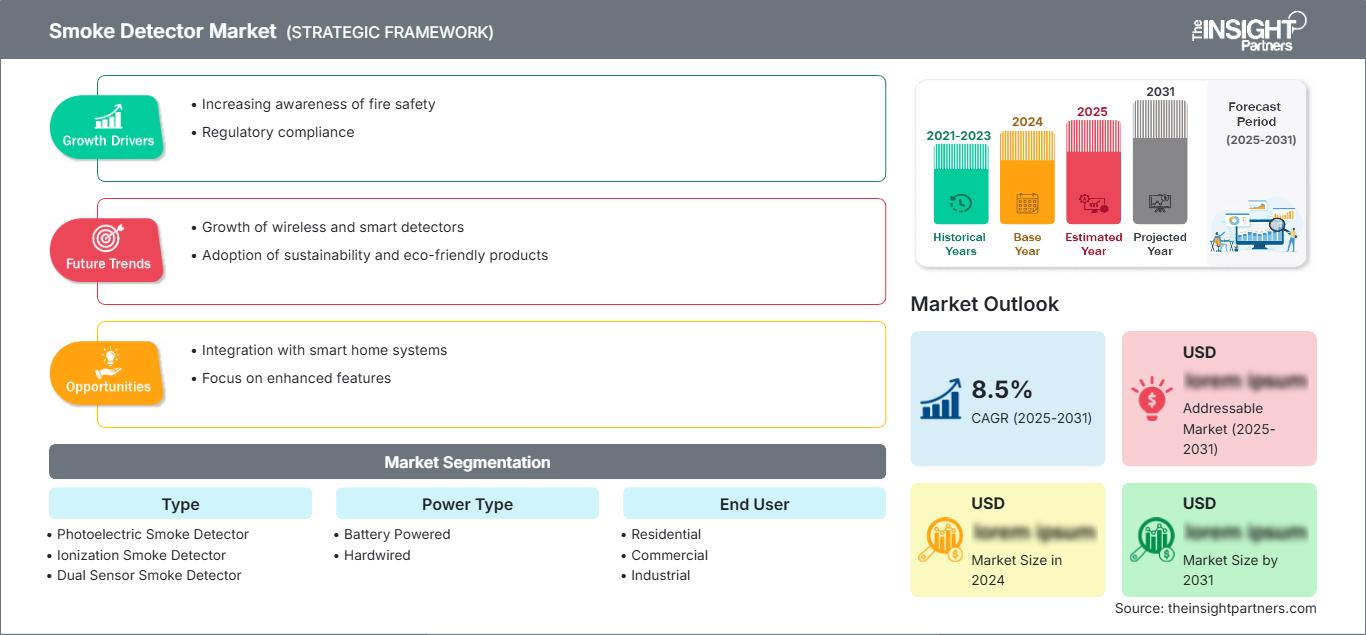
Regional Insights
North America Smoke Detector Market
North America accounts for an estimated ~36% Smoke Detector Market share in 2025 and is projected to grow at ~5% CAGR through 2034. This is due to its wide residential coverage, code installation, tested fire alarm services network, and recurring replacement cycles. It ensures maintenance through functioning alarm knowledge while commercial building owners require additional addressable alarms to know the source of the alarm and for testing purposes.
The growth is therefore value-based and not volume-based. Interconnectivity, sealed battery supply, logic in multiple sensors, mobile notification, and building platform support increases profits per unit installed. In Canada, its growth is aided by provincial building code and multi-residential buildings while manufacturing, logistical operations, and commercial installations support its growth in Mexico. High market saturation curtails growth, but old stock and inspections support the aftermarket.
U.S. Smoke Detector Market
The U.S. represents an estimated ~79% of North American revenue in 2025 and should advance at ~5% CAGR through 2034. Scale results from extensive housing inventory, prevalent alarm ownership, codes for fires and buildings by the government, and frequent replacement of nearing end-of-life equipment. Residential needs range from self-installed battery-powered units to professionally installed hardwired alarms and connected devices that interact with home platforms.
Commercial uses are increasingly leaning toward addressability, centralized monitoring, and service logs through the health care, educational institutions, hospitality industry, warehouses, and offices. Brands and/or technologies represented in this category include Honeywell International Inc., Johnson Controls International plc, Carrier Global Corporation, Google LLC (Nest), and Roost, Inc. The industry is still competitive as consumers consider certification, false alarm reliability, installer friendliness, and service during lifecycle apart from purchase cost.
Europe Smoke Detector Market
Europe holds an estimated ~29% of global revenue in 2025 and is projected to record ~5% CAGR through 2034. Standardized product standards such as EN 14604 for residential smoke detectors create uniform performance expectations, whereas installation requirements are national. The replacement opportunity is significant due to the fact that mature markets have widespread installed base and landlords are required to install appropriate devices. Renovation efforts may create opportunities for electrical and life safety improvement.
Germany leads the European market owing to the presence of dwelling-specific standards, sizeable housing stock, and professional installation channels. The UK benefits from building codes, landlord requirements, and management of social housing assets that work in favor of Aico Ltd. and portfolio management solutions. France creates significant residential demand on account of residential alarms requirements. Italy and Spain provide a relatively larger opportunity on the retrofit front especially hospitality, apartments, and small businesses due to evolving enforcement and insurance practices.
The regional rivalry encompasses all global automated companies and their local counterparts. Bosch Smart Home GmbH, ABB Ltd., Schneider Electric SE, Honeywell International Inc., and Johnson Controls International plc have the ability to link up detection with electrical as well as building management systems. Distinguishing features are few false alarms, ten years of power, radio link, certification, and service availability.
APAC Smoke Detector Market
Asia Pacific represents an estimated ~25% of global revenue in 2025 and is the fastest-growing region at ~7% CAGR through 2034. China is the number one nation in Asia Pacific, characterized by construction, manufacturing, commercial towers, and industrial plants. Japan and South Korea prioritize reliable, modular, and integrated systems in developed urban areas.
India brings growth with mixed-use high-rises, logistic, data center, and institutional projects that comply with national and regional fire safety code requirements. In Australia, there is growth with code-based residential and commercial building replacements. Growth in this region is driven by compliance with policies, urban density, industrial investment, and integration into the fire protection profession.
Middle East & Africa Smoke Detector Market
Middle East & Africa revenue is projected to expand at ~6% CAGR through 2034. The UAE is the leading country in the Middle East & Africa where high-rise construction, hospitality, logistics, and smart-building investment support sophisticated detection. Saudi Arabia adds demand from large mixed-use developments, tourism assets, industrial zones, and infrastructure programs.
South Africa anchors more established sub-Saharan commercial demand, while the Rest of MEA remains uneven because enforcement, affordability, and installer capacity vary. Oil and gas facilities, utilities, transport hubs, data centers, and premium real estate favor addressable or multi-criteria systems, whereas residential adoption is more price-sensitive and often depends on local codes and distribution.
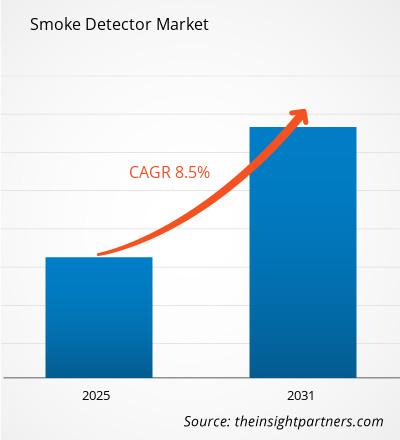
Segmentation Analysis
Type
Type is the largest main segment, representing ~44% of 2025 revenue and advancing at an estimated ~6% CAGR during 2026–2034. The Smoke Detector Market scope spans sensing approaches optimized for smoldering fires, flaming fires, or combined risk recognition. Procurement increasingly rewards low nuisance rates, certified performance, compact design, and compatibility with interconnected or addressable systems.
- Photoelectric Smoke Detector: Optical sensing is widely specified for early recognition of slow, smoldering fires and for reducing cooking-related nuisance alarms. It is strategically important in homes, corridors, offices, hospitality, and many retrofit programs.
- Ionization Smoke Detector: Ionization devices retain demand in price-sensitive installed bases and applications emphasizing rapid response to flaming fires. Regulatory scrutiny, disposal considerations, and buyer preference for optical alternatives constrain their long-term strategic position.
- Dual Sensor Smoke Detector: Dual-sensor designs combine complementary detection principles to broaden fire recognition and reduce reliance on one signature. Their value is strongest where owners prioritize coverage quality, premium functionality, and fewer specification compromises.
Power Type
Power Type is forecast to expand at ~5% CAGR during 2026–2034. Purchase decisions balance installation cost, continuity, maintenance burden, and code requirements. Battery solutions support rapid retrofit and consumer installation, while mains-connected units suit new construction and professionally managed premises. Backup power, low-battery signaling, sealed cells, and interconnection increasingly matter across both architectures.
- Battery Powered: Battery-powered detectors serve retrofit, do-it-yourself, rental, and locations where new wiring is impractical. Sealed long-life cells reduce maintenance risk, although device replacement discipline and correct placement remain central to dependable protection.
- Hardwired: Hardwired detectors are prominent in new buildings, multi-unit housing, and commercial projects where interconnection and dependable primary power are required. Battery backup and panel integration strengthen resilience and support professional inspection practices.
End User
End User is the high-growth main segment, carrying ~34% of 2025 revenue and an estimated ~6% CAGR during 2026–2034. Expansion is driven by a broader mix of managed properties and mission-critical facilities seeking auditable testing, precise alarm location, and integration with evacuation or building systems. Residential replacement remains the volume foundation, while commercial and industrial projects lift system value.
- Residential: Residential demand is sustained by code compliance, landlord responsibilities, ten-year replacement cycles, and consumer awareness. Buyers increasingly favor photoelectric sensing, sealed batteries, wireless interconnection, and mobile notifications where simplicity remains intact.
- Commercial: Offices, retail, hospitality, healthcare, education, and logistics sites require scalable detection, centralized supervision, and documented maintenance. Commercial buyers create recurring opportunities for integrators through upgrades, testing, device replacement, and portfolio standardization.
- Industrial: Manufacturing, energy, utilities, and process facilities need detectors suited to challenging environments and coordinated alarm architectures. Reliability, hazardous-area requirements, fault isolation, and continuity planning make engineering support and lifecycle service strategically important.
Opportunity Snapshot
| End Users | Revenue Contribution | Trend Tag | Adoption Stage |
| Residential | High | Connected Alarms | Mature |
| Commercial | High | Remote Compliance | Scaling |
| Industrial | Medium | Multi-Criteria | Scaling |
Smoke Detector Market Growth Drivers and Impact Analysis
Code Enforcement and Installed-Base Replacement
Risk awareness is translated into regular unit requirements by building and fire codes. New housing and commercial construction necessitates compliance in detection at certain locations, while current alarm systems need testing, maintenance, and replacement in case there are problems in power systems or at the end of service life. This process becomes critical in mature markets because of the already high penetration rate and dependence on the quality of replacement units as opposed to the first time ownership. There is increased standardization of approved units among property owners for ease of inspection and stock control. The effect is felt all the way to the distributors, electricians, fire-alarm system installers, and monitoring firms, hence ensuring long-term channel access for certified suppliers.
Connected Buildings and Portfolio-Level Visibility
Owners of commercial establishments have been moving away from individual alarm points to connected life-safety systems that provide information on device status, failures, and alarm source. Remote monitoring saves effort on manual inspections, assists in maintenance planning, and helps audit evidence gathering for far-flung installations. In addition, addressable detectors assist responders in identifying the involved area more quickly in hospitals, university campuses, hotels, warehouses, and high-rise buildings. For manufacturers, the benefit is an extension of value from sale of hardware to gateways, software, commissioning solutions, service agreements, and replacement of devices on schedule. The result for commerce is increased system value and platform lock-in, but manufacturers need to ensure cybersecurity protection, independent alarm operations, and panel compatibility.
Urban Density and Higher-Value Building Projects
Growing urbanization means that there will be more sophisticated spaces where early smoke detection will be needed. Multi-family buildings, transportation-related structures, data centers, logistics centers, hospitals, hotels, and industrial properties contain many people or valuable equipment, hence making the cost of late detection very high. Such projects would prefer to have interconnected devices, fault isolation features, power reserve, and interoperability with notification or smoke-control systems. More chances will come to Asia Pacific and the Middle East since these regions will be having more opportunities for new constructions which could have advanced architecture right from the beginning, compared to North America and Europe where the main emphasis is on retrofitting. It is not just more detectors in the market.
Smoke Detector Market Future Trends
Multi-Criteria Detection Becomes the Premium Default
Smoke Detector Market trends increasingly point toward combining optical, thermal, and algorithmic inputs rather than relying on a single signal. Better discrimination can improve response across fire types while reducing nuisance events that lead occupants to silence or remove alarms. Through 2034, suppliers are expected to embed more processing at the device edge, enabling adaptive sensitivity and clearer maintenance diagnostics without making cloud connectivity a prerequisite for life-safety operation. Adoption will begin in premium residential, healthcare, hospitality, and complex commercial settings before broadening as components scale. The strategic implication is a shift in competition from basic sensor cost toward validated detection logic, environmental robustness, and evidence that advanced functions do not compromise certification or dependable local alarming.
Detection Data Joins Building Operations Workflows
Fire detection information will increasingly flow into facility-management and compliance workflows, with permissions carefully separated from core alarm functions. Device health, contamination indicators, battery status, test history, and location data can help operators schedule targeted maintenance instead of blanket site visits. Digital records may also improve oversight across rental portfolios, schools, healthcare estates, and distributed retail networks. This transition favors open interfaces, secure gateways, and tools that work with installed panels rather than forcing immediate replacement. It also raises governance requirements around cybersecurity, access control, update management, and data retention. Vendors that make detector information actionable for technicians and property managers can build recurring relationships beyond the initial equipment transaction.
Smoke Detector Market Opportunities
Retrofit Kits for Multi-Site Residential Portfolios
Housing providers, landlords, and property managers need scalable ways to replace aging alarms without extensive rewiring or prolonged dwelling access. Suppliers can address this opportunity with certified detector families, reusable mounting approaches where permitted, wireless interconnection, sealed power options, and simple mobile commissioning. Portfolio dashboards should focus on actionable exceptions such as missing devices, low power, contamination, or overdue tests rather than unnecessary data volume. Smoke Detector Market Forecasts support investment in partnerships with electrical contractors, housing-maintenance providers, and distributors that can deliver standardized rollout programs. Commercial success will depend on clear lifecycle economics, technician training, reliable connectivity, privacy controls, and proof that remote tools supplement rather than replace required physical inspection.
Localized Systems for Fast-Growing Urban Markets
Asia Pacific and Middle Eastern projects create room for localized detector and panel ecosystems tailored to national approvals, languages, power conditions, and installer practices. Manufacturers can prioritize partnerships with local system integrators, certification bodies, developers, and electrical channels rather than exporting a single global configuration. Product portfolios should span cost-efficient stand-alone residential units and addressable commercial devices so suppliers can follow customers across housing, hospitality, logistics, healthcare, and industrial sites. Local assembly or regional sourcing may improve lead times and tender responsiveness, but quality control and component traceability must remain consistent. The strongest investments will combine certification expertise, installer education, spare-parts availability, and long-term service capability.
Recent Developments
- May 2026: Siemens – unveiled its next-generation Sinteso Nova and Cerberus Nova smoke detectors, featuring continuous self-monitoring, anti-masking protection, insect-screen monitoring, and Smoke Entry Supervision. The IoT-enabled detectors support real-time monitoring, remote diagnostics, and predictive maintenance through cloud-based building management systems.
- September 2026: Resideo Technologies – launched a new range of First Alert smoke, carbon monoxide, and combination alarms designed to simplify installation and maintenance. The alarms introduce SoftCue replacement reminders, easy-read LED indicators, side-load battery drawers, and Precision Detection technology aimed at improving fire detection while reducing nuisance alarms.
- September 2026: Comelit-PAC – launched a new range of linear beam smoke detectors designed for large, open spaces. The detectors focus on simplified commissioning and compatibility with both addressable and conventional fire alarm systems, expanding flexible smoke-detection options for commercial and industrial applications.
Frequently Asked Questions

- Comprehensive Market Sizing and Forecast Analysis
- Detailed Segmentation Analysis
- In-Depth Market Dynamics Assessment
- Regional and Country-Level Insights
- Competitive Landscape and Company Benchmarking
- Strategic Business Intelligence
Recent Reports
Testimonials

The Insight Partners provided valuable market intelligence that supported our global go-to-market strategy. Their team was professional, responsive, and attentive to our feedback, providing thoughtful analysis and helpful methodological clarifications throughout the project.
Junmo Kim Chief Financial Officer (CFO), Enertech Co., Ltd.
The Insight Partners' SCADA System Market report is comprehensive, with valuable insights on current trends and future forecasts. The team was highly professional, responsive, and supportive throughout. We are very satisfied and highly recommend their services.
RAN KEDEM Partner, Reali Technologies LTDs
I requested a report on a very specific software market and the team produced the report in a few days. The information was very relevant and well presented. I then requested some changes and additions to the report. The team was again very responsive and I got the final report in less than a week.
JEAN-HERVE JENN Chairman, Future Analytica
We worked with The Insight Partners for an important market study and forecast. They gave us clear insights into opportunities and risks, which helped shape our plans. Their research was easy to use and based on solid data. It helped us make smart, confident decisions. We highly recommend them.
PIYUSH NAGPAL Sr. Vice President, High Beam Global
The Insight Partners delivered insightful, well-structured market research with strong domain expertise. Their team was professional and responsive throughout. The user-friendly website made accessing industry reports seamless. We highly recommend them for reliable, high-quality research services
YUKIHIKO ADACHI CEO, Deep Blue, LLC.
This is the first time I have purchased a market report from The Insight Partners.While I was unsure at first, I visited their web site and felt more comfortable to take the risk and purchase a market report.I am completely satisfied with the quality of the report and customer service. I had several questions and comments with the initial report, but after a couple of dialogs over email with their analyst I believe I have a report that I can use as input to our strategic planning process.Thank you so much for taking the extra time and making this a positive experience.I will definitely recommend your service to others and you will be my first call when we need further market data.
JOHN SUZUKI President and Chief Executive Officer, Board Director, BK Technologies
I wish to appreciate your support and the professionalism you displayed in the course of attending to my request for information regarding to infectious disease IVD market in Nigeria. I appreciate your patience, your guidance, and the fact that you were willing to offer a discount, which eventually made it possible for us to close a deal. I look forward to engaging The Insight Partners in the future, all thanks to the impression you have created in me as a result of this first encounter.
DR CHIJIOKE ONYIA MANAGING DIRECTOR, PineCrest Healthcare Ltd.Reason to Buy
- Informed Decision-Making
- Understanding Market Dynamics
- Competitive Analysis
- Identifying Emerging Markets
- Customer Insights
- Market Forecasts
- Risk Mitigation
- Boosting Operational Efficiency
- Strategic Planning
- Investment Justification
- Tracking Industry Innovations
- Aligning with Regulatory Trends





 Get Free Sample for