
Solar Outdoor LED Lights Market Share, Growth & Forecast by 2034
Coverage: by Product (Solar LED Street Lights, Solar LED Flood Lights, Solar LED Garden Lights, Solar LED Spotlights, Solar LED Area Lights); Power (Less than 50W, Between 50W and 150W, More than 150W); Installation Type (Retrofit, New Installations); Application (Residential, Commercial, Others) , and Geography (North America, Europe, Asia Pacific, and South and Central America)
- Status : Data Released
- Report Code : TIPRE00012679
- Category : Electronics and Semiconductor
- No. of Pages : 150
- Available Report Formats :


- Last update date : October 16, 2026


2025 Market Size
US$ 12.28 Bn
Base year value
2034 Forecast
US$ 109.48 Bn
Projected by 2034
CAGR 2026-2034
27.51 %
Growth rate
Addressable Market
US$ 450.25 Bn
(2026-2034)
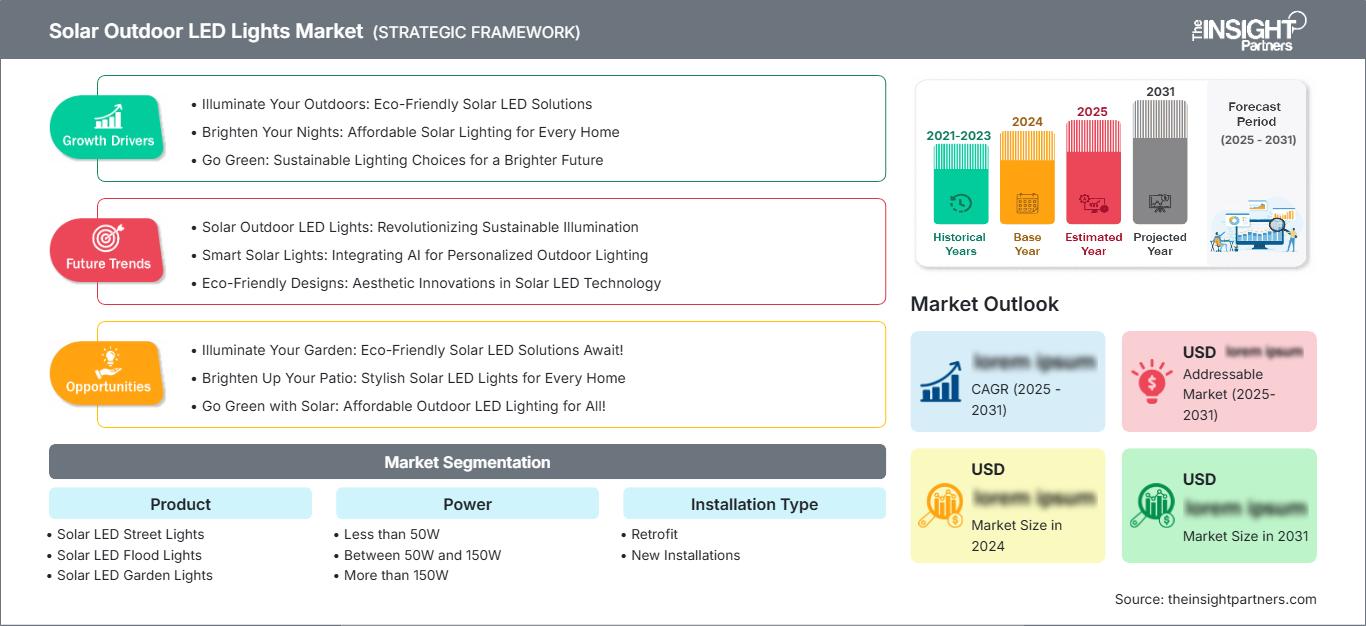
The Solar Outdoor LED Lights Market adoption is being shaped by the convergence of LED efficiency, photovoltaic generation, lithium-based energy storage, and decentralized outdoor infrastructure. The market was valued at US$ 12.28 Billion in 2025 and is projected to reach US$ 109.48 Billion by 2034, expanding at a CAGR of 27.51% from 2026 to 2034. The scope covers solar LED street lights, flood lights, garden lights, spotlights, and area lights across multiple power classes and installation configurations.
Across North America, deployment is increasingly connected with municipal modernization, pathway safety, remote-area illumination, and commercial property upgrades. The regional market is modeled to expand at a ~24% CAGR through 2034, supported by demand for lighting infrastructure that reduces trenching and grid-connection requirements. Product improvements in battery management, photovoltaic efficiency, controls, and modular installation are also broadening the addressable applications beyond conventional roadway lighting.
Solar Outdoor LED Lights Market Assessment and Insights
Regional Outlook
- North America: ~28% of the global market in 2025 | ~24% CAGR through 2034. Market position: North America represents a mature but expanding market, supported by municipal roadway programs, remote infrastructure requirements, commercial outdoor applications, and replacement of conventional lighting. The region also benefits from established solar-lighting suppliers and specification-driven procurement.
- US: ~78% of North American market revenue in 2025 | ~24% CAGR through 2034. Market position: The US accounts for the largest portion of North American demand, with adoption concentrated in municipalities, transportation corridors, parks, campuses, parking areas, and commercial properties. Demand is reinforced by infrastructure modernization and applications where grid extension is costly.
- Europe: ~23% of the global market in 2025 | ~25% CAGR through 2034. Market position: Europe combines relatively mature LED penetration with growing requirements for energy-efficient public infrastructure. Germany, the UK, France, Italy, and Spain provide substantial demand, with Germany representing the leading country in Europe based on industrial capacity, municipal infrastructure, and energy-efficiency priorities.
- Asia Pacific: ~32% of the global market in 2025 | ~32% CAGR through 2034. Market position: Asia Pacific is the fastest-growing region, supported by urban expansion, off-grid infrastructure requirements, manufacturing scale, and public investment in efficient outdoor illumination. China is the leading country in Asia Pacific, while India, Japan, South Korea, and Australia contribute through distinct infrastructure and commercial applications.
Segment Outlook
- Solar LED Street Lights: ~38% Share in 2025 | ~27% CAGR through 2034. Market position: Street lighting leads because it combines high unit deployment potential with strong suitability for roads, pedestrian corridors, public spaces, and areas where electrical trenching is expensive. Municipal and infrastructure applications provide recurring demand for scalable systems.
- New Installations: ~62% Share in 2025 | ~31% CAGR through 2034. Market position: New installations have the stronger growth profile because solar lighting can be incorporated into new roads, developments, campuses, and public infrastructure without the full electrical-network requirements of conventional lighting. Integrated systems also simplify deployment in underserved locations.
Competitive Coverage
Carmanah, Cree Lighting, Gama Sonic, Hubbell Outdoor, Ligman, Okawa Screw Manufacturing, Philips, Signify Holding, Solar Lighting International Inc., Solas Ray
Methodology
The Insight Partners follows Data Collection & Secondary Research, Primary Research, Data Analysis, and Data Triangulation & Final Review to validate market estimates and insights.
Source: The Insight Partners' analysis based on proprietary research, government publications, company annual reports, investor presentations, industry databases, and expert interviews.
From initial standalone photovoltaic lamps, developments in lighting systems have LED to systems that integrate LED lamps, solar panels, lithium batteries, charge controllers, sensors, and programmed controls. Efficacy improvements in LEDs have seen the need for reduced amounts of photovoltaics and battery power for equivalent lighting systems, while modularization has facilitated maintenance and replacement. In addition, manufacturers have developed hybrid and smart lighting systems that react according to user needs or environmental conditions. This will result in procurement decisions being made based on system economics, reliability, maintainability, energy independence, and performance for each particular use.
Within the forecast period, investments will be directed towards areas where the deployment of public lighting coincides with the goals of developing renewable energy and addressing gaps in existing infrastructure. Some of such places include the Asian Pacific region, some countries in Africa and the Middle East, and select countries in Latin America, where decentralized lighting will help, where there is either limited access to the grid or network development is limited. The Solar Outdoor LED Lights Market growth outlook therefore depends not only on solar hardware costs but also on project financing, municipal procurement models, battery durability, and local installation capabilities.
Solar Outdoor LED Lights Market Report Scope
| Report Attribute | Details |
|---|---|
| Market size in 2025 | US$ 12.28 Billion |
| Market Size by 2034 | US$ 109.48 Billion |
| Global CAGR (2026 - 2034) | 27.51% |
| Historical Data | 2021-2024 |
| Forecast period | 2026-2034 |
Solar Outdoor LED Lights Market Analysis
There are three related demands, which include efficiency of illumination, minimal dependence on infrastructure, and simplicity of installation. Solar power systems can do away with underground cabling and thus are particularly ideal for roads, walkways, parks, parking lots, campuses, and ancillary infrastructures. The value chain involves photovoltaic panels, battery systems, controllers, LED lamps, optics, casing, sensors, control systems, poles, installation, and maintenance services. Firms able to offer engineering solutions as well as supply chain services will ensure compatibility among these parts.
Supply trends are increasingly moving toward modular designs, which enable the replacement of batteries, panels, controllers, and lighting engines independently from each other. The Solar Outdoor LED Lights Market analysis also indicates that battery performance and thermal management remain important differentiation areas because illumination reliability depends on stored energy during low-sunlight periods. Product specifications are consequently moving toward higher efficacy, adaptive dimming, better charge management, and serviceable designs rather than simply higher nominal wattage.
Competition spans specialized solar-lighting manufacturers and diversified lighting companies. Carmanah emphasizes engineered solar-powered infrastructure, while Gama Sonic has a strong presence in residential and decorative solar applications. Cree Lighting participates in advanced outdoor LED technologies, and Hubbell Outdoor provides broader outdoor lighting capabilities. Ligman focuses on architectural outdoor solutions, while Philips and Signify Holding bring extensive professional lighting portfolios and specification capabilities. Solar Lighting International Inc. and Solas Ray address dedicated solar-lighting applications, while Okawa Screw Manufacturing contributes through solar-lighting manufacturing capabilities.
Solar Outdoor LED Lights Market Trends investments are increasingly focused on reliability, connectivity, battery optimization, and installation architecture flexibility. Competitive positioning is changing from focusing on luminaire efficiency to a broader concept of system efficiency, covering not only luminaire efficiency but also energy production, battery efficiency, connectivity, and maintainability. One of the important trends that can be observed is the increasing adoption of photovoltaic energy generation, battery efficiency, LEDs, and sensor and remote monitoring capabilities as integral parts of outdoor lighting systems. The suppliers able to provide such systems that would be standard yet customizable at the same time will be better positioned for various applications.
● REPORT CUSTOMIZATION
Tailor This Report To Align With Your Specific Business Requirements
This report can be customized to align precisely with your business objectives, scope, and target markets. Customization options include tailored segmentation, geography, competitive analysis, and strategic insights to support informed decision-making.
Customize This Report →WHAT YOU CAN ADJUST
- ● Segmentations
- ● Geography
- ● Competitive Analysis
- ● Language Preferences
Solar Outdoor LED Lights Market: Strategic Insights
Regional Insights
North America Solar Outdoor LED Lights Market
North America represented ~28% of global Solar Outdoor LED Lights Market revenue in 2025 and is projected to record a ~24% CAGR through 2034. The region benefits from established outdoor-lighting infrastructure, widespread LED adoption, and procurement programs targeting roadway, pathway, parking, and public-space modernization. Solar systems are particularly relevant where extending utility connections requires substantial civil work or where lighting is needed in remote locations. Municipalities, transportation agencies, utilities, and commercial property owners, therefore represent important demand groups.
The US accounts for ~78% of North American revenue and provides the principal regional demand base. Product selection increasingly emphasizes battery autonomy, optical distribution, vandal resistance, environmental durability, and controls. Canada contributes through remote infrastructure, municipal applications, and transportation corridors, although climatic conditions place greater emphasis on battery performance and seasonal solar availability. The regional opportunity is consequently characterized by a combination of new deployments and replacement projects rather than a single application category.
U.S. Solar Outdoor LED Lights Market
The US accounted for ~78% of North American Solar Outdoor LED Lights Market revenue in 2025 and is modeled to grow at a ~24% CAGR through 2034. The need for LED outdoor lighting is fueled by roadway and pedestrian safety standards, recreational parks, parking lots, campuses, industrial facilities, and commercial real estate projects. Some designs can be of special interest for places with high costs of electrical wiring, permits, and utility connections. Customers increasingly take into account the durability and serviceability of solutions during their lifetime, besides purchasing prices.
Different companies, such as Carmanah, Cree Lighting, Gama Sonic, Hubbell Outdoor, and others, target different segments of the US outdoor lighting market. Homeowners tend to purchase decorative and pathway fixtures, while businesses and municipalities focus on lighting effectiveness, reliability, control features, and serviceability. The increased popularity of combined solar fixtures also facilitates an easier installation process. With the expansion of smart lighting and adaptive dimming technologies, the US market is moving towards systems that can adapt their lighting to usage conditions.
Europe Solar Outdoor LED Lights Market
Europe represented ~23% of the global Solar Outdoor LED Lights Market revenue in 2025 and is expected to expand at a ~25% CAGR through 2034. The region combines established LED infrastructure with policy attention to energy efficiency, circularity, and public-sector operating costs. Germany is the leading country in Europe, supported by industrial capabilities, municipal modernization, and demand for energy-efficient outdoor infrastructure. The UK maintains demand across streets, public facilities, campuses, and commercial properties, while France has opportunities in municipalities and transport-linked outdoor applications.
Germany's market is complemented by Italy and Spain, where solar illumination is particularly relevant for public spaces, roads, tourism infrastructure, residential developments, and areas with favorable solar resources. European buyers increasingly consider glare control, light distribution, environmental impact, maintainability, and product lifetime when selecting outdoor lighting. This favors integrated solutions with intelligent dimming and efficient energy storage rather than products differentiated only by lumen output. The Solar Outdoor LED Lights Market share held by Europe therefore reflects a mature specification environment combined with continuing opportunities for decentralized infrastructure.
APAC Solar Outdoor LED Lights Market
APAC accounted for ~32% of global Solar Outdoor LED Lights Market revenue in 2025 and is projected to expand at a ~32% CAGR through 2034, making it the fastest-growing region. China is the leading country in Asia Pacific, supported by large manufacturing capabilities, extensive infrastructure development, and strong solar-equipment supply chains. India also provides substantial potential through urban expansion, public infrastructure programs, rural connectivity, and demand for lower-energy lighting.
Japan and South Korea emphasize technologically advanced lighting, controls, and high-reliability applications, while Australia provides opportunities across remote communities, roads, parks, mining-related infrastructure, and commercial properties. The regional combination of manufacturing scale, solar-resource availability, infrastructure expansion, and decentralized lighting needs supports rapid deployment. Suppliers able to localize products, meet country-specific standards, and provide durable battery systems can address a broad range of application requirements.
Middle East & Africa Solar Outdoor LED Lights Market
The Middle East and Africa Solar Outdoor LED Lights Market is projected to record a ~30% CAGR through 2034. Saudi Arabia represents the leading country in the Middle East and Africa based on infrastructure investment, urban development, and large-scale public-space requirements. The UAE also offers demand from smart-city developments, hospitality facilities, commercial projects, and transport infrastructure. South Africa provides a distinct opportunity through municipal lighting, security-related illumination, and areas where decentralized power can reduce dependence on grid infrastructure.
Solar availability is a central demand enabler across the region, while remote settlements and infrastructure projects can benefit from avoiding extensive cabling. Public lighting programs supported by international development initiatives can further expand deployment in underserved areas. The market is nevertheless sensitive to financing, procurement capacity, battery replacement logistics, and environmental conditions. Products designed for high temperatures, dust exposure, and remote servicing therefore, have stronger application relevance than standardized systems designed for moderate climates.
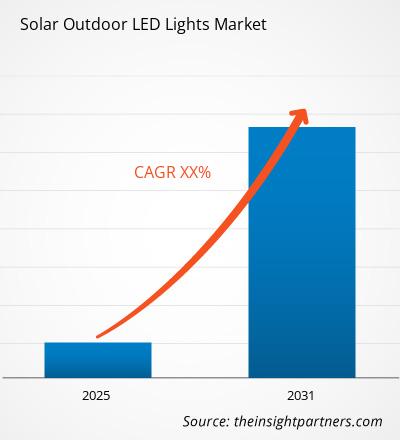
Segmentation Analysis
Product
The Product segment is LED by Solar LED Street Lights, which accounted for the largest market position at ~38% in 2025 and is projected to expand at a ~27% CAGR through 2034. Street lighting benefits from large deployment volumes, infrastructure requirements, and the ability of solar systems to reduce cabling and utility dependence. Flood, garden, spotlight, and area-light products broaden the addressable market into commercial, residential, landscape, security, and recreational applications.
- Solar LED Street Lights: These products represent the core infrastructure application, serving roads, pedestrian routes, parks, parking areas, and public spaces. Demand is influenced by installation simplicity, illumination requirements, battery autonomy, and municipal lifecycle-cost considerations.
- Solar LED Flood Lights: Flood lights address security, industrial, commercial, construction, and recreational applications requiring broader illumination. Their strategic importance comes from flexible mounting and the ability to illuminate areas without dedicated grid connections.
- Solar LED Garden Lights: Garden lights are concentrated in residential landscaping, hospitality, pathways, and decorative applications. Buyers generally prioritize aesthetics, easy installation, weather resistance, and operating simplicity, creating a strong fit for consumer-oriented solar products.
- Solar LED Spotlights: Spotlights serve accent, security, architectural, and landscape applications. Their directional illumination enables targeted lighting while maintaining the advantages of wireless installation and localized solar power generation.
- Solar LED Area Lights: Area lights support parking lots, campuses, industrial properties, public facilities, and recreational spaces. They occupy an important position where broad illumination is required without extensive electrical trenching.
Power
The Power segment is expected to expand at a ~28% CAGR through 2034. Product selection within this category depends on illumination area, mounting height, operating schedule, photovoltaic capacity, and battery requirements. Lower-power systems are well suited to residential and pathway applications, while higher-power configurations address roads, parking facilities, industrial sites, and large outdoor areas. Increasing LED efficacy is allowing manufacturers to achieve greater illumination with comparatively optimized power requirements.
- Less than 50W: This category primarily supports residential, pathway, garden, perimeter, and smaller commercial applications. Its strategic relevance comes from compact system design, lower component requirements, and suitability for distributed installations.
- Between 50W and 150W: This range serves a broad middle market spanning streets, parking areas, campuses, and commercial properties. It offers a balance between illumination coverage, photovoltaic sizing, battery capacity, and installation cost.
- More than 150W: Higher-power products address demanding infrastructure and large-area applications. Their adoption depends heavily on optical efficiency, solar-panel sizing, battery autonomy, thermal management, and the economics of replacing conventional grid-connected systems.
Installation Type
The Installation Type segment is forecast to grow at a ~30% CAGR through 2034. New installations are expected to maintain the larger position because solar lighting can be integrated into infrastructure projects before electrical networks are established. Retrofit projects remain relevant where existing poles and lighting assets can support solar conversion, but technical compatibility and structural conditions can limit addressable installations. Procurement decisions increasingly compare civil-work savings with equipment and maintenance requirements.
- Retrofit: Retrofit projects target existing outdoor-lighting infrastructure and can reduce energy consumption or provide lighting in locations where grid service is unreliable. Their viability depends on pole condition, solar exposure, mounting compatibility, and battery requirements.
- New Installations: New installations support roads, developments, campuses, parks, commercial facilities, and remote infrastructure. Solar systems can be specified from the planning stage, enabling optimized panel orientation, pole design, lighting distribution, and battery sizing.
Application
The Application segment is projected to expand at a ~29% CAGR through 2034. Residential applications benefit from easy installation and decorative product availability, while commercial applications generate larger project opportunities through streets, parking areas, campuses, hospitality properties, industrial facilities, and public-facing infrastructure. Commercial buyers increasingly evaluate lighting as an infrastructure system rather than a standalone fixture, placing greater emphasis on reliability, maintenance, monitoring, and lifecycle performance.
- Residential: Residential demand is centered on gardens, pathways, driveways, entrances, patios, and perimeter lighting. Wireless installation, aesthetics, low operating requirements, and broad product variety support adoption.
- Commercial: Commercial applications include offices, retail properties, hospitality facilities, industrial sites, campuses, parking areas, and public infrastructure. Larger project sizes create demand for standardized systems, controls, durable batteries, and professional installation.
Opportunity Snapshot
| Application | Revenue Contribution | Trend Tag | Adoption Stage |
|---|---|---|---|
| Residential | Medium | Decorative Autonomy | Scaling |
| Commercial | High | Infrastructure Expansion | Scaling |
Solar Outdoor LED Lights Market Growth Drivers and Impact Analysis
Declining Solar and Storage System Costs Improve Project Economics
Economically speaking, advances in solar-powered outdoor lighting include improvements in photovoltaic panels, batteries based on lithium, charge controller units, and the efficiency of LED technology itself. In particular, this development has implications for projects that utilize traditional outdoor lighting and require trenching, cable installation, transformers, utility connections, and other civil engineering work. By transferring some of the project funding from electricity infrastructure to independent equipment, solar technology will alter the cost structure of outdoor illumination. Increased efficiency of LEDs will also mean reduced energy consumption needed to provide a certain level of illumination, thereby enabling the optimization of photovoltaic and battery sizes. In turn, both government bodies and private entities will consider costs saved on grid infrastructure maintenance when calculating the economic viability of solar-powered lighting.
Expansion of Decentralized Public Infrastructure Creates New Lighting Demand
The expansion of infrastructure in emerging economies is leading to lighting requirements outside of utility infrastructure. Roads, walkways, rural installations, public areas, industry, and new housing can all need lighting services before there is an established electric utility infrastructure system. In this regard, solar lighting is used to bridge the gap by using local energy generation and storage solutions, making the use of electrical power infrastructure less necessary. Development aid programs have also shown how solar technology can be used to provide additional public services like street lighting to remote areas. The effects on the market go beyond the sale of luminaires since the projects also require engineering, poles, installation, batteries, controls, and replacements.
Connected Controls Increase the Value of Solar Lighting Systems
These technologies – sensors, dimming, remote monitoring, and programmed lighting schedules – will impact how an outdoor solar system operates. In addition to maintaining constant light during nighttime, these connected solutions can modulate light based on pedestrian or vehicle traffic, thereby cutting down on wasteful energy usage and increasing battery autonomy. It is especially useful when there is seasonality to the solar energy being harnessed or when there are certain periods during nighttime when the demand for light is highest. These connected solutions can also offer insights into the battery's status, charge rates, potential failures, and operational conditions. They will offer certainty about the system's performance and assist in managing the asset intelligently for commercial and municipal buyers.
Solar Outdoor LED Lights Market Future Trends
Hybrid Solar-Grid Systems Will Improve Reliability in Variable Conditions
Systems of the future will probably use solar power generation, battery storage, and even grid supplementation where continuous lighting is essential. A hybrid system may rely predominantly on solar power while consuming small amounts of grid power for prolonged times of poor sunlight. Such an arrangement will overcome one of the principal drawbacks of stand-alone systems in that it will increase reliability without needing the entire electricity supply network that comes with standard lighting systems. Smart energy management programs will control when charging, dimming, changing energy sources, and saving battery power is needed. The solution will probably prove especially important in urban settings, campuses, transportation terminals, and business centers where continuous lighting is important.
Circular and Serviceable Lighting Designs Will Gain Specification Importance
Future product designs will focus on replaceable batteries, maintainable LED engines, upgradable controls, recyclable materials, and extended lifetime of parts. This direction results from increased concern about the efficiency of resources and the cost of replacing entire luminaires. With the use of modular designs, operators will be able to replace only batteries, controls, or lighting parts that are worn out. In addition, modularity can facilitate inventory control of large municipal or commercial facilities. Suppliers who specify repairability, availability of replacement parts, and overall part lifetime will be taken into account in specification-based purchasing. Hence, circularity can be a purchasing factor along with lighting performance and price.
Solar Outdoor LED Lights Market Opportunities
Municipal and Infrastructure Projects Offer Scalable Deployment Opportunities
Municipal roads, pedestrian corridors, parks, parking facilities, and new infrastructure developments represent an important commercial opportunity because projects can involve large numbers of standardized luminaires. Suppliers can strengthen their position by offering complete deployment packages covering lighting design, photovoltaic sizing, batteries, poles, controls, installation, and maintenance. Public procurement can also favor solutions that demonstrate measurable energy and infrastructure savings over the operating life of the system. Emerging urban areas provide additional opportunities where lighting demand is expanding faster than utility infrastructure. Companies with local engineering and service networks can improve project execution by reducing installation delays and ensuring battery replacement and maintenance support. Financing models linked to energy or infrastructure performance may further expand access for municipalities with constrained capital budgets.
Commercial Properties Can Accelerate Adoption Through Distributed Lighting
Commercial sites provide a diversified opportunity across retail, hospitality, industrial, logistics, office, campus, and parking applications. These locations often contain multiple outdoor lighting zones with different operating schedules, making them suitable for modular solar systems and adaptive controls. Property owners can deploy solar lighting selectively in areas where trenching or electrical expansion is costly, then extend the system as requirements change. Suppliers can differentiate through design services, connected monitoring, replacement programs, and warranties rather than relying exclusively on hardware pricing. The Solar Outdoor LED Lights Market Forecasts also indicate that commercial demand can broaden as businesses evaluate decentralized energy technologies as part of wider sustainability and operating-cost programs. Integration with security systems and property-management platforms can create additional value.
Recent Developments
- June 2026: Signify Holding announced further expansion of its professional outdoor specification portfolio under the Signify brand. The company stated that specification road, solar, tunnel, and flood luminaires in Asia, Australia, New Zealand, Africa, and South America would transition to the Signify brand by the end of 2026, reinforcing its focus on professional outdoor lighting solutions.
- June 2025: Gama Sonic introduced three new solar outdoor lighting products, including the Haven Solar Light, Amphora Flammable Bulb Solar Light, and a solar uplight planter base. The launch targeted patios, driveways, gardens, and walkways and emphasized wire-free installation, dusk-to-dawn operation, and energy-efficient residential outdoor lighting.
- April 2025: Carmanah updated its MX Series large solar-panel option from 170 W to 200 W. The change increased available photovoltaic capacity while retaining the same dimensional footprint, demonstrating continued product-level optimization of solar generation for outdoor infrastructure systems.
Frequently Asked Questions

- Comprehensive Market Sizing and Forecast Analysis
- Detailed Segmentation Analysis
- In-Depth Market Dynamics Assessment
- Regional and Country-Level Insights
- Competitive Landscape and Company Benchmarking
- Strategic Business Intelligence
Recent Reports
Testimonials

The Insight Partners provided valuable market intelligence that supported our global go-to-market strategy. Their team was professional, responsive, and attentive to our feedback, providing thoughtful analysis and helpful methodological clarifications throughout the project.
Junmo Kim Chief Financial Officer (CFO), Enertech Co., Ltd.
The Insight Partners' SCADA System Market report is comprehensive, with valuable insights on current trends and future forecasts. The team was highly professional, responsive, and supportive throughout. We are very satisfied and highly recommend their services.
RAN KEDEM Partner, Reali Technologies LTDs
I requested a report on a very specific software market and the team produced the report in a few days. The information was very relevant and well presented. I then requested some changes and additions to the report. The team was again very responsive and I got the final report in less than a week.
JEAN-HERVE JENN Chairman, Future Analytica
We worked with The Insight Partners for an important market study and forecast. They gave us clear insights into opportunities and risks, which helped shape our plans. Their research was easy to use and based on solid data. It helped us make smart, confident decisions. We highly recommend them.
PIYUSH NAGPAL Sr. Vice President, High Beam Global
The Insight Partners delivered insightful, well-structured market research with strong domain expertise. Their team was professional and responsive throughout. The user-friendly website made accessing industry reports seamless. We highly recommend them for reliable, high-quality research services
YUKIHIKO ADACHI CEO, Deep Blue, LLC.
This is the first time I have purchased a market report from The Insight Partners.While I was unsure at first, I visited their web site and felt more comfortable to take the risk and purchase a market report.I am completely satisfied with the quality of the report and customer service. I had several questions and comments with the initial report, but after a couple of dialogs over email with their analyst I believe I have a report that I can use as input to our strategic planning process.Thank you so much for taking the extra time and making this a positive experience.I will definitely recommend your service to others and you will be my first call when we need further market data.
JOHN SUZUKI President and Chief Executive Officer, Board Director, BK Technologies
I wish to appreciate your support and the professionalism you displayed in the course of attending to my request for information regarding to infectious disease IVD market in Nigeria. I appreciate your patience, your guidance, and the fact that you were willing to offer a discount, which eventually made it possible for us to close a deal. I look forward to engaging The Insight Partners in the future, all thanks to the impression you have created in me as a result of this first encounter.
DR CHIJIOKE ONYIA MANAGING DIRECTOR, PineCrest Healthcare Ltd.Reason to Buy
- Informed Decision-Making
- Understanding Market Dynamics
- Competitive Analysis
- Identifying Emerging Markets
- Customer Insights
- Market Forecasts
- Risk Mitigation
- Boosting Operational Efficiency
- Strategic Planning
- Investment Justification
- Tracking Industry Innovations
- Aligning with Regulatory Trends





 Get Free Sample for