
Solar Street Lighting Market Size, Growth & Demand by 2034
Coverage: By Type (Standalone, Grid Connected); Lighting Source (Compact Fluorescent Lamps [CFL], Light Emitting Diode [LED]); Application (Residential, Commercial, Industrial, Others) , and Geography (North America, Europe, Asia Pacific, and South and Central America)
- Status : Data Released
- Report Code : TIPRE00009576
- Category : Electronics and Semiconductor
- No. of Pages : 150
- Available Report Formats :


- Last update date : October 30, 2026


2025 Market Size
US$ 10.2 Bn
Base year value
2034 Forecast
US$ 41.48 Bn
Projected by 2034
CAGR 2026-2034
16.87 %
Growth rate
Addressable Market
US$ 216.76 Bn
(2026-2034)
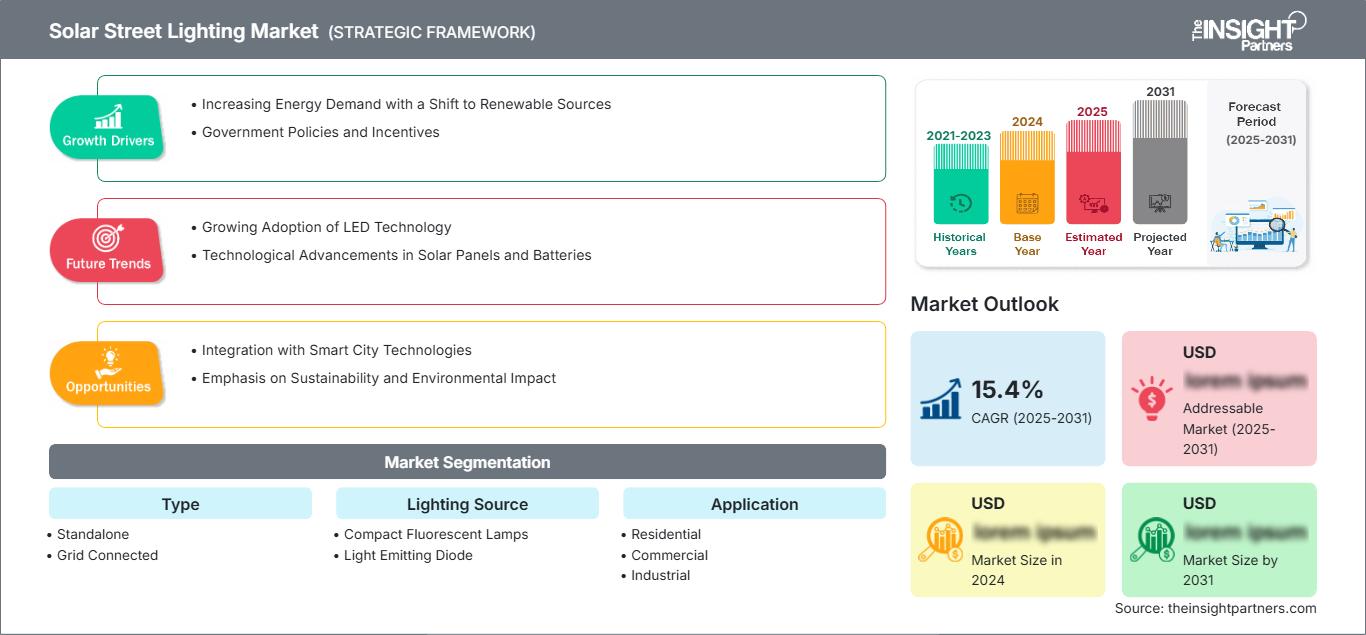
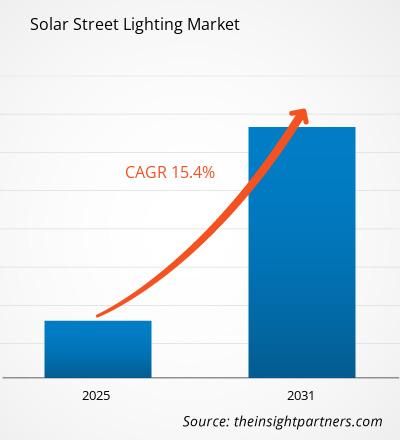
The Solar Street Lighting Market was valued at US$ 10.2 Billion in 2025 and is projected to reach US$ 41.48 Billion by 2034, expanding at a CAGR of 16.87% during 2026–2034. The market includes standalone and grid-connected systems, compact fluorescent lamp and light emitting diode sources, and residential, commercial, and industrial applications. Expansion reflects the convergence of decentralized solar generation, efficient illumination, and public-infrastructure modernization.
Across North America, revenue is expected to advance at an estimated ~15% CAGR through 2034 as municipalities modernize road lighting and developers seek lower-cost electrification for parking areas, campuses, and peripheral roads. The Solar Street Lighting Market size is supported by federal and local clean-infrastructure programs, resilient off-grid designs, and procurement models that evaluate lifetime energy and trenching costs rather than fixture price alone.
Solar Street Lighting Market Assessment and Insights
Regional Outlook
- North America: ~28% of the global Solar Street Lighting Market share in 2025 | ~15% CAGR through 2034. Market position: The region ranks second, supported by municipal retrofit budgets, resilient infrastructure priorities, established lighting contractors, and demand for autonomous systems at roadsides, campuses, and parking facilities.
- US: ~82% of North American market revenue in 2025 | ~15% CAGR through 2034. Market position: The US leads North America through broad municipal purchasing, domestic product engineering, smart-city pilots, and commercial demand for lighting where trenching or utility connections are costly.
- Europe: ~24% of the global market in 2025 | ~14% CAGR through 2034. Market position: Mature public-lighting networks favor replacement-led demand, while France leads regional adoption and Germany, the UK, Italy, and Spain sustain procurement through energy-efficiency and light-pollution requirements.
- Asia Pacific: ~35% of the global market in 2025 | ~19% CAGR through 2034. Market position: Asia Pacific is the largest and fastest-growing region as China, India, Japan, South Korea, and Australia combine local manufacturing, urban expansion, rural access programs, and solar-supportive policy.
Segment Outlook
- Type: ~46% Share in 2025 | ~17% CAGR through 2034. Market position: Type is the largest main segment because system architecture captures the full value of poles, modules, batteries, controllers, luminaires, and installation, with standalone configurations dominating remote deployments.
- Lighting Source: ~29% Share in 2025 | ~19% CAGR through 2034. Market position: Lighting Source has the highest growth outlook as efficient LEDs displace compact fluorescent lamps, enable smaller batteries and panels, and support adaptive controls.
Competitive Coverage
Signify Holding, Sunna Design SA, Fonroche Lighting, Leadsun Global Pty Ltd, SEPCO Solar Electric Power Company, Solar Street Lights USA, Greenshine New Energy LLC, Sol Inc., SOKOYO Solar Lighting Co., Ltd., and Solar Lighting International, Inc.
Methodology
The Insight Partners follows Data Collection & Secondary Research, Primary Research, Data Analysis, and Data Triangulation & Final Review to validate market estimates and insights.
Source: The Insight Partners' analysis based on proprietary research, government publications, company annual reports, investor presentations, industry databases, and expert interviews.
From inefficient systems to highly efficient LED-integrated products with lithium batteries, maximum power point tracking and optics tailored for specific applications, solar-powered streetlights have evolved. The manufacturing process has also been transformed to adopt modularity to facilitate easier installation and replacement, while also making it possible to source panels, cells, poles and electronics from distinct ecosystems. Increased standardization of components has minimized integration risk; however, battery quality, thermal management and appropriate autonomy sizing continue to differentiate reliable solar lighting systems from cheap alternatives.
For the years leading up to 2034, growth in the sector will be facilitated by secondary cities, suburban regions, industrial estates and communities whose grid connection is too expensive. Finance through development funds, climate resilience budgets and performance based contracts will help increase the target market base. Standards for illumination of roadways, glare control, longevity of products and battery management will also favor manufacturers who can provide photometric information, lifecycle costing and after-sales service.
Solar Street Lighting Market Report Scope
| Report Attribute | Details |
|---|---|
| Market size in 2025 | US$ 10.2 Billion |
| Market Size by 2034 | US$ 41.48 Billion |
| Global CAGR (2026 - 2034) | 16.87% |
| Historical Data | 2021-2024 |
| Forecast period | 2026-2034 |
Solar Street Lighting Market Analysis
Solar Street Lighting Market development is aided by savings from trenching, cabling, metering, and the ongoing purchase of electricity. There is demand from municipalities, road agencies, residential property developers, commercial property developers, and industrial property developers. The value chain includes PV/cell suppliers, battery pack assemblers, controller suppliers, luminaire suppliers, pole suppliers, engineering contractors, distributors, and maintainers. Quality procurement depends on the alignment of the PV yield, battery autonomy, mounting height, road type, and nighttime dimming schedule.
The supply base is diverse geographically, although electronic controls, lithium batteries, and photovoltaics are still subject to price volatility and trade policy. Companies which certify alternative components without sacrificing luminaire performance have protection against delays. In-house pole manufacturing and installation services cut freight costs, and remote monitoring reduces service calls.
The market for solar street lights is characterized by a fragmented competition, which includes players from both global lighting companies and companies specializing in autonomous lighting systems. The Signify Holding competes by offering connectivity and extensive channels, whereas Sunna Design SA and Fonroche Lighting focus on engineering autonomy and international project delivery. The companies Leadsun Global Pty Ltd, SEPCO Solar Electric Power Company, Solar Street Lights USA, Greenshine New Energy LLC, Sol Inc., SOKOYO Solar Lighting Co., Ltd., and Solar Lighting International, Inc. are competing on configurability, regional reach, and experience in projects.
Investments are being made in modular cabinets, lithium iron phosphate batteries, predictive energy management systems, and monitoring systems for the fleet as well. As far as strategic positioning goes, reliability of component life span, warranties, ability to deliver services, and finance are very important aspects. Those companies who will be able to integrate technical sizing with sourcing will be able to maintain their profit margins, while the rest will suffer from pricing pressure and warranty risk.
● REPORT CUSTOMIZATION
Tailor This Report To Align With Your Specific Business Requirements
This report can be customized to align precisely with your business objectives, scope, and target markets. Customization options include tailored segmentation, geography, competitive analysis, and strategic insights to support informed decision-making.
Customize This Report →WHAT YOU CAN ADJUST
- ● Segmentations
- ● Geography
- ● Competitive Analysis
- ● Language Preferences
Solar Street Lighting Market: Strategic Insights
Regional Insights
North America Solar Street Lighting Market
North America is projected to expand at ~15% CAGR through 2034. Municipalities are now assessing solar-powered fixtures due to the savings gained by not needing to trench, wire underground and make utility connections in their overall economic benefit. Resilience planning promotes self-reliant street lighting at evacuation points, park spaces, transit stops and isolated public utilities. Commercial developments also rely on solar-powered lighting for parking spaces and pathways without expanding the site’s electricity network.
Regional purchases now lean towards luminaires that have been certified, photometry data, robust battery system, and remote asset management technology. The Solar Street Lighting Market share in North America is due to the existing contractor relationships and valuable connected lighting, but development in this region is tempered by extensive grid infrastructures. Canada helps with remote and cold environments applications, whereas Mexico can help with growing regions close to industrial areas.
U.S. Solar Street Lighting Market
The US accounts for ~82% of North American revenue in 2025 and is forecast to grow at ~15% CAGR through 2034. Positioning is dependent upon capital programs in municipalities, a wide range of existing outdoor lighting installations, diverse solar availability, and need for assets that are resilient. Different specifications are called for by residential subdivisions, commercial campus facilities, logistics centers, parks, and roadside safety initiatives.
Signify Holding, SEPCO Solar Electric Power Company, Solar Street Lights USA, Greenshine New Energy LLC, Sol Inc., and Solar Lighting International, Inc. are examples of firms that are significant in the market or through distribution channels. Customers are becoming more demanding about motion detection, dimming controls, optics with sky-friendly design, and dashboard-based alerts for faults.
Europe Solar Street Lighting Market
Europe represented ~24% of global revenue in 2025 and is expected to register ~14% CAGR through 2034. Grid-connected public lighting infrastructure is advanced here, and therefore there is demand for selective replacement, new corridors, parks, bicycle paths, and areas where civil works are disruptive. Price sensitivity of the energy, carbon mitigation initiatives, and stricter control of glare and uplight contribute to efficiency and precise design of the systems.
France is the leading country in Europe due to the presence of the domestic firms such as Sunna Design SA and Fonroche Lighting, municipal refurbishment needs, and the light pollution regulation. Engineering requirements and lifecycle performance are important in Germany. In the UK, applications cover housing, pathways, and transport-related areas, whereas Italy and Spain have advantages of sunny climate and municipal decarbonization policies.
The competition gives points for the ability of winter autonomy, recyclability/repeatability of parts, and connectivity to the management system. Hybrid systems may solve the problem of the irradiance limitations in the winter season through the use of solar power and grid electricity in the low-generation periods.
APAC Solar Street Lighting Market
Asia Pacific held ~35% of global revenue in 2025 and is forecast to advance at ~19% CAGR, making it the largest and fastest-growing region through 2034. China is the leading country in Asia Pacific because of its photovoltaic, battery, LED, and electronics manufacturing depth. India adds demand from rural roads, urban missions, and industrial development.
Japan and South Korea emphasize high-quality electronics and smart controls, while Australia uses autonomous lighting across remote roads, communities, and resource sites. Local manufacturing lowers equipment cost, and public infrastructure programs widen deployment. Buyers nevertheless place increasing weight on battery safety, weather resistance, and verified output to manage quality differences across a broad supplier base.
Middle East & Africa Solar Street Lighting Market
Middle East & Africa is projected to expand at ~18% CAGR through 2034. High solar availability, dispersed settlements, grid constraints, and new transport infrastructure create a strong functional case for autonomous lighting. Saudi Arabia is the leading country in the Middle East & Africa where large infrastructure programs and renewable-energy ambitions support specification activity.
The UAE emphasizes premium connected systems for roads and developments, while South Africa combines municipal demand with resilience against electricity-supply disruption. Across the rest of MEA, development-funded projects can improve road safety and evening economic activity without costly grid extension. Dust, heat, theft exposure, and maintenance access make robust enclosures, secure batteries, and local service partners decisive.
Segmentation Analysis
Type
Type is projected to expand at ~17% CAGR during 2026–2034. The Solar Street Lighting Market scope covers standalone and grid-connected architectures, allowing buyers to match infrastructure availability and reliability requirements. System choices affect battery capacity, control logic, installation cost, and resilience. Standalone products dominate sites without economical cabling, whereas grid-connected designs suit cities seeking renewable contribution with backup continuity.
- Standalone: Standalone systems lead demand in remote roads, rural settlements, parks, and new developments because they avoid trenching and utility interconnection. Their strategic importance rises where rapid installation and energy independence outweigh higher battery capacity requirements.
- Grid Connected: Grid-connected systems serve urban corridors and high-service-level applications that require continuous illumination during low-solar periods. Hybrid operation can reduce electricity consumption while preserving reliability, making the format relevant to phased municipal modernization.
Lighting Source
Lighting Source is forecast to grow at ~19% CAGR during 2026–2034. Technology substitution drives this main segment as luminous efficacy, optical control, thermal performance, and controllability determine system sizing. Efficient light sources reduce nightly energy draw, enabling smaller photovoltaic modules and batteries. The transition also supports adaptive dimming, motion sensing, diagnostics, and longer maintenance cycles.
- Compact Fluorescent Lamps: Compact fluorescent lamps retain a limited replacement role in legacy installations, but lower controllability, shorter service life, and weaker cold-start and cycling performance constrain new adoption. Suppliers mainly address installed-base maintenance and price-sensitive requirements.
- Light Emitting Diode: Light emitting diode systems are the prevailing technology because high efficacy, directional optics, instant switching, and dimming compatibility improve autonomy and illumination quality. LEDs are central to integrated products, smart controls, and lifecycle-cost-focused tenders.
Application
Application is expected to register ~17% CAGR during 2026–2034. Demand varies by ownership, operating hours, lighting class, security need, and financing route. Public residential streets favor broad rollout and standardized designs; commercial sites value avoided civil works and visible sustainability; industrial locations prioritize reliability, perimeter security, and deployability across large or remote premises.
- Residential: Residential demand centers on neighborhood roads, footpaths, community spaces, and peri-urban expansion. Standardized poles and dusk-to-dawn operation support portfolio deployment, while low operating cost appeals to municipalities and developers managing long-term common infrastructure.
- Commercial: Commercial installations cover parking areas, campuses, retail approaches, hospitality sites, and mixed-use developments. Buyers prioritize fast deployment, appearance, controls, and lower site disruption, giving integrated solar units a clear role in retrofit and greenfield projects.
- Industrial: Industrial use includes logistics yards, factories, mines, warehouses, and utility sites. Autonomous lighting supports perimeter visibility and worker movement where cabling is expensive or vulnerable, while remote monitoring helps operators manage dispersed assets and maintenance schedules.
Opportunity Snapshot
| Application | Revenue Contribution | Trend Tag | Adoption Stage |
| Residential | High | Community Roads | Scaling |
| Commercial | High | Parking Autonomy | Scaling |
| Industrial | Medium | Remote Perimeters | Emerging |
Solar Street Lighting Market Growth Drivers and Impact Analysis
Avoided Grid Extension and Civil-Works Costs
Solar powered street lighting reduces many of the digging, cabling, switch gear, and connecting processes needed in traditional systems. This benefit is particularly true for new streets, remote areas, parking lots, and landscaping where excavation is costly or disruptive. Reduced installation time decreases schedule lengths and can maintain traffic movement, vegetation, and pavement. Therefore, for the user, the economic evaluation must go beyond electrical cost savings and incorporate savings in construction, permitting, and reconstruction costs. The effect results in more suitable locations for street lighting and increased reliability when there are grid failures. Manufacturers that can take these factors into account during bid preparation increase their chances of winning tenders and reduce the chance of price comparison.
Public-Safety and Rural-Access Investment
Lighting is used by road authorities and municipalities to enhance visibility, mobility, and accessibility at night to public services. The autonomous lighting system will be more applicable in villages, secondary roads, bus stations, and informal urban outskirts, in which the expansion of the distribution network may be slower than settlement expansion. Development agencies and procurement mechanisms involving the private sector can bundle a large number of small projects into financially viable programs. Market effects manifest themselves in larger bids, technical specifications, and local production or maintenance needs. Vendors have to demonstrate that their lighting systems are still fit in local climatic and traffic conditions.
LED, Battery, and Controller Efficiency Gains
LED efficacy decreases the energy demand for producing a certain light level, whereas power electronics and lithium batteries contribute to greater utilization of the electricity during each night hour. All these advantages enable reduction of the size of the module or increase its autonomy when compared with other modules of the same size. Moreover, adaptive dimming and motion sensing help to synchronize the energy consumption with traffic on the roads, which allows for maintaining enough energy storage for nights with low solar activity. This technological development positively affects the efficiency of the product in cold, cloudy or hot climatic conditions. But the specifications of components should be considered together: inadequate batteries or exaggerated luminaires can negate all these benefits.
Solar Street Lighting Market Future Trends
Fleet Intelligence and Predictive Maintenance
Solar Street Lighting Market trends will increasingly center on connected controllers that report battery state, solar generation, luminaire performance, and fault conditions to fleet dashboards. Operators will use these data to distinguish component failure from seasonal energy shortfalls and schedule maintenance before service deteriorates. Open interfaces may become more important as cities avoid dependence on a single vendor across long asset lives. The shift will also alter supplier economics by adding software, commissioning, and service revenue to hardware sales. Cybersecurity, communications coverage, and data ownership will remain procurement considerations, particularly when lighting nodes share networks with environmental or mobility sensors.
Circular, Modular, and Climate-Specific Design
Future products will be designed around replaceable batteries, upgradeable controllers, recyclable housings, and region-specific energy sizing rather than sealed, one-size-fits-all assemblies. Modular construction can extend asset life and reduce waste, but it requires clear interfaces and long-term component availability. Climate-specific variants will address heat, cold, dust, cyclones, salt exposure, and prolonged cloud cover through chemistry selection, enclosure engineering, and mounting design. Procurement is likely to place greater weight on repairability, embodied carbon, and documented performance degradation. This favors suppliers that maintain configuration control and lifecycle records, while challenging low-cost sellers whose products lack parts continuity or transparent warranties.
Solar Street Lighting Market Opportunities
Performance-Based Municipal Portfolios
Municipalities can aggregate dispersed sites into portfolio contracts covering design, installation, monitoring, and multiyear service. This structure creates an opportunity for vendors, energy-service companies, and infrastructure investors to compete on verified lighting availability and lifecycle cost. Solar Street Lighting Market Forecasts support capacity planning, but bankability will depend on standardized audits, clear performance baselines, and enforceable maintenance responsibilities. Providers should build financing partnerships, establish regional spare-parts hubs, and offer dashboards that document uptime and battery health. Portfolio packaging can reduce transaction costs for smaller authorities while generating recurring service revenue and stronger customer retention for qualified suppliers.
Industrial Corridors and Off-Grid Commercial Sites
Logistics parks, mines, warehouses, utility compounds, and roadside commercial developments offer scalable demand outside municipal budgets. Many such sites have large perimeters, staged buildouts, or remote sections where conventional cabling raises both capital cost and theft exposure. Suppliers can address this opportunity with high-output luminaires, robust poles, tamper-resistant battery placement, and integration with security operations. Channel partnerships with engineering contractors and facility-management companies can shorten sales cycles. Successful offers should quantify avoided excavation and electricity use, provide site-specific autonomy calculations, and align service coverage with the operational criticality of each location rather than selling standardized wattage claims.
Recent Developments
- June 2026: Energy Efficiency Services Limited (EESL) initiated a smart LED street-lighting project across urban local bodies in Andhra Pradesh, covering the design, supply, installation, commissioning, and monitoring of connected LED streetlights. The project includes a comprehensive seven-year warranty and aims to modernize public lighting infrastructure and improve energy efficiency.
- 2026: India solar street-light deployment continued to expand in India, supported by demand for energy-efficient and smart lighting solutions. The trend is being reinforced by public infrastructure modernization and growing adoption of connected street-lighting systems.
- September 2025: Signify strengthened its professional lighting portfolio by introducing a range of Signify-branded products, expanding its offering for professional lighting applications. The move supports the company’s broader portfolio strategy across connected, energy-efficient, and professional lighting solutions.
Frequently Asked Questions

- Comprehensive Market Sizing and Forecast Analysis
- Detailed Segmentation Analysis
- In-Depth Market Dynamics Assessment
- Regional and Country-Level Insights
- Competitive Landscape and Company Benchmarking
- Strategic Business Intelligence
Recent Reports
Testimonials

The Insight Partners provided valuable market intelligence that supported our global go-to-market strategy. Their team was professional, responsive, and attentive to our feedback, providing thoughtful analysis and helpful methodological clarifications throughout the project.
Junmo Kim Chief Financial Officer (CFO), Enertech Co., Ltd.
The Insight Partners' SCADA System Market report is comprehensive, with valuable insights on current trends and future forecasts. The team was highly professional, responsive, and supportive throughout. We are very satisfied and highly recommend their services.
RAN KEDEM Partner, Reali Technologies LTDs
I requested a report on a very specific software market and the team produced the report in a few days. The information was very relevant and well presented. I then requested some changes and additions to the report. The team was again very responsive and I got the final report in less than a week.
JEAN-HERVE JENN Chairman, Future Analytica
We worked with The Insight Partners for an important market study and forecast. They gave us clear insights into opportunities and risks, which helped shape our plans. Their research was easy to use and based on solid data. It helped us make smart, confident decisions. We highly recommend them.
PIYUSH NAGPAL Sr. Vice President, High Beam Global
The Insight Partners delivered insightful, well-structured market research with strong domain expertise. Their team was professional and responsive throughout. The user-friendly website made accessing industry reports seamless. We highly recommend them for reliable, high-quality research services
YUKIHIKO ADACHI CEO, Deep Blue, LLC.
This is the first time I have purchased a market report from The Insight Partners.While I was unsure at first, I visited their web site and felt more comfortable to take the risk and purchase a market report.I am completely satisfied with the quality of the report and customer service. I had several questions and comments with the initial report, but after a couple of dialogs over email with their analyst I believe I have a report that I can use as input to our strategic planning process.Thank you so much for taking the extra time and making this a positive experience.I will definitely recommend your service to others and you will be my first call when we need further market data.
JOHN SUZUKI President and Chief Executive Officer, Board Director, BK Technologies
I wish to appreciate your support and the professionalism you displayed in the course of attending to my request for information regarding to infectious disease IVD market in Nigeria. I appreciate your patience, your guidance, and the fact that you were willing to offer a discount, which eventually made it possible for us to close a deal. I look forward to engaging The Insight Partners in the future, all thanks to the impression you have created in me as a result of this first encounter.
DR CHIJIOKE ONYIA MANAGING DIRECTOR, PineCrest Healthcare Ltd.Reason to Buy
- Informed Decision-Making
- Understanding Market Dynamics
- Competitive Analysis
- Identifying Emerging Markets
- Customer Insights
- Market Forecasts
- Risk Mitigation
- Boosting Operational Efficiency
- Strategic Planning
- Investment Justification
- Tracking Industry Innovations
- Aligning with Regulatory Trends





 Get Free Sample for