
Stereo Earphones Market Demand, Trends & Forecast by 2034
Coverage: By Product Type (On-Ear, Over-Ear, Earbuds and In-Ear); Application (Smartphones, Computers, Music Players, Other) , and Geography (North America, Europe, Asia Pacific, and South and Central America)
- Status : Data Released
- Report Code : TIPRE00017941
- Category : Electronics and Semiconductor
- No. of Pages : 150
- Available Report Formats :


- Last update date : October 16, 2026


2025 Market Size
US$ 4,437.7 Mn
Base year value
2034 Forecast
US$ 5,209.94 Mn
Projected by 2034
CAGR 2026-2034
1.80 %
Growth rate
Addressable Market
US$ 43,711.93 Mn
(2026-2034)
The Stereo Earphones Market was valued at US$ 4,437.7 Million in 2025 and is projected to reach US$ 5,209.94 Million by 2034, registering a CAGR of 1.80% from 2026 to 2034. The market covers consumer audio products designed for stereo sound reproduction across on-ear, over-ear, earbud, and in-ear formats. Demand is shaped by smartphone adoption, personal entertainment consumption, replacement cycles, audio quality expectations, and continued product innovation across wired and wireless listening formats.
North America remains a mature personal-audio market supported by high consumer electronics spending, established retail networks, premium audio adoption, and frequent device replacement. The Stereo Earphones Market size is also influenced by demand for noise cancellation, improved microphones, spatial audio, low-latency connectivity, and comfortable designs. The region is expected to expand at approximately ~1% CAGR through 2034, with replacement demand and premiumization partially offsetting slower first-time adoption.
Stereo Earphones Market Assessment and Insights
Regional Outlook
- North America: ~32% of the global Stereo Earphones Market share in 2025 | ~1% CAGR through 2034. Market position: North America represents the largest regional revenue base, supported by mature consumer electronics infrastructure, strong premium audio demand, established online channels, and broad adoption of smartphones and connected personal devices.
- US: ~84% of North American market revenue in 2025 | ~1% CAGR through 2034. Market position: The US accounts for most North American demand, with extensive smartphone ownership, premium consumer-audio spending, strong brand availability, and applications spanning mobile entertainment, computing, gaming, and professional listening.
- Europe: ~27% of the global market in 2025 | ~1% CAGR through 2034. Market position: Europe is a mature replacement-driven market. Germany represents the leading country in Europe, supported by its large consumer electronics base, while the UK, France, Italy, and Spain contribute through established retail and digital commerce channels.
- Asia Pacific: ~31% of the global market in 2025 | ~3% CAGR through 2034. Market position: Asia Pacific is the fastest-growing region, supported by large smartphone user populations, expanding middle-income consumption, local electronics manufacturing, competitive pricing, and accelerating adoption of feature-rich earbuds across China, Japan, South Korea, India, and Australia.
Segment Outlook
- Smartphones: ~60% Share in 2025 | ~2% CAGR through 2034. Market position: Smartphone compatibility represents the broadest application base because personal audio is closely integrated with mobile communication, streaming, gaming, social media, navigation, and voice-assistant use. Replacement of smartphones and accompanying accessories sustains recurring demand.
- Earbuds: ~42% Share in 2025 | ~3% CAGR through 2034. Market position: Earbuds represent the high-growth product format because compact form factors, wireless connectivity, active noise cancellation, improved battery performance, and increasingly sophisticated software features are expanding their relevance for commuting, exercise, communication, and entertainment.
Competitive Coverage
AIAIAI ApS, AKG Acoustics GmbH, Apple Inc., Audio-Technica Corporation, beyerdynamic GmbH and Co. KG, Bose Corporation, Creative Technology Ltd, Denon Electronics, Sony Corporation, Sennheiser Electronic GmbH and Co. KG
Methodology
The Insight Partners follows Data Collection & Secondary Research, Primary Research, Data Analysis, and Data Triangulation & Final Review to validate market estimates and insights.
Source: The Insight Partners' analysis based on proprietary research, government publications, company annual reports, investor presentations, industry databases, and expert interviews.
There have been changes from wired listeners to smaller wireless and hybrid devices, though wired solutions are preferred by people who prefer simple devices with reliable performance, reduced latency, and compatibility. The demands for Stereo Earphones Market have consequently centered around Bluetooth connectivity, digital signal processing, active noise cancellation, spatial audio, voice pickup, battery optimization, and better ergonomics. In addition, there has been a trend towards differentiating products not only in terms of hardware but software that enables personalization of the devices. Manufacturing ecosystems for the products have become more global with sourcing and assembly being focused on electronics manufacturing centers in Asia.
For the period up to 2034, the market will see steady growth with different product formats moving in different directions. There may be growth in the emerging Asia Pacific market, especially India and Southeast Asia due to replacement cycle development. Premium markets will see growth via upgrades in features, while the developing markets will remain sensitive to price and battery performance.
Stereo Earphones Market Report Scope
| Report Attribute | Details |
|---|---|
| Market size in 2025 | US$ 4,437.7 Million |
| Market Size by 2034 | US$ 5,209.94 Million |
| Global CAGR (2026 - 2034) | 1.80% |
| Historical Data | 2021-2024 |
| Forecast period | 2026-2034 |
Stereo Earphones Market Analysis
The demand for earbuds is linked to the broader ecosystem of personal devices. The smartphones have the biggest market for applications. Computers are used for work, gaming, educational purposes and entertainment. The music player is a smaller application as its dedicated device use has declined, however, specialist consumers and professionals still generate demand. All along the value chain, there are suppliers of acoustic drivers, microphones, batteries, Bluetooth chipsets, processors, plastic materials, metal and packaging for original equipment manufactures and branded audio manufacturers.
The supply side features the vertical integration of technology companies, specialist audio manufacturers and contract manufactures. Availability of components, acoustic engineering skills, design and distribution capabilities define the positioning of the products. Replacement cycles are particularly crucial since consumers tend to replace devices as they offer improvement in such technologies like ANC, spatial audio, battery life, connectivity and comfort.
The Stereo Earphones Market report shows that intense competition is evident in both premium and mass levels of pricing. Apple Inc., Sony Corporation, Bose Corporation, Sennheiser Electronic GmbH and Co. KG, Audio-Technica Corporation, beyerdynamic GmbH and Co. KG, and AKG Acoustics GmbH compete based on their brand equity, acoustic quality, industrial design, and technological innovation. Creative Technology Ltd and Denon Electronics focus on specialty and consumer market segments, whereas AIAIAI ApS focuses on modularity and creators’ products. Competition now is more about ecosystems, software functionalities, and product cycles.
As such, investment needs to shift towards small components, acoustic engineering, battery life, microphone engineering, connectivity engineering, and software engineering for personalized experience. Firms that are able to do this in combination with effective production and distribution have the opportunity to compete on all price segments without focusing only on premium prices.
● REPORT CUSTOMIZATION
Tailor This Report To Align With Your Specific Business Requirements
This report can be customized to align precisely with your business objectives, scope, and target markets. Customization options include tailored segmentation, geography, competitive analysis, and strategic insights to support informed decision-making.
Customize This Report →WHAT YOU CAN ADJUST
- ● Segmentations
- ● Geography
- ● Competitive Analysis
- ● Language Preferences
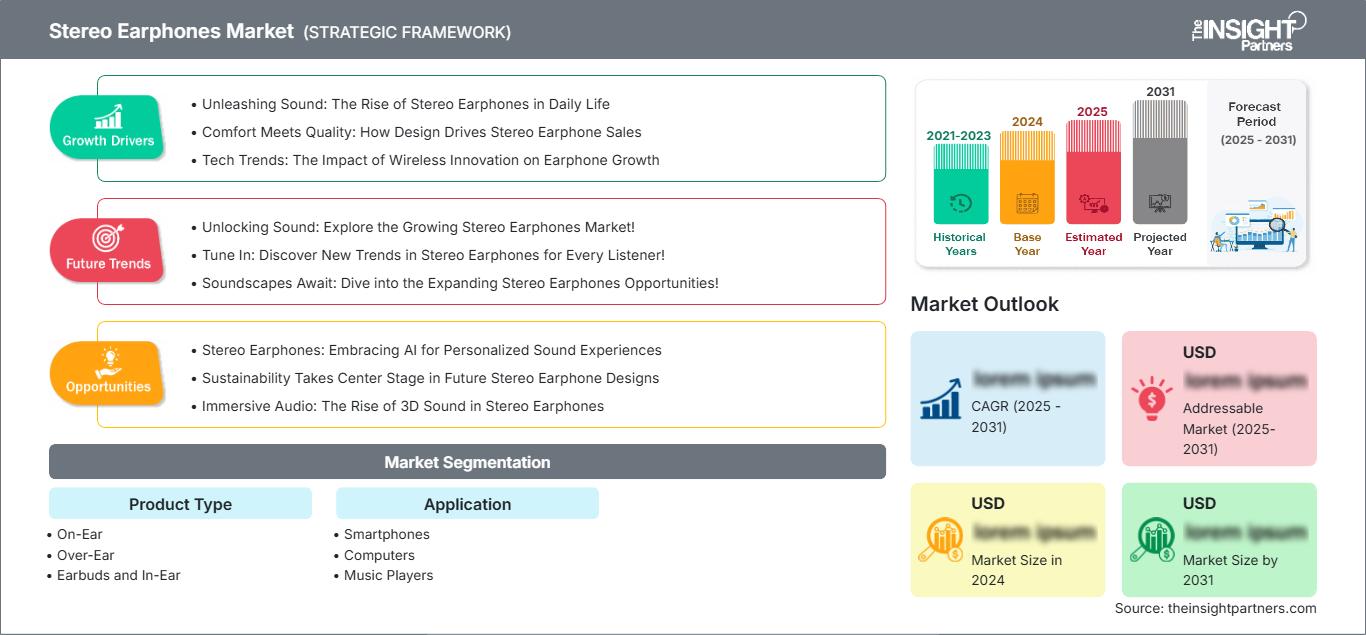
Stereo Earphones Market: Strategic Insights
Regional Insights
North America Stereo Earphones Market
The Stereo Earphones Market forecast shows that North America accounted for ~32% of global revenue in 2025 and is projected to expand at approximately ~1% CAGR through 2034. The area enjoys high levels of penetration of ownership in consumer electronics, online retailing, premium audio content consumption, and connections between smartphones, computers, streaming media, and personal audio products. Demand is driven by replacement sales and improvements in functionality instead of new adoptions.
The US accounts for about ~84% of North American revenue. The large base of consumers drives demand in premium headphones, daily-use earbuds, game audio, and computer-based listening. Canada makes up a smaller but already-established market due to high penetration of electronics in households. Growth in the region is hampered by maturity, though ANC, spatial audio, voice capabilities, comfort, and battery technology might drive replacements.
U.S. Stereo Earphones Market
The US represented ~84% of North American revenue in 2025 and is expected to grow at approximately ~1% CAGR through 2034. The market features a high level of premium and mass-market offerings, wide availability through e-commerce, well-established specialist audio retailers, and high integration between personal audio devices and mobile computing. The smartphones’ user base continues to be the key source of demand, while the computers are generating supplementary demand due to telecommuting, gaming, education, and content creation.
Some of the significant global brands are represented in the market with a great degree of market coverage. These brands include such companies as Apple Inc., Bose Corporation, Sony Corporation, Sennheiser Electronic GmbH and Co. KG, Audio-Technica Corporation, and beyerdynamic GmbH and Co. KG. Product differentiation is shifting towards comfort, ANC, microphone quality, spatial audio, multipoint capabilities, and ecosystem support.
Europe Stereo Earphones Market
Europe represented ~27% of global revenue in 2025 and is projected to expand at approximately ~1% CAGR through 2034. The region has an established consumer-audio ecosystem with brand presence, infrastructure, smartphone prevalence, and specialist audio distribution. Product purchases have become increasingly linked to the need for replacement, premiumization, portability, and enhanced listening experience rather than simple adoption.
Germany leads in Europe due to its large market size for consumer electronics, as well as its audio industry. The UK offers a combination of a developed online commerce platform together with the demand for premium and lifestyle audio products. France provides a wide consumer base with existing retail and specialist channels. Italy and Spain contribute further demand through mobile entertainment, travel, and consumer electronics replacement. Sustainability considerations, durability of products, potential repairs, and evolving electronics needs may impact product development and sourcing decisions throughout Europe.
In the region, the competitive landscape involves both international technology players and specialist audio manufacturing. While premium products can ensure revenues through acoustic innovation and customization, mass market products will continue facing price competition. Therefore, companies need to find a balance between development of features and product longevity/distribution efficiency.
APAC Stereo Earphones Market
APAC represented ~31% of global revenue in 2025 and is expected to record approximately ~3% CAGR through 2034, making it the fastest-growing region. China is the leading country in Asia Pacific because of its large consumer electronics ecosystem, extensive manufacturing capabilities, and substantial domestic demand. Japan and South Korea provide mature premium audio markets, while India represents an important expansion opportunity because of its large smartphone base and developing personal-audio replacement cycle.
India, China, Japan, South Korea, and Australia differ substantially in price sensitivity, channel structure, and product preferences. Competitive pricing, local assembly, online retail, and feature upgrades support demand across developing markets, while premium consumers increasingly seek ANC, spatial audio, and personalized listening. Regional manufacturing capabilities also support faster product launches and broader availability.
Middle East & Africa Stereo Earphones Market
Middle East & Africa is projected to expand at approximately ~2% CAGR through 2034. Saudi Arabia and the UAE provide important demand centers because of comparatively strong consumer purchasing power, high smartphone use, modern retail infrastructure, and concentrated urban populations. South Africa represents a significant market in the region, supported by established electronics distribution and consumer-audio demand.
The region remains more heterogeneous than North America, Europe, or APAC. Imported products, currency conditions, retail availability, and price positioning influence market development. Premium models are concentrated in higher-income urban markets, while affordable earbuds and wired products provide broader accessibility. Infrastructure investment and digital consumption can support gradual category expansion.
Segmentation Analysis
Product Type
Product Type is expected to expand at approximately ~2% CAGR through 2034 as consumers move between traditional headphone designs and compact personal-audio formats. Product selection is influenced by comfort, portability, acoustic performance, use environment, connectivity requirements, and willingness to pay for advanced features.
- On-Ear: On-ear products remain relevant for consumers seeking lightweight designs with a more open wearing experience than full-size headphones. Demand is supported by portability, casual listening, and applications where users prefer a visible and easily accessible headphone structure.
- Over-Ear: Over-ear products retain importance in premium listening, gaming, professional monitoring, travel, and noise-isolation applications. Their larger acoustic chambers support differentiated sound profiles and feature integration, although their size can limit portability compared with earbuds and in-ear formats.
- Earbuds: Earbuds are gaining strategic importance because compact designs combine portability with wireless connectivity and increasingly advanced audio functions. ANC, spatial audio, voice processing, fitness use, and improved charging systems support adoption across commuting, exercise, communication, and everyday entertainment.
- In-Ear: In-ear products serve consumers seeking secure fit, passive isolation, compactness, and direct acoustic delivery. They remain relevant across wired and wireless formats, with demand spanning smartphones, computers, professional audio, and portable entertainment.
Application
Application is expected to expand at approximately ~2% CAGR through 2034, with smartphones retaining the broadest addressable base. Personal audio is increasingly integrated into communication, streaming, gaming, social media, navigation, and voice-assistant activities.
- Smartphones: Smartphones represent the principal application because earphones extend mobile devices into private listening, calling, streaming, gaming, and hands-free communication. Wireless pairing and ecosystem integration further reinforce recurring accessory demand as consumers replace or upgrade connected devices.
- Computers: Computers support demand for stereo earphones across office communication, remote collaboration, gaming, online education, content creation, and multimedia consumption. Microphone quality, low latency, comfort, and multipoint connectivity are particularly relevant to this application.
- Music Players: Dedicated music players constitute a smaller application base but retain relevance among audiophiles, professional listeners, and consumers seeking specialized playback. Demand emphasizes sound quality, impedance compatibility, wired connectivity, and acoustic tuning.
Opportunity Snapshot
Market Opportunity Snapshot
| Application | Revenue Contribution | Trend Tag | Adoption Stage |
| Smartphones | High | Mobile Streaming | Mature |
| Computers | Medium | Hybrid Work | Mature |
| Music Players | Low | Hi-Fi Listening | Mature |
Stereo Earphones Market Growth Drivers and Impact Analysis
Expansion of Connected Personal Audio Across Mobile Use Cases
The increasing involvement of smartphones and computers in various activities related to entertainment, communications, gaming, education, and office tasks will create sustained need for personal listening products. Earbuds now perform the task of being an interface for calls, media playing, voice assistants, video conferences, and applications as opposed to simply being used for music consumption. This will lead to the expansion of the occasions under which a consumer can have reasons to buy dedicated stereo audio products. The business implication is especially true in the case of developing nations where the use of smartphones will provide the initial addressable market, after which replacement and feature enhancement of devices will boost the product category’s demand. This can be leveraged through designing products that work well on multiple operating systems and device categories.
Premium Audio Features Encourage Replacement and Upgrade Purchases
The evolution of advanced audio capabilities will influence substitution behavior in mature markets. Consumers who have already purchased functioning earphones may choose to upgrade them, given that new models offer superior capabilities in active noise cancellation, spatial audio, call quality, battery life, ergonomics, or software capabilities. This adds a second level of demand aside from first purchase, making the refresh cycle an important part of the market dynamic. Moreover, premium capabilities enable manufacturers to distinguish between products in categories where wireless capabilities have been increasingly commoditized. The effect is strongest where technological advances are evident in the daily usage experience of consumers, for instance, in the form of clearer calls in noisy settings or better performance during travel and exercise activities. Hence, companies can preserve their revenues by developing both their hardware and software as well as offering additional ecosystem services. The premiumization process, however, faces limitations from the price sensitivity of consumers.
Manufacturing Scale and Competitive Pricing Broaden Category Accessibility
Large electronics manufacturing ecosystems have reduced the cost of components and enabled increasingly capable products at accessible price points. Competitive sourcing of Bluetooth chipsets, batteries, microphones, acoustic drivers, and miniaturized electronics allows brands to introduce features that were previously associated with premium products into lower-priced models. This expands the addressable consumer base while increasing competitive pressure across established brands. Manufacturing scale is particularly relevant in Asia Pacific, where local production, assembly, supplier density, and online retail can shorten product cycles and improve price competitiveness. For international companies, the ability to combine global brand positioning with efficient sourcing can determine whether advanced features translate into profitable volume. At the same time, intense price competition can compress margins, making supply-chain efficiency and differentiated software or acoustic performance increasingly important.
Stereo Earphones Market Future Trends
Open-Ear and Alternative Ergonomic Designs
The Stereo Earphones Market trends indicate that open-ear and alternative ergonomic formats are likely to gain greater visibility as consumers seek awareness of their surroundings without abandoning personal audio. The product concept creates opportunities for exercise, commuting, outdoor recreation, office use, and situations where users want environmental awareness. Advances in acoustic directionality, microphone processing, battery efficiency, and compact structural design can improve performance while retaining the fundamental open-ear experience. This trend also expands the competitive boundary beyond conventional in-ear and over-ear architectures. Manufacturers may increasingly position products around specific activities rather than generic listening, creating differentiated propositions for fitness, work, travel, and lifestyle applications. The broader implication for the market is that form-factor innovation can stimulate replacement demand even when conventional wireless audio adoption becomes mature.
Integration of AI-Assisted Audio and Health-Oriented Functions
Personal audio devices are increasingly becoming sensor-rich connected accessories. AI-assisted translation, voice interaction, adaptive sound processing, personalized audio profiles, and activity-related functions can increase the perceived value of earphones beyond sound reproduction. Health-oriented capabilities may also become more relevant where sensors and companion applications can provide useful information during exercise or daily activities. The development path depends on processing efficiency, battery consumption, privacy considerations, device compatibility, and user willingness to activate software services. Successful implementations are likely to emphasize practical benefits rather than adding features solely for differentiation. Over time, these capabilities could shift competition toward integrated hardware-software experiences and encourage consumers to replace older products when new functionality requires newer processing architectures.
Stereo Earphones Market Opportunities
Localized Product Portfolios for High-Growth Emerging Markets
Emerging markets provide opportunities for companies that can adapt product portfolios to local price points, retail structures, and consumer preferences. India and other Asia Pacific markets demonstrate the potential for affordable products to coexist with rapidly expanding premium feature adoption. Companies can address this environment through tiered portfolios covering entry-level wired products, affordable wireless earbuds, mid-range ANC devices, and premium audio products. Local assembly, regional sourcing, online distribution, and partnerships with major retailers can further improve competitiveness. Product localization should extend beyond pricing to include language support, local service infrastructure, warranty availability, and compatibility with commonly used smartphones. A differentiated regional strategy can therefore increase addressable demand while reducing dependence on mature markets where first-time adoption is already limited.
Specialized Audio Products for Professional and Lifestyle Applications
Specialized use cases provide an opportunity to reduce reliance on standardized mass-market products. Audio companies can develop differentiated solutions for DJs, creators, gamers, frequent travelers, fitness users, office professionals, and audiophiles, where specific performance requirements support stronger product differentiation. Low latency, acoustic accuracy, microphone performance, durability, modular construction, comfort, and ecosystem compatibility can each form the basis of specialized offerings. The opportunity also extends to accessories, replacement components, software, and personalized sound profiles. Companies with strong engineering capabilities can use specialist segments to test technologies before transferring selected features into mainstream products. This approach can create additional revenue streams while strengthening brand positioning in a market where basic wireless listening functions are increasingly standardized.
Recent Developments
- September 2026: Bose Corporation announced its Bose Noise Cancelling Wired Earbuds, marking the company's return to wired earbuds. The USB-C product combines wired simplicity with active noise cancellation, digital signal processing, lossless audio support, and microphone-based call functionality. Bose stated that the product is designed for compatible phones, tablets, and computers and does not require Bluetooth pairing or an internal rechargeable battery. The earbuds are scheduled to begin shipping in October 2026.
- September 2026: Apple Inc. introduced AirPods 5 with an open-ear design, active noise cancellation, updated acoustic architecture, Adaptive EQ, hands-free Siri access, and Live Translation capabilities. Apple stated that the new design provides substantially improved external-noise reduction compared with the previous generation while maintaining an open-ear listening configuration. The launch demonstrates continued expansion of feature-rich functionality into alternative earphone form factors.
- July 2026: AIAIAI ApS announced a collaboration with Oklou focused on the intersection of music creation, design, and physical audio products. The company also continued its broader strategy of combining its modular headphone platform with collaborations across music and creative culture. Its 2026 press activity reflects continued emphasis on differentiated design, creator-oriented positioning, and specialized headphone products.
Frequently Asked Questions

- Comprehensive Market Sizing and Forecast Analysis
- Detailed Segmentation Analysis
- In-Depth Market Dynamics Assessment
- Regional and Country-Level Insights
- Competitive Landscape and Company Benchmarking
- Strategic Business Intelligence
Recent Reports
Testimonials

The Insight Partners provided valuable market intelligence that supported our global go-to-market strategy. Their team was professional, responsive, and attentive to our feedback, providing thoughtful analysis and helpful methodological clarifications throughout the project.
Junmo Kim Chief Financial Officer (CFO), Enertech Co., Ltd.
The Insight Partners' SCADA System Market report is comprehensive, with valuable insights on current trends and future forecasts. The team was highly professional, responsive, and supportive throughout. We are very satisfied and highly recommend their services.
RAN KEDEM Partner, Reali Technologies LTDs
I requested a report on a very specific software market and the team produced the report in a few days. The information was very relevant and well presented. I then requested some changes and additions to the report. The team was again very responsive and I got the final report in less than a week.
JEAN-HERVE JENN Chairman, Future Analytica
We worked with The Insight Partners for an important market study and forecast. They gave us clear insights into opportunities and risks, which helped shape our plans. Their research was easy to use and based on solid data. It helped us make smart, confident decisions. We highly recommend them.
PIYUSH NAGPAL Sr. Vice President, High Beam Global
The Insight Partners delivered insightful, well-structured market research with strong domain expertise. Their team was professional and responsive throughout. The user-friendly website made accessing industry reports seamless. We highly recommend them for reliable, high-quality research services
YUKIHIKO ADACHI CEO, Deep Blue, LLC.
This is the first time I have purchased a market report from The Insight Partners.While I was unsure at first, I visited their web site and felt more comfortable to take the risk and purchase a market report.I am completely satisfied with the quality of the report and customer service. I had several questions and comments with the initial report, but after a couple of dialogs over email with their analyst I believe I have a report that I can use as input to our strategic planning process.Thank you so much for taking the extra time and making this a positive experience.I will definitely recommend your service to others and you will be my first call when we need further market data.
JOHN SUZUKI President and Chief Executive Officer, Board Director, BK Technologies
I wish to appreciate your support and the professionalism you displayed in the course of attending to my request for information regarding to infectious disease IVD market in Nigeria. I appreciate your patience, your guidance, and the fact that you were willing to offer a discount, which eventually made it possible for us to close a deal. I look forward to engaging The Insight Partners in the future, all thanks to the impression you have created in me as a result of this first encounter.
DR CHIJIOKE ONYIA MANAGING DIRECTOR, PineCrest Healthcare Ltd.Reason to Buy
- Informed Decision-Making
- Understanding Market Dynamics
- Competitive Analysis
- Identifying Emerging Markets
- Customer Insights
- Market Forecasts
- Risk Mitigation
- Boosting Operational Efficiency
- Strategic Planning
- Investment Justification
- Tracking Industry Innovations
- Aligning with Regulatory Trends





 Get Free Sample for