
Stretchable Electronics Market Growth, Trends & Demand by 2034
Coverage: by Component (Battery, Conductor, Polymers, Circuits, Others); End-user (Consumer Electronics, Healthcare, Automotive, Aerospace and Defense, Others) , and Geography (North America, Europe, Asia Pacific, and South and Central America)
- Status : Data Released
- Report Code : TIPRE00008289
- Category : Electronics and Semiconductor
- No. of Pages : 150
- Available Report Formats :


- Last update date : November 11, 2026


2025 Market Size
US$ 663.18 Mn
Base year value
2034 Forecast
US$ 5,844.38 Mn
Projected by 2034
CAGR 2026-2034
27.35 %
Growth rate
Addressable Market
US$ 24,117.96 Mn
(2026-2034)
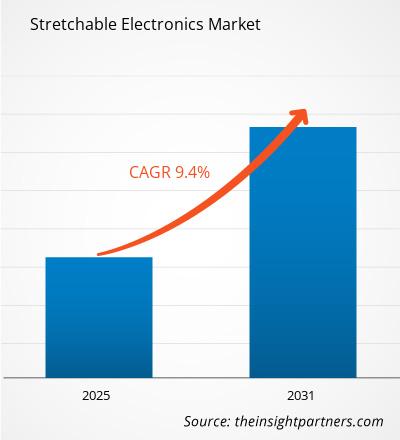
The Stretchable Electronics Market is valued at US$ 663.18 Million in 2025 and is projected to reach US$ 5,844.38 Million by 2034, expanding at a CAGR of 27.35% during 2026–2034. The market encompasses electronic components and systems engineered to retain electrical functionality while bending, twisting, or stretching. Advances in electroactive polymers, conductive materials, flexible power sources, photovoltaic integration, and deformable circuits are widening applications across healthcare, consumer electronics, automotive electronics, and aerospace and defense.
North America is positioned as a major commercialization center, supported by advanced biomedical research, electronics innovation, venture-backed technology development, and established aerospace and automotive industries. The region is expected to expand at ~25% CAGR through 2034, with healthcare wearables, conformal sensors, electronic skin, and in-mold electronics supporting demand. The Stretchable Electronics Market size is also being influenced by increasing investment in materials engineering and device miniaturization.
Stretchable Electronics Market Assessment and Insights
Regional Outlook
- North America: ~34% of the global market in 2025 | ~25% CAGR through 2034. Market position: North America remains a leading regional market because of its strong biomedical R&D base, advanced electronics ecosystem, defense programs, and early commercialization of conformal sensing, wearable monitoring, and deformable electronic systems.
- US: ~84% of North American market revenue in 2025 | ~25% CAGR through 2034. Market position: The US represents the principal North American demand center, supported by medical-device innovation, university research, defense electronics, venture investment, and growing use of conformal sensors and wearable systems in healthcare and advanced engineering.
- Europe: ~23% of the global market in 2025 | ~27% CAGR through 2034. Market position: Europe has a mature research and manufacturing ecosystem, with Germany, the UK, and France particularly important for automotive electronics, medical technologies, advanced materials, and industrial applications. Italy and Spain add manufacturing and healthcare demand.
- Asia Pacific: ~35% of the global market in 2025 | ~32% CAGR through 2034. Market position: Asia Pacific is the fastest-growing region, supported by electronics manufacturing scale, wearable-device production, flexible display expertise, advanced materials research, and expanding automotive electronics. China, Japan, and South Korea are central to regional development.
Segment Outlook
- Stretchable Conductor: ~31% Share in 2025 | ~28% CAGR through 2034. Market position: Stretchable conductors form a fundamental electrical interconnection layer for deformable devices. Their relevance across sensors, smart wearables, electronic skin, automotive interfaces, and flexible circuits supports their leading position within component demand.
- Healthcare: ~34% Share in 2025 | ~30% CAGR through 2034. Market position: Healthcare represents a high-growth application because stretchable systems can conform to skin and biological surfaces while supporting continuous physiological monitoring, rehabilitation, remote observation, and emerging implantable or epidermal electronic applications.
Competitive Coverage
3M, BodyMedia, Cambrios Technologies Corporation, DuPont de Nemours, Inc., Koninklijke Philips N.V., Lockheed Martin Corporation, MC10, Palo Alto Research Center Incorporated, Physical Optics Corporation, PowerFilm Solar Inc., Samsung Electronics Co., Ltd., LG Electronics Inc.
Methodology
The Insight Partners follows Data Collection & Secondary Research, Primary Research, Data Analysis, and Data Triangulation & Final Review to validate market estimates and insights.
Source: The Insight Partners' analysis based on proprietary research, government publications, company annual reports, investor presentations, industry databases, and expert interviews.
Technological progress has moved from demonstration at laboratory scale to integration of elastic substrates, conductive networks, energy storage, sensors, and signal processing in integrated systems. Technological improvements of conductive polymers, nanomaterials, serpentine interconnects, microstructured surfaces, and printing processes will allow better electrical continuity when strained mechanically. Furthermore, encapsulation, fatigue resistance, biocompatibility, and manufacturability issues are becoming relevant as a consequence of the need to deploy products commercially. This will bring the industry from development of stretchable electronic components to full-fledged deformable electronic system architectures.
In the future, commercialization is likely to move on from North American and European research centers. Increasing capabilities for manufacturing wearable electronics, flexible displays, automotive interfaces, and advanced materials are developing in Asia. Issues regarding regulation of medical device performance, product reliability, and biocompatibility will impact the adoption in the healthcare market, while defense electronics and smart connected vehicles could stimulate new applications. Collaborative manufacturing between material suppliers, component developers, device makers, and application partners will be essential.
Stretchable Electronics Market Report Scope
| Report Attribute | Details |
|---|---|
| Market size in 2025 | US$ 663.18 Million |
| Market Size by 2034 | US$ 5,844.38 Million |
| Global CAGR (2026 - 2034) | 27.35% |
| Historical Data | 2021-2024 |
| Forecast period | 2026-2034 |
Stretchable Electronics Market Analysis
Stretchable Electronics Market Growth is dependent on the requirement for electronic systems that can be stretched onto non-linear surfaces without interfering with their electrical performance. Applications in the medical sector drive demand for skin wearables, while consumer electronics require lightweight and ergonomic design. The supply chain includes suppliers of elastomers and polymers, manufacturers of conductive materials, circuits, and batteries, device manufacturers, and original equipment manufacturers based on application. Thus, the supply drivers are not only dictated by the ability of the materials but also by the ability to manufacture functional components.
Manufacturing of stretchable electronics is gradually shifting towards printing, deposition, hybrid manufacturing, and scalable material synthesis. Stretchable conductors play a special role, as they interconnect sensors, energy sources, and electronics, providing for deformability of the system. Energy devices such as stretchable batteries and photovoltaics provide a solution to the power constraints of wearables and autonomous electronics. Commercial material providers face the challenge of combining conductivity, elasticity, thermal stability, mechanical fatigue resistance, environmental durability, and integration capabilities.
The competitive environment mentioned in the Stretchable Electronics Market Report is quite fragmented because of the presence of diversified and larger tech companies in addition to smaller players who deal with specific materials and devices. From among those tech companies, DuPont offers stretchable conductor and dielectric solutions while 3M is part of the competition because of its involvement in advanced materials and electronics. Cambrios Technologies Corporation, on the other hand, offers solutions related to transparent conductors, and PowerFilm Solar Inc. offers flexible photovoltaic integration solutions.
Positioning in the competitive landscape is becoming more and more dependent on intellectual property, application-specific qualification, scalable manufacturing process, and collaboration with healthcare, automotive, aerospace, and consumer-electronics businesses. Koninklijke Philips N.V. and Samsung Electronics Co., Ltd. are relevant within connected and healthcare-focused ecosystems, whereas Lockheed Martin Corporation is relevant within advanced aerospace and defense industry. Therefore, investment is moving towards robust materials, scalable production, power management, and commercially qualified stretchable architectures.
● REPORT CUSTOMIZATION
Tailor This Report To Align With Your Specific Business Requirements
This report can be customized to align precisely with your business objectives, scope, and target markets. Customization options include tailored segmentation, geography, competitive analysis, and strategic insights to support informed decision-making.
Customize This Report →WHAT YOU CAN ADJUST
- ● Segmentations
- ● Geography
- ● Competitive Analysis
- ● Language Preferences
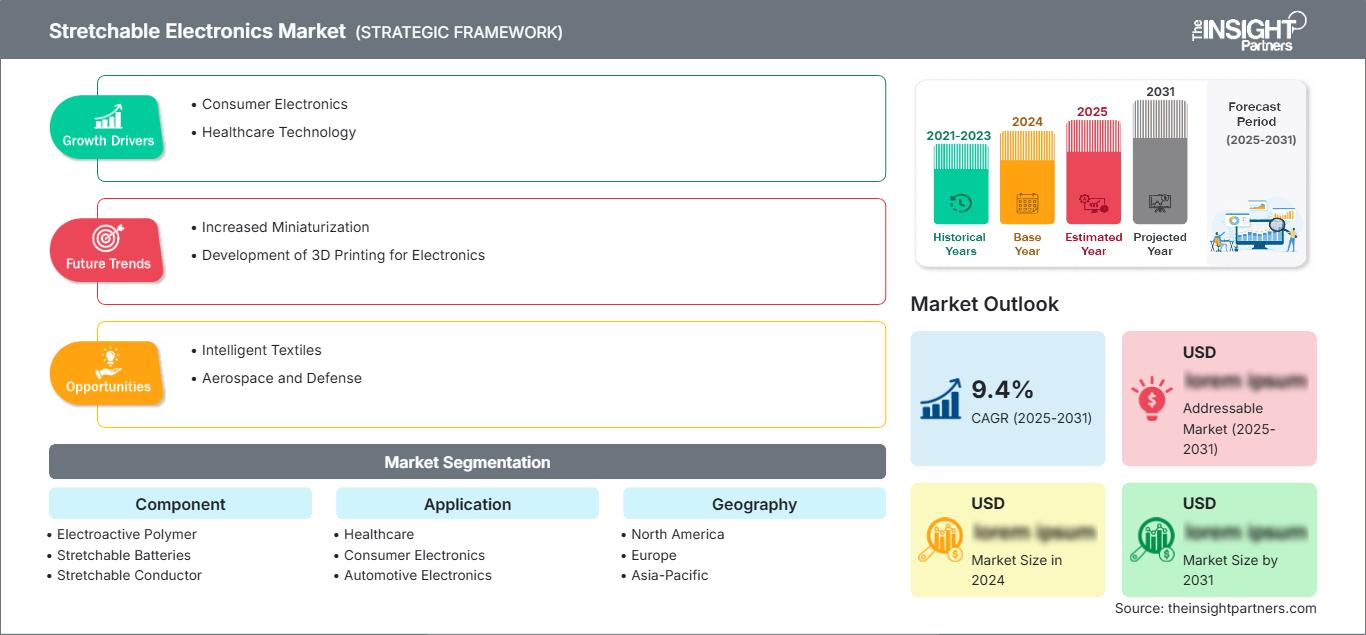
Stretchable Electronics Market: Strategic Insights
Regional Insights
North America Stretchable Electronics Market
North America contributed ~34% of Stretchable Electronics Market Share in 2025 and is anticipated to grow at a ~25% CAGR up until 2034. The region enjoys advantages such as sophisticated medical-device design, research from universities, electronics innovations, and the presence of established aerospace & defense purchasing practices. An application area that holds significant importance is healthcare, wherein conformal sensors help to monitor continuously and reduce the mechanical constraints involved with rigid sensors. Another industry where flexible sensors and embedded electronics have been adopted is automotive.
The US is one of the largest country markets within the North American region and benefits from the presence of research institutions, technology providers, medical-device manufacturers, and defense companies. Increasing emphasis has been placed in commercial settings on improving product life span, power efficiency, manufacturing capability, and incorporation of technologies into applications. Canada contributes via research and electronics development, while the established semiconductor industry, materials, and medical technology industry of the region contribute to the supply chain.
U.S. Stretchable Electronics Market
In 2025, the USA comprised ~84% of North America’s revenue, with forecasted growth of ~25% CAGR from 2026 to 2034. Growth drivers include the use of devices in healthcare wearables, biomedical sensing, human-machine interface applications, automotive electronics, and aerospace systems. Further studies in the field include development of skin-like sensors, deformable circuits, and material for performance under cyclic mechanical strain.
Key players and technology developers in the United States are 3M Company, DuPont de Nemours, Inc., Lockheed Martin Corporation, MC10, Palo Alto Research Center Incorporated, Physical Optics Corporation, and PowerFilm Solar Inc. Healthcare uses focus on monitoring and patient comfort; aerospace and defense uses focus on low mass, deformability, and environmental robustness. Applications in the automotive sector are also providing new opportunities in embedded stretchable conductor and sensing systems.
Europe Stretchable Electronics Market
Europe represented ~23% of the global Stretchable Electronics Market Share in 2025 and is expected to register ~27% CAGR through 2034. Germany is the leading country in Europe based on its strong automotive manufacturing base, industrial electronics capabilities, advanced materials research, and engineering ecosystem. The UK contributes through academic research, healthcare technology, and electronics innovation, while France benefits from aerospace, defense, and medical-technology capabilities.
The automotive industry in Germany represents an important avenue for integrating stretchable conductors, sensors, and deformable interfaces into future vehicles. Applications in France include aerospace and defense, healthcare, and advanced manufacturing sectors. The Italian advantage is based on its strong position in industrial manufacturing and specialty electronic applications, whereas the Spanish advantage is related to healthcare system upgrades, automotive industry, and research.
Commercialization in Europe includes reliable manufacturing, environmental issues, qualification, and integration into current industrial supply chain. The approaches by research institutions and technology providers include mechanically stable constructions and materials that can withstand repeated stretching. There are possibilities for companies which can facilitate research and industrial manufacturing gap, in particular in healthcare and automotive industries.
APAC Stretchable Electronics Market
The APAC region has been responsible for ~35% of the revenue generated worldwide in 2025 and has been forecasted to grow at ~32% CAGR until 2034, making it the fastest-growing region. China dominates the Asia-Pacific region, owing to the large electronics manufacturing base and the manufacture of wearables, material science, and automotive electronics.
Japan and South Korea offer advanced capabilities in displays, semiconductors, batteries, and precision manufacturing. India is building its capabilities in electronics and manufacturing, whereas Australia offers advanced research and specialized applications. The policies focused on the manufacture of electronics and semiconductors and smart manufacturing and digitization of the healthcare industry in the region can help in adoption. The presence of supply chains of consumer electronics and automotive provides APAC with an edge to adopt technology.
Middle East & Africa Stretchable Electronics Market
Middle East and Africa is expected to expand at ~29% CAGR through 2034, supported by investment in digital infrastructure, healthcare modernization, advanced security technologies, and specialized electronics. Saudi Arabia and the UAE are important markets because national technology and infrastructure programs encourage adoption of connected systems and advanced industrial technologies. South Africa provides a regional base for research, healthcare applications, and industrial electronics.
The region's opportunity is increasingly linked to lightweight sensing, remote healthcare monitoring, infrastructure condition monitoring, and defense-related electronics. Saudi Arabia is the leading country in the Middle East & Africa where evidence supports stronger technology-investment momentum. Adoption will depend on localized partnerships, product durability under demanding environments, and integration with broader digital infrastructure programs.
Segmentation Analysis
Component
Component segment in the Stretchable Electronics Market demand is shaped by the need to integrate electrical functionality into systems capable of repeated deformation. Stretchable conductors are central to signal transmission, while stretchable batteries and photovoltaic components address energy requirements. Electroactive polymers provide functional materials for sensing and actuation, and stretchable circuits enable system-level integration. The segment is expected to grow at ~28% CAGR through 2034 as developers move toward thinner, lighter, conformal, and mechanically resilient architectures.
- Electroactive Polymer: Electroactive polymers support electrically responsive deformation and sensing functions. Their tunable mechanical properties make them strategically relevant to soft actuators, wearable devices, artificial muscles, and emerging human-machine interfaces requiring integrated mechanical and electronic behavior.
- Stretchable Batteries: Stretchable batteries address the power constraints of wearable and deformable systems. Their strategic importance increases where conventional rigid batteries restrict device geometry, particularly in skin-mounted electronics, smart textiles, and compact biomedical monitoring systems.
- Stretchable Conductor: Stretchable conductors provide electrical pathways that remain functional under mechanical strain. Demand is supported by sensors, wearable devices, automotive interfaces, and electronic skin, making conductive materials a critical foundation for scalable deformable electronics.
- Photovoltaic: Stretchable photovoltaic components enable energy harvesting from curved or moving surfaces. Their value is strongest in low-power autonomous devices, wearable electronics, distributed sensors, and applications where reducing battery replacement or wiring requirements is important.
- Stretchable Circuit: Stretchable circuits integrate multiple electronic functions while accommodating deformation. They are strategically important for system miniaturization, wearable interfaces, flexible sensors, and advanced devices that require electrical connectivity across irregular or moving surfaces.
Application
Application segment in the Stretchable Electronics Market demand is being shaped by the advantages of conformability, lightweight construction, mechanical flexibility, and continuous sensing. Healthcare currently represents the largest application, while automotive electronics and aerospace and defense provide additional routes for higher-value deployment. The application segment is projected to grow at ~30% CAGR through 2034 as stretchable technologies progress from prototypes to qualified systems.
- Healthcare: Healthcare applications include wearable monitoring, epidermal sensors, rehabilitation systems, and emerging implantable electronics. Demand is driven by the ability to place electronics close to the body while supporting comfort, continuous measurement, and unobtrusive data collection.
- Consumer Electronics: Consumer devices use stretchable technologies for wearable interfaces, smart textiles, deformable sensors, and next-generation device architectures. Product differentiation increasingly depends on compactness, comfort, interactive surfaces, and integration of sensing into unconventional form factors.
- Automotive Electronics: Automotive applications include embedded sensors, flexible interfaces, in-mold electronics, and lightweight electrical structures. Demand is linked to connected vehicles, advanced interiors, electrification, and the need to integrate electronics into curved or space-constrained vehicle surfaces.
- Aerospace & Defense: Aerospace and defense applications emphasize lightweight construction, conformal sensing, structural monitoring, and mechanically adaptable electronics. Stretchable systems can support integration on curved structures where conventional rigid electronic assemblies create weight, geometry, or installation constraints.
Opportunity Snapshot
| Application | Revenue Contribution | Trend Tag | Adoption Stage |
| Healthcare | High | Skin Monitoring | Scaling |
| Consumer Electronics | Medium | Smart Wearables | Scaling |
| Automotive Electronics | Medium | Embedded Sensing | Scaling |
| Aerospace & Defense | Medium | Conformal Systems | Emerging |
| Others | Low | Specialized Devices | Emerging |
Stretchable Electronics Market Growth Drivers and Impact Analysis
Expansion of Wearable and Continuous Healthcare Monitoring
Healthcare monitoring is creating a direct commercial pathway for stretchable electronics because conventional rigid sensors can restrict movement or reduce long-duration comfort. Stretchable architectures can conform to skin and support sensing of physiological or movement-related parameters while maintaining electrical connectivity. This capability is relevant to remote patient monitoring, rehabilitation, sports medicine, and emerging electronic-skin applications. Commercial impact extends across conductive materials, stretchable circuits, flexible power sources, and integrated sensor assemblies. As healthcare developers seek smaller and less intrusive devices, suppliers capable of delivering biocompatible, durable, and repeatable components can address increasingly demanding qualification requirements. The resulting demand also encourages collaboration between electronics manufacturers, medical-device developers, research institutions, and material suppliers.
Advancement of Conductive Materials and Scalable Manufacturing
Material innovation is reducing one of the principal barriers to commercial stretchable electronics: maintaining electrical performance while repeatedly deforming the device. Conductive polymers, nanomaterials, metallic networks, elastomeric systems, and engineered circuit geometries are improving mechanical tolerance. At the same time, printing and patterned manufacturing can support higher production throughput than laboratory fabrication methods. The commercial effect is a broader addressable application base because component developers can design electronics around specific elasticity, conductivity, thickness, and environmental requirements. Suppliers that combine material formulation with manufacturing know-how can improve consistency and simplify integration for OEMs. DuPont's work on stretchable conductors and dielectrics for in-mold electronics illustrates how materials engineering can connect stretchable functionality with automotive electronics requirements.
Integration of Electronics into Connected and Lightweight Systems
Connected products increasingly require electronics to occupy unconventional surfaces and operate with limited space or weight. Stretchable systems can integrate sensing and connectivity into garments, curved vehicle interiors, biomedical patches, robotic structures, and aerospace components. This expands the role of electronics from discrete circuit boards toward embedded and distributed architectures. The commercial impact is particularly relevant where installation geometry, mass, or user comfort limits conventional components. Flexible photovoltaic technologies also support autonomous or low-power architectures by providing energy harvesting on curved or constrained surfaces. PowerFilm Solar Inc., for example, offers thin-film photovoltaic modules designed for embedded electronics and constrained form factors, illustrating the role of flexible power generation within broader deformable electronics ecosystems.
Stretchable Electronics Market Future Trends
Convergence of Stretchable Electronics with AI-Enabled Sensing
Future systems are expected to combine mechanically adaptive sensors with increasingly capable AI and edge-processing architectures. Rather than functioning only as passive sensing layers, stretchable electronics can become distributed data interfaces that capture physiological, motion, pressure, and environmental information. AI can convert these continuous signals into actionable classifications, alerts, or control inputs. The Stretchable Electronics Market trend is particularly relevant to healthcare, robotics, sports, and human-machine interaction. Research into stretchable electroluminescent systems also demonstrates continuing progress toward sophisticated freeform devices and healthcare-oriented applications. As integration improves, suppliers will increasingly compete on system-level data quality, power efficiency, signal stability, and interoperability rather than mechanical flexibility alone.
Transition Toward Fully Integrated Deformable Electronic Platforms
The next stage of development is likely to involve greater integration of sensing, power, communication, and circuitry into unified deformable platforms. Current systems often depend on combinations of flexible and rigid components, creating mechanical and reliability discontinuities. Greater integration can reduce those interfaces and enable more consistent deformation across the complete device. Research is increasingly addressing strain-tolerant architectures, durable encapsulation, energy autonomy, and scalable integration. Commercial developers are therefore likely to prioritize architectures that combine stretchable conductors, energy storage, photovoltaic harvesting, and circuits while maintaining manufacturability and service life.
Stretchable Electronics Market Opportunities
Development of Specialized Medical and Epidermal Platforms
Medical and epidermal systems in the Stretchable Electronics Market Forecast represent an opportunity for companies capable of combining stretchability with biocompatibility, reliable sensing, and secure skin interfaces. Product developers can target monitoring patches, rehabilitation systems, physiological sensors, and specialized diagnostic platforms where comfort and continuous measurement create a meaningful advantage. DuPont's smart-wearable materials portfolio demonstrates the commercial relevance of elastic membranes, silicone-based materials, and conformable interfaces for medical devices. Investment priorities should focus on qualification, material consistency, sterilization compatibility where required, and integration with medical data systems. Partnerships with device manufacturers and healthcare technology developers can shorten commercialization pathways.
Expansion of Embedded Power and Autonomous Electronics
Embedded energy generation and storage can unlock stretchable systems that operate with fewer external power constraints. Flexible photovoltaic modules are already available in thin-film configurations for compact electronic integration, creating a foundation for low-power sensors and distributed devices. Opportunities extend to smart textiles, remote sensing, wearable devices, and infrastructure monitoring where replacing batteries frequently is difficult. Companies can differentiate through improved energy conversion, mechanical durability, low-light performance, and integration with stretchable circuits. The commercial opportunity is strongest where power generation, storage, sensing, and communications can be designed as one application-specific architecture.
Recent Developments
- November 2024: LG Display announced the development of a stretchable display capable of expanding by up to 50%, representing a significant advancement in flexible display technology. The prototype features a 12-inch screen that can expand to 18 inches while maintaining 100 pixels per inch resolution and full RGB color. The company enhanced the display's flexibility by improving a specialized silicon substrate and developing a new wiring structure. The prototype also incorporates micro-LED light sources measuring up to 40 micrometers and can reportedly withstand more than 10,000 stretching cycles while maintaining image quality under temperature variations and external shocks.
- September 2026: RIKEN announced the development of a nanoscale anisotropic conductive film (ACF) that combines more than 500% stretchability with high breathability. The approximately 300-nanometer-thick film uses silver nanowires embedded in an elastomer and can be bonded at room temperature without applying heat or pressure. It maintains electrical conductivity even after being stretched by more than 500% and after 1,000 repeated stretching cycles. The film achieved a water-vapor transmission rate of 1,200 g/m²/day, exceeding that of commonly used medical adhesive films.
- May 2026: Hanwei Electronics Group Corporation introduced its Elastic Stretch Sensor, a flexible sensing solution designed to detect strain and displacement in the human body and other objects. The sensor uses self-developed elastic nanoconductive materials as the sensing element and textile materials as the packaging layer, allowing integration with elastic surfaces such as fabrics and leather. When combined with Hanwei’s wireless detection system and algorithms, the sensor can provide real-time measurements of strain, displacement, bending angle, and tensile force.
Frequently Asked Questions

- Comprehensive Market Sizing and Forecast Analysis
- Detailed Segmentation Analysis
- In-Depth Market Dynamics Assessment
- Regional and Country-Level Insights
- Competitive Landscape and Company Benchmarking
- Strategic Business Intelligence
Recent Reports
Testimonials

The Insight Partners provided valuable market intelligence that supported our global go-to-market strategy. Their team was professional, responsive, and attentive to our feedback, providing thoughtful analysis and helpful methodological clarifications throughout the project.
Junmo Kim Chief Financial Officer (CFO), Enertech Co., Ltd.
The Insight Partners' SCADA System Market report is comprehensive, with valuable insights on current trends and future forecasts. The team was highly professional, responsive, and supportive throughout. We are very satisfied and highly recommend their services.
RAN KEDEM Partner, Reali Technologies LTDs
I requested a report on a very specific software market and the team produced the report in a few days. The information was very relevant and well presented. I then requested some changes and additions to the report. The team was again very responsive and I got the final report in less than a week.
JEAN-HERVE JENN Chairman, Future Analytica
We worked with The Insight Partners for an important market study and forecast. They gave us clear insights into opportunities and risks, which helped shape our plans. Their research was easy to use and based on solid data. It helped us make smart, confident decisions. We highly recommend them.
PIYUSH NAGPAL Sr. Vice President, High Beam Global
The Insight Partners delivered insightful, well-structured market research with strong domain expertise. Their team was professional and responsive throughout. The user-friendly website made accessing industry reports seamless. We highly recommend them for reliable, high-quality research services
YUKIHIKO ADACHI CEO, Deep Blue, LLC.
This is the first time I have purchased a market report from The Insight Partners.While I was unsure at first, I visited their web site and felt more comfortable to take the risk and purchase a market report.I am completely satisfied with the quality of the report and customer service. I had several questions and comments with the initial report, but after a couple of dialogs over email with their analyst I believe I have a report that I can use as input to our strategic planning process.Thank you so much for taking the extra time and making this a positive experience.I will definitely recommend your service to others and you will be my first call when we need further market data.
JOHN SUZUKI President and Chief Executive Officer, Board Director, BK Technologies
I wish to appreciate your support and the professionalism you displayed in the course of attending to my request for information regarding to infectious disease IVD market in Nigeria. I appreciate your patience, your guidance, and the fact that you were willing to offer a discount, which eventually made it possible for us to close a deal. I look forward to engaging The Insight Partners in the future, all thanks to the impression you have created in me as a result of this first encounter.
DR CHIJIOKE ONYIA MANAGING DIRECTOR, PineCrest Healthcare Ltd.Reason to Buy
- Informed Decision-Making
- Understanding Market Dynamics
- Competitive Analysis
- Identifying Emerging Markets
- Customer Insights
- Market Forecasts
- Risk Mitigation
- Boosting Operational Efficiency
- Strategic Planning
- Investment Justification
- Tracking Industry Innovations
- Aligning with Regulatory Trends





 Get Free Sample for