
Subscriber Identification Module (SIM) Card Market Size, Demand & Growth by 2034
Coverage: By Product Type (32 KB, 64 KB, 128 KB, 256 KB, 512 KB); Application (GSM Phones, CDMA Phones, LTE Handsets, Satellite Phones) , and Geography (North America, Europe, Asia Pacific, and South and Central America)
- Status : Data Released
- Report Code : TIPRE00017014
- Category : Electronics and Semiconductor
- No. of Pages : 150
- Available Report Formats :


- Last update date : November 11, 2026


2025 Market Size
US$ 7,871.14 Mn
Base year value
2034 Forecast
US$ 15,631.95 Mn
Projected by 2034
CAGR 2026-2034
7.92 %
Growth rate
Addressable Market
US$ 105,722.35 Mn
(2026-2034)
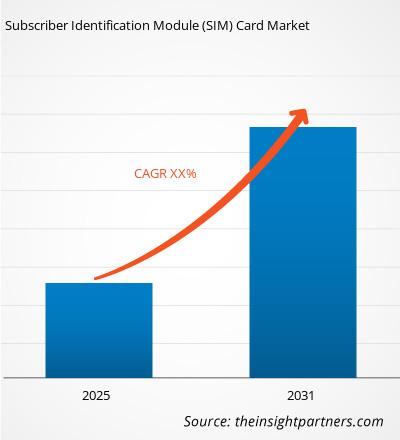
The Subscriber Identification Module Card Market was valued at US$ 7,871.14 Million in 2025 and is projected to reach US$ 15,631.95 Million by 2034, registering a CAGR of 7.92% during 2026–2034. Demand is anchored in secure subscriber authentication across mobile handsets, while migration from legacy GSM and CDMA environments toward LTE devices increases requirements for higher-memory cards, stronger cryptography, and remotely manageable credentials.
North America remains a high-value demand center, with an estimated ~7% CAGR through 2034 as operators modernize authentication for LTE and 5G handsets, expand secure IoT connectivity, and manage coexistence between removable SIMs and embedded credentials. The Subscriber Identification Module Card Market size in the region is also supported by premium device penetration, frequent device replacement, stringent security requirements, and operator investment in interoperable provisioning systems.
Subscriber Identification Module (SIM) Card Market Assessment and Insights
Regional Outlook
- North America: ~29% of the global Subscriber Identification Module Card Market share in 2025 | ~7% CAGR through 2034. Market position: The region ranks second, supported by high-value LTE and 5G subscriptions, demanding security specifications, and rapid operator adoption of hybrid physical and embedded credential strategies.
- US: ~84% of North American market revenue in 2025 | ~7% CAGR through 2034. Market position: The US leads North America through concentrated operator procurement, premium handset replacement, IoT connectivity programs, and demand for secure multi-profile subscriber products.
- Europe: ~24% of the global market in 2025 | ~7% CAGR through 2034. Market position: A mature regulatory and manufacturing ecosystem sustains demand, with Germany leading Europe and the UK, France, Italy, and Spain contributing broad LTE handset volumes.
- Asia Pacific: ~38% of the global market in 2025 | ~9% CAGR through 2034. Market position: Asia Pacific is the largest and fastest-growing region, driven by mass subscriber additions, handset production, LTE migration, and strong demand in China, India, Japan, and South Korea.
Segment Outlook
- Application: ~63% Share in 2025 | ~8% CAGR through 2034. Market position: Application leads because handset deployment volumes directly determine card issuance, replacement, and operator personalization demand across GSM, CDMA, LTE, and satellite devices.
- Product Type: ~37% Share in 2025 | ~9% CAGR through 2034. Market position: Product Type is the higher-growth segment as security applications, larger profiles, and service applets shift procurement toward higher-memory secure cards.
Competitive Coverage
Thales S.A., Giesecke+Devrient GmbH, IDEMIA Secure Transactions, Valid S.A., Eastcompeace Technology Co., Ltd., Watchdata Technologies Pte. Ltd., STMicroelectronics N.V., Infineon Technologies AG, NXP Semiconductors N.V., Kigen
Methodology
The Insight Partners follows Data Collection & Secondary Research, Primary Research, Data Analysis, and Data Triangulation & Final Review to validate market estimates and insights.
Source: The Insight Partners' analysis based on proprietary research, government publications, company annual reports, investor presentations, industry databases, and expert interviews.
Authentication of subscribers has developed from use of removable low-memory cards, which helped only in managing identities, to multicellular UICCs that support operator applets with complex configurations, better encryption techniques, and configurations of LTE services. The effect of such advancements is an increased preference for secure elements, advanced operating systems, and customization of personalization lines in production processes. Despite the changes introduced by the use of eSIMs, there still remains great importance for physical cards when it comes to prepaid card solutions, mobile devices, dual SIM technologies, and geographic areas favoring retail activations.
Units' growth for the next decade until 2034 will be driven by APAC, MEA, and satellite applications, and quality enhancements will come as a result of big memory and security. Investments by operators in 5G, IoT, and remote provisioning provide an adjacency to other services rather than the elimination of removable cards. Standards, interconnectivity among devices, and environmental considerations will influence supplier choice and capital investment.
Subscriber Identification Module (SIM) Card Market Report Scope
| Report Attribute | Details |
|---|---|
| Market size in 2025 | US$ 7,871.14 Million |
| Market Size by 2034 | US$ 15,631.95 Million |
| Global CAGR (2026 - 2034) | 7.92% |
| Historical Data | 2021-2024 |
| Forecast period | 2026-2034 |
Subscriber Identification Module (SIM) Card Market Analysis
The major market growth driver in the Subscriber Identification Module Card Market is continuous development and improvement of certified cellular devices. An increase in the number of LTE phones leads to higher demands for processing power, whereas prepaid services, multi-SIM usage, roaming, and fleet enterprises ensure constant issuance of the cards. The value chain players consist of secure silicon providers, operating systems suppliers, card manufacturers, personalization facilities, mobile service providers, distributors, handset vendors, and certifying bodies.
Market supply economics depend on secure silicon, wafer economics, manufacturing capacities that are certified, cryptography, and local personalization capabilities. The competition affects the prices of the standard products, but the certified memory cards and operator-specific applets provide for differentiation. Higher interests of buyers pay attention to lifecycle security, interoperability, production reliability, and materials used besides the product price.
The Subscriber Identification Module Card Market overview demonstrates the competitive environment, which consists of integrated security solutions providers and semiconductor producers. Thales S.A., Giesecke+Devrient GmbH, IDEMIA Secure Transactions, and Valid S.A. produce the solutions with credentials, manufacturing and provisioning capabilities, whereas Eastcompeace Technology Co., Ltd. and Watchdata Technologies Pte. Ltd. support large regional projects.
Capital is being allocated for flexible manufacturing facilities, substrate recycling, post-quantum secure roadmap, and technologies connecting the world of removable SIM and eSIMs. STMicroelectronics N.V., Infineon Technologies AG, and NXP Semiconductors N.V. impact the performance of the secure element, while Kigen influences software-based solutions for credentials enabling. The main strategic advantages are certifications, operator cooperation, and management of both physical and virtual identities of subscribers.
● REPORT CUSTOMIZATION
Tailor This Report To Align With Your Specific Business Requirements
This report can be customized to align precisely with your business objectives, scope, and target markets. Customization options include tailored segmentation, geography, competitive analysis, and strategic insights to support informed decision-making.
Customize This Report →WHAT YOU CAN ADJUST
- ● Segmentations
- ● Geography
- ● Competitive Analysis
- ● Language Preferences
Subscriber Identification Module (SIM) Card Market: Strategic Insights

Regional Insights
North America Subscriber Identification Module Card Market
The region is projected to record a ~7% CAGR through 2034. The high value of the smartphones, mature LTE networks, and adoption of the eSIMs change the requirements but do not kill the market because the operators still support prepaid clients, BYOD, enterprise mobility, and dual SIM cards. The North American market share in the Subscriber Identification Module Card Market is based on high security per unit and operators’ procurement.
The growth will come from the card updates to increase security, support 5G services, and deploy the Internet of Things solutions where the credentials should be field upgradable. In Canada, LTE and industry connectivity can be added, and in Mexico, there is a boost of the prepaid segment and device updates.
U.S. Subscriber Identification Module Card Market
The US accounts for ~84% of North American revenue in 2025 and is expected to expand at a ~7% CAGR through 2034. Leadership within North America is a result of the scale of national operators, premium phone replacements, enterprise-level device populations, and IoT deployments. Cards are still important for migrations, backup networks, and scenarios where immediate availability of services through retail channels is needed.
The main competitors include Thales S.A., Giesecke+Devrient GmbH, IDEMIA Secure Transactions, as well as chip suppliers. LTE phones drive the largest need for applications, whereas satellites and private network devices provide smaller yet challenging opportunities. More attention is paid to card platforms that have the ability to manage both physical and embedded credentials and use recyclable card bodies.
Europe Subscriber Identification Module Card Market
Europe represents ~24% of global revenue in 2025 and is projected to grow at a ~7% CAGR through 2034. However, mature mobile penetration limits the number of new subscribers, while replacement cycles, multi-device offerings, secure enterprise mobility, and regulatory focus on digital identity maintain value. European carriers need to support physical SIM, eSIM, and roaming interoperability, underscoring the importance of certified OSs and customization.
Germany leads among all European countries due to the large number of subscribers, industrial IoT activities, automotive connectivity supply chain, and local security knowledge. The UK benefits from competitive operator distribution network and high eSIM adoption rates, whereas France enjoys the large number of vendors and telco companies. Italy and Spain have considerable prepaid activations and tourists' activation rates.
Local procurement processes consider lifecycle security and eco-performance of products. Recycled polymers, minimized card body, and decreased packaging allow operators to reach their waste goals without losing any authentications. Local suppliers who can comply with industry standards and connect removable and embedded solutions are most favorable for operators as they optimize their portfolios.
APAC Subscriber Identification Module Card Market
Asia Pacific holds ~38% of global revenue in 2025 and is the fastest-growing region at a ~9% CAGR through 2034. China is the dominant market in the Asia Pacific region, with its strength lying in handset production, operator size, secure element manufacturing capability, and fast transition from LTE to 5G networks. India adds subscribers and multiple SIM use cases, while Japan and South Korea focus on high security and high memory handsets.
Australia caters to high-end devices and enterprise connectivity demand. Within the region, industrial policy initiatives, local electronic components manufacturing, digital inclusion initiatives, and low-cost LTE handsets drive addressable volumes. Local personalization and operator-specific applets are important due to the difference in activation policies among countries.
Middle East & Africa Subscriber Identification Module Card Market
The Middle East & Africa is forecast to expand at a ~9% CAGR through 2034. Increases in subscribers, pre-pay services, investments in network coverage, and the shift towards smartphones will drive physical card distribution. Saudi Arabia leads the way among Middle East & Africa countries in terms of valuable subscription services, smart cities and enterprise connectivity which can deliver sophisticated credentials.
In the UAE, there is a need for roaming services, tourist requirements and IoT. In South Africa, there is a strong demand for operator procurement and LTE upgrade within Sub-Saharan region. Growth in Rest of MEA will be driven by rural network coverage, mobile money and low-cost handsets.
Segmentation Analysis
Product Type
Product Type is projected to grow at a ~9% CAGR during 2026–2034. The Subscriber Identification Module Card Market scope across memory capacities reflects the trade-off among cost, application complexity, profile storage, security features, and operator customization. Lower capacities serve basic authentication, while larger formats support richer applets and longer service lives.
- 32 KB: Cost-sensitive prepaid and legacy GSM programs sustain residual demand. Strategic relevance centers on affordability and broad device compatibility, though limited application storage reduces suitability for advanced operator services.
- 64 KB: This capacity supports mainstream authentication and basic value-added services. It remains important where operators need dependable scale, manageable cost, and compatibility across mixed GSM and early LTE device fleets.
- 128 KB: Balanced memory, security, and pricing make this format attractive for contemporary LTE programs. It accommodates additional applets and operator personalization while preserving efficient high-volume manufacturing.
- 256 KB: Demand is linked to richer security domains, multiple applications, and longer credential lifecycles. Operators use the capacity where service expansion and future updates justify a higher card value.
- 512 KB: The highest-capacity option serves complex profiles, enterprise security, and advanced operator applications. Adoption is selective but strategically important for premium and multi-application deployments requiring substantial storage headroom.
Application
Application is projected to grow at a ~8% CAGR during 2026–2034 and represents ~63% of revenue in 2025. Handset shipment mix, network migration, activation practices, and replacement intensity shape demand. LTE handsets provide the largest commercial base, while satellite phones require resilient and specialized authentication.
- GSM Phones: Demand persists in price-sensitive and rural markets where established 2G networks, feature phones, and prepaid distribution remain practical. The category provides scale but faces gradual substitution by LTE-capable devices.
- CDMA Phones: This application is declining as operators retire standalone CDMA networks. Remaining demand is concentrated in transitional fleets and devices that combine CDMA heritage with LTE authentication requirements.
- LTE Handsets: LTE handsets form the central demand pool due to broad network coverage, affordable smartphones, and continuing 4G service longevity. Cards must support stronger security, operator applets, and smooth migration toward 5G services.
- Satellite Phones: Satellite devices represent a specialized application requiring secure identity, rugged reliability, and global interoperability. Demand comes from maritime, emergency response, defense-adjacent civilian use, remote industry, and disaster recovery.
Opportunity Snapshot
| Application | Revenue Contribution | Trend Tag | Adoption Stage |
| GSM Phones | Medium | Legacy Access | Mature |
| CDMA Phones | Low | Network Sunset | Mature |
| LTE Handsets | High | 4G Refresh | Scaling |
| Satellite Phones | Low | Remote Coverage | Emerging |
Subscriber Identification Module (SIM) Card Market Growth Drivers and Impact Analysis
LTE and 5G Subscriber Migration
Operators will keep on switching subscribers from their existing networks to LTE and 5G-ready networks, thus driving the need for new cards for applications such as authentication, roaming, and services. The effect will be felt most where there is affordable LTE handset availability, providing greater mobile broadband penetration or cases of forced shutdown of old networks requiring upgrades of credentials. Every time this transition happens, operators have the chance to update their security features, streamline product portfolio, and deploy higher memory cards. Suppliers get advantage when they manage to qualify their products on several different handsets and network operators. But capturing the value of the transaction depends more on software security than on unit sales volumes.
Prepaid Distribution and Multi-SIM Behavior
Prepaid purchase continues to be operationally significant in Asia-Pacific, Africa, Latin America, and travel-centric regions. The physical SIM provides instant activation in retail sales, device portability, and affordable delivery through lack of necessity for hardware compatibility. Multi-SIM capability also drives the active credential count when users segregate their usage into professional and private lives, optimize their billing schemes, and ensure connectivity across different networks. This trend benefits manufacturers that can deliver localized customization, smaller batch manufacturing, tamper-proof packaging, and good logistics. The influence of this driver gets diluted through digital customer onboarding and eSIM, but the physical card still holds practical benefits.
Security, Compliance, and Lifecycle Renewal
Credentials are security anchors, so card renewal by the operator is necessary from time to time as new algorithms, new keys, new privacy mechanisms, and new network capabilities are developed. The drivers of fraud protection, roaming protection, and the expectations of regulators have made secure elements that are certified and personalized environments increasingly important. Higher capacity cards allow more applications and updates, increasing their lifecycle value. Lifecycle assurance becomes more important than price per card, as a compromised or non-compliant credential will cause activation problems for customers and create risk.
Subscriber Identification Module (SIM) Card Market Future Trends
Hybrid Physical and Embedded Credential Portfolios
Subscriber Identification Module Card Market trends will increasingly reflect coexistence rather than a simple replacement contest between removable SIM and eSIM. Operators are likely to manage both through common orchestration, allowing customers to activate traditional cards, programmable cards, or embedded profiles according to device and channel needs. Physical formats may incorporate eUICC capabilities, giving users profile flexibility while preserving removability. This convergence changes supplier selection: card manufacturing alone becomes less differentiated, while interoperable credential software, remote lifecycle management, and cybersecurity services gain importance. Vendors that bridge retail distribution with digital provisioning can help operators reduce fragmentation and preserve coverage across diverse device generations.
Higher Memory and Sustainable Materials
Product design will move toward greater memory headroom alongside lower environmental impact. Larger capacities can accommodate multiple applications, security domains, and future updates, supporting longer useful lives even as networks evolve. Simultaneously, operators are expected to reduce full-size plastic carriers, packaging, and virgin polymer use. The commercial implication is a new qualification balance: products must meet electrical, durability, security, and sustainability requirements without materially increasing activation failure rates. Suppliers with recycled substrates, compact formats, auditable material sourcing, and efficient personalization can differentiate in tenders where environmental criteria join price, capacity, and security.
Subscriber Identification Module (SIM) Card Market Opportunities
Localized High-Memory Card Programs
Manufacturers can target emerging operator groups with modular 128 KB, 256 KB, and 512 KB portfolios that combine standard security cores with locally tailored applets. Subscriber Identification Module Card Market Forecasts support investment in flexible personalization lines near high-volume activation markets, reducing lead time and currency exposure. The opportunity is strongest where LTE migration, prepaid scale, and local data-handling expectations intersect. Commercial execution requires operator certification, secure key management, demand forecasting, and regional distribution partnerships. Vendors should prioritize reusable software components and configurable production rather than one-off designs that raise validation costs and slow launch schedules.
Satellite and Resilient Connectivity Credentials
Satellite-enabled handsets and hybrid terrestrial-satellite devices create a focused opportunity for credentials designed around roaming, remote operation, rugged lifecycles, and emergency availability. Addressable volumes are smaller than mainstream LTE, but buyers value reliability, interoperability, and security more heavily. Suppliers can partner with satellite operators, device makers, maritime distributors, and emergency-service integrators to certify tailored products and provisioning workflows. Investment should center on long-life components, geographically resilient personalization, and profile management that can coordinate terrestrial and non-terrestrial access. This niche can improve margin mix while diversifying exposure beyond consumer handset replacement cycles.
Recent Developments
- August 2026: Semtech Corporation entered into a definitive agreement to sell its cellular module business to Compal Electronics for US$62 million in cash, subject to customary adjustments. Compal will acquire substantially all related assets and operations, including intellectual property, customer relationships, and personnel. The transaction is expected to close in Q4 FY2027, subject to regulatory approvals and other closing conditions. Semtech said the divestiture will allow it to focus more closely on data center and LoRa connectivity.
- September 2026: Government of Rajasthan achieved 100% of its targeted 90.19 lakh Farmer IDs, becoming the first state in northern India and sixth state in India to reach the target. The Farmer IDs have been integrated with Aadhaar and Jan Aadhaar databases, with about 83 lakh farmers seeded with Farmer IDs in Jan Aadhaar. The state has also completed georeferencing for about 99% of villages and conducted digital crop surveys across more than 2.72 crore land parcels during the 2025–26 rabi season, strengthening digital identification and data-based agricultural services.
Frequently Asked Questions

- Comprehensive Market Sizing and Forecast Analysis
- Detailed Segmentation Analysis
- In-Depth Market Dynamics Assessment
- Regional and Country-Level Insights
- Competitive Landscape and Company Benchmarking
- Strategic Business Intelligence
Recent Reports
Testimonials

The Insight Partners provided valuable market intelligence that supported our global go-to-market strategy. Their team was professional, responsive, and attentive to our feedback, providing thoughtful analysis and helpful methodological clarifications throughout the project.
Junmo Kim Chief Financial Officer (CFO), Enertech Co., Ltd.
The Insight Partners' SCADA System Market report is comprehensive, with valuable insights on current trends and future forecasts. The team was highly professional, responsive, and supportive throughout. We are very satisfied and highly recommend their services.
RAN KEDEM Partner, Reali Technologies LTDs
I requested a report on a very specific software market and the team produced the report in a few days. The information was very relevant and well presented. I then requested some changes and additions to the report. The team was again very responsive and I got the final report in less than a week.
JEAN-HERVE JENN Chairman, Future Analytica
We worked with The Insight Partners for an important market study and forecast. They gave us clear insights into opportunities and risks, which helped shape our plans. Their research was easy to use and based on solid data. It helped us make smart, confident decisions. We highly recommend them.
PIYUSH NAGPAL Sr. Vice President, High Beam Global
The Insight Partners delivered insightful, well-structured market research with strong domain expertise. Their team was professional and responsive throughout. The user-friendly website made accessing industry reports seamless. We highly recommend them for reliable, high-quality research services
YUKIHIKO ADACHI CEO, Deep Blue, LLC.
This is the first time I have purchased a market report from The Insight Partners.While I was unsure at first, I visited their web site and felt more comfortable to take the risk and purchase a market report.I am completely satisfied with the quality of the report and customer service. I had several questions and comments with the initial report, but after a couple of dialogs over email with their analyst I believe I have a report that I can use as input to our strategic planning process.Thank you so much for taking the extra time and making this a positive experience.I will definitely recommend your service to others and you will be my first call when we need further market data.
JOHN SUZUKI President and Chief Executive Officer, Board Director, BK Technologies
I wish to appreciate your support and the professionalism you displayed in the course of attending to my request for information regarding to infectious disease IVD market in Nigeria. I appreciate your patience, your guidance, and the fact that you were willing to offer a discount, which eventually made it possible for us to close a deal. I look forward to engaging The Insight Partners in the future, all thanks to the impression you have created in me as a result of this first encounter.
DR CHIJIOKE ONYIA MANAGING DIRECTOR, PineCrest Healthcare Ltd.Reason to Buy
- Informed Decision-Making
- Understanding Market Dynamics
- Competitive Analysis
- Identifying Emerging Markets
- Customer Insights
- Market Forecasts
- Risk Mitigation
- Boosting Operational Efficiency
- Strategic Planning
- Investment Justification
- Tracking Industry Innovations
- Aligning with Regulatory Trends





 Get Free Sample for