Switch Knobs Market Size & Overview
The Switch Knobs Market was valued at US$ 1.24 Billion in 2025 and is projected to reach US$ 1.93 Billion by 2034, registering a CAGR of 5.07% from 2026 to 2034. The market covers manually operated knob interfaces used with rotary switches, selector mechanisms, potentiometers, encoders, and related control components. Demand spans residential and commercial environments, with material selection influenced by durability, tactile performance, appearance, operating conditions, manufacturing cost, shaft compatibility, and equipment design requirements.
North America remains an important demand center as manufacturers integrate tactile controls into electrical equipment, appliances, machinery, building systems, and commercial control panels. The Switch Knobs Market size is supported by replacement demand and continued deployment of rotary controls where direct physical feedback remains valuable. The region is estimated to expand at a CAGR of ~5% through 2034, supported by industrial automation, equipment modernization, and demand for durable interfaces in commercial and residential products.
The Switch Knobs Market performance is driven by the demand for the continued use of rotary and selector controls that require physical feedback from the operator. Demand will be created by appliance makers, industrial equipment makers, electrical system integrators, instrument manufacturers, and control panel manufacturers. The value chain consists of materials such as metals and engineered plastics; machining and molding; inserts and fastening systems; surface treatment; decoration; knob assembly; switch assembly; distribution and resale. The choice of product will be based on torque, shaft geometry, operating environment, frequency of actuation, and the need for identification. Demand is affected by the price of raw materials, the capacity for molding, machining accuracy, tooling, and regional sources of supply. Aluminum has the benefit of lightness, rust resistance, and premium appearance, whereas brass has its uses where there is a requirement for mechanical strength, lightness, conductivity, and insert features. Phenolics have their applications where dimensional stability, heat-resistance, electrical insulation, and cost-effectiveness are considered important. Suppliers who have wide-ranging tooling will meet the needs of many OEMs while reducing design times for custom knob designs.
The competitive positioning will require customization, reliability, design capabilities, and the capability to incorporate knobs in an entire switch or control assembly system. As per the Switch Knobs Market report, suppliers having strong industrial distribution channel capabilities will be able to meet the needs of original equipment manufacturers as well as replacement requirements. Davies Molding will focus on customization of knobs, Eaton Corporation plc and Schneider Electric SE will incorporate knob operated selector functionality in their control solutions portfolio. Grayhill, Inc. will focus on rotary controls and encoder interface, whereas, APEM S.A.S. will combine ergonomic controls with HMIs for vehicles and machinery. Investments will be made in multifunctional interfaces, enhanced tactile feel, sealing capabilities, and complex operator controls. Taiwan Alpha Electronic Co., Ltd. will offer solutions for switches, encoders, potentiometer, and control knobs offering component eco-system capabilities. The companies like Amphenol Corporation, Keystone Electronics Corp., Hammond Manufacturing Ltd., and Eagle Plastic Devices, Inc. will be contributing in their adjacent capabilities like electromechanical, enclosures, hardware, and molded components.
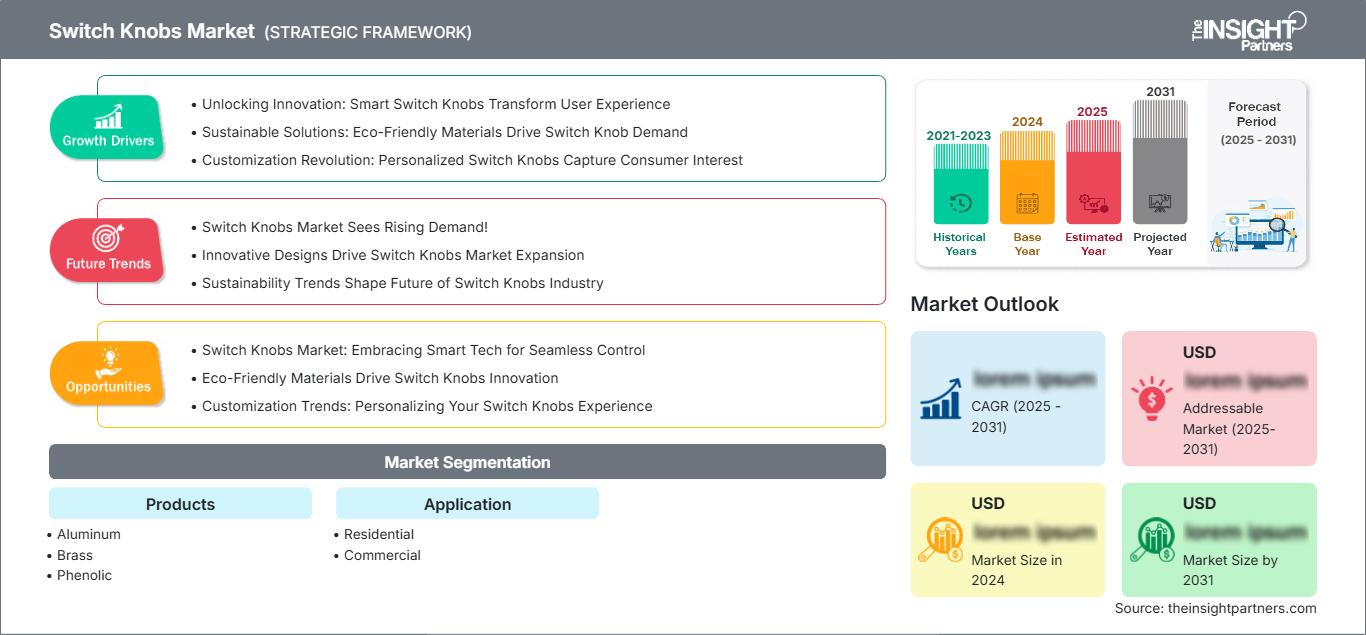
Switch Knobs Market Assessment and Insights
Regional Outlook
- North America: ~29% of the global market in 2025 | ~5% CAGR through 2034. Market position: North America has a mature installed base of rotary controls and a diversified manufacturing ecosystem. Industrial machinery, electrical equipment, appliances, and commercial control panels support replacement and new-equipment demand for durable, ergonomic knob interfaces.
- US: ~83% of North American market revenue in 2025 | ~5% CAGR through 2034. Market position: The US is the leading country in North America, supported by extensive industrial equipment manufacturing, electrical distribution products, appliances, and electronic instrumentation. Buyers emphasize durability, compatibility, ergonomic operation, and dependable supply.
- Europe: ~25% of the global market in 2025 | ~4% CAGR through 2034. Market position: Europe is a mature market, with Germany representing the leading country in Europe. Industrial automation, machinery, electrical equipment, appliances, and engineering-intensive commercial systems sustain demand for precision control components and replacement parts.
- Asia Pacific: ~37% of the global market in 2025 | ~6% CAGR through 2034. Market position: Asia Pacific is the largest and fastest-growing regional market, supported by electronics manufacturing, appliance production, industrial equipment, construction, and expanding commercial infrastructure. China is the leading country in Asia Pacific.
Segment Outlook
- Products: ~58% Share in 2025 | ~5% CAGR through 2034. Market position: Products represents the largest main segment because aluminum, brass, and phenolic knobs collectively serve broad equipment requirements. Selection is shaped by mechanical durability, appearance, weight, temperature tolerance, production economics, and compatibility with underlying switch hardware.
- Application: ~6% CAGR through 2034. Market position: Application demand is expanding as residential and commercial equipment increasingly combines physical controls with digital functions. Commercial equipment creates particularly relevant opportunities where operators need durable, intuitive controls for repeated adjustment and configuration.
Competitive Coverage
Taiwan Alpha Electronic Co., Ltd., Amphenol Corporation, APEM S.A.S., Davies Molding, Eagle Plastic Devices, Inc., Eaton Corporation plc, Grayhill, Inc., Hammond Manufacturing Ltd., Keystone Electronics Corp., Schneider Electric SE
Methodology
The Insight Partners follows Data Collection & Secondary Research, Primary Research, Data Analysis, and Data Triangulation & Final Review to validate market estimates and insights.
Source: The Insight Partners' analysis based on proprietary research, government publications, company annual reports, investor presentations, industry databases, and expert interviews.
Switch Knobs Market Trends
Integration of Physical Knobs With Digital and Connected Interfaces
Switch Knobs Market trends are increasingly centered on hybrid interfaces that combine the tactile certainty of a physical knob with the flexibility of electronic displays, sensors, and software. Rotary controls can act as input devices for multiple digital functions, allowing users to turn, press, or select settings while viewing contextual information on a screen. This approach is relevant to industrial machinery, commercial appliances, vehicles, and sophisticated building systems. Future designs are likely to place greater emphasis on multifunctionality, backlighting, integrated indicators, customizable surfaces, and improved haptic response. The transition could expand the role of knob suppliers from supplying passive mechanical components toward supplying integrated operator-interface elements that combine mechanical design, electronics, illumination, and software-configurable functions.
Material and Surface Engineering for Longer Service Life
Future product development is expected to place greater emphasis on materials and finishes that extend service life while maintaining consistent tactile performance. Aluminum can be anodized or finished for appearance and wear resistance, while engineered polymers and phenolic materials can be optimized for insulation, temperature stability, impact resistance, and dimensional consistency. Surface textures will increasingly be designed around grip, cleaning requirements, and operator comfort. Commercial and industrial customers can also favor coatings and markings that remain legible after repeated handling and cleaning. These developments create opportunities for manufacturers to differentiate otherwise standardized components through material engineering, surface treatment, insert design, and precision molding rather than relying solely on basic shape variations.
Switch Knobs Market Growth Factors
Continued Use of Physical Controls in Industrial Equipment
Industrial operators frequently require immediate, tactile adjustment of machine settings, operating modes, speeds, temperatures, and other parameters. A physical knob provides positional feedback without requiring visual attention to a display, which can be valuable when operators work around machinery or must make rapid adjustments. The resulting demand extends across control panels, machinery, process equipment, laboratory systems, and electrical installations. Knobs must withstand repeated rotation, vibration, contamination, and cleaning, creating demand for stronger shaft connections, textured surfaces, durable markings, and application-specific materials. As industrial equipment becomes more electronically controlled, the role of the knob can shift from directly switching power to providing a human input signal to an electronic controller, preserving physical interaction while allowing software-defined machine behavior.
Expansion of Commercial Equipment and Building Controls
Commercial buildings and professional equipment continue to use physical controls for HVAC, lighting, cooking, laboratory, entertainment, and equipment-management functions. These environments often prioritize straightforward operation because different users interact with the same equipment throughout the day. Knobs can provide easily recognizable positions and adjustment ranges without requiring training on a software interface. Commercial users also place greater emphasis on serviceability, because replacing a worn knob can restore operation without replacing the entire switch or control module. Manufacturers therefore have incentives to use standardized shafts and replaceable interface components. Demand is further supported by equipment refurbishment and facility modernization, particularly where existing systems are upgraded incrementally rather than replaced completely.
Replacement Demand From Large Installed Equipment Bases
Replacement is an important demand mechanism because knobs are exposed directly to repeated human contact and can experience cosmetic wear, cracking, loosening, or loss during equipment service. The underlying switch or potentiometer may remain functional, making a replacement knob a low-complexity maintenance item. This dynamic supports distributors, maintenance suppliers, and manufacturers with extensive catalogs of shaft-compatible products. Replacement requirements also encourage suppliers to preserve legacy dimensions and offer multiple mounting configurations. In commercial and industrial settings, equipment operators can prioritize readily available replacement parts because downtime can exceed the cost of the component itself. This creates a recurring aftermarket channel alongside original-equipment demand and reduces dependence on new equipment production alone.
Switch Knobs Market Opportunities
Premium Customized Controls for Commercial Equipment
The Switch Knobs Market Forecasts point toward opportunities in customized commercial controls where manufacturers require a distinctive appearance combined with reliable mechanical operation. Commercial appliances, laboratory systems, professional kitchen equipment, instrumentation, and building controls can benefit from knobs designed around specific torque, diameter, pointer, mounting, marking, and surface-finish requirements. Suppliers can capture additional value by offering design engineering, prototyping, tooling, decoration, and small-batch production alongside standard catalog components. Customization also allows equipment manufacturers to create consistent visual languages across product families while retaining standardized internal switching mechanisms. This opportunity favors suppliers with flexible tooling and molding capabilities, reliable finishing processes, and engineering teams capable of translating OEM interface requirements into manufacturable components.
Aftermarket and Legacy Equipment Replacement Programs
Replacement programs provide an actionable opportunity because many installed machines, appliances, panels, and instruments remain operational long after their original interface components have become worn or unavailable. Suppliers can develop compatibility catalogs organized around shaft geometry, mounting style, dimensions, pointer position, material, and application. Digital product configurators and searchable component databases can make it easier for maintenance teams to identify suitable replacements without obtaining a complete original assembly. Manufacturers can also maintain selected legacy tooling or develop compatible replacements where original parts are discontinued. Such programs can create recurring revenue while reducing equipment downtime for customers. The opportunity is especially relevant for commercial and industrial users that operate standardized equipment fleets and value predictable access to service components.
Segmentation Analysis
Products
The Products segment is expected to expand at a CAGR of ~5% through 2034. The Switch Knobs Market scope across this category encompasses aluminum, brass, and phenolic constructions, each serving different combinations of mechanical, aesthetic, electrical, thermal, and cost requirements. Material engineering and manufacturing consistency remain important competitive factors because the knob is the operator's physical contact point with the underlying switch or control.
- Aluminum: Aluminum knobs combine low weight, corrosion resistance, machinability, and a premium metallic appearance. They are particularly relevant for equipment where tactile quality and visual finish are important, including instrumentation, commercial equipment, electronics, and selected industrial controls.
- Brass: Brass knobs provide substantial mechanical feel and durability and can be paired with inserts or precision-machined interfaces. Their use is suited to applications where weight, dimensional stability, mechanical strength, and a distinctive metallic finish justify the material choice.
- Phenolic: Phenolic knobs remain important for applications requiring electrical insulation, dimensional stability, heat resistance, and cost-effective molded construction. Their established use in electrical and industrial equipment supports continued demand where performance requirements favor thermoset materials.
Application
The Application segment is projected to grow at a CAGR of ~6% through 2034. The Switch Knobs Market scope within applications is influenced by the distinction between residential and commercial equipment, with purchasing criteria varying according to usage frequency, design expectations, maintenance requirements, and operating environment. Commercial equipment generally requires more robust controls because operators may adjust settings repeatedly throughout the equipment lifecycle.
- Residential: Residential applications include appliances, HVAC controls, lighting interfaces, audio equipment, and other household products. Buyers emphasize appearance, tactile comfort, cost, easy installation, and compatibility with standardized shafts or replacement components.
- Commercial: Commercial applications encompass industrial and business equipment, control panels, instrumentation, building systems, professional appliances, and machinery. Higher operating frequency and maintenance requirements increase demand for durable, clearly indexed, and securely mounted knobs.
Opportunity Snapshot
| Application | Revenue Contribution | Trend Tag | Adoption Stage |
| Residential | High | Appliance Controls | Mature |
| Commercial | High | Industrial HMI | Scaling |
Regional Insights
North America Switch Knobs Market
North America had a share of ~29% of the global market in 2025 and is projected to witness a CAGR of ~5% during the period up to 2034. North America is endowed with an advanced installed base of electrical appliances, industrial machinery, instrumentation, and control systems used in commercial applications. This is because of the presence of replacement opportunities in such knobs since they are interchangeable components that can be easily replaced without having to redesign the underlying system or equipment.
The United States is the dominant country in the region in terms of demand, while Canada contributes through industrial machinery, energy-related equipment, commercial buildings, and specialty manufacturing applications. The market drivers include modernization of factory equipment, control panels, heating and cooling systems, and commercial appliances. There is increasing demand for knobs which offer better grip, visual indexing capability, chemical resistance, and proper shaft holding capacity. Availability of local supply and shorter lead times have continued to remain important factors because even though interface components cost relatively less money, their non-availability can hinder equipment assembly.
U.S. Switch Knobs Market
In North America, the US constituted around 83% of the Switch Knobs Market Share in 2025, and is expected to grow at a CAGR of ~5% until 2034. The presence of numerous industrial equipment makers, electrical component manufacturers, appliance makers, and commercial system integrators helps in growth of the market. Physical selector switches are beneficial where operators need real-time adjustments without having to go through digital menus or configuration of electronics.
The demand drivers of the market include industrial control panels, HVAC equipment, lab equipment, commercial appliances, and electrical distribution equipment. Manufacturers like Eaton Corporation plc, Grayhill, Inc., Keystone Electronics Corp., and Davies Molding manufacture various segments of control components. Product specifications have ergonomic handles, durable materials, clear markings, and shaft compatibility. The replacement market is also beneficial to distributors because knobs are serviceable as individual components and not necessarily as part of the entire switch assembly.
Europe Switch Knobs Market
Europe represented ~25% of the global market in 2025 and is expected to expand at a CAGR of ~4% through 2034. Germany is the leading country in Europe, reflecting its large machinery, automation, electrical equipment, and industrial manufacturing base. The UK contributes through commercial equipment, instrumentation, building systems, and specialized machinery, while France supports demand through industrial equipment, appliances, energy systems, and transportation-related controls.
Italy provides demand from machinery, appliances, manufacturing equipment, and commercial systems. Spain contributes through industrial manufacturing, building equipment, appliances, and electrical installations. Across the region, suppliers face requirements for dependable mechanical operation, clear operator feedback, and material consistency. European equipment manufacturers also emphasize product lifecycle support, making standardized replacement components strategically relevant.
The regional market is relatively mature, so expansion depends more heavily on equipment modernization, replacement cycles, product redesigns, and specialized applications than on first-time adoption. Increasing integration of digital controls does not eliminate mechanical interfaces in safety-related, industrial, or frequently adjusted functions. Instead, hybrid control panels can combine displays with physical knobs, allowing operators to retain tactile interaction while accessing electronically configurable functions. This supports continued demand for engineered knob designs across both original equipment and aftermarket channels.
APAC Switch Knobs Market
APAC held ~37% of the global market in 2025 and is expected to register a CAGR of ~6% through 2034, making it the fastest-growing region. China is the leading country in Asia Pacific, supported by large-scale electronics, appliance, machinery, and electrical-equipment manufacturing. Japan and South Korea contribute through precision equipment, electronics, automation, and high-quality consumer products, while India is expanding manufacturing and commercial infrastructure.
Australia contributes through industrial, building, energy, and equipment applications. Regional demand benefits from manufacturing localization, factory automation, appliance production, and construction activity. Localized sourcing can also shorten supply chains for relatively small components such as knobs, allowing manufacturers to customize colors, finishes, dimensions, and mounting arrangements for regional equipment programs.
Middle East & Africa Switch Knobs Market
Middle East and Africa demand is comparatively smaller but is expected to grow at a CAGR of ~5% through 2034. Saudi Arabia is the leading country in the Middle East and Africa where infrastructure development, commercial construction, industrial facilities, energy projects, and building systems support demand for electrical and mechanical control components. The UAE also contributes through commercial buildings, hospitality, transportation, and industrial facilities.
South Africa provides demand through mining, manufacturing, utilities, commercial equipment, and industrial automation. Rest of MEA is influenced by infrastructure investment, equipment replacement, and expansion of electrical installations. Environmental conditions can increase requirements for robust materials and reliable mechanical interfaces, particularly in equipment exposed to dust, heat, moisture, and intensive field use.
Switch Knobs Market Report Scope
| Report Attribute | Details |
|---|---|
| Market size in 2025 | US$ 1.24 Billion |
| Market Size by 2034 | US$ 1.93 Billion |
| Global CAGR (2026 - 2034) | 5.07% |
| Historical Data | 2021-2024 |
| Forecast period | 2026-2034 |
| Segments Covered | Products, Application |
| Region scope | North America, Europe, Asia-Pacific, South and Central America, Middle East and Africa |
Recent Developments
- September 2026: GRAYHILL's Touch Encoder T1 Series — including both the knob and flushmount styles — has achieved official CANopen certification from CAN in Automation (CiA). The certification confirms that the full T1 range now supports the CANopen communication protocol, giving engineers a certified, standards-based path for integrating the Touch Encoder into CAN-based control networks.
- March 2025: Vishay Intertechnology, Inc. (NYSE: VSH) introduced a new series of control knobs designed to be used with the company’s panel potentiometer portfolio. Available in plastic (ABS) or metallic (aluminum) materials, the Vishay Sfernice ACCK series devices are easy to grip with bare hands or gloves and are highly customizable to meet specific customer requirements.
- July 2024: ABB Vietnam is proud to announce the official launch of its new generation of switches and sockets, designed to elevate the buildings experience across the nation. The launch event takes place in Ho Chi Minh City on 12th July, marking a significant milestone in ABB’s commitment to delivering cutting-edge technology solutions that ensure safety, efficiency, and smart integration for Vietnamese buildings.
Frequently Asked Questions

Recent Reports






