
Tankless Water Heater Market Demand, Size & Forecast by 2034
Coverage: By Product Type (Electric, Gas); Application (Residential, Commercial) , and Geography (North America, Europe, Asia Pacific, and South and Central America)
- Status : Data Released
- Report Code : TIPRE00020881
- Category : Electronics and Semiconductor
- No. of Pages : 150
- Available Report Formats :


- Last update date : November 12, 2026


2025 Market Size
US$ 14.99 Bn
Base year value
2034 Forecast
US$ 25.23 Bn
Projected by 2034
CAGR 2026-2034
5.95 %
Growth rate
Addressable Market
US$ 182.13 Bn
(2026-2034)
The Tankless Water Heater Market is entering a sustained expansion phase as households and businesses prioritize compact, on-demand hot-water systems. The market was valued at US$ 14.99 Billion in 2025 and is projected to reach US$ 25.23 Billion by 2034, registering a CAGR of 5.95% during 2026–2034. Adoption is supported by replacement demand, higher energy costs, urban space constraints, and increasing preference for digitally controlled equipment that reduces standby heat losses.
North America is expected to record an estimated ~6% CAGR through 2034, supported by replacement of aging storage heaters and wider availability of high-efficiency condensing gas models. The Tankless Water Heater Market size in the region also benefits from contractor familiarity, product certification, recirculation features, and incentives that encourage efficient residential equipment. Commercial retrofits in hospitality, food service, multifamily housing, and healthcare further broaden demand beyond single-family installations.
Tankless Water Heater Market Assessment and Insights
Regional Outlook
- North America: ~29% of the global Tankless Water Heater Market share in 2025 | ~6% CAGR through 2034. Market position: The region ranks second, supported by replacement cycles, established gas infrastructure, contractor networks, and rising demand for condensing, connected, low-emission units.
- US: ~82% of North American market revenue in 2025 | ~6% CAGR through 2034. Market position: The US leads North America as broad residential replacement demand, code-compliant products, and commercial applications sustain innovation and channel depth.
- Europe: ~34% of the global market in 2025 | ~5% CAGR through 2034. Market position: Europe leads through mature instantaneous-heating adoption, compact housing stock, and efficiency policy, with Germany, the UK, France, Italy, and Spain forming the principal markets.
- Asia Pacific: ~27% of the global market in 2025 | ~7% CAGR through 2034. Market position: Asia Pacific is the fastest-growing region as urban housing, electrification, and local manufacturing expand, led by China and supported by Japan, South Korea, India, and Australia.
Segment Outlook
- Electric: ~62% Share in 2025 | ~6% CAGR through 2034. Market position: Electric products lead because they fit apartments and point-of-use installations, avoid venting, and align with building electrification where electrical capacity is sufficient.
- Commercial: ~28% Share in 2025 | ~7% CAGR through 2034. Market position: Commercial systems grow fastest as modular arrays provide redundancy, scalable output, and service continuity across hospitality, restaurants, healthcare, and multifamily properties.
Competitive Coverage
A. O. Smith Corporation, Bradford White Corporation, EcoSmart Green Energy Products, Inc., Navien, Inc., Noritz America Corporation, Rheem Manufacturing Company, Rinnai Corporation, Robert Bosch LLC, Stiebel Eltron, Inc., Takagi
Methodology
The Insight Partners follows Data Collection & Secondary Research, Primary Research, Data Analysis, and Data Triangulation & Final Review to validate market estimates and insights.
Source: The Insight Partners' analysis based on proprietary research, government publications, company annual reports, investor presentations, industry databases, and expert interviews.
Product development in the Tankless Water Heater Market has moved beyond immediate heating into the use of condensing combustion, adaptive gas valve, stainless steel heat exchanger, built-in recirculation, and commissioning depending on applications. Such developments will make product installations easy, increase temperature stability, improve diagnostics and flexibility in fuel type use. Manufacturers are designing equipment platforms that are suitable for either indoors or outdoors and use natural gas or propane, which will reduce the distributors' inventories but increase the contractors' choice. Electric water heaters still remain essential in apartment buildings and in point-of-use application while the gas water heater can fulfill the requirements of higher capacity and low inlet water temperatures.
Investments up to 2034 should be focused on the construction of urban building stock in Asia-Pacific region, replacements in North America and renovations in Europe. In some mature markets, electrical panel constraints will hinder the full adoption of whole-house electric, but efforts to decarbonize the grids and high performance building regulations will allow limited adoption. However, equipment manufacturers are already offering training, digital services, local warehousing and pre-engineered commercial racks. Regulations will encourage efficiency, low emission rates, safety venting and connected controls while buyers will be considering life cycle operating cost and installation cost.
Tankless Water Heater Market Report Scope
| Report Attribute | Details |
|---|---|
| Market size in 2025 | US$ 14.99 Billion |
| Market Size by 2034 | US$ 25.23 Billion |
| Global CAGR (2026 - 2034) | 5.95% |
| Historical Data | 2021-2024 |
| Forecast period | 2026-2034 |
Tankless Water Heater Market Analysis
Tankless Water Heater Market growth can be attributed to the requirement of avoiding standby losses, space in the mechanical room and provision of continuous supply of hot water without any storage of a large volume. The demand from residential buyers revolves around smaller size and reduced energy wastage, whereas the demand from commercial buyers revolves around peak-load capacity, reliability and modularity. The tankless water heater ecosystem consists of burner makers, heating element suppliers, heat exchanger makers, electronic component suppliers, OEMs, distributors, plumbers, HVAC contractors, utilities and building owners.
The supply environment favors manufacturers who make it easy for specifiers and installers. Common platforms, flexible fuel options, easy filter access, remote monitoring, and integrated recirculation simplify SKU and labor issues. But semiconductors, stainless steel, copper, installation, venting, gas pipe sizing and electrical service upgrade continue to present costs and lead-time challenges. Hence, channel education is critical to conversion from storage units.
Tankless Water Heaters Market Analysis reveals a competitive landscape where players in the market have been divided into diversified water heaters and specialized firms. Rinnai Corporation, Rheem Manufacturing Company, A. O. Smith Corporation, and Robert Bosch LLC have broad distribution and servicing networks whereas Navien, Inc., Noritz America Corporation, Stiebel Eltron, Inc., Takagi, Bradford White Corporation, and EcoSmart Green Energy Products, Inc. specialize in high-efficiency condensing, friendly design for installers, specialized for electric applications, and commercial applications.
Capital is flowing into advanced control systems, installation training, local inventories, commercial rack engineering, and multi-fuel and multi-mounting applications platforms. The basis for positioning is not the single efficiency factor but rather overall cost of installation, accessibility of spare parts, warranties, and serviceability. Vendors capable of offering equipment together with design consultation and equipment life cycle management services will become more influential in multi-family, hospitality, and food service applications.
● REPORT CUSTOMIZATION
Tailor This Report To Align With Your Specific Business Requirements
This report can be customized to align precisely with your business objectives, scope, and target markets. Customization options include tailored segmentation, geography, competitive analysis, and strategic insights to support informed decision-making.
Customize This Report →WHAT YOU CAN ADJUST
- ● Segmentations
- ● Geography
- ● Competitive Analysis
- ● Language Preferences
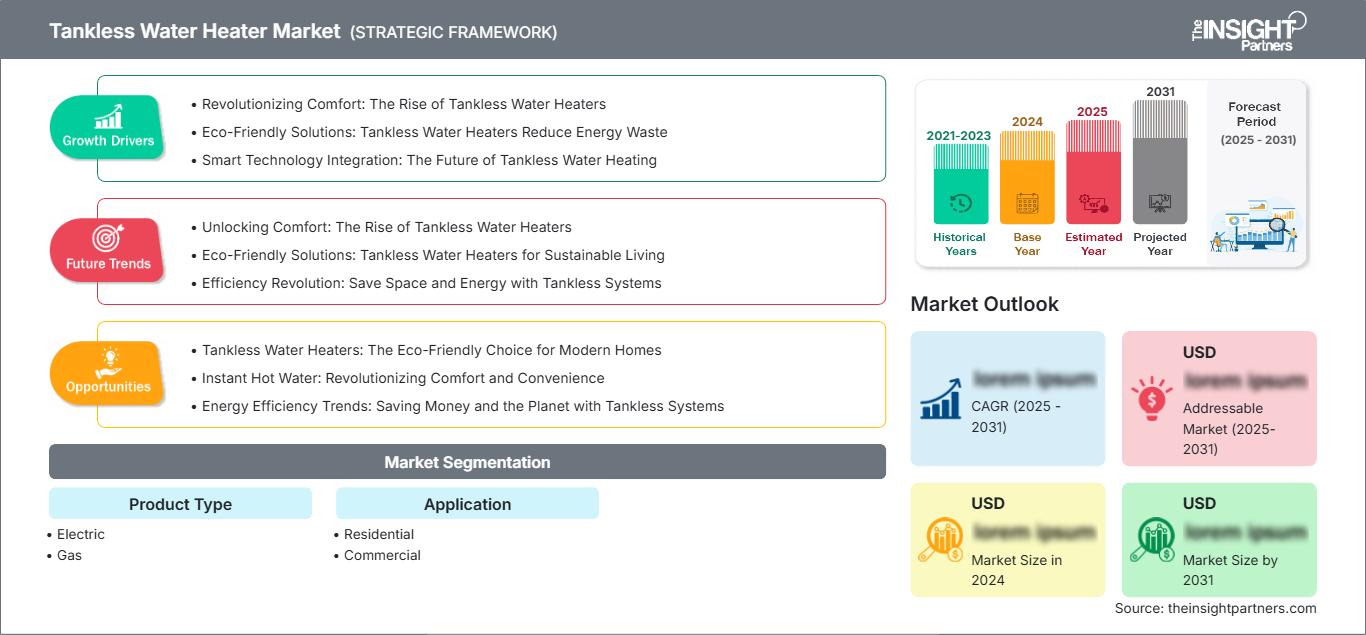
Tankless Water Heater Market: Strategic Insights
Regional Insights
North America Tankless Water Heater Market
North America is projected to advance at ~6% CAGR through 2034. The replacement of old storage heaters, matured natural gas network, heavy usage of hot water, and contractors' expertise help adoption. Condensing units with recirculation and electronic installation provide enhanced comfort along with solving the problems of efficiency and installations. The Tankless Water Heater Market shares in North America are backed by extensive wholesale distribution and product certification capabilities.
Retrofit installations in residential sector form the volume base, whereas hotels, restaurants, hospitals, laundries, and multi-residential buildings offer value-based installation opportunities. Canada gains because of local warehousing and cold weather product development, whereas Mexico provides construction-driven growth opportunities. High initial costs and retrofitting costs serve as the key obstacles to conversion.
U.S. Tankless Water Heater Market
The US accounts for an estimated ~82% of North American revenue in 2025 and is expected to grow at ~6% CAGR through 2034. This country ranks as the dominant market player in North America due to its substantial replacement base, widespread gas distribution network, product certification through codes, and manufacturers' investments in education and distribution networks. The market demand is highest in places that value hot water availability, space savings, and extended lifetimes of equipment.
Key players in this market include Rinnai Corporation, Rheem Manufacturing Company, A. O. Smith Corporation, Bradford White Corporation, Navien, Inc., Noritz America Corporation, and Robert Bosch LLC. In residential projects, condensing technology and recirculation are popular among consumers, whereas multi-unit arrangements are employed in commercial applications. There is no access to electrical service for some whole-home resistance models, but point-of-use options are available.
Europe Tankless Water Heater Market
Europe represents an estimated ~34% of global revenue in 2025 and is projected to expand at ~5% CAGR through 2034. The region leads through long-established use of instantaneous systems, compact homes, renovation activity, high energy awareness, and stringent building-efficiency expectations. Germany is the leading country in Europe, supported by strong engineering capability, replacement demand, and consumer familiarity with efficient hot-water equipment.
The UK blends a tradition of combi-boilers with selective electric point-of-use demand, whereas France considers increasingly the advantages of electrification and energy efficiency in their renovation schemes. Italy and Spain derive some advantage from smaller houses, higher inlet-water temperatures, and appliance renewal, but local fuel economics determine the solution to adopt. In these markets, purchasers compare tankless appliances not only against storage boilers but also against heat pumps and heating packages.
The incumbent brands Stiebel Eltron, Inc., Robert Bosch LLC, among others, compete on energy efficiency, compactness, controllability, and availability of service. Growth is limited by market maturity, yet propelled by replacement, rising energy performance standards, and limited urban space. The hybrid product portfolio and installation support will play an important role in decarbonizing buildings and yielding different results for gas and electric appliances due to national grid conditions.
APAC Tankless Water Heater Market
Asia Pacific holds an estimated ~27% global share in 2025 and is the fastest-growing region at ~7% CAGR through 2034. China is the major country in the Asia-Pacific region due to its widespread manufacturing processes, apartment needs, and appliance renewal. Japan and South Korea provide advanced instant gas expertise and connected appliances. India provides growth because of urban housing requirements, small point-of-use electric appliances, and improved appliance penetration, whereas Australia focuses on efficient gas and electric appliances according to local energy policy.
Regional expansion depends on construction, growing income levels, electrification, localized production, and small equipment requirements. The success of the products depends on voltage match, gas type, water pressure, climate, and services by each country.
Middle East & Africa Tankless Water Heater Market
The Middle East & Africa market is expected to grow at ~6% CAGR through 2034. The UAE is the leading country in the Middle East & Africa where premium residential, hospitality, and mixed-use construction supports efficient compact systems. Saudi Arabia adds project-scale demand linked to tourism and urban infrastructure, while warm inlet water can improve achievable flow.
South Africa presents selective opportunity where electricity reliability, tariffs, solar integration, and backup requirements influence technology choice. Across the Rest of MEA, adoption remains fragmented because installer capability, power quality, gas access, and upfront affordability vary widely. Distributors that combine application engineering, spare parts, and installer training can reduce operational risk and improve specification confidence.
Segmentation Analysis
Product Type
Product Type is projected to grow at ~6% CAGR during 2026–2034 as manufacturers refine condensing gas systems and compact electric platforms. The Tankless Water Heater Market scope includes electric and gas products, each addressing distinct infrastructure, flow, and installation requirements. Gas remains important for high flow and cold-water temperature rise, while electric systems benefit from simple vent-free installation and point-of-use flexibility.
- Electric: Electric units lead with ~62% share in 2025 and suit apartments, washrooms, remote fixtures, and lower-flow applications. Their strategic importance rises with building electrification, though panel capacity and local electricity pricing shape whole-home viability.
- Gas: Gas models serve whole-home and commercial loads requiring higher flow rates. Condensing heat exchangers, adaptive combustion, ultra-low-emission designs, and fuel-convertible platforms strengthen performance, while venting and gas-line upgrades affect installed cost.
Application
Application demand is forecast to increase at ~6% CAGR through 2034. Residential replacements supply recurring volume, while commercial projects create higher equipment value through multi-unit arrays, redundancy, and engineered controls. Specification decisions vary by simultaneous hot-water load, inlet temperature, utility availability, maintenance access, and downtime risk, making application engineering a central route to market.
- Residential: Residential demand is the market’s volume foundation, driven by replacement cycles, space savings, continuous hot water, and connected controls. Adoption is strongest when contractors can reuse suitable utility connections and clearly demonstrate lifecycle benefits.
- Commercial: Commercial applications hold ~28% share in 2025 and are projected to grow at ~7% CAGR. Hotels, restaurants, clinics, schools, laundries, and multifamily properties value modular capacity, redundancy, remote diagnostics, and reduced mechanical-room footprint.
Opportunity Snapshot
| Application | Revenue Contribution | Trend Tag | Adoption Stage |
| Residential | High | Smart Recirculation | Mature |
| Commercial | Medium | Modular Arrays | Scaling |
Tankless Water Heater Market Growth Drivers and Impact Analysis
Replacement of Aging Storage Water Heaters
Replacement is a durable growth engine because water heaters are essential assets and failure often triggers an immediate purchase. Tankless systems compete effectively where buyers want a smaller footprint, continuous hot water, and lower standby loss. The commercial impact extends beyond equipment sales: conversions can require venting, gas-line, electrical, condensate, and recirculation work, creating value for distributors and contractors. Manufacturers that simplify retrofit dimensions, venting choices, fuel conversion, and controls can capture more emergency and planned replacements. However, the purchase decision remains sensitive to installed cost, so clear sizing, transparent lifecycle economics, and dependable local service are essential to turn replacement intent into conversion.
Efficiency, Emissions, and Building Performance Requirements
Building owners are increasingly assessed on energy use, operating cost, and equipment emissions. Tankless designs eliminate storage standby losses, while condensing gas units recover more heat from exhaust and electric models avoid on-site combustion. Standards, certifications, utility programs, and building codes influence which models contractors recommend and which projects can access incentives. The impact is strongest where energy prices are high or renovation rules require measurable performance improvements. Vendors must therefore provide verified efficiency data, compliant venting, low-emission combustion, and documentation for specifiers. Policy direction also creates portfolio risk, encouraging manufacturers to maintain both high-efficiency gas and electric offerings rather than depend on one fuel pathway.
Commercial Need for Scalable, Redundant Hot-Water Capacity
Hotels, restaurants, healthcare facilities, schools, laundries, and multifamily buildings experience variable demand peaks and cannot tolerate prolonged hot-water outages. Cascaded tankless arrays address this requirement by staging units as demand changes and allowing individual modules to be serviced while remaining capacity operates. Pre-engineered racks, common venting, controls, and remote monitoring reduce design complexity and improve lifecycle management. This driver raises average project value and favors suppliers with application engineering, commissioning support, replacement parts, and commercial warranties. It also expands the contractor role from appliance installation to system integration, creating recurring service opportunities and strengthening channel loyalty.
Tankless Water Heater Market Future Trends
Connected Commissioning and Predictive Service
Tankless Water Heater Market trends will increasingly center on digital commissioning, remote diagnostics, usage analytics, and predictive maintenance. Smartphone setup can reduce installation errors, while connected controls can optimize recirculation schedules, identify abnormal combustion or flow conditions, and alert contractors before service interruptions. Commercial portfolios will gain the most because operators can monitor staged arrays across multiple sites. Data ownership, cybersecurity, and interoperability with building-management systems will become purchasing criteria. Manufacturers that convert diagnostic data into practical service workflows can improve uptime and lower warranty cost, but connected features must remain optional, intuitive, and supported throughout the product lifecycle.
Fuel-Flexible Portfolios and Selective Electrification
Future portfolios will reflect uneven decarbonization rather than a uniform shift to one technology. High-output gas tankless systems will remain relevant where gas infrastructure, cold inlet water, and simultaneous demand favor combustion. Electric resistance products will grow in point-of-use and lower-flow applications, especially as renewable generation expands. Manufacturers will respond with fuel-convertible gas platforms, broader voltage options, hybrid system controls, and products designed to coordinate with solar or heat-pump equipment. This strategy reduces exposure to regional policy divergence and lets distributors serve renovation, new-build, residential, and commercial needs with fewer core platforms.
Tankless Water Heater Market Opportunities
Commercial Retrofit Packages for Multi-Site Operators
A strong investment opportunity lies in standardized retrofit packages for restaurant, hotel, retail, and healthcare portfolios. Tankless Water Heater Market Forecasts indicate that commercial applications will outpace the overall market as operators seek redundancy, floor-space savings, and controllable energy use. Suppliers can combine site audits, load modeling, pre-engineered racks, financing, installation partnerships, monitoring, and preventive service into repeatable programs. Multi-site standardization lowers procurement friction and gives manufacturers predictable replacement pipelines. The winning offer will quantify installed cost, downtime avoidance, and maintenance requirements rather than relying on equipment efficiency alone.
Localized Installer Training and Aftermarket Networks
Emerging geographies offer demand potential, but adoption can stall when technicians lack sizing, venting, electrical, water-quality, or commissioning expertise. Manufacturers and distributors can invest in regional training centers, mobile demonstrations, certification, spare-parts hubs, and multilingual digital support. The opportunity is especially relevant in Asia Pacific, the Middle East, and selected African cities where construction grows faster than specialist capability. Strong aftermarket infrastructure reduces perceived risk for developers and facility managers, increases correct installation, and protects product reputation. It also creates recurring revenue through maintenance kits, descaling, sensors, controls, and replacement components.
Recent Developments
- August 2026: Bradford White Corporation launched Infiniti GS and GR 150,000 BTU/h models for residential and commercial use. The ENERGY STAR-certified units use stainless-steel heat exchangers, support indoor or outdoor installation, and operate on natural gas or propane. The GR adds an integrated recirculation pump, addressing hot-water wait time and water waste while broadening contractor application flexibility.
- April 2026: Noritz America Corporation upgraded its EZ Series Pro residential condensing tankless line with a larger multifunction control panel. The integrated interface improves access to system status, startup, diagnostics, operation, and maintenance data, reducing dependence on a separate controller and reinforcing the industry shift toward installer-focused digital servicing.
- February 2025: Rinnai America Corporation presented its SENSEI RX platform at AHR Expo 2025. The series offers up to 0.98 Uniform Energy Factor, adaptive gas-valve technology, natural gas or propane flexibility, indoor or outdoor installation, smartphone-assisted setup, recirculation intelligence, and simplified flushing, illustrating the move toward common platforms and faster field service.
Frequently Asked Questions

- Comprehensive Market Sizing and Forecast Analysis
- Detailed Segmentation Analysis
- In-Depth Market Dynamics Assessment
- Regional and Country-Level Insights
- Competitive Landscape and Company Benchmarking
- Strategic Business Intelligence
Recent Reports
Testimonials

The Insight Partners provided valuable market intelligence that supported our global go-to-market strategy. Their team was professional, responsive, and attentive to our feedback, providing thoughtful analysis and helpful methodological clarifications throughout the project.
Junmo Kim Chief Financial Officer (CFO), Enertech Co., Ltd.
The Insight Partners' SCADA System Market report is comprehensive, with valuable insights on current trends and future forecasts. The team was highly professional, responsive, and supportive throughout. We are very satisfied and highly recommend their services.
RAN KEDEM Partner, Reali Technologies LTDs
I requested a report on a very specific software market and the team produced the report in a few days. The information was very relevant and well presented. I then requested some changes and additions to the report. The team was again very responsive and I got the final report in less than a week.
JEAN-HERVE JENN Chairman, Future Analytica
We worked with The Insight Partners for an important market study and forecast. They gave us clear insights into opportunities and risks, which helped shape our plans. Their research was easy to use and based on solid data. It helped us make smart, confident decisions. We highly recommend them.
PIYUSH NAGPAL Sr. Vice President, High Beam Global
The Insight Partners delivered insightful, well-structured market research with strong domain expertise. Their team was professional and responsive throughout. The user-friendly website made accessing industry reports seamless. We highly recommend them for reliable, high-quality research services
YUKIHIKO ADACHI CEO, Deep Blue, LLC.
This is the first time I have purchased a market report from The Insight Partners.While I was unsure at first, I visited their web site and felt more comfortable to take the risk and purchase a market report.I am completely satisfied with the quality of the report and customer service. I had several questions and comments with the initial report, but after a couple of dialogs over email with their analyst I believe I have a report that I can use as input to our strategic planning process.Thank you so much for taking the extra time and making this a positive experience.I will definitely recommend your service to others and you will be my first call when we need further market data.
JOHN SUZUKI President and Chief Executive Officer, Board Director, BK Technologies
I wish to appreciate your support and the professionalism you displayed in the course of attending to my request for information regarding to infectious disease IVD market in Nigeria. I appreciate your patience, your guidance, and the fact that you were willing to offer a discount, which eventually made it possible for us to close a deal. I look forward to engaging The Insight Partners in the future, all thanks to the impression you have created in me as a result of this first encounter.
DR CHIJIOKE ONYIA MANAGING DIRECTOR, PineCrest Healthcare Ltd.Reason to Buy
- Informed Decision-Making
- Understanding Market Dynamics
- Competitive Analysis
- Identifying Emerging Markets
- Customer Insights
- Market Forecasts
- Risk Mitigation
- Boosting Operational Efficiency
- Strategic Planning
- Investment Justification
- Tracking Industry Innovations
- Aligning with Regulatory Trends





 Get Free Sample for