
Temperature Detection Screen Market Share, Size & Demand by 2034
Coverage: By Type (Handheld, Fixed); Application (Government and Law Enforcement, Military, Healthcare, Energy, Logistics, Other) , and Geography (North America, Europe, Asia Pacific, and South and Central America)
- Status : Data Released
- Report Code : TIPRE00020768
- Category : Electronics and Semiconductor
- No. of Pages : 150
- Available Report Formats :


- Last update date : July 13, 2026


2025 Market Size
US$ 3.98 Bn
Base year value
2034 Forecast
US$ 8.89 Bn
Projected by 2034
CAGR 2026-2034
9.35 %
Growth rate
Addressable Market
US$ 57.51 Bn
(2026-2034)
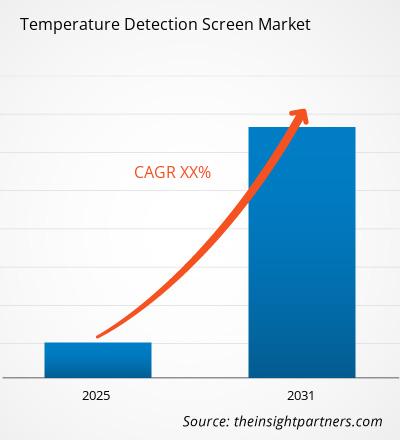
The Temperature Detection Screen Market size is projected to grow from US$ 3.98 Billion in 2025 to US$ 8.89 Billion by 2034; it is expected to register a CAGR of 9.35% during 2026–2034. The growth drivers include increased adoption of thermal imaging for non-contact temperature screening in controlled access places, borders, entrances to healthcare facilities, industrial sites, and logistic centers where preliminary screening is increasingly being incorporated in security and safety processes.
In North America, the market is projected to grow at a CAGR of 8.8-9.4% between 2023 and 2034, driven by conversion of temporary screening solutions to access control systems in government facilities, healthcare institutions, airports, and energy plants. The region enjoys advantages in terms of existing thermal imaging providers, better procurement process, and airport recovery – IATA has stated that in 2025 the demand for global airline travel increased by 5.3%.
Temperature Detection Screen Market Assessment and Insights
- North America: Temperature Detection Screen Market Share in 2025 is estimated at 33–36%, growing at a CAGR between 2026–2034 of 8.8–9.4%, supported by healthcare resilience, public safety upgrades, and mature security infrastructure procurement.
- US: Share in 2025 is estimated at 74–78% of North America, growing at a CAGR between 2026–2034 of 8.7–9.3%, led by federal facilities, hospitals, logistics corridors, and defense contractors.
- Europe: Share in 2025 is estimated at 24–27%, growing at a CAGR between 2026–2034 of 8.4–9.0%, with Germany, the UK, France, Italy, and Spain leading adoption across healthcare, industry, and transport nodes.
- Asia Pacific: Share in 2025 is estimated at 27–30%, growing at a CAGR between 2026–2034 of 10.2–10.8%, led by China, Japan, South Korea, India, and Australia through industrial security and smart infrastructure spending.
- Largest Segment: Fixed systems hold a market share of 58–62% in 2025 and grow at a CAGR of 9.1–9.7% during 2026–2034, reflecting permanent screening integration.
- High Growth Segment: Logistics holds a market share of 10–13% in 2025 and grows at a CAGR of 10.6–11.2% during 2026–2034 as automated warehouses and ports adopt contactless screening.
- Key companies analyzed in detail: Teledyne FLIR LLC, Fluke Corporation, InfraTec GmbH Infrarotsensorik und Messtechnik, Leonardo S.p.A., L3Harris Technologies, Inc., Optotherm, Inc., Opgal Optronic Industries Ltd., Thermoteknix Systems Ltd., Xenics NV, 3M Company, Axis Communications AB, AMETEK Land.
Source: The Insight Partners' analysis based on proprietary research, government publications, company annual reports, investor presentations, industry databases, and expert interviews.
The Temperature Detection Screen Market forecast has evolved from episodic fever-screening purchases into a broader thermal sensing and access-control category. Current fixed camera solutions incorporate calibration references, analysis and alarm management, while handheld systems continue to play an important role in inspection and portable checkpoint solutions. Manufacturing trends have moved towards compact uncooled infrared cores, edge processing and durable casings, simplifying the deployment process for government, health care, energy and logistics clients.
Future requirements will depend on the development of new airport terminals, energy security measures, defense system upgrades and hospital planning related to infection control procedures. Asia Pacific and the Middle East are likely to see new installations due to increased transportation capacity and infrastructure development. The regulatory focus on workplace safety, border security and disease readiness will keep the Temperature Detection Screen Market growth tied to business continuity, not to emergency expenses.
Temperature Detection Screen Market Report Scope
| Report Attribute | Details |
|---|---|
| Market size in 2025 | US$ 3.98 Billion |
| Market Size by 2034 | US$ 8.89 Billion |
| Global CAGR (2026 - 2034) | 9.35% |
| Historical Data | 2021-2024 |
| Forecast period | 2026-2034 |
Temperature Detection Screen Market Analysis
The demand is motivated by the need to scan individuals, equipment, and work areas without hindering flow processes. Airports, hospitals, government facilities, military sites, power plants, and logistics centers need equipment that can detect high surface temperatures without compromising on throughput processes. Temperature Detection Screen Market size is thus tied to facility upgrade, but not health alert systems.
The ecosystem includes infrared detectors providers, lens and optics providers, analytic software providers, accessories calibration providers, system integrator services, and service partners. The supply situation rewards those firms that provide secure sensor availability, cybersecurity software, and compliance certification.
The industry's competitive structure is partially consolidated among thermal imaging experts and diversified industrial technology companies. The Temperature Detection Screen Market report features prominent players, which include Teledyne FLIR LLC, Fluke Corporation, Leonardo S.p.A., L3Harris Technologies, Inc., 3M Company, and Axis Communications AB owing to their reputation, sales channels, and security portfolio. Thermal sensing experts such as Opgal Optronic Industries Ltd., Thermoteknix Systems Ltd., Xenics NV, Optotherm, Inc., and InfraTec GmbH focus on high accuracy, flexibility, and application knowledge.
There will be investment in AI-assisted analytics, multi-sensor technologies, edge computing, and cloud-based dashboards. The vendors will encourage the use of fixed sensors to protect fixed access points and hand-held sensors for inspections staff. The differentiation in the market will depend on calibration, false alarms reduction, durability, and compatibility with video management and access control systems.
● REPORT CUSTOMIZATION
Tailor This Report To Align With Your Specific Business Requirements
This report can be customized to align precisely with your business objectives, scope, and target markets. Customization options include tailored segmentation, geography, competitive analysis, and strategic insights to support informed decision-making.
Customize This Report →WHAT YOU CAN ADJUST
- ● Segmentations
- ● Geography
- ● Competitive Analysis
- ● Language Preferences
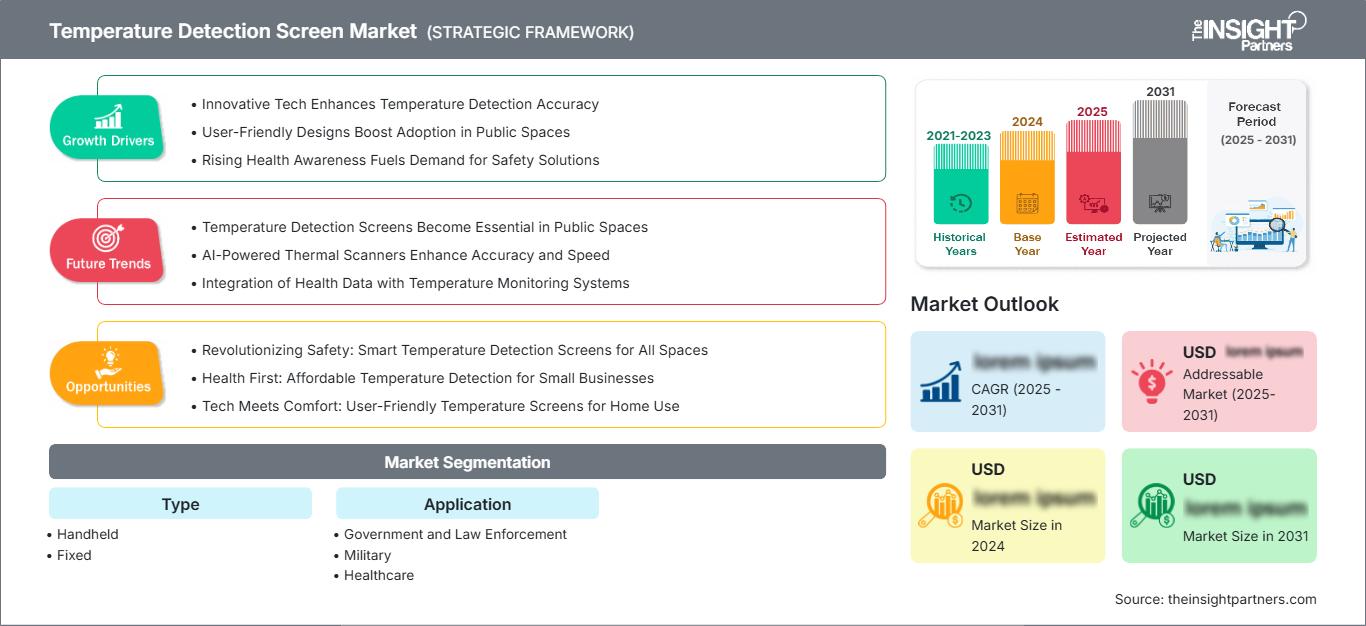
Temperature Detection Screen Market: Strategic Insights
Regional Insights
North America Temperature Detection Screen
North America held an estimated 33–36% share in 2025 and is expected to grow at a CAGR of 8.8–9.4% during 2026–2034. Adoption will take place in hospitals, airports, government buildings, law enforcement centers, energy infrastructure, and logistics centers that have incorporated their screening system into their overall security and emergency plans. Procurement cycles are driven by federal grants, hospital capital spending, and security of critical infrastructures investments. Suppliers will benefit from the installed base in thermal imaging cameras, video management, and building automation systems. There is also an adoption of North American Temperature Detection Screen Market due to OSHA-compliant workplace safety and expanded airport capacity.
U.S. Temperature Detection Screen Market
The U.S. accounted for 74–78% of North America in 2025 and is projected to grow at a CAGR of 8.7–9.3% during 2026–2034. Demand is concentrated in federal buildings, hospital networks, airports, border facilities, military bases, warehouses, and energy infrastructure, where screening must align with access control and surveillance workflows. Teledyne FLIR LLC, Fluke Corporation, L3Harris Technologies, Inc., 3M Company, and AMETEK Land maintain strong U.S. channels, supporting replacement cycles and integration services. Healthcare systems prioritize low-friction triage points, while logistics operators use fixed screening near workforce entry zones and high-volume dispatch areas.
Europe Temperature Detection Screen Market
Europe held an estimated 24–27% share in 2025 and is expected to grow at a CAGR of 8.4–9.0% during 2026–2034. UK excels in adoption due to modernization of airports, planning of NHS estate, and security improvements in the public sector which require the use of calibration system and reporting system that is audit-ready. Germany ranks highest among countries because of its industrial depth with the help of manufacturing factories, research labs, logistics parks, and energy facilities that require continual thermal monitoring. The Germans focus on accuracy, life cycle services, and compatibility with building automation increasing the demand for fixed installations and advanced infrared technology. The contribution of France, Italy, and Spain comes through transport security, healthcare refurbishing, and security programs in public facilities. France has higher demand for defense and airports; Italy for industrial safety and Spain for tourism-based terminals and logistics facilities.
APAC Temperature Detection Screen Market
APAC held an estimated 27–30% share in 2025 and is projected to grow at a CAGR of 10.2–10.8% during 2026–2034, with China leading through manufacturing scale, transport expansion, and security-linked infrastructure programs. Japan and South Korea adopt systems for precision manufacturing, airports, and electronics facilities where calibrated screening supports workforce continuity. India is scaling logistics parks, metro systems, and healthcare infrastructure, creating demand for cost-efficient fixed and handheld solutions. Australia contributes through mining, energy, border control, and airport upgrades. Policy emphasis on public health preparedness and industrial safety broadens the Temperature Detection Screen Market forecast across critical worksites, ports, and emergency response operations.
Middle East & Africa Temperature Detection Screen Market
Middle East and Africa is expected to grow at a CAGR of 9.0–9.6% during 2026–2034, with Saudi Arabia leading regional deployments across airports, energy assets, smart city projects, and government facilities. The UAE shows steady demand from aviation, hospitality, ports, and critical infrastructure, where rapid people screening supports operational continuity. South Africa uses handheld and fixed systems in mines, logistics centers, hospitals, and public security applications. Rest of MEA adoption depends on transport investment, oil and gas security, and healthcare capacity expansion. Energy infrastructure remains the anchor application because remote sites require resilient, low-contact monitoring tools.
Segmentation Analysis
Type
The type segment in the Temperature Detection Screen is projected to grow at a CAGR of 9.0–9.6% during 2026–2034 as buyers balance fixed entry-point coverage with mobile inspection needs. Fixed systems dominate permanent installations, while handheld devices support patrols, maintenance teams, temporary checkpoints, and field response. Procurement decisions increasingly consider calibration, software usability, durability, and integration with existing facility systems.
- Handheld systems remain important for flexible inspections, mobile triage, temporary events, and dispersed industrial assets where operators need rapid spot checks without installing permanent screening infrastructure.
- Fixed systems lead the market because entrances, hospitals, airports, and logistics facilities require continuous screening, automated alerts, and integration with access control, surveillance, and incident management platforms.
Application
The application segment in the Temperature Detection Screen is projected to grow at a CAGR of 9.4–10.0% during 2026–2034 as screening moves from emergency response to routine facility resilience. Government, military, healthcare, energy, and logistics users evaluate solutions differently, but all prioritize rapid detection, minimized queues, and reliable documentation. Temperature Detection Screen Market trends show stronger preference for fixed, networked systems in high-throughput environments.
- Government and law enforcement demand focuses on border points, detention facilities, courthouses, and public buildings where fast screening supports security checks and emergency preparedness planning.
- Military applications require rugged devices, secure integration, and field-ready operation across bases, checkpoints, mobile units, and defense platforms where thermal awareness supports force protection.
- Healthcare users prioritize entrance screening, emergency department triage, infection-control workflows, and visitor management, with buyers emphasizing calibration consistency and low disruption to patient movement.
- Energy facilities adopt screening for refineries, utilities, pipelines, and remote worksites where worker safety, asset protection, and restricted-area access require resilient monitoring.
- Logistics operators use systems in ports, warehouses, cold-chain facilities, and distribution centers where high workforce density and shift changes make automated screening strategically valuable.
Opportunity Snapshot
| Application | Revenue Contribution | Trend Tag | Adoption Stage |
| Government and Law Enforcement | High | Border Screening | Mature |
| Military | Medium | Force Protection | Scaling |
| Healthcare | High | Entrance Triage | Mature |
| Energy | Medium | Site Safety | Scaling |
| Logistics | Medium | Warehouse Access | Emerging |
Temperature Detection Screen Market Growth Drivers and Impact Analysis
Permanent access-control integration
The facility owners are upgrading the stand-alone screening booths to become part of an access control checkpoint system. The effect will be most pronounced in airports, hospitals, governmental buildings, logistic centers, and energy facilities that employ ID verification, camera surveillance, or guard process at all of their entrances. Information about temperature becomes more valuable when the notifications relate to door locks, logs of visitors, and reports of incidents. Such system integration increases the average price of a project, since it allows customers to buy a whole package of equipment and services, such as cameras, calibration devices, software, installation components, and maintenance subscriptions.
Critical infrastructure safety mandates
Expectations for safety and resilience among energy production facilities, ports, data centers, defense bases, and transport hubs have become stricter. Screening devices help achieve these objectives by detecting unusual skin temperatures prior to the entry of people into secured or dangerous zones. The tangible effect is less time spent on manual verification, better efficiency during shifts change, and more accurate documentation for safety audit purposes. Companies also prefer non-intrusive technologies since they minimize resistance in crowded spaces. Reports of IEA concerning the issues of energy security and increasing electricity consumption demonstrate the importance of asset protection, justifying screening device investments.
Sensor accuracy and edge analytics upgrades
Improved uncooled IR sensors, radiometric camera capabilities, embedded processing, and AI assistance in analysis is increasing screening accuracy. There is more demand for solutions that cut down on false positive alerts because of light conditions, surrounding temperature, distance, or crowd movement. Edge computing reduces the burden on networks and helps make faster alerts possible for distant locations. The commercial effect is greater readiness to replace existing emergency-era products with calibrated equipment for constant operations. Solution providers able to offer small form factor, software updates, and integrations can have better margins. Such technology trajectory will help TDS grow through expanded applications beyond fever detection.
Temperature Detection Screen Market Future Trends
Multi-sensor screening corridors
The new installations are expected to blend thermal cameras along with visual cameras, identification technology, occupancy analysis, and environmental sensing devices. In place of temperature screening stations alone, facilities will have screening lanes, which will consider people traffic, surface temperature, access badges, and crowd density in one go. This approach would be useful for airports, stadia, hospitals, and industry campuses where delays could pose a threat to operations. Vendors will have to have an open interface and handle data privately to get any project. Fixed systems with modular software will be another winner because of its potential to expand features.
Radiometric modules for embedded OEM platforms
OEM adoption of compact radiometric modules will reshape product design across security gates, autonomous inspection units, robotics, and portable diagnostic devices. Lower power consumption and smaller form factors allow thermal sensing to be embedded into equipment that previously relied on separate cameras. This trend supports differentiated offerings for defense, logistics, energy, and healthcare environments where mobility and edge intelligence matter. Module suppliers with scalable manufacturing and software development kits will gain influence across the value chain. Over the forecast period, embedded platforms will widen the Temperature Detection Screen scope beyond conventional entrance screening and create new integration partnerships.
Temperature Detection Screen Market Opportunities
Managed screening services for multi-site operators
Multi-site hospitals, warehouse operators, universities, and government agencies need standardized performance across distributed facilities. Vendors can capture this opportunity through managed services that include installation, calibration checks, software updates, remote diagnostics, user training, and periodic compliance reporting. The model reduces buyer complexity and creates predictable revenue for suppliers. It also addresses a persistent pain point: many organizations own screening hardware but lack internal staff to maintain accuracy over time. Service-led contracts can increase customer stickiness and improve data quality across sites. This approach is particularly attractive where procurement teams prefer operating expenditure over fragmented device purchases.
Industrial safety integration in energy and logistics
Energy and logistics facilities offer high-value opportunities because they combine workforce density, restricted zones, and continuity requirements. Suppliers can position screening systems as part of industrial safety architectures that include access control, gas detection, fire monitoring, and predictive maintenance. The business case improves when thermal screening supports both personnel safety and process oversight. Ports, refineries, utilities, cold-chain facilities, and automated warehouses are especially relevant because downtime carries direct financial consequences. Partnerships with systems integrators and facility automation vendors will be essential. This opportunity favors rugged fixed systems, remote monitoring, and analytics that can operate reliably in harsh environments.
Recent Developments
- June 2026: Teledyne FLIR LLC — launched Boson SX8, an NDAA-compliant uncooled LWIR thermal camera module with 1280 × 1024 resolution and 8-micron pixel pitch for defense, industrial, perimeter security, handheld, and AI-enabled applications, strengthening embedded thermal imaging options for compact systems.
- June 2026: Fluke Corporation — showcased AI-driven eMaint capabilities at Maintec 2026, reinforcing its strategy around connected maintenance workflows and digital asset management. The development supports broader industrial monitoring demand where thermal imaging, inspection, and maintenance intelligence are increasingly evaluated together by facility operators.
- September 2025: L3Harris Technologies, Inc. — signed an agreement with Kongsberg Defence & Aerospace to provide WESCAM MX-10D electro-optical and infrared sensor systems for counter-unmanned systems land vehicles, expanding deployment of advanced EO/IR sensing in defense applications.
Frequently Asked Questions

- Comprehensive Market Sizing and Forecast Analysis
- Detailed Segmentation Analysis
- In-Depth Market Dynamics Assessment
- Regional and Country-Level Insights
- Competitive Landscape and Company Benchmarking
- Strategic Business Intelligence
Recent Reports
Testimonials

The Insight Partners' SCADA System Market report is comprehensive, with valuable insights on current trends and future forecasts. The team was highly professional, responsive, and supportive throughout. We are very satisfied and highly recommend their services.
RAN KEDEM Partner, Reali Technologies LTDs
I requested a report on a very specific software market and the team produced the report in a few days. The information was very relevant and well presented. I then requested some changes and additions to the report. The team was again very responsive and I got the final report in less than a week.
JEAN-HERVE JENN Chairman, Future Analytica
We worked with The Insight Partners for an important market study and forecast. They gave us clear insights into opportunities and risks, which helped shape our plans. Their research was easy to use and based on solid data. It helped us make smart, confident decisions. We highly recommend them.
PIYUSH NAGPAL Sr. Vice President, High Beam Global
The Insight Partners delivered insightful, well-structured market research with strong domain expertise. Their team was professional and responsive throughout. The user-friendly website made accessing industry reports seamless. We highly recommend them for reliable, high-quality research services
YUKIHIKO ADACHI CEO, Deep Blue, LLC.
This is the first time I have purchased a market report from The Insight Partners.While I was unsure at first, I visited their web site and felt more comfortable to take the risk and purchase a market report.I am completely satisfied with the quality of the report and customer service. I had several questions and comments with the initial report, but after a couple of dialogs over email with their analyst I believe I have a report that I can use as input to our strategic planning process.Thank you so much for taking the extra time and making this a positive experience.I will definitely recommend your service to others and you will be my first call when we need further market data.
JOHN SUZUKI President and Chief Executive Officer, Board Director, BK Technologies
I wish to appreciate your support and the professionalism you displayed in the course of attending to my request for information regarding to infectious disease IVD market in Nigeria. I appreciate your patience, your guidance, and the fact that you were willing to offer a discount, which eventually made it possible for us to close a deal. I look forward to engaging The Insight Partners in the future, all thanks to the impression you have created in me as a result of this first encounter.
DR CHIJIOKE ONYIA MANAGING DIRECTOR, PineCrest Healthcare Ltd.Reason to Buy
- Informed Decision-Making
- Understanding Market Dynamics
- Competitive Analysis
- Identifying Emerging Markets
- Customer Insights
- Market Forecasts
- Risk Mitigation
- Boosting Operational Efficiency
- Strategic Planning
- Investment Justification
- Tracking Industry Innovations
- Aligning with Regulatory Trends





 Get Free Sample for