
Touch Screen Kiosk Market Size, Share & Forecast by 2034
Coverage: by Product (Hardware, Software and Services); Type (Bank Kiosks, Vending Kiosks, Self-Service Kiosks); Industry Vertical (BFSI, Government, Entertainment, Hospitality, Retail, Healthcare, Others) , and Geography (North America, Europe, Asia Pacific, and South and Central America)
- Status : Data Released
- Report Code : TIPRE00009554
- Category : Electronics and Semiconductor
- No. of Pages : 150
- Available Report Formats :


- Last update date : October 16, 2026


2025 Market Size
US$ 19.43 Bn
Base year value
2034 Forecast
US$ 41.96 Bn
Projected by 2034
CAGR 2026-2034
8.93 %
Growth rate
Addressable Market
US$ 274.78 Bn
(2026-2034)
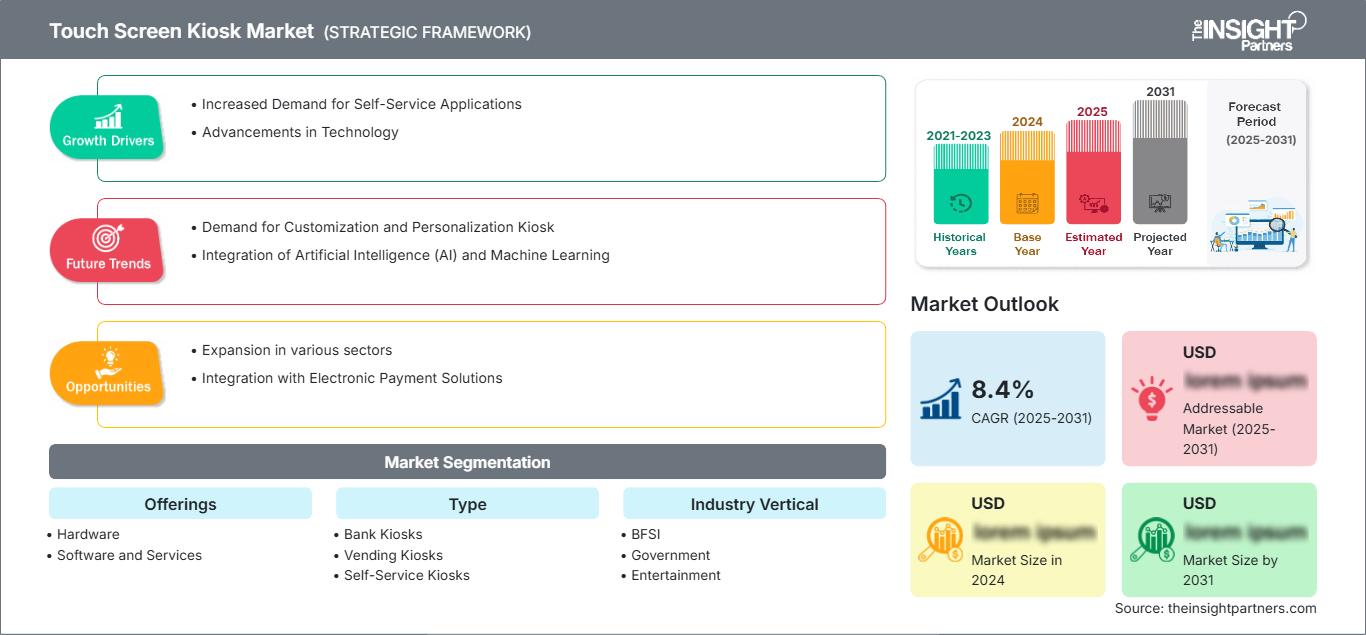
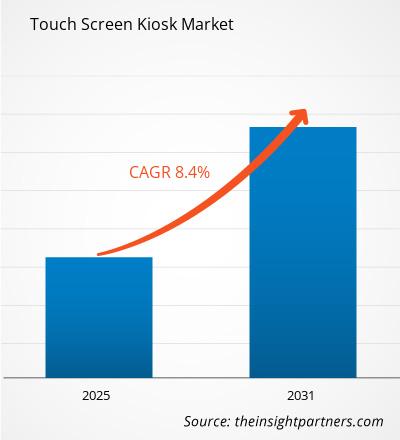
The Touch Screen Kiosk Market reached US$ 19.43 Billion in 2025 and is projected to reach US$ 41.96 Billion by 2034, registering a CAGR of 8.93% during 2026–2034. The market covers touchscreen-enabled interactive terminals used for self-service transactions, information access, ordering, payments, check-in, ticketing, and customer engagement across commercial and public environments. Hardware, software, and services increasingly operate as an integrated ecosystem, allowing organizations to connect physical customer touchpoints with enterprise applications and digital workflows.
The North American Touch Screen Kiosk Market size is expected to expand at ~7% CAGR through 2034. Demand is supported by established self-service infrastructure, widespread digital payment adoption, and continued deployment across retail, banking, hospitality, healthcare, and government facilities. Replacement of legacy terminals with connected devices is also encouraging vendors and operators to prioritize modular hardware, remote monitoring, cybersecurity, and software-driven functionality.
Touch Screen Kiosk Market Assessment and Insights
Regional Outlook
- North America: ~31% of the global Touch Screen Kiosk Market share in 2025 | ~7% CAGR through 2034. Market position: North America holds the largest regional position, supported by mature self-service deployments, strong enterprise software integration, digital payment infrastructure, and demand from retail, BFSI, hospitality, healthcare, and government applications.
- US: ~79% of North American market revenue in 2025 | ~7% CAGR through 2034. Market position: The US represents the largest country market in North America, supported by extensive retail and QSR deployments, established ATM infrastructure, public-service digitization, and continuous investment in connected customer-service terminals.
- Europe: ~27% of the global market in 2025 | ~8% CAGR through 2034. Market position: Europe has a mature self-service ecosystem, with Germany representing the leading country in Europe. The UK, France, Italy, and Spain also support demand through retail automation, transportation, hospitality, and public-service digitization.
- Asia Pacific: ~30% of the global market in 2025 | ~11% CAGR through 2034. Market position: Asia Pacific is the fastest-growing region, supported by large urban populations, expanding digital commerce, smart-city programs, and rapid adoption across China, Japan, South Korea, India, and Australia.
Segment Outlook
- Self-Service Kiosks: ~58% Share in 2025 | ~10% CAGR through 2034. Market position: Self-service kiosks lead because they address high-volume transactions such as ordering, checkout, ticketing, payments, check-in, and information access while helping operators manage labor requirements and improve service throughput.
- Software and Services: ~32% Share in 2025 | ~11% CAGR through 2034. Market position: Software and services represent the higher-growth main segment as operators increasingly require remote monitoring, device management, analytics, cybersecurity, cloud connectivity, content management, and lifecycle support across distributed kiosk estates.
Competitive Coverage
Advanced Kiosks (H32 Design and Development LLC), Diebold Nixdorf, Incorporated, Embross, Frank Mayer and Associates, Inc., KIOSK Information Systems, Lilitab LLC, Meridian Kiosks, NCR Voyix Corporation, Olea Kiosks Inc., REDYREF Interactive Kiosks
Methodology
The Insight Partners follows Data Collection & Secondary Research, Primary Research, Data Analysis, and Data Triangulation & Final Review to validate market estimates and insights.
Source: The Insight Partners' analysis based on proprietary research, government publications, company annual reports, investor presentations, industry databases, and expert interviews.
The Touch Screen Kiosk Market has moved from single stand-alone devices for basic information retrieval applications to an interconnected customer engagement infrastructure. Advances in display technology, processor technology, payments systems, connectivity solutions, biometric elements, printing, scanning, and operating system platforms have increased the functionality of the kiosks. The production process has moved towards modularity enabling the suppliers to tailor the dimensions of the enclosure, peripheral components, display screens, and computer components for a specific environment.
Future growth opportunities are now being driven more by the economics of deployment and not just availability of hardware products. The operators are assessing the kiosks on the basis of total cost of ownership, reliability, software integration, security considerations, accessibility and remote maintenance considerations. The emerging markets are being considered with the growth of digitization of customer interactions in retail, banks, hospitals, transport providers and governmental organizations. Regulatory requirements related to accessibility, payment security, data privacy and identity verification are also becoming important for product design and acquisition considerations.
Touch Screen Kiosk Market Report Scope
| Report Attribute | Details |
|---|---|
| Market size in 2025 | US$ 19.43 Billion |
| Market Size by 2034 | US$ 41.96 Billion |
| Global CAGR (2026 - 2034) | 8.93% |
| Historical Data | 2021-2024 |
| Forecast period | 2026-2034 |
Touch Screen Kiosk Market Analysis
The Touch Screen Kiosk Market is driven by organizations wishing to automate repetitive customer interactions while retaining digital access to human-assisted service options. In retail, kiosks provide ordering and checkout, product search and payment functions. For banks, kiosks facilitate self-service terminals for transactions and branch automation. The use of interactive terminals for registration and patient navigation is growing among healthcare providers. For government agencies and entertainment companies, kiosks have applications for forms, payments, ticketing, wayfinding, and identity-related purposes. Thus, demand is based on transaction volumes, labor availability, customer expectations, physical site limitations, and integration of kiosks with enterprise systems.
There is an ecosystem that consists of enclosure and display manufacturers, computing and peripheral providers, payment technology providers, software developers, system integrators, deployment providers, maintenance providers, and end users. Component availability, display specifications, payment certification, connectivity needs, and localization are some of the factors affecting supply dynamics. Vendors who can bring together hardware, software, and field service capabilities will be able to make deployment easier for multi-site customers. Remote device management is especially important now, as distributed kiosks need to be monitored, updated, and maintained without frequent physical involvement.
The Touch Screen Kiosk Market forecast shows that competitive environment is gradually transitioning from the sale of individual terminals to full-fledged systems for providing services on a self-service basis. Diebold Nixdorf integrates self-service hardware, software, and servicing abilities within the banking and retail sectors, while KIOSK Information Systems concentrates on the development of self-service solutions tailored specifically for corporate clients. Advanced Kiosks concentrates on public sector, healthcare, transport, and other applications, whereas Frank Mayer and Associates, Meridian Kiosks, Olea Kiosks, REDYREF Interactive Kiosks, Lilitab, and Embross concentrate on various combinations of enclosure design, interactive technologies, transport, healthcare, hospitality, retail, and customized deployments.
Priorities of investments are gradually changing towards connected devices, artificial intelligence, remote monitoring, payment solutions, and accessibility features as well as personalization on an application level. NCR Voyix Corporation and Diebold Nixdorf utilize their enterprise experience and relationships for business development, while specialized manufacturers utilize their ability to customize their products, be responsive to the needs of engineering teams, develop expertise within particular verticals, and perform the installations of their kiosks.
● REPORT CUSTOMIZATION
Tailor This Report To Align With Your Specific Business Requirements
This report can be customized to align precisely with your business objectives, scope, and target markets. Customization options include tailored segmentation, geography, competitive analysis, and strategic insights to support informed decision-making.
Customize This Report →WHAT YOU CAN ADJUST
- ● Segmentations
- ● Geography
- ● Competitive Analysis
- ● Language Preferences
Touch Screen Kiosk Market: Strategic Insights
Regional Insights
North America Touch Screen Kiosk Market
North America represented ~31% of the global Touch Screen Kiosk Market in 2025 and is expected to expand at ~7% CAGR through 2034. The area also has the advantage of having an established base of self-service terminals and digital transactions. Businesses, eating establishments, banks, hospitals, airports, and government organizations continue to switch out paper and labor-dependent processes for interactive terminals. Enterprise computing technology also makes it easy to integrate with payment systems, customer relations systems, inventory systems, scheduling systems, and identity systems.
In North America, the United States represents ~79% of market revenue and is the primary hub for deployment. Canada is involved in retail automation, transport, health care, and public services, while Mexico can provide business due to the development of modern retail, financial services, and customer service systems. Manufacturers are focusing on ruggedized equipment, accessibility features, security, remote management, and lifecycle support. Demand, therefore, shifts towards connected platforms that can function continually in different locations.
U.S. Touch Screen Kiosk Market
The US accounted for ~79% of North American revenue in 2025 and is projected to grow at ~7% CAGR through 2034. Larger retail networks, quick service restaurant chains, banks and financial institutions, healthcare organizations, airports, entertainment destinations, and public organizations offer a wide-ranging customer base. Applications such as self-ordering, self-checkout, check-in, ticketing, payment, and documentation processing become especially pertinent where large transaction numbers exist.
Competitors include Advanced Kiosks, Diebold Nixdorf, KIOSK Information Systems, Frank Mayer and Associates, Meridian Kiosks, Olea Kiosks, Lilitab, REDYREF Interactive Kiosks, Embross, and NCR Voyix Corporation. Deployments in recent years have involved remote support, intelligent user interfaces, identity verification, and software connectivity. In 2025, Advanced Kiosks made known new deployments for governments and public services and added AI capabilities to its kiosks.
Europe Touch Screen Kiosk Market
Europe represented ~27% of the global market in 2025 and is forecast to register ~8% CAGR through 2034. Germany is the key country in Europe due to its well-developed retail infrastructure, self-checkout system, industry, and payment system. The United Kingdom has a great deal of equipment deployed within the retail, transportation, hospitality, and public service spheres, while France is introducing self-service solutions in the retail and government sectors. Italy and Spain have their contribution from the tourism, hospitality, transportation, retail, and entertainment segments.
Also, the regional market is driven by accessibility, privacy, security, and payment needs that influence the development of the kiosk and software architecture. Germany is implementing AI-based self-service solutions in its retail sphere such as automated produce recognition and age-verification functions, thus proving that the touchscreen terminals will integrate with computer vision and store management systems.
APAC Touch Screen Kiosk Market
APAC accounted for ~30% of the global market in 2025 and is expected to grow at ~11% CAGR through 2034, making it the fastest-growing region. China leads in the Asia Pacific region due to its large-scale retail modernization, smart city projects, electronic payments, and transportation systems. Japan and South Korea have advanced automation ecosystems, whereas India is progressing in digital government services, retail organizations, health care technology, and financial services. Australia plays a role in retail, transportation, health care, and government sectors.
Industrial digitalization and infrastructure investments are driving the growth of kiosks not only in retail but also in other industries. Manufacturers now produce localized interfaces and payment methods as per local needs. The presence of high numbers of customers, penetration of electronic payments, and investments in automated services offers a solid basis for kiosk installations.
Middle East & Africa Touch Screen Kiosk Market
The Middle East and Africa market is expected to expand at ~7% CAGR through 2034. Saudi Arabia represents a significant Middle Eastern deployment center, supported by tourism, hospitality, financial services, transportation, and digital transformation initiatives. The UAE also has strong demand from airports, hotels, retail environments, government services, and smart-city projects. South Africa provides an important African market through banking, retail, healthcare, and public-service applications.
Opportunities on the regional level are related to the upgrade of infrastructure and the enhancement of service availability within busy environments. Within hospitality and transportation, there may be kiosks that offer information in several languages, registration, ticketing, payment, and navigation. The financial sector is also developing self-service solutions. Deployment of interactive teller machines by Diebold Nixdorf in Kuwait International Bank in 2025 exemplifies this trend.
Segmentation Analysis
Offerings
Hardware, Software and Services
Hardware represented the largest offering component and is expected to register ~8% CAGR during 2026–2034. Hardware demand is supported by new deployments, replacement cycles, customized enclosures, larger interactive displays, payment peripherals, scanners, printers, cameras, and computing modules. Customers increasingly require hardware that can accommodate future software and peripheral upgrades while maintaining reliability in high-traffic environments.
- Hardware: Encompasses touch displays, enclosures, computing units, payment components, printers, scanners, cameras, readers, and other physical modules. Customization is important where kiosks must meet environmental, accessibility, security, or branding requirements.
- Software and Services: Supports operating systems, user interfaces, content management, remote monitoring, analytics, cybersecurity, integration, deployment, maintenance, and technical support. Its strategic importance is increasing as customers manage larger distributed kiosk networks.
Type
Bank Kiosks, Vending Kiosks, Self-Service Kiosks
Self-Service Kiosks accounted for the largest type share and are projected to grow at ~10% CAGR during 2026–2034. Their broad applicability across ordering, checkout, ticketing, registration, payments, information, and check-in gives them a wider addressable customer base than more specialized kiosk formats. Integration with enterprise software and payment systems further supports adoption.
- Bank Kiosks: Extend branch automation beyond conventional ATMs by supporting account services, interactive teller functions, payments, document processing, and customer assistance. Banks use these terminals to increase service availability while managing branch operating requirements.
- Vending Kiosks: Combine interactive screens with product selection, payment, inventory connectivity, and automated dispensing or collection. They are relevant in foodservice, transportation, workplaces, entertainment venues, and unattended retail environments.
- Self-Service Kiosks: Serve diverse workflows including ordering, check-in, checkout, ticketing, registration, payments, and information access. Their flexibility makes them central to multi-industry kiosk deployment strategies.
Industry Vertical
BFSI, Government, Entertainment, Hospitality, Retail, Healthcare, Others
Retail remains a major industry vertical because high transaction volumes and pressure to improve checkout efficiency create a clear business case for self-service. Healthcare is expected to show strong expansion as providers digitize registration, patient navigation, payments, and administrative workflows. The broader industry mix provides diversification across consumer-facing and public-service applications.
- BFSI: Uses kiosks for banking transactions, interactive teller functions, account services, payments, and branch automation, particularly where institutions seek extended service availability.
- Government: Applies kiosks to public forms, permits, payments, document services, identity-related workflows, and citizen information. Distributed access points can reduce dependence on staffed counters for routine processes.
- Entertainment: Includes ticketing, admission, concessions, gaming-related transactions, visitor information, and venue navigation. High visitor volumes create demand for fast and intuitive customer interfaces.
- Hospitality: Hotels, resorts, restaurants, and travel venues use kiosks for check-in, ordering, payments, room-key issuance, concierge functions, and guest information.
- Retail: Supports self-checkout, self-ordering, product information, payments, loyalty engagement, and omnichannel fulfillment. Retailers increasingly connect kiosks with POS and inventory platforms.
- Healthcare: Kiosks facilitate patient registration, appointment workflows, payments, wayfinding, identity verification, and digital front-door processes while supporting accessibility and data-security requirements.
Opportunity Snapshot
| Industry Vertical | Revenue Contribution | Trend Tag | Adoption Stage |
| BFSI | High | Branch Automation | Mature |
| Government | Medium | Citizen Services | Scaling |
| Entertainment | Medium | Digital Ticketing | Scaling |
| Hospitality | Medium | Contactless Check-In | Scaling |
| Retail | High | Self Checkout | Mature |
| Healthcare | High | Patient Check-In | Scaling |
| Others | Low | Custom Workflows | Emerging |
Touch Screen Kiosk Market Growth Drivers and Impact Analysis
Expansion of Self-Service Across High-Volume Customer Environments
Organizations operating high-volume customer touchpoints are increasingly evaluating self-service as a means of improving transaction throughput and reallocating staff toward more complex activities. Retail stores can use interactive terminals for ordering and checkout, restaurants can shift routine ordering to customers, while hospitals can automate registration and payments. Banks and government agencies can similarly move selected transactions from staffed counters to digital terminals. The impact extends beyond labor considerations because kiosks can provide standardized workflows, collect structured transaction data, and operate for longer service windows. As customers become familiar with touchscreen interfaces across smartphones and digital services, the behavioral barrier to kiosk interaction declines, supporting deployment across increasingly varied environments.
Integration of Kiosks With Enterprise Digital Platforms
Kiosks increasingly function as endpoints within broader enterprise systems rather than isolated machines. Integration with POS, payment gateways, customer databases, inventory systems, appointment platforms, ticketing systems, identity services, and cloud applications allows organizations to synchronize physical and digital customer journeys. This integration increases the value of kiosk deployments because the terminal can execute business workflows rather than merely display information. It also creates recurring demand for software maintenance, cybersecurity, remote monitoring, application updates, and managed services. For vendors, the shift expands revenue opportunities beyond initial hardware sales. For buyers, integrated architecture can improve operational visibility and make multi-site deployment easier to manage.
Rising Demand for Accessible and Digitally Enabled Public Services
Government agencies, healthcare organizations, transportation operators, and other public-facing institutions are increasing their use of digital access points to simplify routine interactions. Touchscreen terminals can support multilingual interfaces, accessible workflows, document processing, payments, registration, appointment management, and information delivery. Their ability to operate in lobbies, transit locations, hospitals, public buildings, and other high-traffic environments expands access without requiring every transaction to be handled by an employee. Procurement is increasingly influenced by accessibility standards, cybersecurity, data protection, and uptime requirements. This creates demand for purpose-built hardware and software rather than generic consumer displays, benefiting vendors with experience in regulated and mission-critical deployments.
Touch Screen Kiosk Market Future Trends
AI-Enabled Conversational and Context-Aware Kiosks
The Touch Screen Kiosk Market trends show that next generation of kiosks is likely to move beyond menu-driven touchscreen interactions toward systems that combine touchscreen interfaces with conversational AI, computer vision, recommendation engines, and contextual assistance. Users could receive more adaptive guidance based on the service being requested, while operators could use analytics to identify bottlenecks and optimize workflows. AI can also support fraud detection, age verification, identity workflows, multilingual assistance, and automated customer support. Advanced Kiosks has already highlighted AI-driven features such as conversational chat, voice interaction, and intelligent service routing, while Diebold Nixdorf has deployed computer-vision capabilities in retail self-service environments.
Connected Lifecycle Management Across Distributed Kiosk Fleets
Kiosk procurement is increasingly being evaluated as a lifecycle-management challenge rather than a one-time hardware purchase. Operators with hundreds or thousands of terminals need visibility into device health, application status, component replacement, security updates, connectivity, and performance. Remote monitoring and predictive maintenance can identify faults before they interrupt customer workflows. This trend is encouraging vendors to integrate device management, analytics, service contracts, and software updates into deployment programs. KIOSK Information Systems describes IoT-based monitoring as an operational discipline for distributed self-service networks, while Olea Kiosks has highlighted lifecycle management as an important consideration because internal components can have shorter replacement cycles than kiosk enclosures.
Touch Screen Kiosk Market Opportunities
Verticalized Kiosk Platforms for Healthcare and Hospitality
Healthcare and hospitality offer opportunities for vendors that can package hardware, software, integration, and services around specialized workflows. Healthcare providers require secure patient registration, wayfinding, payment, identity, accessibility, and integration with clinical or administrative systems. Hotels and hospitality operators need check-in, identity verification, room-key issuance, concierge services, payments, and guest engagement. KIOSK Information Systems' 2026 partnership activity in hospitality and healthcare demonstrates the movement toward integrated vertical solutions rather than generic terminals. Vendors can differentiate through compliance-ready platforms, managed services, application integration, and modular configurations suited to multi-location deployments.
Expansion of Self-Service Infrastructure in Emerging Urban Markets
Emerging urban markets provide opportunities where new retail, transportation, hospitality, healthcare, and public-service infrastructure is being developed alongside digital payment and connectivity ecosystems. Vendors can address these markets through localized interfaces, multilingual software, region-specific payment methods, remote fleet management, and durable hardware suited to local operating conditions. Partnerships with system integrators and local service providers can reduce deployment complexity and improve after-sales support. The opportunity is particularly relevant in markets where organizations are moving directly toward digitally enabled service models rather than maintaining extensive legacy counter-based processes. Scalable architectures can allow customers to begin with pilots and expand deployments as utilization becomes established.
Recent Developments
- September 2026: P3 Media announced the launch of Kiosk, a custom point-of-sale extension designed to give retailers greater flexibility in using Shopify POS. The solution enables Shopify POS workflows to operate across desktops, laptops, smartphones, tablets, and touchscreen displays while supporting peripherals such as barcode scanners, receipt printers, scales, RFID readers, and cash drawers. Kiosk also allows retailers to create customized checkout workflows, integrate third-party systems, and support industry-specific retail operations
- December 2025: Touch Dynamic introduced the Summit Kiosk, a next-generation self-checkout solution designed to support retail and hospitality environments. The kiosk combines a compact, modular design with touchscreen functionality and integrated peripheral options to enable flexible self-service transactions. The solution is intended to help businesses streamline checkout operations while providing customers with a convenient and customizable self-service experience.
- May 2024: Firstouch launched a new retail kiosk solution for Daawat at its Noida location. The solution combines a dedicated branded shop kiosk, digital commercial displays, and an interactive information kiosk to enhance product visibility and customer engagement. It enables touchscreen navigation, product information, recipes and usage tips, social media integration, loyalty-program enrollment, and content updates through a centralized CMS.
Frequently Asked Questions

- Comprehensive Market Sizing and Forecast Analysis
- Detailed Segmentation Analysis
- In-Depth Market Dynamics Assessment
- Regional and Country-Level Insights
- Competitive Landscape and Company Benchmarking
- Strategic Business Intelligence
Recent Reports
Testimonials

The Insight Partners provided valuable market intelligence that supported our global go-to-market strategy. Their team was professional, responsive, and attentive to our feedback, providing thoughtful analysis and helpful methodological clarifications throughout the project.
Junmo Kim Chief Financial Officer (CFO), Enertech Co., Ltd.
The Insight Partners' SCADA System Market report is comprehensive, with valuable insights on current trends and future forecasts. The team was highly professional, responsive, and supportive throughout. We are very satisfied and highly recommend their services.
RAN KEDEM Partner, Reali Technologies LTDs
I requested a report on a very specific software market and the team produced the report in a few days. The information was very relevant and well presented. I then requested some changes and additions to the report. The team was again very responsive and I got the final report in less than a week.
JEAN-HERVE JENN Chairman, Future Analytica
We worked with The Insight Partners for an important market study and forecast. They gave us clear insights into opportunities and risks, which helped shape our plans. Their research was easy to use and based on solid data. It helped us make smart, confident decisions. We highly recommend them.
PIYUSH NAGPAL Sr. Vice President, High Beam Global
The Insight Partners delivered insightful, well-structured market research with strong domain expertise. Their team was professional and responsive throughout. The user-friendly website made accessing industry reports seamless. We highly recommend them for reliable, high-quality research services
YUKIHIKO ADACHI CEO, Deep Blue, LLC.
This is the first time I have purchased a market report from The Insight Partners.While I was unsure at first, I visited their web site and felt more comfortable to take the risk and purchase a market report.I am completely satisfied with the quality of the report and customer service. I had several questions and comments with the initial report, but after a couple of dialogs over email with their analyst I believe I have a report that I can use as input to our strategic planning process.Thank you so much for taking the extra time and making this a positive experience.I will definitely recommend your service to others and you will be my first call when we need further market data.
JOHN SUZUKI President and Chief Executive Officer, Board Director, BK Technologies
I wish to appreciate your support and the professionalism you displayed in the course of attending to my request for information regarding to infectious disease IVD market in Nigeria. I appreciate your patience, your guidance, and the fact that you were willing to offer a discount, which eventually made it possible for us to close a deal. I look forward to engaging The Insight Partners in the future, all thanks to the impression you have created in me as a result of this first encounter.
DR CHIJIOKE ONYIA MANAGING DIRECTOR, PineCrest Healthcare Ltd.Reason to Buy
- Informed Decision-Making
- Understanding Market Dynamics
- Competitive Analysis
- Identifying Emerging Markets
- Customer Insights
- Market Forecasts
- Risk Mitigation
- Boosting Operational Efficiency
- Strategic Planning
- Investment Justification
- Tracking Industry Innovations
- Aligning with Regulatory Trends





 Get Free Sample for