
Trail Camera Market Trends, Share & Demand by 2034
Coverage: By Product (Standard, Wireless); Pixel Size (Below 8 MP, 8 to 12 MP, Above 12 MP); Application (Hunting, Wildlife Monitoring, Others) , and Geography (North America, Europe, Asia Pacific, and South and Central America)
- Status : Data Released
- Report Code : TIPRE00019799
- Category : Electronics and Semiconductor
- No. of Pages : 150
- Available Report Formats :


- Last update date : October 16, 2026


2025 Market Size
US$ 128.84 Mn
Base year value
2034 Forecast
US$ 222.09 Mn
Projected by 2034
CAGR 2026-2034
6.24 %
Growth rate
Addressable Market
US$ 1,588.64 Mn
(2026-2034)
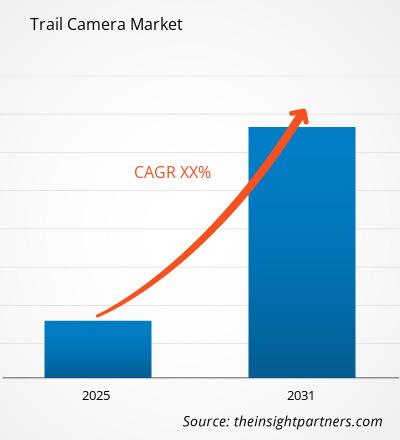
The Trail Camera Market covers motion-activated imaging systems designed for unattended observation of wildlife and outdoor environments, with applications spanning hunting and wildlife monitoring. The global market was valued at US$ 128.84 Million in 2025 and is projected to reach US$ 222.09 Million by 2034, registering a CAGR of 6.24% during 2026–2034. Product differentiation increasingly centers on connectivity, image quality, detection accuracy, battery endurance, and field deployment flexibility.
North America remains a major demand center as established hunting practices, extensive wildlife habitats, and widespread use of remote monitoring equipment support replacement and new installations. The region is expected to register a modeled CAGR of ~5% through 2034. Demand is reinforced by cellular connectivity, improved low-light imaging, and growing use of cameras for habitat observation beyond traditional hunting applications.
Trail Camera Market Assessment and Insights
Regional Outlook
- North America: ~46% of the global Trail Camera Market share in 2025 | ~5% CAGR through 2034. Market position: North America holds the largest regional position, supported by established hunting participation, extensive private and public lands, mature outdoor-equipment channels, and strong familiarity with motion-activated cameras for game scouting and wildlife observation.
- US: ~82% of North American market revenue in 2025 | ~5% CAGR through 2034. Market position: The US represents the largest country market in North America, supported by hunting applications, broad distribution through outdoor specialty channels, extensive rural properties, and increasing adoption of connected cameras for remote monitoring.
- Europe: ~24% of the global market in 2025 | ~6% CAGR through 2034. Market position: Europe has a mature conservation and outdoor-observation ecosystem, with Germany representing the leading country in Europe. The UK, France, Italy, and Spain add demand through wildlife observation, hunting estates, and habitat management.
- Asia Pacific: ~21% of the global market in 2025 | ~8% CAGR through 2034. Market position: Asia Pacific is the fastest-growing region as biodiversity programs, nature observation, remote land monitoring, and improving consumer access expand demand. China represents the leading country in Asia Pacific, supported by manufacturing depth and broad technology adoption.
Segment Outlook
- Wireless: ~55% Share in 2025 | ~8% CAGR through 2034. Market position: Wireless systems lead because remote image transmission reduces field visits and improves the usefulness of cameras installed across large properties, wildlife habitats, and hunting areas. Cellular connectivity also supports recurring service ecosystems.
- Wildlife Monitoring: ~58% Share in 2025 | ~8% CAGR through 2034. Market position: Wildlife Monitoring represents the high-growth main segment as conservation groups, researchers, land managers, and nature observers use unattended cameras to document animal presence, movement, behavior, and habitat changes over extended periods.
Competitive Coverage
Anton Seissiger GmbH, BRAUN Photo Technik GmbH, DÖRR GmbH, ICUserver GmbH, Nedis, MINOX GmbH, Simmons, SPYPOINT, SECACAM, VISTA OUTDOOR OPERATIONS LLC.
Methodology
The Insight Partners follows Data Collection & Secondary Research, Primary Research, Data Analysis, and Data Triangulation & Final Review to validate market estimates and insights.
Source: The Insight Partners' analysis based on proprietary research, government publications, company annual reports, investor presentations, industry databases, and expert interviews.
As such, innovation in technology has seen the category move from its origins of basic motion sensing cameras to those which are connected and feature higher resolution. Manufacturers are increasingly integrating infrared lighting, better motion sensing capabilities, quick trigger speeds, longer battery life, cellular transmission capability, and application-based controls into their products. As a result, manufacturing focus is currently on small electronics, energy efficiency, durable construction and image processing capability. While standard cameras are still used by budget buyers, wireless cameras have more value propositions in remote usage. Higher megapixel counts are also increasingly featured in premium products despite being less important than image usability, detection capabilities, and efficient transmission.
The future looks promising as innovations go beyond basic hunting practices. Programs involving species conservation, biodiversity observation, land management, and property surveillance present new applications for cameras that operate without human intervention. Growing demand from Asia Pacific and certain parts of Europe comes from availability of connected outdoor equipment and interest in ecology observation. Future investments are likely to be made in equipment that offers robust connectivity with low energy consumption potential. In addition, regulations and conservation initiatives may require non-invasive means of surveillance.
Trail Camera Market Report Scope
| Report Attribute | Details |
|---|---|
| Market size in 2025 | US$ 128.84 Million |
| Market Size by 2034 | US$ 222.09 Million |
| Global CAGR (2026 - 2034) | 6.24% |
| Historical Data | 2021-2024 |
| Forecast period | 2026-2034 |
Trail Camera Market Analysis
Trail Camera Market needs come from the hunters, wildlife researchers, conservation groups, landowners, nature enthusiasts, and institutions involved in the management of distant terrains. This ecosystem starts with image sensors, infrared components, processors, memory, batteries, communications, casings, and mounting equipment. The manufacturers then combine these parts to create cameras that are distributed through outdoor stores, specialized dealers, online markets, and direct sellers. In addition to this, wireless products have the dependence on telecommunications and cloud services, thus connectivity and its costs become an issue when purchasing.
Supply considerations increasingly tilt towards modular electronics and power-efficient designs. The development of sensors enables one to improve image resolution without necessarily increasing the camera’s size, but the software and the firmware affect how well the detection, filtering, and management of images work together with user experience. For wireless products, more testing is required in regards to network compatibility and power efficiency. The camera producers are also faced with a trade-off regarding high image resolution versus storage, transmission, and energy costs.
Competition will be differentiated by imaging quality, connectivity, reliability, deployment ease, cost, and brand reputation in outdoor markets. SPYPOINT focuses on connectivity and non-cellular imaging products, whereas MINOX GmbH, DÖRR GmbH, BRAUN Photo Technik GmbH, and Anton Seissiger GmbH cater to the outdoor and wildlife observation needs of Europe. VISTA OUTDOOR OPERATIONS LLC. and Simmons have outdoor equipment vendor positioning, while ICUserver GmbH, Nedis, and SECACAM diversify the specialists' competitive environment. Product lineups are increasingly overlapping in their applications in hunting and wildlife observation.
The Trail Camera Market forecast shows that future investments are being directed towards wireless connectivity, high-quality imaging, solar and power supply extension, improved infrared technology, and application-oriented management. Future strategic positioning will move away from hardware sales to providing customers with complete monitoring systems including accessories, connectivity, data management, and replacements. Outdoor vendors with good outdoor channels can extend their product offerings towards more premium solutions, while specialists can compete on compactness, regional market knowledge, and wildlife observation capabilities. In future competition will become increasingly based on reliable field operation performance rather than specifications per se.
● REPORT CUSTOMIZATION
Tailor This Report To Align With Your Specific Business Requirements
This report can be customized to align precisely with your business objectives, scope, and target markets. Customization options include tailored segmentation, geography, competitive analysis, and strategic insights to support informed decision-making.
Customize This Report →WHAT YOU CAN ADJUST
- ● Segmentations
- ● Geography
- ● Competitive Analysis
- ● Language Preferences
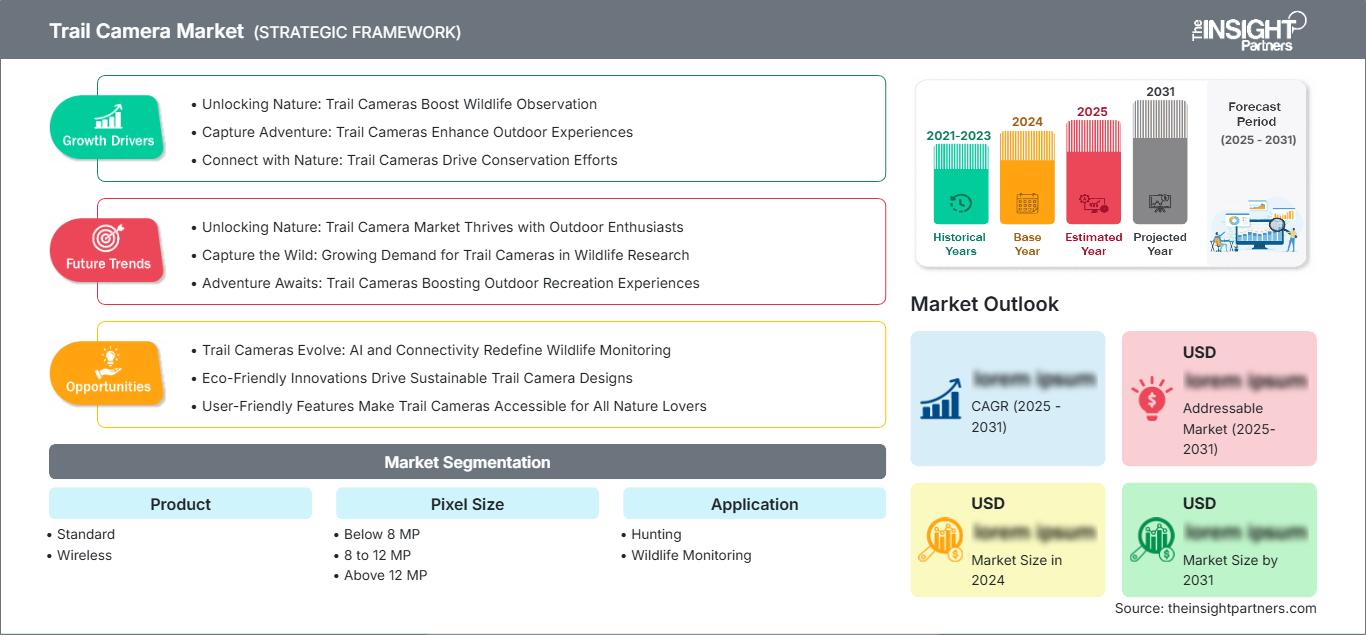
Trail Camera Market: Strategic Insights
Regional Insights
North America Trail Camera Market
North America accounted for ~46% of global demand in 2025 and is projected to grow at ~5% CAGR through 2034. It has an efficient hunting habitat system, vast forests and agriculture, and a well-established sales network of outdoor gear. The trail cameras will be helpful in analyzing animal behavior, identifying their habits, surveying remote regions, and helping in preparing for hunting. The cellular technology will prove effective especially when there is a need to track many camera sites without having to retrieve memory cards from such cameras.
The demand is majorly from the US but comes from Canada through hunting, wildlife viewing, forestry, and remote property use. Technology improvements such as those involving resolution, batteries, infrared lighting, and connectivity make product replacement easy. They can also make more sales by making their products easy to set up and operate. There being an established user base in North America, the growth is expected to come from premiumization, connectivity, wildlife monitoring, and replacement of previous devices.
U.S. Trail Camera Market
The US represented ~82% of North American Trail Camera Market revenue in 2025 and is expected to expand at ~5% CAGR through 2034. Hunting is still one of the main uses, but cameras can also be used to observe wildlife, manage properties, study habitats and monitor remote sites. Large territories and scattered placement of cameras require a practical use of motion detection system and, more and more frequently, remote access to images.
Competitors comprise such companies as SPYPOINT, Simmons, VISTA OUTDOOR OPERATIONS LLC., MINOX GmbH, and other companies which supply products aimed at hunting and wildlife observation market. Wireless cameras become more important from a strategic point of view since users do not have to go to each of the camera sites to check captures. However, regular cameras are still in demand in case of limited cellular communication and low operation costs.
Europe Trail Camera Market
Europe represented ~24% of the global Trail Camera Market in 2025 and is expected to register ~6% CAGR through 2034. Germany is the leading country in Europe, supported by established hunting traditions, nature observation, specialist outdoor equipment channels, and a strong base of regional manufacturers and brands. The UK also provides a substantial application environment through wildlife observation, land management, and outdoor activities.
Germany's market benefits from product specialization and established camera suppliers, while France and Italy offer demand linked to hunting estates, agricultural landscapes, and wildlife management. Spain adds opportunities associated with extensive rural areas and game management, while the UK supports monitoring of wildlife habitats and privately managed land. Across Europe, compact designs, low-glow infrared systems, mobile transmission, and efficient power consumption are increasingly important. Data transmission and simple remote management can improve the economics of monitoring dispersed locations, supporting gradual movement toward connected products.
APAC Trail Camera Market
APAC accounted for ~21% of global demand in 2025 and is projected to expand at ~8% CAGR through 2034, making it the fastest-growing region. China is the leading country in Asia Pacific, supported by manufacturing capabilities, electronics availability, and expanding technology adoption. Japan, South Korea, India, and Australia provide additional demand through wildlife observation, conservation, agriculture, outdoor recreation, and remote monitoring.
Policy interest in biodiversity protection and habitat observation can support institutional applications, while improving digital connectivity increases the usefulness of wireless systems. Australia offers a particularly relevant environment for remote wildlife observation because of its large geographic coverage, while India provides opportunities linked to biodiversity and protected-area monitoring. In China, electronics manufacturing and domestic technology ecosystems can support product availability and localization. Across the region, affordability, battery endurance, ruggedness, and ease of deployment remain important barriers and purchasing criteria.
Middle East & Africa Trail Camera Market
Middle East & Africa is projected to register ~7% CAGR through 2034 as wildlife conservation, protected-area monitoring, outdoor surveillance, and remote land management create demand for unattended imaging. South Africa represents the leading country in the Middle East & Africa region where evidence supports stronger commercial and conservation applications. Saudi Arabia and the UAE offer additional opportunities through large-scale land management and technology-oriented outdoor monitoring.
In Africa, cameras can support observation of wildlife movement across difficult terrain and reduce the need for continuous physical patrols. Energy availability remains a key deployment consideration, increasing the relevance of low-power electronics, solar accessories, and long-duration batteries. In the Middle East, the market is more closely associated with remote property observation, conservation initiatives, and outdoor monitoring. Suppliers able to provide durable housings and reliable operation in heat and dust can address the region's specific deployment requirements.
Segmentation Analysis
Product
Wireless products are projected to register a ~8% CAGR through 2034, reflecting the value of remote image transmission and reduced field visits. Standard cameras remain important where users prefer simple offline operation, lower ownership costs, or deployment in areas with limited cellular connectivity. Product selection increasingly depends on the balance among connectivity, battery endurance, image quality, and operating environment.
- Standard: Standard cameras serve users who prioritize straightforward installation, local storage, and lower recurring costs. They remain relevant for hunting, wildlife observation, and locations without dependable mobile coverage, while improvements in sensors, infrared illumination, and battery efficiency sustain their usefulness.
- Wireless: Wireless cameras support remote access and faster decision-making by transmitting images or notifications without requiring physical retrieval. Their strategic importance is increasing for dispersed camera networks, professional monitoring, and users seeking more frequent visibility into activity.
Pixel Size
Pixel size influences image detail, identification capability, storage demand, and power consumption. Demand is moving toward higher-resolution devices where users need clearer animal identification or detailed behavior records, although resolution remains only one part of camera performance. Efficient compression and processing help higher-resolution models remain practical for remote operation.
- Below 8 MP: Lower-resolution cameras remain relevant for basic monitoring where identification detail is less critical. Their lower processing and storage requirements can support cost-sensitive installations, making them useful for broad deployments and users prioritizing operating simplicity.
- 8 to 12 MP: This range provides a practical balance between image detail, storage requirements, and system cost. It is suited to general wildlife observation and hunting applications where dependable captures are more important than maximum photographic resolution.
- Above 12 MP: Higher-resolution cameras address users requiring greater detail for animal identification, scene interpretation, and premium hunting applications. Their importance is reinforced by improved image processing and the ability to combine detailed still images with high-definition video.
Application
Wildlife Monitoring is projected to grow at a ~8% CAGR through 2034, supported by expanding use of unattended imaging for habitat observation and animal-behavior documentation. Hunting remains a core commercial application, while wildlife programs broaden the addressable customer base. The Trail Camera Market scope therefore increasingly includes both recreational and institutional observation requirements.
- Hunting: Hunting users deploy cameras to understand animal movement, activity timing, feeding locations, and habitat use. Wireless transmission and rapid notifications can reduce scouting time, while high-resolution imaging helps users distinguish animals and evaluate activity without repeated site visits.
- Wildlife Monitoring: Wildlife monitoring supports researchers, conservation organizations, land managers, and nature observers. Cameras provide repeated observations with limited human disturbance, making them useful for documenting presence, movement, nesting, feeding, and changes in animal activity.
Opportunity Snapshot
| Application | Revenue Contribution | Trend Tag | Adoption Stage |
| Hunting | High | Remote Scouting | Mature |
| Wildlife Monitoring | High | Biodiversity Tracking | Scaling |
Trail Camera Market Growth Drivers and Impact Analysis
Remote Connectivity Reduces the Cost of Field-Based Monitoring
Wireless connectivity changes the economics of camera deployment by allowing users to receive captures without repeatedly traveling to remote locations. For hunters, this can reduce scouting trips and accelerate access to information about animal activity. For researchers and land managers, remote transmission can support more frequent review of observations and quicker identification of events requiring attention. The impact extends beyond hardware because connected systems create demand for mobile applications, data plans, cloud storage, and accessories such as external power sources. Manufacturers therefore have an opportunity to increase value per installation through integrated connectivity. At the same time, network availability, subscription costs, power consumption, and data management remain important adoption considerations, particularly for cameras positioned far from reliable infrastructure.
Higher Imaging Performance Improves Identification and Observation Quality
Improvements in image sensors, infrared illumination, processing, and video capture are raising the practical value of unattended cameras. Better image quality can help users distinguish animals, interpret behavior, and review scenes captured in low-light conditions. For hunting, clearer imagery supports assessment of movement and animal characteristics. For wildlife monitoring, improved captures can make observations more useful for research and habitat-management decisions. Manufacturers are responding by combining higher-resolution photography with wider fields of view, faster triggers, better night illumination, and improved compression. The commercial impact is a stronger premium-product segment, although higher specifications must remain compatible with battery and storage constraints. Vendors that optimize the entire imaging system can differentiate more effectively than those competing only on nominal megapixel counts.
Longer Deployment Cycles Increase Demand for Efficient Power Systems
Trail cameras often operate in locations where frequent maintenance is inconvenient or costly. Longer battery life therefore directly affects the usefulness of the equipment and the number of visits required to maintain an installation. Advances in low-power processing, infrared control, standby modes, rechargeable batteries, and solar accessories can extend deployment periods. This benefits both recreational users managing large properties and professional users monitoring remote habitats. Power efficiency also becomes more important as wireless connectivity increases because data transmission can consume additional energy. Manufacturers can differentiate through intelligent power management that adapts capture, illumination, and transmission behavior to field conditions. The resulting product design focus favors efficient electronics and optional external power rather than simply increasing battery capacity.
Trail Camera Market Future Trends
AI-Assisted Event Filtering Will Shift Cameras Toward Selective Intelligence
The Trail Camera Market trends indicate that future cameras are likely to place greater emphasis on deciding which captured events deserve user attention. Motion sensors already trigger image collection, but increasingly capable processors can support more selective filtering of animals, people, vehicles, or empty frames. This can reduce the volume of irrelevant images transmitted through cellular networks and lower the time users spend reviewing footage. For wildlife applications, event classification could help organize observations by species or behavior, subject to the accuracy limitations of compact edge hardware. The trend also changes product differentiation because software capability becomes as important as optical specifications. Vendors may increasingly compete through firmware, mobile interfaces, image organization, and subscription-enabled analysis rather than relying exclusively on camera hardware improvements.
Connected Multi-Camera Networks Will Become More Practical for Large Sites
The next phase of adoption is likely to involve coordinated camera deployments rather than isolated devices. A user managing a large hunting property, conservation area, farm, or research site can benefit from centralized access to multiple camera feeds and consistent configuration. Improvements in cellular connectivity, application design, power management, and remote diagnostics can make such networks easier to operate. Solar-assisted systems and external battery solutions can further support long-duration installations. This trend may encourage vendors to sell camera ecosystems that include mounting hardware, power accessories, connectivity plans, and management software. The commercial opportunity extends from individual devices toward recurring relationships based on fleet management and replacement, although network coverage and total ownership cost will remain critical considerations.
Trail Camera Market Opportunities
Wildlife Conservation Programs Create Institutional Demand
Conservation agencies, research organizations, protected-area managers, and environmental groups represent an opportunity to expand beyond consumer-led hunting demand. These users require dependable observation over extended periods and can deploy multiple cameras across habitats to document animal presence and movement. Suppliers can address this opportunity through rugged housings, secure mounting, low-power operation, high-capacity storage, and centralized data management. Products designed for institutional use can also emphasize interoperability and simplified field maintenance. The opportunity is particularly relevant where conservation programs need non-invasive observation across difficult terrain. Vendors that develop partnerships with research organizations, conservation programs, and specialist distributors can build application-specific credibility while adapting product design to professional monitoring requirements.
Integrated Solar and Service Packages Can Expand Remote Deployments
Power and operating logistics remain constraints when cameras are installed far from roads, buildings, or reliable electrical infrastructure. Integrated solar charging, external battery systems, protective housings, mounting equipment, and connectivity services can convert individual cameras into longer-duration monitoring solutions. Such packages may reduce maintenance requirements and improve the economics of managing multiple installations. Manufacturers can also differentiate through service models that combine hardware with connectivity, cloud storage, mobile applications, and technical support. This approach creates opportunities for higher-value deployments in wildlife monitoring, large hunting properties, agricultural land, and remote facilities. Commercial expansion will depend on reliable field performance, transparent ownership costs, and compatibility with regional cellular networks and environmental conditions.
Recent Developments
- January 2026: ZEISS introduced the ZEISS Secacam 1, a new entry-level trail camera designed to provide users with an accessible solution for wildlife and outdoor monitoring. The camera expands ZEISS’s trail-camera portfolio and is designed for straightforward deployment in outdoor environments, supporting applications such as wildlife observation and property monitoring.
- March 2026: GardePro launched the Link 1.0 Long-Range Wireless Trail Camera System, which combines a hub with the R3 Pro trail camera and supports wireless transmission of up to 3,000 feet (1 km) in open environments. The system uses 802.11ah technology and provides real-time alerts and centralized management for multiple cameras. It is designed for applications including wildlife monitoring, hunting, farm security, and remote property surveillance.
- January 2025: Willfine highlighted its new-generation trail camera portfolio for 2025, featuring advanced connectivity, AI capabilities, and improved wildlife monitoring functions. The lineup includes the T200 AI-powered 4G trail camera, which combines intelligent species recognition with cellular connectivity and remote monitoring. The company also showcased solutions designed for hunting, wildlife observation, outdoor security, and remote property monitoring.
Frequently Asked Questions

- Comprehensive Market Sizing and Forecast Analysis
- Detailed Segmentation Analysis
- In-Depth Market Dynamics Assessment
- Regional and Country-Level Insights
- Competitive Landscape and Company Benchmarking
- Strategic Business Intelligence
Recent Reports
Testimonials

The Insight Partners provided valuable market intelligence that supported our global go-to-market strategy. Their team was professional, responsive, and attentive to our feedback, providing thoughtful analysis and helpful methodological clarifications throughout the project.
Junmo Kim Chief Financial Officer (CFO), Enertech Co., Ltd.
The Insight Partners' SCADA System Market report is comprehensive, with valuable insights on current trends and future forecasts. The team was highly professional, responsive, and supportive throughout. We are very satisfied and highly recommend their services.
RAN KEDEM Partner, Reali Technologies LTDs
I requested a report on a very specific software market and the team produced the report in a few days. The information was very relevant and well presented. I then requested some changes and additions to the report. The team was again very responsive and I got the final report in less than a week.
JEAN-HERVE JENN Chairman, Future Analytica
We worked with The Insight Partners for an important market study and forecast. They gave us clear insights into opportunities and risks, which helped shape our plans. Their research was easy to use and based on solid data. It helped us make smart, confident decisions. We highly recommend them.
PIYUSH NAGPAL Sr. Vice President, High Beam Global
The Insight Partners delivered insightful, well-structured market research with strong domain expertise. Their team was professional and responsive throughout. The user-friendly website made accessing industry reports seamless. We highly recommend them for reliable, high-quality research services
YUKIHIKO ADACHI CEO, Deep Blue, LLC.
This is the first time I have purchased a market report from The Insight Partners.While I was unsure at first, I visited their web site and felt more comfortable to take the risk and purchase a market report.I am completely satisfied with the quality of the report and customer service. I had several questions and comments with the initial report, but after a couple of dialogs over email with their analyst I believe I have a report that I can use as input to our strategic planning process.Thank you so much for taking the extra time and making this a positive experience.I will definitely recommend your service to others and you will be my first call when we need further market data.
JOHN SUZUKI President and Chief Executive Officer, Board Director, BK Technologies
I wish to appreciate your support and the professionalism you displayed in the course of attending to my request for information regarding to infectious disease IVD market in Nigeria. I appreciate your patience, your guidance, and the fact that you were willing to offer a discount, which eventually made it possible for us to close a deal. I look forward to engaging The Insight Partners in the future, all thanks to the impression you have created in me as a result of this first encounter.
DR CHIJIOKE ONYIA MANAGING DIRECTOR, PineCrest Healthcare Ltd.Reason to Buy
- Informed Decision-Making
- Understanding Market Dynamics
- Competitive Analysis
- Identifying Emerging Markets
- Customer Insights
- Market Forecasts
- Risk Mitigation
- Boosting Operational Efficiency
- Strategic Planning
- Investment Justification
- Tracking Industry Innovations
- Aligning with Regulatory Trends





 Get Free Sample for