
Ultrasonic Non-Destructive Testing Market Demand, Size & Forecast by 2034
Coverage: By Equipment Type (Thickness gauges, Digital flaw detectors, Phased array flaw detectors, Test machines, Others); Component (Equipment, Service); End-Use Industry (Oil and gas, Power Generation, Aerospace and defense, Automotive and Transportation, Others) , and Geography (North America, Europe, Asia Pacific, and South and Central America)
- Status : Data Released
- Report Code : TIPRE00026931
- Category : Electronics and Semiconductor
- No. of Pages : 150
- Available Report Formats :


- Last update date : October 30, 2026


2025 Market Size
US$ 3.68 Bn
Base year value
2034 Forecast
US$ 6.42 Bn
Projected by 2034
CAGR 2026-2034
6.38 %
Growth rate
Addressable Market
US$ 45.70 Bn
(2026-2034)
The ultrasonic non-destructive testing market was valued at US$ 3.68 Billion in 2025 and is projected to reach US$ 6.42 Billion by 2034, registering a CAGR of 6.38% from 2026 to 2034. The market covers equipment and services used to detect internal discontinuities, measure material thickness, characterize flaws, and assess component integrity without damaging the inspected asset across thickness gauges, digital flaw detectors, phased array flaw detectors, and test machines.
North America accounted for an estimated 31.0% of the global ultrasonic non-destructive testing market size in 2025, with a modeled 6.85% CAGR from 2026 to 2034. Mature aerospace, oil and gas, power generation, and transportation inspection programs support recurring demand, while digital inspection workflows and stricter asset-integrity requirements encourage replacement of conventional instruments with connected ultrasonic systems. The region also benefits from established NDT qualification practices and a dense supplier and service ecosystem.
Ultrasonic Non-Destructive Testing Market Assessment and Insights
- North America: The region held an estimated 31.0% global market share in 2025 and is projected to grow at a 6.85% CAGR from 2026 to 2034, supported by mature inspection programs, aerospace MRO activity, energy infrastructure, and demand for portable digital and automated ultrasonic systems.
- U.S.: The U.S. represented an estimated 72.0% of North America in 2025 and is expected to record a 6.70% CAGR, supported by aerospace inspection, pipeline integrity programs, power infrastructure maintenance, and established qualification requirements for NDT personnel.
- Europe: Europe represented an estimated 27.0% of the global market in 2025 and is projected to grow at a 6.15% CAGR, led by Germany, the UK, France, Italy, and Spain, where industrial quality systems, engineering-intensive manufacturing, and safety-oriented inspection requirements sustain adoption.
- Asia Pacific: Asia Pacific accounted for an estimated 30.0% of the global market in 2025 and is expected to expand at a 7.35% CAGR, with China, Japan, South Korea, India, and Australia supported by manufacturing capacity, infrastructure development, energy projects, and expanding local inspection capabilities.
- Largest Segment: Equipment is the largest main segment within the Component category and is estimated to grow at a 6.55% CAGR from 2026 to 2034, reflecting the continuing requirement for portable, automated, and digitally connected inspection hardware.
- High Growth Segment: Aerospace and defense is the fastest-growing main end-use segment, with a modeled 7.75% CAGR from 2026 to 2034, driven by composite structures, engine components, MRO activity, and increased use of advanced imaging and phased-array inspection.
- Key companies analyzed in detail: Evident Corporation, Waygate Technologies, Sonatest Limited, Danatronics Corporation, James Instruments Inc., Eddyfi Technologies, NDT Systems Inc., Qualitest International Inc., PaR Systems, Inc., and Trinity NDT.
Source: The Insight Partners' analysis based on proprietary research, government publications, company annual reports, investor presentations, industry databases, and expert interviews.
The Ultrasonic Non-Destructive Testing Market Share is evolving from conventional single-channel inspection toward digitally controlled flaw detection, phased array imaging, automated scanning, and data-rich inspection workflows. Modern portable equipment incorporates functions of acquisition, visualization, storage, and reporting, whereas automated solutions incorporate scanning devices, probes, software, and inspection procedures that can be performed repeatedly. The issuance of the ISO 16810:2024 standard on general principles of ultrasonic testing for industrial applications included addressing the applicability of the principles of ultrasonic testing to array testing. The development of these standards highlights the need for traceability and appropriate equipment configurations.
Prospects until 2034 are influenced by industrial localization, upgrading of inspection laboratories, aerospace manufacturing and MRO spending, maintenance of energy facilities, and creation of automated inspection cells. New demand will emerge in India, Southeast Asia, China, and certain Middle Eastern manufacturing centers, whereas existing markets will develop connectivity of instruments and management of inspection data. Supply chains become more regional due to the need of shortened servicing cycle, availability of calibrated equipment, application engineering, and local technical support.
Ultrasonic Non-Destructive Testing Market Report Scope
| Report Attribute | Details |
|---|---|
| Market size in 2025 | US$ 3.68 Billion |
| Market Size by 2034 | US$ 6.42 Billion |
| Global CAGR (2026 - 2034) | 6.38% |
| Historical Data | 2021-2024 |
| Forecast period | 2026-2034 |
Ultrasonic Non-Destructive Testing Market Analysis
More often, the demand will be driven by integrity requirements than by the mere replacement of instruments. Aging pipes, pressure vessels, welds, aircraft structural parts, railway pieces and power generation equipment will have to go through periodic thickness measurements and flaw detections, thereby giving rise to a repetitive process of inspection. As a result of the demand, users would be inclined to use thickness meters, digital flaw detectors, phased array equipment and test machines, thereby raising the demand for probes, scanners, calibration kits, software and other after-sales services.
The supply side of the equation will be driven by the technical challenge of designing and integrating the probes, acquisition systems, algorithms, calibration tools and scanners. While conventional ultrasonic devices will continue to play their role due to standardization of the inspection procedures and cost considerations, phased array and imaging technologies will become more relevant whenever there is a need for detailed defect characterization, faster inspection and challenging geometries. Service providers will continue to be a vital part of the chain because the inspection procedures require trained professionals.
The competitive environment is characterized by a mix of diversified firms offering industrial inspections alongside specific manufacturers of ultrasonic machines and NDT services. The Evident Corporation has been maintaining its broad portfolio of industrial inspections after the sale of the scientific solutions segment of Olympus, while Waygate Technologies offers portable and automatic ultrasonic devices for flaw detection, thickness gauging, and industrial inspections. Sonatest stands out with conventional UT, phased array, total focusing method, transducer, and scanner technologies in its portfolio.
Investment is increasingly directed toward imaging, automation, software integration, and portable high-performance instruments. Ultrasonic Non-Destructive Testing Market Trends highlight a competitive shift toward advanced phased array imaging, total focusing methods, and automated inspection systems. Eddyfi Technologies expanded its advanced ultrasonic portfolio with the Cipher platform in 2025, emphasizing phased array and total focusing method capabilities. Waygate Technologies also introduced automated ultrasonic inspection technology for rail applications, illustrating the growing focus on repeatable inspection and reduced operator variability. These developments indicate that differentiation is moving beyond hardware specifications toward workflow integration, automation, data quality, and application-specific engineering.
● REPORT CUSTOMIZATION
Tailor This Report To Align With Your Specific Business Requirements
This report can be customized to align precisely with your business objectives, scope, and target markets. Customization options include tailored segmentation, geography, competitive analysis, and strategic insights to support informed decision-making.
Customize This Report →WHAT YOU CAN ADJUST
- ● Segmentations
- ● Geography
- ● Competitive Analysis
- ● Language Preferences
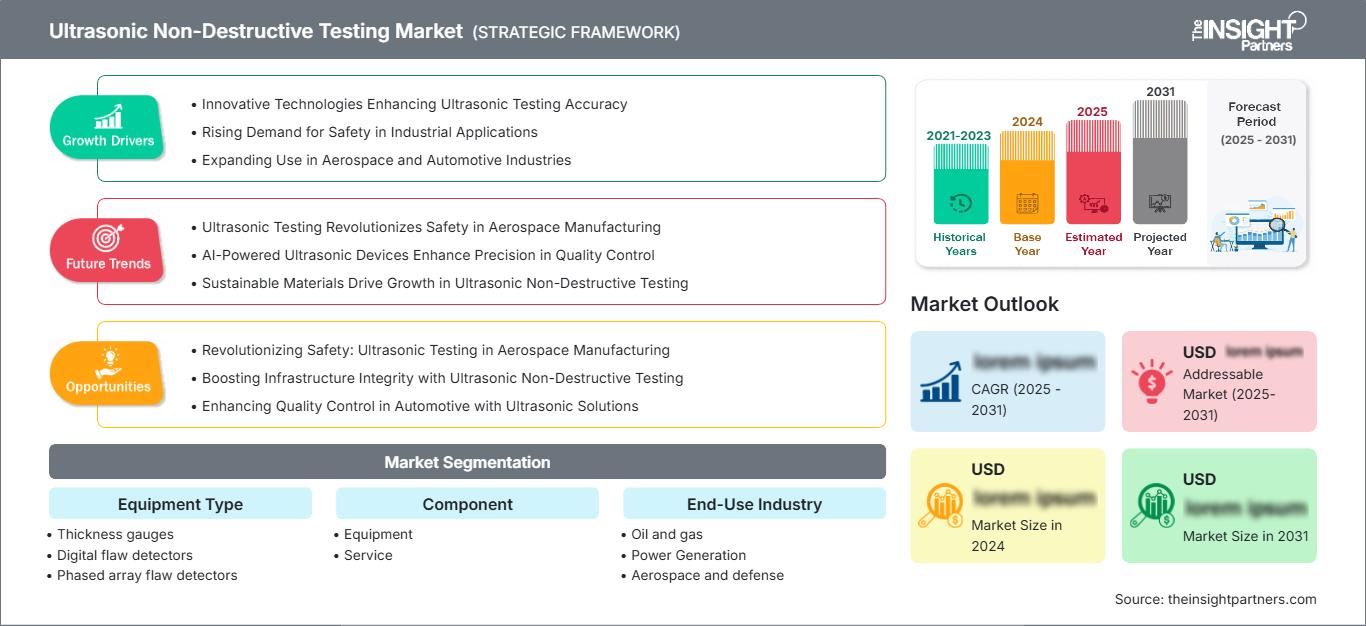
Ultrasonic Non-Destructive Testing Market: Strategic Insights
Regional Insights
North America Ultrasonic Non-Destructive Testing Market
North America held an estimated 31.0% share of the global market in 2025 and is projected to grow at a 6.85% CAGR through 2034. The Ultrasonic Non-Destructive Testing Market Report highlights the U.S. as the primary contributor to regional demand, supported by recurring inspection requirements across aerospace MRO, oil and gas infrastructure, power generation, automotive manufacturing, and heavy industrial facilities. These industries require regular inspection of welds, pressure components, composites, and corrosion-prone assets. Canada further contributes to regional demand through energy infrastructure, transportation equipment, and industrial fabrication.
The region has a deep equipment and services ecosystem spanning Evident Corporation, Waygate Technologies, Sonatest Limited, Danatronics Corporation, and NDT Systems Inc. Portable systems remain important for field inspections, while automated ultrasonic equipment is increasingly deployed in manufacturing and high-throughput inspection. The 2024 revision of ISO 16810 and continuing use of established U.S. inspection codes reinforce the need for standardized procedures, calibrated equipment, qualified operators, and reproducible inspection records.
U.S. Ultrasonic Non-Destructive Testing Market
The U.S. represented an estimated 72.0% of North America's market in 2025 and is expected to expand at a 6.70% CAGR through 2034. The Ultrasonic Non-Destructive Testing Market Forecast reflects sustained demand across aerospace, oil and gas, power generation, automotive, defense, rail, and industrial manufacturing, with corrosion measurement and weld inspection remaining important field applications.
The distinguishing point is the availability of mature qualifications for NDT, developed infrastructure in industry, and high coverage by local vendors. The aerospace industry and MRO facilities have growing demands on inspection capabilities that are able to handle composite materials and complex geometries, whereas energy firms use ultrasonic thickness and flaw detection techniques for asset integrity management purposes. The availability of specialized vendors like Danatronics and NDT Systems, along with diversified inspection companies, allows for several buying options.
Europe Ultrasonic Non-Destructive Testing Market
Europe accounted for an estimated 27.0% of the global market in 2025 and is projected to grow at a 6.15% CAGR through 2034. Germany constitutes the lead country in this region due to the presence of state-of-the-art manufacturing, industrial machinery, automobile manufacturing, rail engineering, and inspection equipment. The UK relies heavily on its aerospace, energy, and offshore industries. The French region gains from aerospace and nuclear-based industrial inspection. The Italian and Spanish regions rely on demand generated from the automobile, machinery, energy, transportation, and fabrication industries.
The European adoption can be characterized by rigorous quality specifications, engineering-heavy manufacturing processes, and the rising importance of written inspection procedures. Germany relies on its manufacturing facilities for automated testing and production line inspections. France and the UK benefit from their aerospace and energy-based industrial applications. Italy and Spain have significant demands arising from fabricated metal products, transportation equipment, and industrial maintenance. Regional as well as foreign manufacturers compete on account of their advanced imaging, portable systems, service delivery, and application engineering.
APAC Ultrasonic Non-Destructive Testing Market
APAC represented an estimated 30.0% of the global market in 2025 and is forecast to grow at a 7.35% CAGR through 2034. China is the leading country because of its manufacturing scale, shipbuilding, energy infrastructure, transportation equipment, and expanding industrial inspection requirements. Japan and South Korea maintain strong demand through automotive, electronics, shipbuilding, aerospace, and precision manufacturing, while India is supported by infrastructure, energy, rail, aerospace, and industrial localization.
Australia contributes through mining, energy, pipelines, and infrastructure inspection. Across APAC, demand is increasingly moving toward portable digital instruments and advanced imaging as manufacturers seek greater inspection repeatability. Local production capabilities, industrial automation programs, aerospace investment, and energy infrastructure modernization create favorable conditions for ultrasonic inspection equipment and services.
Middle East & Africa Ultrasonic Non-Destructive Testing Market
The Middle East and Africa market is supported by oil and gas, petrochemicals, power, construction, transportation, and industrial infrastructure. Saudi Arabia and the UAE represent major demand centers because large energy and infrastructure assets require weld inspection, corrosion monitoring, and asset-integrity services. South Africa adds demand from mining, power generation, rail, and industrial maintenance.
The region is estimated to expand at a 6.55% CAGR from 2026 to 2034. Localization of industrial services, development of domestic technical capabilities, and investment in energy and manufacturing infrastructure are increasing the relevance of ultrasonic inspection. Buyers increasingly value equipment that can operate in demanding field environments while maintaining traceable inspection records and compatibility with established procedures.
South & Central America Ultrasonic Non-Destructive Testing Market
South and Central America are driven primarily by oil and gas, mining, power generation, transportation, and heavy manufacturing. Brazil is the leading regional market because of its energy infrastructure, offshore oil and gas activity, industrial base, and extensive requirement for weld and corrosion inspection. Argentina contributes through energy, manufacturing, and infrastructure applications.
The regional market is estimated to grow at a 6.40% CAGR from 2026 to 2034. Brazil's offshore energy activity favors advanced inspection services and equipment, while Argentina's developing energy projects support field inspection demand. The rest of South and Central America remains more dependent on imported equipment and regional service providers, creating opportunities for distributors, calibration services, training, and application engineering.
Segmentation Analysis
Equipment Type
The Equipment Type segment covers thickness gauges, digital flaw detectors, phased array flaw detectors, and test machines used across field, laboratory, production, and automated inspection environments. The segment is modeled to grow at a 6.75% CAGR from 2026 to 2034. Demand is shaped by inspection complexity, portability, imaging requirements, automation, and the need for repeatable measurements. Suppliers increasingly differentiate through software, scanning integration, data storage, and advanced imaging.
- Thickness gauges: Provide rapid material-thickness assessment for corrosion, erosion, and remaining-wall evaluation, with strong use in pipelines, tanks, vessels, boilers, and industrial maintenance.
- Digital flaw detectors: Support conventional pulse-echo inspection and weld or component assessment, remaining important where portability, established procedures, and straightforward defect detection are priorities.
- Phased array flaw detectors: Enable electronically steered inspection and advanced imaging, making them strategically important for complex welds, composites, aerospace structures, and applications requiring broader inspection coverage.
- Test machines: Integrate ultrasonic inspection into controlled production or laboratory environments, with adoption influenced by automation, repeatability, component geometry, and throughput requirements.
Component
The Component segment includes equipment and services supporting ultrasonic inspection programs. It is modeled to grow at a 6.55% CAGR from 2026 to 2034. Equipment remains the principal component because instruments, probes, scanners, and acquisition hardware are fundamental to inspection deployment, while services benefit from operator shortages, procedure development, calibration, application engineering, and outsourced asset-integrity programs.
- Equipment: Forms the physical inspection infrastructure, including instruments, probes, scanners, acquisition electronics, and related accessories required for field and automated testing.
- Service: Covers inspection execution, calibration, application engineering, training, procedure development, maintenance, and technical support, reducing the need for customers to maintain every specialist capability internally.
End-Use Industry
The End-Use Industry segment encompasses oil and gas, power generation, aerospace and defense, and automotive and transportation applications. It is modeled to grow at a 7.10% CAGR from 2026 to 2034. Adoption depends on asset criticality, inspection frequency, safety requirements, component complexity, and the economics of avoiding unplanned failures or production interruptions.
- Oil and gas: Uses ultrasonic inspection for welds, pipelines, tanks, pressure equipment, corrosion monitoring, and integrity management across production and transportation assets.
- Power Generation: Applies ultrasonic techniques to boilers, turbines, pressure components, welds, piping, and other critical equipment where reliability and planned maintenance are central.
- Aerospace and defense: Requires high-sensitivity inspection of aircraft structures, engine components, composites, and bonded assemblies, with advanced imaging and repeatable procedures increasingly important.
- Automotive and Transportation: Uses ultrasonic inspection across fabricated components, wheels, rails, welds, castings, and production-quality applications where throughput and repeatability influence equipment selection.
Opportunity Snapshot
| End-Use Industry | Revenue Contribution | Trend Tag | Adoption Stage |
| Oil and gas | High | Integrity Monitoring | Mature |
| Power Generation | High | Asset Life | Mature |
| Aerospace and defense | Medium | Advanced Imaging | Scaling |
| Automotive and Transportation | Medium | Inline Inspection | Scaling |
Ultrasonic Non-Destructive Testing Market Growth Drivers and Impact Analysis
Increasing Asset-Integrity Requirements Across Energy Infrastructure
The aging of pipe lines, pressure vessels, storage tanks, boilers, and generation equipment is leading to an increased demand for recurring ultrasonic inspection since corrosion, erosion, weld defects, and degradation may occur without any surface indication. The result of this is that operators initiate enhanced thickness measuring and flaw detection programs, especially if shutdowns are expensive and/or if safety issues are involved in equipment failure. This leads to a chain reaction going from risk of asset integrity to recurring inspection, new replacement of old equipment and higher demand for portable equipment, scanning equipment, probes, and special services.
Advanced Imaging Improves Inspection of Complex Components
Welds that are complex, composites, multilayers, and aerospace materials need to be inspected through techniques that give out more details than a typical single-beam ultrasonic test. Such techniques include the use of phased array, full matrix capture, total focusing method workflow, and automation of scanning processes. With increasing complexities of geometries of components, there will be increased interest from the inspectors in devices that can steer beams electronically, provide image-based outputs and store inspection data for analysis. Therefore, there will be increased market value in sophisticated acquisition devices, probes, scanners and software products than just instruments.
Digitalization and Automation Reduce Inspection Variability
There is a trend towards standardization of the process with the objective of minimizing variation attributable to the individual operator and ensuring reporting consistency. The ability of digital equipment to save the A-scan, images, settings, calibration, and inspection details provides the means for automation to repeat the predefined path through production parts. This approach is seen in recent innovations in the field of automated rail inspection and portable advanced ultrasonic systems. The concept is very simple: repeatable acquisition minimizes variability in the interpretation process, increases auditability, and may help to minimize the time required for the inspection process.
Ultrasonic Non-Destructive Testing Market Future Trends
AI-Assisted Imaging and Data-Centric Inspection Workflows
Ultrasonic inspection is moving toward data-centric workflows in which raw acquisition data, imaging, analysis, and reporting are connected rather than treated as separate activities. This trend is emerging because phased array and total focusing methods generate increasingly rich datasets that can support more detailed interpretation than conventional A-scan inspection alone. Equipment manufacturers, software developers, and inspection service providers are therefore affected by rising demand for intuitive analysis, standardized procedures, remote review, and traceable records. The likely implication is greater differentiation through software and workflow design, with buyers evaluating instruments according to how effectively they integrate acquisition, visualization, analysis, storage, and reporting.
Automation and Robotics for Repeatable Industrial Inspection
Automated ultrasonic inspection is expanding from specialized manufacturing applications toward rail, energy, aerospace, and other asset-intensive environments. The change is driven by the need to inspect complex surfaces consistently while reducing operator exposure to difficult or hazardous locations. Automated scanners, robotic systems, remote-access instruments, and motor-controlled phased array solutions can execute repeatable paths and maintain more consistent acquisition conditions. Equipment manufacturers and service providers are affected because buyers increasingly evaluate complete inspection cells rather than standalone instruments. The implication is a gradual shift toward integrated hardware, robotics, software, and procedure packages, particularly where inspection volume or safety considerations can justify system investment.
Ultrasonic Non-Destructive Testing Market Opportunities
Localized Advanced NDT Solutions in Emerging Manufacturing Hubs
India, Southeast Asia, and selected Middle Eastern manufacturing centers offer opportunities for suppliers of advanced ultrasonic systems, calibration services, and application engineering. Aerospace, rail, energy, automotive, and industrial fabrication investments are creating inspection requirements while local technical ecosystems continue to develop. The principal barrier is not equipment availability alone but the need for qualified personnel, validated procedures, service support, and reliable calibration. Suppliers can address this gap through localized technical centers, distributor training, application laboratories, and service contracts. Companies that combine equipment with procedural support and operator enablement can improve adoption among manufacturers transitioning from conventional inspection toward phased array and automated workflows.
Inspection-as-a-Service for Specialized Asset Owners
Outsourced ultrasonic inspection presents an opportunity for power producers, energy operators, transportation companies, and smaller manufacturers that cannot justify maintaining advanced phased array systems and specialist personnel internally. The opportunity is strongest where inspections are periodic, technically complex, or geographically dispersed. High equipment costs, training requirements, calibration obligations, and interpretation complexity can make specialist services more efficient than full internal deployment. Service providers can differentiate through portable advanced equipment, automated scanning, digital reporting, remote technical review, and recurring asset-integrity contracts. This model can also accelerate the adoption of sophisticated inspection methods because customers can access advanced capabilities without assuming the full burden of equipment ownership and technical qualification.
Frequently Asked Questions

- Comprehensive Market Sizing and Forecast Analysis
- Detailed Segmentation Analysis
- In-Depth Market Dynamics Assessment
- Regional and Country-Level Insights
- Competitive Landscape and Company Benchmarking
- Strategic Business Intelligence
Recent Reports
Testimonials

The Insight Partners provided valuable market intelligence that supported our global go-to-market strategy. Their team was professional, responsive, and attentive to our feedback, providing thoughtful analysis and helpful methodological clarifications throughout the project.
Junmo Kim Chief Financial Officer (CFO), Enertech Co., Ltd.
The Insight Partners' SCADA System Market report is comprehensive, with valuable insights on current trends and future forecasts. The team was highly professional, responsive, and supportive throughout. We are very satisfied and highly recommend their services.
RAN KEDEM Partner, Reali Technologies LTDs
I requested a report on a very specific software market and the team produced the report in a few days. The information was very relevant and well presented. I then requested some changes and additions to the report. The team was again very responsive and I got the final report in less than a week.
JEAN-HERVE JENN Chairman, Future Analytica
We worked with The Insight Partners for an important market study and forecast. They gave us clear insights into opportunities and risks, which helped shape our plans. Their research was easy to use and based on solid data. It helped us make smart, confident decisions. We highly recommend them.
PIYUSH NAGPAL Sr. Vice President, High Beam Global
The Insight Partners delivered insightful, well-structured market research with strong domain expertise. Their team was professional and responsive throughout. The user-friendly website made accessing industry reports seamless. We highly recommend them for reliable, high-quality research services
YUKIHIKO ADACHI CEO, Deep Blue, LLC.
This is the first time I have purchased a market report from The Insight Partners.While I was unsure at first, I visited their web site and felt more comfortable to take the risk and purchase a market report.I am completely satisfied with the quality of the report and customer service. I had several questions and comments with the initial report, but after a couple of dialogs over email with their analyst I believe I have a report that I can use as input to our strategic planning process.Thank you so much for taking the extra time and making this a positive experience.I will definitely recommend your service to others and you will be my first call when we need further market data.
JOHN SUZUKI President and Chief Executive Officer, Board Director, BK Technologies
I wish to appreciate your support and the professionalism you displayed in the course of attending to my request for information regarding to infectious disease IVD market in Nigeria. I appreciate your patience, your guidance, and the fact that you were willing to offer a discount, which eventually made it possible for us to close a deal. I look forward to engaging The Insight Partners in the future, all thanks to the impression you have created in me as a result of this first encounter.
DR CHIJIOKE ONYIA MANAGING DIRECTOR, PineCrest Healthcare Ltd.Reason to Buy
- Informed Decision-Making
- Understanding Market Dynamics
- Competitive Analysis
- Identifying Emerging Markets
- Customer Insights
- Market Forecasts
- Risk Mitigation
- Boosting Operational Efficiency
- Strategic Planning
- Investment Justification
- Tracking Industry Innovations
- Aligning with Regulatory Trends





 Get Free Sample for