
USB type C Market Growth, Size & Forecast by 2034
Coverage: By Protocol (DisplayPort, HDMI, MHL, Thunderbolt, USB Audio over USB Type C); Application (Smartphones and Tablets, Personal Computers and Laptops, Digital Cameras, TV, Chargers and Adapters, Media Players, Others); Industry (Consumer Electronics, Automotive, Media and Entertainment, Telecommunications, Healthcare, Others) , and Geography (North America, Europe, Asia Pacific, and South and Central America)
- Status : Data Released
- Report Code : TIPRE00022398
- Category : Electronics and Semiconductor
- No. of Pages : 150
- Available Report Formats :


- Last update date : September 21, 2026


2025 Market Size
US$ 15,835.92 Mn
Base year value
2034 Forecast
US$ 47,466.08 Mn
Projected by 2034
CAGR 2026-2034
12.97 %
Growth rate
Addressable Market
US$ 275,433.41 Mn
(2026-2034)
The USB Type C market was valued at US$ 15,835.92 million in 2025 and is projected to reach US$ 47,466.08 million by 2034, registering a CAGR of 12.97% during 2026–2034. The USB Type C market is moving from accessory-led adoption toward system-level integration as smartphones, laptops, tablets, automotive infotainment, media devices, chargers, adapters, and healthcare equipment increasingly rely on one compact interface for power, data, audio, and display connectivity.
North America remains a high-value adoption center, supported by premium device penetration, enterprise laptop refresh cycles, connected vehicle upgrades, and growing preference for certified fast-charging accessories. The USB Type C market size in the region is expected to benefit from a CAGR range of 11.8–12.6% through 2034, with demand shaped by higher-wattage charging, hybrid work hardware, and standardization across consumer and commercial electronics.
USB type C Market Assessment and Insights
- North America: The region accounted for 29–32% share in 2025 and is estimated to grow at a CAGR range of 11.8–12.6% during 2026–2034, supported by premium notebooks, tablets, smartphones, gaming hardware, and in-vehicle charging adoption.
- U.S.: The U.S. represented 76–79% of North America share in 2025 and is projected to expand at 11.9–12.7% CAGR, led by enterprise device refresh and accessory demand.
- Europe: Europe held 22–25% share in 2025 and is forecast to grow at 12.1–12.9% CAGR, with Germany, the UK, France, Italy, and Spain benefiting from common charger regulation and automotive electronics demand.
- Asia Pacific: Asia Pacific captured 36–39% share in 2025 and is expected to grow at 13.6–14.4% CAGR, led by China, Japan, South Korea, India, and Taiwan across device manufacturing and component supply.
- Largest Segment: Smartphones and Tablets held 34–37% market share in 2025 and are expected to grow at 12.4–13.1% CAGR because USB-C is now embedded across flagship and mid-range device portfolios.
- High Growth Segment: Automotive held 8–11% share in 2025 and is projected to grow at 14.0–15.2% CAGR, supported by connected cabins, EV platforms, rear-seat charging, and infotainment integration.
- Key companies analyzed in detail: Analog Devices, Inc.; Analogix Semiconductor Inc.; Belkin International, Inc.; Diodes Incorporated; Infineon Technologies AG; Microchip Technology Incorporated; NXP Semiconductors N.V.; onsemi; ROHM Co., Ltd.; Texas Instruments Incorporated.
Source: The Insight Partners' analysis based on proprietary research, government publications, company annual reports, investor presentations, industry databases, and expert interviews.
Product evolution in the USB Type C market has shifted from basic connector migration to a broader performance race involving USB Power Delivery, USB4, Thunderbolt, DisplayPort alternate mode, HDMI conversion, audio transport, and compact power-management silicon. Manufacturers are investing in controllers, redrivers, receptacles, cables, hubs, chargers, docking stations, and protection devices that support higher data rates and safer current handling in smaller form factors.
Over the forecast period, regulatory alignment, enterprise hardware standardization, and manufacturing scale in Asia are expected to strengthen USB Type C market growth. Investments are likely to concentrate in certified high-wattage charging, automotive-grade power delivery controllers, secure interface components, and multifunctional adapters as device makers reduce proprietary ports and simplify user ecosystems.
USB type C Market Report Scope
| Report Attribute | Details |
|---|---|
| Market size in 2025 | US$ 15,835.92 Million |
| Market Size by 2034 | US$ 47,466.08 Million |
| Global CAGR (2026 - 2034) | 12.97% |
| Historical Data | 2021-2024 |
| Forecast period | 2026-2034 |
USB type C Market Analysis
The USB Type C market growth is primarily driven by the consolidation of charging, data, display, and audio functions into one reversible connector. USB-C has started to gain popularity among smartphone brands, laptop makers, tablet providers, and even accessory companies because all of them are trying to make their product roadmaps compatible with USB-C to eliminate potential compatibility problems and satisfy consumer expectations regarding one cable connection. The demand is being driven by multiple supply chain benefits in terms of repeated orders for certified cables, chargers, adapters, hubs, docking stations, and controllers.
Power delivery capabilities have started to play an important role in this situation. More gaming laptops, creators' notebooks, monitors, cameras, and in-vehicle systems require interfaces that are able to deliver power and data at the same time.
Competitive positioning in the USB Type C market analysis reflects a mix of semiconductor depth and accessory execution. Infineon Technologies AG, Texas Instruments Incorporated, onsemi, NXP Semiconductors N.V., Microchip Technology Incorporated, Analog Devices, Inc., Diodes Incorporated, and ROHM Co., Ltd. compete through power management, protection, signal conditioning, and controller portfolios. Analogix Semiconductor Inc. is concerned with display interfaces, whereas Belkin International, Inc. is more interested in consumer-level charging and connectivity accessories.
Investments are going in the direction of designing solutions that are integrated, certified, and energy-efficient. Suppliers offering solutions that incorporate USB-C power delivery, over-voltage protection, alternate mode, and small form factor will be able to do well with device OEMs. Differentiation by accessory companies includes multiple port chargers, material responsibility, portability, and compatibility across devices.
● REPORT CUSTOMIZATION
Tailor This Report To Align With Your Specific Business Requirements
This report can be customized to align precisely with your business objectives, scope, and target markets. Customization options include tailored segmentation, geography, competitive analysis, and strategic insights to support informed decision-making.
Customize This Report →WHAT YOU CAN ADJUST
- ● Segmentations
- ● Geography
- ● Competitive Analysis
- ● Language Preferences
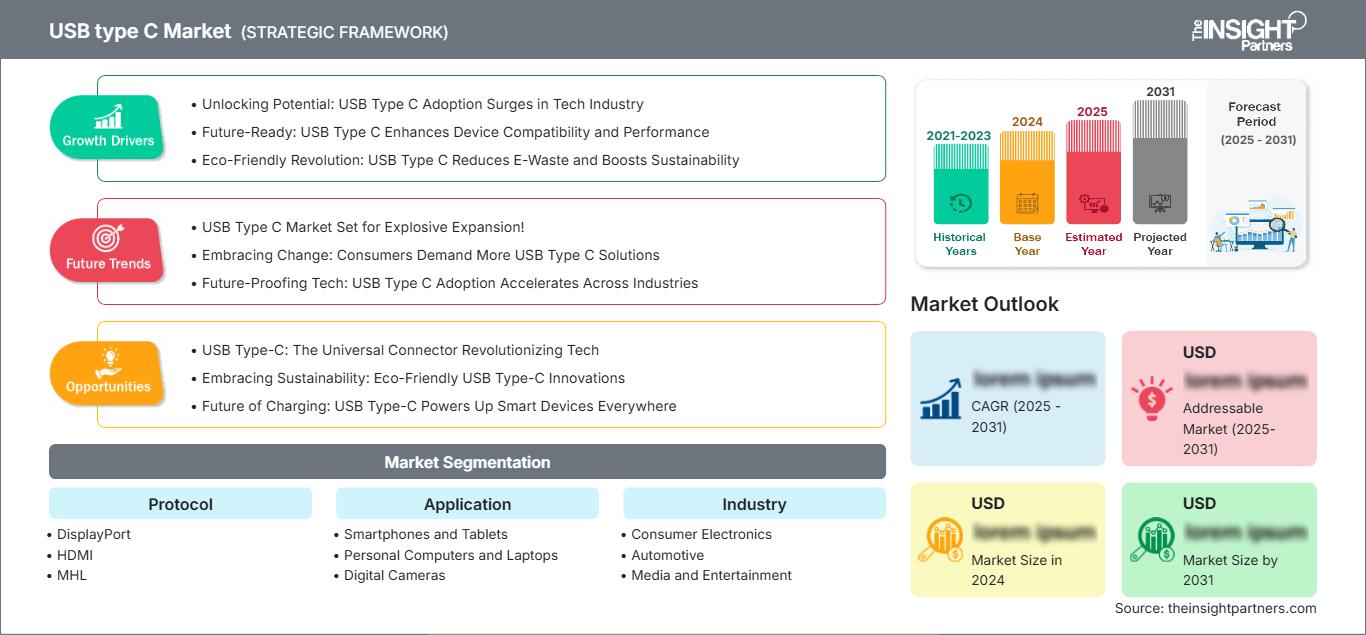
USB type C Market: Strategic Insights
Regional Insights
North America USB Type C Market
North America held 29–32% USB Type C market share in 2025 and is expected to expand at 11.8–12.6% CAGR during 2026–2034. Growth is supported by high penetration of premium laptops, smartphones, tablets, gaming consoles, and content-creation devices that require faster charging and reliable data transfer.
Enterprise procurement is another demand anchor. U.S. and Canadian organizations are standardizing docking stations, monitors, keyboards, cameras, and chargers around USB-C to simplify hybrid workplace deployment. The region also benefits from automotive infotainment upgrades and demand for certified accessories sold through online, retail, and telecom channels.
U.S. USB Type C Market
The U.S. accounted for 76–79% of North America’s 2025 revenue and is projected to grow at 11.9–12.7% CAGR. Strong notebook replacement cycles, smartphone upgrade demand, media production workflows, and gaming accessories support premium cable, hub, adapter, and charger consumption.
Domestic demand is reinforced by the presence of semiconductor design centers, accessory brands, and cloud-connected device ecosystems. Companies such as Texas Instruments Incorporated, Analog Devices, Inc., Microchip Technology Incorporated, onsemi, and Belkin International, Inc. contribute through power-management, interface, and consumer connectivity portfolios.
Europe USB Type C Market
Europe represented 22–25% share in 2025 and is forecast to grow at 12.1–12.9% CAGR as common charging requirements accelerate USB-C adoption across portable electronics. Germany excels in automotive electronics and industrial engineering, while the UK exhibits a consistent need for laptops, tablets, media players, and retail accessories.
The countries France, Italy, and Spain have benefited from the standardization of smartphones, digitalization in the public sector, and consumer replacements. It is because of the emphasis laid by the region on interoperability, minimizing electronic waste, and the installation of charging stations that are certified to use USB-C chargers.
APAC USB Type C Market
APAC captured 36–39% share in 2025 and is projected to grow at 13.6–14.4% CAGR. China is leading in terms of manufacturing of electronics through its scale, whereas Japan and South Korea help in the process through their high-end devices, display products, cameras, memory products, and auto-electronics.
India is rising as a demand base of fast growth through the manufacture of smartphones, digital payment hardware, and low-cost tablets. Taiwan and Southeast Asia are helping in the assembly of components, cable manufacturing, and the export of adapters.
Middle East & Africa USB Type C Market
The Middle East and Africa are expected to grow at 10.8–11.7% CAGR through 2034, supported by smartphone penetration, tourism-linked consumer electronics retail, and infrastructure investment in connected transport hubs. Premium devices and smart cities drive adoption in Saudi Arabia and the UAE.
South Africa still continues to be the most mature market, where the demand for batteries depends on telecom, accessories, and enterprise computing. Overall, the MEA region's growth potential is limited by cost sensitivity; however, the charger replacement cycle keeps up the steady baseline demand.
Segmentation Analysis
Protocol
Protocol is expected to grow at 12.5–13.3% CAGR during 2026–2034, according to the USB Type C market forecast. The USB Type C market scope across protocols reflects rising demand for video output, power delivery, audio transfer, and high-speed data in compact devices. Protocol support is becoming a key purchasing factor for docks, adapters, PCs, monitors, smartphones, and professional media equipment.
- DisplayPort: DisplayPort over USB-C supports external monitors, creator workflows, docking stations, and enterprise displays, making it important for compact laptops that require high-resolution video output without separate ports.
- HDMI: HDMI conversion demand is sustained by projectors, televisions, conference-room screens, and media players that rely on USB-C adapters to bridge modern devices with installed display infrastructure.
- MHL: MHL remains a niche protocol in selected mobile-to-display use cases, where low-power video output and compatibility with legacy consumer electronics continue to support replacement accessory demand.
- Thunderbolt: Thunderbolt strengthens premium adoption by combining high-speed data, display, and power delivery, especially in professional laptops, external storage, docking stations, and creator peripherals.
- USB Audio over USB Type C: USB audio demand is tied to smartphones, tablets, headsets, media players, and professional microphones as device makers remove legacy audio jacks and prioritize digital audio paths.
Application
Application is projected to grow at 12.8–13.6% CAGR, reflecting key USB Type C market trends. Smartphones and tablets remain the largest segment, while chargers, adapters, laptops, cameras, TVs, and media players strengthen recurring accessory demand. USB Type C forecasts are increasingly shaped by multi-device charging habits and the need for interoperable, high-performance connectivity across home, office, travel, and vehicle environments.
- Smartphones and Tablets: This segment leads demand because USB-C is now widely used for charging, data transfer, audio accessories, external displays, and ecosystem standardization across premium and mid-range devices.
- Personal Computers and Laptops: PC and laptop adoption is driven by docking stations, external monitors, enterprise accessories, high-speed storage, and the need to reduce port complexity in thin device designs.
- Digital Cameras: Cameras use USB-C for faster file transfer, charging, tethering, and video workflows, particularly among content creators requiring compact but reliable connectivity in field operations.
- TV: Television applications remain selective, but USB-C assists media playback, adapter connectivity, low-power peripheral integration, and compatibility with tablets, phones, and streaming devices.
- Chargers and Adapters: Chargers and adapters benefit from repeat replacement, travel demand, multi-port charging, regulatory standardization, and consumer preference for one accessory serving several devices.
- Media Players: Media players use USB-C for charging, storage transfer, audio output, and connection to home entertainment systems, supporting demand for compact adapters and certified cables.
Industry
Industry demand is expected to expand at 12.6–13.5% CAGR, according to the USB Type C market report. Consumer electronics remains the largest revenue contributor, while automotive is the fastest-growing industry. Healthcare, telecommunications, and media and entertainment are integrating USB-C to reduce device clutter, improve charging consistency, and support portable diagnostic, communications, and production workflows.
- Consumer Electronics: Consumer electronics dominate revenue as smartphones, tablets, laptops, headphones, gaming accessories, power banks, cameras, and wearables increasingly standardize charging and data interfaces around USB-C.
- Automotive: Automotive demand is rising as connected cabins, EVs, passenger comfort systems, infotainment ports, rear-seat charging, and embedded controllers make USB-C a standard vehicle feature.
- Media and Entertainment: Media and entertainment users rely on USB-C for cameras, storage drives, microphones, monitors, editing systems, and portable production gear requiring high-speed transfer and compact connectivity.
- Telecommunications: Telecommunications demand is supported by routers, field devices, smartphones, tablets, power banks, and service equipment that benefit from standardized charging and reliable data transfer.
- Healthcare: Healthcare adoption is driven by portable diagnostic tools, patient monitoring equipment, tablets, handheld scanners, and charging carts where durability, interoperability, and power efficiency matter.
Opportunity Snapshot
| Application | Revenue Contribution | Trend Tag | Adoption Stage |
| Smartphones and Tablets | High | Universal Charging | Mature |
| Personal Computers and Laptops | High | Docking Shift | Scaling |
| Digital Cameras | Medium | Creator Transfer | Scaling |
| TV | Low | Display Bridge | Emerging |
| Chargers and Adapters | High | Fast Charging | Mature |
| Media Players | Medium | Audio Transfer | Scaling |
USB type C Market Growth Drivers and Impact Analysis
Regulatory Standardization of Device Charging
Universal charger regulations and conformity programs are speeding up the process of adoption of USB-C technology by manufacturers of portable electronic battery-operated devices. Such a driver facilitates standardization of charging systems, provides more convenience for the customer, and prompts manufacturers to redesign their products using only certified connectors, cables, and power supplies. The effect will be noticeable mostly in smartphones, tablets, headphones, cameras, handheld games consoles, and laptops, since the deadline dates of compliance with the regulations force manufacturers to include USB-C support in their product lineups.
Rising Data, Display, and Power Requirements
Requirements of today's devices include interfaces capable of performing charge, high-speed data transfer, attaching additional displays, sound, and accessories without thickening the device. All these requirements are met by USB-C due to its reversibility, alternative mode capability, USB Power Delivery, USB4, and Thunderbolt compliance. Opportunities are created for such ICs as controllers, redrivers, protection devices, docks, hubs, and certified cables. The effect of all this can be observed in creator laptops, external SSDs, displays, conference systems, gaming devices, and cameras, where users appreciate one interface for multiple tasks.
Automotive Cabin Digitization and EV Adoption
The car makers have begun including USB-C connectivity in their infotainment systems, rear seat charging units, center console units, and interiors of electric cars. Charging and data connectivity are becoming an important differentiator in connected cars. The effect trickles down to the semiconductor companies offering automotive-grade power delivery controllers, protection circuitry, and signal conditioning solutions. With automotive software platforms getting defined, USB-C becomes an area that offers lasting growth opportunities beyond consumer devices.
USB type C Market Future Trends
USB4 and Thunderbolt Ecosystem Expansion
Trends in USB Type-C are moving towards higher connectivity performance with the increased usage of USB4, Thunderbolt, and DisplayPort alt-mode technology in premium laptops, monitors, docking stations, storage devices, and other pro peripherals. The trend will drive up the need for certified cables, active adapters, retimers, and power-delivery controllers. The trend will define product segmentation with basic charging products differentiated from high bandwidth products that cater to creatives, gamers, engineers, and enterprise customers.
Higher-Wattage Charging as a Differentiator
The USB PD expansion is projected to be such that high-wattage charging will become a major buying criterion for laptops, tablets, handheld gaming consoles, monitors, and multiple-port chargers. With less number of device specific chargers being carried by users, the demand will move towards safer and certified chargers and cables with EPR rating. This will favor the premiumization of accessories and further power management semiconductor chips.
USB type C Market Opportunities
Premium Certified Accessories for Multi-Device Users
Predictions for USB Type C suggest that there is considerable potential in certified accessories for smartphones, tablets, laptops, gaming consoles, cameras, and media players in one standard interface. Users and businesses have shifted from inferior cables and chargers to multiport high-wattage safety-certified devices. For accessory makers, value can be realized in terms of packaging deals, travel chargers, docking stations, and compatibility information for specific devices. The highest potential is in those devices made from premium materials, with visible certification labels, a smaller size, and the ability to charge and transfer data simultaneously.
Automotive and Healthcare Grade Connectivity Solutions
There is a chance to develop ruggedized, reliable and compliant USB-C products for automotive and healthcare markets. In the automotive market, there will be demand for robust connectors, PD controllers, ESD protection circuits and thermal management products. In healthcare, there will be a requirement for safe charging and reliable data communication solutions for portable diagnostic equipment. Differentiation can happen with reference designs, long product life and certification, which lowers validation effort for OEMs.
Frequently Asked Questions

- Comprehensive Market Sizing and Forecast Analysis
- Detailed Segmentation Analysis
- In-Depth Market Dynamics Assessment
- Regional and Country-Level Insights
- Competitive Landscape and Company Benchmarking
- Strategic Business Intelligence
Recent Reports
Testimonials

The Insight Partners' SCADA System Market report is comprehensive, with valuable insights on current trends and future forecasts. The team was highly professional, responsive, and supportive throughout. We are very satisfied and highly recommend their services.
RAN KEDEM Partner, Reali Technologies LTDs
I requested a report on a very specific software market and the team produced the report in a few days. The information was very relevant and well presented. I then requested some changes and additions to the report. The team was again very responsive and I got the final report in less than a week.
JEAN-HERVE JENN Chairman, Future Analytica
We worked with The Insight Partners for an important market study and forecast. They gave us clear insights into opportunities and risks, which helped shape our plans. Their research was easy to use and based on solid data. It helped us make smart, confident decisions. We highly recommend them.
PIYUSH NAGPAL Sr. Vice President, High Beam Global
The Insight Partners delivered insightful, well-structured market research with strong domain expertise. Their team was professional and responsive throughout. The user-friendly website made accessing industry reports seamless. We highly recommend them for reliable, high-quality research services
YUKIHIKO ADACHI CEO, Deep Blue, LLC.
This is the first time I have purchased a market report from The Insight Partners.While I was unsure at first, I visited their web site and felt more comfortable to take the risk and purchase a market report.I am completely satisfied with the quality of the report and customer service. I had several questions and comments with the initial report, but after a couple of dialogs over email with their analyst I believe I have a report that I can use as input to our strategic planning process.Thank you so much for taking the extra time and making this a positive experience.I will definitely recommend your service to others and you will be my first call when we need further market data.
JOHN SUZUKI President and Chief Executive Officer, Board Director, BK Technologies
I wish to appreciate your support and the professionalism you displayed in the course of attending to my request for information regarding to infectious disease IVD market in Nigeria. I appreciate your patience, your guidance, and the fact that you were willing to offer a discount, which eventually made it possible for us to close a deal. I look forward to engaging The Insight Partners in the future, all thanks to the impression you have created in me as a result of this first encounter.
DR CHIJIOKE ONYIA MANAGING DIRECTOR, PineCrest Healthcare Ltd.Reason to Buy
- Informed Decision-Making
- Understanding Market Dynamics
- Competitive Analysis
- Identifying Emerging Markets
- Customer Insights
- Market Forecasts
- Risk Mitigation
- Boosting Operational Efficiency
- Strategic Planning
- Investment Justification
- Tracking Industry Innovations
- Aligning with Regulatory Trends





 Get Free Sample for