
Variable Air Volume (VAV) Systems Market Trends, Share & Demand by 2034
Coverage: by Type (Single-duct VAV, Dual-duct VAV, Fan-powered VAV, Induction VAV); Application (Commercial buildings, Residential buildings, Industrial buildings) , and Geography (North America, Europe, Asia Pacific, and South and Central America)
- Status : Data Released
- Report Code : TIPRE00007187
- Category : Manufacturing and Construction
- No. of Pages : 150
- Available Report Formats :


- Last update date : September 17, 2026


2025 Market Size
US$ 17.72 Bn
Base year value
2034 Forecast
US$ 29.76 Bn
Projected by 2034
CAGR 2026-2034
5.93 %
Growth rate
Addressable Market
US$ 215.08 Bn
(2026-2034)
The Variable air volume systems market is valued at US$ 17.72 Billion in 2025 and is projected to reach US$ 29.76 Billion by 2034, expanding at a CAGR of 5.93% during 2026–2034. The market reflects increasing deployment of zone-level airflow control across commercial, residential, and industrial buildings, supported by demand for efficient HVAC operation, improved thermal comfort, and integration with increasingly automated building management environments.
North America remains a structurally important market, with the variable air volume systems market size expected to expand at approximately 5.5%–6.5% CAGR during 2026–2034. Aging commercial infrastructure, modernization of healthcare and institutional facilities, tighter building-performance requirements, and broader deployment of connected building controls are supporting replacement and retrofit demand, particularly in the United States and Canada.
Variable Air Volume (VAV) Systems Market Assessment and Insights
- North America: North America is estimated to represent 28%–32% share in 2025, with demand growing at a 5.5%–6.5% CAGR between 2026–2034, supported by commercial retrofits, healthcare modernization, energy codes, and mature building automation adoption.
- US: The US accounts for approximately 72%–78% of North American demand in 2025, growing at a 5.5%–6.5% CAGR between 2026–2034, led by commercial and institutional applications.
- Europe: Europe holds approximately 25%–29% share in 2025 and is projected to grow at a 5.0%–6.0% CAGR between 2026–2034, with Germany, the UK, France, Italy, and Spain supporting demand through efficiency upgrades and building renovation.
- Asia Pacific: Asia Pacific represents approximately 24%–28% share in 2025 and is expected to expand at a 6.5%–7.5% CAGR between 2026–2034, led by China, Japan, India, South Korea, and Australia.
- Largest Segment: Commercial buildings represent approximately 58%–63% market share in 2025, expanding at a 5.8%–6.8% CAGR between 2026–2034, reflecting intensive use across offices, healthcare, education, retail, and hospitality.
- High Growth Segment: Fan-powered VAV represents approximately 18%–22% market share in 2025, growing at a 6.5%–7.5% CAGR between 2026–2034, supported by zoning flexibility and terminal-level control.
- Key companies analyzed in detail: Barcol-Air; Carrier Corporation; DAIKIN INDUSTRIES, Ltd.; Emerson Electric Co.; Honeywell International Inc.; Johnson Controls, Inc.; KMC Controls, Inc.; Schneider Electric SE; Siemens AG; TROX GmbH; Trane Technologies plc; Lennox International Inc.
Source: The Insight Partners' analysis based on proprietary research, government publications, company annual reports, investor presentations, industry databases, and expert interviews.
The variable air volume systems market has evolved from mechanically regulated airflow equipment toward electronically controlled terminal architectures linked with sensors, actuators, and building automation platforms. Moving from the fixed volume approach to demand-based airflow allows for responses based on occupancy, heating and cooling loads, and ventilation needs. Contemporary controllers have become more adept at supporting protocols such as BACnet and IP compatibility, pressure control, and digital commissioning, shifting the focus from isolated devices to building performance as a whole.
The future direction will be influenced by renovations, electrification, indoor air quality considerations, and stricter building performance standards. Upcoming construction in India, Southeast Asia, Gulf nations, and certain Latin American cities offers new prospects, although in mature markets, replacements become increasingly important rather than new installations. Money is also being poured into connected controls, wireless sensors, fault detection, and data analysis capable of squeezing more efficiency out of existing VAV terminals.
Variable Air Volume (VAV) Systems Market Report Scope
| Report Attribute | Details |
|---|---|
| Market size in 2025 | US$ 17.72 Billion |
| Market Size by 2034 | US$ 29.76 Billion |
| Global CAGR (2026 - 2034) | 5.93% |
| Historical Data | 2021-2024 |
| Forecast period | 2026-2034 |
Variable Air Volume (VAV) Systems Market Analysis
Variable air volume systems market growth is closely tied to the expansion and modernization of buildings requiring differentiated thermal conditions across multiple zones. The commercial buildings continue to be the key demand source, given that many times these buildings may require simultaneous heating, cooling, ventilation, and occupancy systems. The value chain involves terminal manufacturers, controls manufacturers, manufacturers of air handling devices, sensors, actuators, engineering firms, distributors, contractors, and building operators.
There is now a greater focus on integration in terms of supply dynamics and not terminal products alone. Manufacturers have been integrating VAV boxes along with pressure sensors, controllers, actuators, reheat interfacing, and digital commissioning solutions. Suppliers can benefit from offering interoperable equipment within mixed building automation environments. The capability of installers continues to matter, as balancing minimum airflow requirements, pressure requirements, and sequencing programs is critical in achieving performance and occupant comfort levels.
Variable air volume systems market competition is characterized by a combination of HVAC manufacturers, building automation specialists, terminal-unit suppliers, and controls companies. Carrier Corporation, DAIKIN INDUSTRIES, Ltd., Emerson Electric Co., Honeywell International Inc., Johnson Controls, Inc., Schneider Electric SE, and Siemens AG differentiate through comprehensive automation and equipment offerings. Barcol-Air and TROX GmbH offer a specific focus in the areas of air distribution and terminal products, while KMC Controls, Inc. focuses on control applications.
Current positioning is driven by capabilities around interoperability, ease of retrofit, digital commissioning, and life-cycle services. Trane Technologies plc and Lennox International Inc. represent established players with HVAC product lines in the current competitive landscape. Investment areas include IP-enabled controllers, wireless sensors, occupancy-based operation, analytics, and remote service capability. Suppliers that can tie terminal-level metrics into building management systems will have differentiation capabilities in operations versus equipment.
● REPORT CUSTOMIZATION
Tailor This Report To Align With Your Specific Business Requirements
This report can be customized to align precisely with your business objectives, scope, and target markets. Customization options include tailored segmentation, geography, competitive analysis, and strategic insights to support informed decision-making.
Customize This Report →WHAT YOU CAN ADJUST
- ● Segmentations
- ● Geography
- ● Competitive Analysis
- ● Language Preferences
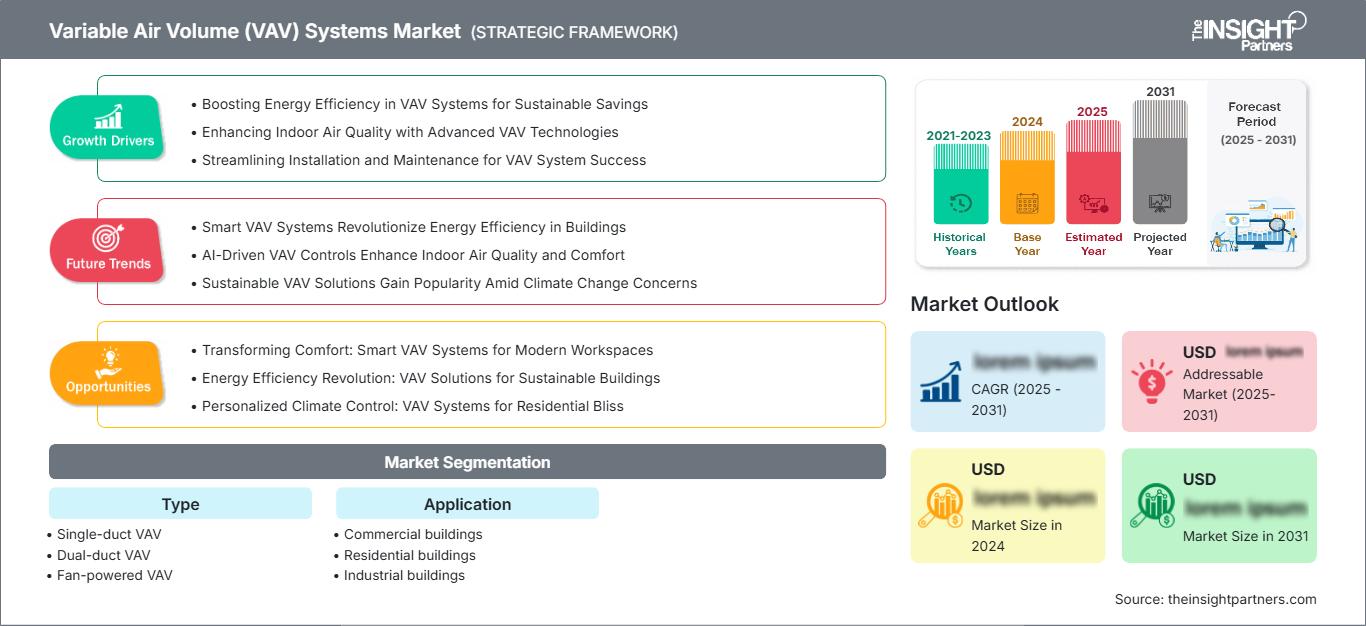
Variable Air Volume (VAV) Systems Market: Strategic Insights
Regional Insights
North America Variable Air Volume Systems Market
North America represented approximately 28%–32% of the Variable Air Volume Systems Market share in 2025 and is projected to expand at a 5.5%–6.5% CAGR through 2034. The region benefits from a mature commercial building stock, extensive HVAC installed capacity, established engineering standards, and widespread building automation. Retrofit projects are particularly relevant because facility owners can use terminal replacement and controls modernization to improve zoning without fully replacing central air-handling infrastructure.
The US represents approximately 72%–78% of North American demand, while Canada contributes to institutional, commercial, and public infrastructure projects. Healthcare facilities, universities, offices, airports, and large mixed-use developments provide recurring applications. Energy-performance requirements, demand for indoor-air-quality monitoring, and pressure to reduce operating expenses encourage upgrades to electronically controlled terminals. The regional supply ecosystem is also supported by established contractors, commissioning specialists, controls integrators, and national HVAC distribution networks.
U.S. Variable Air Volume Systems Market
The US accounted for approximately 72%–78% of the North American Variable Air Volume Systems Market demand in 2025 and is expected to grow at 5.5%–6.5% CAGR through 2034. Demand exists within commercial structures, hospitals, educational institutions, governmental premises, hotels, laboratories, and office complexes. The existing penetration rate and age of the equipment create an opportunity for replacement rather than relying only on new constructions.
Building owners consider VAV upgrades along with controls, sensors, air balancing, and building management systems. The involvement of companies like Carrier Corporation, Honeywell International Inc., Johnson Controls, Inc., Siemens AG, and Schneider Electric SE provides a boost to the ecosystem. Trends within applications are heading towards occupancy-based air flow, pressure management, remote commissioning, and indoor air quality measurement. Such capabilities enable terminal control to help achieve overall energy management goals while enjoying the benefits of zoning from central air distribution.
Europe Variable Air Volume Systems Market
Europe accounted for approximately 25%–29% share of the Variable Air Volume Systems Market in 2025 and is forecast to grow at a 5.0%–6.0% CAGR through 2034. The reasons for Germany being the key player include industrial background, commercial refurbishment projects, and an advanced engineering environment. The UK offers high demand owing to office upgrading projects, healthcare facilities, educational buildings, and building performance projects. In Western Europe, the demand for replacement is increasing, since the owners tend to reduce energy consumption without affecting ventilation and comfort.
Other countries, such as France, Italy, and Spain, offer additional demand owing to commercial construction, hospitality, public infrastructure projects, and refurbishments. The criteria used by the European customers when choosing VAV equipment include interoperability of control, life-cycle efficiency, acoustic properties, and commissioning requirements. The main competitors of this market segment in Germany are TROX GmbH, Siemens AG, Schneider Electric SE, and Barcol-Air, among others.
APAC Variable Air Volume Systems Market
APAC represented approximately 24%–28% share of the Variable Air Volume Systems Market in 2025 and is projected to grow at a 6.5%–7.5% CAGR through 2034. China remains the leading country, supported by large-scale commercial construction and industrial facilities. Japan and South Korea contribute through advanced building automation, while India and Australia provide opportunities from urban development, institutional construction, and modernization.
China and India offer the strongest volume potential, whereas Japan and South Korea emphasize technologically sophisticated controls. Australia benefits from building-efficiency requirements and commercial renovation. Industrial expansion, data-intensive facilities, healthcare construction, and smart-building policies support the adoption of connected VAV architectures. Suppliers with localized engineering, commissioning, and service capabilities are better positioned to address varying project specifications and contractor ecosystems across APAC.
Middle East & Africa Variable Air Volume Systems Market
Middle East & Africa Variable Air Volume Systems Market demand is expected to grow at approximately 5.0%–6.0% CAGR through 2034, with Saudi Arabia representing a leading market. Large urban developments, hospitality projects, healthcare facilities, airports, and mixed-use infrastructure support demand for zoned air distribution. The UAE remains an important technology-adoption center because of sophisticated commercial developments and building automation requirements.
South Africa contributes through commercial, institutional, and industrial applications, while the rest of MEA is driven by infrastructure and cooling requirements. High ambient temperatures increase the importance of efficient air distribution and controllability, particularly in large facilities. Saudi Arabia and the UAE provide significant project opportunities through large-scale development programs, while suppliers increasingly emphasize commissioning, controls integration, and lifecycle optimization to address energy-intensive cooling environments.
Segmentation Analysis
Type
Type is divided into Single-duct VAV, Dual-duct VAV, Fan-powered VAV, and Induction VAV. The type landscape is shaped by building configuration, zoning requirements, heating strategy, ceiling-space limitations, and project lifecycle economics. Single-duct systems retain broad applicability because of relatively straightforward architecture, while fan-powered configurations gain relevance where heating and zoning flexibility justify additional terminal equipment. As highlighted in the Variable Air Volume Systems Market report, system selection increasingly depends on balancing energy efficiency, occupant comfort, installation complexity, and long-term operating costs.
- Single-duct VAV: Single-duct VAV maintains a strong market position because of straightforward distribution architecture and broad compatibility with central air-handling systems. Demand remains concentrated in offices, education, healthcare, and institutional buildings requiring dependable zoning.
- Dual-duct VAV: Dual-duct VAV serves facilities where simultaneous conditioning requirements and precise zone control justify more complex air-distribution arrangements. Its strategic importance remains strongest in specialized commercial, institutional, and legacy installations.
- Fan-powered VAV: Fan-powered VAV is increasingly selected where perimeter heating, zoning flexibility, and terminal-level airflow control are priorities. The configuration can improve application flexibility in buildings with diverse occupancy patterns and seasonal heating requirements.
- Induction VAV: Induction VAV remains relevant where architectural constraints, low terminal noise, and efficient zone conditioning influence equipment selection. Its adoption is more application-specific, with opportunities concentrated in carefully engineered commercial and institutional projects.
Application
Application comprises Commercial Buildings, Residential Buildings, and Industrial Buildings. The application segment is influenced by building size, occupancy variability, ventilation requirements, energy-management priorities, and the economic feasibility of centralized air distribution. Commercial properties remain the largest demand center because multi-zone operation creates a strong technical rationale for variable airflow control. As outlined in the Variable Air Volume Systems Market forecast, adoption is expected to be supported by increasing demand for energy-efficient HVAC systems, intelligent building management, and enhanced occupant comfort across diverse building environments.
- Commercial buildings: Commercial buildings constitute the dominant application because offices, hospitals, schools, hotels, retail facilities, and public buildings require independent zone control. VAV systems support changing occupancy, comfort requirements, and centralized HVAC management.
- Residential buildings: Residential applications remain comparatively selective because decentralized and unitary HVAC configurations are common. Larger multifamily developments and premium residential projects create opportunities where centralized ventilation, zoning, and building automation justify VAV deployment.
- Industrial buildings: Industrial buildings generate demand where process-adjacent spaces, laboratories, warehouses, and large facilities require controlled ventilation and differentiated environmental conditions. Adoption depends strongly on process requirements, contamination control, and facility design.
Opportunity Snapshot
| Application | Revenue Contribution (High/Medium/Low) | Trend Tag | Adoption Stage (Emerging/Scaling/Mature) |
| Commercial buildings | High | Smart Zoning | Mature |
| Residential buildings | Low | Centralized Ventilation | Emerging |
| Industrial buildings | Medium | Process Ventilation | Scaling |
Variable Air Volume (VAV) Systems Market Growth Drivers and Impact Analysis
Building Energy Optimization and Demand-Responsive Airflow
Optimization of energy usage has become a more significant factor in decision-making when buyers consider their HVAC system on the basis of lifecycle costs rather than just the cost of the machinery. The benefit of VAV design lies in the capability of the system to allow airflow in proportion to changing zone loads, thereby decreasing airflow that is not necessary during times of lesser demand. The effect is even further enhanced through the use of variable speed fans, occupancy sensors, pressure controllers, and building management software. Variable occupancy in commercial facilities thus becomes possible, allowing the facilities to tailor airflow in proportion to the real usage.
Expansion of Smart Building Automation and Connected Controls
Automation of building controls is moving away from central supervision and control towards control closer to the room and terminal level. With connected VAV controllers, there is the ability to pass on information about airflow, temperature, pressure, occupancy and alarms to building management systems, which creates more data. It helps to automate setpoints, diagnose faults, schedule, and remote services. For the business side of the equation, this is more significant for existing buildings due to IP-based controllers and wireless sensors that make it easier to avoid disruption in retrofit projects. This becomes one of the key differentiators between various terminal and controls companies since open communication protocols, cybersecurity issues, simpler commissioning processes and compatibility with existing automation systems become more important factors in buying decisions.
Renovation of Aging Commercial and Institutional Infrastructure
There exists a sizeable existing building base, necessitating the need for upgrades of HVAC terminals, control systems, actuators, and sensors as equipment reaches the end of its useful life. Renovations present a very good business opportunity for VAV manufacturers since the upgrades at the terminal level allow for improvements in zoning and control capabilities without necessarily having to replace the entire central system. Important target markets include hospitals, universities, government buildings, airports, and large office buildings whose operation hours and comfort needs require accurate control of airflows. Other factors that will impact retrofit decisions include the availability of maintenance services, spare parts, energy audit, and compatibility with legacy control systems.
Variable Air Volume (VAV) Systems Market Future Trends
AI-Assisted Fault Detection and Autonomous Optimization
Variable air volume systems market trends are moving toward greater use of analytics and artificial intelligence for fault detection, predictive maintenance, and automated optimization. Future controllers are likely to process airflow, pressure, temperature, occupancy, and equipment-status data continuously rather than relying primarily on fixed schedules. Algorithms can identify abnormal damper positions, sensor drift, inadequate airflow, simultaneous heating and cooling, and unstable pressure conditions before these issues become operationally significant. The next stage will involve supervisory systems that recommend or automatically implement corrective actions while maintaining comfort constraints. Digital twins and standardized fault taxonomies could improve interoperability across equipment brands. Adoption will depend on cybersecurity, data quality, model transparency, and integration with existing building management platforms. Vendors that combine AI functions with practical commissioning workflows are likely to gain an advantage in sophisticated commercial facilities.
Wireless Zoning and Occupancy-Aware Terminal Control
Another emerging direction is the expansion of wireless sensing and occupancy-aware control around VAV terminals. Traditional systems often rely on fixed occupancy assumptions, but changing workplace patterns make those assumptions less reliable. Wireless temperature, humidity, carbon dioxide, and occupancy sensors can provide more granular information without extensive new cabling during retrofit projects. Controllers can use this information to adjust airflow, ventilation minimums, and schedules dynamically. The approach is particularly relevant to offices, education facilities, hotels, and mixed-use buildings where occupancy changes throughout the day. Future deployments are expected to emphasize secure wireless communication, simplified device commissioning, battery management, and seamless integration with centralized automation platforms. As sensor costs and installation complexity decline, building owners can expand zoning intelligence incrementally rather than undertaking comprehensive controls replacement programs.
Variable Air Volume (VAV) Systems Market Opportunities
Retrofit Packages for Existing Commercial Buildings
Variable air volume systems market opportunities are particularly strong in retrofit packages that combine terminal replacement with digital controllers, sensors, actuators, and commissioning services. Instead of positioning VAV equipment as an isolated mechanical purchase, suppliers can package modernization around measurable operational outcomes. This approach addresses a common barrier in older buildings where central air-handling equipment remains serviceable but terminal controls are outdated or poorly balanced. Integrated packages can target offices, hospitals, universities, hotels, and government facilities with phased implementation strategies. Suppliers can also use remote diagnostics and service contracts to create recurring revenue after installation. The strongest commercial opportunity lies in standardized retrofit architectures that accommodate common legacy control environments while providing a clear migration path toward IP-based building management and analytics.
High-Performance Systems for New Data-Intensive Facilities
Variable air volume systems market opportunities are also emerging in data-intensive and technically complex facilities where airflow management, heat rejection, ventilation, and environmental stability require precise coordination. Data centers, advanced laboratories, semiconductor facilities, healthcare environments, and specialized manufacturing sites increasingly require engineered HVAC architectures rather than generic terminal solutions. Suppliers can differentiate through high-accuracy sensing, pressure management, redundancy, rapid commissioning, and integration with facility management platforms. The opportunity extends beyond equipment sales because these facilities place a premium on reliability, monitoring, service response, and documented performance. Companies with expertise across controls and mechanical systems can pursue higher-value projects by integrating VAV terminals into broader environmental-management strategies. Local engineering partnerships will remain important where projects involve specialized codes, commissioning requirements, or complex operating conditions.
Frequently Asked Questions

- Comprehensive Market Sizing and Forecast Analysis
- Detailed Segmentation Analysis
- In-Depth Market Dynamics Assessment
- Regional and Country-Level Insights
- Competitive Landscape and Company Benchmarking
- Strategic Business Intelligence
Recent Reports
Testimonials

The Insight Partners' SCADA System Market report is comprehensive, with valuable insights on current trends and future forecasts. The team was highly professional, responsive, and supportive throughout. We are very satisfied and highly recommend their services.
RAN KEDEM Partner, Reali Technologies LTDs
I requested a report on a very specific software market and the team produced the report in a few days. The information was very relevant and well presented. I then requested some changes and additions to the report. The team was again very responsive and I got the final report in less than a week.
JEAN-HERVE JENN Chairman, Future Analytica
We worked with The Insight Partners for an important market study and forecast. They gave us clear insights into opportunities and risks, which helped shape our plans. Their research was easy to use and based on solid data. It helped us make smart, confident decisions. We highly recommend them.
PIYUSH NAGPAL Sr. Vice President, High Beam Global
The Insight Partners delivered insightful, well-structured market research with strong domain expertise. Their team was professional and responsive throughout. The user-friendly website made accessing industry reports seamless. We highly recommend them for reliable, high-quality research services
YUKIHIKO ADACHI CEO, Deep Blue, LLC.
This is the first time I have purchased a market report from The Insight Partners.While I was unsure at first, I visited their web site and felt more comfortable to take the risk and purchase a market report.I am completely satisfied with the quality of the report and customer service. I had several questions and comments with the initial report, but after a couple of dialogs over email with their analyst I believe I have a report that I can use as input to our strategic planning process.Thank you so much for taking the extra time and making this a positive experience.I will definitely recommend your service to others and you will be my first call when we need further market data.
JOHN SUZUKI President and Chief Executive Officer, Board Director, BK Technologies
I wish to appreciate your support and the professionalism you displayed in the course of attending to my request for information regarding to infectious disease IVD market in Nigeria. I appreciate your patience, your guidance, and the fact that you were willing to offer a discount, which eventually made it possible for us to close a deal. I look forward to engaging The Insight Partners in the future, all thanks to the impression you have created in me as a result of this first encounter.
DR CHIJIOKE ONYIA MANAGING DIRECTOR, PineCrest Healthcare Ltd.Reason to Buy
- Informed Decision-Making
- Understanding Market Dynamics
- Competitive Analysis
- Identifying Emerging Markets
- Customer Insights
- Market Forecasts
- Risk Mitigation
- Boosting Operational Efficiency
- Strategic Planning
- Investment Justification
- Tracking Industry Innovations
- Aligning with Regulatory Trends





 Get Free Sample for