
Video Management System (VMS) Market Growth, Share & Trends by 2034
Coverage: By Solution (Video intelligence, Case management, Others); Technology (Analogy-based VMS, IP-based VMS); Service (Professional service, Managed service); Deployment (Cloud, On-Premise) , and Geography (North America, Europe, Asia Pacific, and South and Central America)
- Status : Data Released
- Report Code : TIPRE00007857
- Category : Electronics and Semiconductor
- No. of Pages : 150
- Available Report Formats :


- Last update date : September 21, 2026


2025 Market Size
US$ 3.05 Bn
Base year value
2034 Forecast
US$ 8.43 Bn
Projected by 2034
CAGR 2026-2034
11.96 %
Growth rate
Addressable Market
US$ 50.37 Bn
(2026-2034)
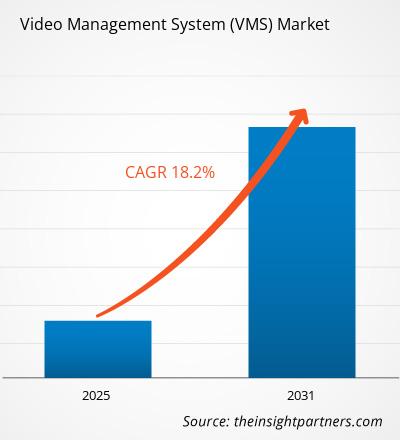
The video management system market was valued at US$ 3.05 Billion in 2025 and is projected to reach US$ 8.43 Billion by 2034, growing at a CAGR of 11.96% during 2026–2034. Demand is rising as enterprises, public agencies, transport operators, campuses, and critical infrastructure owners replace fragmented CCTV recording tools with software-led platforms that unify camera feeds, storage, alerts, analytics, and evidence workflows.
Across North America, the video management system market size is supported by dense IP camera penetration, smart city investments, retail loss-prevention programs, financial-sector compliance, and demand for centralized monitoring across distributed facilities. The region is expected to expand at an estimated 10.8–12.2% CAGR during 2026–2034, helped by cloud migration, AI-enabled video intelligence, and rising managed security adoption.
Video Management System (VMS) Market Assessment and Insights
- North America: The region accounted for an estimated 34–37% share in 2025 and is expected to grow at a CAGR of 10.8–12.2% during 2026–2034, led by high security spending, multi-site enterprises, and public infrastructure upgrades.
- US: The US represented about 76–80% of North America in 2025 and is expected to grow at 10.9–12.4% CAGR, supported by smart buildings and transport security.
- Europe: Europe held an estimated 24–27% share in 2025 and is projected to post a 10.2–11.6% CAGR, with the UK, Germany, France, Italy, and Spain leading adoption.
- Asia Pacific: APAC captured around 25–29% share in 2025 and is expected to grow at 12.8–14.6% CAGR, driven by China, Japan, South Korea, India, and Australia.
- Largest Segment: Solution held an estimated 61–65% market share in 2025 and is projected to grow at a CAGR of 11.4–12.7% during 2026–2034.
- High Growth Segment: Cloud deployment represented about 32–36% share in 2025 and is expected to grow at 14.8–16.5% CAGR due to remote access and subscription-based scalability.
- Key companies analyzed in detail: Bosch Security Systems GmbH, Hanwha Vision Co., Ltd., Honeywell International Inc., Schneider Electric SE, Axis Communications AB, Johnson Controls International plc, Hangzhou Hikvision Digital Technology Co., Ltd., NetApp, Inc., Dahua Technology Co., Ltd., Kedacom, Genetec Inc., Milestone Systems A/S, Motorola Solutions, Inc., and Eagle Eye Networks, Inc.
Source: The Insight Partners' analysis based on proprietary research, government publications, company annual reports, investor presentations, industry databases, and expert interviews.
The market has evolved from basic recording and playback toward integrated video intelligence, cybersecurity controls, open architecture, and evidence-management workflows. IP cameras, edge analytics, and cloud storage have changed buying decisions because platform scalability now matters as much as hardware cost. The market growth is also influenced by interoperability requirements across access control, alarms, command centers, and enterprise IT environments.
In the Video Management System Market report, looking ahead, adoption will broaden across airports, manufacturing sites, data centers, retail chains, hospitals, and municipal infrastructure. Emerging geographies are investing in safer cities and digital public services, while mature markets are refreshing legacy analog estates. Regulatory pressure around incident traceability, employee safety, and privacy-compliant monitoring will favor auditable platforms with granular permissions, retention policies, and encrypted video handling.
Video Management System (VMS) Market Report Scope
| Report Attribute | Details |
|---|---|
| Market size in 2025 | US$ 3.05 Billion |
| Market Size by 2034 | US$ 8.43 Billion |
| Global CAGR (2026 - 2034) | 11.96% |
| Historical Data | 2021-2024 |
| Forecast period | 2026-2034 |
Video Management System (VMS) Market Analysis
Demand is now being influenced by a move away from passive surveillance to operational security activities. Consumers expect systems that are able to cut down on review times, provide alerts in real time, and enable the use of vast amounts of video footage for operational purposes. Market expansion is taking place in scenarios with large, decentralized, and critical camera networks at transportation facilities, industries, commercial sites, and public locations.
Supply conditions have also changed as vendors integrate cameras, storage, analytics, cloud-hosting services, and others in a partner ecosystem. IP-based VMS systems have an advantage over others since they provide higher resolution feeds, flexible integration possibilities, and remote management. The analog-based VMS system still holds significance in low-budget environments, but migration strategies combining both technologies are prevalent.
The competitive landscape is dynamic and fragmented, as there is competition between global security vendors, camera makers, software firms, and cloud natives for open architectures, high-quality analytics, cybersecurity, and total ownership costs. The companies that still carry weight in the market are Bosch Security Systems GmbH, Axis Communications AB, Genetec Inc., Milestone Systems A/S, Motorola Solutions, Inc., Hangzhou Hikvision Digital Technology Co., Ltd., and Dahua Technology Co., Ltd.
The strategic positioning of the players depends on software competencies, managed services relationships, and AI model governance. Market research has shown that clients have shifted from buying solutions on a per-camera basis to buying solutions for use cases that include fast investigation, queue monitoring, perimeter monitoring, shrinkage reduction, and compliance reporting.
● REPORT CUSTOMIZATION
Tailor This Report To Align With Your Specific Business Requirements
This report can be customized to align precisely with your business objectives, scope, and target markets. Customization options include tailored segmentation, geography, competitive analysis, and strategic insights to support informed decision-making.
Customize This Report →WHAT YOU CAN ADJUST
- ● Segmentations
- ● Geography
- ● Competitive Analysis
- ● Language Preferences
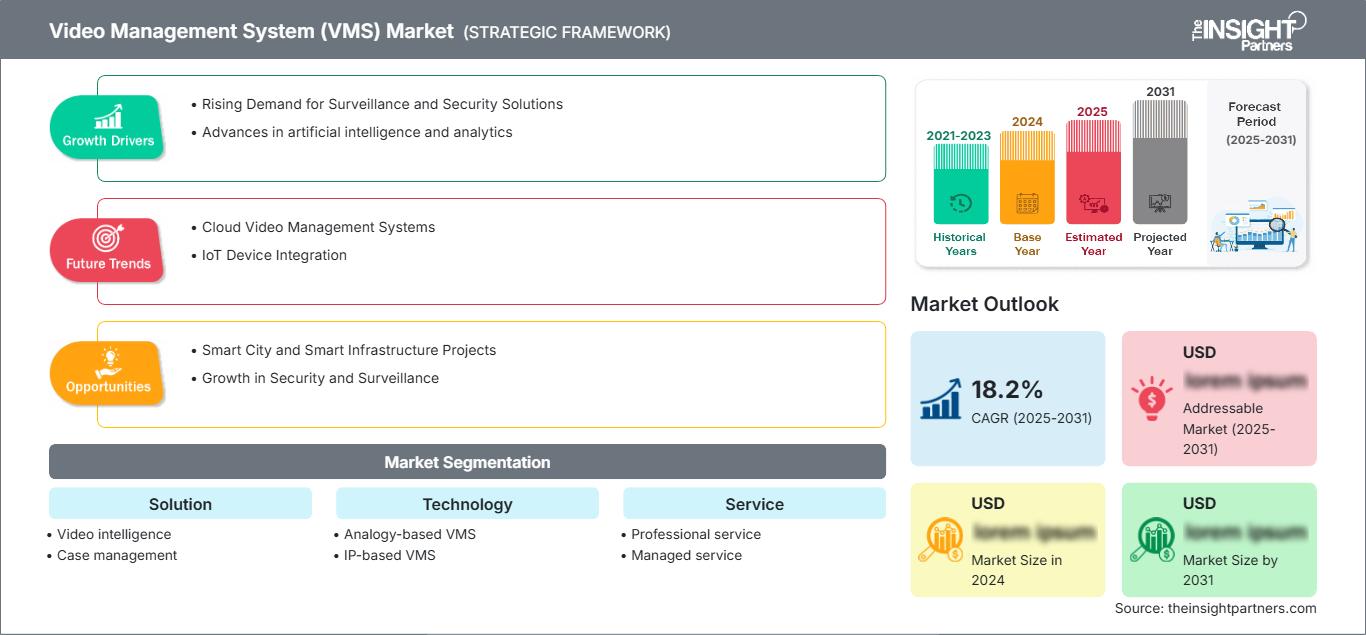
Video Management System (VMS) Market: Strategic Insights
Regional Insights
North America video management system market
North America is expected to retain a leading video management system market share of 34–37% in 2025, supported by mature enterprise security budgets, broad IP camera penetration, and large public safety programs. Adoption is reinforced by financial services, logistics, retail, and education facilities that require centralized visibility across multiple sites.
The region is projected to grow at 10.8–12.2% CAGR during 2026–2034. Federal, state, and municipal investments in transport surveillance, smart buildings, and emergency response infrastructure are encouraging integrated platforms. Cloud VMS is gaining momentum where organizations need remote health monitoring, rapid scaling, and lower on-site server maintenance.
U.S. video management system Market
The US accounted for an estimated 76–80% of North America in 2025 and is forecast to expand at 10.9–12.4% CAGR. The successful adoption can be seen in airports, educational institutions, hospitals, retail stores, warehouses, and smart cities, where video evidence and live alerts enable security and continuity.
Companies are well-represented in the market, including Motorola Solutions, Inc., Honeywell International Inc., Johnson Controls International plc, Eagle Eye Networks, Inc., Genetec Inc., and Milestone Systems A/S. In addition, the country is one of the most important places for testing cloud-managed security, artificial intelligence searches, and integrated access controls.
Europe video management system Market
Europe represented about 24–27% share in 2025 and is expected to grow at 10.2–11.6% CAGR. Deployment is based on secure and privacy-enabled implementation, and therefore, audit trails, role-based access, storage management, and GDPR-compliant video processing are among key purchase considerations. The United Kingdom and Germany take the lead in the enterprise and transportation segments.
In France, Italy, and Spain, development continues in urban security, retail transformation, and industrial monitoring solutions. Companies like Schneider Electric SE, Bosch Security Systems GmbH, Axis Communications AB, and Milestone Systems A/S profit from the need for interoperable solutions that link building management, cameras, alarm systems, and control panels.
APAC video management system Market
APAC held an estimated 25–29% share in 2025 and is forecast to grow at 12.8–14.6% CAGR, making it the highest-growth region. China continues to be a significant manufacturing and deployment center, while Japan, South Korea, India, and Australia have increasing applications in transportation, commercial buildings, education, logistics, and security for governments.
Demand for scalable VMS is being driven by policy-driven smart city development, industrial automation, and the growth of digital infrastructure. Some of the firms driving this trend include Hikvision Digital, Dahua Technology Co., Ltd., Hanwha Vision Co., Ltd., and Kedacom, along with regional integrators.
Middle East & Africa video management system Market
Middle East & Africa is projected to grow at 9.8–11.4% CAGR during 2026–2034. Saudi Arabia and the UAE lead adoption through airport expansion, smart city developments, hospitality security, energy-sector protection, and large commercial projects. South Africa shows demand in retail, logistics, mining, and public safety applications.
Energy infrastructure, mega-project development, and high-value asset protection make integrated video platforms strategically important. Buyers in the region often prioritize centralized command centers, ruggedized deployments, and hybrid cloud approaches that can manage bandwidth constraints while supporting real-time incident response and long-term evidence retention.
Segmentation Analysis
Solution
Solution is the largest segment, with an estimated 61–65% share in 2025 and 11.4–12.7% CAGR outlook. The market scope is anchored by software-led capabilities, including video intelligence, case handling, recording, search, policy-based storage, and integrations with access control and alarm systems.
- Video intelligence supports event detection, object classification, forensic search, and operational analytics, turning high-volume footage into actionable alerts and reducing dependence on manual screen monitoring.
- Case management enables evidence packaging, audit trails, incident collaboration, and export controls, which are essential for public safety, corporate investigations, insurance claims, and compliance workflows.
Technology
Technology is expected to grow at 11.1–12.8% CAGR as users balance legacy preservation with IP modernization. IP-based VMS is favored for high-resolution cameras, remote access, analytics, and flexible storage, while analog-based VMS remains part of phased migration programs in existing facilities.
- Analogy-based VMS remains relevant in cost-sensitive installations and legacy estates where organizations want to extend existing camera investments before shifting fully to networked infrastructure.
- IP-based VMS is gaining preference because it supports scalable camera networks, higher image quality, centralized administration, cybersecurity controls, and integration with cloud and edge analytics.
Service
Service is projected to grow at 10.6–12.1% CAGR as organizations seek design, deployment, maintenance, monitoring, and lifecycle support. The shift toward complex hybrid architectures increases demand for skilled integrators and managed service providers that can maintain uptime, cybersecurity, and system performance.
- Professional service covers consulting, system design, integration, training, and optimization, helping buyers align camera architecture, storage policies, analytics rules, and compliance requirements.
- Managed service is expanding as organizations outsource monitoring, system health checks, cloud administration, updates, and incident support to reduce internal security technology burdens.
Deployment
Deployment is forecast to grow at 12.0–13.9% CAGR, with on-premise systems still important for data control and low-latency sites. Cloud adoption is rising faster as buyers prioritize remote management, elastic storage, recurring licensing, and rapid deployment across distributed properties.
- Cloud platforms offer scalable storage, remote access, automated updates, and lower infrastructure complexity, making them attractive for multi-location enterprises and managed service models.
- On-Premise deployments remain preferred where bandwidth, data sovereignty, latency, or cybersecurity policies require local control over recording, storage, and video access.
Opportunity Snapshot
| Solution | Revenue Contribution | Trend Tag | Adoption Stage |
|---|---|---|---|
| Video Intelligence | High | AI Search | Scaling |
| Case Management | Medium | Evidence Workflow | Scaling |
| Analog-Based VMS | Medium | Legacy Migration | Mature |
| IP-Based VMS | High | Network Cameras | Scaling |
| Professional Service | Medium | System Integration | Mature |
| Managed Service | Medium | Remote Monitoring | Scaling |
| Cloud | High | Cloud VMS | Scaling |
| On-Premise | High | Data Control | Mature |
Video Management System (VMS) Market Growth Drivers and Impact Analysis
Rising Need for Intelligent Security Operations
More sophisticated requirements in terms of surveillance systems have been emerging, which should be capable of performing tasks beyond just capturing the footage. The volume of video that a large-scale system will generate is larger than what can be manually analyzed by the security personnel, hence the necessity of automatic alerts and prioritization based on analytics. The application of AI to a VMS allows it to detect motions, objects, violations of restricted zones, and unusual behavior.
Migration from Analog Infrastructure to IP-Based Platforms
While many systems have legacy analog camera systems in place, it is becoming increasingly common for buyers to choose IP camera systems due to the increased resolution, routing capabilities, security protocols, and remote management options offered. A hybrid VMS system makes it possible to utilize legacy systems and add new features like network cameras, cloud-based storage, and analytics at chosen points within an organization’s facility.
Expansion of Smart Cities and Critical Infrastructure Monitoring
Video technology solutions for smart cities, airport projects, railways, ports, utilities, and energy systems must be able to interconnect distributed cameras with control rooms. The use of VMS is appropriate in such cases because it allows situational awareness, incident management, traffic surveillance, perimeter surveillance, and evidentiary management. In terms of public sector buyers, there is a need for auditability and compliance-driven retention. With the digitization of security operations in infrastructure facilities, such platforms are likely to see increased adoption.
Video Management System (VMS) Market Future Trends
Cloud-Native VMS Becomes a Standard Procurement Option
The video management system market trends point toward wider adoption of cloud-native and hybrid cloud platforms. The customer base is considering cloud not just for its capacity to manage storage but also because of easy software upgrades, diagnostics done remotely, access from multiple locations, cybersecurity patches, and subscription-based costs. Cloud is not going to replace on-premises solutions in bandwidth-demanding or regulated circumstances, but hybrid solutions will be the order of the day.
Video Analytics Moves from Add-On to Core Platform Layer
Analytics is evolving from elective modules to integrated platform features. Natural language search, classification of events in real time, object tracking, face blurring for privacy concerns, and operational dashboards will be key considerations in future VMS implementations. Edge computing will relieve network congestion by filtering the pertinent events prior to transmission. In the context of increased adoption, consumers will evaluate algorithmic precision, minimizing false positives, explainability, and governance.
Video Management System (VMS) Market Opportunities
Managed Video Services for Distributed Enterprises
The video management system market forecasts show a strong opportunity in managed services for retail chains, warehouses, schools, healthcare networks, and franchise operators. These users often lack internal security technology teams but require reliable uptime, remote troubleshooting, camera health checks, and quick incident retrieval. Service providers can combine cloud VMS, maintenance, monitoring, and analytics configuration into recurring contracts. This model improves customer retention while helping smaller organizations access advanced features without large internal infrastructure investments.
Compliance-Ready Evidence and Case Management Platforms
Security teams increasingly need structured evidence workflows that preserve the chain of custody, redact sensitive content, manage access permissions, and support audit requests. This creates an opportunity for VMS vendors to strengthen case management, export controls, retention automation, and integration with law enforcement or enterprise risk systems. Industries such as banking, transportation, healthcare, education, and government can benefit from platforms that reduce investigation time while protecting privacy and regulatory compliance.
Frequently Asked Questions

- Comprehensive Market Sizing and Forecast Analysis
- Detailed Segmentation Analysis
- In-Depth Market Dynamics Assessment
- Regional and Country-Level Insights
- Competitive Landscape and Company Benchmarking
- Strategic Business Intelligence
Recent Reports
Testimonials

The Insight Partners provided valuable market intelligence that supported our global go-to-market strategy. Their team was professional, responsive, and attentive to our feedback, providing thoughtful analysis and helpful methodological clarifications throughout the project.
Junmo Kim Chief Financial Officer (CFO), Enertech Co., Ltd.
The Insight Partners' SCADA System Market report is comprehensive, with valuable insights on current trends and future forecasts. The team was highly professional, responsive, and supportive throughout. We are very satisfied and highly recommend their services.
RAN KEDEM Partner, Reali Technologies LTDs
I requested a report on a very specific software market and the team produced the report in a few days. The information was very relevant and well presented. I then requested some changes and additions to the report. The team was again very responsive and I got the final report in less than a week.
JEAN-HERVE JENN Chairman, Future Analytica
We worked with The Insight Partners for an important market study and forecast. They gave us clear insights into opportunities and risks, which helped shape our plans. Their research was easy to use and based on solid data. It helped us make smart, confident decisions. We highly recommend them.
PIYUSH NAGPAL Sr. Vice President, High Beam Global
The Insight Partners delivered insightful, well-structured market research with strong domain expertise. Their team was professional and responsive throughout. The user-friendly website made accessing industry reports seamless. We highly recommend them for reliable, high-quality research services
YUKIHIKO ADACHI CEO, Deep Blue, LLC.
This is the first time I have purchased a market report from The Insight Partners.While I was unsure at first, I visited their web site and felt more comfortable to take the risk and purchase a market report.I am completely satisfied with the quality of the report and customer service. I had several questions and comments with the initial report, but after a couple of dialogs over email with their analyst I believe I have a report that I can use as input to our strategic planning process.Thank you so much for taking the extra time and making this a positive experience.I will definitely recommend your service to others and you will be my first call when we need further market data.
JOHN SUZUKI President and Chief Executive Officer, Board Director, BK Technologies
I wish to appreciate your support and the professionalism you displayed in the course of attending to my request for information regarding to infectious disease IVD market in Nigeria. I appreciate your patience, your guidance, and the fact that you were willing to offer a discount, which eventually made it possible for us to close a deal. I look forward to engaging The Insight Partners in the future, all thanks to the impression you have created in me as a result of this first encounter.
DR CHIJIOKE ONYIA MANAGING DIRECTOR, PineCrest Healthcare Ltd.Reason to Buy
- Informed Decision-Making
- Understanding Market Dynamics
- Competitive Analysis
- Identifying Emerging Markets
- Customer Insights
- Market Forecasts
- Risk Mitigation
- Boosting Operational Efficiency
- Strategic Planning
- Investment Justification
- Tracking Industry Innovations
- Aligning with Regulatory Trends





 Get Free Sample for