
Video Measuring System Market Demand, Size & Forecast by 2034
Coverage: by Component (Hardware, Software, Services); Product Type (Manual, Semi-Automated, Automated/CNC); Application (Automotive, Aerospace and Defense, Heavy Machinery Industry, Energy and Power, Electronics, Others) , and Geography (North America, Europe, Asia Pacific, and South and Central America)
- Status : Data Released
- Report Code : TIPRE00011510
- Category : Electronics and Semiconductor
- No. of Pages : 150
- Available Report Formats :


- Last update date : September 21, 2026


2025 Market Size
US$ 808.35 Mn
Base year value
2034 Forecast
US$ 1,430.9 Mn
Projected by 2034
CAGR 2026-2034
6.55 %
Growth rate
Addressable Market
US$ 10,125.59 Mn
(2026-2034)
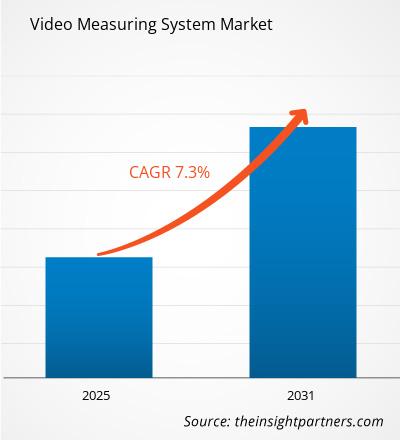
The global Video Measuring System market was valued at US$ 808.35 million in 2025 and is expected to reach US$ 1430.9 million by 2034; it is estimated to record a CAGR of 6.55% during 2026-2034.
Video Measuring System Market Assessment and Insights
- North America: The region accounted for an estimated 34–37% share in 2025 and is expected to grow at a CAGR of 6.8–7.4% during 2026–2034, led by aerospace, automotive, and electronics inspection programs.
- U.S.: The U.S. represented nearly 76–80% of North America demand in 2025 and is projected to expand at a CAGR of 6.9–7.5% through 2034.
- Europe: Europe held an estimated 25–28% share in 2025 and is forecast to grow at a CAGR of 6.5–7.1%, with Germany, the UK, France, and Italy leading adoption.
- Asia Pacific: Asia Pacific captured an estimated 29–33% share in 2025 and is expected to register a CAGR of 7.8–8.5%, supported by China, Japan, South Korea, and India.
- Largest Segment: Hardware held the largest market share range of 52–56% in 2025 and is projected to grow at a CAGR of 6.9–7.5% during 2026–2034.
- High Growth Segment: Automated/CNC systems held a 38–42% market share range in 2025 and are expected to grow at a CAGR of 8.1–8.8% during 2026–2034.
- Key companies analyzed in detail: Carl Zeiss AG, CARMAR ACCURACY CO., LTD., FARO Technologies, Inc., Hexagon AB, KEYENCE CORPORATION, Nikon Metrology NV, Perceptron, Inc., Renishaw plc, Vision Engineering Ltd., and WENZEL Group.
Source: The Insight Partners' analysis based on proprietary research, government publications, company annual reports, investor presentations, industry databases, and expert interviews.
The market has evolved from standalone optical comparators toward integrated video metrology systems that combine cameras, sensors, motion controllers, and analytics software. Manufacturers are using these platforms to reduce inspection cycle time, improve repeatability, and document quality outcomes for regulated and tolerance-sensitive applications. The market growth is also tied to Industry 4.0 programs that require measurement data to move directly into production control and quality management systems.
In the Video Measuring System Market report, future demand will be shaped by investment in automated inspection, compact measuring machines, and software platforms that simplify programming for non-specialist operators. Emerging manufacturing hubs in Asia Pacific and Eastern Europe are increasing procurement as suppliers pursue export-grade quality certification. Regulatory pressure in aerospace, energy, and electronics will continue to support adoption where traceable dimensional data is necessary.
Video Measuring System Market Report Scope
| Report Attribute | Details |
|---|---|
| Market size in 2025 | US$ 808.35 Million |
| Market Size by 2034 | US$ 1,430.9 Million |
| Global CAGR (2026 - 2034) | 6.55% |
| Historical Data | 2021-2024 |
| Forecast period | 2026-2034 |
Video Measuring System Market Analysis
The factors driving demand include reduced component sizes, narrow tolerance limits, and the need for reducing waste in mass production. The market development is mainly evident in applications in the field of electronics and vehicles, where non-contact technology can help measure tiny, fragile, and complicated parts without distorting them. Hardware providers, software providers, calibration services, and system integrators constitute an interlinked ecosystem that provides installation, validation, training, and lifecycle management.
The dynamics in supply chain have been improving because of increased access to better camera technology, edge detection techniques, and motion control technologies. The findings in the market analysis reveal that buyers are now comparing the systems based on their speed of measurement, size of field of view, software friendliness, automation capability, and connection with digital quality reports.
Competitive positioning in the market is dominated by global metrology experts and optical inspection firms. The main competitors in the category include Carl Zeiss AG, Hexagon AB, KEYENCE CORPORATION, Nikon Metrology NV, FARO Technologies, Inc., and Renishaw plc. Competing on accuracy, software capabilities, automation friendliness, and global services are the main differentiators for these companies.
Investment focus is on software solutions that can reduce programming effort and enable connected manufacturing. The firms are coming up with new versions of inspection software and architectures and hybrid measurement to serve quality teams with labor constraints. The suppliers that have scalable software solutions, flexible service networks, and application engineering capability stand a chance of growing their market share as their customers adopt standardized metrology processes in their facilities.
● REPORT CUSTOMIZATION
Tailor This Report To Align With Your Specific Business Requirements
This report can be customized to align precisely with your business objectives, scope, and target markets. Customization options include tailored segmentation, geography, competitive analysis, and strategic insights to support informed decision-making.
Customize This Report →WHAT YOU CAN ADJUST
- ● Segmentations
- ● Geography
- ● Competitive Analysis
- ● Language Preferences
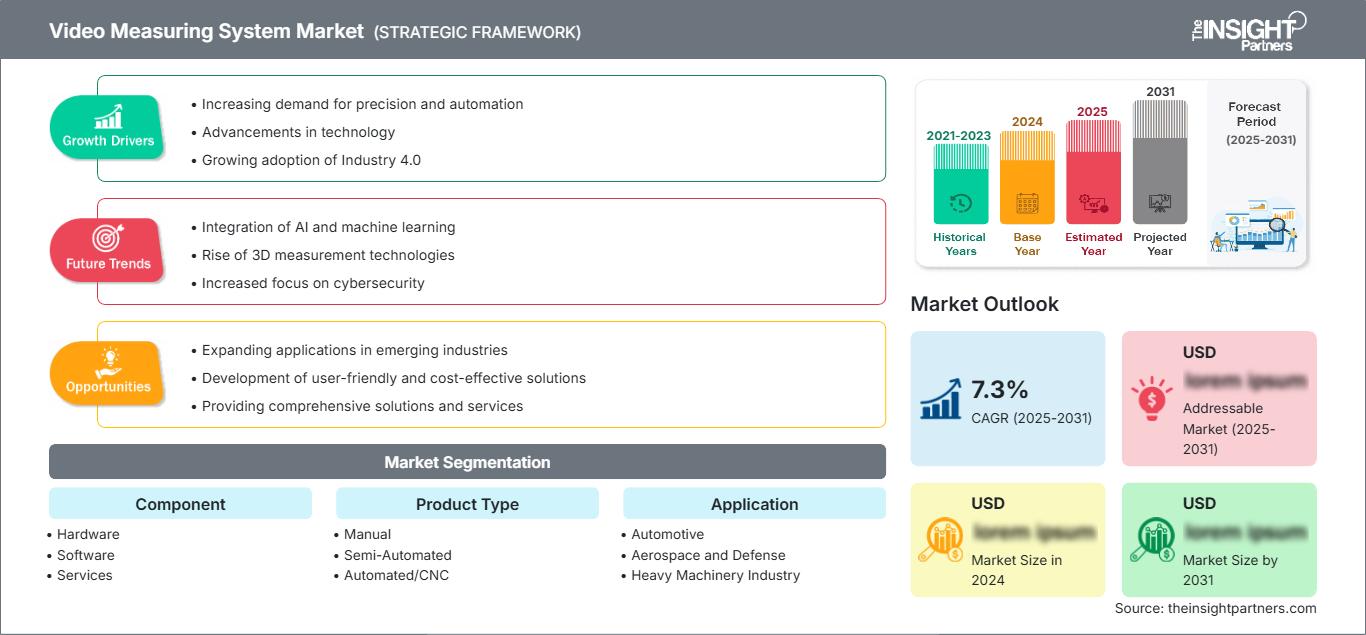
Video Measuring System Market: Strategic Insights
Regional Insights
North America Video Measuring System Market
North America accounted for an estimated 34–37% video measuring system market share in 2025 and is expected to grow at a CAGR of 6.8–7.4% during 2026–2034. Aerospace, defense, automotive, medical manufacturing, and electronics suppliers drive demand for repeatable dimensional inspection and faster quality documentation.
The region benefits from high automation intensity and strong adoption of digital quality systems. Manufacturing reshoring, electric vehicle component production, and precision machining demand support spending on automated and semi-automated video measuring platforms.
U.S. Video Measuring System Market
The U.S. represented about 76–80% of North America demand in 2025 and is projected to grow at a CAGR of 6.9–7.5%. Domestic aerospace, medical device, semiconductor equipment, and advanced automotive supply chains sustain procurement of high-accuracy metrology platforms.
Company presence is strong across sales, service, and application engineering networks. U.S. manufacturers increasingly prefer systems that connect inspection results with statistical process control, reducing manual reporting and supporting traceable quality decisions.
Europe Video Measuring System Market
Europe held an estimated 25–28% share in 2025 and is expected to expand at a CAGR of 6.5–7.1%. Germany leads regional demand through automotive, machinery, and precision engineering industries, while the UK and France add aerospace and defense-related inspection requirements.
Italy and Spain support adoption through industrial machinery, energy components, and export-focused manufacturing. European buyers emphasize measurement traceability, software validation, and lifecycle service, making established metrology suppliers well-positioned.
APAC Video Measuring System Market
APAC held an estimated 29–33% share in 2025 and is projected to grow at a CAGR of 7.8–8.5%. China leads regional volume, while Japan and South Korea contribute advanced electronics, automotive, and precision tooling demand.
India and Australia add momentum through industrial modernization, aerospace supply chain development, and quality certification programs. The region’s expansion is supported by electronics manufacturing, factory automation, and rising local demand for inspection productivity.
Middle East & Africa Video Measuring System Market
The Middle East and Africa market is expected to grow at a CAGR of 5.8–6.5% during 2026–2034. Saudi Arabia and the UAE are investing in industrial diversification, aerospace maintenance, energy equipment, and precision fabrication.
South Africa remains a key industrial base for regional adoption, while the rest of MEA shows selective demand from energy, infrastructure, and machinery repair markets. Growth is gradual because adoption depends on skilled operators and capital availability.
Segmentation Analysis
Component
The component segment is expected to grow at a CAGR of 7.0–7.6% during 2026–2034. The video measuring system market scope across hardware, software, and services reflects a shift from equipment purchasing to integrated inspection workflows that combine optics, image processing, calibration, and operator training.
- Hardware: Hardware includes cameras, lenses, stages, lighting, sensors, and controllers. It remains the largest revenue contributor because accuracy and measurement stability depend on optical quality and mechanical precision.
- Software: Software demand is rising as users require automated edge detection, reporting, measurement programming, data analysis, and integration with quality management systems.
- Services: Services cover installation, calibration, maintenance, validation, and training. Demand is strongest among manufacturers that require traceable measurements and system uptime.
Product Type
The product type segment is projected to grow at a CAGR of 7.2–7.9% during 2026–2034. Automated platforms are gaining preference, but manual and semi-automated systems remain relevant for smaller manufacturers, laboratories, and low-volume inspection tasks.
- Manual: Manual systems suit laboratories, tool rooms, and smaller production environments where flexibility, lower capital cost, and operator-led inspection remain important.
- Semi-Automated: Semi-automated systems balance cost and productivity by improving repeatability while retaining operator control for mixed-part inspection workflows.
- Automated/CNC: Automated/CNC systems support repeatable inspection, high throughput, and digital reporting, making them strategically important for production-scale quality control.
Application
The application segment is forecast to grow at a CAGR of 7.1–7.8% during 2026–2034. Automotive, aerospace and defense, electronics, heavy machinery, and energy applications use video measurement to confirm dimensional accuracy, reduce rework, and protect product reliability.
- Automotive: Automotive users prioritize rapid inspection of stamped, machined, molded, and electronic components to support high-volume production and supplier quality programs.
- Aerospace and Defense: Aerospace and defense applications require traceable inspection of complex, high-value parts where dimensional deviations can affect safety and compliance.
- Heavy Machinery Industry: Heavy machinery manufacturers use video measurement for machined parts, assemblies, tooling, and fabricated components where repeatability supports durability.
- Energy and Power: Energy and power applications include turbines, connectors, precision hardware, and fabricated parts where dimensional control supports performance and reliability.
- Electronics: Electronics manufacturers depend on optical measurement for compact components, connectors, circuit-related parts, and precision assemblies with small geometries.
Opportunity Snapshot
| Application | Revenue Contribution | Trend Tag | Adoption Stage |
|---|---|---|---|
| Automotive | High | EV Components | Mature |
| Aerospace and Defense | High | Precision Compliance | Scaling |
| Heavy Machinery Industry | Medium | Durable Parts | Scaling |
| Energy and Power | Medium | Turbine Quality | Scaling |
| Electronics | High | Miniature Inspection | Mature |
Video Measuring System Market Growth Drivers and Impact Analysis
Automation of Precision Inspection
Manufacturers are stepping up investments in automated inspection since the quality team needs to perform measurements on more parts without slowing down the manufacturing process. Automated/CNC inspection systems lessen manual positioning, increase repeatability, and facilitate shift consistency. The need for automation is highest in the automotive, electronics, and aerospace industries, where delays due to inspection are causing production bottlenecks. As manufacturing plants link metrology machines to SPC and MES, video measurements act as inputs to process improvement as opposed to being outputs of final inspections.
Rising Demand for Non-Contact Measurement
The combination of complexity in the components, sensitivity of the surfaces, and the miniaturization of components is compelling manufacturers to adopt non-contact measurement techniques. Video measurement systems are ideal for inspecting the components that cannot be measured using any form of calipers, gauges, and probing. It is evident in industries such as the electronics industry, the manufacture of medical devices, energy components, and precision machining industries because any form of surface interference will affect the quality of the components.
Digital Quality and Traceability Requirements
There is an increased tendency towards documentation and data analysis as far as quality control is concerned due to the increased customer demands to show proof of compliance in terms of dimensions. Video measurement systems are designed to cater to such demands through the generation of data, inspection reports, and consistent measurement procedures. Such a need is particularly relevant in industries such as aerospace, defense, automobile, and regulated industries, where product liability and vendor qualification are of significance.
Video Measuring System Market Future Trends
AI-Assisted Measurement Programming
The video measuring system market trends are moving toward software that automates programming, feature recognition, and measurement-path optimization. AI-powered devices will decrease dependency on skilled metrology programmers and will help to speed up the setup process when working with new parts. This development will become crucial for those manufacturing facilities that operate in the high-mix manufacturing setting. With the user-friendly interface becoming available, usage of such devices may be expanded not only in special laboratories but also on production lines, supplier sites, and small manufacturing plants.
Hybrid Optical and Multi-Sensor Platforms
Future systems will use an integration of camera-based measurement and touch probes, along with lasers and lights, to address varied inspection challenges using a single system. The hybrid systems will be able to help manufacturers measure geometries and surfaces and materials without moving parts across several stations. Hybridization is helping manufacturers become more efficient and streamline their process flow. Manufacturers will benefit from suppliers who provide them with flexible and upgradable systems.
Video Measuring System Market Opportunities
Factory-Level Standardization of Metrology Workflows
The video measuring system market forecasts indicate a strong opportunity in standardizing measurement workflows across multiple plants. The large manufacturer needs standardized inspection processes, standardized reporting, and quality data from one source. The vendor can make money through scalable software, remote assistance, calibrations, and training programs that make it possible to deploy the inspection process consistently. This is especially important for auto makers, aircraft makers, electronics companies, and machinery companies that have dispersed supplier networks.
Growth in Electronics and Miniaturized Components
There is a strategy opportunity in the manufacture of electronic products due to the fact that parts are small, there is a high volume of inspection work, and the tolerances are small. Video measurement will help in providing speed and accuracy without contact when measuring connectors, housings, circuits, associated components, and high-precision assemblies. The firms that can produce systems that are compact, automated, and computerized can cater to large and small firms in the electronics industry.
Frequently Asked Questions

- Comprehensive Market Sizing and Forecast Analysis
- Detailed Segmentation Analysis
- In-Depth Market Dynamics Assessment
- Regional and Country-Level Insights
- Competitive Landscape and Company Benchmarking
- Strategic Business Intelligence
Recent Reports
Testimonials

The Insight Partners provided valuable market intelligence that supported our global go-to-market strategy. Their team was professional, responsive, and attentive to our feedback, providing thoughtful analysis and helpful methodological clarifications throughout the project.
Junmo Kim Chief Financial Officer (CFO), Enertech Co., Ltd.
The Insight Partners' SCADA System Market report is comprehensive, with valuable insights on current trends and future forecasts. The team was highly professional, responsive, and supportive throughout. We are very satisfied and highly recommend their services.
RAN KEDEM Partner, Reali Technologies LTDs
I requested a report on a very specific software market and the team produced the report in a few days. The information was very relevant and well presented. I then requested some changes and additions to the report. The team was again very responsive and I got the final report in less than a week.
JEAN-HERVE JENN Chairman, Future Analytica
We worked with The Insight Partners for an important market study and forecast. They gave us clear insights into opportunities and risks, which helped shape our plans. Their research was easy to use and based on solid data. It helped us make smart, confident decisions. We highly recommend them.
PIYUSH NAGPAL Sr. Vice President, High Beam Global
The Insight Partners delivered insightful, well-structured market research with strong domain expertise. Their team was professional and responsive throughout. The user-friendly website made accessing industry reports seamless. We highly recommend them for reliable, high-quality research services
YUKIHIKO ADACHI CEO, Deep Blue, LLC.
This is the first time I have purchased a market report from The Insight Partners.While I was unsure at first, I visited their web site and felt more comfortable to take the risk and purchase a market report.I am completely satisfied with the quality of the report and customer service. I had several questions and comments with the initial report, but after a couple of dialogs over email with their analyst I believe I have a report that I can use as input to our strategic planning process.Thank you so much for taking the extra time and making this a positive experience.I will definitely recommend your service to others and you will be my first call when we need further market data.
JOHN SUZUKI President and Chief Executive Officer, Board Director, BK Technologies
I wish to appreciate your support and the professionalism you displayed in the course of attending to my request for information regarding to infectious disease IVD market in Nigeria. I appreciate your patience, your guidance, and the fact that you were willing to offer a discount, which eventually made it possible for us to close a deal. I look forward to engaging The Insight Partners in the future, all thanks to the impression you have created in me as a result of this first encounter.
DR CHIJIOKE ONYIA MANAGING DIRECTOR, PineCrest Healthcare Ltd.Reason to Buy
- Informed Decision-Making
- Understanding Market Dynamics
- Competitive Analysis
- Identifying Emerging Markets
- Customer Insights
- Market Forecasts
- Risk Mitigation
- Boosting Operational Efficiency
- Strategic Planning
- Investment Justification
- Tracking Industry Innovations
- Aligning with Regulatory Trends





 Get Free Sample for