
Wall Keypad Market Growth, Trends & Demand by 2034
Coverage: By Type (Touch Type, Push Button Type); Application (Residential, Commercial) , and Geography (North America, Europe, Asia Pacific, and South and Central America)
- Status : Data Released
- Report Code : TIPRE00024672
- Category : Electronics and Semiconductor
- No. of Pages : 150
- Available Report Formats :


- Last update date : September 23, 2026


2025 Market Size
US$ 2.34 Bn
Base year value
2034 Forecast
US$ 4.1 Bn
Projected by 2034
CAGR 2026-2034
6.43 %
Growth rate
Addressable Market
US$ 29.13 Bn
(2026-2034)
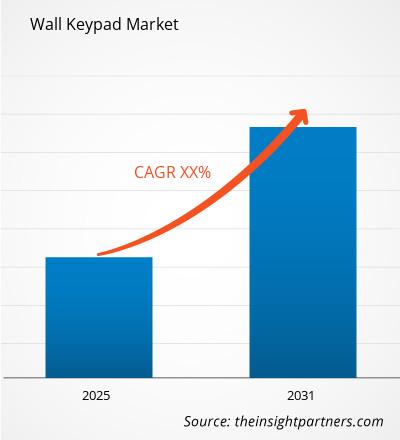
The Wall Keypad market was valued at US$ 2.34 billion in 2025 and is expected to reach US$ 4.1 billion by 2034; it is estimated to record a CAGR of 6.43% during 2026-2034.
Wall Keypad Market Assessment and Insights
- North America: North America is expected to represent 35–39% share in 2025 and grow at a CAGR of 6.8–7.4% between 2026–2034, supported by mature automation ecosystems, retrofit activity, and professional integration across premium homes and commercial properties.
- US: The US is projected to account for 80–84% of North America's 2025 share, growing at a CAGR of 6.9–7.5% between 2026–2034, supported by smart security and connected-home installations.
- Europe: Europe is estimated at 27–31% share in 2025 and is expected to expand at a CAGR of 6.5–7.1% between 2026–2034, led by Germany, the UK, France, Italy, and Spain as connected-home adoption and energy-management requirements strengthen.
- Asia Pacific: Asia Pacific is estimated at 24–28% share in 2025 and is projected to advance at a CAGR of 8.2–9.0% between 2026–2034, with China, Japan, South Korea, and India supporting adoption through urban development and connected-building investment.
- Largest Segment: Touch Type is estimated to hold 58–62% market share in 2025, expanding at a CAGR of 7.7–8.3% between 2026–2034, reflecting demand for sleek, programmable interfaces.
- High Growth Segment: Commercial applications are estimated at 36–40% market share in 2025, with a CAGR of 8.0–8.6% between 2026–2034, driven by centralized building-control requirements.
- Key companies analyzed in detail: Insteon Inc.; LG Innotek Co., Ltd.; Texecom Ltd.; Crestron Electronics, Inc.; Nelson-Miller, Inc.; Vexos Inc.; Honeywell International Inc.; Centralite Systems, Inc.; Kramer Electronics Ltd.; Legrand SA.
Source: The Insight Partners' analysis based on proprietary research, government publications, company annual reports, investor presentations, industry databases, and expert interviews.
The wall keypad market has evolved from basic mechanical control panels toward programmable interfaces capable of managing lighting, shades, security, audiovisual equipment, and scenes. Product differentiation increasingly depends on button configuration, tactile response, backlighting, engraving, connectivity, and compatibility with broader automation platforms. Manufacturers are also balancing wired reliability with wireless installation flexibility, while contract electronics manufacturers support increasingly customized low-volume production for premium projects and commercial control applications.
The wall keypad market report indicates that, looking forward, the market is likely to gain from emerging residential construction in Asia Pacific and modernization projects across Europe and North America. Investment is shifting toward interoperability, low-power wireless communication, retrofit-friendly installation, and interfaces that coexist with mobile applications. Regulatory emphasis on energy efficiency should also encourage integrated controls that let users manage lighting, shading, heating, and other electrical loads through coordinated scenes.
Wall Keypad Market Report Scope
| Report Attribute | Details |
|---|---|
| Market size in 2025 | US$ 2.34 Billion |
| Market Size by 2034 | US$ 4.1 Billion |
| Global CAGR (2026 - 2034) | 6.43% |
| Historical Data | 2021-2024 |
| Forecast period | 2026-2034 |
Wall Keypad Market Analysis
The wall keypad market growth is closely linked to the expansion of connected lighting, security, shading, and audiovisual ecosystems. The most powerful demand occurs in areas where users need instant local control, even when cloud applications or smartphone-based devices cannot be utilized. In the value chain, the industry includes semiconductor and electronic component manufacturers, printed circuit board assembly, enclosure and switch producers, software vendors, systems integration, distribution, and building contractors. The supply situation becomes more favorable for designs with a modular structure that will allow the use of universal electronics for different configurations of buttons, finish options, and communication protocols.
Touch-based interfaces can enjoy the advantages of upscale residential design trends, while push-button devices still have a role to play for applications that require tactile feedback, ease of use, quick operation, and predictability of control. The industry also adopts wireless capability, programmable logic, status lighting, and gateway functionality. All this diversifies the application base from light control to security modes, room scenes, meeting room management, hotel control, and energy management applications.
The wall keypad market analysis indicates a fragmented competitive environment in which differentiation occurs through integration capability rather than hardware alone. Crestron Electronics Inc. stresses configurable Cameo and Horizon platforms, while Insteon Inc. provides lighting and automation keypads. Texecom Ltd. places much stress on security control, while Legrand SA links wall controls with electricity and smart home systems.
Channel management is another important aspect in competitive positioning. Premium firms work with architects, integrators, electricians, and specialty distributors, while general electricity producers take advantage of the network of contractors and extensive range of products. Honeywell International Inc. takes advantage of security systems, Kramer Electronics Ltd. of audio visual control, while LG Innotek Co., Ltd. makes use of its electronics manufacturing capacities. Key areas of investment are interoperability, ease of installation, customization, and product platforms for both new construction and renovation.
● REPORT CUSTOMIZATION
Tailor This Report To Align With Your Specific Business Requirements
This report can be customized to align precisely with your business objectives, scope, and target markets. Customization options include tailored segmentation, geography, competitive analysis, and strategic insights to support informed decision-making.
Customize This Report →WHAT YOU CAN ADJUST
- ● Segmentations
- ● Geography
- ● Competitive Analysis
- ● Language Preferences
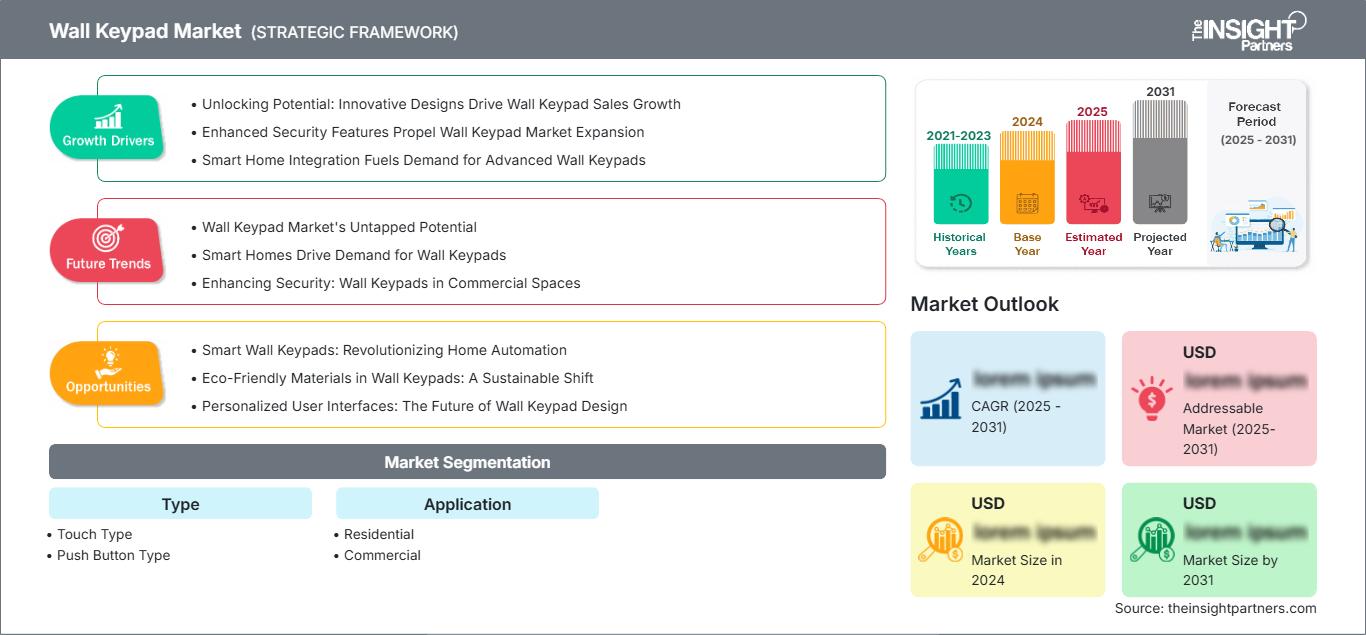
Wall Keypad Market: Strategic Insights
Regional Insights
North America wall keypad market
North America is estimated to hold 35–39% share in 2025, with a regional CAGR of 6.8–7.4% through 2034. The area enjoys the advantage of existing home-automation distribution channels, a well-established professionally-installed security system penetration rate, and renovation budgets. In terms of markets, the US leads while Canada provides support with residential remodeling and building controls for commercial purposes. The demand is especially strong in high-value installations where customized interfaces allow for integration of different systems.
In the US, the presence of physical controls becomes necessary despite the growing trend of mobile and voice interface use, due to the requirement of a reliable local operation by installers, as well as instantaneous visual feedback needed by homeowners. High-end homes use lighting, shades, entertainment, and security scenes controlled via programmed keypads. Applications include hospitality, conference, office, and multi-family buildings.
U.S. wall keypad Market
The US is estimated to represent 80–84% of North America's 2025 share and is projected to grow at a CAGR of 6.9–7.5% through 2034. The increasing trend towards smart access and security adoption has enhanced the importance of local control interfaces, while professional integrators are specifying configurable products for high-end residential and commercial systems. Smart-home access control adoption will serve as an ecosystem for the connected control hardware.
The companies such as Crestron Electronics, Inc., Insteon Inc., Honeywell International Inc., Centralite Systems, Inc. and Nelson-Miller, Inc. cover different segments of the U.S. ecosystem through automation, security, electronics and customized control solutions. The applications are being made to include lighting scenes, shades, security modes, audio and energy management. Compatibility with retrofit installations, neutral wire availability, wireless communication and customizable engraving have become essential purchasing criteria.
Europe wall keypad Market
Europe is estimated at 27–31% of the wall keypad market share in 2025, growing at a CAGR of 6.5–7.1% through 2034, with Germany positioned as a leading market. High levels of adoption of digital devices and growing awareness of home energy management solutions create a suitable platform for the development of physical interfaces, especially when lighting, security and energy systems are incorporated.
The United Kingdom and Germany are two key regions thanks to the presence of existing smart buildings, retrofitting activities, and professional installation networks. In addition, countries such as France, Italy, and Spain provide additional business opportunities by offering residential retrofitting and hospitality projects, and connected buildings. Growing emphasis on energy efficiency, interoperability, design quality, and installation standards among European consumers gives manufacturers with electrical distribution networks an edge when launching connected keypads along with switches and other products.
APAC wall keypad Market
APAC is estimated at 24–28% share of the wall keypad market in 2025 and is expected to grow at a CAGR of 8.2–9.0% through 2034, making it the fastest-growing major region. China dominates regional demand, whereas Japan and South Korea back premium adoption. India provides an interesting opportunity for growth owing to the development of connected home technology, urban housing, and digital infrastructure.
China boasts large-scale electronics manufacturing and smart-home adoption; Japan and South Korea specialize in advanced automation and energy efficiency. India and Australia provide additional opportunities for growth due to new constructions and renovations. Regional demand is bolstered by wireless connectivity, mobile phone penetration, and smart building development. China is likely to continue dominating the market in terms of its size, and India will demonstrate better growth rates.
Middle East & Africa wall keypad Market
The Middle East and Africa wall keypad market demand is estimated to represent a smaller portion of global revenue, with a modeled CAGR of 6.2–7.0% through 2034. Saudi Arabia and the UAE lead regional adoption through premium residential developments, hospitality projects, commercial construction, and smart-city investment. South Africa remains the principal sub-Saharan market, supported by commercial automation and security applications.
Energy management and infrastructure modernization create additional opportunities for programmable control interfaces. High-value hotels, villas, offices, and mixed-use developments favor aesthetically integrated controls that can coordinate lighting, shading, security, and room scenes. Saudi Arabia is expected to remain the leading Gulf opportunity by project pipeline, while the UAE benefits from mature luxury-property and building-automation ecosystems.
Segmentation Analysis
Type
Wall Keypad Market forecast indicates that the Type segment is expected to expand at a CAGR of 7.2–8.0% between 2026–2034. Product selection increasingly depends on application complexity, aesthetic requirements, tactile preferences, installation conditions, and desired integration with automation systems. Touch products benefit from premium design positioning, while push-button systems retain strong relevance where users prioritize physical feedback and straightforward operation.
- Touch Type: Touch-based keypads address premium residential and commercial projects seeking minimalist surfaces, programmable functions, illuminated indicators, and seamless integration with broader automation systems. Their design flexibility supports sophisticated room-control applications and architectural customization.
- Push Button Type: Push-button configurations remain strategically important for tactile operation, accessibility, rapid scene selection, and dependable physical feedback. They are well-suited to security, lighting, hospitality, and commercial environments where users need clearly differentiated controls.
Application
The Application segment is projected to grow at a CAGR of 7.5–8.4% between 2026–2034 as physical interfaces become embedded in connected buildings. Residential projects emphasize comfort and personalization, whereas commercial installations prioritize centralized control, operational consistency, durability, and integration with building-management systems.
- Residential: Residential demand is shaped by smart lighting, shading, security, entertainment, and energy-management installations. Buyers increasingly favor interfaces that combine multiple functions without requiring smartphones for routine actions, particularly in premium homes and renovation projects.
- Commercial: Commercial applications benefit from standardized room control across hotels, offices, meeting spaces, retail environments, and multifamily buildings. Programmable controls can simplify user interaction while supporting centralized management, status indication, and integration with security or audiovisual systems.
Opportunity Snapshot
| Application | Revenue Contribution | Trend Tag | Adoption Stage |
| Residential | High | Scene Control | Mature |
| Commercial | Medium | Room Automation | Scaling |
Wall Keypad Market Growth Drivers and Impact Analysis
Expansion of Integrated Smart-Home Control Ecosystems
Connected-home systems increasingly combine lighting, security, climate, entertainment, shading, and energy functions within unified control environments. This convergence raises the value of a dedicated physical interface because users can activate multiple programmed scenes without navigating separate applications. Eurostat reported that 70.9% of EU residents used internet-connected devices in 2024, while 11.8% used smart-home security devices, demonstrating an expanding connected-device base that can support physical control points. For keypad manufacturers, ecosystem integration creates opportunities to sell higher-value devices with programmable buttons, status indicators, and multiple communication options. It also encourages integrators to standardize interfaces across rooms, supporting repeat purchases and replacement demand.
Rising Adoption of Smart Access and Security Solutions
Security applications are expanding the role of wall-mounted controls beyond conventional lighting and switching. In the US, 11% of internet households owned a smart door lock in early 2026, while households with security systems showed substantially higher smart-lock adoption than households without such systems. This relationship supports demand for local interfaces that can arm, disarm, trigger scenes, or provide visible system status. The impact extends across residential and commercial environments, where security controls must remain accessible and intuitive. Vendors that connect keypad functions with alarms, access devices, cameras, and automation controllers can strengthen system-level differentiation and increase the value of each installation.
Preference for Retrofit-Friendly and Customizable Interfaces
The existing presence of a large number of traditional switches and control panels is a chance to replace interfaces that can be installed without major rewiring. Wireless communication, no use of the neutral wire, modularity of button layout, customization by engraving, and a small wall form factor can simplify installation. Crestron Electronics, Inc. shows this trend through the development of Cameo line products intended for both newly built and already existing buildings, including customizable layouts and wireless solutions. The commercial significance is two-fold: installers can handle a larger variety of buildings, while manufacturers can compete in design and installation capabilities and not just in electronic performance.
Wall Keypad Market Future Trends
Convergence of Physical Controls with Interoperable Smart-Home Standards
The wall keypad market trends are likely to increasingly reflect interoperability between physical controls and multi-vendor smart-home ecosystems. While Matter is working on reducing the friction of connecting devices from different brands, the existing wired solutions will still be very useful for professional installations. In the future, keypads will probably offer both local control and ecosystem awareness, which means that a press of a button can turn on the lighting, the shades, activate the security system or energy scenes. Battery-free wireless solutions could also attract more attention since they facilitate the retrofit process and maintenance.
Design-Led Interfaces with Embedded Intelligence
Future designs will shift from basic button operation to interfaces that incorporate contextually driven feedback, illumination adaptation, and greater flexibility in scene configuration. Premium residential installations will increasingly be treating keypads as a building block in the architecture, which means that materials, finishes, engraving, button actuation, and look are becoming essential considerations. Commercial installations may place greater value on label programmability, status display, and standardized layouts across different rooms. Interface designs may also take advantage of occupancy, energy management, and security conditions to deliver better-relevant controls for different rooms. This trend will benefit suppliers who have combined industrial design, electronics, firmware, and system integration skills, not those just trying to beat competition by offering cheap switches.
Wall Keypad Market Opportunities
Expansion Across High-Growth Asian Residential Developments
Geographically, the best opportunity is offered by Asia Pacific due to the development of urban housing, smart cities, digital infrastructure, and domestic electronic product manufacturing, which presents a positive environment for the sale of connected control devices. China will benefit from the scale and supply chain aspects, while India still has much room left for growth due to growing connected home awareness. Manufacturers can focus on developing modular keypad families with several finishes, methods of communication, and price levels. Localization is vital since preferences vary from market to market in terms of button designs, electrical compliance, languages, and installation procedures.
Commercial Retrofit and Hospitality Control Packages
The commercial retrofits market represents a promising area due to the fact that operators can retrofit room-level control capabilities without changing their building automation systems in totality. Hotels, office buildings, convention centers, and multifamily structures can leverage programmable interfaces for consolidation of lighting, shades, audio-visual control, and certain security features. It is possible to bundle up keypads, gateways, dimmers, sensors, and software solutions to develop standard room-level control schemes. This market becomes especially interesting in the case when property owners wish to improve users’ experience without carrying out major construction work. It gives vendors with good integrator networks an opportunity to extract value via specification, installation, customization, and replacement services.
Frequently Asked Questions

- Comprehensive Market Sizing and Forecast Analysis
- Detailed Segmentation Analysis
- In-Depth Market Dynamics Assessment
- Regional and Country-Level Insights
- Competitive Landscape and Company Benchmarking
- Strategic Business Intelligence
Recent Reports
Testimonials

The Insight Partners provided valuable market intelligence that supported our global go-to-market strategy. Their team was professional, responsive, and attentive to our feedback, providing thoughtful analysis and helpful methodological clarifications throughout the project.
Junmo Kim Chief Financial Officer (CFO), Enertech Co., Ltd.
The Insight Partners' SCADA System Market report is comprehensive, with valuable insights on current trends and future forecasts. The team was highly professional, responsive, and supportive throughout. We are very satisfied and highly recommend their services.
RAN KEDEM Partner, Reali Technologies LTDs
I requested a report on a very specific software market and the team produced the report in a few days. The information was very relevant and well presented. I then requested some changes and additions to the report. The team was again very responsive and I got the final report in less than a week.
JEAN-HERVE JENN Chairman, Future Analytica
We worked with The Insight Partners for an important market study and forecast. They gave us clear insights into opportunities and risks, which helped shape our plans. Their research was easy to use and based on solid data. It helped us make smart, confident decisions. We highly recommend them.
PIYUSH NAGPAL Sr. Vice President, High Beam Global
The Insight Partners delivered insightful, well-structured market research with strong domain expertise. Their team was professional and responsive throughout. The user-friendly website made accessing industry reports seamless. We highly recommend them for reliable, high-quality research services
YUKIHIKO ADACHI CEO, Deep Blue, LLC.
This is the first time I have purchased a market report from The Insight Partners.While I was unsure at first, I visited their web site and felt more comfortable to take the risk and purchase a market report.I am completely satisfied with the quality of the report and customer service. I had several questions and comments with the initial report, but after a couple of dialogs over email with their analyst I believe I have a report that I can use as input to our strategic planning process.Thank you so much for taking the extra time and making this a positive experience.I will definitely recommend your service to others and you will be my first call when we need further market data.
JOHN SUZUKI President and Chief Executive Officer, Board Director, BK Technologies
I wish to appreciate your support and the professionalism you displayed in the course of attending to my request for information regarding to infectious disease IVD market in Nigeria. I appreciate your patience, your guidance, and the fact that you were willing to offer a discount, which eventually made it possible for us to close a deal. I look forward to engaging The Insight Partners in the future, all thanks to the impression you have created in me as a result of this first encounter.
DR CHIJIOKE ONYIA MANAGING DIRECTOR, PineCrest Healthcare Ltd.Reason to Buy
- Informed Decision-Making
- Understanding Market Dynamics
- Competitive Analysis
- Identifying Emerging Markets
- Customer Insights
- Market Forecasts
- Risk Mitigation
- Boosting Operational Efficiency
- Strategic Planning
- Investment Justification
- Tracking Industry Innovations
- Aligning with Regulatory Trends





 Get Free Sample for