
Water Filtration Equipment Market Size, Share & Trends by 2034
Coverage: by Product (Conventional Filtration, Membrane Filtration, and Other); and End User (Municipal & utilities, Food & Beverages, Chemicals & Pharmaceuticals, and Others), and Geography (North America, Europe, Asia Pacific, and South and Central America)
- Status : Data Released
- Report Code : TIPRE00002815
- Category : Manufacturing and Construction
- No. of Pages : 150
- Available Report Formats :


- Last update date : September 28, 2026


2025 Market Size
US$ 33.58 Bn
Base year value
2034 Forecast
US$ 38.32 Bn
Projected by 2034
CAGR 2026-2034
1.48 %
Growth rate
Addressable Market
US$ 325.49 Bn
(2026-2034)
The water filtration equipment market was valued at US$ 33.58 Billion in 2025 and is projected to reach US$ 38.32 Billion by 2034, registering a CAGR of 1.48% during 2026–2034. Expansion is supported by municipal water-quality requirements, industrial process-water needs, wastewater reuse, and replacement demand for aging filtration assets across developed and emerging economies.
North America is expected to remain a market, with an estimated 3.0–4.0% CAGR between 2026–2034. PFAS treatment requirements, potable water reuse, infrastructure renewal, and industrial demand from semiconductor, pharmaceutical, food processing, and energy facilities are strengthening investment in the water filtration equipment market size, filtration capacity and treatment systems.
Water Filtration Equipment Market Assessment and Insights
- North America: The region is estimated to account for 31–35% share in 2025 and grow at a 3.0–4.0% CAGR between 2026–2034, supported by regulatory upgrades, water reuse, PFAS treatment, and industrial process-water investment.
- US: The US represents approximately 70–75% of North America's 2025 share, with the market expanding at a 3.1–4.1% CAGR between 2026–2034 as utilities and industries modernize treatment assets.
- Europe: Europe is estimated at 25–29% share in 2025 and is projected to grow at a 2.2–3.2% CAGR between 2026–2034, led by Germany, the UK, France, Italy, and Spain through water reuse and environmental compliance.
- Asia Pacific: Asia Pacific is estimated at 27–31% share in 2025 and is projected to register a 3.2–4.2% CAGR between 2026–2034, with China, India, Japan, South Korea, and Australia supporting industrial and municipal investment.
- Largest Segment: Conventional Filtration is estimated to hold 63–67% market share in 2025, growing at a 1.1–1.6% CAGR between 2026–2034 because of its broad installed base and comparatively low operating complexity.
- High Growth Segment: Membrane Filtration is estimated to represent 33–37% market share in 2025, expanding at a 2.5–3.2% CAGR between 2026–2034 as reuse, desalination, and contaminant-removal requirements increase.
- Key companies analyzed in detail: Xylem Inc.; Pentair plc; DuPont de Nemours, Inc.; Evoqua Water Technologies; Ecolab Inc.; SUEZ; Danaher Corporation; Veolia Environnement S.A.; Chembond Chemicals Limited; Thermax Limited.
Source: The Insight Partners' analysis based on proprietary research, government publications, company annual reports, investor presentations, industry databases, and expert interviews.
Filtration is moving from traditional particulate removal technologies to multi-step treatment system architectures that incorporate traditional media, membranes, monitoring, automation, and targeted processes for specific contaminants. Installed systems are predominantly traditional systems owing to a preference for reliability, maintainability, and lifecycle considerations at utility and industrial facilities. In addition, membrane-based systems are becoming increasingly relevant in cases where water reuse, dissolved contaminants, and tighter discharge requirements necessitate better separation performance. Supply considerations are increasingly favoring suppliers who offer their equipment, consumables, engineering, monitoring, and maintenance services.
In the coming years, investment is anticipated to be in metropolitan areas experiencing water stress, industry clusters, semiconductor manufacturing, pharmaceutical manufacturing, and water reuse projects. The regulatory focus on emerging contaminants is likely to benefit high-performance filtration systems, while decentralized treatment will benefit from lack of centralized facilities. Asia Pacific is likely to provide the largest incremental project pipeline, whereas North America should continue generating attractive replacement and technology-upgrade demand in the water filtration equipment market report.
Water Filtration Equipment Market Report Scope
| Report Attribute | Details |
|---|---|
| Market size in 2025 | US$ 33.58 Billion |
| Market Size by 2034 | US$ 38.32 Billion |
| Global CAGR (2026 - 2034) | 1.48% |
| Historical Data | 2021-2024 |
| Forecast period | 2026-2034 |
Water Filtration Equipment Market Analysis
The market drivers include the need to maintain public health, stabilize production processes, cut back on fresh water usage, and meet more strict discharge criteria. This includes companies that supply filters and membranes, engineering contractors, utilities, industrial users, and maintenance companies. Conventional systems still have a high penetration rate due to their familiarity and flexibility; however, for more advanced filtering techniques, the criteria include dissolved solids, microbes, trace chemicals, and reuse requirements.
The water filtration equipment market growth trajectory is therefore influenced by both new capacity and replacement cycles. According to the WHO, access to safe managed drinking water continued to be one of the infrastructure priorities globally, while wastewater treatment and recycling remained key areas that require acceleration. Structural factors thus provide an ongoing need for filtration products, media, membranes, pumps, instruments, and related services in municipal and industrial sectors.
Competitive positioning now is increasingly driven by solution capability in addition to product offering. Xylem Inc., which was fortified through the acquisition of Evoqua, offers treatment technologies and water infrastructure solutions, whereas Pentair plc has exposure to residential, commercial, and professional water treatment markets. Ecolab Inc. focuses on water management and treatment services within industries, while Veolia Environnement S.A. has broadened its technology platform in municipal and strategic industrial segments.
Investment strategies increasingly target high-value applications where filtration performance directly affects production continuity or regulatory compliance. DuPont de Nemours, Inc., SUEZ, Danaher Corporation, Chembond Chemicals Limited, and Thermax Limited participate across different technology and geographic niches. Strategic differentiation is emerging around membrane efficiency, energy consumption, automation, remote monitoring, consumables, and long-term service agreements rather than equipment capacity alone in the water filtration equipment market forecast.
● REPORT CUSTOMIZATION
Tailor This Report To Align With Your Specific Business Requirements
This report can be customized to align precisely with your business objectives, scope, and target markets. Customization options include tailored segmentation, geography, competitive analysis, and strategic insights to support informed decision-making.
Customize This Report →WHAT YOU CAN ADJUST
- ● Segmentations
- ● Geography
- ● Competitive Analysis
- ● Language Preferences
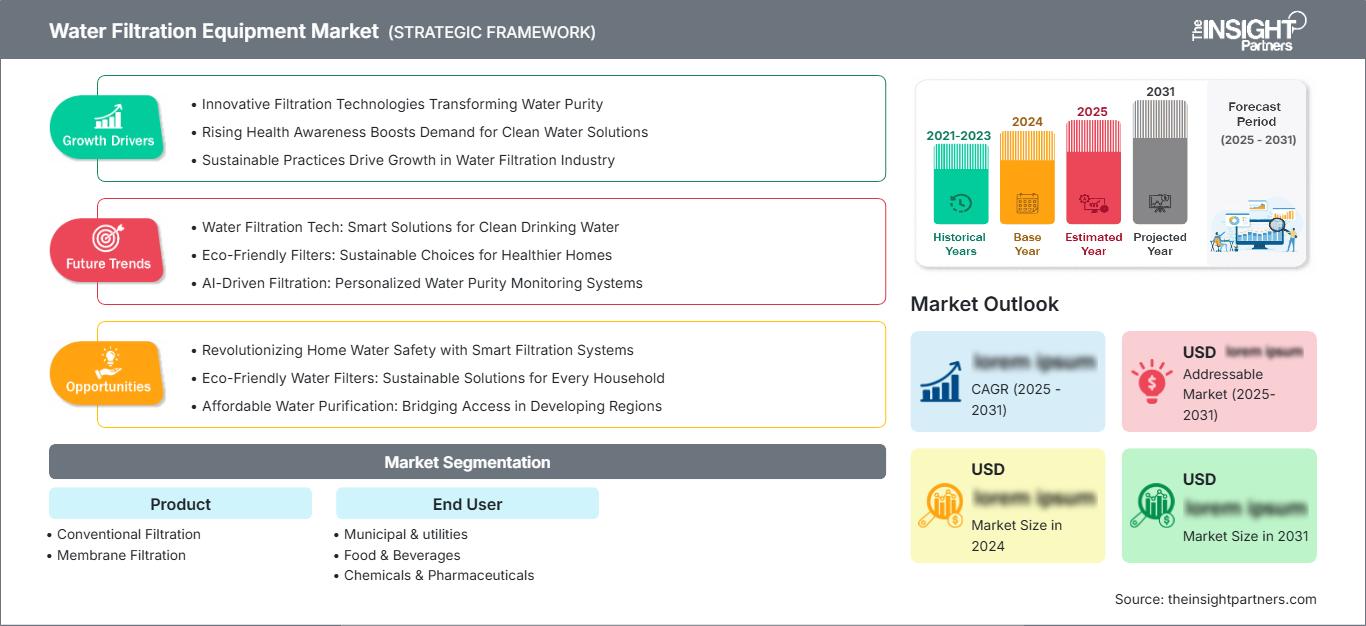
Water Filtration Equipment Market: Strategic Insights
Regional Insights
North America water filtration equipment market
North America is estimated to hold 31–35% share of the water filtration equipment market in 2025, with a 3.0–4.0% CAGR through 2034. The USA accounts for the majority of regional demand, and Canada adds through municipal infrastructure improvements, industrial wastewater treatment, and mining applications. Treatment of PFAS, aging water treatment facilities, potable reuse, and more refined industrial water quality requirements have been driving replacement and technological upgrade investment. Municipalities are also looking at filtration systems that allow for better removal of contaminants while managing energy and chemical usage.
The industrial sector is very prominent in pharmaceuticals, food & beverage, electronics, power generation, and energy sectors. Regulation in the US is driving utility interest in technologies to remove emerging contaminants, while water reuse projects are expanding the market for advanced filtration. Municipal spending on filtration systems will be influenced by budget considerations and lifecycle cost, making providers with the ability to provide engineering, commissioning, monitoring, and maintenance of higher interest.
U.S. water filtration equipment Market
The US accounts for approximately 70–75% of North America's 2025 water filtration equipment market share and is expected to expand at a 3.1–4.1% CAGR through 2034. Demand is supported by municipal compliance programs, PFAS treatment, industrial reuse, and modernization of aging water infrastructure. Applications increasingly combine granular media, membranes, ion exchange, and other treatment stages according to source-water characteristics.
Xylem Inc., Pentair plc, Ecolab Inc., and other established suppliers have broad exposure across utility and industrial applications. Semiconductor facilities require ultrapure water, while pharmaceutical and food processors prioritize consistent process-water quality. Potable reuse is also becoming strategically relevant in water-stressed states. These requirements encourage modular systems, digital monitoring, automated backwashing, predictive maintenance, and performance-based service contracts. The market therefore, combines replacement-driven demand with targeted adoption of higher-value filtration technologies.
Europe water filtration equipment Market
Europe is estimated to represent 25–29% share of the water filtration equipment market in 2025 and grow at a 2.2–3.2% CAGR through 2034. Germany leads regional industrial demand, while the UK, France, Italy, and Spain contribute substantial municipal, food-processing, pharmaceutical, and water-reuse opportunities. Circular water management and environmental compliance remain central purchasing considerations.
The UK emphasizes leakage reduction, resilience, and wastewater improvement. Germany benefits from advanced industrial water management and strong manufacturing demand. France, Italy, and Spain are increasingly focused on reuse, drought resilience, and efficient municipal treatment. Across Europe, tighter resource constraints encourage filtration systems capable of lowering freshwater consumption and supporting closed-loop processes. Suppliers with established local service networks and regulatory expertise should remain competitive as utilities and industries prioritize dependable lifecycle performance over minimum upfront cost.
APAC water filtration equipment Market
APAC is estimated to hold 27–31% of the water filtration equipment market share in 2025 and is projected to grow at a 3.2–4.2% CAGR through 2034, making it a leading incremental-demand region. China remains the largest market, followed by Japan, South Korea, India, and Australia. Industrialization, urbanization, water stress, and infrastructure expansion support broad adoption.
China's manufacturing base and municipal investment underpin regional demand, while India is placing increasing emphasis on reliable water and wastewater infrastructure. Japan and South Korea contribute advanced industrial filtration requirements, particularly for electronics and high-purity applications. Australia emphasizes water security and reuse. Public infrastructure programs, industrial parks, semiconductor investment, and stricter discharge requirements collectively create opportunities for conventional and membrane systems.
Middle East & Africa water filtration equipment Market
The Middle East & Africa water filtration equipment market is expected to expand at a 2.5–3.5% CAGR through 2034, supported by desalination, water scarcity, industrial diversification, and municipal infrastructure. Saudi Arabia and the UAE lead regional technology investment, while South Africa represents a significant municipal and industrial treatment market. The rest of MEA remains more fragmented.
Energy-intensive desalination and industrial projects create demand for robust pretreatment and membrane filtration, while municipal programs emphasize reliable drinking-water treatment. Saudi Arabia's water-security investments and the UAE's desalination infrastructure strengthen regional opportunities. South Africa's municipal challenges create refurbishment potential, although financing and project execution can constrain adoption. Suppliers with local partnerships, remote monitoring capabilities, and service infrastructure are positioned to address geographically dispersed installations.
Segmentation Analysis
Product
Product segmentation divides demand between Conventional Filtration and Membrane Filtration. Conventional systems remain the largest installed technology category because they provide economical removal of suspended solids and turbidity across municipal and industrial applications. Membrane systems are gaining faster adoption where higher separation performance, reuse, desalination, and contaminant-specific treatment are required. Product selection increasingly depends on feed-water quality, required treatment targets, footprint, energy consumption, maintenance requirements, and total lifecycle cost. The main segment is expected to grow at approximately 1.1–3.2% CAGR between 2026–2034, depending on technology configuration, reflecting evolving water filtration equipment market trends.
- Conventional Filtration: This category remains strategically important for municipal plants and industrial pretreatment because media-based systems are familiar, scalable, serviceable, and compatible with established treatment trains requiring reliable particulate removal.
- Membrane Filtration: Membrane configurations address increasingly demanding separation requirements and are gaining adoption in water reuse, desalination, ultrapure-water production, and applications requiring tighter contaminant control.
End User
End-user demand is concentrated across Municipal & utilities, Food & Beverages, and Chemicals & Pharmaceuticals. Municipal applications provide a broad installed base and recurring replacement demand, while industrial users increasingly evaluate filtration as part of resource-efficiency, compliance, and production-continuity strategies. Food processors require hygienic water quality, whereas pharmaceutical and chemical facilities require tightly controlled process conditions. The segment is expected to expand at approximately 1.3–3.0% CAGR between 2026–2034, with industrial applications generally favoring higher-specification systems.
- Municipal & utilities: Utilities remain the principal volume application, purchasing filtration equipment for drinking-water treatment, wastewater processes, reuse schemes, and infrastructure refurbishment where dependable performance and regulatory compliance are essential.
- Food & Beverages: Food and beverage producers use filtration to maintain process-water consistency, protect equipment, and support hygienic production, with system selection influenced by sanitation requirements and operating continuity.
- Chemicals & Pharmaceuticals: Chemical and pharmaceutical facilities require controlled water quality for production and cleaning, creating demand for filtration systems integrated with monitoring, purification, and process-control architectures.
Opportunity Snapshot
| End User | Revenue Contribution | Trend Tag | Adoption Stage |
|---|---|---|---|
| Municipal & Utilities | High | Reuse Infrastructure | Mature |
| Food & Beverages | Medium | Hygienic Processing | Mature |
| Chemicals & Pharmaceuticals | Medium | High Purity | Scaling |
Water Filtration Equipment Market Growth Drivers and Impact Analysis
Water Reuse and Resource Security Requirements
Water scarcity is transforming the filtration purchasing process from one based purely on regulatory compliance into one based on resource management and investment. Water utilities and industry alike are increasingly looking for technologies that allow them to recycle wastewater and process water and reduce their reliance on sources of fresh water. This will create a need for technologies that can provide consistent water quality despite fluctuating water quality levels at the input. Membrane filtration is especially well-suited where requirements for wastewater reuse dictate higher standards of contaminants removal, while conventional filtration remains important as pretreatment. For equipment providers, this means new opportunities not only in the building of facilities but also in servicing existing equipment through the replacement of membranes and media, monitoring, and optimization.
Stricter Contaminant and Drinking-Water Requirements
The regulation of contaminants like PFAS has made the technology of drinking water treatment more complex. In the United States, utility and industrial operators are looking for treatment solutions that can remove the targeted contaminants while ensuring reliability in throughput. Filtration providers will see increased need for validation, certifications, and scheduled monitoring and replacement of their filtration products. This change will affect the market for granular activated carbon, ion exchange, reverse osmosis, and pretreatment processes. It offers an opportunity for companies offering integrated solutions rather than just individual filters. There will also be a growing need for evidence-based procurement as the operators will have to show treatment efficiency over time. This is good news for companies able to integrate filtration hardware with analytics and other services.
Industrial Water Quality and Process Continuity
Industrial customers increasingly treat water quality as a production-continuity issue rather than simply an environmental requirement. Semiconductor, pharmaceutical, chemical, food-processing, and energy facilities can experience substantial operational disruption when water quality deviates from process specifications. This supports investment in redundant filtration trains, pretreatment, membrane systems, online monitoring, and automated control. High-value industrial projects also tend to prioritize engineering reliability and service responsiveness, enabling technology providers to compete through system integration and lifecycle support. The impact is strongest where manufacturing expansion creates new high-purity water requirements. Semiconductor facilities are particularly significant because ultrapure water is integral to manufacturing processes. As industrial capacity expands in North America and the Asia Pacific, filtration suppliers can benefit from project specifications that require higher treatment reliability and tighter performance monitoring.
Water Filtration Equipment Market Future Trends
Digitalized Filtration Performance Management
Digital monitoring is expected to become increasingly embedded in filtration equipment as operators seek earlier identification of fouling, pressure changes, membrane deterioration, and abnormal operating conditions. Sensors connected to centralized platforms can provide continuous visibility into flow, pressure, conductivity, turbidity, and other performance indicators. Over time, analytical systems can support predictive maintenance and optimize cleaning cycles, reducing unnecessary downtime and consumables usage. The shift should favor suppliers that combine equipment with software, analytics, remote diagnostics, and technical support. Smaller utilities may adopt cloud-enabled monitoring without extensive internal engineering resources, while large industrial sites can integrate filtration data with broader plant-management systems. This trend could gradually shift purchasing decisions toward measurable lifecycle performance rather than equipment specifications alone, strengthening the value proposition of connected systems.
Lower-Energy Membrane and Hybrid Treatment Architectures
Future filtration designs are likely to place greater emphasis on reducing energy intensity while maintaining separation performance. Membrane suppliers are developing configurations intended to improve flux, recovery, fouling resistance, and cleaning efficiency, while system integrators increasingly combine conventional pretreatment with membranes to optimize overall economics. Hybrid treatment can reduce membrane loading and extend component life by removing larger contaminants before advanced separation. Energy efficiency will be particularly important in desalination and water-reuse projects, where operating costs materially influence project feasibility. The resulting technology landscape should include more application-specific combinations rather than standardized treatment trains. Equipment manufacturers that can optimize pretreatment, filtration, energy consumption, and maintenance as one system may gain an advantage in large municipal and industrial projects.
Water Filtration Equipment Market Opportunities
Industrial Closed-Loop Water Systems
Industrial facilities offer an opportunity to expand filtration demand through closed-loop water management. Instead of treating water only before discharge, manufacturers can deploy filtration systems at multiple points within production processes to recover and reuse water. This approach can reduce freshwater purchases, wastewater volumes, and exposure to supply interruptions. Chemicals, pharmaceuticals, food processing, electronics, and energy facilities are particularly suitable because water quality can be defined according to individual process steps. Suppliers can pursue this opportunity through modular filtration packages, membrane systems, monitoring platforms, and service contracts. The commercial opportunity is strongest where freshwater costs or availability create measurable economic benefits. Projects can also be designed incrementally, allowing operators to begin with high-consumption processes and expand reuse as performance data accumulates.
Water Infrastructure Modernization and Decentralized Treatment
A second opportunity lies in the modernization of distributed water infrastructure, particularly where centralized treatment capacity is constrained or geographically difficult to expand. Compact filtration systems can support smaller municipalities, industrial campuses, remote facilities, commercial developments, and emergency applications. Modular architectures allow capacity to be added progressively and can reduce installation complexity compared with large centralized projects. The opportunity is relevant in emerging markets where urbanization is increasing demand faster than traditional infrastructure can be developed. It also applies in developed markets where utilities require resilience and backup capacity. Vendors can strengthen their position through standardized equipment, remote monitoring, mobile treatment, local service networks, and financing structures. These capabilities can lower project barriers while creating recurring revenue from consumables, maintenance, and technology upgrades.
Frequently Asked Questions

- Comprehensive Market Sizing and Forecast Analysis
- Detailed Segmentation Analysis
- In-Depth Market Dynamics Assessment
- Regional and Country-Level Insights
- Competitive Landscape and Company Benchmarking
- Strategic Business Intelligence
Recent Reports
Testimonials

The Insight Partners provided valuable market intelligence that supported our global go-to-market strategy. Their team was professional, responsive, and attentive to our feedback, providing thoughtful analysis and helpful methodological clarifications throughout the project.
Junmo Kim Chief Financial Officer (CFO), Enertech Co., Ltd.
The Insight Partners' SCADA System Market report is comprehensive, with valuable insights on current trends and future forecasts. The team was highly professional, responsive, and supportive throughout. We are very satisfied and highly recommend their services.
RAN KEDEM Partner, Reali Technologies LTDs
I requested a report on a very specific software market and the team produced the report in a few days. The information was very relevant and well presented. I then requested some changes and additions to the report. The team was again very responsive and I got the final report in less than a week.
JEAN-HERVE JENN Chairman, Future Analytica
We worked with The Insight Partners for an important market study and forecast. They gave us clear insights into opportunities and risks, which helped shape our plans. Their research was easy to use and based on solid data. It helped us make smart, confident decisions. We highly recommend them.
PIYUSH NAGPAL Sr. Vice President, High Beam Global
The Insight Partners delivered insightful, well-structured market research with strong domain expertise. Their team was professional and responsive throughout. The user-friendly website made accessing industry reports seamless. We highly recommend them for reliable, high-quality research services
YUKIHIKO ADACHI CEO, Deep Blue, LLC.
This is the first time I have purchased a market report from The Insight Partners.While I was unsure at first, I visited their web site and felt more comfortable to take the risk and purchase a market report.I am completely satisfied with the quality of the report and customer service. I had several questions and comments with the initial report, but after a couple of dialogs over email with their analyst I believe I have a report that I can use as input to our strategic planning process.Thank you so much for taking the extra time and making this a positive experience.I will definitely recommend your service to others and you will be my first call when we need further market data.
JOHN SUZUKI President and Chief Executive Officer, Board Director, BK Technologies
I wish to appreciate your support and the professionalism you displayed in the course of attending to my request for information regarding to infectious disease IVD market in Nigeria. I appreciate your patience, your guidance, and the fact that you were willing to offer a discount, which eventually made it possible for us to close a deal. I look forward to engaging The Insight Partners in the future, all thanks to the impression you have created in me as a result of this first encounter.
DR CHIJIOKE ONYIA MANAGING DIRECTOR, PineCrest Healthcare Ltd.Reason to Buy
- Informed Decision-Making
- Understanding Market Dynamics
- Competitive Analysis
- Identifying Emerging Markets
- Customer Insights
- Market Forecasts
- Risk Mitigation
- Boosting Operational Efficiency
- Strategic Planning
- Investment Justification
- Tracking Industry Innovations
- Aligning with Regulatory Trends





 Get Free Sample for