
Waterproof Camera Market Demand, Share & Growth by 2034
Coverage: by Type (Normal, Disposable); Application (10-30M, 30-60M, 60-80M) , and Geography (North America, Europe, Asia Pacific, and South and Central America)
- Status : Data Released
- Report Code : TIPRE00006263
- Category : Electronics and Semiconductor
- No. of Pages : 150
- Available Report Formats :


- Last update date : September 28, 2026


2025 Market Size
US$ 6.05 Bn
Base year value
2034 Forecast
US$ 9.41 Bn
Projected by 2034
CAGR 2026-2034
5.03 %
Growth rate
Addressable Market
US$ 70.15 Bn
(2026-2034)
The global Waterproof Camera market was valued at US$ 6.05 billion in 2025 and is expected to reach US$ 9.41 billion by 2034; it is estimated to record a CAGR of 5.03% during 2026-2034.
Waterproof Camera Market Assessment and Insights
- North America: The region is expected to account for 29–33% share in 2025, growing at a 5.0–6.0% CAGR between 2026–2034, supported by outdoor recreation, travel photography, diving, and strong consumer electronics distribution.
- US: The US is projected to represent 78–82% of North America's 2025 share, expanding at a 5.1–6.1% CAGR during 2026–2034 through action imaging and creator applications.
- Europe: Europe is estimated at 23–27% share in 2025, with a 4.5–5.5% CAGR between 2026–2034. Germany, the UK, France, Italy, and Spain provide diverse demand across tourism, marine recreation, and outdoor photography.
- Asia Pacific: Asia Pacific is estimated at 28–32% share in 2025, advancing at a 6.0–7.0% CAGR during 2026–2034. China, Japan, South Korea, and India benefit from manufacturing capabilities, tourism, and expanding digital content creation.
- Largest Segment: Normal cameras are estimated to hold 72–76% market share in 2025, with a 5.0–6.0% CAGR during 2026–2034, reflecting their broader reuse and feature sets.
- High Growth Segment: Disposable cameras are estimated at 24–28% market share in 2025, with a 6.0–7.0% CAGR during 2026–2034, supported by low-cost recreational and event photography.
- Key companies analyzed in detail: Canon Inc.; Fujifilm Corporation; GoPro, Inc.; Honeywell International Inc.; Nikon Corporation; Olympus Corporation; Panasonic Corporation; Ricoh Imaging Company, Ltd.; SeaLife Cameras; Sony Corporation.
Source: The Insight Partners' analysis based on proprietary research, government publications, company annual reports, investor presentations, industry databases, and expert interviews.
Product development has been moving beyond simple water-resistant compact cameras to imaging products that incorporate advanced sensors, electronic image stabilization, wireless connectivity, low-light imaging, and advanced video capabilities. The waterproof feature has become more integrated with shock-proof, dust-proof, freeze-proof, and crush-proof capabilities, enabling manufacturers to serve the outdoor recreation and industrial sectors through fewer accessories and less complex workflows.
During the forecast period, manufacturers are likely to focus on developing compact products, computational imaging, smartphone connectivity, and workflow-assisted operations. Emerging demand from Asia Pacific and selected Middle Eastern tourism markets should broaden the addressable customer base, while environmental durability standards and consumer expectations for longer product life may encourage improved sealing, materials, and repairability, according to the Waterproof Camera Market report.
Waterproof Camera Market Report Scope
| Report Attribute | Details |
|---|---|
| Market size in 2025 | US$ 6.05 Billion |
| Market Size by 2034 | US$ 9.41 Billion |
| Global CAGR (2026 - 2034) | 5.03% |
| Historical Data | 2021-2024 |
| Forecast period | 2026-2034 |
Waterproof Camera Market Analysis
Demand is shaped by the convergence of travel, outdoor recreation, underwater photography, action sports, and creator content. The waterproof camera market growth ecosystem includes sensor suppliers, optical component manufacturers, imaging processors, battery providers, rugged enclosure specialists, software developers, distributors, retailers, and accessory producers. The value of products is becoming more reliant upon the fusion of imaging performance with durability as opposed to solely waterproof capability.
The dynamics of supply continue to be dominated by incumbent Japanese imaging firms and action-camera specialists, and are supplemented by Asian electronics manufacturing capability. The TG-7 from OM SYSTEM shows how waterproof technology can be paired with shock-resistance, freeze-proof capability, 4K filming, and macro capability, while the FinePix rugged cameras from Fujifilm highlight the ongoing popularity of small outdoor cameras. These attributes facilitate price differentiation.
The level of competition is becoming more dependent upon sensor capability, stabilization, battery life, software integration, accessory capability, and brand reputation. Action camera specialist GoPro, Inc. continues to hold a competitive position, and other companies like Canon Inc., Fujifilm Corporation, Nikon Corporation, Panasonic Corporation, and Sony Corporation use their imaging capability. Ricoh Imaging Company, Ltd. maintains a specialized rugged-camera position, while SeaLife Cameras focuses strongly on underwater photography and related accessories, as highlighted in the Waterproof Camera Market forecast.
Positioning is also broadening in terms of technology, other than just the hardware itself. Manufacturers have begun using mobile apps, cloud processing, connected peripherals, and functions that appeal to content creators in an effort to engage customers. The RX0 series by Sony Corporation shows how a small waterproof design and excellent imaging technology can co-exist, whereas OM SYSTEM's TG-7 incorporates ruggedness with computational shooting.
● REPORT CUSTOMIZATION
Tailor This Report To Align With Your Specific Business Requirements
This report can be customized to align precisely with your business objectives, scope, and target markets. Customization options include tailored segmentation, geography, competitive analysis, and strategic insights to support informed decision-making.
Customize This Report →WHAT YOU CAN ADJUST
- ● Segmentations
- ● Geography
- ● Competitive Analysis
- ● Language Preferences
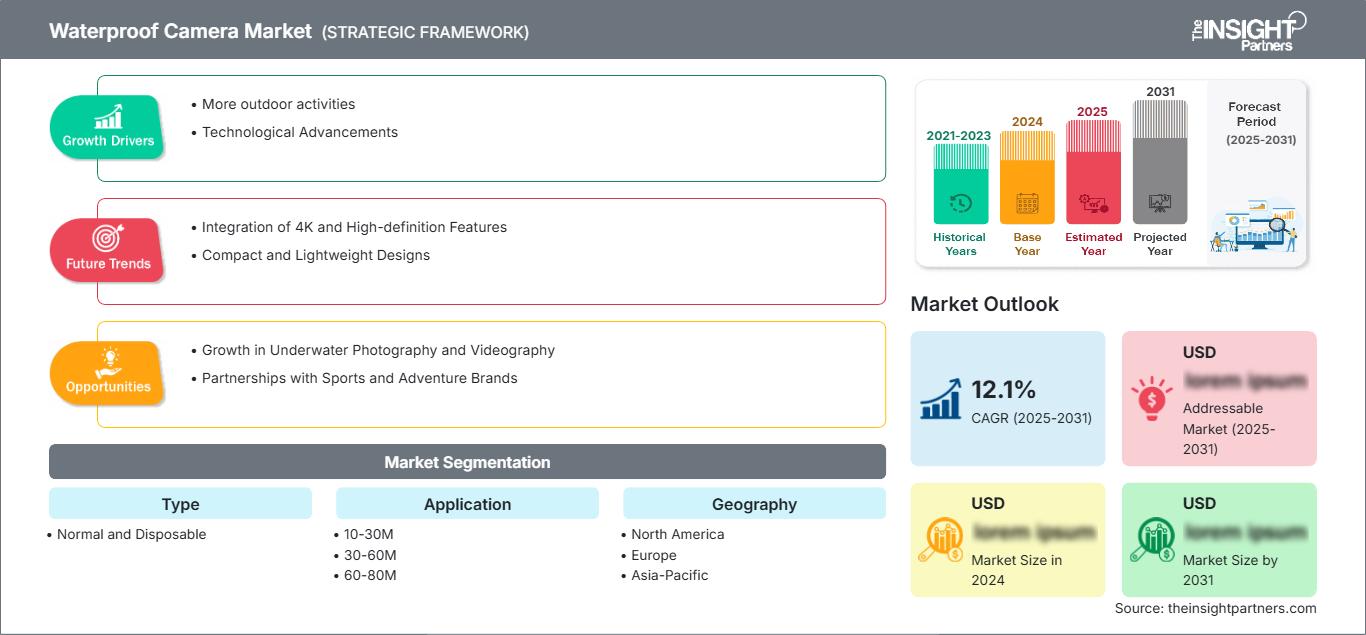
Waterproof Camera Market: Strategic Insights
Regional Insights
North America Waterproof Camera Market
North America is estimated to represent 29–33% of global share in 2025 and is projected to grow at a 5.0–6.0% CAGR during 2026–2034. The US remains the principal demand center because of extensive recreational boating, diving, surfing, hiking, skiing, and adventure tourism. Canada contributes through outdoor recreation and seasonal travel, while specialized retailers support premium rugged-camera sales.
Consumer demand increasingly favors devices that can move between underwater and land-based activities without additional housings. Action sports, family travel, marine recreation, and social content creation provide recurring purchase occasions. Established distribution networks, strong online retail penetration, and the presence of major imaging brands support replacement cycles. Professional inspection and field documentation also create niche opportunities where durability reduces equipment handling risks.
U.S. Waterproof Camera Market
The US represents approximately 78–82% of North America's 2025 share and is expected to expand at a 5.1–6.1% CAGR during 2026–2034. Demand spans recreational diving, surfing, fishing, travel, adventure sports, and creator applications, with premium action cameras gaining visibility.
Company presence is broad, with GoPro, Inc., Canon Inc., Sony Corporation, Panasonic Corporation, and Ricoh Imaging Company, Ltd. addressing different price and performance tiers. Applications increasingly emphasize stabilized video, rapid smartphone transfer, hands-free mounting, and underwater recording. Online marketplaces improve product discovery, while specialty diving and outdoor retailers remain important for higher-value equipment, accessories, and technical guidance.
Europe Waterproof Camera Market
Europe is expected to account for 23–27% share in 2025, expanding at a 4.5–5.5% CAGR during 2026–2034. Germany is another major market with backing from outdoor activities, technical photography, and solid electronics channels. Coastal tourism, action sports, and the demand for content creation help the UK market, and France enjoys the combination of tourism and diving, along with photography. Italy and Spain supplement their markets with seasonal demand through Mediterranean tourism, beach visits, boat rides, and aquatic sports.
The German market comprises users who are technically knowledgeable in assessing durability and optics. The UK market has a relatively strong segment of action-sports and travel content generation, which favors small and durable cameras. The French, Italian, and Spanish markets benefit from marine tourism and leisure activities.
APAC Waterproof Camera Market
APAC is estimated at 28–32% of the Waterproof Camera Market share in 2025 and is expected to register a 6.0–7.0% CAGR during 2026–2034. China is the leading market, followed by Japan, South Korea, India, and Australia. Manufacturing depth, tourism, water sports, consumer electronics adoption, and expanding creator economies support regional demand. Japanese brands retain a strong technological influence, while China and India offer substantial volume opportunities.
Middle East & Africa Waterproof Camera Market
The Middle East and Africa Waterproof Camera Market is expected to expand at a 5.0–6.0% CAGR during 2026–2034, with Saudi Arabia and the UAE serving as important demand centers. Luxury tourism, marine recreation, destination development, and outdoor activities support adoption. South Africa contributes through diving, wildlife tourism, coastal recreation, and adventure sports, while the rest of MEA remains more price sensitive.
Segmentation Analysis
Type
The Type segment is projected to expand at a 5.0–6.0% CAGR during 2026–2034. Normal cameras remain central because their reusable construction, broader functionality, and compatibility with accessories support repeated use across travel, recreation, and professional activities. Disposable models serve convenience-oriented customers seeking simple underwater or event photography without long-term equipment ownership.
- Normal: Normal waterproof cameras hold the dominant position because consumers increasingly prefer reusable devices with better image quality, rechargeable power, wireless connectivity, stabilization, and broader functionality across outdoor activities.
- Disposable: Disposable waterproof cameras retain relevance among occasional users, travelers, event participants, and customers prioritizing simplicity, low upfront commitment, and convenient use in environments where equipment loss is possible.
Application
The Application segment is projected to grow at a 5.5–6.5% CAGR during 2026–2034. Demand varies according to required operating depth, environmental exposure, and user expectations for image quality. Shallow and intermediate underwater use represents the broadest consumer opportunity, while deeper applications require greater sealing reliability, pressure resistance, and specialized accessories, reflecting evolving Waterproof Camera Market trends.
- 10-30M: Cameras supporting 10-30M applications address mainstream snorkeling, diving, marine recreation, travel, and adventure photography, making this range strategically important for consumer-oriented manufacturers and accessory suppliers.
- 30-60M: The 30-60M range serves more demanding diving and underwater documentation requirements, where pressure resistance, sealing integrity, handling, and dependable imaging performance become increasingly important.
- 60-80M: The 60-80M range addresses specialized underwater users requiring deeper operational capability, with product selection influenced by housing design, pressure tolerance, image reliability, and professional-grade underwater workflows.
Opportunity Snapshot
| Application | Revenue Contribution | Trend Tag | Adoption Stage |
| 10-30M | High | Shallow Diving | Mature |
| 30-60M | Medium | Technical Diving | Scaling |
| 60-80M | Low | Deep Diving | Emerging |
Waterproof Camera Market Growth Drivers and Impact Analysis
Expansion of Adventure Tourism and Water-Based Recreation
There is an expansion of the customer base for durable imaging products due to the fact that tourists take images while going on diving, snorkeling, surfing, rafting, boat and coastal tours. The ongoing focus of the World Tourism Organization on tourism recovery and experience-oriented tourism helps in developing the overall ecosystem for activity-oriented electronics. This leads to the requirement of electronics that can work in a wet, sandy, humid and shock-prone environment. In terms of market influence, the scope goes beyond camera bodies and covers such products as floating grips, protection gadgets, memory cards, lighting equipment and mountings. Investments made in marine tourism will help in driving sales in a seasonal manner.
Demand for Compact Creator and Action Video Equipment
In terms of the evolution of short-form videos, travel content, sports videography, and social media posting, there is now increased pressure to create compact cameras that can provide a smooth shot in tough conditions. Customers start assessing the ability of the camera to be waterproof along with stabilization capabilities, resolution of video, connectivity, microphone compatibility, battery efficiency, and ease of editing. Such a combination modifies the purchasing criteria since, nowadays, a durable camera cannot be treated just like an auxiliary option when on holiday. In other words, it can serve as a main shooting device for people who operate underwater or in bad weather conditions. For companies, it is important to balance durability and a smooth software process.
Advances in Rugged Imaging and Computational Photography
Technological advancements in terms of sensor efficiency, image processing, stabilization, auto-focus, and computational photography enhance the capabilities of output generation by compact rugged cameras. The technology of waterproofing had some compromises concerning the size, movement of lenses, control, and quality of images earlier; however, recent designs enable companies to incorporate more functions in smaller sizes. For instance, OM SYSTEMs' TG-7 incorporates features of waterproof up to 15 meters along with shock-proofing, freeze-proofing, 4K recording, and unique macro functions. These examples illustrate how durability can coexist with sophisticated imaging capabilities. The effect of such developments is mainly seen in the premium segment of compact camera devices, where customers are ready to spend money on several environmental protections and special modes.
Waterproof Camera Market Future Trends
Computational Underwater Imaging
Future waterproof camera market trends will increasingly involve computational correction of underwater color, contrast, distortion, noise, and motion. This is due to the varying absorption rates of water across the visible spectrum with increased depth, making it challenging to achieve accurate color reproduction in images through conventional image processing processes. This problem can be overcome by manufacturers by implementing scene recognition, computational white balancing, machine learning, and adaptive image processing. The improvement potential also includes smartphone-based systems, whereby the device will be able to recognize underwater scenes and set up camera settings accordingly. With improved processing, reliance on manual setups would be reduced, enabling even advanced imaging techniques to become more easily usable by leisure consumers. Premium versions of the device might combine computational power with depth data, stabilization, and lenses for better pictures and videos.
Integrated Connectivity and Cloud-Based Workflows
The future products will probably rely more heavily on connectivity between rugged cameras, phones, tablets, and cloud platforms. Speedier wireless data transfer will reduce the gap between picture taking and publishing, an advantage especially useful to creators, travelers, guides, educators, and athletes. Some features of cameras may include automatic data backup, location-based tags, remote camera operation, synchronization, and intelligent media organization. In such a case, the competition game will change since it will not be enough just to provide great hardware specifications. Companies with well-developed software solutions will be able to keep their customers engaged even after the sale of the device and develop some accessories and software offers. Moreover, cameras could be used in combination with others for professional underwater video shooting, travel documentation, and technical inspection.
Waterproof Camera Market Opportunities
Premium Technical Diving and Professional Documentation
There is a strategic opportunity to target the higher margin customers who need their products in technical diving applications, scientific research support, underwater training, inspection, and content creation. Such customers are more concerned about the reliability of their product's sealing capabilities, depth capabilities, ability to see in poor light conditions, usability in water, battery life, and accessory compatibility rather than the cost of purchase. The manufacturers can appeal to such market segments by offering modulated lighting, depth-capable housing, external monitors, special lenses, and mounting accessories. Collaborating with distributors and training organizations catering to such segments will be helpful. It will be easy to create product differentiation in terms of serviceability, calibration capability, seal replacement, and maintenance packages. Such products will give better margins compared to entry-level products while creating accessory demand.
Tourism, Rental, and Destination-Based Camera Services
There is an unexplored business opportunity for robust camera technology from tourism operators, resort complexes, dive facilities, cruise lines, and activity providers. As opposed to targeting the purchase of cameras by individuals, the manufacturers can provide rental fleets or activity packages where cameras are offered in addition to snorkeling, diving, rafting, or water sports adventures. The fleet model can target simpler controls, removable protection, quick charging, robust construction, and easy media downloading. The destination operators can use the same to offer content creation services and add-ons for photos to customers. The business opportunity is especially pertinent in areas that focus on developing marine tourism. The manufacturers will create ongoing institutional demand by building channel partnerships, maintenance programs, and standard accessory offerings.
Frequently Asked Questions

- Comprehensive Market Sizing and Forecast Analysis
- Detailed Segmentation Analysis
- In-Depth Market Dynamics Assessment
- Regional and Country-Level Insights
- Competitive Landscape and Company Benchmarking
- Strategic Business Intelligence
Recent Reports
Testimonials

The Insight Partners provided valuable market intelligence that supported our global go-to-market strategy. Their team was professional, responsive, and attentive to our feedback, providing thoughtful analysis and helpful methodological clarifications throughout the project.
Junmo Kim Chief Financial Officer (CFO), Enertech Co., Ltd.
The Insight Partners' SCADA System Market report is comprehensive, with valuable insights on current trends and future forecasts. The team was highly professional, responsive, and supportive throughout. We are very satisfied and highly recommend their services.
RAN KEDEM Partner, Reali Technologies LTDs
I requested a report on a very specific software market and the team produced the report in a few days. The information was very relevant and well presented. I then requested some changes and additions to the report. The team was again very responsive and I got the final report in less than a week.
JEAN-HERVE JENN Chairman, Future Analytica
We worked with The Insight Partners for an important market study and forecast. They gave us clear insights into opportunities and risks, which helped shape our plans. Their research was easy to use and based on solid data. It helped us make smart, confident decisions. We highly recommend them.
PIYUSH NAGPAL Sr. Vice President, High Beam Global
The Insight Partners delivered insightful, well-structured market research with strong domain expertise. Their team was professional and responsive throughout. The user-friendly website made accessing industry reports seamless. We highly recommend them for reliable, high-quality research services
YUKIHIKO ADACHI CEO, Deep Blue, LLC.
This is the first time I have purchased a market report from The Insight Partners.While I was unsure at first, I visited their web site and felt more comfortable to take the risk and purchase a market report.I am completely satisfied with the quality of the report and customer service. I had several questions and comments with the initial report, but after a couple of dialogs over email with their analyst I believe I have a report that I can use as input to our strategic planning process.Thank you so much for taking the extra time and making this a positive experience.I will definitely recommend your service to others and you will be my first call when we need further market data.
JOHN SUZUKI President and Chief Executive Officer, Board Director, BK Technologies
I wish to appreciate your support and the professionalism you displayed in the course of attending to my request for information regarding to infectious disease IVD market in Nigeria. I appreciate your patience, your guidance, and the fact that you were willing to offer a discount, which eventually made it possible for us to close a deal. I look forward to engaging The Insight Partners in the future, all thanks to the impression you have created in me as a result of this first encounter.
DR CHIJIOKE ONYIA MANAGING DIRECTOR, PineCrest Healthcare Ltd.Reason to Buy
- Informed Decision-Making
- Understanding Market Dynamics
- Competitive Analysis
- Identifying Emerging Markets
- Customer Insights
- Market Forecasts
- Risk Mitigation
- Boosting Operational Efficiency
- Strategic Planning
- Investment Justification
- Tracking Industry Innovations
- Aligning with Regulatory Trends





 Get Free Sample for