
Wearable AI Market Share, Growth & Forecast by 2034
Coverage: By Product (Smart Watch, Ear Wear, Eye Wear); Operation (On-Device AI, Cloud-Based AI); Component (Processor, Connectivity IC, Sensors); Application (Consumer Electronics, Enterprise, Healthcare, Others) , and Geography (North America, Europe, Asia Pacific, and South and Central America)
- Status : Data Released
- Report Code : TIPRE00003350
- Category : Electronics and Semiconductor
- No. of Pages : 150
- Available Report Formats :


- Last update date : September 28, 2026


2025 Market Size
US$ 36.02 Bn
Base year value
2034 Forecast
US$ 107.92 Bn
Projected by 2034
CAGR 2026-2034
12.97 %
Growth rate
Addressable Market
US$ 626.49 Bn
(2026-2034)
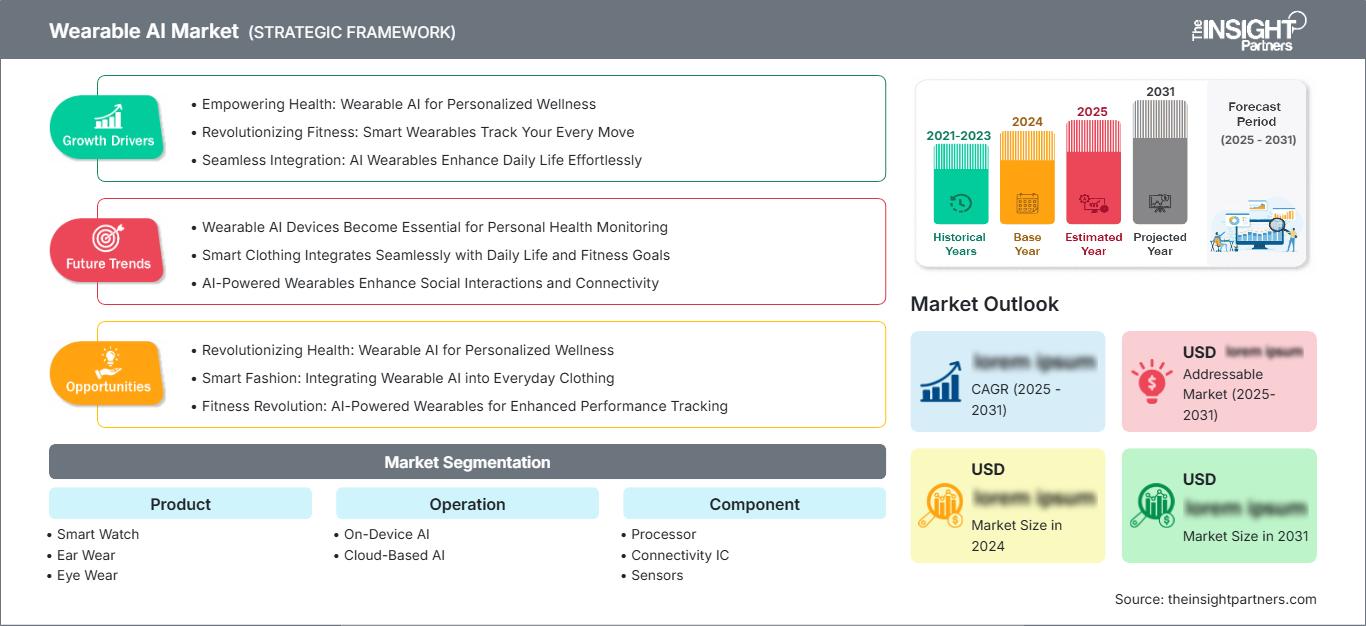
The wearable ai market was valued at US$ 36.02 Billion in 2025 and is projected to reach US$ 107.92 Billion by 2034, growing at a CAGR of 12.97% from 2026 to 2034. Demand is being shaped by the transition from basic activity tracking toward intelligent devices that interpret biometric, behavioral, and contextual signals across consumer electronics, enterprise, and healthcare environments.
North America remains an important commercialization base as device makers, digital health platforms, employers, and care providers expand AI-enabled wearables into prevention, fitness coaching, remote monitoring, and workforce safety. The wearable ai market size in the region is supported by higher smartwatch penetration, reimbursement discussions around remote monitoring, and strong cloud infrastructure for connected health services.
Wearable AI Market Assessment and Insights
- North America: The region accounted for 33–36% share in 2025 and is expected to grow at a 12–14% CAGR during 2026–2034, supported by premium smartwatch adoption, health analytics integration, and enterprise pilots.
- US: The country represented 76–80% of North America revenue in 2025, expanding at a 12–13.5% CAGR as AI health coaching and connected care applications scale.
- Europe: Europe held 24–27% share in 2025 and is forecast to grow at an 11–13% CAGR, led by the UK, Germany, France, Italy, and Spain.
- Asia Pacific: APAC captured 28–31% share in 2025 and is expected to post a 13.5–15.5% CAGR, led by China, Japan, South Korea, India, and Australia.
- Largest Segment: Smart Watch held 41–45% market share in 2025 and is expected to grow at an 11.5–13% CAGR through broader health, payment, and connectivity use cases.
- High Growth Segment: Healthcare applications held 20–24% share in 2025 and are expected to grow at a 14–16% CAGR as monitoring and risk-screening tools mature.
- Key companies analyzed in detail: Apple Inc., Atlas Wearables, Bragi GmbH, Fitbit LLC, Sony Group Corporation, Google LLC, Huawei Technologies Co., Ltd., IBM Corporation, Moov Inc., and Samsung Electronics Co., Ltd.
Source: The Insight Partners' analysis based on proprietary research, government publications, company annual reports, investor presentations, industry databases, and expert interviews.
The development of the device has advanced from pedometers and notification-based wearables to AI-enabled sensing systems, which integrate processing, connectivity ICs, and multi-modal sensors. Smartwatches are still at the forefront of these innovations; however, earwear and eyewear have gained significance due to their increasing utility of voice, spatial computing, and context-aware assistants. Additionally, the market growth is being driven by energy efficiency, edge processing, and enhanced integration between devices, smartphones, and analytics in the cloud.
The future will be driven by health-grade insights, corporate workplace safety initiatives, and new markets where low-cost devices are making preventive wellness available. Data privacy concerns, algorithmic transparency, and clinical claims will impact the commercialization of products. Companies that integrate reliable sensing, robust data infrastructure, and coaching functionalities are poised to capitalize on the conversion of consumer usage into a recurring services business model.
Wearable AI Market Report Scope
| Report Attribute | Details |
|---|---|
| Market size in 2025 | US$ 36.02 Billion |
| Market Size by 2034 | US$ 107.92 Billion |
| Global CAGR (2026 - 2034) | 12.97% |
| Historical Data | 2021-2024 |
| Forecast period | 2026-2034 |
Wearable AI Market Analysis
The demand for AI will increase as individuals and enterprises increasingly desire real-time intelligence rather than relying on static device dashboards. On-device AI provides quicker action through alerts, coaching, and activity analysis, while cloud AI helps provide analytics, model training, and insights at scale. Value chain elements include chipset providers, sensor providers, device manufacturers, operating systems, health platforms, app providers, and enterprise software integration.
The supply situation is influenced by advances in miniaturized chips, sensors, and low-power connectivity. Device manufacturers are focusing on comfort, battery life, and contextual software as people expect their devices to function during sleep, exercise, work, and travel. Market analysis shows that device manufacturers should focus less on hardware features and more on data stream interpretation.
The competition is focused on the control of the ecosystem, health service reliability, and retaining users. Companies such as Apple Inc., Samsung Electronics Co., Ltd., Google LLC, Fitbit LLC, and Huawei Technologies Co., Ltd. are competing by offering wide-ranging device sets and service offerings, whereas companies like Bragi GmbH, Atlas Wearables, and Moov Inc. are focusing on special features of interaction, fitness, or coaching.
There is a trend towards investing in AI coaching, smart rings, hearables, and regulated health features. Companies have been extending the lifetime of their products and engaging customers recurrently via software updates. Increasingly important is the strategic positioning via partnering with health systems, insurance companies, employers, semiconductor manufacturers, and application ecosystems able to turn wearable data into impact.
● REPORT CUSTOMIZATION
Tailor This Report To Align With Your Specific Business Requirements
This report can be customized to align precisely with your business objectives, scope, and target markets. Customization options include tailored segmentation, geography, competitive analysis, and strategic insights to support informed decision-making.
Customize This Report →WHAT YOU CAN ADJUST
- ● Segmentations
- ● Geography
- ● Competitive Analysis
- ● Language Preferences
Wearable AI Market: Strategic Insights
Regional Insights
North America wearable ai market
North America held 33–36% wearable ai market share in 2025 and is expected to grow at a 12–14% CAGR during 2026–2034. The region benefits from high spending on premium wearables, strong digital health adoption, and enterprise willingness to test AI-enabled safety, productivity, and wellness tools across hybrid workforces.
Clinical monitoring, sports analytics, and consumer wellness are becoming more connected through subscription services and cloud platforms. Demand is strongest where wearables provide interpretable alerts rather than raw metrics, especially for sleep, cardiovascular indicators, fitness readiness, and personalized coaching.
U.S. wearable ai Market
The U.S. represented 76–80% of North America revenue in 2025 and is projected to grow at a 12–13.5% CAGR. The country’s leadership reflects early adoption of Apple Watch, Fitbit, Galaxy Watch, and connected health services, alongside strong employer wellness and virtual care infrastructure.
Company presence is deep across hardware, software, cloud, and analytics. AI-enabled applications are expanding from fitness and sleep scoring into risk detection, health coaching, remote patient engagement, and workforce monitoring. Integration with smartphones and healthcare platforms improves retention and data continuity.
Europe wearable ai Market
Europe accounted for 24–27% share in 2025 and is expected to grow at an 11–13% CAGR. The UK and Germany lead adoption due to higher digital health maturity, strong insurance participation, and consumer demand for clinically relevant wellness features.
France, Italy, and Spain are expanding through fitness, chronic disease management, and workplace safety applications. European growth is moderated by data protection expectations, but these requirements also raise demand for transparent, secure, and high-quality AI wearable platforms.
APAC wearable ai Market
APAC held 28–31% share in 2025 and is forecast to grow at a 13.5–15.5% CAGR, the fastest regional pace. China, Japan, South Korea, India, and Australia are important markets due to their electronic manufacturing capability, consumer behavior being mobile first, and increased health consciousness.
China and South Korea have good device ecosystems, while aging care is of great importance for Japan and India provides a large number of value-seeking consumers. Adoption of smartwatches, ear-wear, and health applications is increasing among local and international competition in affordable pricing and artificial intelligence.
Middle East & Africa wearable ai Market
The Middle East and Africa is expected to grow at a 10.5–12.5% CAGR during 2026–2034. Demand in the UAE and Saudi Arabia is being driven by digital health spend, use of consumer electronic devices and smart cities programs that promote connected lifestyles.
Slow adoption is taking place in South Africa and the rest of MEA, especially within fitness, remote wellness and enterprise workforce monitoring applications. Challenges lie in infrastructure gaps and price sensitivities, but there are opportunities with smartphones and healthcare digitalization.
Segmentation Analysis
Product
Product is expected to grow at an 11.8–13.4% CAGR during 2026–2034. The market scope across smart watch, ear wear, and eye wear reflects different user contexts, from wrist-based health monitoring to audio assistance and visual computing. Product strategy increasingly depends on comfort, sensor depth, ecosystem compatibility, and software intelligence.
- Smart Watch: Smart watches remain the largest product category because they combine health sensing, communication, payments, navigation, and app access in a familiar form factor with strong consumer retention.
- Ear Wear: Ear wear adoption is rising as voice assistants, biometric audio devices, translation, and workplace communication tools become more useful in hands-free environments.
- Eye Wear: Eye wear is developing around augmented information, enterprise training, navigation, and AI-assisted visual interaction, though comfort, battery life, and price still influence adoption.
Operation
Operation is projected to grow at a 12.2–14.1% CAGR during 2026–2034. On-device AI is gaining importance for latency-sensitive recommendations and privacy, while cloud-based AI remains necessary for large-scale model training, longitudinal health analytics, and cross-device intelligence.
- On-Device AI: On-device AI supports quicker interpretation of workouts, sleep, gestures, alerts, and sensor changes while reducing dependency on continuous connectivity and improving privacy perception.
- Cloud-Based AI: Cloud-based AI enables deeper analytics, personalized coaching, model updates, and integration with healthcare or enterprise systems that require larger datasets and longer historical views.
Component
Component is expected to grow at an 11.9–13.6% CAGR from 2026 to 2034. Processors, connectivity ICs, and sensors determine device intelligence, battery performance, and data quality. Vendors are prioritizing low-power chips, accurate physiological sensing, and reliable wireless communication to support continuous use.
- Processor: Processors are critical for AI inference, power management, gesture control, and real-time interpretation of biometric and contextual data on compact wearable devices.
- Connectivity IC: Connectivity ICs support Bluetooth, Wi-Fi, cellular, and near-field communication, allowing wearables to synchronize with phones, cloud platforms, accessories, and payment systems.
- Sensors: Sensors remain strategically important because heart rate, motion, temperature, oxygen, sleep, and environmental data form the foundation for personalized recommendations.
Application
Application is forecast to grow at a 12.7–14.8% CAGR during 2026–2034. Consumer electronics lead revenue, but healthcare and enterprise use cases are gaining importance as AI wearables move into monitoring, safety, productivity, and preventive care workflows.
- Consumer Electronics: Consumer electronics adoption is driven by fitness, notifications, payments, lifestyle coaching, and ecosystem loyalty, making it the most visible application area for AI-enabled wearables.
- Enterprise: Enterprise usage includes worker safety, hands-free communication, workflow authentication, fatigue monitoring, and training support in logistics, manufacturing, field service, and healthcare operations.
- Healthcare: Healthcare applications are accelerating through remote monitoring, sleep analysis, cardiovascular alerts, adherence support, and preventive engagement models that connect users with care teams.
Opportunity Snapshot
| Application | Revenue Contribution | Trend Tag | Adoption Stage |
| Consumer Electronics | High | AI Coaching | Mature |
| Enterprise | Medium | Worker Safety | Scaling |
| Healthcare | High | Remote Monitoring | Scaling |
Wearable AI Market Growth Drivers and Impact Analysis
AI-enabled health monitoring moves wearables into preventive care
Continuous sensing is proving its worth due to the interpretation of sleep quality, heartbeat patterns, activity readiness, and physiological variations. Such a trend will enhance preventative engagement since the users and healthcare practitioners will be able to take early action when any deviation takes place. The effect is especially powerful in the areas of chronic conditions, remote monitoring, and wellness programs, where frequent data helps personalize care. With the development of algorithms, device manufacturers can turn health functionalities into subscriptions.
Edge processing improves responsiveness, privacy, and battery efficiency
Another key reason for using on-device AI technology is that wearable devices need to provide instant alerts without draining batteries or transferring all the data to the cloud. On-device computing allows for the processing of gestures, activities, speech, and anomalies. Privacy issues can be solved since not all the data needs to be transferred. This allows brands to promote their products as being safer, faster, and more reliable.
Enterprise adoption expands beyond wellness into productivity workflows
Businesses are using wearables in order to provide safety, hands-free communication, authentication, training, and fatigue detection for their employees. The use of wearables can add value to various industries such as manufacturing, logistics, field service, healthcare, and retail. Artificial intelligence adds value to the case by recognizing patterns, giving alerts, and linking information from wearables with workflow applications. Wearables adoption depends on privacy guidelines, wearables' durability, and reduced downtime/accidents/reports.
Wearable AI Market Future Trends
Screenless and ambient devices become mainstream
The wearable ai market trends are moving toward devices that collect continuous data without requiring constant interaction. Smart rings, screenless bands, and discreet sensors appeal to users who want health insights without notifications or app fatigue. These products will complement smartwatches rather than replace them by serving sleep, recovery, and passive monitoring needs. The trend favors lightweight design, long battery life, and AI services that turn low-friction sensing into practical recommendations.
Multimodal AI assistants connect wearables with broader ecosystems
The next generation of wearables will work as an input channel for multimodal personal assistants that blend voice, biometrics, location, motion, and contextual calendar information. Such devices will enhance training, translation, navigation, accessibility, and guidance in the office environment. The most advanced platforms will integrate watches, earbuds, rings, glasses, phones, and cloud services into a single intelligence layer. Consequently, competitive advantage will lie in interpreting intent correctly while maintaining control of users and their data.
Wearable AI Market Opportunities
Healthcare partnerships for remote monitoring and triage
The wearable AI market forecasts point to a strong opportunity in healthcare partnerships where devices support triage, recovery tracking, chronic care, and patient engagement. The company can collaborate with providers, payers, and digital health platforms for validation of use cases and reimbursement pathways. The potential does not end at premium watches, but extends to rings, patches, and cheap trackers. It requires a feature-driven approach, secure interoperability, and demarcation between wellness insights and medical claims.
AI services layered on affordable hardware
More affordable products become viable when combined with paid AI services that provide guidance, recovery tips, and lifestyle advice. In this way, high costs for devices are minimized while creating additional income through software. Such an approach is very important when we talk about emerging countries or employee wellness programs. Companies with good sensors, easy onboarding, and clear subscription value can get customers even though they cannot afford premium smartwatches.
Frequently Asked Questions

- Comprehensive Market Sizing and Forecast Analysis
- Detailed Segmentation Analysis
- In-Depth Market Dynamics Assessment
- Regional and Country-Level Insights
- Competitive Landscape and Company Benchmarking
- Strategic Business Intelligence
Recent Reports
Testimonials

The Insight Partners provided valuable market intelligence that supported our global go-to-market strategy. Their team was professional, responsive, and attentive to our feedback, providing thoughtful analysis and helpful methodological clarifications throughout the project.
Junmo Kim Chief Financial Officer (CFO), Enertech Co., Ltd.
The Insight Partners' SCADA System Market report is comprehensive, with valuable insights on current trends and future forecasts. The team was highly professional, responsive, and supportive throughout. We are very satisfied and highly recommend their services.
RAN KEDEM Partner, Reali Technologies LTDs
I requested a report on a very specific software market and the team produced the report in a few days. The information was very relevant and well presented. I then requested some changes and additions to the report. The team was again very responsive and I got the final report in less than a week.
JEAN-HERVE JENN Chairman, Future Analytica
We worked with The Insight Partners for an important market study and forecast. They gave us clear insights into opportunities and risks, which helped shape our plans. Their research was easy to use and based on solid data. It helped us make smart, confident decisions. We highly recommend them.
PIYUSH NAGPAL Sr. Vice President, High Beam Global
The Insight Partners delivered insightful, well-structured market research with strong domain expertise. Their team was professional and responsive throughout. The user-friendly website made accessing industry reports seamless. We highly recommend them for reliable, high-quality research services
YUKIHIKO ADACHI CEO, Deep Blue, LLC.
This is the first time I have purchased a market report from The Insight Partners.While I was unsure at first, I visited their web site and felt more comfortable to take the risk and purchase a market report.I am completely satisfied with the quality of the report and customer service. I had several questions and comments with the initial report, but after a couple of dialogs over email with their analyst I believe I have a report that I can use as input to our strategic planning process.Thank you so much for taking the extra time and making this a positive experience.I will definitely recommend your service to others and you will be my first call when we need further market data.
JOHN SUZUKI President and Chief Executive Officer, Board Director, BK Technologies
I wish to appreciate your support and the professionalism you displayed in the course of attending to my request for information regarding to infectious disease IVD market in Nigeria. I appreciate your patience, your guidance, and the fact that you were willing to offer a discount, which eventually made it possible for us to close a deal. I look forward to engaging The Insight Partners in the future, all thanks to the impression you have created in me as a result of this first encounter.
DR CHIJIOKE ONYIA MANAGING DIRECTOR, PineCrest Healthcare Ltd.Reason to Buy
- Informed Decision-Making
- Understanding Market Dynamics
- Competitive Analysis
- Identifying Emerging Markets
- Customer Insights
- Market Forecasts
- Risk Mitigation
- Boosting Operational Efficiency
- Strategic Planning
- Investment Justification
- Tracking Industry Innovations
- Aligning with Regulatory Trends





 Get Free Sample for