
Wearable Computing Market Size, Growth & Demand by 2034
Coverage: By Technology (Computing Technologies, Display Technologies, Networking Technologies, Others); Product (Smart Clothing, Smart Watches and Bands, Smart Glasses, Others); Industry Vertical (Defense and Security, Home Automation, Medical and Healthcare, Enterprise and Industrial, Fitness and Wellness, Media and Entertainment, Other) , and Geography (North America, Europe, Asia Pacific, and South and Central America)
- Status : Data Released
- Report Code : TIPRE00005286
- Category : Electronics and Semiconductor
- No. of Pages : 150
- Available Report Formats :


- Last update date : September 28, 2026


2025 Market Size
US$ 99.9 Bn
Base year value
2034 Forecast
US$ 502.39 Bn
Projected by 2034
CAGR 2026-2034
19.66 %
Growth rate
Addressable Market
US$ 2,450.20 Bn
(2026-2034)
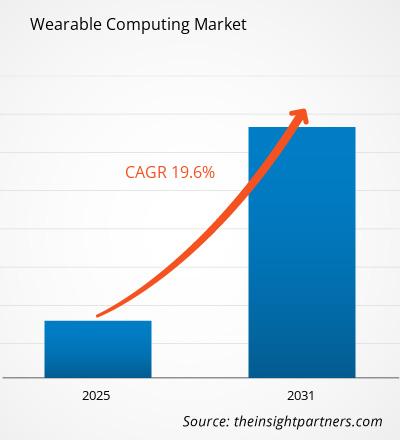
The wearable computing market is projected to expand from US$ 99.9 Billion in 2025 to US$ 502.39 Billion by 2034, registering a CAGR of 19.66% during 2026–2034. The market is advancing as smart watches and bands, connected eyewear, smart clothing, and medically oriented wearables shift from accessory devices into persistent computing interfaces for health, productivity, fitness, safety, and contextual digital services.
North America remains a key demand center for wearable computing market size expansion, supported by high smartphone penetration, early deployment of digital health tools, enterprise pilots, and premium smartwatch adoption. The region is expected to grow at a CAGR range of 18.5–20.5% during 2026–2034 as remote monitoring, sports analytics, insurance-linked wellness, and workplace safety programs strengthen recurring device and software demand.
Wearable Computing Market Assessment and Insights
- North America: The region accounted for 32–35% share in 2025 and is expected to grow at a CAGR of 18.5–20.5% during 2026–2034, led by connected health, sports technology, and enterprise safety adoption.
- US: The US represented 76–80% of North America in 2025 and is expected to grow at a CAGR of 18.8–20.8% during 2026–2034.
- Europe: Europe held 23–26% share in 2025 and is expected to grow at a CAGR of 17.5–19.2%, supported by Germany, the UK, France, Italy, and Spain.
- Asia Pacific: Asia Pacific held 28–31% share in 2025 and is expected to grow at a CAGR of 21.0–23.5%, with China, Japan, South Korea, India, and Australia shaping demand.
- Largest Segment: Smart Watches and Bands held 54–58% market share in 2025 and are expected to grow at a CAGR of 18.8–20.5% during 2026–2034.
- High Growth Segment: Smart Glasses held 8–11% market share in 2025 and are expected to grow at a CAGR of 24.0–27.0% during 2026–2034.
- Key companies analyzed in detail: Adidas AG, Apple Inc., Boston Scientific Corporation, Fitbit LLC, Garmin Ltd., LG Electronics Inc., Google LLC, Nike Inc., Samsung Electronics Co., Ltd., and Sony Group Corporation.
Source: The Insight Partners' analysis based on proprietary research, government publications, company annual reports, investor presentations, industry databases, and expert interviews.
The wearable computing market growth has evolved through three overlapping waves: basic activity monitoring, connected health and communication, and context-aware computing. While early demand came from fitness trackers, today’s adoption hinges on the precision of sensors, efficient battery usage, display miniaturization, cloud computing, biometrics analysis, and integration with other devices.
Further development will be driven not only by new devices, but by more valuable applications. The healthcare industry, companies, insurance firms, manufacturers, and military units are piloting the use of wearable devices to monitor people’s health status, ensure their safety, conduct maintenance work, communicate and train. This creates a stronger outlook for vendors that combine hardware, software, data governance, connectivity, and services, according to the Wearable Computing Market report.
Wearable Computing Market Report Scope
| Report Attribute | Details |
|---|---|
| Market size in 2025 | US$ 99.9 Billion |
| Market Size by 2034 | US$ 502.39 Billion |
| Global CAGR (2026 - 2034) | 19.66% |
| Historical Data | 2021-2024 |
| Forecast period | 2026-2034 |
Wearable Computing Market Analysis
Demand is being driven by preventive healthcare, digital fitness, hands-free work, and the need for always-available computing interfaces. IDC reported that global wearable device shipments reached 611.5 million units in 2025, growing 9.1% year over year, while Q1 2026 shipments reached 145.7 million units. These shipment trends support wearable computing market analysis focused on scale, replacement cycles, and higher-value health-oriented functions.
The ecosystem is dependent on component providers, sensor manufacturers, display manufacturers, operating systems, app platforms, cloud computing analytics, and channel partners. The supply chain has been changing owing to the cost implications of memory issues, sensors, and display technology. Companies that control operating systems, app stores, and health data platforms are likely to have an easier time maintaining their margins compared to hardware companies alone.
Competition exists among ecosystem providers and device specialists. The main competitors include Apple Inc., Samsung Electronics Co., Ltd., Google LLC, Garmin Ltd., and Fitbit LLC due to their wrist devices and health services, while Sony Group Corporation, LG Electronics Inc., Adidas AG, Nike Inc., and Boston Scientific Corporation are expanding the market using entertainment, smart clothing, sports performance, and medicine.
Investment will focus on artificial intelligence for health analysis, smart glasses, medical-grade tracking, and enterprise process automation. Apple's introduction of the Apple Watch Series 11 in 2025 included features such as hypertension detection, sleep scoring, 5G cellular capabilities, and extended battery life, demonstrating how high-end products now compete through health insight, connectivity, and continuous use rather than mere activity tracking.
● REPORT CUSTOMIZATION
Tailor This Report To Align With Your Specific Business Requirements
This report can be customized to align precisely with your business objectives, scope, and target markets. Customization options include tailored segmentation, geography, competitive analysis, and strategic insights to support informed decision-making.
Customize This Report →WHAT YOU CAN ADJUST
- ● Segmentations
- ● Geography
- ● Competitive Analysis
- ● Language Preferences
Wearable Computing Market: Strategic Insights
Regional Insights
North America Wearable Computing Market
North America accounted for 32–35% wearable computing market share in 2025. Demand is supported by premium smartwatch adoption, digital health investments, sports analytics, and enterprise deployments in logistics, industrial safety, and field service. The region is expected to grow at a CAGR of 18.5–20.5% during 2026–2034 as health monitoring becomes more integrated with care delivery and wellness reimbursement models.
The US and Canada are also benefiting from clearer digital health pathways. FDA digital health guidance and chronic disease technology pilots are encouraging more structured use of wearable data in healthcare. This is improving the commercial case for validated sensors, remote monitoring platforms, and software that can convert continuous data into actionable interventions.
U.S. Wearable Computing Market
The US represented 76–80% of North America Wearable Computing Market in 2025 and is expected to grow at a CAGR of 18.8–20.8% during 2026–2034. There are advantages in the country due to a high installed base in devices such as Apple Watch, Fitbit, Garmin, Samsung Galaxy Watch, and Pixel Watch, as well as the use of subscription services related to fitness, wellness, and health analytics.
Medical applications are now one of the significant differentiators. The FDA’s policies related to digital health products, guidance related to low-risk wellness products, and use of remote monitoring have increased the opportunities for wrist-worn products as well as sensor products.
Europe Wearable Computing Market
Europe held 23–26% share in 2025 and is expected to grow at a CAGR of 17.5–19.2% during 2026–2034. Germany is leading in terms of adopting wearable technology through its industrial application, privacy-centric health platforms, and demands of workplace safety. The UK is developing in terms of digital health and fitness technology adoption, while France, Italy, and Spain are adopting wearables due to the demands of healthcare, due to their elderly population and sports.
The adoption of wearable technology in Europe is influenced by issues of data privacy expectations, regulation of medical devices, and preferences of consumers in terms of durability and interoperability. European consumers are increasingly assessing wearable technology in terms of battery life, reparability, security of data, and clinical validity.
APAC Wearable Computing Market
APAC held 28–31% share in 2025 and is expected to grow at a CAGR of 21.0–23.5% during 2026–2034. China is the market leader, driven by powerful local brands, government subsidies, and scale manufacturing. Japanese and South Korean markets provide premium electronics requirements, whereas India and Southeast Asian markets offer volumes through budget bands, watches, and fitness-related use cases.
These trends get further amplified by mobile-first behavior and e-commerce sales channels, along with growing awareness about health among young customers. IDC found that government subsidies drove China’s wearable demand in 2025, and Huawei and Xiaomi added to smartwatch and wristband adoption. Such trends make APAC a critical region for price innovations and form factor experiments.
Middle East & Africa Wearable Computing Market
The Middle East & Africa Wearable Computing Market is expected to grow at a CAGR of 16.0–18.0% during 2026–2034. UAE and Saudi Arabia are driving regional adoption through smart city initiatives, high-end consumer electronics, workplace safety, and healthcare initiatives. South Africa promotes gradual adoption through fitness, wellness insurance, and private healthcare.
There is considerable disparity in regional demand due to differences in pricing, distribution penetration, and broadband availability. But enterprise applications in areas such as energy, construction, logistics, and security can offer an opportunity for rugged wearables, smart glasses, and connected workers. With the growth in healthcare IT, the use of wearables in preventive care can become increasingly important.
Segmentation Analysis
Technology
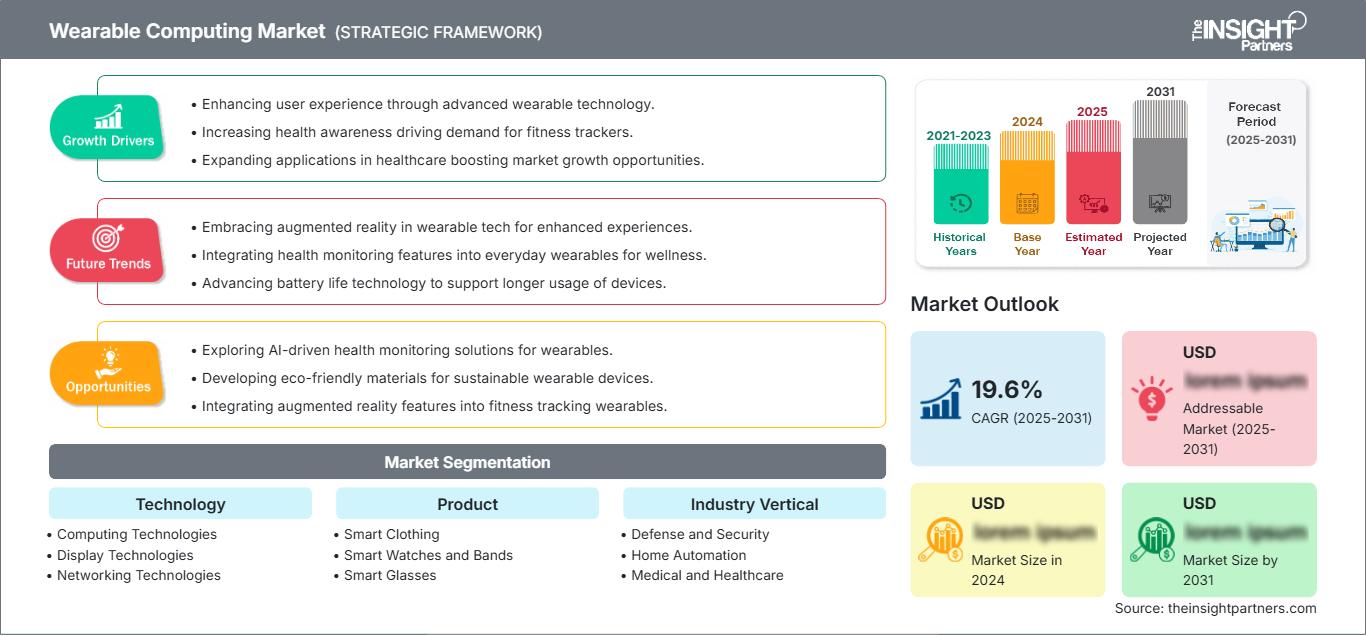
Technology is expected to grow at a CAGR of 19.0–21.0% during 2026–2034 as processors, displays, connectivity, and sensors become more efficient. The wearable computing market scope is expanding because device makers are combining edge computing, cloud services, Bluetooth, Wi-Fi, cellular, and AI models to support richer, lower-latency applications.
- Computing Technologies: Miniaturized processors, low-power chipsets, and edge AI enable faster health interpretation, gesture recognition, and contextual alerts while improving battery performance across watches, bands, glasses, and apparel.
- Display Technologies: OLED, microLED, low-power always-on screens, and waveguide optics improve readability, energy efficiency, and the user experience in smartwatches, bands, and emerging smart glasses.
- Networking Technologies: Bluetooth, Wi-Fi, NFC, LTE, 5G, and ultra-wideband support payments, notifications, location tracking, device pairing, remote monitoring, and enterprise connectivity across wearable ecosystems.
Product
Product is expected to grow at a CAGR of 19.2–21.3% during 2026–2034. Smart watches and bands dominate revenue, but smart glasses and smart clothing are gaining strategic importance as vendors pursue hands-free computing, fitness analytics, posture monitoring, immersive media, and worker enablement.
- Smart Clothing: Sensor-embedded apparel supports posture, exertion, recovery, and motion tracking, making it relevant for elite sports, rehabilitation, defense training, and industrial safety monitoring.
- Smart Watches and Bands: This segment remains the largest due to health tracking, notifications, payments, navigation, fitness coaching, and strong replacement demand across consumer and professional users.
- Smart Glasses: Smart glasses are shifting from experimental hardware to practical interfaces for content capture, field service, navigation, training, remote assistance, and AI-enabled contextual prompts.
Industry Vertical
Industry Vertical is expected to grow at a CAGR of 18.7–20.8% during 2026–2034. Fitness and wellness remain central, but healthcare, defense, enterprise, home automation, and media applications are increasing total addressable demand by making wearables useful for operational and clinical outcomes as well as lifestyle needs.
- Defense and Security: Wearables support soldier monitoring, location awareness, secure communication, fatigue tracking, and augmented field information, particularly where situational awareness and mobility are critical.
- Home Automation: Wrist and voice-enabled wearables provide convenient interfaces for access control, lighting, entertainment, alerts, appliance control, and connected home security management.
- Medical and Healthcare: Continuous heart, sleep, activity, glucose, and respiratory monitoring help extend care outside clinical settings and support earlier intervention for chronic disease risks.
- Enterprise and Industrial: Connected worker devices improve safety, workflow guidance, hands-free communication, inspection accuracy, and productivity in logistics, manufacturing, utilities, and maintenance environments.
- Fitness and Wellness: Activity tracking, recovery analytics, coaching, nutrition support, and training optimization keep this vertical a core revenue contributor across consumer and professional segments.
- Media and Entertainment: Smart glasses, audio wearables, haptics, and fitness-gaming integrations support immersive content, live capture, hands-free controls, and personalized entertainment experiences.
Opportunity Snapshot
| Industry Vertical | Revenue Contribution | Trend Tag | Adoption Stage |
| Defense and Security | Medium | Field Safety | Scaling |
| Home Automation | Low | Ambient Control | Emerging |
| Medical and Healthcare | High | Remote Care | Scaling |
| Enterprise and Industrial | Medium | Connected Worker | Scaling |
| Fitness and Wellness | High | Recovery Analytics | Mature |
| Media and Entertainment | Medium | Immersive Capture | Emerging |
Wearable Computing Market Growth Drivers and Impact Analysis
Preventive Health Monitoring Moves Wearables into Daily Care
Wearables are emerging as the most powerful structural driver due to the capability to provide continuous information that would have otherwise been missed through regular checkups. Health monitors such as heart rate, sleep analysis, oxygen saturation, body temperature, ECG, blood pressure, and glucose management have increased the relevance of these devices. The FDA digital health guidelines and technology trials for chronic illnesses are paving the way for both low-risk wellness applications and regulated medical functionalities.
Enterprise Adoption Creates Higher-Value Use Cases
The use of enterprise wearables is moving from pilot implementations into full-scale deployments as firms test out these devices for applications related to safety, productivity, telepresence, and training. Smart glasses can be used to guide workers through visual directions, and wrist-based devices can be used to measure fatigue, track location, and send out alarms in case of an emergency. Hands-free operation is important in industrial and logistics settings since workers may have to operate machinery, vehicles, or protective equipment.
AI and Sensor Fusion Improve User Relevance
AI is helping add more value to wearables by converting raw sensor data into insights that are tailored to each user. Sensor fusion allows combining data about body movements, heart rates, temperatures, locations, sounds, and context to make better suggestions related to sleep, recovery, navigation, safety, and training. According to IDC, new wearable device designs like smart rings and smart glasses will be popular, indicating that intelligence and usability become as important as screen sizes.
Wearable Computing Market Future Trends
AI-Enabled Smart Glasses Become Practical Interfaces
The wearable computing market trends increasingly point toward smart glasses that combine audio, camera, AI assistants, and optional displays. IDC forecast smart glasses shipments of 13.6 million units in 2026, up 41.4% year over year, and projected the category to approach 27.3 million units by 2030. Adoption will depend on comfort, privacy safeguards, battery life, and useful everyday workflows. Practical applications include field service, content capture, real-time translation, navigation, training, and hands-free enterprise collaboration.
Clinical-Grade Wearables Blend with Consumer Platforms
The distinction between consumer and medical technologies will keep shrinking, thanks to the combination of reliable sensors, regulated software, and wellness solutions. Today's smartwatches provide the consumer with access to information about ECG, sleep, activity, and heart rhythms, whereas continuous glucose monitors and patches represent further remote care possibilities. The next step will be integration into patient medical records, cybersecurity, consent management, and efficient clinical processes. Companies offering a solution combining consumer and medical technologies will win physician and payer confidence.
Wearable Computing Market Opportunities
Remote Patient Monitoring and Chronic Care Integration
The wearable computing market forecasts point to expanding opportunities in remote patient monitoring, particularly for cardiovascular, metabolic, respiratory, and sleep-related conditions. Healthcare providers need scalable tools that reduce avoidable visits, identify deterioration earlier, and improve adherence outside clinics. Wearable vendors can capture value by offering clinically validated sensors, alert logic, care-team dashboards, and reimbursement-ready workflows. Partnerships with hospitals, insurers, pharmacy networks, and digital therapeutics companies will be essential for converting device data into measurable outcomes.
Connected Worker Platforms for Industrial Safety
Industrial employers are seeking tools that reduce accidents, improve training, and support dispersed workforces. Wearables can deliver hazard alerts, biometric monitoring, posture insights, location awareness, and hands-free instructions in high-risk environments. Smart glasses are especially relevant for remote expert support and guided maintenance. The opportunity is strongest where hardware is bundled with analytics, compliance reporting, secure identity management, and integration into enterprise systems. Vendors that prove measurable safety and productivity gains can unlock recurring service revenue.
Frequently Asked Questions

- Comprehensive Market Sizing and Forecast Analysis
- Detailed Segmentation Analysis
- In-Depth Market Dynamics Assessment
- Regional and Country-Level Insights
- Competitive Landscape and Company Benchmarking
- Strategic Business Intelligence
Recent Reports
Testimonials

The Insight Partners provided valuable market intelligence that supported our global go-to-market strategy. Their team was professional, responsive, and attentive to our feedback, providing thoughtful analysis and helpful methodological clarifications throughout the project.
Junmo Kim Chief Financial Officer (CFO), Enertech Co., Ltd.
The Insight Partners' SCADA System Market report is comprehensive, with valuable insights on current trends and future forecasts. The team was highly professional, responsive, and supportive throughout. We are very satisfied and highly recommend their services.
RAN KEDEM Partner, Reali Technologies LTDs
I requested a report on a very specific software market and the team produced the report in a few days. The information was very relevant and well presented. I then requested some changes and additions to the report. The team was again very responsive and I got the final report in less than a week.
JEAN-HERVE JENN Chairman, Future Analytica
We worked with The Insight Partners for an important market study and forecast. They gave us clear insights into opportunities and risks, which helped shape our plans. Their research was easy to use and based on solid data. It helped us make smart, confident decisions. We highly recommend them.
PIYUSH NAGPAL Sr. Vice President, High Beam Global
The Insight Partners delivered insightful, well-structured market research with strong domain expertise. Their team was professional and responsive throughout. The user-friendly website made accessing industry reports seamless. We highly recommend them for reliable, high-quality research services
YUKIHIKO ADACHI CEO, Deep Blue, LLC.
This is the first time I have purchased a market report from The Insight Partners.While I was unsure at first, I visited their web site and felt more comfortable to take the risk and purchase a market report.I am completely satisfied with the quality of the report and customer service. I had several questions and comments with the initial report, but after a couple of dialogs over email with their analyst I believe I have a report that I can use as input to our strategic planning process.Thank you so much for taking the extra time and making this a positive experience.I will definitely recommend your service to others and you will be my first call when we need further market data.
JOHN SUZUKI President and Chief Executive Officer, Board Director, BK Technologies
I wish to appreciate your support and the professionalism you displayed in the course of attending to my request for information regarding to infectious disease IVD market in Nigeria. I appreciate your patience, your guidance, and the fact that you were willing to offer a discount, which eventually made it possible for us to close a deal. I look forward to engaging The Insight Partners in the future, all thanks to the impression you have created in me as a result of this first encounter.
DR CHIJIOKE ONYIA MANAGING DIRECTOR, PineCrest Healthcare Ltd.Reason to Buy
- Informed Decision-Making
- Understanding Market Dynamics
- Competitive Analysis
- Identifying Emerging Markets
- Customer Insights
- Market Forecasts
- Risk Mitigation
- Boosting Operational Efficiency
- Strategic Planning
- Investment Justification
- Tracking Industry Innovations
- Aligning with Regulatory Trends





 Get Free Sample for