
Webcam Market Growth, Size & Forecast by 2034
Coverage: By Product (Wireless, USB); Technology (Analog Webcams, Digital Webcams); End Use (Defense, Visual Marketing, Life Events, Healthcare, Sports, Others) , and Geography (North America, Europe, Asia Pacific, and South and Central America)
- Status : Data Released
- Report Code : TIPRE00010134
- Category : Electronics and Semiconductor
- No. of Pages : 150
- Available Report Formats :


- Last update date : September 28, 2026


2025 Market Size
US$ 10.11 Bn
Base year value
2034 Forecast
US$ 18.56 Bn
Projected by 2034
CAGR 2026-2034
6.99 %
Growth rate
Addressable Market
US$ 129.51 Bn
(2026-2034)
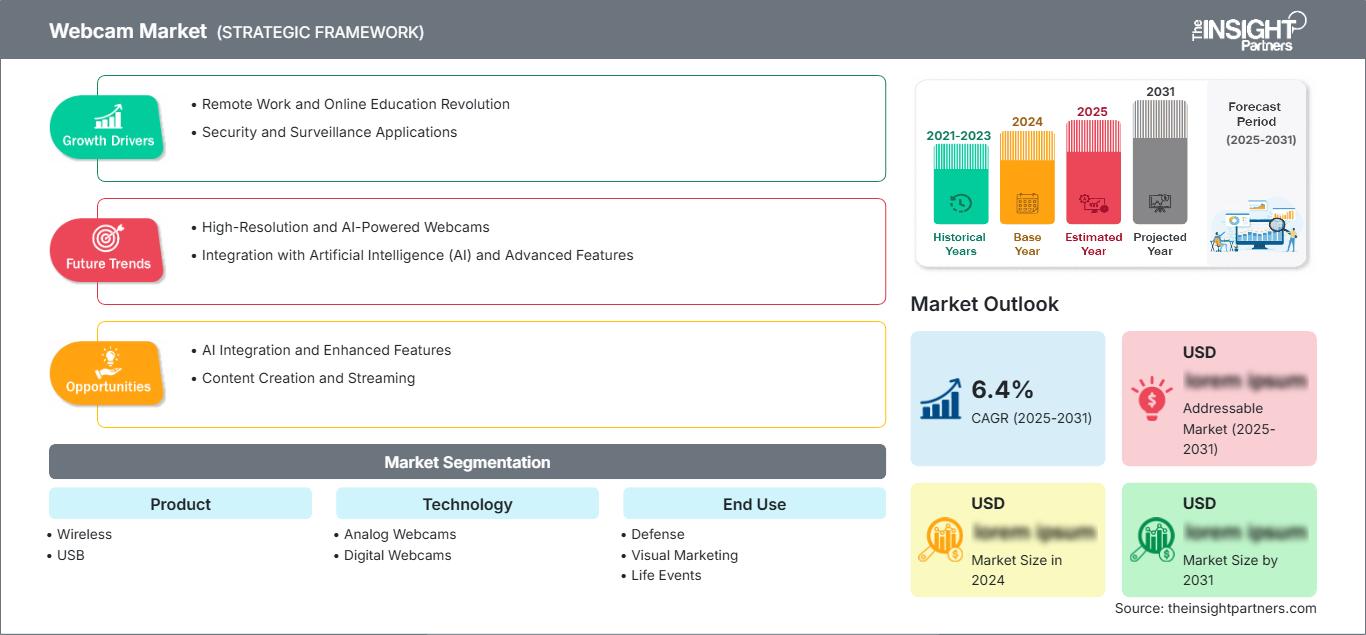
The webcam market was valued at US$ 10.11 Billion in 2025 and is projected to reach US$ 18.56 Billion by 2034, registering a CAGR of 6.99% during 2026–2034. Expansion is supported by sustained demand for professional video communication, creator workflows, digital learning, remote collaboration, and specialized visual applications. Product innovation is increasingly centered on higher resolution, computational image processing, improved microphones, privacy controls, compact designs, and connectivity options suited to increasingly distributed digital environments.
Across North America, the market is expected to expand at an estimated 6.5–7.2% CAGR through 2034. Structural drivers include continued hybrid-work infrastructure, enterprise video collaboration, creator-economy activity, and replacement of aging peripherals. The webcam market size is also influenced by growing demand for intelligent imaging capabilities that improve framing, lighting, background handling, and device-management efficiency across professional and consumer deployments.
Webcam Market Assessment and Insights
- North America accounted for an estimated 29–33% share in 2025 and is expected to grow at a CAGR of 6.5–7.2% between 2026–2034, supported by enterprise collaboration, creator activity, and technology replacement cycles.
- US represented approximately 72–76% of North American revenue in 2025 and is projected to register a 6.6–7.3% CAGR between 2026–2034, driven by business conferencing and content production.
- Europe held an estimated 23–27% share in 2025 and is expected to grow at 6.1–6.8% CAGR between 2026–2034. Germany, the UK, France, Italy, and Spain provide the region’s principal demand centers through enterprise digitization and professional imaging adoption.
- Asia Pacific represented approximately 35–39% of global revenue in 2025 and is projected to advance at 7.3–8.1% CAGR between 2026–2034. China, Japan, South Korea, and India remain important manufacturing, technology, and consumption centers.
- Largest Segment: USB represented an estimated 55–59% market share in 2025 and is expected to grow at a 6.8–7.5% CAGR between 2026–2034, reflecting compatibility and deployment simplicity.
- High Growth Segment: Wireless represented approximately 18–22% market share in 2025 and is forecast to expand at a 9.0–10.2% CAGR between 2026–2034 as flexible installations gain traction.
- Key companies analyzed in detail: Canon Inc.; Cisco Systems, Inc.; Creative Technology Ltd.; D-Link Corporation; Koninklijke Philips N.V.; Logitech International S.A.; Microsoft Corporation; Razer Inc.; Samsung Electronics Co., Ltd.; Sony Group Corporation; Lenovo Group Limited; Xiaomi Corporation.
Source: The Insight Partners' analysis based on proprietary research, government publications, company annual reports, investor presentations, industry databases, and expert interviews.
From simple video chat to multi-purpose imaging equipment that is capable of aiding collaboration, streaming, education, telemedicine, marketing, and monitoring, the demand has changed. Advanced features such as digital sensors, autofocus, HDR, low light capabilities, inbuilt microphones, privacy shutters, and software-based framing are distinguishing new cameras. The production costs are dependent on CMOS sensors, lenses, processors, connection components, semiconductors, and USB interface.
The future of investment includes computational imaging, artificial intelligence, device management software, and camera architecture that is specific to the application. Developing nations provide further volume opportunities due to broadband access, digital education, online services, and small business technology. Regulatory attention to privacy, cybersecurity, accessibility, and responsible use of camera-enabled systems is also likely to influence product design, particularly for enterprise, healthcare, public-sector, and defense-related applications, according to the Webcam Market report.
Webcam Market Report Scope
| Report Attribute | Details |
|---|---|
| Market size in 2025 | US$ 10.11 Billion |
| Market Size by 2034 | US$ 18.56 Billion |
| Global CAGR (2026 - 2034) | 6.99% |
| Historical Data | 2021-2024 |
| Forecast period | 2026-2034 |
Webcam Market Analysis
Demand is supported by the normalization of distributed work and the increasing importance of visual communication across corporate and consumer settings. Organizations require dependable cameras for meetings, training, customer engagement, and internal communications, while creators increasingly seek higher resolution and improved image consistency. The webcam market growth therefore, reflects both replacement demand and feature-driven upgrades rather than only new-user adoption.
Value chain elements consist of imaging sensors, optical assembly, processors, microphones, connectivity modules, casings, software, distribution channels, system integration, and end users. Manufacturers now focus on software-based imaging processing techniques as a means of differentiation instead of just hardware capabilities. The supply chain is affected by factors such as the availability of imaging sensors, the cost of semiconductors, logistics issues, and local sourcing of components, while distribution online allows manufacturers to achieve more geographic coverage and rapid product updates.
Positioning will be influenced by the capability to integrate imaging technology with software intelligence. Logitech International S.A. covers a wide range of both consumer and enterprise uses, while Microsoft Corporation and Cisco Systems, Inc. leverage robust collaborative ecosystems. Canon Inc. and Sony Group Corporation contribute imaging expertise, whereas Razer Inc. emphasizes creator and gaming use cases, as highlighted in the Webcam Market forecast.
Other players go for differentiated niches. Creative Technology Ltd. and D-Link Corporation cater to the needs of consumer connectivity and peripherals, while Koninklijke Philips N.V. is involved in imaging and digital devices. Samsung Electronics Co., Ltd., Lenovo Group Limited, and Xiaomi Corporation get their edge through broader electronic systems. Investments now focus on AI-based imaging, privacy features, platform certification, efficiency in manufacturing, and regional distribution capability.
● REPORT CUSTOMIZATION
Tailor This Report To Align With Your Specific Business Requirements
This report can be customized to align precisely with your business objectives, scope, and target markets. Customization options include tailored segmentation, geography, competitive analysis, and strategic insights to support informed decision-making.
Customize This Report →WHAT YOU CAN ADJUST
- ● Segmentations
- ● Geography
- ● Competitive Analysis
- ● Language Preferences
Webcam Market: Strategic Insights
Regional Insights
North America Webcam Market
North America held an estimated 29–33% share of the webcam market in 2025 and is expected to register a 6.5–7.2% CAGR through 2034. Domination of regional demand by the US is ensured through collaboration, replacement of home offices, professional streaming, online learning, and digital content creation. The contribution from Canada comes from the digitization of businesses and upgrades in institutions. Consumers assess autofocus capabilities, HDR, mics, privacy shutter, USB-C, and software management, along with resolution.
Collaboration remains an especially important structural feature as collaborative teams need standard peripheral equipment to work reliably in collaboration software. Healthcare, finance, educational and governmental institutions also need reliable imaging in virtual interactions and training. Demand driven by creators underpins premium devices, whereas household demand ensures lower-end volume sales.
U.S. Webcam Market
The US represented approximately 72–76% of North American webcam market revenue in 2025 and is projected to grow at a 6.6–7.3% CAGR through 2034. Demand includes hybrid working, enterprise video collaboration, streaming, telehealth, learning, and professional communication. Major existing suppliers like Logitech International S.A., Microsoft Corporation, Cisco Systems, Inc., Canon Inc., Razer Inc., and others continue to have strong application coverage in both enterprise and consumer sectors.
There is a growing preference among enterprise customers for certified peripherals that can be rolled out among a significant number of employees easily, without complex setup. Premium peripherals will be influenced by the demand for 4K imaging, intelligent framing, low-light correction, and enhanced sound capturing. Creator applications will stimulate demands for higher frame rate capabilities and variable field of view, while privacy is still going to be important for home as well as enterprise applications.
Europe Webcam Market
Europe represented an estimated 23–27% share of the Webcam Market in 2025 and is forecast to grow at 6.1–6.8% CAGR through 2034. The UK and Germany are leading markets, supported by enterprise collaboration and digital workplace investment. France, Italy, and Spain contribute through professional services, education, media, and small-business adoption, while privacy expectations encourage stronger controls and transparent device-management practices.
The UK benefits from mature hybrid-work infrastructure and high usage of collaborative platforms. Germany emphasizes enterprise-grade reliability, industrial communication, and data-conscious procurement. France combines business digitization with education and creative applications, while Italy and Spain show opportunities through small and medium-sized businesses, online services, and content production. Regional demand increasingly favors products with privacy shutters, manageable software, USB-C interfaces, and certified compatibility. Sustainability considerations, including packaging and material efficiency, are also becoming more relevant to institutional procurement decisions.
APAC Webcam Market
APAC held an estimated 35–39% of the Webcam Market share in 2025 and is expected to grow at 7.3–8.1% CAGR through 2034, making it the leading regional market by revenue contribution. China remains a major manufacturing and consumption center, while Japan and South Korea contribute advanced electronics capabilities. India benefits from expanding digital services, education, and enterprise collaboration, with Australia supporting professional and institutional adoption.
Industrial capacity, semiconductor ecosystems, broadband expansion, and public digitalization programs support regional demand. Manufacturers can increasingly integrate sensors, processors, and connectivity components within localized supply chains, improving scalability. The region also contains a wide range of price points, from basic USB devices to premium AI-enabled systems. Demand from creators, enterprises, education providers, and public institutions provides diversified application opportunities and reduces dependence on a single end-use category.
Middle East & Africa Webcam Market
The Middle East and Africa Webcam Market region is expected to expand at a 7.0–7.8% CAGR through 2034. Saudi Arabia and the UAE are leading demand centers because of digital transformation programs, smart infrastructure investment, and multinational business activity. South Africa remains an important African market, while the rest of the region provides longer-term potential through education and enterprise connectivity.
Energy-sector digitization, infrastructure modernization, remote collaboration, and government service transformation support adoption. UAE organizations increasingly require professional video systems for distributed operations, while Saudi Arabia’s digital investment agenda supports technology procurement across commercial and public applications. African markets remain more price-sensitive, favoring durable USB products and online distribution. Vendors that combine competitive pricing with local support, simple installation, and reliable connectivity can improve penetration across fragmented regional markets.
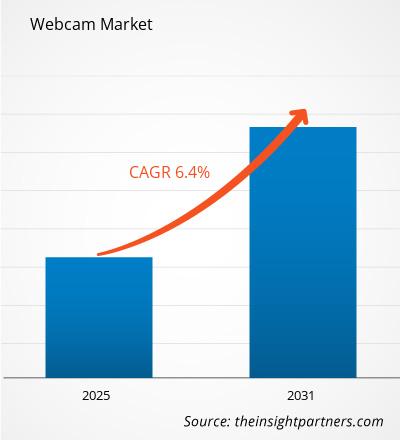
Segmentation Analysis
Product
The Product segment is expected to grow at a 7.0–7.6% CAGR from 2026–2034. USB devices remain central because they offer broad compatibility, simple installation, predictable power delivery, and extensive enterprise support. Wireless products are gaining strategic importance where cable-free placement, room flexibility, and compact setups outweigh the simplicity of wired connections, reflecting evolving Webcam Market trends.
- USB: Broad compatibility with computers and collaboration platforms keeps USB products central to enterprise, education, home-office, and creator deployments, while USB-C adoption improves connectivity, convenience and future device compatibility.
- Wireless: Wireless models address flexible room layouts, mobile workspaces, and cleaner installations. Their strategic importance rises as users seek reduced cabling and greater freedom when positioning cameras.
Technology
The Technology segment is projected to advance at a 6.8–7.4% CAGR during 2026–2034. Digital webcams dominate practical deployment because they integrate efficiently with modern computing platforms and enable sophisticated image processing. Analog technology retains relevance in specialized legacy environments but faces structural pressure from digital interfaces, software compatibility, and demand for higher image quality.
- Analog Webcams: Analog solutions continue serving selected legacy and specialized environments where existing infrastructure supports them, but replacement decisions increasingly favor digital architectures with broader application compatibility.
- Digital Webcams: Digital devices benefit from software processing, high-resolution sensors, autofocus, HDR, and intelligent image correction, making them strategically important across professional and consumer applications.
End Use
The End Use segment is expected to register a 7.2–7.9% CAGR through 2034. Demand is diversifying beyond conferencing into healthcare, sports, visual marketing, defense, and personal life-event recording. Each application imposes different requirements for reliability, image quality, mobility, privacy, and integration, encouraging vendors to develop increasingly specialized product configurations.
- Defense: Defense applications prioritize ruggedness, dependable imaging, secure communications, and integration with broader surveillance or remote-operation systems where environmental and cybersecurity requirements are stringent.
- Visual Marketing: Marketing teams use cameras for product demonstrations, livestreaming, virtual presentations, and social content, increasing demand for accurate color, autofocus, flexible framing, and dependable audio capture.
- Life Events: Weddings, celebrations, interviews, and personal broadcasts sustain consumer demand for accessible high-quality imaging, particularly where users want convenient recording without professional camera-system complexity.
- Healthcare: Healthcare applications require consistent image quality, secure connectivity, and dependable operation for virtual consultations, training, documentation, and selected remote-care workflows.
- Sports: Sports applications value high frame rates, wide viewing angles, low-light performance, and reliable streaming capabilities for training, analysis, broadcasting, and fan-oriented content.
- Others: Other applications span education, security, customer service, industrial communication, and specialized monitoring, creating demand for products with flexible mounting, reliable connectivity, and application-specific software.
Opportunity Snapshot
| End Use | Revenue Contribution | Trend Tag | Adoption Stage |
| Defense | Medium | Secure Imaging | Scaling |
| Visual Marketing | High | Creator Commerce | Scaling |
| Life Events | Medium | Live Capture | Scaling |
| Healthcare | Medium | Virtual Care | Scaling |
| Sports | Medium | Remote Analysis | Scaling |
| Others | Low | Specialized Vision | Emerging |
Webcam Market Growth Drivers and Impact Analysis
Expansion of Hybrid Collaboration Infrastructure
The trend towards hybrid employment has made video communication move from being an infrequent business function to a frequently occurring operation process. Enterprises require reliable cameras not only at offices but also at home, in training rooms, and at contact points with clients. The increased demand calls for the replacement of older hardware components. However, the consequence is more than just the amount of purchases because consumers pay attention not only to the quality of image and microphones but also to the possibilities to control devices, privacy, and certifications. Manufacturers with options to configure devices centrally and ensure their compatibility can secure larger corporate orders. The underlying structural change is the development of a more stable demand that does not depend on temporary work-from-home purchasing cycles.
AI-Enabled Imaging Raises Product Value
Differentiation is moving away from resolution and towards image intelligence as artificial intelligence changes the fundamentals of differentiation. Automated framing, exposure adjustment, background management, face tracking, noise cancellation, and scene optimization make it possible to enhance quality even without users' knowledge about the technical aspects of photography. Such technology gives companies the chance to offer high-end products targeted at professionals, content creators, teachers, and businesses. This approach is important as the software can be upgraded post-sale and thus increase product capabilities as well as monetization possibilities via ecosystems. Moreover, thanks to AI, vendors will be able to differentiate cameras and devices that have the same sensors or lenses.
Growth of Creator and Visual Commerce Applications
Growth in livestreaming, online learning, demonstrations, influencer marketing, and customer outreach through remote means extends camera demand away from traditional conference applications. Small companies are turning to video technology in order to demonstrate their products, train their employees, engage with their clients, and take advantage of social commerce practices. Similarly, creators are looking for gear that will allow them to produce a constant stream of video content without having to resort to professional cameras. Such growth in addressability creates the need for improved frame rate, field of view, low-light conditions tolerance, and versatility of mounts. This can be done via a differentiation of offerings into basic conference communication tools and more advanced creator gear. Such an opportunity is especially appealing to companies that can pair hardware with software solutions.
Webcam Market Future Trends
Computational Imaging Becomes a Core Product Differentiator
The importance of computational imaging as a factor in the design of webcams will only grow as sensors become standardized. Future models are predicted to have the combination of real-time exposure adjustment, subject identification, scene framing, depth effects, background separation, and intelligent color adjustment. Instead of asking users to manually set up their lighting or adjust the camera settings, the system will analyze the scene and process the images accordingly. In addition, this approach may help in differentiation through charging more for higher-quality processing in a hard-to-process situation. Another important consideration will be privacy-preserving processing, as companies will assess camera intelligence in a controlled environment. Those who manage to balance processing, latency, and security will be successful in professional use cases.
Interoperable Cameras Expand Across Multi-Platform Workflows
Future use will likely lean towards webcams, which will work reliably on a number of collaboration, streaming, learning, and content creation platforms. Consumers are seeking solutions that can easily switch between platforms without proprietary constraints, while IT teams would like standard methods of configuration and firmware management. This will motivate vendors to focus on standards compliance, platform certification, management interfaces, and software compatibility. USB-C will continue playing a role in modern computers and docking scenarios, while wireless technology will provide additional benefits when flexible placement is desired. Support of OS camera APIs and collaboration software will become an increasingly important purchase consideration. The key implication here is that winning products will be judged not just as imaging devices but as ecosystem-compatible endpoints.
Webcam Market Opportunities
Enterprise Fleet Modernization and Device Management
Enterprise device replacement strategies offer an opening for vendors to transition from the selling of individual peripheral devices to portfolio-based devices. Enterprises can take advantage of uniform camera hardware that comes with uniform firmware, security capability, and platform certification. Vendors can differentiate themselves through the provision of unique combinations of hardware, administration software, analytics, implementation, and support. The strategy can enhance vendor customer loyalty since changing vendors is made difficult through embedded device management within the workplace infrastructure. Opportunities are especially relevant within distributed enterprises, educational networks, health care organizations, and government institutions with many endpoint devices. Vendors who provide security documentation, warranties, and provisioning scalability can ease procurement issues while building lasting business relations.
Application-Specific Imaging Solutions in Emerging Economies
Emerging markets offer opportunities to develop products around specific application requirements rather than simply competing on price. India, Southeast Asia, the Middle East, and parts of Latin America can support solutions tailored to digital classrooms, small-business communication, telehealth, creator commerce, and remote professional services. Localized bundles combining cameras, microphones, lighting accessories, software, and installation support can reduce adoption barriers for customers with limited technical resources. Vendors can also use regional distribution partnerships and e-commerce channels to reach fragmented customer groups. Product design should emphasize durability, simple configuration, multilingual software support, and efficient operation. Such strategies can broaden adoption while allowing manufacturers to establish differentiated positions in markets where professional video infrastructure remains less standardized.
Frequently Asked Questions

- Comprehensive Market Sizing and Forecast Analysis
- Detailed Segmentation Analysis
- In-Depth Market Dynamics Assessment
- Regional and Country-Level Insights
- Competitive Landscape and Company Benchmarking
- Strategic Business Intelligence
Recent Reports
Testimonials

The Insight Partners' SCADA System Market report is comprehensive, with valuable insights on current trends and future forecasts. The team was highly professional, responsive, and supportive throughout. We are very satisfied and highly recommend their services.
RAN KEDEM Partner, Reali Technologies LTDs
I requested a report on a very specific software market and the team produced the report in a few days. The information was very relevant and well presented. I then requested some changes and additions to the report. The team was again very responsive and I got the final report in less than a week.
JEAN-HERVE JENN Chairman, Future Analytica
We worked with The Insight Partners for an important market study and forecast. They gave us clear insights into opportunities and risks, which helped shape our plans. Their research was easy to use and based on solid data. It helped us make smart, confident decisions. We highly recommend them.
PIYUSH NAGPAL Sr. Vice President, High Beam Global
The Insight Partners delivered insightful, well-structured market research with strong domain expertise. Their team was professional and responsive throughout. The user-friendly website made accessing industry reports seamless. We highly recommend them for reliable, high-quality research services
YUKIHIKO ADACHI CEO, Deep Blue, LLC.
This is the first time I have purchased a market report from The Insight Partners.While I was unsure at first, I visited their web site and felt more comfortable to take the risk and purchase a market report.I am completely satisfied with the quality of the report and customer service. I had several questions and comments with the initial report, but after a couple of dialogs over email with their analyst I believe I have a report that I can use as input to our strategic planning process.Thank you so much for taking the extra time and making this a positive experience.I will definitely recommend your service to others and you will be my first call when we need further market data.
JOHN SUZUKI President and Chief Executive Officer, Board Director, BK Technologies
I wish to appreciate your support and the professionalism you displayed in the course of attending to my request for information regarding to infectious disease IVD market in Nigeria. I appreciate your patience, your guidance, and the fact that you were willing to offer a discount, which eventually made it possible for us to close a deal. I look forward to engaging The Insight Partners in the future, all thanks to the impression you have created in me as a result of this first encounter.
DR CHIJIOKE ONYIA MANAGING DIRECTOR, PineCrest Healthcare Ltd.Reason to Buy
- Informed Decision-Making
- Understanding Market Dynamics
- Competitive Analysis
- Identifying Emerging Markets
- Customer Insights
- Market Forecasts
- Risk Mitigation
- Boosting Operational Efficiency
- Strategic Planning
- Investment Justification
- Tracking Industry Innovations
- Aligning with Regulatory Trends





 Get Free Sample for