
Wet Scrubber Market Size, Growth & Trends by 2034
Coverage: By Product (Packed Bed Scrubber, Venturi Scrubber, Spray Scrubber, Others); End-user (Power Generation, Chemical, Marine, Cement, Refinery and Petrochemicals, Pulp and Paper, Others) , and Geography (North America, Europe, Asia Pacific, and South and Central America)
- Status : Data Released
- Report Code : TIPRE00015041
- Category : Manufacturing and Construction
- No. of Pages : 150
- Available Report Formats :


- Last update date : September 28, 2026


2025 Market Size
US$ 15.17 Bn
Base year value
2034 Forecast
US$ 22.45 Bn
Projected by 2034
CAGR 2026-2034
4.45 %
Growth rate
Addressable Market
US$ 170.81 Bn
(2026-2034)
The Wet scrubber market was valued at US$ 15.17 Billion in 2025 and is projected to reach US$ 22.45 Billion by 2034, expanding at a CAGR of 4.45% during 2026–2034. The market encompasses equipment and integrated systems that remove particulate matter, acid gases, and other contaminants from industrial exhaust streams through gas-liquid contact. Demand is shaped by environmental compliance, process requirements, industrial modernization, and the need for increasingly reliable emissions-control infrastructure.
Across North America, wet scrubber market size is expected to advance at an estimated 4.9–5.4% CAGR through 2034. Industrial emissions regulations, replacement of aging pollution-control assets, refinery and chemical investments, and continued requirements for sulfur and particulate control support demand. The US remains the principal regional contributor because of its broad installed industrial base, while Mexico provides an additional avenue for equipment suppliers as manufacturing and process industries expand.
Wet Scrubber Market Assessment and Insights
- North America: North America held an estimated 27–31% share in 2025 and is projected to expand at a 4.9–5.4% CAGR between 2026–2034, supported by industrial compliance, modernization, and replacement of established emissions-control equipment.
- US: The US represented approximately 52–57% of North America's 2025 demand and is expected to grow at a 5.1–5.6% CAGR between 2026–2034, supported by refinery, chemical, power, and manufacturing applications.
- Europe: Europe accounted for about 29–33% share in 2025 and is projected to grow at a 4.2–4.8% CAGR between 2026–2034, with Germany, the UK, France, Italy, and Spain supporting adoption through stringent industrial emissions requirements.
- Asia Pacific: Asia Pacific represented approximately 24–28% share in 2025 and is forecast to register a 5.2–5.8% CAGR between 2026–2034, led by China, Japan, South Korea, India, and Australia as industrial capacity and environmental controls expand.
- Largest Segment: Packed Bed Scrubber held an estimated 42–46% market share in 2025 and is expected to grow at a 4.1–4.6% CAGR between 2026–2034, reflecting strong absorption applications.
- High Growth Segment: Venturi Scrubber represented approximately 22–26% market share in 2025 and is projected to grow at a 5.0–5.6% CAGR between 2026–2034, benefiting from fine-particle control requirements.
- Key companies analyzed in detail: Alfa Laval AB, Babcock & Wilcox Enterprises, Inc., CECO Environmental Corp., DuPont de Nemours, Inc., Evoqua Water Technologies LLC, Fuji Electric Co., Ltd., GEA Group AG, HAMON, Nederman Holding AB, Wärtsilä Corporation, ANDRITZ AG, and Tri-Mer Corporation.
Source: The Insight Partners' analysis based on proprietary research, government publications, company annual reports, investor presentations, industry databases, and expert interviews.
Wet scrubber market has evolved from relatively standardized pollution-control installations toward application-specific systems combining absorption, particulate capture, cooling, monitoring, and wastewater management. Packed columns remain important where gas absorption is central, while venturi configurations address higher-energy particulate capture. The US Environmental Protection Agency notes that many wet scrubbers achieve particulate collection efficiencies above 95%, while performance depends strongly on energy input, gas-liquid contact, liquid flow, pressure differential, and particle characteristics.
Looking forward, investment is shifting toward systems capable of meeting tighter pollutant limits without disproportionately increasing operating costs. Emerging installations increasingly emphasize corrosion-resistant materials, automated process control, water management, and compact footprints. The Wet Scrubber Market report highlights that integration with downstream filtration, heat recovery, and carbon-management infrastructure is also becoming strategically relevant. Such developments broaden the addressable role of wet scrubbing from conventional pollutant removal toward integrated industrial emissions management and long-term asset optimization.
Wet Scrubber Market Report Scope
| Report Attribute | Details |
|---|---|
| Market size in 2025 | US$ 15.17 Billion |
| Market Size by 2034 | US$ 22.45 Billion |
| Global CAGR (2026 - 2034) | 4.45% |
| Historical Data | 2021-2024 |
| Forecast period | 2026-2034 |
Wet Scrubber Market Analysis
Demand is primarily generated by industries handling combustion gases, chemical vapors, acid gases, particulate matter, and process exhausts. The wet scrubber market growth trajectory therefore, depends on the interaction between industrial production, environmental permitting, fuel composition, and equipment replacement cycles. The supply chain consists of process owners, engineering contractors, scrubber designers, suppliers of pumps and fans, reagents, instrumentation companies, installation contractors, and lifecycle service providers. Reliable liquid distribution and mist elimination continue to be of critical importance to system performance.
Suppliers who can engineer entire systems have a competitive advantage over those who can provide just the vessels. Choices will be based on the chemistry of the pollutants, temperature, pressure loss, amount of flow, moisture content, degree of efficiency, utilities, and limitations on wastewater. The EPA has listed factors like liquid flow rate, pressure difference, outlet concentration, pH level, and make-up/blowdown conditions as key performance criteria.
Competitive positioning in the wet scrubber market analysis is increasingly influenced by engineering depth, geographic service networks, customization, and lifecycle support. Alfa Laval AB and Wärtsilä Corporation are especially noteworthy within the marine exhaust market segment, and GEA Group AG, Babcock & Wilcox Enterprises, Inc., and ANDRITZ AG are strong contenders within the wider industrial emission reduction category. CECO Environmental Corp., Nederman Holding AB, Fuji Electric Co., Ltd., and HAMON are involved in industrial air pollution control technologies.
The investment trends are pointing towards modular technology, digitalization, hybrid technologies, and systems built to cope with future regulations. Babcock & Wilcox Enterprises, Inc. disclosed over 300 wet scrubber installations within its 2025 investor presentation, which emphasizes the importance of wet gas technology as a flue-gas pretreatment process for carbon management purposes. According to the Wet Scrubber Market forecast, suppliers with established engineering, commissioning, and aftermarket capabilities are positioned to capture both new-build and retrofit opportunities.
● REPORT CUSTOMIZATION
Tailor This Report To Align With Your Specific Business Requirements
This report can be customized to align precisely with your business objectives, scope, and target markets. Customization options include tailored segmentation, geography, competitive analysis, and strategic insights to support informed decision-making.
Customize This Report →WHAT YOU CAN ADJUST
- ● Segmentations
- ● Geography
- ● Competitive Analysis
- ● Language Preferences
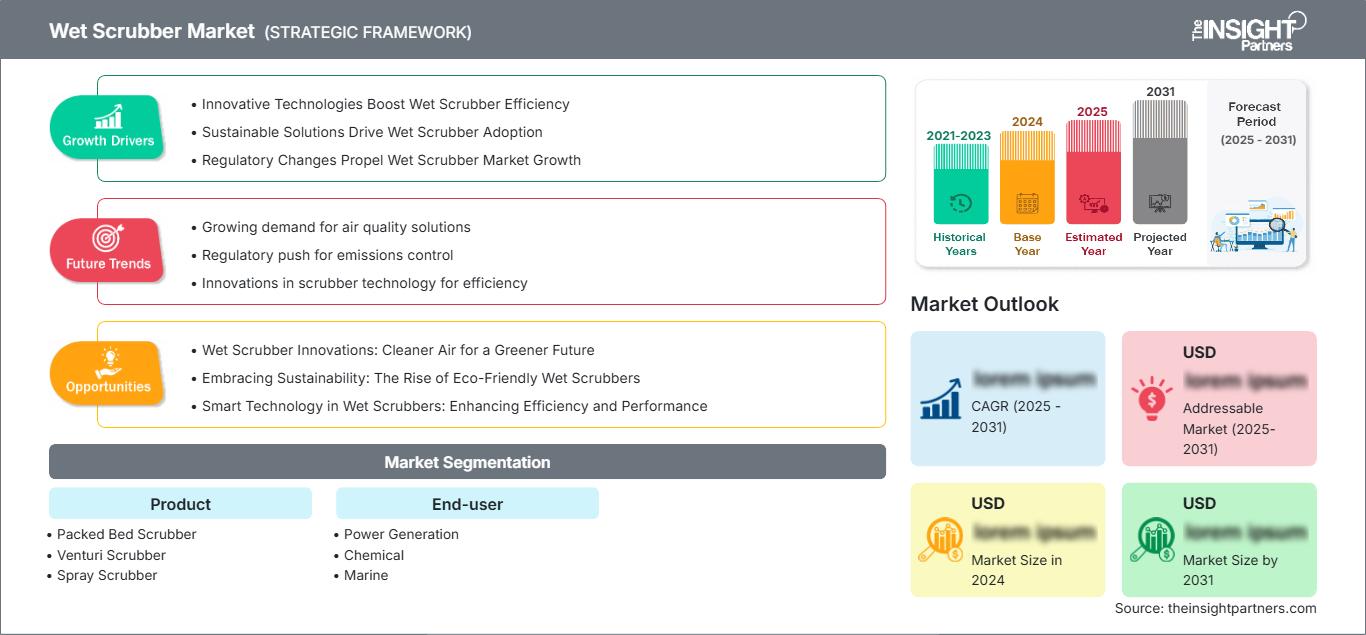
Wet Scrubber Market: Strategic Insights
Regional Insights
North America Wet Scrubber Market
North America accounted for an estimated 27–31% share of the global wet scrubber market revenue in 2025 and is projected to grow at a 4.9–5.4% CAGR through 2034. The area enjoys the advantage of mature industrial infrastructure, robust environmental licensing procedures, and constant investments to improve emission controls. Market needs are split between refining, chemical production, power generation, pulp and paper production, cement production, and marine operations. The replacement of legacy equipment becomes important where facilities need more reliability, less pressure drop, corrosion protection, and monitoring. The market players are considering the installation of scrubbers as part of the multi-pollutant control solution rather than separate pollution control equipment. The US is the main source of demand with an extensive industrial base and many regulations. Canada is also involved in terms of resource processing, chemical production, and pulp and paper. Mexico also provides a lot of potential due to the development of manufacturing capabilities.
U.S. Wet Scrubber Market
The US represented approximately 52–57% of North America's wet scrubber market share in 2025 and is projected to expand at a 5.1–5.6% CAGR through 2034. Its installed base spans power generation, refineries, chemical processing, cement, metals, and industrial manufacturing, creating recurring demand for retrofit and replacement projects. The regulatory framework promotes the ability of operators to deliver consistent pollutant control results and record operational data. Venturi scrubbers will be pertinent in cases where fine particulate capture is vital, whereas packed scrubbers will still play an important role in absorption processes that require the use of soluble gases. Local suppliers who have the capacity to undertake engineering and servicing operations can help in reducing the timelines for projects and assist in plant turnaround services. There are also opportunities in the marine field due to the requirement for exhaust gas cleaning, especially for ships operating under sulfur control schemes.
Europe Wet Scrubber Market
Europe represented an estimated 29–33% share of the global wet scrubber market revenue in 2025 and is forecast to grow at a 4.2–4.8% CAGR through 2034. Germany is a prime market due to its highly industrialized nature, along with a focus on state-of-the-art emissions control technology. The United Kingdom continues to show a market for the product range within chemicals, refineries, waste handling, and power industries, with France helping through industrialization and environmental regulation. Italy and Spain have demand from the construction of cement, chemical, manufacturing, and power plants. Across the region, the operators are more concerned with less water usage, efficient reagent utilization, anti-corrosive material, and monitoring systems. Decarbonizing of the industry helps in encouraging technologies that make the exhaust ready for further processing stages. The demand within the marine segment is strong since European shipping and ports are operating under strict emissions rules, which allow the use of hybrid and closed loop configurations under discharge restrictions.
APAC Wet Scrubber Market
APAC represented approximately 24–28% of global market revenue in 2025 and is projected to grow at a 5.2–5.8% CAGR through 2034. China leads regional demand, supported by industrial production and environmental infrastructure, while Japan and South Korea contribute through mature manufacturing and marine industries. India is becoming increasingly important as chemicals, cement, refining, and power investments expand. Australia contributes through resource processing and energy-related applications. Policy-driven air-quality improvements, industrial modernization, and tighter emissions requirements support adoption. Suppliers with local manufacturing and service capabilities can benefit from diverse project requirements and shorter delivery expectations.
Middle East & Africa Wet Scrubber Market
The Middle East & Africa is expected to record a 4.7–5.2% CAGR through 2034, with Saudi Arabia leading regional demand as refining, petrochemicals, power, and industrial diversification projects progress. UAE supplies through the marine, refining and infrastructure sectors, while South Africa helps meet demand from the power, minerals, chemicals, and manufacturing sectors. There are select MEA countries where the growth of industry overlaps with the requirements of emissions control. High-energy requirements, refineries' upgrades and new infrastructure generate demand for sturdy equipment that can withstand hot environment, corrosive substances and pollutants of different kinds. Economics of projects continues to be dictated by availability of water and availability of reagents, thus, water recycling, efficient liquid recycling and resistance to corrosion become more and more relevant. Regional buyers value those suppliers who are able to provide not only equipment but also services of engineering, installation, spare parts and maintenance.
Segmentation Analysis
Product
Product selection in the market is determined by pollutant characteristics, gas flow, required removal efficiency, pressure-drop tolerance, liquid chemistry, and operating temperature. The segment is projected to grow at a 4.3–4.8% CAGR during 2026–2034, with packed systems retaining broad absorption applications while venturi designs gain importance in demanding particulate-control duties. Current Wet Scrubber Market trends indicate increasing adoption of application-specific scrubber configurations that balance removal efficiency, operational reliability, water consumption, and compliance with evolving industrial emissions standards.
- Packed Bed Scrubber: Packed configurations provide extensive gas-liquid contact and are widely suited to the absorption of soluble gases. Their relatively low pressure-drop characteristics support continuous industrial applications where energy efficiency and stable chemical absorption are important.
- Venturi Scrubber: Venturi systems create high-energy gas-liquid contact and are strategically important for fine particulate capture and combined gas-particle treatment. EPA data indicates venturi collection performance can exceed 99% under appropriate operating conditions.
- Spray Scrubber: Spray scrubbers use distributed liquid droplets to contact contaminated gas and can provide straightforward cooling, particulate capture, and absorption. Their comparatively simple configuration supports applications where moderate control performance and operational simplicity are priorities.
End-user
End-user demand in wet scrubber market is projected to expand at a 4.5–5.0% CAGR during 2026–2034, reflecting environmental compliance, production expansion, retrofit requirements, and increasing attention to process emissions. Requirements differ substantially according to fuel, pollutant composition, operating profile, and wastewater-management constraints.
- Power Generation: Power facilities use wet scrubbing for sulfur and particulate control, particularly where high-volume combustion gases require dependable flue-gas treatment. Equipment modernization increasingly emphasizes reagent efficiency, availability, and integration with broader emissions-control systems.
- Chemical: Chemical producers require flexible systems capable of handling corrosive and water-soluble gases. Material selection, absorption chemistry, emergency protection, and precise liquid distribution are strategically important because pollutant composition can vary substantially between processes.
- Marine: Marine operators use exhaust-gas cleaning systems to manage sulfur emissions while retaining fuel flexibility. Open-loop, closed-loop, and hybrid configurations address different vessel routes, water conditions, port restrictions, and operational requirements.
- Cement: Cement plants require robust gas-cleaning systems capable of handling high dust loads and acid gases. Equipment durability, abrasion resistance, pressure-drop management, and integration with particulate-control equipment strongly influence purchasing decisions.
- Refinery and Petrochemicals: Refineries and petrochemical facilities require advanced gas treatment for sulfur compounds, acid gases, particulate matter, and process-specific contaminants. Integrated absorber and wet electrostatic configurations can address multiple pollutants within compact process arrangements.
- Pulp and Paper: Pulp and paper facilities apply scrubbers to manage process gases and chemical emissions. Reliability, odor control, corrosion resistance, water reuse, and compatibility with existing mill infrastructure shape technology selection and retrofit economics.
Opportunity Snapshot
| End-user | Revenue Contribution | Trend Tag | Adoption Stage |
| Power Generation | High | SOx Control | Mature |
| Chemical | High | Acid Gas | Mature |
| Marine | Medium | Hybrid Scrubbing | Scaling |
| Cement | High | Flue Gas | Mature |
| Refinery and Petrochemicals | High | Multi-Pollutant | Scaling |
| Pulp and Paper | Medium | Odor Control | Scaling |
Wet Scrubber Market Growth Drivers and Impact Analysis
Stricter Multi-Pollutant Emission Requirements
The regulatory compliance now includes a combination of sulfur oxides, particulate matter, acid gases, and hazardous emissions instead of focusing only on a single control mechanism. Such an aspect increases the importance of wet scrubbing since it enables the simultaneous treatment of the pollutants using a single process. The EPA guidelines suggest that wet scrubbers can be effective in controlling both pollutants in an appropriate configuration, while the gaseous absorbers have a removal efficiency of more than 90% for most pollutants. The practical implication in terms of cost is huge since industries can decrease the number of treatment steps required and use wet scrubbing in combination with other systems.
Industrial Asset Modernization and Retrofit Demand
An extensive installed base of equipment used in industries for controlling pollution calls for regular renewal, replacement, and improvement. Old scrubbers may suffer from problems such as corrosion, nozzle clogging, scaling, poor distribution of liquids, or bad mist elimination, which makes them a good subject for renovation instead of total reconstruction. Possible solutions may include replacement of the interior, installation of better pumps, controls, spraying, or demister design. The presence of engineering databases and field services becomes beneficial here as each particular retrofitting is dependent on existing ductwork, fan capacity, available structural space, and process variables. The effect goes further than just the original equipment sale by generating additional demand for parts, inspection services, instrumentation, water treatment, and service contracts. It also becomes important to estimate the life cycle costs of upgrades.
Expansion of Fuel and Process Flexibility Requirements
There is an increasing need for industrial and marine operators to look for equipment that can adapt to changing fuels, operating conditions, and locations while ensuring no reduction in emissions performance. The wet scrubbers are flexible in that their scrubber chemistry, liquid flow, contact intensity, and operating modes can be varied based on the pollutants. Marine wet scrubbers have taken advantage of this flexibility by offering open loop, closed loop, and hybrid configurations depending on the operating environment. Wärtsilä says that it has over 800 systems worldwide for the exhaust gas treatment of SOx and other pollutants. Such a level of flexibility is beneficial for investments in uncertain future fuel economy and regulations. Hence, equipment that can be modified using controls, water, filtration, or other pollutant removal modules deserves more consideration.
Wet Scrubber Market Future Trends
Digital Scrubber Performance Optimization
Future wet scrubber market trends will increasingly center on digital optimization that connects liquid-flow measurements, pressure differential, pH, reagent dosing, gas composition, and equipment health. With more advanced control systems, it is possible to make adjustments without using set points but by continuously changing operating parameters depending on emissions performance versus energy/reagents use. Data historians and predictive algorithms can help detect abnormal pressure changes, fouling of nozzles, or scaling/pump wear well in advance. When applied for marine use, digital systems are capable of comparing fuel use, routes, water parameters, and emissions performance as well. Ultimately, digital solutions must take scrubber management from an occasional check system into a condition-based one. Hardware and software vendors that offer integrated analytics services may be able to develop long-term relationships with cost-conscious customers.
Integration with Carbon Management and Heat Recovery
Another important direction is greater integration between pollutant scrubbing, carbon capture preparation, heat recovery, and broader process optimization. Flue-gas pretreatment is essential for protecting downstream carbon-capture equipment from contaminants that can degrade solvents or increase maintenance requirements. This creates an opportunity for wet scrubbing systems to become part of a sequential emissions-treatment architecture rather than an isolated control stage. Industrial operators can also recover useful thermal energy before or around gas-cleaning processes where process conditions permit. Such integration will encourage system designs with lower pressure losses, optimized gas temperatures, and more predictable contaminant loads. The long-term trend favors modular platforms that can accommodate additional treatment technologies as regulations, carbon-management strategies, and plant economics evolve without requiring wholesale replacement of existing equipment.
Wet Scrubber Market Opportunities
Localized Manufacturing and Lifecycle Service Networks
Value creation through greater development of localized manufacturing, engineering, commissioning, and aftermarket services is possible for suppliers. There is a need for fast delivery of replacement nozzles, pumps, mist eliminators, instrumentation, and other corrosion-resistant materials, since sudden scrapping of the system will result in loss of production time. This will help to reduce the time needed for delivery and at the same time will give suppliers an option to modify equipment according to the processes and requirements of the region. Cooperation with engineering contractors and maintenance companies will further assist in gaining access to projects. Such an approach would be more applicable in Asia Pacific and the Middle East, where new capacities are being built amid tougher regulations on emissions. The service-led business model will also allow creating revenue streams from inspections, performance reviews, maintenance contracts, optimizations, and upgrades of equipment.
Water Management and Resource-Efficient Scrubbing
Availability of water and wastewater treatments has become an increasingly critical factor for scrubber purchases, especially in areas of water shortage for industries. Suppliers can stand out by virtue of lower consumption rates of water, efficient recirculation, effective solid separations, and treatments that will allow partial or more reuse of water. The closed-loop system may appear ideal, where discharging is not possible due to environmental laws or conditions. Efficient systems will assist clients with their consumption of reagents and the cost of sludge production. The business potential includes the sale of monitoring systems capable of assessing water quality, pH value, suspended solids, and the need for blowdown. Suppliers capable of offering systems that offer water savings and lower consumption of other consumables will make projects economical and help industrialists to achieve their environmental goals.
Frequently Asked Questions

- Comprehensive Market Sizing and Forecast Analysis
- Detailed Segmentation Analysis
- In-Depth Market Dynamics Assessment
- Regional and Country-Level Insights
- Competitive Landscape and Company Benchmarking
- Strategic Business Intelligence
Recent Reports
Testimonials

The Insight Partners' SCADA System Market report is comprehensive, with valuable insights on current trends and future forecasts. The team was highly professional, responsive, and supportive throughout. We are very satisfied and highly recommend their services.
RAN KEDEM Partner, Reali Technologies LTDs
I requested a report on a very specific software market and the team produced the report in a few days. The information was very relevant and well presented. I then requested some changes and additions to the report. The team was again very responsive and I got the final report in less than a week.
JEAN-HERVE JENN Chairman, Future Analytica
We worked with The Insight Partners for an important market study and forecast. They gave us clear insights into opportunities and risks, which helped shape our plans. Their research was easy to use and based on solid data. It helped us make smart, confident decisions. We highly recommend them.
PIYUSH NAGPAL Sr. Vice President, High Beam Global
The Insight Partners delivered insightful, well-structured market research with strong domain expertise. Their team was professional and responsive throughout. The user-friendly website made accessing industry reports seamless. We highly recommend them for reliable, high-quality research services
YUKIHIKO ADACHI CEO, Deep Blue, LLC.
This is the first time I have purchased a market report from The Insight Partners.While I was unsure at first, I visited their web site and felt more comfortable to take the risk and purchase a market report.I am completely satisfied with the quality of the report and customer service. I had several questions and comments with the initial report, but after a couple of dialogs over email with their analyst I believe I have a report that I can use as input to our strategic planning process.Thank you so much for taking the extra time and making this a positive experience.I will definitely recommend your service to others and you will be my first call when we need further market data.
JOHN SUZUKI President and Chief Executive Officer, Board Director, BK Technologies
I wish to appreciate your support and the professionalism you displayed in the course of attending to my request for information regarding to infectious disease IVD market in Nigeria. I appreciate your patience, your guidance, and the fact that you were willing to offer a discount, which eventually made it possible for us to close a deal. I look forward to engaging The Insight Partners in the future, all thanks to the impression you have created in me as a result of this first encounter.
DR CHIJIOKE ONYIA MANAGING DIRECTOR, PineCrest Healthcare Ltd.Reason to Buy
- Informed Decision-Making
- Understanding Market Dynamics
- Competitive Analysis
- Identifying Emerging Markets
- Customer Insights
- Market Forecasts
- Risk Mitigation
- Boosting Operational Efficiency
- Strategic Planning
- Investment Justification
- Tracking Industry Innovations
- Aligning with Regulatory Trends





 Get Free Sample for