
WiFi 6 Device Market Trends, Share & Demand by 2034
Coverage: By Solution (Component, Services); Industry (Manufcaturing, Retail, Healthcare, Government, Transportation, Others); End User (Consumer, Enterprises) , and Geography (North America, Europe, Asia Pacific, and South and Central America)
- Status : Data Released
- Report Code : TIPRE00021432
- Category : Electronics and Semiconductor
- No. of Pages : 150
- Available Report Formats :


- Last update date : September 28, 2026


2025 Market Size
US$ 9.96 Bn
Base year value
2034 Forecast
US$ 115.2 Bn
Projected by 2034
CAGR 2026-2034
31.26 %
Growth rate
Addressable Market
US$ 441.90 Bn
(2026-2034)
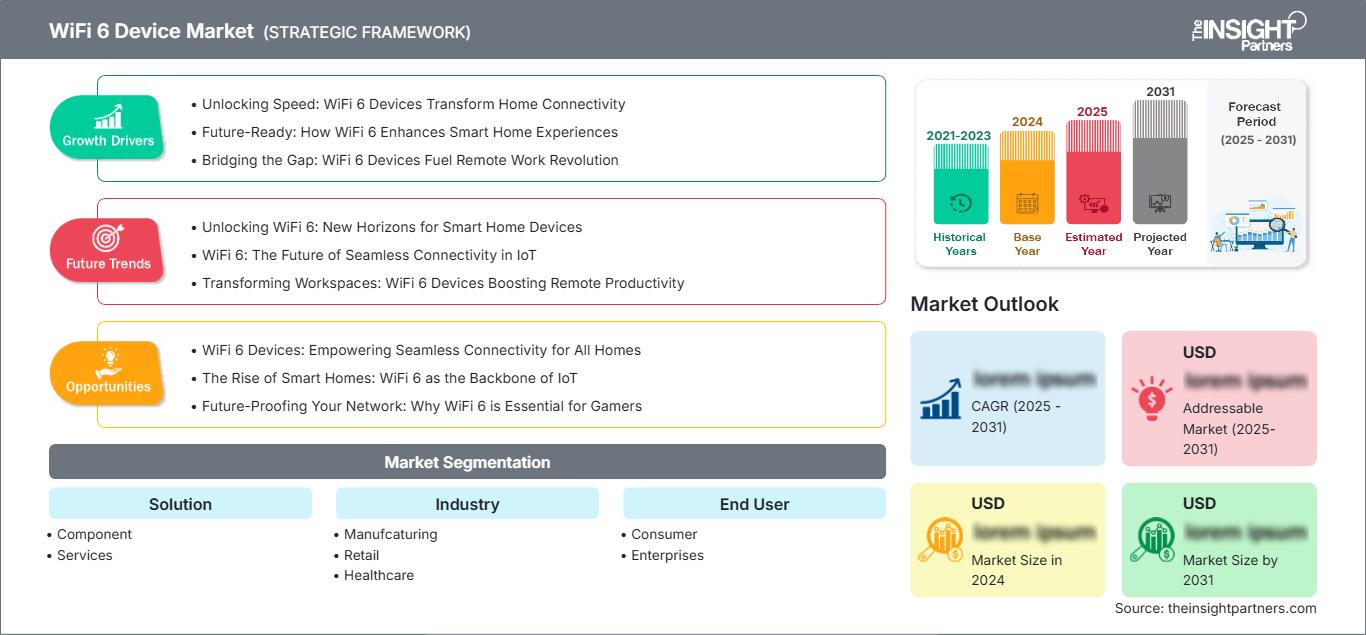
The wifi 6 device market was valued at US$ 9.96 Billion in 2025 and is projected to reach US$ 115.2 Billion by 2034, registering a CAGR of 31.26% during 2026–2034. The market encompasses Wi-Fi 6-enabled devices and associated solutions serving consumer and enterprise connectivity requirements. Expansion is supported by increasing connected-device density, higher bandwidth requirements, industrial digitization, and the transition toward intelligent wireless infrastructure across diverse operating environments.
North America remains a structurally important market, with the wifi 6 device market size expected to expand at an estimated 28–31% CAGR during 2026–2034. Accelerating enterprise wireless upgrades, widespread cloud adoption, and continued deployment of high-capacity connectivity across healthcare, manufacturing, retail, and transportation are strengthening replacement demand and supporting broader Wi-Fi 6 adoption.
WiFi 6 Device Market Assessment and Insights
- North America commands an estimated 32–36% share in 2025 and is projected to grow at a CAGR of 28–31% between 2026–2034, supported by enterprise modernization, high device density, and established wireless infrastructure.
- US represents approximately 72–76% of North American demand in 2025 and is expected to expand at a CAGR of 28–31% through 2034, driven by cloud networking and digital workplace investments.
- Europe accounts for approximately 27–30% share in 2025 and is expected to register a 29–32% CAGR between 2026–2034, led by Germany, the UK, France, Italy, and Spain.
- Asia Pacific holds approximately 25–29% share in 2025 and is forecast to grow at a CAGR of 34–37% during 2026–2034, led by China, Japan, South Korea, and India.
- Largest Segment: Enterprises within End User, estimated at a 55–59% market share in 2025 and projected to grow at a 32–35% CAGR during 2026–2034.
- High Growth Segment: Services within Solution, estimated at an 18–22% market share in 2025 and expected to expand at a 34–38% CAGR between 2026–2034.
- Key companies analyzed in detail: ADTRAN, Inc.; Aerohive Networks, Inc.; Aruba Networks, Inc.; Cambium Networks Corporation; Cisco Systems, Inc.; CommScope, Inc.; Extreme Networks, Inc.; Fortinet, Inc.; Huawei Technologies Co., Ltd.; Qualcomm Incorporated; Hewlett Packard Enterprise Company; MediaTek Inc.
Source: The Insight Partners' analysis based on proprietary research, government publications, company annual reports, investor presentations, industry databases, and expert interviews.
The technology has evolved from basic wireless access toward coordinated, high-density connectivity capable of supporting numerous endpoints, cloud applications, industrial sensors, video workloads, and mobility services. Wi-Fi 6 introduces OFDMA, improved MU-MIMO, Target Wake Time, and enhanced scheduling, enabling more efficient spectrum utilization. Device manufacturers increasingly integrate these capabilities into access points, gateways, smartphones, computers, industrial equipment, and connected consumer products, broadening the addressable ecosystem.
Over the forecast period, investment is expected to shift toward managed wireless architectures, intelligent network controls, and infrastructure capable of supporting Wi-Fi 6 alongside newer generations. Emerging economies are particularly relevant as fiber broadband, smart manufacturing, digital healthcare, and public connectivity programs expand. The WiFi 6 Device Market report highlights that spectrum policy, enterprise cybersecurity requirements, and the increasing need for predictable wireless performance should reinforce adoption, while installed Wi-Fi 5 equipment creates a substantial replacement opportunity.
WiFi 6 Device Market Report Scope
| Report Attribute | Details |
|---|---|
| Market size in 2025 | US$ 9.96 Billion |
| Market Size by 2034 | US$ 115.2 Billion |
| Global CAGR (2026 - 2034) | 31.26% |
| Historical Data | 2021-2024 |
| Forecast period | 2026-2034 |
WiFi 6 Device Market Analysis
The wifi 6 device market growth is being shaped by rising endpoint density and the need to maintain reliable performance under simultaneous connections. Organizations need wireless networks that can provide connectivity to video collaboration tools, cloud-based services, devices and machinery, portable terminals, and IoT sensors without an equally proportional increase in network complexity. Value chain includes chipmakers, device makers, network infrastructure companies, software firms, system integrators, telecoms, and managed services firms.
The supply side is becoming more driven by factors such as chipset, radio frequency component, semiconductor packaging, and platform interoperability. Qualcomm and MediaTek provide silicon for connectivity, while Cisco, Aruba Networks, Huawei, Extreme Networks, Cambium Networks, and CommScope provide the network infrastructure. Broadband, cloud, security, and analytics environment is provided by telecoms and system integrators.
Competitive positioning increasingly depends on integrated management rather than access-point specifications alone. The wifi 6 device market analysis therefore, considers vendors according to hardware breadth, software intelligence, security integration, channel reach, and deployment economics. Cisco integrates features from enterprise networking, security, and observability, but Aruba Networks focuses on campus and edge networking. Extreme Networks has built up its cloud-based management and AI assistance, while Fortinet combines wireless access with its security framework.
The trends of investments point towards platforms that cut operational complexity and simplify multi-location management. Huawei has a solid presence in enterprise networking ecosystems, but Qualcomm has connectivity platforms for a wide variety of devices. ADTRAN caters to the requirements of service providers and consumer connectivity, while Cambium Networks has a focus on broadband and enterprise deployments.
● REPORT CUSTOMIZATION
Tailor This Report To Align With Your Specific Business Requirements
This report can be customized to align precisely with your business objectives, scope, and target markets. Customization options include tailored segmentation, geography, competitive analysis, and strategic insights to support informed decision-making.
Customize This Report →WHAT YOU CAN ADJUST
- ● Segmentations
- ● Geography
- ● Competitive Analysis
- ● Language Preferences
WiFi 6 Device Market: Strategic Insights
Regional Insights
North America wifi 6 device market
North America represented approximately 32–36% of global WiFi 6 Device Market demand in 2025 and is projected to grow at a 28–31% CAGR during 2026–2034. This region enjoys advanced broadband infrastructure, considerable enterprise spending on IT and cloud migration. US corporations are upgrading their old wireless systems in response to the need for connected workspaces, denser campuses, automation, and more dispersed endpoints. The FCC's move to open up the 6 GHz band increased the capacity of unlicensed wireless considerably, and supported the greater ecosystem of Wi-Fi 6E and wireless of high capacity.
Canada is another important source for broadband evolution, public sector connectivity, and digital transformation within the education and healthcare sectors. Manufacturers are increasingly using wireless connectivity for mobile terminals, sensors, asset tracking, and operational technology, while retailers are setting up dense wireless systems for POS applications and inventory management. Cisco, Aruba Networks, Extreme Networks, Fortinet, CommScope, and ADTRAN are all important regional players. It is expected that this region will continue to be an important revenue generator in terms of network resilience and wireless management.
U.S. wifi 6 device Market
The US accounted for approximately 72–76% of North American WiFi 6 Device Market demand in 2025 and is expected to expand at a 28–31% CAGR through 2034. Enabling adoption factors include large enterprise campus facilities, technology-based industries, wide broadband accessibility, and high need for cloud-managed networks. Various manufacturing, healthcare, retail, educational, and governmental entities are increasingly adopting wireless capabilities that can cater to dense endpoints and applications.
Examples of applications include connected warehouses, clinical mobile devices, smart classrooms, distributed offices, and wireless industrial equipment. Cisco Systems Inc., Aruba Networks, Extreme Networks Inc., Fortinet Inc., CommScope, Inc., Qualcomm, and Hewlett Packard Enterprise have carved out their places in various levels of the ecosystem. Developments in regulation related to spectrum use will continue to impact product designs and the economics of deployment. Enterprises will be considering lifecycle costs, cybersecurity, and automation in addition to the traditional approach of access points.
Europe wifi 6 device Market
Europe held approximately 27–30% of the global WiFi 6 Device Market demand in 2025 and is forecast to register a 29–32% CAGR through 2034. Germany is a leading market because industrial automation, connected factories, logistics digitization, and automotive manufacturing create strong requirements for dependable wireless connectivity. These benefits for the UK include cloud computing, smart buildings, educational innovations, and public services driven by digitization. At the same time, business needs for security dictate the deployment of managed wireless networks.
In France, adoption is growing in the sphere of public infrastructure, manufacturing, transport, and health care, with network modernization becoming more frequently associated with cybersecurity and digital sovereignty goals. Italy is being assisted by manufacturing innovations, retail modernization, and the development of connected industrial environments. Spain is benefiting from the creation of smart cities, tourism infrastructure, logistics, and increasing digital workplace requirements. Germany remains the leader in Europe, while European focus on cyber security, interoperability, energy efficiency, and data security impacts procurement.
APAC wifi 6 device Market
APAC is estimated to account for 25–29% of global WiFi 6 Device Market demand in 2025 and is expected to record a 34–37% CAGR through 2034. China drives the regional uptake of IoT through massive manufacturing scale, enterprise digitization, and local network infrastructure. Japan and South Korea get help from their sophisticated electronics, automobiles, robotics, and industrial automation industries, whereas India receives assistance from its growing broadband infrastructure, digital public sector, and enterprise IT investments.
Australia brings in contributions from its smart infrastructure, educational institutions, healthcare, and enterprise cloud computing. Dense wireless coverage is becoming increasingly necessary for regional manufacturers for purposes of automation, mobility, and connectivity of their production equipment. The need for digitalization and industrialization will continue to drive demand in the region.
Middle East & Africa wifi 6 device Market
The Middle East and Africa WiFi 6 Device Market demand is supported by smart-city development, digital government programs, enterprise modernization, and investments in telecommunications infrastructure. Saudi Arabia and the UAE are major markets due to the need for wireless connectivity in urban areas and digital transformation projects. South Africa is a significant African market via enterprise digitization, education, health care, and industries. Demand from the rest of the MEA is increasing gradually due to better broadband penetration and cloud services. The region is expected to register 27%–30% CAGR in 2026–2034, with the UAE and Saudi Arabia continuing to be market leaders.
Segmentation Analysis
Solution
Solution remains the central technology layer, covering Components and Services. The segment is projected to grow at a 32–36% CAGR during 2026–2034 as customers increasingly purchase integrated connectivity, management, security, and lifecycle capabilities. Hardware remains foundational, while services gain importance as organizations seek predictable performance and simplified network administration. According to the WiFi 6 Device Market forecast, demand will increasingly favor integrated solutions that combine advanced connectivity, centralized management, cybersecurity features, and ongoing support services to improve network performance and operational efficiency.
- Component: Components include access points, gateways, wireless chipsets, antennas, controllers, and related connectivity hardware. Demand is closely linked to endpoint density, broadband upgrades, enterprise refresh cycles, and the need for higher capacity across homes and business environments.
- Services: Services encompass deployment, integration, management, support, maintenance, optimization, and managed connectivity. Their strategic importance is increasing as multi-site enterprises seek centralized operations, automated monitoring, security integration, and lower internal network-management workloads.
Industry
Industry is projected to expand at a 30–34% CAGR during 2026–2034 as wireless connectivity becomes embedded in operational environments. Demand differs by endpoint density, regulatory requirements, application criticality, and the degree of digital transformation undertaken by each vertical. Current WiFi 6 Device Market trends indicate growing adoption across industries as organizations invest in higher-capacity networks, lower-latency connectivity, enhanced security features, and infrastructure capable of supporting increasing numbers of connected devices and data-intensive applications.
- Manufcaturing: Manufacturing applications emphasize reliable wireless mobility for connected equipment, sensors, robotics, handheld terminals, and production monitoring. Adoption is strengthened by industrial automation and the movement toward increasingly software-defined production environments.
- Retail: Retail deployments support point-of-sale systems, inventory tracking, customer connectivity, digital signage, handheld devices, and analytics. Multi-location operators value centralized management and predictable performance across stores, warehouses, and distribution facilities.
- Healthcare: Healthcare environments require secure and resilient connectivity for clinical mobility, connected medical equipment, digital records, telehealth applications, and location-enabled workflows. Reliability and cybersecurity remain decisive purchasing considerations.
- Government: Government adoption is associated with smart facilities, public connectivity, secure campuses, digital services, and modernization of administrative infrastructure. Procurement increasingly considers cybersecurity, lifecycle support, interoperability, and operational resilience.
- Transportation: Transportation applications include airports, rail facilities, logistics centers, ports, fleet operations, and passenger services. High mobility, dense endpoint populations, and real-time operational requirements create demand for dependable wireless infrastructure.
End User
End User is expected to grow at a 31–35% CAGR during 2026–2034, with enterprises representing the largest demand base. Consumer adoption remains significant because smartphones, computers, routers, smart-home products, and connected electronics increasingly incorporate Wi-Fi 6 capabilities. The WiFi 6 Device Market is being driven by expanding enterprise network modernization initiatives and growing consumer demand for high-speed, low-latency wireless connectivity across an increasingly connected digital ecosystem.
- Consumer: Consumer deployments are driven by connected households, broadband upgrades, gaming, streaming, smart-home ecosystems, and increasing device density. Buyers increasingly expect seamless connectivity across smartphones, televisions, computers, appliances, and other endpoints.
- Enterprises: Enterprise demand is supported by cloud applications, distributed workforces, industrial IoT, connected campuses, cybersecurity requirements, and operational digitization. Organizations increasingly prioritize centrally managed infrastructure with measurable performance and lifecycle visibility.
Opportunity Snapshot
| End User | Revenue Contribution | Trend Tag | Adoption Stage |
| Consumer | Medium | Smart Homes | Scaling |
| Enterprises | High | Industrial Wireless | Scaling |
WiFi 6 Device Market Growth Drivers and Impact Analysis
Increasing Endpoint Density and Wireless Traffic
The expansion of connected endpoints is increasing pressure on organizations to improve wireless capacity without creating excessive infrastructure complexity. Smartphones, laptops, sensors, handheld terminals, cameras, appliances, and industrial devices increasingly operate concurrently within the same environments. Wi-Fi 6 addresses this pressure through technologies such as OFDMA, uplink and downlink MU-MIMO, spatial reuse, and Target Wake Time. The resulting efficiency is particularly relevant to offices, hospitals, warehouses, factories, educational campuses, and high-density residential environments. As endpoint populations rise, replacement decisions increasingly consider simultaneous connection handling rather than headline throughput alone. This driver expands demand across both access infrastructure and compatible client devices, while encouraging vendors to integrate management, analytics, and security capabilities into broader wireless platforms.
Enterprise Digital Transformation and Industrial Connectivity
Enterprise digitalization is shifting wireless networks from supporting general internet access toward enabling operational workflows. Manufacturing facilities use connected sensors, mobile terminals, robotics, and asset-monitoring systems, while retailers connect inventory devices, payment infrastructure, and customer-facing applications. Healthcare organizations require connectivity for mobile clinical equipment, digital records, and location-aware workflows. The WHO's continued global digital-health strategy highlights the importance of connectivity, interoperability, and technological infrastructure in transforming health systems. This creates a structural requirement for reliable wireless environments rather than temporary connectivity solutions. As organizations digitize operational processes, wireless infrastructure becomes increasingly integrated with cloud platforms, cybersecurity systems, analytics tools, and enterprise applications, supporting sustained replacement and expansion demand.
Expansion of High-Capacity Broadband and Spectrum Availability
Broadband upgrades are increasing the performance expectations placed on in-home and enterprise wireless devices. Fiber deployments, multigigabit access services, cloud applications, high-resolution media, and real-time collaboration require wireless networks capable of distributing greater bandwidth throughout buildings. Spectrum policy is also important. In the US, the FCC's 6 GHz allocation nearly tripled the amount of unlicensed bandwidth available for Wi-Fi, encouraging innovation across Wi-Fi 6E and related technologies. Service providers consequently have stronger incentives to replace aging gateways and routers, while enterprises can justify infrastructure upgrades through improved capacity and application performance. This driver links broadband economics with device refresh cycles and expands opportunities for vendors offering integrated hardware, software, and managed services.
WiFi 6 Device Market Future Trends
AI-Assisted Wireless Network Operations
Artificial intelligence is expected to become increasingly embedded in wireless management, changing how networks identify congestion, predict failures, allocate resources, and optimize application performance. Future platforms will combine telemetry from access points, endpoints, security systems, and cloud applications to automate troubleshooting and prioritize mission-critical traffic. This evolution should reduce dependence on manual configuration and help enterprises operate increasingly complex wireless environments with smaller IT teams. AI-assisted systems may also identify abnormal device behavior, detect configuration drift, and recommend capacity adjustments before users experience significant degradation. The trend will favor vendors capable of combining wireless hardware with analytics, security, observability, and automation. It will also increase the strategic importance of software subscriptions and managed services, gradually shifting purchasing decisions from individual devices toward complete operational platforms.
Convergence of Wi-Fi Generations and Multi-Standard Devices
Wi-Fi 6 deployments will increasingly coexist with Wi-Fi 6E, Wi-Fi 7, and emerging generations rather than being replaced immediately. Organizations with long asset lifecycles will operate mixed environments in which different endpoints require different performance levels, spectrum bands, and security capabilities. This will encourage vendors to develop flexible access points and gateways that can support multiple operating modes while preserving centralized management. Qualcomm's progression from Wi-Fi 6 connectivity platforms toward newer generations illustrates the industry's rapid technology cadence. At the same time, many customers will continue purchasing Wi-Fi 6 devices where cost, availability, compatibility, and application requirements make newer standards unnecessary. Consequently, interoperability, backward compatibility, and lifecycle support will become increasingly important differentiators.
WiFi 6 Device Market Opportunities
Managed Wireless Services for Multi-Site Enterprises
Managed wireless services represent an attractive opportunity because enterprises increasingly operate geographically distributed facilities while maintaining limited internal networking resources. Service providers can package access points, monitoring, security, analytics, maintenance, and lifecycle replacement into recurring contracts. This model reduces upfront complexity and gives customers predictable operating costs, while vendors gain longer customer relationships and recurring revenue. Retail chains, healthcare networks, logistics operators, educational groups, and government agencies are particularly suited to standardized managed deployments because they operate multiple locations with similar requirements. The opportunity extends beyond installation because providers can continuously optimize radio performance, monitor device health, manage firmware, and integrate wireless telemetry with broader security and IT operations. This approach should increase penetration where organizations have historically delayed upgrades because of operational complexity.
Industrial Wireless Ecosystems and Private Connectivity
Industrial environments provide a substantial opportunity for vendors that can combine wireless infrastructure with operational technology, edge computing, security, and industrial applications. Factories, warehouses, ports, utilities, and transportation facilities increasingly require mobile connectivity for machines, sensors, handheld devices, cameras, and autonomous equipment. Wi-Fi 6 can serve applications where deterministic performance, capacity, and device density are more important than conventional office connectivity. Vendors can differentiate through ruggedized hardware, specialized antennas, industrial security, centralized management, and integration with automation platforms. Partnerships between network equipment providers, systems integrators, industrial software companies, and telecommunications operators can accelerate deployment by reducing integration barriers. The strongest opportunity is likely to arise where wireless connectivity becomes part of a broader operational architecture rather than a standalone network purchase.
Frequently Asked Questions

- Comprehensive Market Sizing and Forecast Analysis
- Detailed Segmentation Analysis
- In-Depth Market Dynamics Assessment
- Regional and Country-Level Insights
- Competitive Landscape and Company Benchmarking
- Strategic Business Intelligence
Recent Reports
Testimonials

The Insight Partners provided valuable market intelligence that supported our global go-to-market strategy. Their team was professional, responsive, and attentive to our feedback, providing thoughtful analysis and helpful methodological clarifications throughout the project.
Junmo Kim Chief Financial Officer (CFO), Enertech Co., Ltd.
The Insight Partners' SCADA System Market report is comprehensive, with valuable insights on current trends and future forecasts. The team was highly professional, responsive, and supportive throughout. We are very satisfied and highly recommend their services.
RAN KEDEM Partner, Reali Technologies LTDs
I requested a report on a very specific software market and the team produced the report in a few days. The information was very relevant and well presented. I then requested some changes and additions to the report. The team was again very responsive and I got the final report in less than a week.
JEAN-HERVE JENN Chairman, Future Analytica
We worked with The Insight Partners for an important market study and forecast. They gave us clear insights into opportunities and risks, which helped shape our plans. Their research was easy to use and based on solid data. It helped us make smart, confident decisions. We highly recommend them.
PIYUSH NAGPAL Sr. Vice President, High Beam Global
The Insight Partners delivered insightful, well-structured market research with strong domain expertise. Their team was professional and responsive throughout. The user-friendly website made accessing industry reports seamless. We highly recommend them for reliable, high-quality research services
YUKIHIKO ADACHI CEO, Deep Blue, LLC.
This is the first time I have purchased a market report from The Insight Partners.While I was unsure at first, I visited their web site and felt more comfortable to take the risk and purchase a market report.I am completely satisfied with the quality of the report and customer service. I had several questions and comments with the initial report, but after a couple of dialogs over email with their analyst I believe I have a report that I can use as input to our strategic planning process.Thank you so much for taking the extra time and making this a positive experience.I will definitely recommend your service to others and you will be my first call when we need further market data.
JOHN SUZUKI President and Chief Executive Officer, Board Director, BK Technologies
I wish to appreciate your support and the professionalism you displayed in the course of attending to my request for information regarding to infectious disease IVD market in Nigeria. I appreciate your patience, your guidance, and the fact that you were willing to offer a discount, which eventually made it possible for us to close a deal. I look forward to engaging The Insight Partners in the future, all thanks to the impression you have created in me as a result of this first encounter.
DR CHIJIOKE ONYIA MANAGING DIRECTOR, PineCrest Healthcare Ltd.Reason to Buy
- Informed Decision-Making
- Understanding Market Dynamics
- Competitive Analysis
- Identifying Emerging Markets
- Customer Insights
- Market Forecasts
- Risk Mitigation
- Boosting Operational Efficiency
- Strategic Planning
- Investment Justification
- Tracking Industry Innovations
- Aligning with Regulatory Trends





 Get Free Sample for