
Wireless Headphones Market Size, Trends & Growth by 2034
Coverage: By Type (Over-ear and In-ear); Distribution Channel (Multi Branded Stores, Hypermarket/Supermarket, and Online); Application (Gaming, Music & Entertainment, Fitness/Sports, and Others), and Geography (North America, Europe, Asia Pacific, and South and Central America)
- Status : Data Released
- Report Code : TIPEL00002120
- Category : Electronics and Semiconductor
- No. of Pages : 150
- Available Report Formats :


- Last update date : September 30, 2026


2025 Market Size
US$ 77.18 Bn
Base year value
2034 Forecast
US$ 233.72 Bn
Projected by 2034
CAGR 2026-2034
13.10 %
Growth rate
Addressable Market
US$ 1,351.37 Bn
(2026-2034)
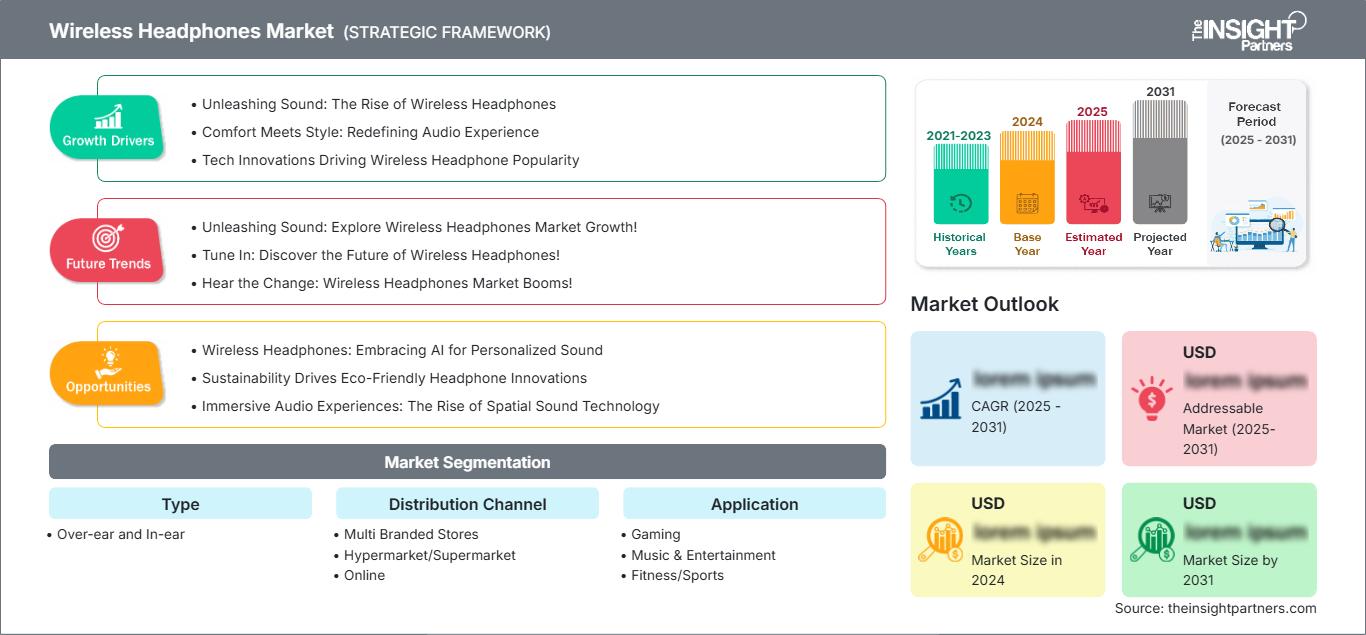
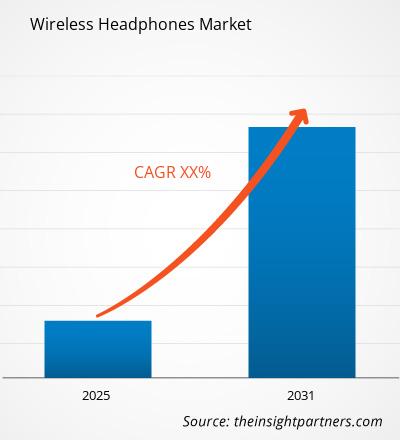
The wireless headphones market is valued at US$ 77.18 Billion in 2025 and is projected to reach US$ 233.72 Billion by 2034, expanding at a CAGR of 13.10% during 2026–2034. The market encompasses connected over-ear and in-ear audio products serving entertainment, communication, gaming, and fitness use cases. Product differentiation increasingly depends on acoustics, active noise cancellation, battery efficiency, device integration, comfort, and software-enabled personalization.
North America remains a structurally attractive region, with the wireless headphones market size supported by high smartphone penetration, premium consumer electronics adoption, and replacement demand. Regional growth is estimated at 12.2–13.2% CAGR during 2026–2034, supported by demand for advanced noise cancellation, spatial audio, seamless device switching, and increasingly sophisticated health and communication features.
Wireless Headphones Market Assessment and Insights
- North America: The region is estimated to account for 32–34% share in 2025, growing at a 12.2–13.2% CAGR between 2026–2034. Premiumization, replacement cycles, connected ecosystems, and demand for ANC support sustained adoption across consumer segments.
- US: The US is estimated to represent 76–80% of North America's 2025 market, growing at a 12.1–13.1% CAGR between 2026–2034, supported by premium earbuds, gaming peripherals, and ecosystem-led purchases.
- Europe: Europe is estimated at 27–30% share in 2025, expanding at a 12.0–13.0% CAGR between 2026–2034. Germany, the UK, France, Italy, and Spain provide strong demand through mobile entertainment, commuting, sports, and premium audio adoption.
- Asia Pacific: Asia Pacific is estimated at 30–34% share in 2025, advancing at a 14.0–15.0% CAGR between 2026–2034. China, Japan, South Korea, India, and Australia benefit from manufacturing scale, smartphone ecosystems, digital entertainment, and expanding middle-income consumption.
- Largest Segment: In-ear products are estimated to hold a 65–69% market share in 2025, with a 13.5–14.5% CAGR during 2026–2034, reflecting portability, convenience, and broad smartphone compatibility.
- High Growth Segment: Gaming applications are estimated at 18–22% market share in 2025, growing at a 15.5–16.5% CAGR during 2026–2034, supported by low-latency connectivity, immersive audio, and competitive gaming adoption.
- Key companies analyzed in detail: Sennheiser Electronic GmbH & Co. KG, Bragi GmbH, Skullcandy Inc., Bose Corporation, Apple Inc., Samsung Electronics Co., Ltd., Beats Electronics LLC, Sony Corporation, Koninklijke Philips N.V., Victor Company of Japan, Limited.
Source: The Insight Partners' analysis based on proprietary research, government publications, company annual reports, investor presentations, industry databases, and expert interviews.
From simple Bluetooth connectivity, the product architecture has evolved to include integrated computing platforms that include microphones, processors, sensors, adaptive equalization, ANC, spatial audio, and voice processing. The wireless headphones industry is consequently affected by access to semiconductors, acoustic component development, battery efficiency, firmware development, and operating system compatibility with smartphones.
Looking ahead, the nascent economies of Asia will bring about additional growth per unit, while the value pools will lie in North America and Europe. The technology push lies in computing audio, artificial intelligence voice processing, personal sound profiles, and fitness sensors. Growing regulations on sustainable battery, e-waste, radio frequency performance, and safety for consumers are also pushing for improved durability and sustainability of products.
Wireless Headphones Market Report Scope
| Report Attribute | Details |
|---|---|
| Market size in 2025 | US$ 77.18 Billion |
| Market Size by 2034 | US$ 233.72 Billion |
| Global CAGR (2026 - 2034) | 13.10% |
| Historical Data | 2021-2024 |
| Forecast period | 2026-2034 |
Wireless Headphones Market Analysis
Demand will be influenced by the convergence of smartphones, streaming services, telecommunication, gaming, and fitness activities. The development of the wireless headphones sector will be driven by customers switching from wired headphones to smaller devices that offer mobility and hands-free usage through Bluetooth connection. The industry includes players from the sectors of chips, acoustic components, batteries, original equipment manufacturers, software companies, retailers, logistics firms, and customer support services.
The supply environment is becoming more favorable for those manufacturers able to combine hardware and software competencies. Advanced chipset with capabilities like Bluetooth, low power consumption, multipoint connectivity, and spatial audio will enable brands to stand out through innovations without focusing only on the design of the product. However, contract manufacturing plays an important role in cost management in the region. Qualification of components, batteries, microphones, and firmware optimization is crucial at launch time.
The competitive environment is divided among the ecosystem leaders, audio companies, and value competitors. The competitive edge of Apple Inc. and Beats Electronics LLC is achieved owing to platform integration, whereas Samsung Electronics Co., Ltd. makes use of connectivity within its Galaxy ecosystem. Sony Corporation and Bose Corporation focus on acoustic quality and ANC, Sennheiser Electronic GmbH & Co. KG – on high-end sound engineering.
More funds are being invested into development of computational audio, AI-powered call enhancement, adaptive ANC, spatial sound, and health-oriented sensing. From the analysis of the wireless headphones market report, it becomes clear that strategic positioning is gradually moving away from the unit volumes towards ecosystem loyalty, repeatable software use, premium feature integration, and differentiation. Mobile platforms vendors are able to leverage device cross-selling capabilities, whereas specialists should be competing in acoustic expertise, industrial design, comfort, battery efficiency, and applications targeting.
● REPORT CUSTOMIZATION
Tailor This Report To Align With Your Specific Business Requirements
This report can be customized to align precisely with your business objectives, scope, and target markets. Customization options include tailored segmentation, geography, competitive analysis, and strategic insights to support informed decision-making.
Customize This Report →WHAT YOU CAN ADJUST
- ● Segmentations
- ● Geography
- ● Competitive Analysis
- ● Language Preferences
Wireless Headphones Market: Strategic Insights
Regional Insights
North America wireless headphones market
North America is projected to account for 32% to 34% wireless headphones marketshare in 2025, registering a regional CAGR of 12.2% to 13.2% over 2026-2034. High smartphone usage, high consumer spending on electronics, prevalence of streaming, and replacement are driving demand. Consumers consider noise cancellation (ANC), microphone quality, multipoint capability, spatial audio, and battery life during replacement of older products. Corporate hybrid work environment continues to drive demand for wireless communications products.
The United States represents 76% to 80% of regional value of North America in 2025, whereas Canada makes up the rest of the region's value. Music, gaming, traveling, fitness, and professional communication are all drivers of demand. The importance of premium earbuds and over-ear products cannot be underestimated since consumers prefer comfort and audio performance over the cheapest options available in the market.
U.S. wireless headphones Market
The US accounts for 76-80% of North America's 2025 market and is expected to grow with 12.1-13.1% CAGR during 2026-2034. Apple Inc., Bose Corporation, Sony Corporation, and Beats Electronics LLC have substantial market presence within premium audio segments, supported by gamer and sportspersons. The market can be defined by quick adoption of new features and constant comparisons between different models.
The diversity of applications is growing since customers utilize wireless devices while traveling, communicating, playing games, training, and entertaining. Premium ANC, spatial audio, voice isolation, and compatibility with devices are more frequently seen as default features. Presence of big players from the technology and audio industry ensures wide retail distribution, easy product discovery on-line, possibility of upgrade, and faster adoption of new connection and audio processing technologies.
Europe wireless headphones Market
Europe is forecast to hold 27-30% share in 2025 with 12.0-13.0% CAGR during 2026-2034. Germany is a key value market, and the UK, France, Italy, and Spain provide significant consumer demand. High mobile connectivity, commuting trends, streaming habits, and a preference for premium audio facilitate replacements and upgrades. Sustainability is becoming an important factor influencing buying behavior, favoring products with increased durability and extended software availability.
The UK has an established market for premium audio listeners and high demand for ANC products from commuters and travelers. Germany has a preference for engineering-related purchases in combination with widespread use of connected consumer electronic devices. France, Italy, and Spain have growing demand for applications in entertainment, fitness, and lifestyles, with online retail making it easy to compare the products. In Europe, brands will increasingly compete on comfort, energy efficiency, reparability, sound personalization, and compatibility with mobile ecosystems.
APAC wireless headphones Market
APAC is estimated to hold 30–34% share in 2025, growing at 14.0–15.0% CAGR during 2026–2034, making it the fastest-expanding major region. China leads regional demand, followed by Japan, South Korea, India, and Australia. Large-scale electronics manufacturing, rising disposable income, smartphone adoption, and strong digital entertainment ecosystems create favorable conditions.
China takes advantage of strong manufacturing base and fierce competition among brands. Japan and South Korea back high-quality audio and ecosystem-based approach. India can deliver huge volume through affordable solutions and growing premiumization trends. Australia represents mature market for premium and sport products. Local manufacturing and growth of offline channels in developing countries will improve accessibility to the category.
Middle East & Africa wireless headphones Market
Demand in the Middle East and Africa is anticipated to grow at a CAGR of 11.0–12.0% over the period 2026–2034. In the Middle East, demand for premium products is dominated by Saudi Arabia and the UAE, whereas in Africa, sub-Saharan demand is driven by South Africa. Demand drivers include tourism, smartphones, entertainment activities, and retail infrastructure development in metropolitan areas.
Premium consumer electronics retailers and international tourism boost demand in the UAE. Demand in Saudi Arabia is driven by digital transformation initiatives and entertainment growth, while consumer electronics in South Africa provide an existing base of demand. Rest of MEA consumers are more price-sensitive, and therefore, in-ear products remain significant. Energy-efficient charging, durable design, and increased online distribution could increase availability in emerging markets.
Segmentation Analysis
Type
Type segmentation is led by In-ear and supported by Over-ear products. The main segment is expected to expand at 13.2–14.1% CAGR during 2026–2034. Adoption depends on portability, comfort, battery efficiency, acoustic performance, and application-specific requirements. In-ear products benefit from compact form factors, while over-ear devices remain important for immersive listening and professional or gaming environments.
- Over-ear: Over-ear products retain strong relevance where consumers prioritize immersive sound, longer listening sessions, comfort, and powerful ANC. Their larger acoustic chambers support premium positioning across travel, entertainment, and gaming applications.
- In-ear: In-ear devices dominate everyday portability because they are lightweight, compact, and convenient for commuting, calls, fitness, and casual entertainment. Charging cases and improved fit technologies reinforce their role as everyday connected accessories.
Distribution Channel
Distribution Channel comprises Multi Branded Stores, Hypermarket/Supermarket, and Online channels and is projected to grow at 13.0–13.8% CAGR during 2026–2034. Channel strategies increasingly combine physical demonstration with digital comparison. Online purchasing supports broad assortment and price transparency, while stores remain valuable for premium audio trials, service, and immediate availability.
- Multi Branded Stores: Multi-branded outlets provide consumers with direct product comparison across acoustic profiles, comfort, pricing, and feature sets. They remain strategically relevant for premium products requiring physical evaluation before purchase.
- Hypermarket/Supermarket: Hypermarkets and supermarkets broaden access to mass-market devices through high footfall and convenient purchasing. Their role is strongest for affordable products, promotional bundles, and replacement purchases driven by everyday consumer needs.
- Online: Online channels enable extensive product discovery, reviews, specifications, promotions, and rapid fulfillment. They are particularly influential in emerging markets, where broad geographic reach helps brands scale without equivalent physical retail investment.
Application
Application includes Gaming, Music & Entertainment, and Fitness/Sports and is projected to grow at 13.8–14.7% CAGR during 2026–2034. Application-specific features increasingly influence product selection. Gaming emphasizes latency and spatial positioning, entertainment prioritizes sound quality and ANC, while fitness requires stability, sweat resistance, and reliable wireless performance.
- Gaming: Gaming demand favors low-latency wireless connections, directional audio, microphone clarity, and immersive sound. Competitive users increasingly expect synchronization between visual action and audio feedback, supporting specialized headset development.
- Music & Entertainment: Music and entertainment remain foundational applications, with consumers seeking richer codecs, adaptive equalization, spatial audio, ANC, and comfortable long-duration listening. Streaming habits support continued product replacement and premium feature adoption.
- Fitness/Sports: Fitness and sports users prioritize secure fit, durability, sweat resistance, transparency modes, and lightweight construction. Sensor integration and health-oriented functionality are expanding the strategic importance of this application.
Opportunity Snapshot
| Application | Revenue Contribution | Trend Tag | Adoption Stage |
|---|---|---|---|
| Gaming | Medium | Low Latency | Scaling |
| Music & Entertainment | High | Spatial Audio | Mature |
| Fitness/Sports | Medium | Health Sensing | Scaling |
Wireless Headphones Market Growth Drivers and Impact Analysis
Expansion of Active Noise Cancellation and Computational Audio
Active noise cancellation moves beyond premium differentiation towards increased availability due to higher efficiency and lower costs associated with processing. In turn, the above leads to an increase in demand due to better hearing and voice communication for people in public transportation, offices, gyms, and even outside. In addition to that, computational audio allows adaptive equalization, environment sensing, beamforming, and voice amplification. Such possibilities allow manufacturers to offer their products by differentiating themselves via software and not only through hardware. Thus, the attention is being paid more to algorithms, microphone arrays, chipset partnerships, and firmware updates. Companies capable of providing consistent performance in various environments will be able to retain customers better, charge a premium, and attach people to the ecosystem without relying exclusively on aesthetic product upgrades.
Growing Integration with Smartphones and Connected Ecosystems
Wireless audio products increasingly function as extensions of smartphones, tablets, watches, computers, and other connected devices. Seamless pairing, automatic switching, synchronized controls, voice assistance, spatial audio, and personalized settings make ecosystem compatibility an important purchasing factor. This integration reduces friction and increases the perceived value of remaining within a particular technology platform. Manufacturers therefore have incentives to optimize proprietary software layers, companion applications, and cross-device functionality. The commercial impact extends beyond headphone sales because a successful audio accessory can reinforce smartphone loyalty and stimulate complementary device purchases. Platform providers can also use firmware updates to introduce features after initial purchase, extending product relevance. As consumers become accustomed to connected experiences, standalone hardware differentiation becomes less sufficient without supporting software and ecosystem capabilities.
Rising Demand for Premium Features Across Emerging Consumer Markets
Premiumization is spreading beyond developed markets as consumers in emerging economies gain access to higher-value smartphones and digital subscription services. The transition does not necessarily mean a uniform move to flagship pricing. Instead, buyers increasingly seek specific premium attributes, including ANC, improved microphones, better battery life, low-latency gaming, and spatial audio, within attainable price bands. India illustrates this shift, with industry tracking in 2025 showing stronger interest in premium TWS products alongside continued value sensitivity. Manufacturers can respond through tiered portfolios that transfer selected flagship technologies into mid-range models. This approach broadens feature adoption while protecting premium differentiation. It also encourages localized assembly, regional distribution partnerships, and product configurations tailored to local price expectations, thereby creating a wider pathway from entry-level ownership to premium upgrades.
Wireless Headphones Market Future Trends
AI-Native Personal Audio and Adaptive Listening
AI is likely to transform wireless audio from a passive playback accessory into an adaptive personal interface. Future products can continuously optimize sound according to surroundings, listening behavior, speech conditions, and user preferences while maintaining low power consumption. AI-enabled microphones may improve calls by separating speech from environmental noise, while on-device processing can support privacy-sensitive features without continuously transferring audio data to cloud systems. Personalized hearing profiles may also become more sophisticated as devices learn individual listening patterns. The wireless headphones market trends will therefore increasingly reflect software capabilities, model efficiency, sensor fusion, and seamless interaction with smartphones. Vendors that combine useful AI functions with dependable battery performance and transparent controls can establish stronger differentiation than brands relying solely on incremental acoustic improvements.
Health, Translation, and Context-Aware Wearable Functions
Wireless audio devices are likely to become more closely integrated with health, communication, and contextual computing functions. Ear-worn sensors can support activity monitoring, heart-rate measurement, hearing-related personalization, and other wellness experiences when accuracy and regulatory requirements are appropriately addressed. Real-time translation is another potential growth area, particularly for travelers, international businesses, and multilingual communities. These capabilities can increase the strategic value of earbuds by expanding usage beyond entertainment. Product design will need to balance sensor integration against weight, comfort, privacy, battery life, and cost. Apple Inc. demonstrated the direction in 2025 by adding heart-rate sensing and workout-related functionality to AirPods Pro 3. Similar developments could encourage competitors to build broader software ecosystems around ear-worn devices.
Wireless Headphones Market Opportunities
Localized Product Architectures for Emerging Economies
Manufacturers have an opportunity to develop region-specific portfolios that balance premium functionality with local purchasing power. Instead of transferring flagship products unchanged across markets, vendors can select features with the strongest perceived value, such as ANC, long battery life, gaming latency, or improved call quality, and package them at competitive price points. Local assembly can further support cost management and supply-chain responsiveness. India provides an important example because industry data indicated strong online channel participation and increasing premium interest in TWS products during 2025. The wireless headphones market Forecasts should therefore account for differentiated regional pricing, local manufacturing incentives, retail structures, and consumer preferences. Companies that combine localized engineering with established global quality standards can capture upgrade demand while building stronger distribution relationships.
Enterprise and Professional Communication Expansion
Professional communication offers an underdeveloped opportunity beyond conventional consumer entertainment. Hybrid work, mobile collaboration, customer service, field operations, and remote education require reliable voice capture, noise suppression, multipoint connectivity, and long battery life. Vendors can create specialized products optimized for professional communication while retaining compatibility with mainstream devices. Software certification, device management, security controls, and fleet deployment capabilities can provide additional differentiation for business customers. This opportunity is particularly relevant where organizations operate distributed workforces and need consistent audio performance across varied environments. Manufacturers can also develop service models around firmware management, replacement cycles, accessories, and enterprise support. Such approaches can diversify revenue sources and reduce dependence on seasonal consumer launches while increasing the lifetime value of commercial customers.
Frequently Asked Questions

- Comprehensive Market Sizing and Forecast Analysis
- Detailed Segmentation Analysis
- In-Depth Market Dynamics Assessment
- Regional and Country-Level Insights
- Competitive Landscape and Company Benchmarking
- Strategic Business Intelligence
Recent Reports
Testimonials

The Insight Partners' SCADA System Market report is comprehensive, with valuable insights on current trends and future forecasts. The team was highly professional, responsive, and supportive throughout. We are very satisfied and highly recommend their services.
RAN KEDEM Partner, Reali Technologies LTDs
I requested a report on a very specific software market and the team produced the report in a few days. The information was very relevant and well presented. I then requested some changes and additions to the report. The team was again very responsive and I got the final report in less than a week.
JEAN-HERVE JENN Chairman, Future Analytica
We worked with The Insight Partners for an important market study and forecast. They gave us clear insights into opportunities and risks, which helped shape our plans. Their research was easy to use and based on solid data. It helped us make smart, confident decisions. We highly recommend them.
PIYUSH NAGPAL Sr. Vice President, High Beam Global
The Insight Partners delivered insightful, well-structured market research with strong domain expertise. Their team was professional and responsive throughout. The user-friendly website made accessing industry reports seamless. We highly recommend them for reliable, high-quality research services
YUKIHIKO ADACHI CEO, Deep Blue, LLC.
This is the first time I have purchased a market report from The Insight Partners.While I was unsure at first, I visited their web site and felt more comfortable to take the risk and purchase a market report.I am completely satisfied with the quality of the report and customer service. I had several questions and comments with the initial report, but after a couple of dialogs over email with their analyst I believe I have a report that I can use as input to our strategic planning process.Thank you so much for taking the extra time and making this a positive experience.I will definitely recommend your service to others and you will be my first call when we need further market data.
JOHN SUZUKI President and Chief Executive Officer, Board Director, BK Technologies
I wish to appreciate your support and the professionalism you displayed in the course of attending to my request for information regarding to infectious disease IVD market in Nigeria. I appreciate your patience, your guidance, and the fact that you were willing to offer a discount, which eventually made it possible for us to close a deal. I look forward to engaging The Insight Partners in the future, all thanks to the impression you have created in me as a result of this first encounter.
DR CHIJIOKE ONYIA MANAGING DIRECTOR, PineCrest Healthcare Ltd.Reason to Buy
- Informed Decision-Making
- Understanding Market Dynamics
- Competitive Analysis
- Identifying Emerging Markets
- Customer Insights
- Market Forecasts
- Risk Mitigation
- Boosting Operational Efficiency
- Strategic Planning
- Investment Justification
- Tracking Industry Innovations
- Aligning with Regulatory Trends





 Get Free Sample for