
Wireless Keyboard Market Growth, Share & Trends by 2034
Coverage: by Technology (Radio Frequency, Bluetooth, Infrared); Application (Desktop, Laptop, Smart TV, Others) , and Geography (North America, Europe, Asia Pacific, and South and Central America)
- Status : Data Released
- Report Code : TIPRE00011512
- Category : Electronics and Semiconductor
- No. of Pages : 150
- Available Report Formats :


- Last update date : September 28, 2026


2025 Market Size
US$ 4.82 Bn
Base year value
2034 Forecast
US$ 8.06 Bn
Projected by 2034
CAGR 2026-2034
5.88 %
Growth rate
Addressable Market
US$ 58.35 Bn
(2026-2034)
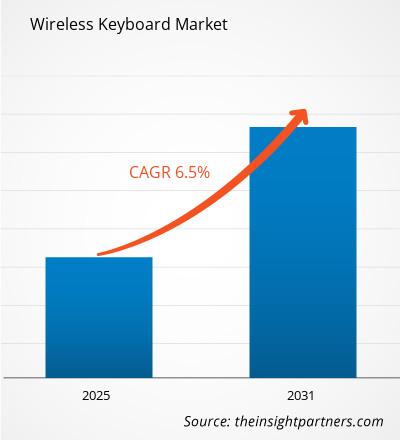
The global Wireless Keyboard market was valued at US$ 4.82 billion in 2025 and is expected to reach US$ 8.06 billion by 2034; it is estimated to record a CAGR of 5.88% during 2026-2034.
Wireless Keyboard Market Assessment and Insights
- North America is estimated at 31–35% share in 2025 and a 5.8–6.6% CAGR between 2026–2034, supported by enterprise refreshes and hybrid work.
- US represents 76–80% of North American revenue in 2025, growing at a 5.9–6.7% CAGR between 2026–2034 through corporate and home computing.
- Europe is estimated at 25–29% share in 2025 and a 5.6–6.4% CAGR between 2026–2034, led by Germany, the UK, France, Italy, and Spain.
- Asia Pacific is estimated at 28–32% share in 2025 and a 7.2–8.0% CAGR between 2026–2034, led by China, Japan, South Korea, and India.
- Largest Segment: Bluetooth technology, estimated at 54–58% market share in 2025 and a 7.0–7.8% CAGR during 2026–2034, reflecting compatibility.
- High Growth Segment: Smart TV application, estimated at 9–12% market share in 2025 and an 8.0–9.0% CAGR during 2026–2034, supported by connected entertainment.
- Key companies analyzed in detail: Adesso Inc.; ASUSTeK Computer Inc.; Dell Technologies Inc.; HP Development Company, L.P.; Lenovo Group Limited; Logitech International S.A.; Microsoft Corporation; Rapoo Corporation; Razer Inc.; Samsung Electronics Co., Ltd.
Source: The Insight Partners' analysis based on proprietary research, government publications, company annual reports, investor presentations, industry databases, and expert interviews.
The market has evolved from cable replacement products into a differentiated peripheral category combining connectivity, ergonomics, battery management, multi-device control, and design. Radio-frequency solutions remain relevant where dedicated receivers and predictable links are valued, while Bluetooth benefits from native support across laptops, tablets, televisions, and other platforms. Production increasingly emphasizes low-power controllers, rechargeable cells, and compact structures.
Looking ahead, suppliers are likely to focus on interoperable multi-device products, regional channel expansion, and higher-value ergonomic designs. Asia-Pacific offers manufacturing and consumption advantages, while North America and Europe provide stronger premiumization opportunities. Regulatory attention to batteries, electronic waste, radio interoperability, and energy efficiency can influence design and replacement economics.
Wireless Keyboard Market Report Scope
| Report Attribute | Details |
|---|---|
| Market size in 2025 | US$ 4.82 Billion |
| Market Size by 2034 | US$ 8.06 Billion |
| Global CAGR (2026 - 2034) | 5.88% |
| Historical Data | 2021-2024 |
| Forecast period | 2026-2034 |
Wireless Keyboard Market Analysis
Demand is driven by mobile computing, hybrid workstations, intelligent entertainment, and multi-user computing. Growth in the market is bolstered by Bluetooth enabled PCs and laptops, while receiver type products cater to users who give importance to focused connectivity. The Bluetooth SIG estimates over 5.3 billion units shipped in 2025 and 8 billion units by 2029, powered by Bluetooth.
In the value chain, semiconductor manufacturers supply radio controllers and power management, manufacturing companies supply switches and enclosures, while brand suppliers create differentiation in terms of software, ergonomic considerations, battery life, and design. The retail supplier creates impact on visibility and replacement cycle. Controller supply, batteries, transportation costs, and foreign exchange are key to supply dynamics.
The following analysis is focused on positioning, compatibility, software integration, design, and distribution channels. Competing in mainstream environments include Logitech International S.A., Microsoft Corporation, Dell Technologies Inc., HP Development Company, L.P., Lenovo Group Limited, and Samsung Electronics Co., Ltd., while Razer Inc. and Rapoo Corporation specialize in niche markets. ASUSTeK Computer Inc. and Adesso Inc. also participate in the market with their gaming, productivity, and ergonomic solutions.
Investments are now made into rechargeable designs, low latency connections, mechanical switches, programmable keys, and software ecosystem features. Peripheral manufacturers with an established reputation may increase the rate of attach by selling bundled kits and making their devices compatible across platforms. From analyzing wireless keyboards, competition is evolving to become less about connectivity and more about ownership experience.
● REPORT CUSTOMIZATION
Tailor This Report To Align With Your Specific Business Requirements
This report can be customized to align precisely with your business objectives, scope, and target markets. Customization options include tailored segmentation, geography, competitive analysis, and strategic insights to support informed decision-making.
Customize This Report →WHAT YOU CAN ADJUST
- ● Segmentations
- ● Geography
- ● Competitive Analysis
- ● Language Preferences
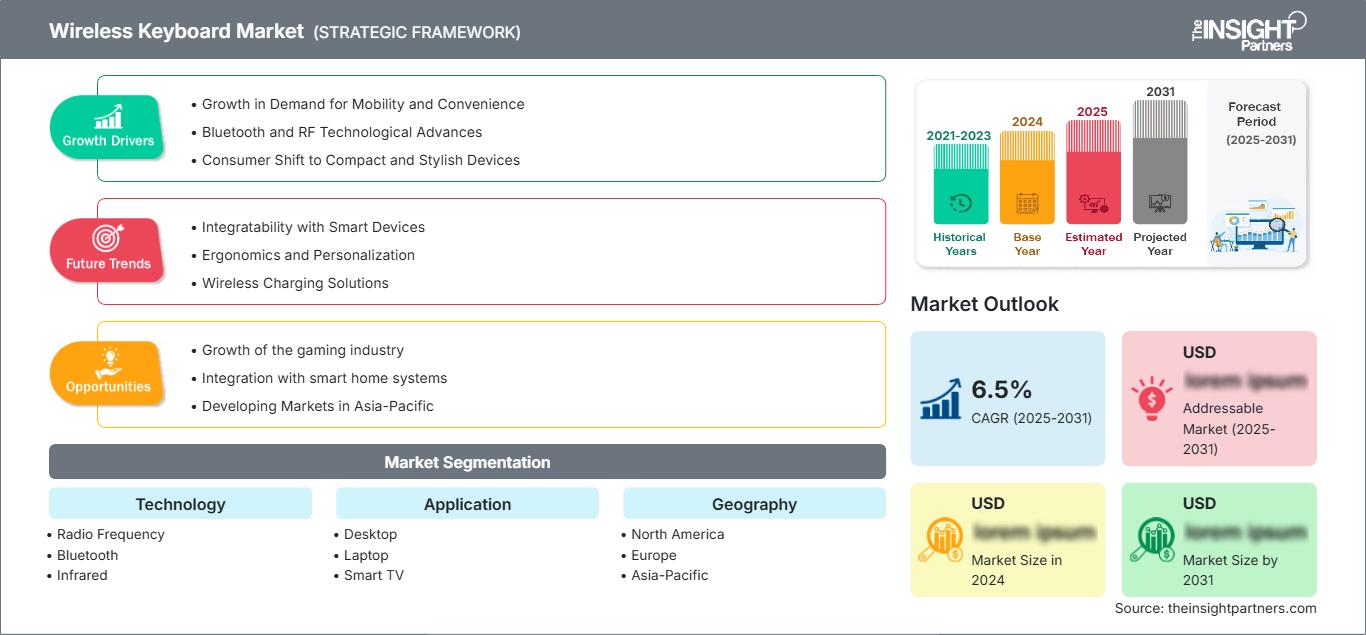
Wireless Keyboard Market: Strategic Insights
Regional Insights
North America wireless keyboard market
The wireless keyboard market share is estimated at 31–35% of global revenue in 2025 and expand at a 5.8–6.6% CAGR through 2034. The demand is driven by enterprise desktop computer upgrades, home office usage, gaming, and the availability of Bluetooth functionality. The primary market for this industry is that of the United States, with Canada adding its consumer demands for corporate, education, and general computing purposes. Ergonomic designs and multi-device keyboard solutions are especially applicable for laptop and monitor/tablet usage.
Purchases made regionally are now driven by the need for increased productivity, desk efficiency, and software compatibility rather than the mere removal of cables. The primary vendors offer both retail and enterprise sales, while smaller brands rely on mechanical switches, programmability, and accessibility. The procurement process favors standardized peripherals, while replacements among consumers require premium products. Costs, tariffs, and logistics influence pricing.
U.S. wireless keyboard Market
The US is estimated to account for 76–80% of North American revenue in 2025 and is projected to grow at a 5.9–6.7% CAGR through 2034. The market benefits from large enterprise technology budgets, extensive home computing adoption, and strong gaming participation. Dell Technologies Inc., HP Development Company, L.P., Microsoft Corporation, Logitech International S.A., and Razer Inc. have meaningful positioning across business, consumer, and performance-oriented applications.
The wireless keyboard market favors compact desktop setups, laptop docking environments, smart televisions, and multi-device productivity. Corporate buyers value compatibility, security, battery life, and supportability, while consumers prioritize aesthetics, switch feel, backlighting, and device switching. Replacement demand is influenced by laptop upgrades and workspace changes, supporting accessory attachment when PC cycles fluctuate.
Europe wireless keyboard Market
Europe is estimated at 25–29% share in 2025 and is forecast to grow at a 5.6–6.4% CAGR through 2034. Germany is a prominent market driven by the requirement of industrial and professional computing. The UK continues to be a vital market due to enterprise, gaming, and e-retail markets. The French market is a result of consumer and commercial devices. Italy and Spain are additional contributors to growth due to flexible working and entertaining trends.
There is significant demand for robust and ergonomic peripherals in Germany, whereby purchasing considerations include reliability and office applicability. There is the combination of mature enterprise adoption along with gaming and e-retail in the UK. The French, Italian, and Spanish markets have seen continued interest in portable and wireless devices that can be used for laptops, home offices, and televisions. The sustainable practices of Europe also influence vendor positioning through longer lifecycle, rechargeable batteries, reparability, and less packing.
APAC wireless keyboard Market
Asia Pacific is estimated at 28–32% share in 2025 and is expected to grow at a 7.2–8.0% CAGR through 2034. China dominates demand and manufacturing depth, whereas Japan and South Korea promote premium technologies. India continues to become significant in light of increasing digitalization and electronics consumerism, whereas Australia brings about mature replacement demand.
Production capacity, e-commerce prevalence, gaming, and home networking facilitate regional expansion. There are advantages of concentrated supply chains for components, as well as domestic production encouragement programs to increase self-sufficiency and resilience of local production and supply chains. Bluetooth has become common in all computing devices, which allows manufacturers to distribute products throughout the national markets with fewer connection problems.
Middle East & Africa wireless keyboard Market
The Middle East and Africa are estimated to expand at a 5.0–6.0% CAGR through 2034, with Saudi Arabia and the UAE leading Gulf demand and South Africa serving as an important sub-Saharan market. Investment in the digital workplace, retail sales of consumer electronics, and connected entertainment are crucial aspects for adoption.
Infrastructure improvement, smart cities initiatives, and increased spending on technology are favorable for Saudi Arabia and the UAE, whereas South Africa has good channels for business and consumer computing. Demand for Rest of MEA is still sensitive to pricing and logistics. Infrastructure and energy investment can increase the use of digital devices, but import prices, currency fluctuation, and logistics remain key concerns.
Segmentation Analysis
Technology
Technology is led by Bluetooth, with the main segment expected to expand at a 7.0–7.8% CAGR from 2026–2034. Native compatibility with laptops, tablets, smart TVs, and modern PCs reduces receiver dependence, while radio-frequency remains relevant for dedicated links and enterprise deployment requirements. Infrared retains a narrow role in specialized legacy and line-of-sight environments.
- Radio Frequency supports dedicated receiver connectivity, making it relevant for desktops, managed workstations, and applications where predictable pairing and controlled peripheral environments remain important.
- Bluetooth benefits from native platform support, multi-device pairing, low setup complexity, and broad consumer familiarity, strengthening its strategic position across computing and connected entertainment.
- Infrared serves limited line-of-sight use cases and legacy applications, with its strategic importance concentrated where simple direct communication outweighs the flexibility of newer wireless standards.
Application
Application is projected to grow at a 6.2–7.0% CAGR during 2026–2034 as keyboards increasingly serve mixed computing and entertainment environments. Desktop use remains substantial, while laptops and smart TVs expand accessory attachment through docking, productivity, and living-room configurations. Product differentiation increasingly follows use context, layout, portability, and multi-device control.
- Desktop remains a core application because users often pair wireless keyboards with monitors, docking stations, compact PCs, and productivity workstations requiring flexible desk layouts.
- Laptop demand reflects docking, travel, hybrid work, and extended typing needs, creating opportunities for compact keyboards that switch between notebooks, tablets, and other devices.
- Smart TV adoption is supported by search, navigation, streaming, and connected-home interfaces, particularly where remote controls are inefficient for text entry and application discovery.
Opportunity Snapshot
| Application | Revenue Contribution | Trend Tag | Adoption Stage |
| Desktop | High | Desk Flexibility | Mature |
| Laptop | High | Hybrid Work | Scaling |
| Smart TV | Medium | TV Texting | Scaling |
| Others | Low | Specialty Input | Emerging |
Wireless Keyboard Market Growth Drivers and Impact Analysis
Expansion of multi-device computing environments
The user moves from one laptop to another or from one desktop or tablet to another or even from one computer screen to the television screen, hence requiring peripherals that will be able to serve many hosts without having to switch cables. Multi-host switching will result in changes in buying behavior that will revolve around factors like connection management, memory of pairings, platform compatibility, and speed switching. Inclusion of switches that can allow fast switching and good firmware on the devices will ensure that the vendor has high-value demand without the issue of competition from wired devices. A single keyboard will suffice for all these devices.
Ergonomic redesign of modern workstations
Workstation design has become concerned with comfort, posture, proper organization of the desk, and prolonged typing efficiency. Thus, ergonomics has come to play an important role in keyboard choice. The split design, lower profile of the keys, adjustable tilt, palm rest, quieter switch, and smaller size cater to different typing styles without altering the basic input device. Companies may use comfort as a basis for selecting peripheral devices when upgrading their workstations, whereas consumers choose keyboards based on durability and performance. This driver favors companies that incorporate ergonomics with wireless and rechargeable technologies into their keyboard models.
Growth of connected entertainment and smart-home interfaces
Connected TV sets, online streaming services, small form-factor PCs, and smart home controllers make scenarios that involve text input and navigation difficult using conventional remote controls. Wireless keyboards allow for searching applications, browsing online, account logging, and discovering new content particularly in homes where there is both TV watching and occasional computing. The use case could be met by manufacturers by offering compact designs, touchpad functionality, backlighting, ease-of-use, and multi-operating system compatibility. The purchase of wireless keyboards depends less on desktop productivity and more on living room ergonomics, noise, battery usage, and storage capacity.
Wireless Keyboard Market Future Trends
Ultra-low-power wireless architectures
Future market product development will increasingly combine efficient radio controllers, smarter sleep states, rechargeable batteries, and power-aware firmware to extend operating intervals without enlarging the enclosure. Bluetooth SIG forecasts more than 5.3 billion Bluetooth-enabled device shipments in 2025 and nearly 8 billion by 2029, indicating a connectivity ecosystem. The wireless keyboard market trends emerging from this environment will emphasize faster wake behavior, stable connections, lower idle consumption, and predictable battery reporting. Manufacturers may integrate battery-health monitoring into companion software, helping users plan charging and replacement. Longer operating intervals can reduce enterprise maintenance and consumer charging interruptions while supporting slimmer, lighter product designs and longer service intervals.
Adaptive input and software-defined personalization
Software is likely to become a larger source of differentiation as keyboards gain programmable controls, application shortcuts, device profiles, lighting management, and adaptive settings. Future products can use companion applications to map commands across productivity, creative, gaming, and entertainment environments, allowing one device to support several workflows. Firmware updates may improve compatibility without immediate hardware replacement, extending product usefulness and reducing support friction. Adaptive features could assist users with accessibility needs through configurable key behavior, macros, and simplified command layers. Vendors with established software ecosystems may have an advantage over hardware-only competitors because software engagement strengthens retention and cross-device integration. It will also increase the importance of cybersecurity, update governance, privacy controls, and software support.
Wireless Keyboard Market Opportunities
Enterprise peripheral standardization
The Enterprise buyer represents an opportunity for vendors to design wireless peripherals based on factors such as compatibility, security, ergonomic considerations, fleet management, and life-cycle economics. The vendor solutions may be designed differently for different target groups such as office workers, executives, shared stations, call centers, or specialty users, but using the same management and maintenance processes. Categorizing peripheral solutions such as keyboards and mice along with other peripherals such as docking stations, displays, and endpoint devices will make the purchasing easier and increase account penetration. Peripheral solutions such as firmware documentation, replacement cycle scheduling, battery monitoring, and operating system compatibility can be very effective in this opportunity.
Emerging-market localization and channel expansion
Growth is possible in markets where the rate of development of computing, internet commerce, online learning, and workplace computerization is greater than that of premium peripherals. Firms can customize products through localized keyboards, localized packaging, durability, power requirements, and pricing in line with local incomes. It is important to consider distributor relationships where fragmented distribution systems and import difficulties hinder direct marketing channels. India, Southeast Asia, certain economies of Latin America, and the Gulf offer scope for distinct channel strategies. Companies should employ e-commerce analysis to determine preferred keyboard configurations, price points, colors, and software packages. Localization may facilitate adoption and shield premium peripherals from mature markets. The most compelling forecast scenario for the wireless keyboard market includes scalable core hardware together with regional customization.
Frequently Asked Questions

- Comprehensive Market Sizing and Forecast Analysis
- Detailed Segmentation Analysis
- In-Depth Market Dynamics Assessment
- Regional and Country-Level Insights
- Competitive Landscape and Company Benchmarking
- Strategic Business Intelligence
Recent Reports
Testimonials

The Insight Partners provided valuable market intelligence that supported our global go-to-market strategy. Their team was professional, responsive, and attentive to our feedback, providing thoughtful analysis and helpful methodological clarifications throughout the project.
Junmo Kim Chief Financial Officer (CFO), Enertech Co., Ltd.
The Insight Partners' SCADA System Market report is comprehensive, with valuable insights on current trends and future forecasts. The team was highly professional, responsive, and supportive throughout. We are very satisfied and highly recommend their services.
RAN KEDEM Partner, Reali Technologies LTDs
I requested a report on a very specific software market and the team produced the report in a few days. The information was very relevant and well presented. I then requested some changes and additions to the report. The team was again very responsive and I got the final report in less than a week.
JEAN-HERVE JENN Chairman, Future Analytica
We worked with The Insight Partners for an important market study and forecast. They gave us clear insights into opportunities and risks, which helped shape our plans. Their research was easy to use and based on solid data. It helped us make smart, confident decisions. We highly recommend them.
PIYUSH NAGPAL Sr. Vice President, High Beam Global
The Insight Partners delivered insightful, well-structured market research with strong domain expertise. Their team was professional and responsive throughout. The user-friendly website made accessing industry reports seamless. We highly recommend them for reliable, high-quality research services
YUKIHIKO ADACHI CEO, Deep Blue, LLC.
This is the first time I have purchased a market report from The Insight Partners.While I was unsure at first, I visited their web site and felt more comfortable to take the risk and purchase a market report.I am completely satisfied with the quality of the report and customer service. I had several questions and comments with the initial report, but after a couple of dialogs over email with their analyst I believe I have a report that I can use as input to our strategic planning process.Thank you so much for taking the extra time and making this a positive experience.I will definitely recommend your service to others and you will be my first call when we need further market data.
JOHN SUZUKI President and Chief Executive Officer, Board Director, BK Technologies
I wish to appreciate your support and the professionalism you displayed in the course of attending to my request for information regarding to infectious disease IVD market in Nigeria. I appreciate your patience, your guidance, and the fact that you were willing to offer a discount, which eventually made it possible for us to close a deal. I look forward to engaging The Insight Partners in the future, all thanks to the impression you have created in me as a result of this first encounter.
DR CHIJIOKE ONYIA MANAGING DIRECTOR, PineCrest Healthcare Ltd.Reason to Buy
- Informed Decision-Making
- Understanding Market Dynamics
- Competitive Analysis
- Identifying Emerging Markets
- Customer Insights
- Market Forecasts
- Risk Mitigation
- Boosting Operational Efficiency
- Strategic Planning
- Investment Justification
- Tracking Industry Innovations
- Aligning with Regulatory Trends





 Get Free Sample for