
Wireless Docking Station Market Size, Trends & Growth by 2034
Coverage: by Connectivity (WiGig, WUSB, WHDI); Application (Consumer Electronics, Automotive, IT and Telecom, Education, Healthcare, Others) , and Geography (North America, Europe, Asia Pacific, and South and Central America)
- Status : Data Released
- Report Code : TIPRE00009320
- Category : Electronics and Semiconductor
- No. of Pages : 150
- Available Report Formats :


- Last update date : September 30, 2026


2025 Market Size
US$ 36.37 Bn
Base year value
2034 Forecast
US$ 71.82 Bn
Projected by 2034
CAGR 2026-2034
7.86 %
Growth rate
Addressable Market
US$ 487.02 Bn
(2026-2034)
The wireless docking station market is positioned at the intersection of high-speed wireless connectivity, device mobility, and flexible workstation architecture. The market was valued at US$ 36.37 Billion in 2025 and is projected to reach US$ 71.82 Billion by 2034, expanding at a CAGR of 7.86% during 2026–2034. Demand is supported by the increasing need to connect laptops, displays, peripherals, and network resources without repeated physical cable connections.
North America is expected to remain a structurally important region, with the wireless docking station market size estimated to expand at approximately 7.2–8.4% CAGR between 2026–2034. Enterprise hybrid-work deployments, premium computing adoption, and investments in flexible office infrastructure support demand, while technology refresh cycles encourage organizations to standardize simpler device-connection environments.
Wireless Docking Station Market Assessment and Insights
- North America: The region is estimated to account for 31–35% share in 2025 and expand at a 7.2–8.4% CAGR between 2026–2034, supported by enterprise mobility, premium laptops, and workplace modernization.
- US: The US is estimated to represent 68–72% of North American demand in 2025 and grow at a 7.3–8.5% CAGR between 2026–2034, led by enterprise computing and hybrid work.
- Europe: Europe is estimated to hold a 25–29% share in 2025 and grow at a 6.8–8.0% CAGR between 2026–2034. Germany, the UK, France, Italy, and Spain support demand through business digitization and workplace upgrades.
- Asia Pacific: Asia Pacific is estimated to command 28–32% share in 2025 and register a 8.3–9.5% CAGR between 2026–2034. China, Japan, South Korea, and India provide substantial manufacturing and technology demand.
- Largest Segment: IT and Telecom is estimated to represent a 31–35% market share in 2025 and expand at a 8.0–9.0% CAGR between 2026–2034, reflecting enterprise connectivity requirements.
- High Growth Segment: Automotive is estimated to hold a 14–18% market share in 2025 and grow at a 9.0–10.2% CAGR between 2026–2034 as cockpit digitization accelerates.
- Key companies analyzed in detail: Dell, Inc.; DisplayLink Corporation; HP Development Company, L.P.; Intel Corporation; Kensington Computer Products Group, a division of ACCO Brands Corporation; Koninklijke Philips N.V.; Qualcomm Technologies, Inc.; Samsung Electronics Co., Ltd.; Targus International LLC; Toshiba America, Inc.
Source: The Insight Partners' analysis based on proprietary research, government publications, company annual reports, investor presentations, industry databases, and expert interviews.
Wireless docking stations have moved from providing a wireless connection for peripherals to enabling workstations. The WiGig technology architectures proved to be capable of handling high bandwidth connections over shorter ranges, and advancements in wireless display, wireless device authentication, silicon integration, and power management technologies have increased the opportunities for deployment. More and more throughputs, latencies, intercompatibility, security, thermal efficiency, and installation ease considerations are included into the design process of wireless docking products by manufacturers.
During the forecast period, the trend will be in favor of purchasing more standardized platforms, incorporating wireless connectivity and software management, as well as offering greater endpoint security. New Asian emerging economies can become significant in this regard, with their growth in enterprise computing infrastructure, as well as European sustainability regulations pushing for longer product lifecycles and serviceable hardware.
Wireless Docking Station Market Report Scope
| Report Attribute | Details |
|---|---|
| Market size in 2025 | US$ 36.37 Billion |
| Market Size by 2034 | US$ 71.82 Billion |
| Global CAGR (2026 - 2034) | 7.86% |
| Historical Data | 2021-2024 |
| Forecast period | 2026-2034 |
Wireless Docking Station Market Analysis
Wireless docking station market growth is currently being influenced by hybrid working, mobility of computer fleets, multi-display operations, and the prevalence of USB-C laptops. The supply chain includes semiconductor companies, wireless technologies suppliers, operating systems and driver software, docking stations, accessories, distributors, and IT integration in enterprises. The supply chain is determined by radio-frequency hardware, processors, memory, power management, display interface solutions, and specialized firmware.
Wireless docking station demand is currently high where workers often switch from one workplace to another including meeting rooms, home offices, shared desks, classrooms, or clinical and technical spaces. Wireless technology may eliminate connection issues but retain access to displays, keyboards, storages, Ethernet, and other devices. Signal interference, security needs, interoperability, latencies, and performance of high-end displays remain influential criteria for adoption.
Wireless docking station market report suggests that the market comprises a combination of traditional computing vendors, connectivity firms, and accessory firms. Dell Inc., HP Development Company, L.P., and Intel Corporation benefit from their widespread enterprise ecosystems, while DisplayLink Corporation provides software and silicon solutions for display connectivity. Qualcomm Technologies Inc. and Samsung Electronics Co., Ltd. provide wireless and device-platform solutions that may impact product design in the future.
Less emphasis is put on wireless connectivity and greater stress is being placed on compatibility, manageability, security and integration. Targus International LLC specializes in docking and mobile computing accessories for professionals. Kensington Computer Products Group and Koninklijke Philips N.V., on the other hand, concentrate on office and display products. Toshiba America Inc. still remains relevant due to their experience in computing and peripherals.
● REPORT CUSTOMIZATION
Tailor This Report To Align With Your Specific Business Requirements
This report can be customized to align precisely with your business objectives, scope, and target markets. Customization options include tailored segmentation, geography, competitive analysis, and strategic insights to support informed decision-making.
Customize This Report →WHAT YOU CAN ADJUST
- ● Segmentations
- ● Geography
- ● Competitive Analysis
- ● Language Preferences
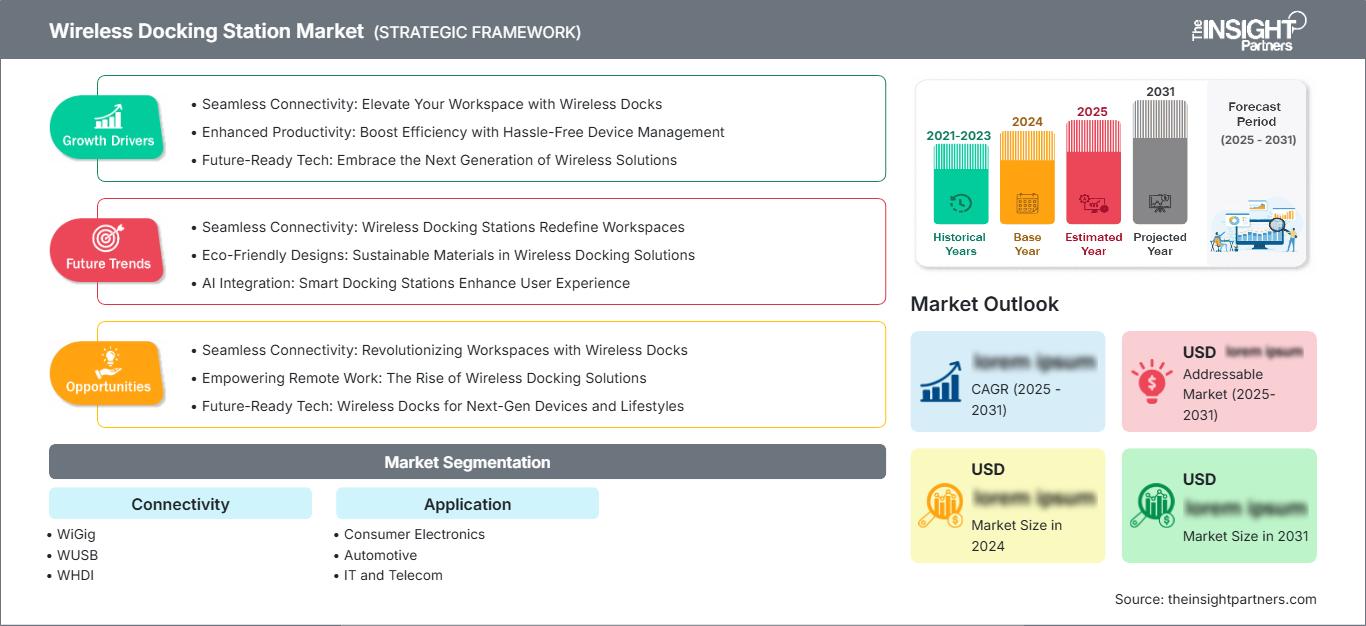
Wireless Docking Station Market: Strategic Insights
Regional Insights
North America wireless docking station market
North America is forecasted to constitute about 31-35% of the wireless docking station market share by 2025 and grow at a CAGR of 7.2-8.4% until 2034. Corporate computer fleets, flexible seating, video conferencing, and remote working generate a continuing need for easy workstation setup. The United States continues to be the key market driver, whereas Canada and Mexico provide more room for growth due to further digitalization of businesses. Compatibility issues, security of endpoints, remote management and lifecycle support of docking stations have become important factors when purchasing.
IT departments of companies have also started favoring standardized accessories of the managed notebook fleets, increasing the availability of docking stations. High-end displays, conferencing equipment, and multitasking setups raise the importance of high-quality peripheral aggregation. However, vendors in North America have advanced distribution channels and ecosystems but buyers are still concerned with the cost and connectivity of docking solutions.
U.S. wireless docking station Market
Estimations show that the share of the US in terms of North American wireless docking stations market demand will amount to 68–72% by 2025, with the expected CAGR of 7.3–8.5% until 2034. Significant corporate tech budgets, adoption of hybrid work models, and the prevalence of high-end laptops contribute to demand. The demand will be recorded within corporate offices, education, healthcare, financial, and tech organizations where employees frequently switch locations. Suppliers enjoy excellent distribution channels and enterprise-focused solutions.
Trends indicate growing demand for managed spaces that can easily link different monitors and peripherals. Companies like Dell, Inc., HP Development Company, L.P., Targus International LLC, and Kensington Computer Products Group provide professional solutions with their diverse accessory portfolios. Purchasers take into account such factors as wireless security, device authentication, software management capabilities, operability with different operating systems, and ease of maintenance. Such factors create room for vendors able to balance convenience and reliable performance.
Europe wireless docking station Market
Europe is estimated to account for 25–29% share of the wireless docking station market in 2025 and grow at a 6.8–8.0% CAGR through 2034. Germany is expected to lead regional demand, followed by the UK, France, Italy, and Spain. German manufacturers and enterprises emphasize industrial digitization, engineering workstations, and standardized workplace technologies, creating demand for reliable connectivity and managed peripherals.
There are advantages for the United Kingdom in the use of hybrid staffing and tech-driven professional services, while there is help for France through the modernization of firms and the digital transformation of the public sector. Meanwhile, Italy and Spain provide opportunities due to modernization of offices and flexible computing systems by small and medium enterprises. There are also concerns about energy savings, reparability, security, and electronic waste in European procurement. Such factors motivate producers to focus more on sustainability than connectivity speed.
APAC wireless docking station Market
APAC is estimated to hold 28–32% share of the wireless docking station market in 2025 and expand at an 8.3–9.5% CAGR through 2034. China leads regional scale, while Japan, South Korea, India, and Australia contribute through enterprise digitization, electronics production, education technology, and growing premium-device adoption. Industrial ecosystems and expanding IT services support demand for flexible connectivity.
China enjoys advantages due to depth of electronics manufacture and high volume of devices. Advanced computing and displays are the key focus areas for Japan and South Korea respectively. Digital office and technology services support the position of India. The needs of professionals and education sectors are the strength of Australia. Regional policies for developing digital infrastructure and local production of electronics may enhance the ecosystem.
Middle East & Africa wireless docking station Market
The Middle East & Africa region is estimated to grow at a CAGR between 6.5% and 7.8% till 2034, with Saudi Arabia leading regional growth in terms of adoption. The UAE is aided by investments in smart office spaces and high-tech commercial facilities, whereas South Africa continues to be a significant market for enterprise and educational sectors.
Both Saudi Arabia and the UAE are making heavy investments in digitally-enabled workplaces, services, and infrastructure. South Africa continues to offer a relatively mature foundation for enterprise accessories, whereas the remainder of the MEA region offers future growth opportunities driven by connectivity and urban development. Energy savings, physical security, device management, and compatibility issues will continue to be important in the deployment of advanced computing infrastructure in geographically dispersed facilities.
Segmentation Analysis
Connectivity
The Connectivity segment is expected to expand at a 7.6–8.7% CAGR during 2026–2034. Adoption depends on bandwidth, latency, spectrum availability, device compatibility, security, and the ability to support displays and peripherals reliably. WiGig remains strategically important because its high-frequency architecture is suited to short-range high-throughput connections, while WUSB and WHDI serve more specialized compatibility and multimedia requirements.
- WiGig: WiGig occupies the strategic center of high-bandwidth wireless docking because 60 GHz connectivity can support fast short-range transfers and display applications. Adoption depends on line-of-sight performance, chipset integration, and compatible endpoint hardware.
- WUSB: WUSB supports wireless peripheral connectivity where users prioritize cable reduction and convenient device attachment. Its strategic role is concentrated in established ecosystems and applications requiring wireless USB-style peripheral communication.
- WHDI: WHDI remains relevant for wireless multimedia transmission and display-oriented environments. Its value proposition centers on convenient high-definition content delivery, particularly where users want to reduce physical video cabling.
Application
The Application segment is projected to register a 7.8–8.9% CAGR during 2026–2034. Demand varies substantially by workflow, with professional environments emphasizing manageability and reliability while consumer applications prioritize convenience. IT and Telecom remains the largest application area because distributed teams, device fleets, multi-display workflows, and centralized endpoint policies create recurring docking requirements.
- Consumer Electronics: Consumer adoption is supported by laptops, monitors, televisions, gaming equipment, and smart peripherals. Buyers favor simple pairing, broad compatibility, compact designs, and convenient switching between personal devices.
- Automotive: Automotive demand is developing around digital cockpits, passenger connectivity, service environments, and device integration. Wireless docking concepts can reduce physical interfaces and support increasingly software-defined vehicle architectures.
- IT and Telecom: IT and Telecom represents the largest application opportunity because enterprise workers require rapid access to displays, networks, storage, and peripherals. Fleet management and security requirements further strengthen professional adoption.
- Education: Education institutions value simplified classroom and hybrid-learning setups that allow instructors to connect portable computers with displays, cameras, audio systems, and network resources without extensive cabling.
- Healthcare: Healthcare applications emphasize secure connectivity, workstation mobility, infection-control considerations, and reliable access to displays and peripherals. Wireless solutions can support flexible clinical and administrative environments when security requirements are satisfied.
Opportunity Snapshot
| Application | Revenue Contribution | Trend Tag | Adoption Stage |
|---|---|---|---|
| Consumer Electronics | High | Device Switching | Scaling |
| Automotive | Medium | Digital Cockpit | Emerging |
| IT and Telecom | High | Hybrid Workspace | Mature |
| Education | Medium | Flexible Classroom | Scaling |
| Healthcare | Medium | Clinical Mobility | Scaling |
Wireless Docking Station Market Growth Drivers and Impact Analysis
Hybrid Work Is Increasing the Need for Flexible Workstation Connectivity
The normalization of hybrid work is changing the economics of workstation accessories. Employees increasingly alternate between corporate offices, home environments, meeting rooms, and shared desks, creating repeated demand for faster setup and consistent peripheral access. Wireless docking can reduce the friction associated with connecting multiple devices and may help organizations standardize employee workspaces around portable computers. The impact is strongest among knowledge-intensive enterprises with large managed notebook fleets. Procurement teams are increasingly evaluating docking infrastructure as part of the broader endpoint experience rather than as an isolated accessory category. This shift supports recurring replacement demand when notebook generations, displays, operating systems, or security policies change. Vendors capable of combining connectivity, management, and security can therefore capture greater value per deployment while improving the operational consistency of distributed work environments.
Higher-Resolution Displays Are Raising Bandwidth Requirements
The transition toward larger, higher-resolution displays is increasing the performance requirements placed on docking architectures. Professional users increasingly operate multiple monitors, high-refresh displays, conferencing cameras, external storage, and network connections simultaneously. Wireless solutions must therefore manage bandwidth allocation carefully while maintaining acceptable latency and connection stability. Improvements in 60 GHz wireless technology, silicon integration, beamforming, and display-processing capabilities can expand the range of practical use cases. The market impact extends beyond office productivity because creative professionals, engineers, designers, educators, and healthcare administrators increasingly depend on multi-display workflows. Vendors that optimize wireless throughput alongside thermal efficiency and device interoperability can differentiate products more effectively. This driver also encourages closer coordination between chipset developers, operating-system providers, laptop manufacturers, and accessory brands to reduce compatibility barriers during deployment.
Enterprise Security and Device Management Are Becoming Purchase Criteria
Enterprise buyers increasingly treat peripheral security as part of endpoint governance. A docking solution that connects displays, storage, network interfaces, and other peripherals can influence the security posture of a workstation, making authentication, firmware integrity, configuration controls, and software updates important purchasing considerations. Organizations are therefore moving toward managed accessories that can be monitored and maintained alongside laptops and other endpoints. This trend favors suppliers with established enterprise software, support, and lifecycle-management capabilities. It also creates opportunities for vendors to differentiate through secure pairing, centralized configuration, automatic firmware management, and policy-based access. As wireless connectivity expands beyond consumer environments, security requirements will increasingly shape product specifications and procurement frameworks. The resulting market impact should favor vendors that can demonstrate interoperability and dependable lifecycle support while reducing the administrative burden associated with large-scale deployments.
Wireless Docking Station Market Future Trends
Intelligent Dock Management Will Become More Software Defined
wireless docking station market trends are expected to increasingly reflect software-defined management rather than hardware connectivity alone. Future products can incorporate intelligent device discovery, automated profile selection, adaptive channel management, usage diagnostics, and centralized firmware orchestration. Enterprise administrators may increasingly monitor docking performance through endpoint-management platforms, allowing organizations to identify connection failures, update firmware, and enforce configuration policies remotely. Artificial intelligence can support anomaly detection by identifying recurring interference, compatibility, or performance issues across distributed workspaces. Another likely development is deeper integration with operating systems, allowing users to move between locations while preserving display, audio, and peripheral preferences. These capabilities could make docking infrastructure more predictable and reduce support costs. Vendors that build strong software ecosystems around hardware may gain differentiation even when competing devices use similar wireless standards and comparable semiconductor components.
Converged Wireless Workspaces Will Extend Beyond Traditional Docking
Proposed future solutions would shift from dock devices to wireless workspace solutions, which can help integrate display units, conferencing devices, peripherals, charging stations, and networking components. Rather than looking at every device separately, it is possible to create coordinated environments that are capable of identifying users and setting up available devices. Such solutions will be especially useful in shared workspaces, meeting rooms, education environments, and healthcare administrations. It is still necessary to maintain interoperability standards because companies use different notebook vendors and operating systems in their heterogeneous fleets. It may lead to the creation of new architecture that includes both wireless high-speed connections and wired connections for some devices that need guaranteed performance. It will provide new possibilities for developing high-end solutions for customers while pushing the manufacturers to produce modular hardware and software that could evolve along with the wireless standards, displays, and computing platforms.
Wireless Docking Station Market Opportunities
Enterprise Fleet Standardization Creates Recurring Replacement Opportunities
Vendors can target enterprise fleet programs by positioning wireless docking as part of standardized notebook deployment rather than an optional peripheral. Large organizations periodically refresh laptops, monitors, security policies, and collaboration infrastructure, creating opportunities to bundle docking equipment into procurement agreements. Suppliers can strengthen these propositions through centralized management, extended warranties, service-level commitments, compatibility testing, and automated configuration. Vertical-specific packages can further differentiate offerings for financial services, healthcare, education, engineering, and government environments. Another opportunity lies in designing modular docks that support changing display and peripheral requirements without requiring complete replacement. Channel partnerships with system integrators and managed-service providers can improve reach among organizations that prefer outsourced endpoint administration. Vendors with strong compatibility matrices and lifecycle support can therefore compete on operational value while reducing customer concerns about deployment complexity and technology obsolescence.
Emerging Asian Markets Offer Room for Localized Product Strategies
Expansion across Asia Pacific provides opportunities for localized wireless docking portfolios tailored to price sensitivity, device mix, regulatory requirements, and workplace architecture. India, China, Southeast Asia, Japan, and South Korea differ significantly in enterprise purchasing behavior and technology maturity, making a single global product strategy less effective. Vendors can improve market penetration through regional distributors, local technical support, language-specific software, and compatibility with widely deployed notebook ecosystems. Partnerships with electronics manufacturers can also strengthen component sourcing and accelerate integration into locally produced devices. Education, technology services, automotive engineering, and digitally enabled offices represent attractive application environments. Companies that establish local certification expertise and supply-chain resilience may gain advantages as demand expands. The wireless docking station market forecast opportunity is particularly relevant for vendors seeking volume growth while maintaining differentiated products for enterprise, professional, and premium consumer users.
Frequently Asked Questions

- Comprehensive Market Sizing and Forecast Analysis
- Detailed Segmentation Analysis
- In-Depth Market Dynamics Assessment
- Regional and Country-Level Insights
- Competitive Landscape and Company Benchmarking
- Strategic Business Intelligence
Recent Reports
Testimonials

The Insight Partners' SCADA System Market report is comprehensive, with valuable insights on current trends and future forecasts. The team was highly professional, responsive, and supportive throughout. We are very satisfied and highly recommend their services.
RAN KEDEM Partner, Reali Technologies LTDs
I requested a report on a very specific software market and the team produced the report in a few days. The information was very relevant and well presented. I then requested some changes and additions to the report. The team was again very responsive and I got the final report in less than a week.
JEAN-HERVE JENN Chairman, Future Analytica
We worked with The Insight Partners for an important market study and forecast. They gave us clear insights into opportunities and risks, which helped shape our plans. Their research was easy to use and based on solid data. It helped us make smart, confident decisions. We highly recommend them.
PIYUSH NAGPAL Sr. Vice President, High Beam Global
The Insight Partners delivered insightful, well-structured market research with strong domain expertise. Their team was professional and responsive throughout. The user-friendly website made accessing industry reports seamless. We highly recommend them for reliable, high-quality research services
YUKIHIKO ADACHI CEO, Deep Blue, LLC.
This is the first time I have purchased a market report from The Insight Partners.While I was unsure at first, I visited their web site and felt more comfortable to take the risk and purchase a market report.I am completely satisfied with the quality of the report and customer service. I had several questions and comments with the initial report, but after a couple of dialogs over email with their analyst I believe I have a report that I can use as input to our strategic planning process.Thank you so much for taking the extra time and making this a positive experience.I will definitely recommend your service to others and you will be my first call when we need further market data.
JOHN SUZUKI President and Chief Executive Officer, Board Director, BK Technologies
I wish to appreciate your support and the professionalism you displayed in the course of attending to my request for information regarding to infectious disease IVD market in Nigeria. I appreciate your patience, your guidance, and the fact that you were willing to offer a discount, which eventually made it possible for us to close a deal. I look forward to engaging The Insight Partners in the future, all thanks to the impression you have created in me as a result of this first encounter.
DR CHIJIOKE ONYIA MANAGING DIRECTOR, PineCrest Healthcare Ltd.Reason to Buy
- Informed Decision-Making
- Understanding Market Dynamics
- Competitive Analysis
- Identifying Emerging Markets
- Customer Insights
- Market Forecasts
- Risk Mitigation
- Boosting Operational Efficiency
- Strategic Planning
- Investment Justification
- Tracking Industry Innovations
- Aligning with Regulatory Trends





 Get Free Sample for