
Wireless Microphone Market Share, Growth & Demand by 2034
Coverage: By Type (Handheld, Clip-on Others); Technology (Wi-Fi Band, Radio Frequency Channel, Radio Frequency Band); End User (Corporate, Education, Hospitality, Sporting Events, Others) , and Geography (North America, Europe, Asia Pacific, and South and Central America)
- Status : Data Released
- Report Code : TIPRE00019802
- Category : Electronics and Semiconductor
- No. of Pages : 150
- Available Report Formats :


- Last update date : September 28, 2026


2025 Market Size
US$ 3.3 Bn
Base year value
2034 Forecast
US$ 6.07 Bn
Projected by 2034
CAGR 2026-2034
7.02 %
Growth rate
Addressable Market
US$ 42.34 Bn
(2026-2034)
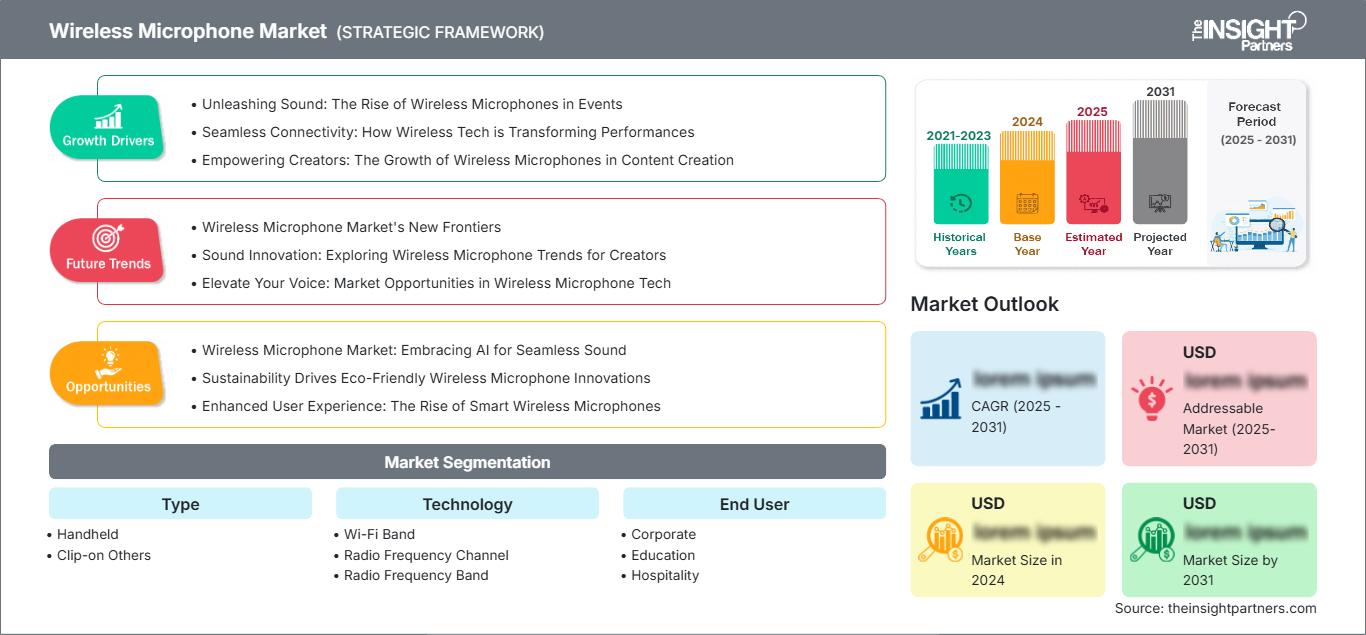
The wireless microphone market is positioned for sustained expansion as professional audio moves toward flexible, digitally managed systems across live events, corporate communication, education, hospitality, and sports. The market is valued at US$ 3.3 Billion in 2025 and is projected to reach US$ 6.07 Billion by 2034, reflecting a CAGR of 7.02% during 2026–2034. Demand is increasingly shaped by mobility, reliable spectrum use, and integration with modern audiovisual workflows.
Across North America, the wireless microphone market size is supported by established professional audio infrastructure, recurring live-event production, corporate audiovisual investment, and strong content-creation activity. Regional growth is estimated at 6.5–7.0% CAGR during 2026–2034. The structural outlook is reinforced by the replacement of legacy wired systems, higher channel-density requirements, and increasing deployment of digitally managed wireless audio in education, broadcasting, and enterprise environments.
Wireless Microphone Market Assessment and Insights
- North America: North America is expected to represent 35–38% share in 2025 and expand at a 6.5–7.0% CAGR during 2026–2034, supported by mature entertainment, broadcasting, corporate AV, and education infrastructure.
- US: The US is expected to account for 77–81% of North American revenue in 2025 and grow at a 6.4–6.9% CAGR through 2034, supported by live production and enterprise AV spending.
- Europe: Europe is projected to hold 25–28% share in 2025 and grow at a 6.2–6.8% CAGR, led by Germany, the UK, France, Italy, and Spain, where touring, hospitality, broadcasting, and institutional applications remain substantial.
- Asia Pacific: Asia Pacific is estimated at 22–25% share in 2025 and is expected to expand at an 8.0–8.7% CAGR through 2034, with China, Japan, South Korea, and India benefiting from expanding media, education, and sports ecosystems.
- Largest Segment: Handheld products are estimated to hold a 49–52% market share in 2025 and grow at a 6.5–7.0% CAGR during 2026–2034, reflecting broad professional and event use.
- High Growth Segment: Clip-on products are estimated at a 29–33% market share in 2025 and are projected to grow at an 8.8–9.4% CAGR, supported by mobility and creator applications.
- Key companies analyzed in detail: AKG Acoustics GmbH, Audio-Technica Corporation, Blue, LEWITT GmbH, RØDE Microphones, Samson Technologies, Inc., Sennheiser electronic SE & Co. KG, Shure Incorporated, Sony Electronics Inc., and Yamaha Corporation.
Source: The Insight Partners' analysis based on proprietary research, government publications, company annual reports, investor presentations, industry databases, and expert interviews.
The wireless microphone market has evolved from primarily analog professional systems toward digitally managed platforms that combine frequency coordination, low-latency transmission, improved battery performance, encryption, and software-based control. Product development increasingly emphasizes compact transmitters, dual-channel workflows, USB connectivity, onboard recording, and compatibility with smartphones, cameras, conferencing systems, and production consoles. These changes broaden addressable applications beyond traditional stage environments.
Forward-looking development is increasingly tied to geographic diversification and institutional investment. Asia Pacific is gaining importance as media production, sports programming, education modernization, and hospitality construction expand. The Wireless Microphone Market report highlights that spectrum-management policies also influence system design, particularly where dense deployments require coordinated frequencies. Manufacturers are therefore balancing RF performance with simpler installation, remote monitoring, interoperability, and lifecycle support to address buyers seeking lower operational complexity.
Wireless Microphone Market Report Scope
| Report Attribute | Details |
|---|---|
| Market size in 2025 | US$ 3.3 Billion |
| Market Size by 2034 | US$ 6.07 Billion |
| Global CAGR (2026 - 2034) | 7.02% |
| Historical Data | 2021-2024 |
| Forecast period | 2026-2034 |
Wireless Microphone Market Analysis
The demand factor is driven by the increasing need for mobility in presentations, performances, lectures, interviews, and sportscasts. The adoption of wireless microphones is further driven by the increased number of hybrid meetings and digital content creation, which entails that audio needs to be relayed smoothly from camera to mobile phones, computers, and professional mixers. The value chain comprises manufacturers of microphones, acoustic capsules, and RF components suppliers, battery providers, distributors, system integrators, rentals, and audiovisual services.
The supply dynamics are shifting in favor of suppliers that offer both good acoustic and wireless transmission. Digital RF technology requires coordination between hardware, firmware, antennas, receivers, and frequency management, hence the need for integration in engineering. In terms of the distribution segment, rentals and professional audio visual are critical because the large events call for the use of a multi-channel system and not single units. According to the Wireless Microphone Market forecast, competitive success will increasingly depend on delivering integrated wireless ecosystems, efficient spectrum utilization, reliable connectivity, and lifecycle support that meets the evolving requirements of professional audio, broadcast, education, hospitality, and live-event applications
The analysis of wireless microphones suggests that competition is moving away from fundamental hardware characteristics and towards the entire workflow solutions. Shure Incorporated, Sennheiser electronic SE & Co. KG, Audio-Technica Corporation, Sony Electronics Inc. and Yamaha Corporation compete in the field of professional and institutional use, whereas RØDE Microphones and Blue concentrate on small, creator-focused systems. AKG Acoustics GmbH, LEWITT GmbH and Samson Technologies, Inc. ensure more choices in the sphere of performance and recording.
Key investments are increasingly focused on the areas of digital signal processing, compact RF design, software control and ease of setup. The example of future Shure's product activity up to 2025, which includes scalable receivers and wireless collaboration solutions, demonstrates the trend towards channel density and deployment management. In the same way, the extension of Profile Wireless solutions from Sennheiser shows the growing interest in portable creator systems.
● REPORT CUSTOMIZATION
Tailor This Report To Align With Your Specific Business Requirements
This report can be customized to align precisely with your business objectives, scope, and target markets. Customization options include tailored segmentation, geography, competitive analysis, and strategic insights to support informed decision-making.
Customize This Report →WHAT YOU CAN ADJUST
- ● Segmentations
- ● Geography
- ● Competitive Analysis
- ● Language Preferences
Wireless Microphone Market: Strategic Insights
Regional Insights
North America Wireless Microphone Market
North America is estimated to hold 35–38% of the wireless microphone market share in 2025 and is expected to expand at a 6.5–7.0% CAGR through 2034. The area has excellent live entertainment facilities, broadcast production, corporate conferences, educational institutions, places of worship, and sports venues. The replacement of old equipment is another critical recurring need driver.
There is also considerable strength in the local ecosystem with respect to manufacturer presence and rental channel maturity. The customers are looking for multi-channel integration, remote monitoring, encryption capability, and compatibility with existing AV networks. The content providers create another layer of demand for small clip-on units. The regulatory focus on spectrum availability is still a strategically important factor since big productions depend on reliable RF performance.
U.S. Wireless Microphone Market
The U.S. represents approximately 77–81% of North American wireless microphone market revenue in 2025 and is projected to grow at a 6.4–6.9% CAGR during 2026–2034. The country features comprehensive event facilities along with robust demand from corporate campuses, universities, broadcasters, sport organizations, theatres, and production companies.
Developing trends for applications include scalable digital systems capable of working with multiple speakers as well as integration with conference and production equipment. Major market players such as Shure Incorporated, Sennheiser electronic SE & Co. KG, Audio-Technica Corporation, and Sony Electronics Inc. feature high visibility within the market. Spectrum coordination becomes especially critical for dense facilities, while 2.4 GHz offerings targeted at creators broaden the user base.
Europe Wireless Microphone Market
Europe is estimated to account for 25–28% of the wireless microphone market in 2025 and is expected to grow at a 6.2–6.8% CAGR. Germany is a leading market because of its professional audio manufacturing base, touring activity, corporate events, and strong institutional AV spending. The UK remains significant through broadcasting, entertainment, education, and large-scale event production. France, Italy, and Spain contribute through hospitality, cultural venues, sports, and live performance applications. Regional procurement increasingly favors efficient frequency management, interoperability, and durable systems suited to touring and permanent installations.
APAC Wireless Microphone Market
APAC is estimated to represent 22–25% of the wireless microphone market in 2025 and is projected to achieve an 8.0–8.7% CAGR through 2034. China leads regional demand, followed by Japan, South Korea, India, and Australia. Expanding entertainment production, education modernization, sports events, hospitality investment, and creator economies support adoption.
China benefits from extensive manufacturing and event infrastructure, while Japan and South Korea emphasize professional production quality. India is developing rapidly through education, weddings, entertainment, broadcasting, and corporate events. Australia provides a mature professional audio environment, creating demand for higher-specification systems and spectrum-efficient deployments.
Middle East & Africa Wireless Microphone Market
The Middle East and Africa market is expected to grow at a 5.8–6.5% CAGR through 2034. Saudi Arabia and the UAE lead regional demand, supported by entertainment investment, tourism infrastructure, hospitality development, conferences, and large public events. South Africa remains an important professional audio market.
The broader region is also benefiting from infrastructure modernization and diversification beyond energy-related activity. Large venues require scalable wireless systems for presentations, performances, sports, and broadcast production. Demand in the Rest of MEA remains more project-driven, with purchasing decisions strongly influenced by distributor capability, equipment reliability, installation support, and total system cost.
Segmentation Analysis
Type
The Type segment is expected to grow at a 6.8–7.4% CAGR during 2026–2034. The wireless microphone market continues to favor products that combine dependable transmission with ergonomic handling. Handheld systems retain broad professional relevance, while clip-on solutions gain importance in presentations, interviews, content creation, and applications where discreet placement improves speaker mobility.
- Handheld: Handheld systems remain central to concerts, speeches, broadcasting, worship, and sporting environments because users can control microphone distance directly. Their established workflow supports continued replacement and rental demand across professional applications.
- Clip-on: Clip-on systems benefit from discreet placement and hands-free operation. Demand is expanding among presenters, journalists, educators, creators, and production crews that prioritize mobility, compactness, and natural speaker movement.
Technology
The Technology segment is projected to expand at a 7.0–7.6% CAGR during 2026–2034. Adoption is increasingly determined by reliability, interference management, range, channel density, interoperability, and ease of configuration. Buyers are evaluating transmission architecture alongside software control, battery management, and integration with installed audiovisual infrastructure. Current Wireless Microphone Market trends indicate growing demand for digital wireless technologies that offer enhanced spectrum efficiency, improved signal stability, advanced interference mitigation, and seamless integration with professional audiovisual ecosystems.
- Wi-Fi Band: Wi-Fi-oriented systems support flexible digital workflows and can integrate with connected devices and networked environments. Their strategic relevance is strongest where simple configuration and digital connectivity outweigh the requirements of specialized RF deployments.
- Radio Frequency Channel: Dedicated RF channels remain important for professional installations requiring predictable transmission. Their value is particularly evident in large venues where multiple microphones operate simultaneously and frequency coordination is essential.
- Radio Frequency Band: RF-band solutions continue to support professional audio because they offer established transmission architectures and broad equipment compatibility. Demand remains linked to touring, broadcasting, institutional AV, and high-channel-count production requirements.
End User
The End User segment is forecast to grow at a 7.2–7.8% CAGR during 2026–2034. Adoption is spreading from entertainment into structured communication environments where mobility, clear speech, and reduced cabling improve operational flexibility. Corporate and education users increasingly integrate wireless audio into conferencing, lecture, training, and hybrid communication systems.
- Corporate: Corporate deployments prioritize clear speech, professional presentation quality, and compatibility with conferencing infrastructure. Demand is strongest in meeting rooms, training facilities, executive events, and multi-purpose conference environments.
- Education: Educational institutions increasingly require flexible audio for lectures, assemblies, hybrid classes, and campus events. Wireless systems reduce setup constraints and support movement across classrooms, auditoriums, and outdoor learning environments.
- Hospitality: Hotels and event venues use wireless microphones for conferences, weddings, presentations, entertainment, and guest programming. Procurement emphasizes reliability, rapid setup, channel flexibility, and compatibility with installed sound systems.
- Sporting Events: Sporting venues require dependable systems for announcements, interviews, commentary, ceremonies, and field communication. Demand is supported by increasingly sophisticated event production and the need to coordinate multiple audio sources.
Opportunity Snapshot
| End User | Revenue Contribution (High/Medium/Low) | Trend Tag (MAX 2 words) | Adoption Stage (Emerging/Scaling/Mature) |
| Corporate | High | Hybrid AV | Mature |
| Education | Medium | Campus Audio | Scaling |
| Hospitality | Medium | Event Production | Scaling |
| Sporting Events | Medium | Venue Broadcast | Scaling |
Wireless Microphone Market Growth Drivers and Impact Analysis
Expansion of Hybrid and Distributed Communication
The trend toward the use of hybrid conferences, distributed learning, remote presentations, and multiple room communications is raising the demand for versatile microphone solutions. There will be an ever-increasing demand for solutions where the microphone can be easily shifted from one physical space to another or even used along with cameras, PCs, and conferencing solutions without having to rewire anything. This is an opportunity for systems that provide USB connectivity, pairing, network control, and scalable receiver solutions. The effect goes beyond individual unit sales since users might standardize their wireless audio solution across their entire facility instead of buying separate solutions. System integrators will play a more important role in the specification and implementation of such solutions.
Rising Production Complexity in Live and Broadcast Environments
The complexity of live events has grown with the integration of several artists, hosts, commentary, interviews, streaming, and broadcasting into a production. With an increased number of channels, there is an elevated need for frequency management, immunity to interference, low latency, dependability in batteries, and quick problem resolution. Thus, wireless microphone systems are increasingly serving as production tools rather than microphones themselves. Providers of rental equipment and professional audio/video production services are responding with an upgrade of their inventories to the next generation of wireless systems that support high-density deployments. This results in the obsolescence of old equipment as well as the demand for more dense-channel receivers and software-managed systems.
Growth of Mobile Content Production
The fast growth of mobile video, live video streaming, podcasts, social media, and independent news is increasing the potential user base of wireless audio gear. Cameras on smartphones made video creation accessible, yet the onboard microphone tends to become ineffective once people start to step back from the phone. Compact and easy-to-install clip-on solutions solve this problem using direct connections to mobile devices, automatic gain control, charging cases, and simple installation. The need generated by this trend is different from the one in the previous professional purchasing scenario in that users often value portability, usability, power, convenience, and good value-for-money. Manufacturers try to respond with small transmitters, built-in recorders, application controls, and mobile workflow.
Wireless Microphone Market Future Trends
Intelligent Audio Processing and Automated Configuration
Wireless microphones' future trend in terms of design and usage is seen in making the devices incorporate smart processing features where the gain is controlled, background noise is suppressed, speech characteristics are analyzed, and configurations are made simple. Unlike the current trend, which requires people to be familiar with technical knowledge in audio engineering, future wireless microphones will probably allow more automated processes without compromising professional settings. Machines will be capable of analyzing any possible clipping, battery hazards, or signal issues before production is affected. Software interfaces may be used for managing the status of the receiver, updating firmware, organizing frequencies, and diagnosing the equipment. This is especially important for industries, schools, hospitality organizations, and production companies without audio engineers.
Convergence of Wireless Audio With Networked AV
A further promising direction for research is the convergence of wireless microphone technology with networked audiovisual systems. In future implementation, increasing attention is going to be paid to such aspects as Ethernet connection, centralized management, remote monitoring, cloud-based management, and compatibility with digital conferencing systems. Such an approach can relieve the burden of room-by-room and facility-by-facility management of microphone infrastructure. In larger companies, there will be more cases where microphone systems are going to be treated as managed endpoints in AV systems and not separate devices. From the manufacturer’s point of view, this opens possibilities to build common software ecosystems across microphones, receivers, mixers, and control systems. This integration capacity will be especially useful when deploying systems in colleges, hotels, company headquarters, broadcasting studios, and entertainment centers, where hundreds of devices are going to be managed together.
Wireless Microphone Market Opportunities
Scalable Institutional Audio Platforms
Institutional customers represent an opportunity for suppliers to move beyond individual microphone sales toward scalable audio platforms. Universities, corporate campuses, hotel groups, government facilities, and large event operators can require standardized systems across numerous rooms and venues. Vendors can address this opportunity through modular receiver architectures, centralized monitoring, simplified frequency coordination, fleet management, and service agreements. Procurement teams increasingly value predictable maintenance and consistent user experience, making standardization commercially attractive. Integrators can strengthen the opportunity by offering deployment audits, room-level configuration, training, and lifecycle replacement programs. Manufacturers that develop interoperable product families can potentially increase customer retention because upgrading one part of an installation does not require replacing the entire audio environment. The opportunity is particularly relevant where organizations are consolidating AV purchasing across multiple sites.
Emerging-Market Creator and Event Ecosystems
Emerging markets offer opportunities to develop wireless audio products specifically for creators, education providers, event companies, and small production teams. India, Southeast Asia, the Middle East, and selected African markets are expanding digital media activity while professional AV infrastructure develops unevenly. Products that combine compact form factors, intuitive operation, mobile compatibility, long battery life, and accessible pricing can address users who previously relied on wired or smartphone audio. Local distribution and technical support will remain important because customers often need assistance with frequency selection, accessories, configuration, and maintenance. Suppliers can also work with rental businesses and production schools to increase product familiarity. Over time, these ecosystems can create upgrade pathways from entry-level clip-on systems to multi-channel professional platforms as production requirements become more sophisticated.
Frequently Asked Questions

- Comprehensive Market Sizing and Forecast Analysis
- Detailed Segmentation Analysis
- In-Depth Market Dynamics Assessment
- Regional and Country-Level Insights
- Competitive Landscape and Company Benchmarking
- Strategic Business Intelligence
Recent Reports
Testimonials

The Insight Partners' SCADA System Market report is comprehensive, with valuable insights on current trends and future forecasts. The team was highly professional, responsive, and supportive throughout. We are very satisfied and highly recommend their services.
RAN KEDEM Partner, Reali Technologies LTDs
I requested a report on a very specific software market and the team produced the report in a few days. The information was very relevant and well presented. I then requested some changes and additions to the report. The team was again very responsive and I got the final report in less than a week.
JEAN-HERVE JENN Chairman, Future Analytica
We worked with The Insight Partners for an important market study and forecast. They gave us clear insights into opportunities and risks, which helped shape our plans. Their research was easy to use and based on solid data. It helped us make smart, confident decisions. We highly recommend them.
PIYUSH NAGPAL Sr. Vice President, High Beam Global
The Insight Partners delivered insightful, well-structured market research with strong domain expertise. Their team was professional and responsive throughout. The user-friendly website made accessing industry reports seamless. We highly recommend them for reliable, high-quality research services
YUKIHIKO ADACHI CEO, Deep Blue, LLC.
This is the first time I have purchased a market report from The Insight Partners.While I was unsure at first, I visited their web site and felt more comfortable to take the risk and purchase a market report.I am completely satisfied with the quality of the report and customer service. I had several questions and comments with the initial report, but after a couple of dialogs over email with their analyst I believe I have a report that I can use as input to our strategic planning process.Thank you so much for taking the extra time and making this a positive experience.I will definitely recommend your service to others and you will be my first call when we need further market data.
JOHN SUZUKI President and Chief Executive Officer, Board Director, BK Technologies
I wish to appreciate your support and the professionalism you displayed in the course of attending to my request for information regarding to infectious disease IVD market in Nigeria. I appreciate your patience, your guidance, and the fact that you were willing to offer a discount, which eventually made it possible for us to close a deal. I look forward to engaging The Insight Partners in the future, all thanks to the impression you have created in me as a result of this first encounter.
DR CHIJIOKE ONYIA MANAGING DIRECTOR, PineCrest Healthcare Ltd.Reason to Buy
- Informed Decision-Making
- Understanding Market Dynamics
- Competitive Analysis
- Identifying Emerging Markets
- Customer Insights
- Market Forecasts
- Risk Mitigation
- Boosting Operational Efficiency
- Strategic Planning
- Investment Justification
- Tracking Industry Innovations
- Aligning with Regulatory Trends





 Get Free Sample for