
Wireless Paging System Market Demand, Size & Forecast by 2034
Coverage: by Product (Pager Transmitters, Staff Pagers, Healthcare Pagers, Guest Pagers, Waiter Pager); End User (Entertainment and Media, Organization and Hospitality Management, Government and Institute, Healthcare, Warehouse and Logistics, Banks, Military, Others) , and Geography (North America, Europe, Asia Pacific, and South and Central America)
- Status : Data Released
- Report Code : TIPRE00008892
- Category : Electronics and Semiconductor
- No. of Pages : 150
- Available Report Formats :


- Last update date : September 28, 2026


2025 Market Size
US$ 1.4 Bn
Base year value
2034 Forecast
US$ 2.4 Bn
Projected by 2034
CAGR 2026-2034
6.22 %
Growth rate
Addressable Market
US$ 17.24 Bn
(2026-2034)
The Wireless paging system market size is valued at US$ 1.4 Billion in 2025 and is projected to reach US$ 2.4 Billion by 2034, registering a CAGR of 6.22% from 2026 to 2034. Demand is supported by persistent requirements for reliable, low-distraction communication across healthcare, hospitality, logistics, institutional, and service environments. Systems increasingly combine dedicated pagers with digital transmitters, text capabilities, alert management, and integration features while retaining the operational simplicity associated with onsite notification.
North America remains a structurally important market, with the wireless paging system market size supported by established healthcare, hospitality, restaurant, retail, and institutional deployments. Regional expansion is expected at approximately 5.8–6.5% CAGR during 2026–2034. Replacement of aging communication infrastructure, labor-efficiency initiatives, emergency notification requirements, and integration with digital ordering and patient-management workflows are sustaining demand across mature and expanding applications.
Wireless Paging System Market Assessment and Insights
- North America: North America represents approximately 32–36% Wireless paging system market share in 2025 and is expected to expand at a 5.8–6.5% CAGR between 2026–2034, supported by healthcare, hospitality, retail, and institutional replacement demand.
- US: The US accounts for approximately 62–68% of North American revenue in 2025 and is projected to grow at a 5.7–6.4% CAGR during 2026–2034, supported by broad commercial adoption.
- Europe: Europe holds approximately 27–31% share in 2025 and is projected to advance at a 5.5–6.2% CAGR during 2026–2034. Germany, the UK, France, Italy, and Spain remain significant markets.
- Asia Pacific: Asia Pacific represents approximately 23–27% share in 2025 and is forecast to grow at a 7.0–7.8% CAGR during 2026–2034, led by China, Japan, South Korea, India, and Australia.
- Largest Segment: Staff Pagers hold an estimated 34–38% market share in 2025 and are expected to register a 6.4–7.0% CAGR during 2026–2034 as organizations prioritize rapid employee notification.
- High Growth Segment: Healthcare Pagers represent approximately 18–22% share in 2025 and are projected to grow at an 8.2–9.0% CAGR during 2026–2034 amid expanding clinical communication needs.
- Key companies analyzed in detail: Interpage Network Services, Inc.; Cantex Equipment Ltd.; JTECH Global Enterprises, Inc.; Long Range Systems, LLC; MMCall; PagerGenius; Pagertec Corp.; Quest Retail Systems, Inc.; Telcom & Data, Inc.; Visiplex, Inc.
Source: The Insight Partners' analysis based on proprietary research, government publications, company annual reports, investor presentations, industry databases, and expert interviews.
Development of the wireless paging system market has transitioned from independent one-way notification systems to comprehensive communication systems which comprise RF transmitters, wearable/hand-held receivers, alert button devices, SMS text services, and application programming interfaces. The product design is progressively focusing on battery life span, reliable coverage, interference reduction, durability, and scalability of receiver devices. Devices have also been modified for use in the healthcare sector, in warehousing, restaurant services, campus and public facilities where local reliable communication is still valued.
For the future, the wireless paging system market growth will increasingly be characterized by installation within new service economies, infrastructural development within institutions, and resilient operations. The Asia Pacific region provides particular promise as a result of the expanding healthcare infrastructure, organized hospitality industry, logistics centers, and commercial infrastructure. Concerns relating to emergency communication, radio frequency regulations, access requirements, and occupational safety are also driving demand for more formalized notification systems.
Wireless Paging System Market Report Scope
| Report Attribute | Details |
|---|---|
| Market size in 2025 | US$ 1.4 Billion |
| Market Size by 2034 | US$ 2.4 Billion |
| Global CAGR (2026 - 2034) | 6.22% |
| Historical Data | 2021-2024 |
| Forecast period | 2026-2034 |
Wireless Paging System Market Analysis
Wireless paging system market demand is driven by circumstances where messages need to be delivered to particular people in quick time without the use of smartphones and without constant network connectivity. Paging systems are used by hospitals for communication purposes, whereas in restaurants, they are employed for both the guests' pagers as well as those of waiters to ensure queue management. Similar are the circumstances for warehouses, banks, entertainment centers, and government organizations.
According to the wireless paging system market report, the ecosystem of the market comprises of transmitter companies, pager companies, charging system providers, software providers, installation companies, distributors, and system integrators. The supply environment will now be more impacted by component supply, radio frequency requirements, battery requirements, enclosures and their durability and compatibility. In general, customers do not focus on the price of the hardware itself but consider other aspects like coverage, receiver capability, alert methods, maintenance, system integration, and total cost of ownership.
The future of market growth in wireless paging system market will be dependent more on the convergence of hardware used for alert notifications and the application of workflow through software capabilities. Current transmitters have capabilities of handling texts, triggers, and interfaces and the receivers can offer vibration, audible, visual, and alphanumeric notifications. This has allowed operators to continue with the reliable onsite communication and at the same time tie up paging activities with ordering, patients' management, security, scheduling, and alerts in the facilities.
This competitive positioning will now shift away from being focused on the hardware used in paging but rather focus on operational solutions. JTECH Global Enterprises, Inc. specializes in guest, staff, healthcare and ordering workflow, Long Range Systems, LLC on hospitality, retail, entertainment and operational communication and Visiplex, Inc. is specialized in facility wide wireless alerts, intercom, voice paging and emergency notification.
● REPORT CUSTOMIZATION
Tailor This Report To Align With Your Specific Business Requirements
This report can be customized to align precisely with your business objectives, scope, and target markets. Customization options include tailored segmentation, geography, competitive analysis, and strategic insights to support informed decision-making.
Customize This Report →WHAT YOU CAN ADJUST
- ● Segmentations
- ● Geography
- ● Competitive Analysis
- ● Language Preferences
Wireless Paging System Market: Strategic Insights
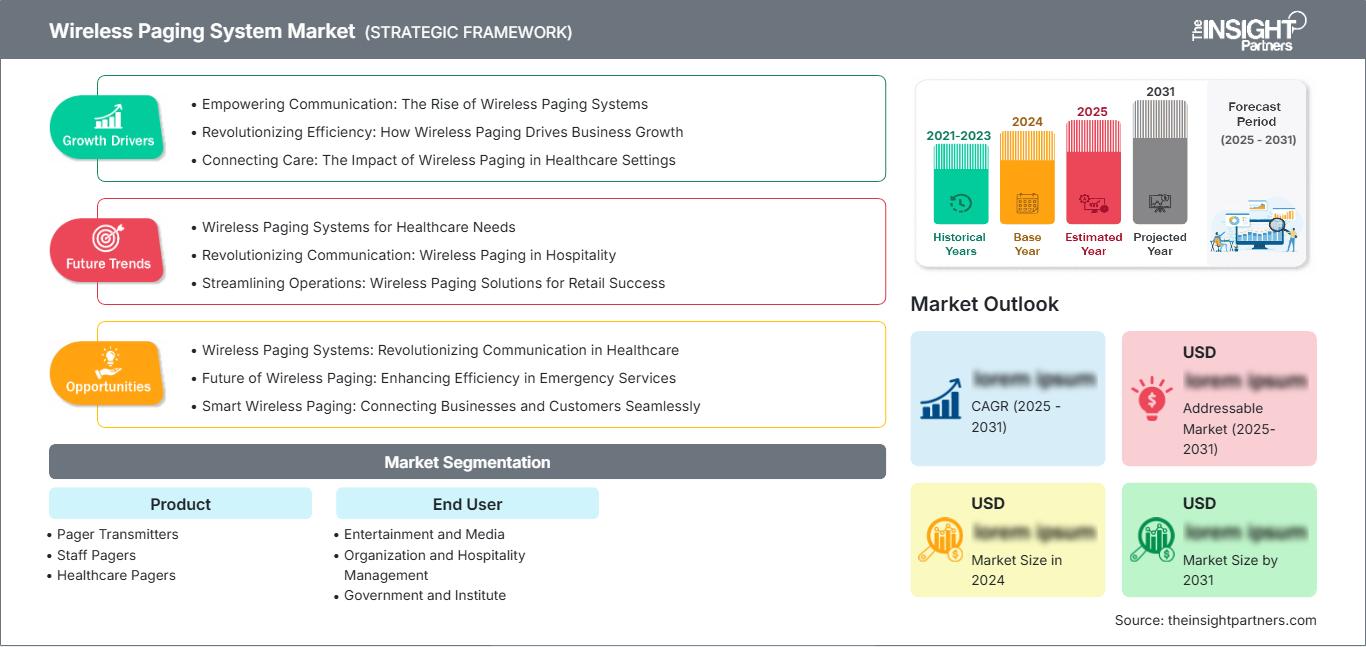
Regional Insights
North America wireless paging system market
North America is estimated to account for 32–36% of global revenue in 2025, with growth of 5.8–6.5% CAGR through 2034. The area can leverage the large base of installations in hospitals, restaurants, hotels, retail facilities, universities, warehousing operations, and public places. It is vital to consider replacement cycles since buyers may need to replace the transmitter, charger, receiver, or the software while retaining the existing process.
Healthcare continues to be a major structural component since hospitals need effective communication between various departments, waiting areas, and other related departments. Guest and employee notification is used by hospitality and food service providers to manage congestion. Compliance with the need for emergency communication, radio frequency, and accessibility will also make an investment worthwhile. The United States is the main contributor of the region, with Canada also contributing to it.
U.S. wireless paging system market
The US contributes approximately 62–68% of North American revenue in 2025 and is expected to grow at a 5.7–6.4% CAGR through 2034. Adoption occurs among restaurants, healthcare providers, retail outlets, warehouses, hotels, entertainment facilities, banks, and government-owned facilities. Suppliers and distributors provide for needs through expansion of their products or systems in dispersed commercial settings.
There is a growing trend towards adoption of hybrid communication methods. The use of pagers along with SMS, computer-based notifications, call buttons, display screens, and table-location systems is possible. Suppliers of paging technology such as JTECH Global Enterprises, Inc., Long Range Systems, LLC, Pagertec Corp., Visiplex, Inc., and others maintain a commercial footprint within multiple sectors. Labor management requirements aid adoption since swift communication does not need everyone to own a smartphone.
Europe wireless paging system market
Europe represents approximately 27–31% of global revenue in 2025 and is projected to expand at a 5.5–6.2% CAGR through 2034. In Germany, there is a dominant presence in the regional market driven by the needs of industries, healthcare, hospitality, logistics, and institutions. There is considerable demand for chargers in the UK owing to the healthcare, hospitality, and retail sectors, apart from public establishments, with mature replacement cycles favoring upgrade purchases.
Germany offers a blend of the need for industrial communications and strong focus on equipment reliability and safety. In the UK, it is the deployment of chargers in the hospitality, healthcare, and services sectors that allow the continued use of staff and customer notifications. France and Italy offer demand owing to healthcare, hotels, restaurants, and public places, along with commercial establishments, whereas Spain derives its demand owing to the hospitality and tourism sector.
APAC wireless paging system market
APAC accounts for approximately 23–27% of global revenue in 2025 and is projected to grow at a 7.0–7.8% CAGR through 2034. China is the leading market for demand within the region, followed by Japan, South Korea, India, and Australia. Increasing numbers of hospitals, hospitality venues, manufacturing and logistics facilities, and institutional sites create additional deployment possibilities.
In China, the focus is on manufacturing and development of facilities in large scales, while in Japan there is an emphasis on dependable communications and health care systems. South Korea favors technology-oriented facilities, India has expansion capacity via health care and organized services, and Australia via health care, hospitality, and institutional sites.
Middle East & Africa wireless paging system market
Middle East and Africa demand is supported by healthcare expansion, hospitality investment, logistics infrastructure, and institutional modernization. Saudi Arabia leads regional adoption, followed by the UAE and South Africa, while other markets provide incremental opportunities. Regional growth is estimated at 5.8–6.7% CAGR through 2034.
In Saudi Arabia and the United Arab Emirates, there is an advantage of huge hospitality, health care, retail, and infrastructure projects. In South Africa, there is a ready market for projects involving health care, commercial and institutional infrastructure projects. In other areas, investments in hospital buildings, hotels, industrial and public infrastructures offer scope for wireless solutions where wiring could be disruptive and expensive.
Segmentation Analysis
Product
The Product segment is expected to expand at a 6.4–6.8% CAGR during 2026–2034. Wireless paging system market procurement increasingly combines transmitters with application-specific receivers, creating integrated configurations rather than isolated hardware purchases. Product selection depends on coverage, alert modes, receiver capacity, battery design, durability, and compatibility with operational workflows. Healthcare and hospitality requirements particularly influence configuration choices.
- Pager Transmitters: Transmitters remain the system control point, determining coverage, receiver addressing, message initiation, and integration capability. Demand favors scalable units capable of supporting larger receiver populations and multiple notification workflows.
- Staff Pagers: Staff pagers support rapid employee communication in restaurants, hotels, healthcare facilities, warehouses, and retail operations. Their discreet vibration, audible alerts, and compact designs make them suitable for mobile personnel.
- Healthcare Pagers: Healthcare pagers prioritize dependable notification, discreet alerts, battery endurance, and operational simplicity. They remain relevant where clinical teams require immediate communication across departments, treatment areas, and support functions.
- Guest Pagers: Guest pagers help operators manage waiting customers without requiring them to remain near reception or ordering counters. Their strongest applications involve restaurants, hospitality properties, entertainment venues, and service businesses.
- Waiter Pager: Waiter pagers facilitate service requests and task coordination between guests and employees. Their importance increases where rapid response can improve table turnover, order accuracy, and staff utilization.
End User
The End User segment is projected to grow at a 6.0–6.5% CAGR through 2034. Adoption differs by operating environment, communication urgency, workforce mobility, and infrastructure complexity. Healthcare and hospitality provide strong recurring demand, while warehouses, banks, military facilities, government organizations, and entertainment venues broaden the addressable customer base.
- Entertainment and Media: Stadiums, cinemas, event venues, and entertainment facilities use paging for staff coordination, guest management, service requests, and operational alerts across large and crowded environments.
- Organization and Hospitality Management: Hotels, restaurants, resorts, and service organizations use paging to coordinate employees and manage guest notifications. Systems support distributed workflows where rapid communication affects customer experience.
- Government and Institute: Government buildings, universities, schools, and public institutions use paging for routine announcements, emergency communication, staff coordination, and accessibility-oriented notification requirements.
- Healthcare: Hospitals, clinics, medical centers, and care facilities use paging to coordinate staff, communicate patient-related alerts, and manage waiting processes where reliable notification remains operationally important.
- Warehouse and Logistics: Warehouses and logistics facilities use pagers to communicate with mobile workers, supervisors, drivers, and support personnel across noisy or expansive environments where smartphones may be impractical.
- Banks: Banks use paging for customer queue management, employee assistance, service coordination, and accessibility. Dedicated receivers can provide discreet notifications without requiring customers to remain beside service counters.
- Military: Military facilities can use controlled paging architectures for routine operational communication, alerts, scheduling, and facility coordination where robust local communication and defined coverage zones are required.
Opportunity Snapshot
| End User | Revenue Contribution (High/Medium/Low) | Trend Tag (MAX 2 words, specific) | Adoption Stage (Emerging/Scaling/Mature) |
|---|---|---|---|
| Entertainment and Media | Medium | Venue Coordination | Scaling |
| Organization and Hospitality Management | High | Guest Flow | Mature |
| Government and Institute | Medium | Emergency Alerts | Scaling |
| Healthcare | High | Clinical Alerts | Mature |
| Warehouse and Logistics | High | Worker Dispatch | Scaling |
| Banks | Low | Queue Notification | Mature |
| Military | Low | Secure Alerts | Emerging |
Wireless Paging System Market Growth Drivers and Impact Analysis
Expansion of healthcare communication requirements
Healthcare establishments need reliable means of communication between staff members involved in clinical activities, administration, technical issues, and support operations. According to WHO estimates, there will be a worldwide shortage of around 11 million health workers by 2030, hence increasing the need for effective collaboration between people. Wireless notification allows staff members to communicate promptly without completely depending on mobile phones or software systems. The effects will be most felt in the settings such as hospitals, clinics, medical centers, and care facilities where notifications need to be received by people going from one room or department to another.
Growth of organized hospitality and foodservice operations
Hospitality and foodservice operators continue to prioritize customer flow, labor efficiency, and rapid service coordination. Wireless paging system market demand benefits when restaurants use guest pagers to reduce counter congestion or staff pagers to communicate orders, assistance requests, and service requirements. IATA projected global passenger numbers at 5.2 billion in 2025, illustrating the scale of travel activity supporting hotels, airports, restaurants, and related service infrastructure. Although paging represents only one communication layer, its low training burden and predictable local operation make it useful in busy facilities. Suppliers increasingly connect paging with waitlist software, kiosks, table-location technology, call buttons, and digital signage to address operational bottlenecks.
Modernization of distributed industrial and institutional facilities
Warehouses, manufacturing plants, campuses, public buildings, and large commercial properties require communication methods that function across physical spaces, equipment zones, and operational teams. Wireless systems can reduce cabling requirements while supporting zone-based notifications, scheduled alerts, emergency messages, and mobile staff communication. Modern facilities also increasingly evaluate resilience because communication interruptions can affect productivity and safety. Products incorporating multiple alert modes, extended coverage, remote activation, and integration with visual or audible notification infrastructure can address these requirements. This creates demand for scalable architectures rather than isolated pager units. Vendors with experience in facility-wide deployments can capture replacement projects by positioning paging as part of broader communication and emergency-notification infrastructure.
Wireless Paging System Market Future Trends
Convergence of paging with software-defined workflows
Wireless paging system market trends are expected to move toward deeper integration between dedicated receivers and software-defined operational workflows. Future deployments will increasingly allow paging events to originate from ordering platforms, patient-management applications, warehouse systems, security interfaces, scheduling tools, and facility sensors. This architecture can preserve the reliability of dedicated notification while expanding automation. Buyers are likely to favor platforms that provide application programming interfaces, configurable event rules, centralized administration, and audit visibility. Another development will involve multi-channel alerts, where a single event can trigger a pager, SMS, email, display, beacon, or voice message according to predefined rules. Such architectures can improve continuity when one communication channel becomes unavailable.
More specialized receivers for workforce and accessibility needs
Future products are likely to differentiate receivers according to workplace conditions rather than relying on one universal pager design. Healthcare environments may prioritize discreet vibration and readable displays, warehouses may emphasize ruggedization and high-volume charging, while hospitality applications may favor compact guest devices and simplified allocation. Accessibility will also influence product design, with visual, vibration, and audible alert combinations supporting workers and customers with different communication needs. Battery management should become more sophisticated as organizations seek lower maintenance costs and higher equipment availability. Manufacturers may also develop modular charging stations, remote diagnostics, configurable alert profiles, and device-health monitoring. These features can strengthen recurring service relationships while reducing replacement uncertainty for large deployments.
Wireless Paging System Market Opportunities
Integrated healthcare communication platforms
Healthcare presents an opportunity for suppliers to move from standalone paging equipment toward integrated communication platforms. Hospitals can connect pagers with nurse-call systems, patient-flow applications, emergency notification tools, scheduling platforms, and digital displays. The opportunity is particularly relevant for facilities managing multiple departments where staff members move continuously between clinical and administrative zones. Vendors can differentiate through interoperability, role-based messaging, centralized configuration, and secure event management. Procurement strategies should prioritize lifecycle cost, receiver durability, charging infrastructure, coverage validation, and service support rather than initial hardware pricing alone. Partnerships with healthcare technology integrators can broaden distribution and create larger project opportunities. Solutions designed for phased deployment can also reduce disruption during upgrades.
Connected hospitality and logistics notification ecosystems
Hospitality and logistics provide an opportunity to connect paging with customer-flow and workforce-management systems. Restaurants can combine guest notification, order-ready alerts, table-location technology, and staff calls, while warehouses can connect worker paging with dispatch, equipment assistance, loading activities, and supervisory alerts. The wireless paging system market Forecasts indicate that value creation will increasingly depend on workflow integration rather than pager volume alone. Suppliers can pursue this opportunity by developing open interfaces, configurable event triggers, cloud-managed dashboards, and modular hardware. Regional partners can also support expansion into fragmented customer bases where local installation, training, and after-sales service influence purchasing decisions. These models can create repeat business through system additions and software upgrades.
Frequently Asked Questions

- Comprehensive Market Sizing and Forecast Analysis
- Detailed Segmentation Analysis
- In-Depth Market Dynamics Assessment
- Regional and Country-Level Insights
- Competitive Landscape and Company Benchmarking
- Strategic Business Intelligence
Recent Reports
Testimonials

The Insight Partners provided valuable market intelligence that supported our global go-to-market strategy. Their team was professional, responsive, and attentive to our feedback, providing thoughtful analysis and helpful methodological clarifications throughout the project.
Junmo Kim Chief Financial Officer (CFO), Enertech Co., Ltd.
The Insight Partners' SCADA System Market report is comprehensive, with valuable insights on current trends and future forecasts. The team was highly professional, responsive, and supportive throughout. We are very satisfied and highly recommend their services.
RAN KEDEM Partner, Reali Technologies LTDs
I requested a report on a very specific software market and the team produced the report in a few days. The information was very relevant and well presented. I then requested some changes and additions to the report. The team was again very responsive and I got the final report in less than a week.
JEAN-HERVE JENN Chairman, Future Analytica
We worked with The Insight Partners for an important market study and forecast. They gave us clear insights into opportunities and risks, which helped shape our plans. Their research was easy to use and based on solid data. It helped us make smart, confident decisions. We highly recommend them.
PIYUSH NAGPAL Sr. Vice President, High Beam Global
The Insight Partners delivered insightful, well-structured market research with strong domain expertise. Their team was professional and responsive throughout. The user-friendly website made accessing industry reports seamless. We highly recommend them for reliable, high-quality research services
YUKIHIKO ADACHI CEO, Deep Blue, LLC.
This is the first time I have purchased a market report from The Insight Partners.While I was unsure at first, I visited their web site and felt more comfortable to take the risk and purchase a market report.I am completely satisfied with the quality of the report and customer service. I had several questions and comments with the initial report, but after a couple of dialogs over email with their analyst I believe I have a report that I can use as input to our strategic planning process.Thank you so much for taking the extra time and making this a positive experience.I will definitely recommend your service to others and you will be my first call when we need further market data.
JOHN SUZUKI President and Chief Executive Officer, Board Director, BK Technologies
I wish to appreciate your support and the professionalism you displayed in the course of attending to my request for information regarding to infectious disease IVD market in Nigeria. I appreciate your patience, your guidance, and the fact that you were willing to offer a discount, which eventually made it possible for us to close a deal. I look forward to engaging The Insight Partners in the future, all thanks to the impression you have created in me as a result of this first encounter.
DR CHIJIOKE ONYIA MANAGING DIRECTOR, PineCrest Healthcare Ltd.Reason to Buy
- Informed Decision-Making
- Understanding Market Dynamics
- Competitive Analysis
- Identifying Emerging Markets
- Customer Insights
- Market Forecasts
- Risk Mitigation
- Boosting Operational Efficiency
- Strategic Planning
- Investment Justification
- Tracking Industry Innovations
- Aligning with Regulatory Trends





 Get Free Sample for