
Wireless Platforms Market Size, Growth & Trends by 2034
Wireless Platforms Market Size and Forecasts (2021 - 2034), Global and Regional Share, Trends, and Growth Opportunity Analysis Report Coverage : By Platform Type (Cloud-Based Wireless Platforms, On-Premises Wireless Platforms, Hybrid Wireless Platforms), Deployment Model (Public Cloud, Private Cloud, Software-as-a-Service (SaaS), Platform-as-a-Service (PaaS)), Application (Wireless Device Management, Network Monitoring and Troubleshooting, Security and Compliance), Protocol (Wi-Fi, Cellular (LTE, 5G), Bluetooth, Zigbee, LoRaWAN)
- Status : Data Released
- Report Code : TIPRE00039842
- Category : Technology, Media and Telecommunications
- No. of Pages : 150
- Available Report Formats :


- Last update date : August 04, 2026


2025 Market Size
US$ 175.46 Bn
Base year value
2034 Forecast
US$ 297.74 Bn
Projected by 2034
CAGR 2026-2034
6.05 %
Growth rate
Addressable Market
US$ 2,142.68 Bn
(2026-2034)
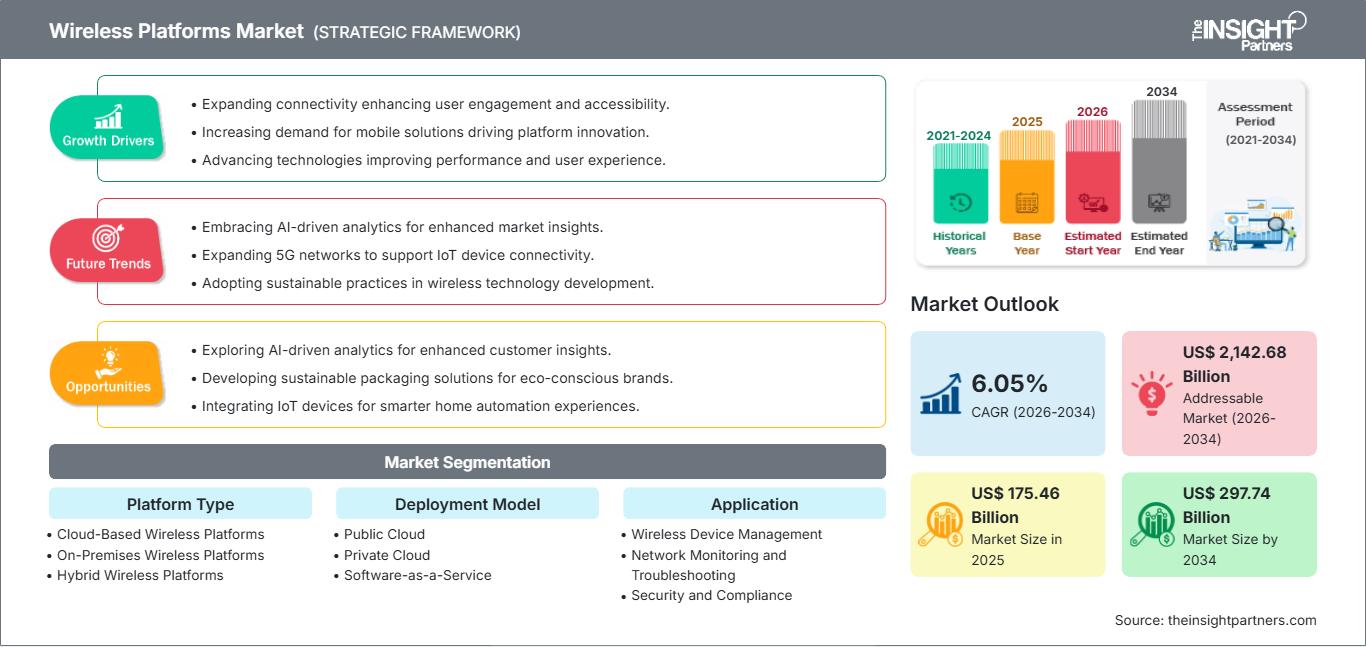
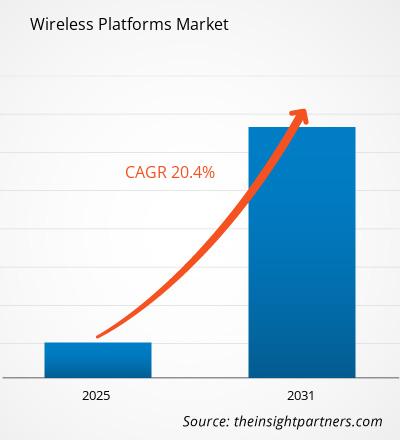
The global Wireless Platforms Market was valued at US$ 175.46 Billion in 2025 and is projected to reach US$ 297.74 Billion by 2034, expanding at a CAGR of 6.05% between 2026 and 2034. This growth trajectory reflects sustained enterprise investment in connectivity infrastructure, device management systems, and network orchestration technologies across industrial, commercial, and consumer environments worldwide, driven by escalating data traffic and IoT proliferation.
North America continues to anchor global demand, with enterprises accelerating investments in unified connectivity infrastructure. The region is estimated to expand at a CAGR between 5.7% and 6.4% through 2034, propelled by widespread 5G densification, rising hybrid workplace connectivity requirements, and early adoption of cloud-native network orchestration platforms among telecom operators and large enterprises. The Wireless Platforms Market size in North America benefits from mature digital infrastructure and regulatory support for spectrum expansion.
Wireless Platforms Market Assessment and Insights
- North America: Holds an estimated 30–34% share in 2025, growing at a CAGR of 5.7–6.4% during 2026–2034, supported by dense enterprise networks, advanced telecom infrastructure, and strong 5G rollout momentum across commercial sectors.
- US: Accounts for roughly 85–89% of North America's share in 2025, expanding at a CAGR of 5.6–6.3%, led by hyperscale cloud adoption and enterprise mobility initiatives.
- Europe: Commands an estimated 22–26% share in 2025, growing at a CAGR of 5.4–6.0% during 2026–2034, with Germany, the UK, and France driving industrial automation and smart infrastructure deployments.
- Asia Pacific: Holds approximately 28–32% share in 2025, expanding at a CAGR of 6.6–7.3%, led by China, Japan, South Korea, and India through aggressive telecom modernization and manufacturing digitization.
- Largest Segment: Cloud-Based Wireless Platforms lead with an estimated 42–46% market share in 2025, growing at a CAGR of 6.3–6.9% during 2026–2034, driven by scalability and remote management demand.
- High Growth Segment: Hybrid Wireless Platforms represent the fastest-growing category, holding 18–22% share in 2025 and expanding at a CAGR of 7.0–7.6% through 2034.
- Key companies analyzed in detail: Intel Corporation, NEC Corporation, Oracle Corporation, Mavenir Systems Inc., Cisco Systems Inc., VMware Inc., Fujitsu Limited, Samsung Electronics Co. Ltd., Huawei Technologies Co. Ltd., Nokia Corporation
Source: The Insight Partners' analysis based on proprietary research, government publications, company annual reports, investor presentations, industry databases, and expert interviews.
There have been significant developments in the wireless connectivity infrastructure because companies have changed from disjointed hardware-based systems to more unified and software-defined approaches. The initial deployments involved the use of on-premise controllers and other management systems that hindered scalability in distributed systems. The vendors are increasingly integrating cloud orchestration, artificial intelligence, and policy enforcement to enable the management of mixed devices, monitoring of network performance in real-time and compliance of security standards through the use of expanding endpoint ecosystems, especially in the face of increased remote work and IoT adoption.
In the future, the Wireless Platforms Market will experience expansion in developing countries through the modernization of their legacy infrastructure and implementation of government requirements for digital connectivity. Allocation of more capital to private 5G networks, edge computing, and laws that promote spectrum liberalization will drive adoption. The vendors will increase their investments in AI native platform technologies.
Wireless Platforms Market Report Scope
| Report Attribute | Details |
|---|---|
| Market size in 2025 | US$ 175.46 Billion |
| Market Size by 2034 | US$ 297.74 Billion |
| Global CAGR (2026 - 2034) | 6.05% |
| Historical Data | 2021-2024 |
| Forecast period | 2026-2034 |
Wireless Platforms Market Analysis
The demand for centralized wireless management is growing among enterprises as they have to cope with a highly complicated device ecosystem that involves Wi-Fi, cellular, Bluetooth, and low-power wide area network. The growth of the Wireless Platforms market is supported by an increase in the number of connected devices used in manufacturing plants, retailers, and health care institutions, where connectivity has a direct impact on service continuity.
The supply chain includes chip makers, software suppliers of platforms, systems integrators, and managed service providers that all provide different competencies in providing end-to-end connectivity solutions. The supply side is still affected by semiconductor supply and the development of interoperability standards, which requires stronger cooperation between vendors in the field of hardware and software.
Competitive intensity within the sector remains pronounced as established technology providers expand platform portfolios through targeted acquisitions and strategic alliances, contributing to the growth of the Wireless Platforms Market share. Cisco Systems Inc. and VMware Inc. have strengthened software-defined networking capabilities, while Huawei Technologies Co. Ltd. and Samsung Electronics Co. Ltd. continue advancing 5G-integrated platform offerings tailored to telecom operators and industrial clients across multiple geographies.
The investment trend is increasingly leaning towards automated and secure networks that use AI, where Oracle Corporation and Mavenir Systems Inc. are leveraging cloud-based systems in order to take advantage of modernization investments. NEC Corporation and Fujitsu Limited enjoy a strong market presence in the Asia Pacific region thanks to local deployment, whereas Intel Corporation is providing the basic silicon infrastructure for platform performance in various enterprise and carrier environments.
● REPORT CUSTOMIZATION
Tailor This Report To Align With Your Specific Business Requirements
This report can be customized to align precisely with your business objectives, scope, and target markets. Customization options include tailored segmentation, geography, competitive analysis, and strategic insights to support informed decision-making.
Customize This Report →WHAT YOU CAN ADJUST
- ● Segmentations
- ● Geography
- ● Competitive Analysis
- ● Language Preferences
Wireless Platforms Market: Strategic Insights
Regional Insights
North America Wireless Platforms Market
North America represents a mature and technologically advanced market, underpinned by extensive enterprise digitization and early adoption of cloud-native connectivity platforms. Structural drivers include dense broadband infrastructure, aggressive 5G spectrum deployment, and sustained investment in hybrid workplace connectivity solutions across financial services, healthcare, and manufacturing sectors, positioning the region for a CAGR between 5.7% and 6.4% through 2034, according to the Wireless Platforms Market report.
Centralized systems, which can cater to multi-protocol environments including Wi-Fi 6E, private cellular and IoT protocols like LoRaWAN, have become the priority of enterprises in the region. The regulatory assistance that is available for spectrum allocation along with venture capital investments in network automation start-ups, will ensure that North America retains its status as a technology innovation center.
U.S. Wireless Platforms Market
The United States dominates North America, contributing an estimated 85–89% share of the regional Wireless Platforms Market in 2025, with a projected CAGR of 5.6–6.3% through 2034. This leadership stems from concentrated hyperscale cloud infrastructure, extensive enterprise IT budgets, and early carrier-grade 5G commercialization across metropolitan and industrial corridors.
Company presence is still strong with Cisco Systems Inc., VMware Inc., Intel Corporation, and Mavenir Systems Inc. retaining a sizable operational presence for their business and telecom customers. Application trends focus on network surveillance and security compliance, especially in industries like financial services, health care, and military, where data protection regulations become more stringent by the day, thus requiring continued investment in managing wireless devices and threat detection systems.
Europe Wireless Platforms Market
Europe holds an estimated 22–26% share of the global Wireless Platforms Market in 2025, expanding at a CAGR of 5.4–6.0% through 2034, with Germany positioned as the leading contributor owing to its robust industrial automation base and strong manufacturing digitization initiatives across automotive and engineering sectors.
The U.K. ensures steady demands from financial services' digitization and increasing smart cities connectivity, driven by spectrum modernization policies backed by the government and cloud migrations for enterprises in the thick commercial streets of London.
In Germany, the industrial sector is the major driver for platform adoption, especially in the context of automated manufacturing facilities under the Industry 4.0 environment, which require reliable wireless low-latency connectivity, backed by the robust government investment in digitalization efforts that facilitate 5G private network deployments within factories across the nation.
Italy, Spain, and France together provide regional volumes; France has telecom infrastructure modernization efforts, Italy has industrial Internet of Things deployment efforts in its manufacturing sector, while Spain has its efforts on smart and retail connectivity, funded by EU digital cohesion programs.
APAC Wireless Platforms Market
Asia Pacific commands approximately 28–32% share of the global Wireless Platforms Market in 2025, expanding at the fastest regional CAGR of 6.6–7.3% through 2034, with China leading through aggressive telecom infrastructure modernization and expansive manufacturing digitization initiatives across its industrial base.
Japan and South Korea have highly evolved connectivity ecosystems due to their robust semiconductor industry and early 5G commercialization, whereas India shows a growing trend of adoption in its telecom subscriber base and the country's digital infrastructure policies. Australia enhances the adoption of enterprise cloud platforms in the mining and logistics industries, which is additionally aided by government policies for IoT and smart manufacturing.
Middle East & Africa Wireless Platforms Market
The Middle East and Africa Wireless Platforms Market is expanding at a CAGR of 5.9–6.5% through 2034, with Saudi Arabia leading regional adoption through substantial infrastructure investment tied to national digital transformation programs supporting smart city development and industrial diversification initiatives across energy-adjacent sectors.
UAE solidifies its stance by investing in telecoms upgrading and growing enterprise cloud implementation in Dubai’s business centers, whereas South Africa builds on its connectivity infrastructure for mining and logistics activities. RoMEA is characterized by a slow but steady adoption of the technology owing to energy digitalization and increased infrastructure investments related to economic diversification.
Segmentation Analysis
Platform Type
Cloud-Based Wireless Platforms lead this segment, growing at a CAGR of 6.3–6.9% between 2026 and 2034. Enterprises increasingly favor cloud-based architectures for their scalability, reduced infrastructure overhead, and centralized visibility across distributed device fleets, particularly as multi-site organizations seek unified management without extensive on-premises hardware investment, reinforcing this Wireless Platforms Market scope across diverse enterprise verticals.
- Cloud-Based Wireless Platforms: Preferred by enterprises seeking scalable, subscription-based management with minimal capital expenditure, supporting rapid deployment across geographically dispersed operational sites and branch locations.
- On-Premises Wireless Platforms: Retained by organizations with strict data sovereignty requirements, particularly within defense, government, and highly regulated financial services environments demanding localized control.
- Hybrid Wireless Platforms: Increasingly adopted by enterprises, balancing cloud scalability with localized processing needs, supporting latency-sensitive applications while maintaining centralized policy oversight across distributed networks.
Deployment Model
Software-as-a-Service leads deployment models, expanding at a CAGR of 6.4–7.0% through 2034. This model's dominance stems from predictable subscription economics and simplified upgrade cycles, enabling enterprises to access continuously updated platform capabilities without dedicated infrastructure teams managing version control.
- Public Cloud: Widely adopted by small and mid-sized enterprises seeking cost-efficient scalability without dedicated infrastructure investment or specialized IT management resources.
- Private Cloud: Favored by large enterprises requiring enhanced data control, supporting industries with stringent compliance obligations around sensitive network traffic.
- Software-as-a-Service: Dominant model offering subscription flexibility, rapid deployment, and continuous feature updates across enterprise wireless management environments.
- Platform-as-a-Service: Utilized by developers building custom connectivity applications, supporting integration flexibility across diverse enterprise technology stacks.
Application
The Wireless Device Management application segment of the Wireless Platforms Market leads applications and is projected to grow at a CAGR of 6.2–6.8% through 2034, driven by expanding endpoint volumes that require centralized provisioning, monitoring, and lifecycle management across enterprise and industrial IoT deployments. Increasing demand for secure device connectivity, remote management capabilities, and real-time operational visibility continues to support adoption across industries undergoing digital transformation.
- Wireless Device Management: Core application supporting provisioning, configuration, and lifecycle oversight across expanding fleets of connected enterprise and industrial devices.
- Network Monitoring and Troubleshooting: Critical for maintaining operational continuity, enabling proactive issue detection across complex multi-protocol enterprise network environments.
- Security and Compliance: Increasingly prioritized amid rising cyber threats, supporting regulatory adherence across finance, healthcare, and government network infrastructures.
Protocol
Wi-Fi remains the dominant protocol, growing at a CAGR of 5.8–6.4% through 2034, supported by ubiquitous enterprise deployment and continuous technical evolution through successive standards enhancing throughput and device density support.
- Wi-Fi: Foundational protocol supporting high-density enterprise environments, benefiting from continuous standards evolution, improving throughput and connection reliability.
- Cellular: Expanding rapidly through private 5G network deployments, supporting mission-critical industrial and logistics applications requiring wide-area coverage.
- Bluetooth: Widely used for short-range device connectivity, particularly within retail, healthcare, and consumer electronics ecosystems.
- Zigbee: Utilized across smart building and industrial automation applications requiring low-power mesh networking capabilities.
- LoRaWAN: Adopted for long-range, low-power IoT applications, including asset tracking and environmental monitoring across expansive industrial sites.
Opportunity Snapshot
| Application | Revenue Contribution | Trend Tag | Adoption Stage |
| Wireless Device Management | High | Fleet Provisioning | Scaling |
| Network Monitoring and Troubleshooting | High | Predictive Analytics | Scaling |
| Security and Compliance | Medium | Zero Trust | Emerging |
Wireless Platforms Market Growth Drivers and Impact Analysis
Enterprise 5G Densification Accelerates Platform Adoption
The deployment of private and public 5G networks within manufacturing, logistics, and healthcare facilities has created an urgent need for businesses to integrate wireless platforms that can handle diverse networking connectivity scenarios. Enterprises are facing a challenge where there is a need for a unified vision of their Wi-Fi, cellular, and IoT networks amid an increase in device density. Telecom service providers are equally updating their infrastructure to facilitate network slicing that meets enterprise needs. The merging of carrier-grade solutions and enterprise needs is impacting purchasing decisions, with enterprises looking for vendors that provide multi-protocol integration and automated policy management.
Rising Cybersecurity Mandates Drive Compliance-Integrated Platforms
The increasing trend of regulatory oversight on data protection issues, especially in the financial services, health care, and public service areas, is forcing organizations to favor wireless solutions with inherent security and compliance features. Businesses are under increasing pressure to provide visibility and instant detection of threats to their networks, leading to continued investment in security solutions. The tightening up of regulations with respect to the handling of data by regulatory authorities in several countries has been affecting the selection criteria for platforms. Vendors that offer features such as encryption, access control, and compliance reporting are becoming preferred over others.
Industrial IoT Expansion Fuels Multi-Protocol Platform Demand
The manufacturing and logistics industry is adopting technologies such as connected sensors and automation that call for the need for a platform able to manage different protocols, including Zigbee, LoRaWAN, and cellular. The increasing number of IoT devices used in the manufacturing industry creates the need for platforms that offer unified management for different connectivity levels. The industrial automation efforts in different countries with thriving manufacturing industries keep reinforcing this development since companies try to reduce downtime through monitoring and predictive maintenance services. There is a growing preference for vendors able to support different protocols, but with a consistent management interface.
Wireless Platforms Market Future Trends
AI-Native Network Automation Gains Momentum
Trends in the market for Wireless Platforms have increasingly begun to trend towards platforms that are natively built with an AI structure, allowing for independent network optimization and prediction-based fault correction. These solutions involve the use of algorithms that are integrated with the core of wireless platforms, facilitating the analysis of traffic patterns and capacity management in real time without the need for human interference. This not only lowers the operational costs of enterprise IT staff but also ensures that there is an increase in the stability of wireless networks despite their complexity in today’s world.
Edge-Integrated Platform Architectures Expand
Platform providers are now including the capacity to perform edge computing within wireless platform management itself. Such an approach caters to the need arising from the demand from various sectors of industry for instant responses from applications that cannot be achieved through cloud computing alone. In addition, such a platform helps organizations maintain control over their policies while performing computational operations closer to endpoint devices, thus decreasing bandwidth utilization and improving performance. With the advent of 5G technology around the globe, the integration of edge computing and wireless platform management will become more widespread.
Wireless Platforms Market Opportunities
Private 5G Network Integration Presents Substantial Investment Potential
Enterprises in the manufacturing, mining, and logistics domains are using private 5G networks, which present huge potential for vendors that provide platforms with unified management capabilities for both cellular and conventional Wi-Fi networks. Companies that plan to use dedicated spectrum for mission-critical operations need advanced platform management capabilities that will enable management of network slicing, quality of service, and multi-vendor interoperability. Vendors who will successfully merge telecom-class cellular network technology and corporate IT management will benefit from continued investment as the regulatory frameworks in several countries are opening up the spectrum for private industrial networks, which is a strong indicator for long-term market growth.
Emerging Market Telecom Modernization Creates Expansion Pathways
Telecom operators across Southeast Asia, Latin America, and parts of Africa are actively modernizing legacy network infrastructure, creating meaningful expansion opportunities for wireless platform vendors offering cost-effective, scalable solutions tailored to developing digital ecosystems. Government-backed connectivity initiatives across these regions are accelerating infrastructure investment, particularly around rural broadband expansion and smart city pilot programs. Vendors capable of offering flexible deployment models suited to varying infrastructure maturity levels, combined with localized support capabilities, are well-positioned to capture first-mover advantages as these markets transition from basic connectivity toward more sophisticated, application-rich wireless management requirements over the coming decade.
Frequently Asked Questions

- Comprehensive Market Sizing and Forecast Analysis
- Detailed Segmentation Analysis
- In-Depth Market Dynamics Assessment
- Regional and Country-Level Insights
- Competitive Landscape and Company Benchmarking
- Strategic Business Intelligence
Recent Reports
Testimonials

The Insight Partners' SCADA System Market report is comprehensive, with valuable insights on current trends and future forecasts. The team was highly professional, responsive, and supportive throughout. We are very satisfied and highly recommend their services.
RAN KEDEM Partner, Reali Technologies LTDs
I requested a report on a very specific software market and the team produced the report in a few days. The information was very relevant and well presented. I then requested some changes and additions to the report. The team was again very responsive and I got the final report in less than a week.
JEAN-HERVE JENN Chairman, Future Analytica
We worked with The Insight Partners for an important market study and forecast. They gave us clear insights into opportunities and risks, which helped shape our plans. Their research was easy to use and based on solid data. It helped us make smart, confident decisions. We highly recommend them.
PIYUSH NAGPAL Sr. Vice President, High Beam Global
The Insight Partners delivered insightful, well-structured market research with strong domain expertise. Their team was professional and responsive throughout. The user-friendly website made accessing industry reports seamless. We highly recommend them for reliable, high-quality research services
YUKIHIKO ADACHI CEO, Deep Blue, LLC.
This is the first time I have purchased a market report from The Insight Partners.While I was unsure at first, I visited their web site and felt more comfortable to take the risk and purchase a market report.I am completely satisfied with the quality of the report and customer service. I had several questions and comments with the initial report, but after a couple of dialogs over email with their analyst I believe I have a report that I can use as input to our strategic planning process.Thank you so much for taking the extra time and making this a positive experience.I will definitely recommend your service to others and you will be my first call when we need further market data.
JOHN SUZUKI President and Chief Executive Officer, Board Director, BK Technologies
I wish to appreciate your support and the professionalism you displayed in the course of attending to my request for information regarding to infectious disease IVD market in Nigeria. I appreciate your patience, your guidance, and the fact that you were willing to offer a discount, which eventually made it possible for us to close a deal. I look forward to engaging The Insight Partners in the future, all thanks to the impression you have created in me as a result of this first encounter.
DR CHIJIOKE ONYIA MANAGING DIRECTOR, PineCrest Healthcare Ltd.Reason to Buy
- Informed Decision-Making
- Understanding Market Dynamics
- Competitive Analysis
- Identifying Emerging Markets
- Customer Insights
- Market Forecasts
- Risk Mitigation
- Boosting Operational Efficiency
- Strategic Planning
- Investment Justification
- Tracking Industry Innovations
- Aligning with Regulatory Trends





 Get Free Sample for