
Workholding Market Growth, Trends & Forecast by 2034
Coverage: By Type (Milling/Drilling, Turning, Grinding); Application (Automotive, Manufacturing, Metals, Others) , and Geography (North America, Europe, Asia Pacific, and South and Central America)
- Status : Data Released
- Report Code : TIPRE00026921
- Category : Manufacturing and Construction
- No. of Pages : 150
- Available Report Formats :


- Last update date : October 13, 2026


2025 Market Size
US$ 7.47 Bn
Base year value
2034 Forecast
US$ 14.08 Bn
Projected by 2034
CAGR 2026-2034
8.25 %
Growth rate
Addressable Market
US$ 102.04 Bn
(2026-2034)
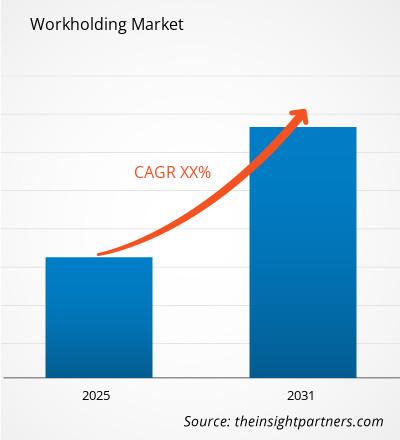
The workholding market size is valued at US$ 7.47 Billion in 2025 and is projected to reach US$ 14.08 Billion by 2034, registering a CAGR of 8.25% from 2026 to 2034. The market encompasses clamping, fixturing, positioning, and holding technologies used across machining operations. Demand is increasingly linked to CNC utilization, production flexibility, tighter tolerances, shorter setup cycles, and automation-enabled manufacturing environments.
Across North America, the workholding market is expected to expand at an estimated 7.5–8.5% CAGR between 2026 and 2034. The regional outlook is supported by reshoring of precision manufacturing, expansion of automated machining cells, and sustained requirements from automotive, aerospace, defense, and industrial equipment producers seeking repeatable setups and reduced operator dependency.
Workholding Market Assessment and Insights
- North America held an estimated 21–24% workholding market share in 2025 and is projected to grow at a 7.5–8.5% CAGR between 2026–2034, supported by CNC modernization, reshoring, automated loading, and demand for repeatable quick-change systems.
- US represented approximately 78–82% of North American demand in 2025 and is expected to expand at a 7.6–8.6% CAGR between 2026–2034, led by aerospace, automotive, defense, and industrial automation.
- Europe accounted for an estimated 23–26% share in 2025 and is projected to register a 7.0–8.0% CAGR between 2026–2034. Germany, Italy, France, the UK, and Spain remain important precision-manufacturing markets.
- Asia Pacific represented approximately 37–40% share in 2025 and is forecast to grow at an 8.8–9.8% CAGR between 2026–2034, with China, Japan, South Korea, and India supporting manufacturing capacity and automation investments.
- Largest Segment Milling/Drilling held an estimated 38–41% market share in 2025 and is expected to grow at a 8.0–9.0% CAGR between 2026–2034, reflecting widespread use in machining centers.
- High Growth Segment Manufacturing application represented approximately 35–38% share in 2025 and is projected to expand at a 9.0–10.0% CAGR between 2026–2034, supported by flexible production and automated machining.
- Key companies analyzed in detail: DESTACO, Enerpac Tool Group Corp., Gerardi S.p.A., Jergens Inc., TE-CO Manufacturing LLC, Alpha Workholding Solutions, LLC, EMUGE-FRANKEN USA, EROWA AG, LANG Technik GmbH, and Pierson Workholding.
Source: The Insight Partners' analysis based on proprietary research, government publications, company annual reports, investor presentations, industry databases, and expert interviews.
Workholding systems are shifting from conventional mechanical clamping to modular, quick-release, hydraulic, pneumatic and automated compatible systems. CNC machining centers are now looking for fixtures that ensure rigidity while allowing easy tool approach, particularly in five-axis machining. In addition, industry research has noted that fixtures are an integral part of the machining force and accuracy system and can influence stiffness, thermal stability, and the quality of the finished product. The above requirements increase the value of engineered systems rather than just holding systems.
In the forecast period, the investments in the workholding market are likely to be shifted towards flexible manufacturing cells, standard interfaces, zero-point concepts, sensor-based clamping, and digital coordination of the production process. There will be increased demand for manufacturing centers being developed in India and Southeast Asia along with improved equipment used by manufacturers in Europe and North America. Regulations concerning safety of machinery, process control, energy efficiency, and traceability will favor suppliers that possess mechanical functionality as well as automation capabilities.
Workholding Market Report Scope
| Report Attribute | Details |
|---|---|
| Market size in 2025 | US$ 7.47 Billion |
| Market Size by 2034 | US$ 14.08 Billion |
| Global CAGR (2026 - 2034) | 8.25% |
| Historical Data | 2021-2024 |
| Forecast period | 2026-2034 |
Workholding Market Analysis
The increasing use of CNC machines, complicated geometrical designs of parts, and the need for fast and efficient setups and changes are closely linked with the growth of the workholding market. In the case of automotive, metals, and general manufacturing sectors, there is a requirement for holding devices that will guarantee precision positioning during milling, drilling, turning, and grinding at high speed. The players in the value chain include machine tool suppliers, fixture suppliers, component suppliers, integration firms, distributors, and end-users.
There is also a shift in the supply structure due to the requirement of a common platform capable of handling different types of components and manufacturing orders by manufacturers. Interchangeable jaws, modular fixtures, pallets, and zero-point systems allow the manufacturer to switch its equipment from one job to another. It is also essential to take into consideration raw material costs, complexity of machining, and reliability of lead times.
Increasingly, analysis of the workholding market is taking into account competitiveness in terms of customization, modularity, automation preparedness, and overall productivity throughout the life cycle. The company DESTACO is distinguished by combining workholding technology with automation, Enerpac Tool Group Corp. offers engineered industrial tools and hydraulics, whereas Gerardi S.p.A. and Jergens Inc. are strong competitors in precision tooling and modularity. TE-CO Manufacturing LLC, Alpha Workholding Solutions, LLC, and Pierson Workholding offer products to meet special needs in machining operations.
Also, competitiveness in the workholding market is affected by developments in flexible manufacturing and customer-specific engineering. In particular, the company EROWA AG is focused on automated manufacturing and palletizing technology, LANG Technik GmbH has a reputation of a leader in modular workholding and automation solutions, while EMUGE-FRANKEN USA provides products for both precision tooling and machining. The strategic advantage in workholding is achieved nowadays via shortening setup times, improving the machine utilization, and supporting multiple configurations.
● REPORT CUSTOMIZATION
Tailor This Report To Align With Your Specific Business Requirements
This report can be customized to align precisely with your business objectives, scope, and target markets. Customization options include tailored segmentation, geography, competitive analysis, and strategic insights to support informed decision-making.
Customize This Report →WHAT YOU CAN ADJUST
- ● Segmentations
- ● Geography
- ● Competitive Analysis
- ● Language Preferences
Workholding Market: Strategic Insights

Regional Insights
North America workholding market
According to the workholding market report, North America accounted for approximately 21–24% of global demand in 2025, with a 7.5–8.5% CAGR anticipated through 2034. There is also ample existing base of CNC technology in the region along with investments made in aerospace, automotive, defense, medical, and industrial machinery. Reshoring and nearshoring efforts have led to increased investment by manufacturing firms into setting up or upgrading their machine shop facilities leading to growth in the demand for modular fixturing, quick-change pallets, and automated clamping systems.
The United States is the major consumer in the region, while Canada makes its contributions through aerospace, energy machinery, automotive, and precision manufacturing. Engineering response time, domestic presence, repeatability, and robot loading capabilities become increasingly important to buyers. There is still importance attached to hydraulic and pneumatic clamping systems in production environments, but zero-point and sensor-based technologies have started to acquire importance in regions where manufacturers are looking for reduced cycle times and process control.
U.S. workholding market
The US represented approximately 78–82% of North American demand in 2025, with a projected 7.6–8.6% CAGR through 2034. The nation experiences a large amount of aerospace, automotive, defense, industrial equipment, and contract machining operations. The investments made in manufacturing are becoming more geared towards automation, machine tool upgrades, and domestic production, thereby contributing to the need for workholding that will be used across different machining operations.
Current applications in the workholding market are looking to minimize setup times, positioning accuracy, and the ability to be used with automated handling equipment. Manufacturers are also beginning to look at the total cost associated with workholding and not just its acquisition cost, taking into account changeover times, life expectancy, maintenance, and machining capability. Jergens Inc., DESTACO, and other traditional workholding manufacturers have been maintaining their position in the marketplace by means of engineering and application experience.
Europe workholding market
The workholding market forecast shows that Europe represented approximately 23–26% share in 2025 and is expected to expand at a 7.0–8.0% CAGR. Germany stays ahead due to its high concentration of machine tools, automotive, and industrial engineering industry. The UK has demand from aerospace, defense, and advanced engineering. France has aerospace and industrial equipment demands, while Italy and Spain have automotive, machinery, metalworking, and manufacturing demands.
Procurement in Europe is repeatable, well documented, compatible with machines, and process stable. Germany with its advanced machining industry helps in producing modular and automated systems, while Italy with its machine tool industry has demand for flexible fixturing. France and the UK are focused on precision systems for aerospace and parts, while Spain benefits from automotive and industrial production. Sustainable solutions for scrap reduction, setup reduction, and compressed air reduction are promoted by the region.
APAC workholding market
APAC held approximately 37–40% share in 2025 and is projected to record an 8.8–9.8% CAGR through 2034, making it the fastest-growing major region. The largest market is China, then Japan, South Korea, India, and Australia. Mass production of automotive, electronics, machinery, and precision components results in significant needs for precise machining setups.
China uses its manufacturing capacity along with investing in automation, while Japan pays attention to precision and process control. South Korea has advantages in automotive, shipbuilding, electronics, and advanced manufacturing. India is growing in terms of CNC capability via automotive, aerospace, defense, and localization of manufacturing industries, and Australia helps with mining and industry machinery demands.
Middle East & Africa workholding market
Middle East and Africa represent a smaller portion of global demand but are expected to expand at approximately 6.5–7.5% CAGR through 2034. Saudi Arabia leads regional opportunity, supported by industrial diversification, machinery investment, and energy-related manufacturing. The UAE is developing advanced production capabilities, while South Africa provides an established base in automotive, mining, engineering, and industrial equipment.
Regional demand is closely connected with infrastructure, energy, metals, and diversification programs. Buyers often prioritize robust systems, reliable service, and adaptable solutions capable of supporting heavier components and varied machining requirements. New industrial facilities provide opportunities to install standardized workholding architectures from inception, while existing plants increasingly seek productivity improvements through modular fixtures and quicker changeovers.
Segmentation Analysis
Type
The Type segment covers Milling/Drilling, Turning, and Grinding applications. It is expected to register approximately 8.0–9.0% CAGR from 2026–2034, as manufacturers increasingly select application-specific holding technologies capable of controlling vibration, maintaining access, and supporting automated production. Demand is strongest where machining complexity and throughput requirements make fixture rigidity and repeatability central to production economics.
- Milling/Drilling represents the largest application group because machining centers process diverse prismatic components. Flexible vises, fixtures, pallets, and zero-point interfaces support rapid setup changes and improved tool accessibility.
- Turning serves components requiring secure rotational positioning and concentricity. Chucking and collet-based systems remain important across automotive, industrial, and precision-machining applications where repeatability directly affects finished-part quality.
- Grinding requires stable positioning and controlled clamping forces because surface finish and dimensional accuracy are highly sensitive to vibration, distortion, and thermal effects. Specialized fixtures therefore retain strategic importance.
Application
The Application segment includes Automotive, Manufacturing, and Metals and is projected to grow at approximately 8.4–9.4% CAGR from 2026–2034. Broader adoption of automated machining cells and increasingly varied production programs is increasing the need for versatile systems that can accommodate frequent component changes while maintaining precision.
- Automotive requires repeatable, high-throughput workholding for engine, transmission, drivetrain, structural, and electric-vehicle components. Standardized interfaces and automated clamping support production consistency across large manufacturing programs.
- Manufacturing covers general industrial and precision production where flexibility is essential. Demand is supported by contract manufacturing, shorter batch cycles, machine utilization targets, and growing deployment of modular fixture systems.
- Metals includes machining environments handling demanding metal components. Robust clamping, high rigidity, and resistance to cutting forces are strategically important for heavy-duty production and applications requiring reliable process stability.
Opportunity Snapshot
| Application | Revenue Contribution (High/Medium/Low) | Trend Tag (MAX 2 words) | Adoption Stage (Emerging/Scaling/Mature) |
| Automotive | High | EV Machining | Mature |
| Manufacturing | High | Flexible Cells | Scaling |
| Metals | Medium | Heavy Clamping | Scaling |
Workholding Market Growth Drivers and Impact Analysis
Expansion of automated CNC production cells
Automation is increasing the value of workholding systems that can interface reliably with robots, pallets, machine controls, and automated loading equipment. As manufacturers seek higher spindle utilization, fixtures must permit predictable loading, secure clamping, and rapid release without introducing positional variability. The impact extends beyond large automotive plants because smaller contract manufacturers are adopting collaborative robots and flexible cells to address labor constraints. Quick-change foundations and modular fixtures can shorten non-cutting time and enable one machine to process more product families. Sensor-enabled systems could further strengthen this trend by providing confirmation of clamp status and workpiece positioning. Suppliers that design mechanical interfaces around automated production requirements should therefore gain opportunities in both greenfield installations and retrofit projects.
Rising demand for five-axis and complex-part machining
The increasing production of geometrically complex components is raising the importance of low-profile, rigid, and accessible holding systems. Five-axis machining can reduce the number of setups required, but it places greater demands on fixture geometry because clamps must secure parts without obstructing tool paths. Aerospace, medical, energy, and advanced automotive components often require multi-surface access and consistent positioning across operations. The resulting market impact favors modular systems that can be rapidly configured around different component shapes. It also encourages suppliers to develop compact clamping elements, integrated locating concepts, and engineered fixtures that balance holding force with machining accessibility. As manufacturers pursue shorter production routes and fewer manual interventions, workholding becomes a process-enabling component rather than a passive accessory.
Pressure to reduce setup time and skilled-labor dependence
Manufacturers increasingly evaluate productivity through total cycle economics, making setup duration and operator dependency important cost variables. Workholding systems that simplify loading, establish repeatable references, or enable rapid fixture changes can reduce the time required between production batches. This is particularly valuable in high-mix environments where machines may switch between several component families each day. Standardized interfaces also allow fixture elements to be reused across machines and programs, reducing engineering duplication. The effect is strongest among manufacturers facing skilled-labor shortages because intuitive, repeatable clamping can reduce reliance on highly experienced operators for routine setup activities. Over time, this driver should support greater adoption of modular, quick-change, and automation-ready systems across both large plants and smaller machining businesses.
Workholding Market Future Trends
Connected fixtures with process-level feedback
Workholding market trends are expected to increasingly incorporate sensing and digital connectivity into clamping systems. Future solutions may monitor clamp force, fixture condition, part presence, temperature, or positional status and transmit information to machine controls or manufacturing execution systems. Such functionality can create a feedback loop between fixture performance and machining quality, helping manufacturers identify incorrect loading before cutting begins. Digital records could also support traceability for regulated production, particularly in aerospace and medical manufacturing. As sensor costs decline, connected capabilities may move beyond premium systems into standardized modular products. Suppliers that develop interoperable communication architectures will be positioned to participate in broader smart-factory ecosystems. The strongest applications will likely involve automated cells where reliable confirmation of part and fixture status directly supports unattended or lights-out production.
Adaptive workholding for variable production
Future workholding systems are likely to become more configurable as manufacturers balance mass production with shorter product lifecycles and increasing customization. Instead of dedicated fixtures for every component, modular architectures may combine standardized bases with adjustable locating and clamping elements. Digital fixture design could allow production engineers to validate access, force distribution, and collision risks before hardware is installed. Additive manufacturing may also support lightweight fixture components and customized contact geometries for selected applications. These developments can reduce engineering lead times and make smaller production runs economically viable. Adoption should be strongest in contract manufacturing, aerospace, industrial equipment, and emerging electric-mobility applications where product configurations change rapidly. The long-term direction is toward reusable platforms that combine physical adaptability with digitally documented setup instructions.
Workholding Market Opportunities
Standardized platforms for multi-site manufacturing
workholding market Forecasts indicate an opportunity for suppliers to develop standardized platforms that can be replicated across geographically distributed production facilities. Manufacturers operating multiple plants increasingly seek common interfaces, fixture specifications, and maintenance procedures so that production methods can be transferred without extensive re-engineering. A common architecture can simplify spare-parts management, operator training, and process qualification while allowing individual plants to configure fixtures for local component requirements. Suppliers can strengthen their position by offering engineering libraries, digital configuration tools, and regional technical support around a standardized product family. This opportunity is particularly relevant to automotive and industrial manufacturers expanding production across North America, Europe, India, and Southeast Asia. Vendors capable of combining global specifications with localized service can improve customer retention and create recurring demand.
Integrated fixture engineering and automation services
A second opportunity lies in combining workholding hardware with fixture engineering, automation integration, and production optimization services. Customers increasingly evaluate solutions according to machine utilization, changeover time, accessibility, and overall process reliability rather than component purchase price. Suppliers can capture greater value by helping manufacturers select clamping architectures, design customized fixtures, integrate robotic loading, and validate production sequences. Such services are particularly attractive for smaller manufacturers that lack dedicated fixture-engineering teams. A service-led approach also creates opportunities for recurring revenue through replacement components, modifications, maintenance, and engineering support. Companies with strong application expertise can differentiate themselves from lower-cost hardware providers by demonstrating measurable productivity outcomes. This model should gain traction as machining environments become more automated and production programs become more variable.
Frequently Asked Questions

- Comprehensive Market Sizing and Forecast Analysis
- Detailed Segmentation Analysis
- In-Depth Market Dynamics Assessment
- Regional and Country-Level Insights
- Competitive Landscape and Company Benchmarking
- Strategic Business Intelligence
Recent Reports
Testimonials

The Insight Partners provided valuable market intelligence that supported our global go-to-market strategy. Their team was professional, responsive, and attentive to our feedback, providing thoughtful analysis and helpful methodological clarifications throughout the project.
Junmo Kim Chief Financial Officer (CFO), Enertech Co., Ltd.
The Insight Partners' SCADA System Market report is comprehensive, with valuable insights on current trends and future forecasts. The team was highly professional, responsive, and supportive throughout. We are very satisfied and highly recommend their services.
RAN KEDEM Partner, Reali Technologies LTDs
I requested a report on a very specific software market and the team produced the report in a few days. The information was very relevant and well presented. I then requested some changes and additions to the report. The team was again very responsive and I got the final report in less than a week.
JEAN-HERVE JENN Chairman, Future Analytica
We worked with The Insight Partners for an important market study and forecast. They gave us clear insights into opportunities and risks, which helped shape our plans. Their research was easy to use and based on solid data. It helped us make smart, confident decisions. We highly recommend them.
PIYUSH NAGPAL Sr. Vice President, High Beam Global
The Insight Partners delivered insightful, well-structured market research with strong domain expertise. Their team was professional and responsive throughout. The user-friendly website made accessing industry reports seamless. We highly recommend them for reliable, high-quality research services
YUKIHIKO ADACHI CEO, Deep Blue, LLC.
This is the first time I have purchased a market report from The Insight Partners.While I was unsure at first, I visited their web site and felt more comfortable to take the risk and purchase a market report.I am completely satisfied with the quality of the report and customer service. I had several questions and comments with the initial report, but after a couple of dialogs over email with their analyst I believe I have a report that I can use as input to our strategic planning process.Thank you so much for taking the extra time and making this a positive experience.I will definitely recommend your service to others and you will be my first call when we need further market data.
JOHN SUZUKI President and Chief Executive Officer, Board Director, BK Technologies
I wish to appreciate your support and the professionalism you displayed in the course of attending to my request for information regarding to infectious disease IVD market in Nigeria. I appreciate your patience, your guidance, and the fact that you were willing to offer a discount, which eventually made it possible for us to close a deal. I look forward to engaging The Insight Partners in the future, all thanks to the impression you have created in me as a result of this first encounter.
DR CHIJIOKE ONYIA MANAGING DIRECTOR, PineCrest Healthcare Ltd.Reason to Buy
- Informed Decision-Making
- Understanding Market Dynamics
- Competitive Analysis
- Identifying Emerging Markets
- Customer Insights
- Market Forecasts
- Risk Mitigation
- Boosting Operational Efficiency
- Strategic Planning
- Investment Justification
- Tracking Industry Innovations
- Aligning with Regulatory Trends





 Get Free Sample for