
A2P Messaging Market Trends, Size & Growth by 2034
A2P Messaging Market Size and Forecasts (2021–2034), Global and Regional Share, Trends, and Growth Opportunity Analysis Report Coverage : By Component (Software, Services); Deployment (Cloud, On premises); Organization Size (Large Enterprises, SMEs); End Users (IT and Telecom, Healthcare, Manufacturing, Retail and E-commerce, Government, BFSI, Others)
- Status : Data Released
- Report Code : TIPRE00039697
- Category : Technology, Media and Telecommunications
- No. of Pages : 150
- Available Report Formats :


- Last update date : August 06, 2026


2025 Market Size
US$ 75.01 Bn
Base year value
2034 Forecast
US$ 120.69 Bn
Projected by 2034
CAGR 2026-2034
6.13 %
Growth rate
Addressable Market
US$ 919.74 Bn
(2026-2034)
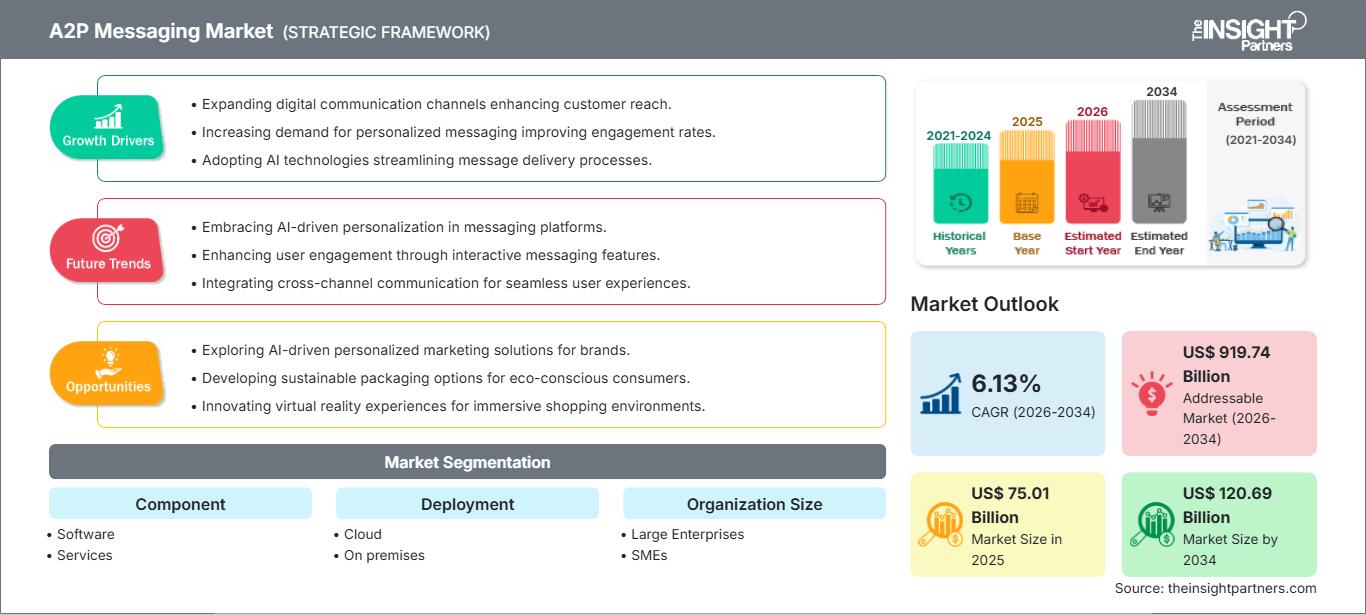
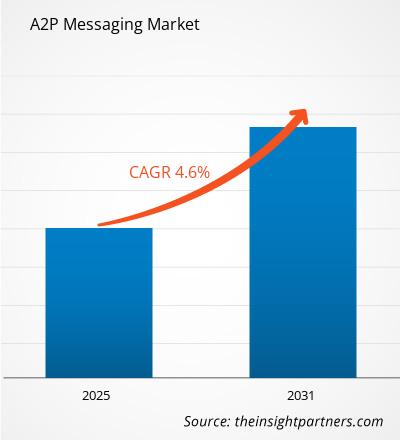
The A2P messaging market was valued at US$ 75.01 Billion in 2025 and is projected to reach US$ 120.69 Billion by 2034, registering a CAGR of 6.13% during 2026–2034. Demand for application-to-person communications continues to expand as enterprises increasingly rely on mobile channels for authentication, transactional notifications, customer engagement, and service delivery. Growth is further supported by rising digital commerce activity, expanding smartphone adoption, and the growing importance of secure communication frameworks across industries.
Across North America, enterprise digitization, widespread cloud adoption, and sophisticated telecom infrastructure continue to support messaging volumes. The A2P messaging market size in the region benefits from strong demand for two-factor authentication, customer notifications, promotional messaging, and omnichannel engagement solutions. Continued deployment of rich communication services (RCS), AI-enabled customer interaction tools, and verified business messaging is expected to support a regional growth trajectory of approximately 5.5–6.5% CAGR through 2034.
A2P Messaging Market Assessment and Insights
- North America: Share in 2025 estimated at 32–36%, supported by cloud communications adoption, enterprise digital transformation, and strong operator ecosystems. CAGR between 2026–2034 is expected at 5.5–6.5%.
- US: Represents approximately 78–82% of North American revenue in 2025, driven by enterprise messaging platforms, fintech expansion, and retail engagement applications. CAGR between 2026–2034 estimated at 5.8–6.8%.
- Europe: Share in 2025 estimated at 24–28%, with the UK, Germany, and France leading regional demand. CAGR between 2026–2034 expected at 5.3–6.3%.
- Asia Pacific: Share in 2025 estimated at 30–34%, led by China, India, Japan, and South Korea. CAGR between 2026–2034 expected at 7.0–8.0%.
- Largest Segment: IT and Telecom end users account for approximately 26–30% market share in 2025, supported by operator-driven messaging ecosystems and customer communication requirements. CAGR between 2026–2034 estimated at 5.8–6.8%.
- High Growth Segment: Cloud deployment represents approximately 58–62% share in 2025 and is expected to expand at a 7.0–8.0% CAGR during 2026–2034.
- Key companies analyzed in detail: Twilio Inc., Dialogue Communications Ltd., Infobip Ltd., Sinch AB, Proximus Group, Tata Communications Limited, AT&T Inc., China Mobile Limited, Orange S.A., Genesys Cloud Services, Inc.
Source: The Insight Partners' analysis based on proprietary research, government publications, company annual reports, investor presentations, industry databases, and expert interviews.
The A2P messaging market has evolved from a largely operator-controlled SMS delivery environment into a sophisticated enterprise communications ecosystem integrating cloud infrastructure, APIs, analytics platforms, security frameworks, and automation tools. Organizations now require scalable messaging solutions capable of supporting customer engagement, transaction verification, service notifications, and regulatory communications. Continuous improvements in delivery intelligence, fraud prevention capabilities, and platform integration have strengthened the strategic role of business messaging across digital economies globally.
Future market development is expected to be shaped by growing investments in conversational communications, enterprise automation, and verified digital identities. Expansion across emerging economies, particularly in Southeast Asia, the Middle East, and parts of Africa, is likely to create substantial volume opportunities. Regulatory efforts supporting trusted business messaging combined with broader adoption of RCS-enabled communication experiences are expected to contribute to long-term market expansion and service innovation.
A2P Messaging Market Report Scope
| Report Attribute | Details |
|---|---|
| Market size in 2025 | US$ 75.01 Billion |
| Market Size by 2034 | US$ 120.69 Billion |
| Global CAGR (2026 - 2034) | 6.13% |
| Historical Data | 2021-2024 |
| Forecast period | 2026-2034 |
A2P Messaging Market Analysis
The A2P messaging market growth outlook remains supported by rising levels of mobile engagement throughout consumer and enterprise ecosystems. As organizations continue digitizing customer touchpoints, messaging channels have become essential for authentication, payment notifications, appointment reminders, delivery updates, and customer service interactions. Businesses increasingly prioritize mobile communication because of its high reach, immediacy, and ability to support critical user interactions. Demand is particularly pronounced across banking, healthcare, retail, and government sectors where reliable communication can directly influence customer satisfaction, security, and operational efficiency.
The industry value chain encompasses mobile network operators, messaging aggregators, communication platform providers, software developers, enterprise customers, and cloud service providers. Messaging traffic continues to increase as digital commerce transactions expand globally. Supply-side participants focus on improving delivery quality, compliance capabilities, routing efficiency, fraud mitigation, and infrastructure scalability. Investments in API-driven services, automation tools, and cross-channel communications have further enhanced platform capabilities and strengthened long-term industry competitiveness.
The A2P messaging market analysis indicates a competitive environment characterized by platform differentiation, geographic expansion, and technological innovation. Leading participants such as Twilio Inc., Infobip Ltd., Sinch AB, and Tata Communications Limited continue investing in programmable communications, automation capabilities, and omnichannel customer engagement solutions. At the same time, operator-backed participants including AT&T Inc., Orange S.A., China Mobile Limited, and Proximus Group leverage extensive telecom infrastructure and enterprise relationships to capture messaging traffic growth opportunities.
Investment activity is increasingly focused on cloud-native communication platforms, AI-assisted engagement workflows, security enhancement technologies, and next-generation messaging standards. Genesys Cloud Services, Inc. continues to strengthen customer experience integration capabilities, while Dialogue Communications Ltd. remains active in enterprise engagement solutions. Strategic partnerships among software companies, telecom operators, cloud providers, and enterprise technology vendors are expected to remain a defining feature of competitive positioning throughout the forecast period.
● REPORT CUSTOMIZATION
Tailor This Report To Align With Your Specific Business Requirements
This report can be customized to align precisely with your business objectives, scope, and target markets. Customization options include tailored segmentation, geography, competitive analysis, and strategic insights to support informed decision-making.
Customize This Report →WHAT YOU CAN ADJUST
- ● Segmentations
- ● Geography
- ● Competitive Analysis
- ● Language Preferences
A2P Messaging Market: Strategic Insights
Regional Insights
North America A2P messaging market
North America accounted for an estimated 32–36% of global A2P messaging market share in 2025 and is anticipated to grow at a 5.5–6.5% CAGR between 2026 and 2034. The region benefits from high smartphone penetration, advanced telecommunications infrastructure, extensive enterprise cloud adoption, and a mature digital commerce ecosystem. Strong demand for authentication messages, transaction alerts, appointment confirmations, and customer service notifications continues to support messaging volumes across multiple sectors. Financial institutions, retailers, healthcare organizations, and technology companies remain among the largest users of enterprise messaging services.
Regulatory focus on consumer privacy, messaging transparency, and fraud prevention is encouraging organizations to adopt more secure communication platforms. Businesses across the region are increasingly deploying AI-supported customer engagement tools and omnichannel communication strategies to enhance service quality. Investment in RCS capabilities, digital identity verification solutions, and programmable communication platforms continues to strengthen the regional market outlook while creating additional monetization opportunities for service providers and telecom operators.
U.S. A2P messaging market
The United States represents approximately 78–82% of North American revenue and is projected to register a 5.8–6.8% CAGR through 2034. Strong enterprise technology spending, large-scale e-commerce activity, and widespread use of mobile financial services support continued messaging demand. Businesses increasingly integrate communication platforms with customer relationship management systems, analytics applications, and automation solutions to improve engagement effectiveness. High levels of digital service consumption across sectors contribute directly to increasing messaging volumes.
Major market participants including Twilio Inc., AT&T Inc., and Genesys Cloud Services, Inc. maintain significant operational activity within the country. The United States continues to lead adoption of advanced customer communication technologies such as AI-enabled messaging workflows, personalized engagement campaigns, and verified messaging services. Growing emphasis on secure authentication, fraud monitoring, and customer retention strategies is expected to sustain enterprise investment in messaging infrastructure during the forecast period.
Europe A2P messaging market
Europe held an estimated 24–28% share of global A2P messaging market revenue in 2025 and is expected to expand at a 5.3–6.3% CAGR through 2034. The region benefits from mature enterprise digital infrastructure, strong mobile connectivity, and high levels of regulatory oversight concerning data protection and electronic communications. The UK remains one of the most significant markets due to widespread digital banking adoption, advanced e-commerce activity, and extensive use of enterprise communication solutions across both private and public sectors.
Germany represents another major contributor owing to its large industrial base and growing use of secure messaging platforms throughout manufacturing, logistics, financial services, and enterprise operations. Demand for authentication services and customer communication tools continues to rise as organizations expand digital service offerings and customer engagement initiatives.
France, Italy, and Spain all send large volumes of messages through financial institutions, healthcare organizations, retail establishments, and governmental organizations. The continued usage of mobile-centric models and automated alerts keeps demand strong in Southern Europe. Germany is the top-spending country in enterprise messaging, and the use of cloud-based communications technology continues to drive market growth in the region.
APAC A2P messaging market
Asia Pacific accounted for approximately 30–34% of global A2P messaging market revenue in 2025 and is forecast to grow at a 7.0–8.0% CAGR through 2034. China remains the largest market by volume, while India continues to record rapid expansion due to growing digital payment adoption, e-commerce activity, and government digitization initiatives.
Japan, South Korea, and Australia contribute through advanced telecommunications infrastructure and enterprise technology deployment. Continued smartphone adoption, fintech expansion, and cloud platform investments across the region are expected to support robust demand for business messaging services.
Middle East & Africa A2P messaging market
The Middle East and Africa A2P messaging market is projected to expand at a 6.5–7.5% CAGR during the forecast period. Increasing mobile internet penetration, modernization of telecom infrastructure, and expanding digital service ecosystems are strengthening market demand across multiple industries.
Saudi Arabia and the United Arab Emirates remain key growth centers due to smart city programs, e-government initiatives, and accelerating fintech adoption. South Africa continues serving as an important regional hub, while broader infrastructure and digital transformation investments support messaging demand across emerging economies throughout the region.
Segmentation Analysis
Component
The component segment is expected to expand at a 6.0–7.0% CAGR during 2026–2034. A2P messaging market participants increasingly focus on strengthening software functionality while expanding managed and professional service offerings. Advanced messaging orchestration, campaign automation, customer analytics, compliance monitoring, and API integration capabilities are driving adoption. Simultaneously, enterprises require implementation support, managed routing, and optimization services to achieve high delivery rates and regulatory compliance across multiple communication environments.
- Software – Supports automated campaign management, messaging orchestration, analytics, customer engagement workflows, routing optimization, delivery monitoring, and authentication processes across large-scale enterprise communication environments.
- Services – Includes consulting, integration, deployment, maintenance, managed communication operations, compliance support, and performance optimization services that enable enterprises to maximize messaging effectiveness and operational efficiency.
Deployment
The deployment segment is projected to register a 6.5–7.5% CAGR through 2034. Organizations increasingly favor cloud-based architectures because of scalability, flexibility, rapid implementation, and reduced infrastructure management requirements. At the same time, regulatory considerations and internal governance policies continue supporting selected on-premises deployments among organizations with highly sensitive communication and compliance requirements.
- Cloud – Delivers flexible infrastructure, lower upfront investment, simplified upgrades, API accessibility, and support for omnichannel engagement strategies, making it the preferred deployment model across most enterprise environments.
- On-premises – Remains relevant for organizations requiring direct infrastructure control, customized security management, strict compliance oversight, and integration with complex internal communication systems.
Organization Size
The organization-size segment in the A2P messaging market is anticipated to grow at a CAGR of 5.8-6.8% during 2026-2034. The large enterprise segment continues to generate high volumes of communications for customer engagement, authentication, and service notifications. On the other hand, the small and medium enterprise segment is increasingly adopting subscription-based communication solutions with affordable pricing and easy deployment.
- Large Enterprises – Generate substantial message traffic through large customer bases, extensive service ecosystems, enterprise applications, loyalty programs, and high-frequency transactional communications.
- SMEs – Utilize messaging platforms to improve customer acquisition, service engagement, promotional outreach, and operational communication without significant infrastructure investment requirements.
End Users
The end-user segment A2P messaging market is expected to grow at a 6.2%-7.2% CAGR over 2034. Adoption varies by industry, owing to differing needs for communication and customer engagement. Rising digitization, along with mobile-first service delivery, continues to drive adoption across multiple sectors, making enterprise communication capabilities increasingly strategic to business operations.
- IT and Telecom – Represents the largest end-user category, utilizing messaging extensively for customer notifications, authentication services, service activation alerts, account updates, and network-related communications.
- Healthcare – Employs messaging platforms for appointment reminders, patient communication, prescription notifications, telehealth engagement, administrative coordination, and ongoing healthcare service interactions.
- Manufacturing – Uses communication platforms to improve supply chain visibility, workforce coordination, production monitoring, maintenance scheduling, and operational notification processes.
- Retail and E-commerce – Relies heavily on customer notifications, order confirmations, shipment tracking updates, promotional campaigns, loyalty engagement programs, and customer service interactions.
- Government – Utilizes messaging solutions for citizen communication, emergency notifications, public service updates, digital governance initiatives, and community engagement activities.
- BFSI – Depends on secure communication channels for transaction alerts, fraud monitoring, account verification, regulatory notifications, customer support, and authentication workflows.
Opportunity Snapshot
| End Users | Revenue Contribution | Trend Tag | Adoption Stage |
| IT and Telecom | High | Network Alerts | Mature |
| Healthcare | Medium | Patient Messaging | Scaling |
| Manufacturing | Medium | Asset Tracking | Scaling |
| Retail and E-commerce | High | Conversational Commerce | Scaling |
| Government | Medium | Citizen Connect | Scaling |
| BFSI | High | Fraud Prevention | Mature |
A2P Messaging Market Growth Drivers and Impact Analysis
Rising adoption of mobile authentication and verification systems
Digital service providers now rely more on authentication to ensure the safety of their customers and transactions. Banks through mobile banking systems, financial institutions through fintech, e-commerce marketplaces, health care systems, and even government agencies need an effective method of identity verification. App-to-person messaging remains popular for sending one-time passwords and security messages. As cyber threats continue increasing globally, organizations are investing more heavily in communication infrastructure capable of supporting high-volume authentication traffic. The expansion of digital services in both developed and emerging economies is consequently creating sustained long-term demand for secure enterprise messaging solutions, while further strengthening messaging's position as a critical component of customer security strategies.
Expansion of digital commerce and customer engagement ecosystems
The rapid growth of digital commerce continues to increase enterprise dependence on real-time communication channels. Consumers expect immediate confirmation of purchases, shipment updates, payment notifications, delivery alerts, and customer service responses. Messaging platforms offer an extremely effective means of delivering such interactions at scale. As more and more organizations become digitally empowered in areas such as retailing, logistics, banking, and services, there is a simultaneous increase in the need for communication. Businesses are now looking at mobile messaging not just as a business tool but as a way to improve the customer experience. This is leading to increased focus on investments in communication platforms, automation technologies, and integrated engagement ecosystems that support personalized communication throughout the customer lifecycle.
Growing enterprise investment in communication automation
Companies are adopting automated solutions to enhance efficiency and lower costs across various industry sectors. Communication platforms coupled with customer relationship management systems, analytics tools, artificial intelligence applications, and workflow solutions enable an organization to automate a variety of communication operations. Appointments, service notifications, transactions, customer support updates, and promotional activities can all be handled with minimal human involvement. With automation, an organization may respond faster and scale communication more consistently. As companies emphasize their digital transformation objectives, the demand for intelligent communication infrastructure will definitely increase in the coming years.
A2P Messaging Market Future Trends
Migration toward rich communication and branded messaging experiences
The A2P messaging market trends now clearly show that the future of messaging is moving towards richer digital communication formats beyond simple text. Enterprises are now looking at solutions that can facilitate multimedia communication with brands, including embedded interactions and actions, and improve delivery metrics. With wider deployment and improved RCS device capabilities, enterprises are expected to leverage richer messaging formats to improve the customer experience. Improved security and brand identity features could increase trust and mitigate fraud-related issues. In the long run, rich messaging will play an important role in differentiation and mobile communication.
Artificial intelligence transforming communication orchestration
AI is anticipated to be integrated into enterprise messaging ecosystems throughout the forecast period. The AI-powered tools will optimize routing decisions, personalize content, track engagement patterns, and automate communication processes based on customer behavior. Organizations are also expected to leverage predictive analytics to enhance campaign performance and improve operational efficiency. The integration of conversational tools, customer data platforms, and messaging technology will create an extremely responsive environment that enables a personalized user experience. Over time, as companies invest in intelligent digital engagement solutions, communication orchestration driven by artificial intelligence will become an important competitive advantage.
A2P Messaging Market Opportunities
Expansion opportunities across emerging digital economies
Digital transformation in developing countries is creating a good environment for the growth of messaging services. The increase in smartphone use, internet access, growth in the digital payments ecosystem, and government-driven digitization have led to a greater need for enterprises to secure their means of communication through their mobile phones. Many financial service providers, e-commerce firms, health-care organizations, and governmental bodies are developing their digital service platforms, creating a need for numerous messages. According to A2P messaging market forecasts, there are strong business prospects in Southeast Asia, the Middle East, and certain regions of Africa, where enterprise communication technologies will be upgraded. Organizations that establish partnerships with mobile carriers, enable compliance, and provide cloud messaging solutions will be able to capture significant market share.
Development of industry-specific communication ecosystems
Communication platforms for industries are a major growth area for vendors and investors alike. Many businesses are looking for solutions designed with the industry's regulatory requirements, workflow processes, engagement strategies, and security needs in mind. Healthcare companies need features for patient engagement and appointment scheduling. The financial sector needs highly secure authentication and transactional messaging capabilities. For government agencies, citizen communications solutions on a grand scale are necessary, while retailers need sophisticated customer engagement capabilities and promotions messaging solutions. Vendors that can develop solutions incorporating analytics, workflows, AI-driven engagement, and compliance management will be better suited to meet these needs. These platforms can charge premium prices, retain customers, and earn recurring revenues.
Frequently Asked Questions

- Comprehensive Market Sizing and Forecast Analysis
- Detailed Segmentation Analysis
- In-Depth Market Dynamics Assessment
- Regional and Country-Level Insights
- Competitive Landscape and Company Benchmarking
- Strategic Business Intelligence
Recent Reports
Testimonials

The Insight Partners' SCADA System Market report is comprehensive, with valuable insights on current trends and future forecasts. The team was highly professional, responsive, and supportive throughout. We are very satisfied and highly recommend their services.
RAN KEDEM Partner, Reali Technologies LTDs
I requested a report on a very specific software market and the team produced the report in a few days. The information was very relevant and well presented. I then requested some changes and additions to the report. The team was again very responsive and I got the final report in less than a week.
JEAN-HERVE JENN Chairman, Future Analytica
We worked with The Insight Partners for an important market study and forecast. They gave us clear insights into opportunities and risks, which helped shape our plans. Their research was easy to use and based on solid data. It helped us make smart, confident decisions. We highly recommend them.
PIYUSH NAGPAL Sr. Vice President, High Beam Global
The Insight Partners delivered insightful, well-structured market research with strong domain expertise. Their team was professional and responsive throughout. The user-friendly website made accessing industry reports seamless. We highly recommend them for reliable, high-quality research services
YUKIHIKO ADACHI CEO, Deep Blue, LLC.
This is the first time I have purchased a market report from The Insight Partners.While I was unsure at first, I visited their web site and felt more comfortable to take the risk and purchase a market report.I am completely satisfied with the quality of the report and customer service. I had several questions and comments with the initial report, but after a couple of dialogs over email with their analyst I believe I have a report that I can use as input to our strategic planning process.Thank you so much for taking the extra time and making this a positive experience.I will definitely recommend your service to others and you will be my first call when we need further market data.
JOHN SUZUKI President and Chief Executive Officer, Board Director, BK Technologies
I wish to appreciate your support and the professionalism you displayed in the course of attending to my request for information regarding to infectious disease IVD market in Nigeria. I appreciate your patience, your guidance, and the fact that you were willing to offer a discount, which eventually made it possible for us to close a deal. I look forward to engaging The Insight Partners in the future, all thanks to the impression you have created in me as a result of this first encounter.
DR CHIJIOKE ONYIA MANAGING DIRECTOR, PineCrest Healthcare Ltd.Reason to Buy
- Informed Decision-Making
- Understanding Market Dynamics
- Competitive Analysis
- Identifying Emerging Markets
- Customer Insights
- Market Forecasts
- Risk Mitigation
- Boosting Operational Efficiency
- Strategic Planning
- Investment Justification
- Tracking Industry Innovations
- Aligning with Regulatory Trends





 Get Free Sample for