
Augmented Reality in Retail Market Size, Share & Forecast by 2034
Augmented Reality in Retail Market Size and Forecasts (2021–2034), Global and Regional Share, Trends, and Growth Opportunity Analysis Report Coverage : By Offering (Hardware, and Software and Services), Application (Try-On Solution, Planning & Designing, Others), Retail Type (Apparel, Beauty and Cosmetics, Furniture, Footwear, Others)
- Status : Data Released
- Report Code : TIPRE00039733
- Category : Electronics and Semiconductor
- No. of Pages : 150
- Available Report Formats :


- Last update date : July 17, 2026


2025 Market Size
US$ 22.42 Bn
Base year value
2034 Forecast
US$ 161.68 Bn
Projected by 2034
CAGR 2026-2034
24.55 %
Growth rate
Addressable Market
US$ 706.65 Bn
(2026-2034)
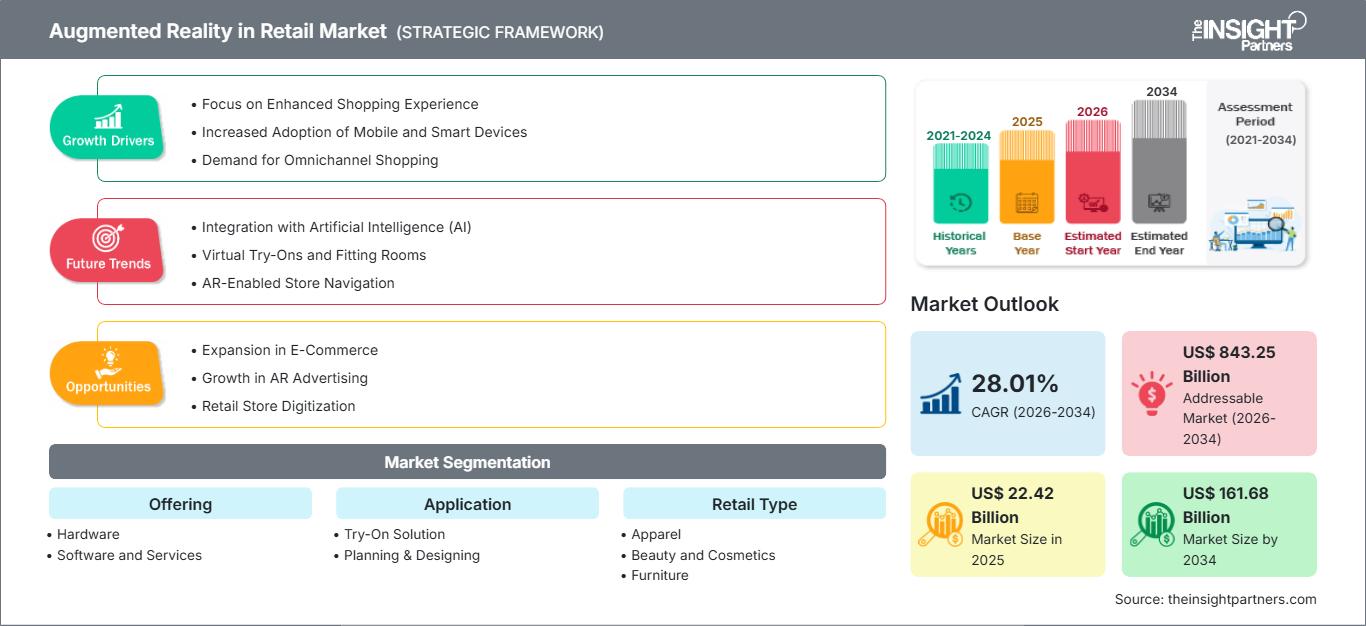
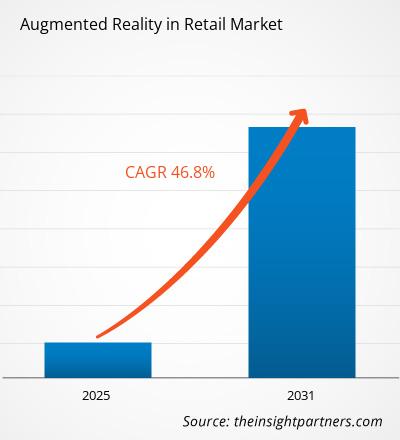
The Augmented Reality in Retail market was valued at US$ 22.42 billion in 2025 and is expected to reach US$ 161.68 billion by 2034; it is estimated to record a CAGR of 24.55% during 2026-2034.
Augmented Reality in Retail Market Assessment and Insights
- North America held a 36–38% share in 2025 and is expected to grow at a CAGR range of 26.5–27.8% during 2026–2034, supported by omnichannel retail maturity and AR-enabled commerce pilots.
- US accounted for 78–82% of North America in 2025 and is projected to grow at a CAGR range of 26.8–28.0% through 2034.
- Europe represented a 24–26% share in 2025 and is forecast to grow at 25.1–26.4% CAGR, led by the UK, Germany, France, Italy, and Spain.
- Asia Pacific captured a 27–29% share in 2025 and is expected to expand at 29.2–31.0% CAGR, with China, Japan, South Korea, India, and Australia leading adoption.
- Largest Segment Hardware held 42–45% market share in 2025 and is projected to grow at a CAGR range of 25.8–27.2% during 2026–2034.
- High Growth Segment Software held 34–37% market share in 2025 and is expected to grow at 29.5–31.4% CAGR during 2026–2034.
- Key companies analyzed in detail: Google LLC, PTC Inc., Apple Inc., Microsoft Corporation, Zugara, Inc., Blippar Group Limited, ViewAR GmbH, Holition Ltd., Qualcomm Technologies, Inc., Epson America, Inc.
Source: The Insight Partners' analysis based on proprietary research, government publications, company annual reports, investor presentations, industry databases, and expert interviews.
Retail AR has moved from isolated marketing trials toward integrated commerce infrastructure. Early smartphone filters and digital mirrors demonstrated engagement value, while current deployments connect 3D content management, product information systems, store analytics, and AI recommendation engines. Production dynamics are shifting from campaign-specific assets to reusable 3D product libraries, allowing retailers to deploy consistent visualization across web, mobile apps, social commerce, and assisted selling. This evolution improves content economics and supports broader use of Augmented Reality in the retail market across categories.
Over the forecast period, expansion will be shaped by lower-cost AR development tools, device-level spatial computing, and retailer pressure to improve digital conversion without increasing return costs. Emerging geographies will benefit from mobile-first shopping behavior and rapid 5G coverage. Data privacy regulation will also influence platform design, pushing vendors toward on-device processing, consent-based personalization, and measurable customer experience outcomes within the market.
Augmented Reality in Retail Market Report Scope
| Report Attribute | Details |
|---|---|
| Market size in 2025 | US$ 22.42 Billion |
| Market Size by 2034 | US$ 161.68 Billion |
| Global CAGR (2026 - 2034) | 24.55% |
| Historical Data | 2021-2024 |
| Forecast period | 2026-2034 |
Augmented Reality in Retail Market Analysis
Demand in the Augmented Reality in Retail Market growth cycle is driven by a practical retail problem: shoppers want confidence before purchasing products they cannot physically test online. Virtual try-on, room visualization, and guided product discovery address size, color, fit, and placement uncertainty while improving engagement time and purchase intent.
The value chain combines device makers, chip suppliers, 3D asset studios, software platforms, cloud providers, and retailers. Supply dynamics are improving as ARCore, spatial computing platforms, and AI image-generation tools reduce implementation friction. Retailers increasingly prefer modular solutions that integrate with inventory, CRM, and commerce systems rather than standalone campaign tools.
Competitive positioning in the Augmented Reality in Retail Market analysis reflects a split between platform ecosystems and specialist solution providers. Google LLC, Apple Inc., Microsoft Corporation, and Qualcomm Technologies, Inc. influence device, operating system, and developer environments, while PTC Inc., Zugara, Inc., Blippar Group Limited, ViewAR GmbH, and Holition Ltd. focus on vertical applications.
Investment is moving toward reusable 3D assets, analytics dashboards, and AI-assisted personalization. Epson America, Inc. strengthens hardware-led use cases for assisted retail and field operations. Strategic differentiation depends on rendering quality, integration speed, privacy controls, and proof that AR reduces returns while increasing average order value.
● REPORT CUSTOMIZATION
Tailor This Report To Align With Your Specific Business Requirements
This report can be customized to align precisely with your business objectives, scope, and target markets. Customization options include tailored segmentation, geography, competitive analysis, and strategic insights to support informed decision-making.
Customize This Report →WHAT YOU CAN ADJUST
- ● Segmentations
- ● Geography
- ● Competitive Analysis
- ● Language Preferences
Augmented Reality in Retail Market: Strategic Insights
Regional Insights
North America Augmented Reality in Retail Market
North America accounted for a 36–38% Augmented Reality in Retail Market share in 2025 and is expected to expand at 26.5–27.8% CAGR through 2034. Retailers in the region are using AR to connect e-commerce, social discovery, and in-store engagement, particularly in apparel, beauty, footwear, and furniture.
Structural drivers include high mobile commerce penetration, broad access to AR-capable devices, and rapid adoption of AI-based merchandising. Brands are also investing in virtual try-on to address return costs, while store teams use visual recognition and digital shelf tools to improve execution accuracy and product availability.
U.S. Augmented Reality in Retail Market
The U.S. represented 78–82% of North America in 2025 and is forecast to grow at 26.8–28.0% CAGR during 2026–2034. Adoption is strongest among large retailers, beauty brands, apparel marketplaces, and home furnishing chains that require scalable product visualization across web and app channels.
Company presence is deep, with Google LLC, Apple Inc., Microsoft Corporation, Qualcomm Technologies, Inc., Zugara, Inc., and Epson America, Inc. supporting platform, hardware, and application layers. U.S. retailers are moving beyond consumer-facing try-on toward store operations, associate training, and shelf intelligence.
Europe Augmented Reality in Retail Market
Europe held a 24–26% share in 2025 and is projected to grow at 25.1–26.4% CAGR through 2034. The UK leads regional adoption as fashion, luxury, and beauty retailers use AR to support omnichannel selling, product discovery, and localized customer engagement.
Germany follows with demand from furniture, automotive retail showrooms, and planning applications, supported by strong enterprise software integration. France, Italy, and Spain are advancing through luxury retail, cosmetics, footwear, and tourism-linked flagship stores, where immersive content enhances brand storytelling while respecting privacy-driven digital commerce standards.
APAC Augmented Reality in Retail Market
APAC captured a 27–29% share in 2025 and is estimated to grow at 29.2–31.0% CAGR, the fastest regional pace. China dominates due to the adoption of social commerce, livestream retailing, and mobile payment services, whereas Japan and South Korea offer premium beauty, electronics, and fashion visualization.
India and Australia are using AR to develop mobile-based marketplaces, marketing campaigns, and furniture-planning tools. The policies for digital infrastructure, the proliferation of 5G technology, and high smartphone adoption, among other factors, have made APAC region strategic for vendors seeking to achieve growth through volume.
Middle East & Africa Augmented Reality in Retail Market
Middle East & Africa is projected to grow at 24.0–25.6% CAGR during 2026–2034, led by the UAE and Saudi Arabia. Premium malls, luxury retail, tourism, and smart city investment support digital store experiences and interactive product visualization.
South Africa is adopting AR selectively in furniture, apparel, and cosmetics, whereas the rest of MEA is still in its early stages. There is potential from energy-funded infrastructure development and premium retail development, but affordability and content localization will affect the speed of adoption.
Segmentation Analysis
Offering
The Offering segment is expected to grow at 27.2–28.8% CAGR during 2026–2034 as retailers combine devices, software engines, and managed services. The Augmented Reality in Retail Market scope is widening from consumer engagement to enterprise workflows, requiring reliable rendering, product data integration, analytics, support, and continuous content updates.
- Hardware remains the largest sub-segment as smart mirrors, headsets, sensors, and AR-capable devices enable immersive in-store and assisted-selling experiences requiring reliable display quality and processing capability.
- Software and Services are gaining strategic importance as retailers need 3D asset management, analytics, integration, personalization engines, and support services to scale AR across channels.
Application
The Application segment is forecast to expand at 28.6–30.2% CAGR as retailers prioritize use cases that directly influence purchase confidence. Try-on solutions address fit and shade uncertainty, while planning and designing tools support higher-value decisions in furniture, interiors, and store layouts within the Augmented Reality in Retail Market.
- Try-On Solution leads consumer engagement by helping shoppers preview apparel, cosmetics, eyewear, and footwear digitally, improving confidence before purchase and supporting measurable conversion improvements.
- Planning & Designing is essential for furniture and store design, enabling customers and associates to visualize dimensions, layouts, color combinations, and placement before committing to purchases.
Retail Type
The Retail Type segment is projected to grow at 27.8–29.3% CAGR during 2026–2034, with adoption varying by product complexity and return exposure. Apparel and beauty drive high-frequency engagement, furniture supports spatial planning, and footwear benefits from sizing visualization and interactive product launches.
- Apparel uses AR to reduce fit uncertainty, support personalized styling, and strengthen digital merchandising across marketplaces, brand apps, and social commerce campaigns.
- Beauty and cosmetics have mature adoption because shade matching, facial visualization, and product comparison can be delivered quickly through smartphone cameras and online product pages.
- Furniture benefits from room-scale visualization, allowing shoppers to assess size, placement, material appearance, and style compatibility before ordering bulky, higher-value products.
- Footwear is gaining traction through virtual sizing, limited-edition product drops, and interactive 3D previews that support younger consumers and sneaker-focused retail communities.
Opportunity Snapshot
| Application | Revenue Contribution | Trend Tag | Adoption Stage |
| Try-On Solution | High | Virtual Fit | Scaling |
| Planning & Designing | Medium | Room Preview | Scaling |
Augmented Reality in Retail Market Growth Drivers and Impact Analysis
Rising Need to Reduce Digital Purchase Uncertainty
As online retailing has expanded, the cost of uncertainty has risen because consumers tend to return their orders whenever there is a mismatch in fit, color, texture, or size. Virtual reality addresses that problem by allowing customers to preview a product before purchasing it. AR works especially well in industries like fashion, cosmetics, shoes, and furniture, where a virtual preview can turn browsing into buying decisions. The effect is most pronounced in cases where product returns are costly or where visualization influences cart size. Retailers also gain behavioral data from interactions, helping merchandising teams identify preferred colors, styles, and configurations without relying only on completed transactions.
Expansion of AR-Capable Devices and Mobile Commerce
The availability of smartphones, tablets, and spatial computers makes AR much more accessible than in the past, when headsets were required. Current technology, such as CPUs, cameras, and even artificial intelligence, helps to render better graphics, track objects faster, and improve privacy. Today, retailers can easily offer AR experiences in their app stores, web browsers, and social media channels without needing special equipment for every consumer. This way, it becomes easier to scale these campaigns in different geographic locations. As mobile commerce becomes the norm, AR becomes the user interface.
Retailer Focus on Omnichannel Experience Consistency
Retailers need to provide an equivalent experience for their products on the store floor, website, marketplace, and social media. The advantage of AR here is that 3D assets can be leveraged across these different channels without duplicating content creation effort. The same sofa model can drive a website visualizer, a sales assistant's tablet computer, and a social media campaign. This enhances brand uniformity and makes 3D content economically more feasible. The operational aspect is significant, as AR use will increasingly depend on efficiency rather than hype.
Augmented Reality in Retail Market Future Trends
AI-Generated 3D Content Pipelines
One of the most important Augmented Reality in Retail Market trends is the shift toward AI-assisted 3D asset creation. Retailers need thousands of accurate product models, but manual production can be costly and slow. Generative tools, photogrammetry, and automated quality checks will shorten content cycles while improving scalability. This trend will favor vendors that combine creative automation with product data accuracy, material realism, and commerce system integration. Over time, faster asset production will allow small and mid-sized retailers to adopt AR beyond seasonal campaigns.
Privacy-Centric Personalization in Spatial Shopping
AR retail experiences of the future will rely on personalized recommendations that leverage body, space, and preference cues while avoiding extraneous data collection. Design standards such as on-device computation, informed consent workflows, and anonymized analytics will be mandatory for AR applications, particularly in Europe and high-end consumer products. It is incumbent upon retailers to demonstrate the convenience of AR technology without fostering unwanted profiling. The vendors that incorporate privacy measures into their product architecture will be able to build trust with enterprises, regulators, and consumers.
Augmented Reality in Retail Market Opportunities
Enterprise AR Analytics for Merchandising Decisions
AR experiences can be transformed into marketing insights by identifying which items are tried on, customized, discarded, or shared. Such trends offer vendors an opportunity to develop dashboards that connect immersive experiences to inventory management, product design, and campaigns. The strongest Augmented Reality in Retail Market Forecast predictions are on platforms that demonstrate more than just visual appeal in their commercial potential. Service providers will distinguish themselves by making such connections between AR experiences and conversions, reduced returns, traffic, and lifetime values.
Localized AR Commerce for Emerging Markets
The developing world presents an excellent opportunity for AR-based mobile commerce, as consumers often discover products on social media before purchasing them through marketplaces. Sellers can create templates customized to the different festivals, languages, skin tones, room sizes, and fashion styles in each region. The strategy helps keep deployment costs low and culturally appropriate. Sellers in India, Southeast Asia, the Middle East, and Latin America can leverage AR technology to differentiate themselves online without having to set up extensive physical infrastructure.
Recent Developments
- July 2026: Chinese Wok launched WokVerse, an immersive customer engagement platform that blends augmented reality (AR), gaming, and social experiences to transform the QSR dining experience. Designed for Gen Z and millennials, the initiative keeps customers engaged while waiting for their orders through interactive, mobile-first digital experiences.
- June 2026: FittingBox strengthened its leadership in AI-powered virtual eyewear try-on by completing the acquisition of Ditto, expanding its portfolio with advanced virtual try-on technology, AI-driven frame recommendations, and one of the world's largest digital eyewear catalogs. The deal enhances FittingBox's capabilities in computer vision, 3D visualization, and omnichannel retail experiences for eyewear brands and retailers.
- June 2026: Snap acquired AR startup Illumix to accelerate development of its Specs smart glasses and strengthen its spatial computing ecosystem. Illumix's spatial mapping and persistent AR technology will be integrated into Snap's platform, with most of the startup's team joining the company to enhance real-world AR experiences and next-generation wearable devices.
Frequently Asked Questions

- Comprehensive Market Sizing and Forecast Analysis
- Detailed Segmentation Analysis
- In-Depth Market Dynamics Assessment
- Regional and Country-Level Insights
- Competitive Landscape and Company Benchmarking
- Strategic Business Intelligence
Recent Reports
Testimonials

The Insight Partners provided valuable market intelligence that supported our global go-to-market strategy. Their team was professional, responsive, and attentive to our feedback, providing thoughtful analysis and helpful methodological clarifications throughout the project.
Junmo Kim Chief Financial Officer (CFO), Enertech Co., Ltd.
The Insight Partners' SCADA System Market report is comprehensive, with valuable insights on current trends and future forecasts. The team was highly professional, responsive, and supportive throughout. We are very satisfied and highly recommend their services.
RAN KEDEM Partner, Reali Technologies LTDs
I requested a report on a very specific software market and the team produced the report in a few days. The information was very relevant and well presented. I then requested some changes and additions to the report. The team was again very responsive and I got the final report in less than a week.
JEAN-HERVE JENN Chairman, Future Analytica
We worked with The Insight Partners for an important market study and forecast. They gave us clear insights into opportunities and risks, which helped shape our plans. Their research was easy to use and based on solid data. It helped us make smart, confident decisions. We highly recommend them.
PIYUSH NAGPAL Sr. Vice President, High Beam Global
The Insight Partners delivered insightful, well-structured market research with strong domain expertise. Their team was professional and responsive throughout. The user-friendly website made accessing industry reports seamless. We highly recommend them for reliable, high-quality research services
YUKIHIKO ADACHI CEO, Deep Blue, LLC.
This is the first time I have purchased a market report from The Insight Partners.While I was unsure at first, I visited their web site and felt more comfortable to take the risk and purchase a market report.I am completely satisfied with the quality of the report and customer service. I had several questions and comments with the initial report, but after a couple of dialogs over email with their analyst I believe I have a report that I can use as input to our strategic planning process.Thank you so much for taking the extra time and making this a positive experience.I will definitely recommend your service to others and you will be my first call when we need further market data.
JOHN SUZUKI President and Chief Executive Officer, Board Director, BK Technologies
I wish to appreciate your support and the professionalism you displayed in the course of attending to my request for information regarding to infectious disease IVD market in Nigeria. I appreciate your patience, your guidance, and the fact that you were willing to offer a discount, which eventually made it possible for us to close a deal. I look forward to engaging The Insight Partners in the future, all thanks to the impression you have created in me as a result of this first encounter.
DR CHIJIOKE ONYIA MANAGING DIRECTOR, PineCrest Healthcare Ltd.Reason to Buy
- Informed Decision-Making
- Understanding Market Dynamics
- Competitive Analysis
- Identifying Emerging Markets
- Customer Insights
- Market Forecasts
- Risk Mitigation
- Boosting Operational Efficiency
- Strategic Planning
- Investment Justification
- Tracking Industry Innovations
- Aligning with Regulatory Trends





 Get Free Sample for