
Electric Wheelchair Market Share, Growth & Demand by 2034
Coverage: By Product (Front Wheel Drive, Center Wheel Drive, Rear Wheel Drive, Standing Electric Wheelchair); End-user (Personal, Hospitals/Clinics), and Geography (North America, Europe, Asia Pacific, and South and Central America)
- Status : Data Released
- Report Code : TIPRE00016967
- Category : Electronics and Semiconductor
- No. of Pages : 150
- Available Report Formats :


- Last update date : August 05, 2026


2025 Market Size
US$ 5.30 Bn
Base year value
2034 Forecast
US$ 14.62 Bn
Projected by 2034
CAGR 2026-2034
11.95 %
Growth rate
Addressable Market
US$ 87.48 Bn
(2026-2034)
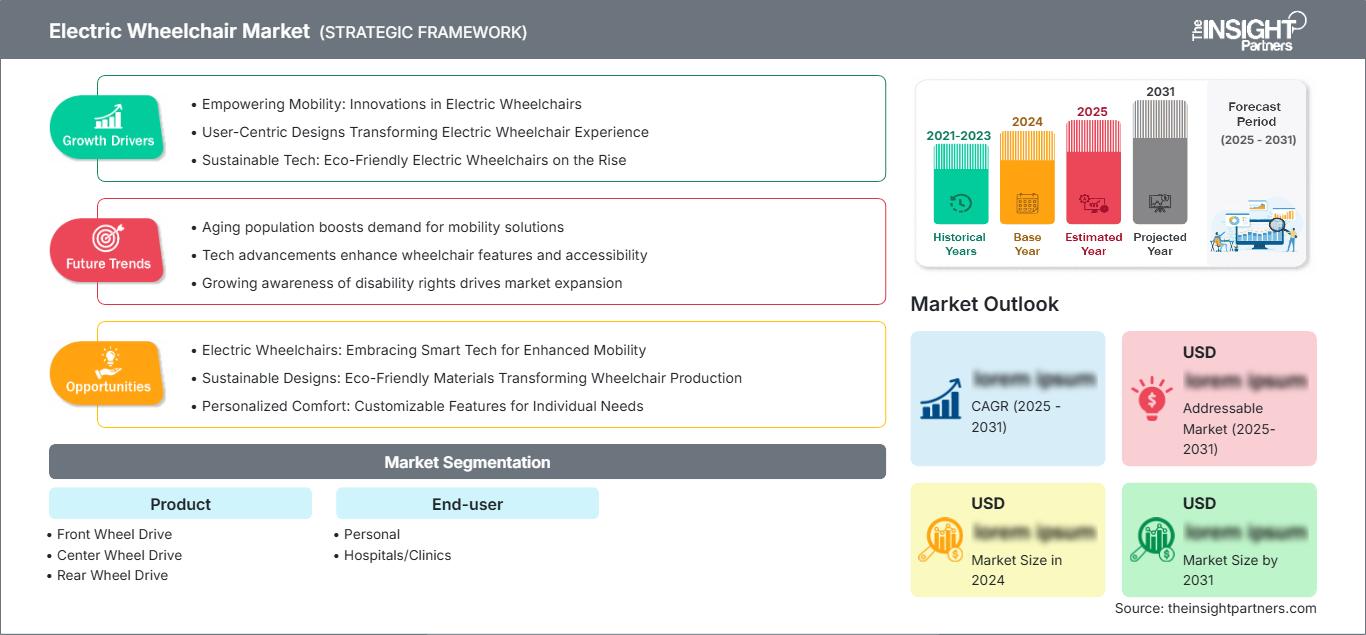
The Electric Wheelchair Market was valued at US$ 5.30 Billion in 2025 and is projected to reach US$ 14.62 Billion by 2034, registering a CAGR of 11.95% during 2026–2034. The market includes powered mobility chairs used across personal mobility, rehabilitation, hospitals, clinics, and long-term care settings where users require independent movement, postural support, and reliable assisted mobility.
North America Electric Wheelchair Market size is expected to expand at a CAGR of 10.8–11.6% during 2026–2034, supported by reimbursement pathways, aging-in-place preferences, and strong clinical evaluation networks. Demand is reinforced by complex rehabilitation technology adoption, veterans’ care, accessible housing, and rising use of customized seating systems for chronic mobility impairments.
Electric Wheelchair Market Assessment and Insights
- North America held 38–42% share in 2025 and is growing at a CAGR of 10.8–11.6% during 2026–2034, led by reimbursement, aging demographics, and CRT assessment networks.
- US represented 88–92% of North American revenue in 2025 and is growing at a CAGR of 10.9–11.7% during 2026–2034, supported by payer coverage and specialist suppliers.
- Europe accounted for 24–28% share in 2025 and is growing at a CAGR of 9.6–10.4% during 2026–2034, with Germany, the UK, France, Italy, and Spain leading adoption.
- Asia Pacific held 20–24% share in 2025 and is growing at a CAGR of 13.2–14.0% during 2026–2034, led by China, Japan, South Korea, India, and Australia.
- Largest Segment Rear Wheel Drive held 34–38% market share in 2025 and is growing at a CAGR of 10.6–11.4% during 2026–2034 due to stability and outdoor usability.
- High Growth Segment Standing Electric Wheelchair represented 8–12% market share in 2025 and is growing at a CAGR of 14.4–15.2% during 2026–2034, supported by rehabilitation benefits.
- Key companies analyzed in detail: Hoveround Corporation; Invacare Corporation; Karman Healthcare, Inc.; Levo AG; MATSUNAGA MANUFACTORY Co., Ltd.; MEYRA GmbH; Ottobock SE & Co. KGaA; Permobil AB; Pride Mobility Products Corporation; Sunrise Medical GmbH.
Source: The Insight Partners' analysis based on proprietary research, government publications, company annual reports, investor presentations, industry databases, and expert interviews.
Powered mobility has developed from simple battery operated wheelchairs to sophisticated systems having advanced drive control, adjustable seats, lithium-ion versions, and specialized standing features. Manufacturing is reliant upon motors, controllers, batteries, frame, cushions, actuators, joystick, and clinical fitting expertise. The company needs to strike a balance between standard products used for individual purposes and elaborate rehabilitation systems requiring assessment and documentation from therapists.
The future demand for powered mobility will be driven by care at home, accessibility to transportation, rehabilitation spending, and policy awareness regarding assistive devices as a healthcare need. Future growth regions will develop owing to procurement programs, private funding, and local marketing relationships. The favorable regulatory winds pertaining to safety of device, reimbursement data, and disability inclusion will affect the product design, documentation, and after-sales services.
Electric Wheelchair Market Report Scope
| Report Attribute | Details |
|---|---|
| Market size in 2025 | US$ 5.30 Billion |
| Market Size by 2034 | US$ 14.62 Billion |
| Global CAGR (2026 - 2034) | 11.95% |
| Historical Data | 2021-2024 |
| Forecast period | 2026-2034 |
Electric Wheelchair Market Analysis
The Electric Wheelchair Market is stimulated by the aging population, injuries to the spine, neuro-muscular conditions, post-stroke rehab, and the desire for mobility outside of institutional settings. The industry consists of manufacturers of components, specialized seating manufacturers, rehabilitation professionals, durable medical equipment distributors, payers, hospitals, and technicians. There is a need for electric chairs which are customizable, maneuverable indoors, stable outdoors, pressure relieving, and capable of facilitating participation.
The supply chain depends on the supply of batteries, electronics, testing for regulations, costs for transportation, and local services. The rear-wheel drive wheelchairs are significant because of their stability, while the center-wheel drive wheelchairs make for better maneuvering indoors and in institutional settings. There is interest from the clinical sector in standing systems since they provide mobility as well as postural control.
Competitive dynamics of the Electric Wheelchair Market Report involve clinical credibility, range of offerings, customization, dealerships, and documentation of reimbursement. Competitors like Permobil AB, Sunrise Medical GmbH, Pride Mobility Products Corporation, and Invacare Corporation are well-established in the field of complex rehabilitation and personal mobility. Moreover, the positioning of Ottobock SE & Co. KGaA and MEYRA GmbH in Europe is enhanced by seating, orthotics, and mobility products.
These companies include Hoveround Corporation, Karman Healthcare, Inc., Levo AG, and MATSUNAGA MANUFACTORY Co., Ltd. The key needs that are met by each company include custom seating solutions, remote diagnostics, battery safety, alternative controls, and fast service response. The downtime caused by any problem leads to negative consequences for the independence of a user and his/her caregiver.
● REPORT CUSTOMIZATION
Tailor This Report To Align With Your Specific Business Requirements
This report can be customized to align precisely with your business objectives, scope, and target markets. Customization options include tailored segmentation, geography, competitive analysis, and strategic insights to support informed decision-making.
Customize This Report →WHAT YOU CAN ADJUST
- ● Segmentations
- ● Geography
- ● Competitive Analysis
- ● Language Preferences
Electric Wheelchair Market: Strategic Insights
Regional Insights
North America Electric Wheelchair Market
North America represented 38-42% of Electric Wheelchair market share in 2025 and is expected to grow at a CAGR of 10.8-11.6% during 2026-2034 due to documentation practices related to Medicare, veterans’ mobility services, specialty seating centers, and widespread distribution of durable medical equipment. The demand is driven by complex rehab technology, bariatric mobility, and personalized chairs.
Drivers are aging-in-place considerations, home accessibility modifications, discharge planning from hospitals, and greater awareness of pressure injury prevention. Manufacturers also have access to assistive technology professionals that configure drives, seating, controls, and service plans properly. North America is still highly dependent on service, so the dealer capabilities and payer documentation are equally important to chair performance.
U.S. Electric Wheelchair Market
For North America, the U.S. is responsible for 88%-92% of revenues in 2025 and has a predicted CAGR of 10.9%-11.7% from 2026 to 2034. Trend applications involve complex rehabilitation, personal mobility, home care discharge, veterans' rehabilitation, and progressive neurological disorders. Purchasing patterns include big dealer networks and payer approval processes.
Prominent brands in the U.S. market through complex, standard, and direct channels are Permobil AB, Pride Mobility Products Corporation, Sunrise Medical GmbH, Hoveround Corporation, and Invacare Corporation. Buyers compare seating elevation, tilt, recline, suspension, battery capacity, maintenance time, and availability of services. Documentation is critical in the purchasing process since reimbursement approval will decide the accessibility of more sophisticated products.
Europe Electric Wheelchair Market
The region has a market share of 24-28% in 2025, and is forecasted to grow at a CAGR of 9.6-10.4% from 2026-2034. Germany excels with rehabilitation infrastructure, engineering-based mobility, and specialty providers. The United Kingdom provides national health service wheelchairs, advanced equipment, and indoor mobility requirements.
There are contributions from France, Italy, and Spain since there is hospital rehabilitation, elder care, and disabilities integration. Europe prioritizes safety certification, maintenance, battery power, and longevity when purchasing products. The manufacturers who increase availability in the region include Ottobock SE & Co. KGaA, MEYRA GmbH, Sunrise Medical GmbH, and Levo AG.
APAC Electric Wheelchair Market
Asia Pacific was responsible for 20-24% market share in 2025, while it is predicted to exhibit CAGR of 13.2-14.0% during 2026-2034. The region is dominated by China through manufacturing capacity, local companies, and elderly care sector growth, whereas the other countries – Japan, South Korea, India, and Australia - contribute through rehabilitation, insurance, and aging population.
Factors driving the policies include disabled inclusion, long-term care programs, hospitals' renovation, and urban accessibility programs. Price sensitivity continues, although more emphasis is laid on safety of batteries, small turning radius, and service. MATSUNAGA MANUFACTORY Co., Ltd. along with international players competes with regional assemblers.
Middle East & Africa Electric Wheelchair Market
Middle East and Africa Market is forecast to witness a CAGR of 11.8%-12.6% between 2026 and 2034. Saudi Arabia and UAE are dominant through their investment in healthcare infrastructure, rehabilitation centers, and accessibility programs, whereas South Africa fuels the market through their private healthcare system, disability assistance, and urban mobility requirements.
Rest of MEA demand is driven by affordability, duty on imports, availability of services, and access to assistive technology through donor support. Energy context becomes crucial since power supply and battery replacement have an effect on everyday operations. Suppliers combining high-quality equipment with skilled technicians and finance in place have a better chance.
Segmentation Analysis
Product
Product is projected to grow at a CAGR of 11.4–12.2% during 2026–2034. Electric Wheelchair Market scope covers front wheel drive, center wheel drive, rear wheel drive, and standing electric wheelchair models designed for different stability, maneuverability, posture, and terrain needs. Product selection depends on clinical profile, home layout, outdoor use, transport requirements, seating complexity, and payer approval.
- Front Wheel Drive models support obstacle negotiation, outdoor traction, and forward stability, making them important for users who require strong performance across uneven surfaces and community environments.
- Center Wheel Drive chairs provide tight turning radius and intuitive indoor handling, supporting users in apartments, clinics, and care facilities where confined maneuvering is a decisive purchase factor.
- Rear Wheel Drive chairs remain the largest segment because users and clinicians value straight-line stability, predictable outdoor control, and proven service familiarity across personal and clinical settings.
- Standing Electric Wheelchair systems address therapeutic positioning, reach, pressure relief, and social interaction, making them strategically important for specialized rehabilitation despite higher documentation and cost requirements.
End-user
End-user is forecast to grow at a CAGR of 11.7–12.5% during 2026–2034. Personal users account for sustained demand as home care, aging-in-place, and independent community mobility expand. Hospitals and clinics influence prescriptions, evaluations, rehabilitation protocols, and transition-of-care planning, making clinical endorsement central to product selection and long-term use.
- Personal users drive recurring demand for customized seating, reliable batteries, maneuverability, and service plans because chair uptime directly affects work, education, home access, and social participation.
- Hospitals/Clinics shape procurement through rehabilitation evaluation, inpatient mobility, discharge planning, and therapy programs where standardized devices and specialty configurations support patient recovery.
Opportunity Snapshot
| End-user | Revenue Contribution | Trend Tag | Adoption Stage |
| Personal | High | Home Mobility | Scaling |
| Hospitals/Clinics | Medium | Rehab Access | Mature |
Electric Wheelchair Market Growth Drivers and Impact Analysis
Aging and chronic mobility impairment expand powered mobility need
Population aging, stroke survivorship, spinal cord injury, multiple sclerosis, Parkinson’s disease, and other mobility-limiting conditions are increasing the number of users who cannot rely on manual wheelchairs for daily movement. World Health Organization assistive technology priorities and national disability programs reinforce the role of mobility products in participation and long-term care. The market impact is stronger demand for powered chairs that combine independence with pressure management, caregiver relief, and safe indoor movement. Suppliers that align product evidence with clinical documentation can improve approval rates and expand access among users with progressive functional limitations.
Home care and reimbursement pathways support personal adoption
Healthcare systems are shifting suitable patients from extended institutional stays toward home-based care, where powered mobility can reduce caregiver workload and improve independence. Reimbursement pathways, when supported by clear evaluation, functional justification, and supplier documentation, make advanced chairs more attainable for eligible users. This driver changes market behavior by rewarding manufacturers and dealers that provide clinical education, seating assessments, repair support, and compliant paperwork. The impact is particularly visible in North America and Europe, where payer decisions influence configuration choices, service expectations, and replacement cycles.
Technology upgrades improve safety, comfort, and daily usability
Innovation in controllers, suspension, batteries, seat elevation, tilt, recline, and alternative input systems is improving user experience beyond basic transport. Better maneuverability supports compact homes, while stronger outdoor performance expands community participation. Safety improvements also matter because tip resistance, braking reliability, battery compliance, and service diagnostics affect clinical trust. The market impact is a shift toward differentiated platforms rather than commodity devices, allowing suppliers to segment by user complexity, funding route, and service intensity while maintaining durable relationships with clinicians and distributors.
Electric Wheelchair Market Future Trends
Smart controls and connected service become standard expectations
Electric Wheelchair Market trends point toward smarter controls, remote diagnostics, programmable drive profiles, app-based settings, and alerts that help users and technicians manage faults before mobility is interrupted. Connected service can reduce downtime by identifying battery degradation, joystick issues, actuator faults, or usage patterns that require adjustment. The shift will favor suppliers that protect data privacy, keep interfaces simple, and integrate dealer workflows. Over time, digital support may become a decisive differentiator in personal mobility, especially where service networks are stretched.
Standing and advanced seating move into broader rehabilitation use
Standing functions, seat elevation, pressure-relief positioning, and highly adjustable seating are expected to move from niche adoption toward wider rehabilitation consideration. Clinicians increasingly view posture, reach, circulation, and participation as part of mobility value, not optional comfort. Broader use will depend on outcome evidence, payer acceptance, training, and safe home integration. Manufacturers that document functional benefits and simplify adjustment protocols can expand advanced seating adoption while supporting users with complex neurological, orthopedic, and long-term disability needs.
Electric Wheelchair Market Opportunities
Personal mobility service bundles for aging-in-place users
Electric Wheelchair Market Forecasts support investment in service bundles that combine powered chairs, seating assessment, home-fit guidance, maintenance, battery replacement, and user training. Personal buyers and caregivers often need confidence about turning radius, thresholds, charging routines, and repair access before selecting a chair. Distributors can improve adoption by offering predictable support instead of one-time transactions. This opportunity is strongest where aging-in-place policies, private insurance, and family-funded mobility upgrades intersect with demand for safer home movement and community access.
Emerging-market financing and local service networks
Access gaps in low- and middle-income markets create opportunities for affordable powered mobility models supported by financing, procurement partnerships, and technician training. High out-of-pocket spending limits adoption, while weak service networks reduce trust in advanced devices. Manufacturers can address these barriers through modular platforms, regional assembly, spare-part depots, and partnerships with hospitals, disability organizations, and public programs. The most durable opportunity is not only lower price, but a reliable ownership model that keeps chairs usable after the initial purchase.
Recent Developments
- April 2025: Sunrise Medical proudly unveils the Magic Mobility XT4, a cutting-edge 4x4 power wheelchair engineered for riders who refuse to be limited by rough terrain. With the all-wheel suspension, servo-powered steering, and four high-torque 700W motors, the XT4 delivers unmatched off-road performance, allowing riders to explore with confidence and control.
- May 2025: Sunrise Medical is proud to announce the launch of a brand-new color palette for its QUICKIE adult manual, ZIPPIE pediatric, and JAY back products across the North American, EU, and APAC markets. This reinforces the company's long-standing leadership in design innovation and personalization within the wheelchair industry.
- October 2024: Yamaha Motor Co., Ltd. (Tokyo: 7272) has developed a new wheelchair electric power unit, the JWG-1, and will begin selling it domestically from January 2025. The Company also plans to introduce the product in markets around the world, including Europe (scheduled for April) and the United States (scheduled for September).
Frequently Asked Questions

- Comprehensive Market Sizing and Forecast Analysis
- Detailed Segmentation Analysis
- In-Depth Market Dynamics Assessment
- Regional and Country-Level Insights
- Competitive Landscape and Company Benchmarking
- Strategic Business Intelligence
Recent Reports
Testimonials

The Insight Partners' SCADA System Market report is comprehensive, with valuable insights on current trends and future forecasts. The team was highly professional, responsive, and supportive throughout. We are very satisfied and highly recommend their services.
RAN KEDEM Partner, Reali Technologies LTDs
I requested a report on a very specific software market and the team produced the report in a few days. The information was very relevant and well presented. I then requested some changes and additions to the report. The team was again very responsive and I got the final report in less than a week.
JEAN-HERVE JENN Chairman, Future Analytica
We worked with The Insight Partners for an important market study and forecast. They gave us clear insights into opportunities and risks, which helped shape our plans. Their research was easy to use and based on solid data. It helped us make smart, confident decisions. We highly recommend them.
PIYUSH NAGPAL Sr. Vice President, High Beam Global
The Insight Partners delivered insightful, well-structured market research with strong domain expertise. Their team was professional and responsive throughout. The user-friendly website made accessing industry reports seamless. We highly recommend them for reliable, high-quality research services
YUKIHIKO ADACHI CEO, Deep Blue, LLC.
This is the first time I have purchased a market report from The Insight Partners.While I was unsure at first, I visited their web site and felt more comfortable to take the risk and purchase a market report.I am completely satisfied with the quality of the report and customer service. I had several questions and comments with the initial report, but after a couple of dialogs over email with their analyst I believe I have a report that I can use as input to our strategic planning process.Thank you so much for taking the extra time and making this a positive experience.I will definitely recommend your service to others and you will be my first call when we need further market data.
JOHN SUZUKI President and Chief Executive Officer, Board Director, BK Technologies
I wish to appreciate your support and the professionalism you displayed in the course of attending to my request for information regarding to infectious disease IVD market in Nigeria. I appreciate your patience, your guidance, and the fact that you were willing to offer a discount, which eventually made it possible for us to close a deal. I look forward to engaging The Insight Partners in the future, all thanks to the impression you have created in me as a result of this first encounter.
DR CHIJIOKE ONYIA MANAGING DIRECTOR, PineCrest Healthcare Ltd.Reason to Buy
- Informed Decision-Making
- Understanding Market Dynamics
- Competitive Analysis
- Identifying Emerging Markets
- Customer Insights
- Market Forecasts
- Risk Mitigation
- Boosting Operational Efficiency
- Strategic Planning
- Investment Justification
- Tracking Industry Innovations
- Aligning with Regulatory Trends





 Get Free Sample for