
Media Streaming Devices Market Size, Demand & Growth by 2034
Coverage: by Device Type (Streaming Box/Stick, Smart TV, and Game Console); Resolution (4K Ultra HD, 1080P, and 720P); Application (Gaming, Streaming audio/video, and E-Learning), and Geography (North America, Europe, Asia Pacific, and South and Central America)
- Status : Data Released
- Report Code : TIPRE00002944
- Category : Electronics and Semiconductor
- No. of Pages : 150
- Available Report Formats :


- Last update date : October 15, 2026


2025 Market Size
US$ 73.58 Bn
Base year value
2034 Forecast
US$ 286.72 Bn
Projected by 2034
CAGR 2026-2034
16.31 %
Growth rate
Addressable Market
US$ 1,519.26 Bn
(2026-2034)
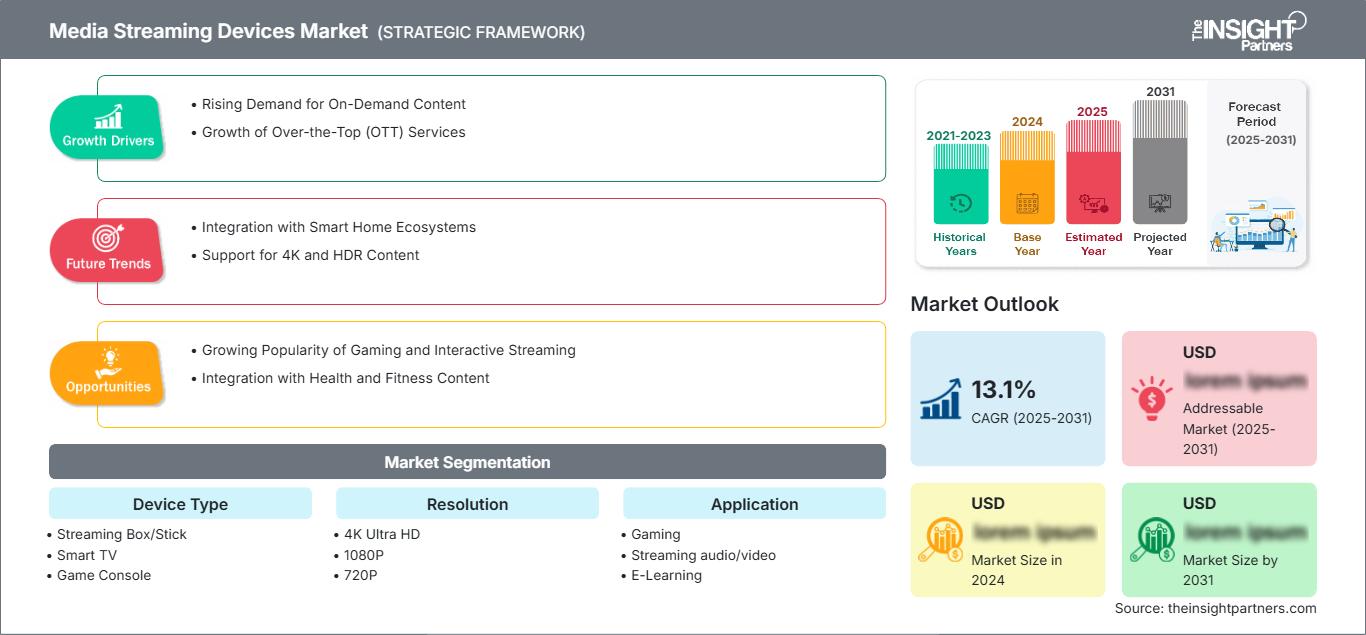
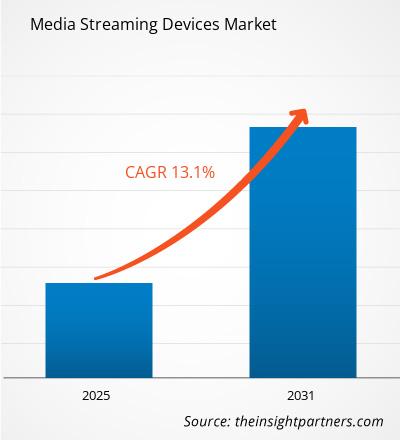
The Media Streaming Devices Market was valued at US$ 73.58 Billion in 2025 and is projected to reach US$ 286.72 Billion by 2034, expanding at a CAGR of 16.31% during 2026–2034. Rising consumer preference for connected entertainment ecosystems, increasing penetration of high-speed broadband, and the expansion of subscription-based digital content platforms are reshaping demand patterns across residential and commercial environments worldwide.
Across North America, device adoption continues to benefit from mature broadband infrastructure, widespread smart home integration, and strong household spending on digital entertainment. The media streaming devices market size in the region is supported by accelerating migration from traditional television services toward internet-delivered content. Regional growth is expected to remain robust, with CAGR estimated between 14.8%–16.2% through 2034, supported by 4K content availability and expanding connected-device ecosystems.
Media Streaming Devices Market Assessment and Insights
- North America: The region accounted for 36–40% share in 2025 and is expected to grow at a CAGR between 14.8%–16.2% during 2026–2034. Strong OTT penetration, advanced broadband infrastructure, and high smart-home adoption continue supporting demand for streaming hardware solutions.
- US: The country represented 74–78% of North American revenue in 2025 and is projected to expand at a CAGR between 14.5%–16.0% during 2026–2034. Premium streaming subscriptions and gaming integration remain primary demand catalysts.
- Europe: Europe captured 24–28% share in 2025 and is forecast to register a CAGR between 14.0%–15.5% during 2026–2034. Germany, the UK, and France lead adoption due to digital television transitions and expanding connected entertainment ecosystems.
- Asia Pacific: The region held 26–30% share in 2025 and is expected to achieve a CAGR between 18.0%–20.0% during 2026–2034. China, Japan, India, and South Korea are benefiting from expanding broadband access and growing digital content consumption.
- Largest Segment: Streaming Box/Stick represented a market share of 52–56% in 2025 and is expected to grow at a CAGR between 15.5%–17.0% during 2026–2034, supported by affordability and compatibility across multiple display platforms.
- High Growth Segment: 4K Ultra HD accounted for 42–46% market share in 2025 and is forecast to expand at a CAGR between 18.5%–20.5% during 2026–2034, driven by premium content consumption and higher display quality expectations.
- Key companies analyzed in detail: Amazon.com, Inc., Apple Inc., Google LLC, LG Electronics Inc., Microsoft Corporation, NVIDIA Corporation, Roku, Inc., Samsung Electronics Co., Ltd., Sony Group Corporation, VIZIO Holding Corp.
Source: The Insight Partners' analysis based on proprietary research, government publications, company annual reports, investor presentations, industry databases, and expert interviews.
The market has shifted from mere devices that provide access to media content to advanced entertainment units that incorporate voice assistants, artificial intelligence, cloud syncing, games, and home automation systems. Innovations in chipsets, wireless technology, and operating systems have made it possible for device makers to offer an advanced content aggregation process that spans all available streaming media providers. Simultaneously, falling prices of components and increased manufacturing capacities in Asia have ensured that the products remain affordable to cater to wider consumer segments.
In the future, there will be more investments in emerging economies of the digital world, where broadband internet and connected TV penetration are expanding fast. Digital infrastructure investments by government agencies, together with fiber broadband and new wireless networks generation will provide a favorable adoption environment. Moreover, the growing number of hardware providers and content providers will contribute to the competitiveness of the ecosystem. All of these factors ensure the promising growth of the market in question during the forecast period.
Media Streaming Devices Market Report Scope
| Report Attribute | Details |
|---|---|
| Market size in 2025 | US$ 73.58 Billion |
| Market Size by 2034 | US$ 286.72 Billion |
| Global CAGR (2026 - 2034) | 16.31% |
| Historical Data | 2021-2024 |
| Forecast period | 2026-2034 |
Media Streaming Devices Market Analysis
The media streaming devices market growth trajectory is supported by expanding global consumption of on-demand entertainment and increasing household adoption of connected devices. Streaming platforms have been investing a lot in their own libraries of original content, thus urging consumers to buy upgraded hardware, which would offer an enhanced experience to the viewer. Value chain comprises semiconductor suppliers, software platform providers, hardware vendors, content aggregators, and distributors, which form a diversified ecosystem that drives innovation in products and markets.
There are still favorable dynamics on the supply side due to better performance of semiconductors and improved efficiency of manufacturing. There are more advanced processors, AI-driven recommendation systems and low-latency connectivity. It not only enhances user experience but also meets content delivery needs. Growing demand for games, educational purposes, and mixed-use is diversifying income sources for the ecosystem.
The media streaming devices market analysis indicates an increasingly competitive environment characterized by ecosystem integration and platform differentiation. Businesses are working towards better user experiences, content exclusivity partnerships, voice-activated navigation systems, and smart home interoperability in order to improve their competitive positioning. Platform loyalty is an important factor now that customers are looking for smooth interaction between several interconnected devices and subscription services.
Amazon.com, Inc., Apple Inc., Google LLC, Roku, Inc., Samsung Electronics Co., Ltd., and LG Electronics Inc. are continuing to make efforts towards operating systems, AI, and content partnerships, while Microsoft Corporation, Sony Group Corporation, and NVIDIA Corporation are benefiting from gaming ecosystems to establish themselves within the world of connected entertainment.
● REPORT CUSTOMIZATION
Tailor This Report To Align With Your Specific Business Requirements
This report can be customized to align precisely with your business objectives, scope, and target markets. Customization options include tailored segmentation, geography, competitive analysis, and strategic insights to support informed decision-making.
Customize This Report →WHAT YOU CAN ADJUST
- ● Segmentations
- ● Geography
- ● Competitive Analysis
- ● Language Preferences
Media Streaming Devices Market: Strategic Insights
Regional Insights
North America Media Streaming Devices Market
North America accounted for 36–40% of the global Media Streaming Devices Market revenue in 2025 and remains the largest regional contributor. Growth is expected to continue at a CAGR of 14.8%–16.2% during 2026–2034, supported by extensive broadband penetration, high disposable incomes, and widespread adoption of connected entertainment solutions. Consumers increasingly favor internet-delivered content over traditional broadcasting, creating sustained demand for streaming hardware across households. The region also benefits from strong technology ecosystems and early adoption of emerging entertainment technologies.
Platform providers and device manufacturers continue introducing integrated solutions combining streaming, gaming, voice assistance, and smart-home control. Growing availability of premium subscription services and expanding 4K content libraries support upgrade cycles among existing users. The region's established digital infrastructure and strong content consumption habits are expected to maintain its leadership position throughout the forecast period.
U.S. Media Streaming Devices Market
The United States represented 74–78% of North American revenue in 2025 and is expected to register a CAGR of 14.5%–16.0% through 2034. Strong presence of major technology firms, advanced broadband networks, and extensive OTT service adoption continue to support market expansion. Households increasingly use multiple connected devices for content consumption, driving demand for interoperable streaming ecosystems capable of supporting diverse entertainment preferences.
Companies including Amazon.com, Inc., Apple Inc., Google LLC, Roku, Inc., and Microsoft Corporation maintain substantial influence across the domestic ecosystem. Demand is also supported by rising gaming integration, cloud-based entertainment services, and smart television connectivity. Increasing adoption of premium video formats and personalized content experiences is expected to reinforce long-term growth prospects across the country.
Europe Media Streaming Devices Market
Europe held 24–28% of global Media Streaming Devices Market revenue in 2025 and is projected to expand at a CAGR of 14.0%–15.5% during 2026–2034. The region benefits from strong broadband availability, widespread connected television ownership, and increasing adoption of subscription-based streaming services. Regulatory support for digital transformation and ongoing improvements in telecommunications infrastructure continue to strengthen market fundamentals across key economies.
The United Kingdom remains a major contributor, supported by mature digital media consumption patterns and widespread smart television adoption. Germany leads continental Europe through strong consumer electronics demand, advanced connectivity infrastructure, and growing adoption of premium streaming subscriptions. France, Italy, and Spain collectively contribute significant revenue through expanding broadband penetration, increasing digital entertainment spending, and growing acceptance of connected media ecosystems. Germany is expected to remain the leading country market during the forecast period.
APAC Media Streaming Devices Market
Asia Pacific accounted for 26–30% of the Media Streaming Devices Market share in 2025 and is expected to record the fastest expansion with a CAGR of 18.0%–20.0% during 2026–2034. Rapid urbanization, increasing smartphone penetration, and expanding broadband networks are driving adoption across major economies.
China leads regional demand, while Japan and South Korea benefit from advanced connectivity infrastructure. India represents a significant long-term opportunity due to rising digital consumption and expanding fiber broadband deployment. Australia also maintains strong adoption supported by mature digital entertainment markets and favorable connectivity conditions.
Middle East & Africa Media Streaming Devices Market
The region is expected to achieve a CAGR of 15.0%–17.0% during 2026–2034, supported by digital transformation initiatives and increasing investment in telecommunications infrastructure. Expanding broadband coverage and growing youth populations are creating favorable conditions for connected entertainment adoption.
Saudi Arabia and the UAE lead regional demand through smart city investments and advanced connectivity projects. South Africa remains an important market due to growing digital media consumption. Continued infrastructure development across the broader region is expected to support sustained adoption over the forecast horizon.
Segmentation Analysis
Device Type
The Device Type segment is expected to register a CAGR of 15.8%–17.2% during 2026–2034. The segment remains central to market development as consumers increasingly seek affordable and versatile solutions for accessing digital content. Product innovation, platform compatibility, and integration with smart home ecosystems continue influencing purchasing decisions. The media streaming devices market scope continues to broaden as manufacturers introduce advanced features supporting entertainment, gaming, and educational applications.
- Streaming Box/Stick remains the dominant category due to affordability, ease of installation, extensive platform compatibility, and the ability to upgrade legacy televisions into connected entertainment systems.
- Smart TV adoption continues to expand as manufacturers integrate native streaming functionality, reducing dependence on external hardware while enhancing convenience and content accessibility.
- Game Console devices maintain strategic relevance through the integration of streaming applications alongside gaming ecosystems, creating multifunctional entertainment hubs for consumers.
Resolution
The Resolution segment is expected to expand at a CAGR of 17.0%–18.5% during 2026–2034. Consumer preferences increasingly favor higher-quality viewing experiences, encouraging manufacturers and content providers to support advanced display technologies. Improvements in broadband capacity and content availability are accelerating migration toward premium resolution formats across both developed and emerging markets.
- 4K Ultra HD continues gaining prominence due to superior visual quality, expanding content libraries, and increasing availability of compatible displays across consumer segments.
- 1080P remains relevant for cost-conscious consumers and regions where bandwidth limitations influence content consumption preferences and device purchasing decisions.
- 720P maintains niche demand in entry-level applications where affordability and basic streaming functionality remain primary purchasing considerations.
Application
The Application segment is projected to grow at a CAGR of 16.8%–18.3% during 2026–2034. Expanding use cases beyond entertainment are supporting broader adoption across households and educational environments. Increasing digital engagement and growing availability of specialized content platforms continue to enhance application diversity across end-user groups.
- Gaming is benefiting from cloud gaming services, low-latency streaming technologies, and increasing integration between entertainment and interactive digital experiences.
- Streaming audio/video represents the largest application area due to widespread consumer demand for on-demand content and subscription-based entertainment services.
- E-Learning is gaining momentum as educational institutions and learners increasingly rely on digital content delivery and remote learning platforms.
Opportunity Snapshot
| Application | Revenue Contribution | Trend Tag | Adoption Stage |
| Gaming | Medium | Cloud Gaming | Scaling |
| Streaming audio/video | High | Premium OTT | Mature |
| E-Learning | Medium | Digital Learning | Scaling |
Media Streaming Devices Market Growth Drivers and Impact Analysis
Expansion of Global OTT Subscription Ecosystems
The rise of subscription-based streaming services has revolutionized the pattern of digital content consumption globally. Consumers' preference for the on-demand model of accessing entertainment compared to traditional broadcasting leads to the consistent need for specialized streaming hardware. Streaming service providers keep making efforts in terms of investing in exclusive content, multilingual content and recommendations in order to convince their users to buy specialized devices for consuming content from several sources at once. With the growth of content portfolios in the areas of sports, movies, TV shows and live content, consumers are updating their entertainment devices in order to be able to stream high-quality content. The most evident evidence of this trend can be observed in countries characterized by growing broadband penetration and connected TV ownership.
Advancements in Broadband and Wireless Connectivity Infrastructure
Advances in broadband infrastructure and future generation wireless networks have greatly improved the quality and availability of streaming content. Deployment of fiber infrastructure, high internet connection speeds in households, and increased 5G infrastructure have made it possible for the transfer of heavy bandwidth content, including 4K and interactive streaming services. Advances in this infrastructure decrease buffering problems, increase customer satisfaction, and facilitate the use of connected entertainment devices. There is still much investment going on by governments and telecommunications companies to upgrade their digital infrastructure, especially in developing countries where internet access is growing at a very fast pace. Higher connectivity also makes possible the provision of cloud gaming, live streaming, and educational content through the same hardware infrastructure. Improved network performance increases the willingness of customers to buy premium hardware capable of using such services.
Growing Integration of Smart Home and Voice-Controlled Ecosystems
With the growing trend of connected homes, users are looking for devices that can function easily within digital ecosystems. Streaming devices have progressed from being simply used to consume content to being multi-functional hubs that can support voice assistants and smart home controls, as well as sync other devices with each other. Convenience, compatibility, and centralization of connected technology systems are what consumers seek, thus encouraging manufacturers to build such software features into their streaming devices. Linking to lighting systems, security systems, and intelligent assistants makes streaming devices more useful and builds brand loyalty for the platforms. Artificial Intelligence has been used by manufacturers to facilitate content search and consumer engagement. All these factors increase the value beyond just entertainment and boost usage among tech-savvy homes.
Media Streaming Devices Market Future Trends
AI-Driven Personalized Content Experiences
The media streaming devices market trends increasingly point toward deeper integration of artificial intelligence across content discovery and user interaction. Future platforms are expected to leverage behavioral analytics, contextual recommendations, and predictive algorithms to deliver highly personalized entertainment experiences. Voice-enabled interfaces will become more intuitive, enabling natural language interactions and improved content navigation. AI will also support targeted advertising models, automated content categorization, and enhanced accessibility features. As users engage with growing volumes of digital content, personalization capabilities will become a critical differentiator among ecosystem providers. Manufacturers that successfully integrate advanced intelligence into hardware and software environments are expected to strengthen user retention and platform engagement over the coming decade.
Convergence of Streaming, Gaming, and Cloud Services
The evolution of the market in the future will be determined by the emergence of greater convergence of entertainment streaming, cloud computing, and gaming environments. Users are increasingly looking for solutions that will provide them with access to a variety of digital products in one system. Cloud game streaming, interactive format, and subscription packages will become increasingly common as technological advancements make this possible. It will also be more common for hardware manufacturers to develop devices that can perform operations at low latency and have smooth access to cloud technologies.
Media Streaming Devices Market Opportunities
Expansion into Emerging Digital Economies
Significant investment opportunities exist across developing economies where internet penetration, connected television ownership, and digital content consumption continue rising. Markets in South Asia, Southeast Asia, Africa, and parts of Latin America remain underpenetrated relative to developed regions, creating substantial room for expansion. Manufacturers can capitalize on demand through affordable product portfolios, localized content partnerships, and region-specific software ecosystems. Improvements in broadband infrastructure and smartphone adoption are supporting greater awareness of streaming services among new user groups. Long-term media streaming devices market forecasts indicate that emerging economies will contribute an increasing proportion of incremental demand. Companies that establish strong distribution networks and strategic partnerships early are likely to secure meaningful competitive advantages.
Growth of Education and Enterprise Streaming Applications
Besides entertainment, streaming devices are gaining popularity in educational and business use cases. Schools are adopting digital learning techniques using video content delivery, whereas businesses are incorporating streaming technologies in collaborative and training platforms. There are prospects for designing specific products geared towards virtual classrooms, remote training, and enterprise communications. In addition, improved security measures, cloud connectivity, and interoperability with productivity tools will make the adoption of such technology in areas outside of entertainment easier. With hybrid learning and remote work remaining a necessity in many global markets, the market for streaming-enabled devices will grow in demand.
Frequently Asked Questions

- Comprehensive Market Sizing and Forecast Analysis
- Detailed Segmentation Analysis
- In-Depth Market Dynamics Assessment
- Regional and Country-Level Insights
- Competitive Landscape and Company Benchmarking
- Strategic Business Intelligence
Recent Reports
Testimonials

The Insight Partners provided valuable market intelligence that supported our global go-to-market strategy. Their team was professional, responsive, and attentive to our feedback, providing thoughtful analysis and helpful methodological clarifications throughout the project.
Junmo Kim Chief Financial Officer (CFO), Enertech Co., Ltd.
The Insight Partners' SCADA System Market report is comprehensive, with valuable insights on current trends and future forecasts. The team was highly professional, responsive, and supportive throughout. We are very satisfied and highly recommend their services.
RAN KEDEM Partner, Reali Technologies LTDs
I requested a report on a very specific software market and the team produced the report in a few days. The information was very relevant and well presented. I then requested some changes and additions to the report. The team was again very responsive and I got the final report in less than a week.
JEAN-HERVE JENN Chairman, Future Analytica
We worked with The Insight Partners for an important market study and forecast. They gave us clear insights into opportunities and risks, which helped shape our plans. Their research was easy to use and based on solid data. It helped us make smart, confident decisions. We highly recommend them.
PIYUSH NAGPAL Sr. Vice President, High Beam Global
The Insight Partners delivered insightful, well-structured market research with strong domain expertise. Their team was professional and responsive throughout. The user-friendly website made accessing industry reports seamless. We highly recommend them for reliable, high-quality research services
YUKIHIKO ADACHI CEO, Deep Blue, LLC.
This is the first time I have purchased a market report from The Insight Partners.While I was unsure at first, I visited their web site and felt more comfortable to take the risk and purchase a market report.I am completely satisfied with the quality of the report and customer service. I had several questions and comments with the initial report, but after a couple of dialogs over email with their analyst I believe I have a report that I can use as input to our strategic planning process.Thank you so much for taking the extra time and making this a positive experience.I will definitely recommend your service to others and you will be my first call when we need further market data.
JOHN SUZUKI President and Chief Executive Officer, Board Director, BK Technologies
I wish to appreciate your support and the professionalism you displayed in the course of attending to my request for information regarding to infectious disease IVD market in Nigeria. I appreciate your patience, your guidance, and the fact that you were willing to offer a discount, which eventually made it possible for us to close a deal. I look forward to engaging The Insight Partners in the future, all thanks to the impression you have created in me as a result of this first encounter.
DR CHIJIOKE ONYIA MANAGING DIRECTOR, PineCrest Healthcare Ltd.Reason to Buy
- Informed Decision-Making
- Understanding Market Dynamics
- Competitive Analysis
- Identifying Emerging Markets
- Customer Insights
- Market Forecasts
- Risk Mitigation
- Boosting Operational Efficiency
- Strategic Planning
- Investment Justification
- Tracking Industry Innovations
- Aligning with Regulatory Trends





 Get Free Sample for