
Smart Label Market Growth, Size & Forecast by 2034
Coverage: By Component (Transceivers, Batteries, Microprocessor, Memories); Technology (Electronic Article Surveillance Labels (EAS), RFID Labels, Sensing Labels, Electronic Shelf/Dynamic Display Labels, Near Field Communication (NFC) Tags); Application (Retail Inventory, Electronic and IT Assets, Equipment, Pallets Tracking, Others); Industry (Healthcare, Automotive, Retail, Manufacturing, Logistics, Food and Beverages, Others) , and Geography (North America, Europe, Asia Pacific, and South and Central America)
- Status : Data Released
- Report Code : TIPTE100000647
- Category : Electronics and Semiconductor
- No. of Pages : 150
- Available Report Formats :


- Last update date : September 03, 2026


2025 Market Size
US$ 17.26 Bn
Base year value
2034 Forecast
US$ 44.23 Bn
Projected by 2034
CAGR 2026-2034
11.02 %
Growth rate
Addressable Market
US$ 271.64 Bn
(2026-2034)
The Smart Label Market was valued at US$ 17.26 billion in 2025 and is projected to reach US$ 44.23 billion by 2034, registering a CAGR of 11.02% over the forecast period from 2026 to 2034. The growth trajectory reflects accelerating adoption of RFID and NFC technologies, driven by supply chain digitization requirements and increasing consumer demand for product transparency and authentication .
Smart Label Market in North America currently holds a dominant share of 35–38% in 2025 and is projected to grow at an estimated CAGR of 10–12% during 2026–2034. The region's market leadership is anchored by extensive retail infrastructure and early adoption of inventory visibility solutions, with regulatory frameworks such as the Drug Supply Chain Security Act (DSCSA) mandating serialization compliance. Strong demand from retail, healthcare, logistics, and food & beverage sectors continues to support Smart Label Market size expansion across the region.
Smart Label Market Assessment and Insights
- North America – Estimated to account for 35-38% of the global market in 2025. The region is expected to exhibit strong growth at a CAGR of 10-12% from 2026 to 2034, driven by retail RFID mandates and healthcare serialization requirements .
- US – Represents approximately 85-90% of the North American market in 2025, growing at a CAGR of 10-12% through 2034. Market strength is driven by large retail chains implementing store-wide RFID programs and pharmaceutical traceability mandates .
- Europe – Accounts for 26-30% of the global market in 2025, growing at an estimated CAGR of 11-13% during 2026-2034. Germany, the UK, and France are leading countries, supported by the EU Packaging and Packaging Waste Regulation (PPWR) promoting digital product passports .
- Asia Pacific – Represents 22-26% of global market share in 2025, projected to grow at the fastest CAGR of 13-15% through 2034. China, Japan, and India lead regional adoption, driven by manufacturing expansion and e-commerce growth .
- Largest Segment – RFID Labels technology segment held the largest share of 35-40% in 2025, with a CAGR of 10-12% projected through 2034, supported by proven scalability in retail inventory and logistics applications .
- High Growth Segment – Sensing Labels technology is projected as the fastest-growing segment with a CAGR of 14-16% from 2026 to 2034, driven by demand for environmental monitoring in cold-chain pharmaceuticals and perishable goods logistics .
- Key companies analyzed in detail – Avery Dennison Corporation, Alien Technology, LLC, SOLUM Group, CCL Industries, Checkpoint Systems; Inc., SATO Holdings Corporation, Mühlbauer Group, Zebra Technologies Corporation, Schreiner Group, and RubberLabelsUSA.
Source: The Insight Partners' analysis based on proprietary research, government publications, company annual reports, investor presentations, industry databases, and expert interviews.
The evolution of the market, as highlighted in the Smart Label Market report, reflects a shift from basic identification tags to intelligent, data-rich systems integrating RFID, NFC, and sensing technologies. The production trends continue to focus on chip downsizing, substrate printing flexibility, and software platforms that convert simple tags into intelligent information sources. The industry is driven by the intersection of IoT infrastructure and cloud analytics, which facilitates real-time visibility of inventory and condition management in the retail, healthcare, and logistics industries. The regulation, including pharmaceutical serialization needs in the U.S. and digital product passport legislation in Europe, has pushed the market forward and turned the regulatory requirements into competitive advantages for supply chain players.
New regions, especially the countries of Southeast Asia and Latin America, offer substantial growth opportunities amid the fast-paced process of retail transformation and the growing importance of e-commerce. The investment in 5G and IoT infrastructure allows deploying large-scale sensor networks without batteries, which decreases the total cost of ownership and opens up new applications. The regulatory drivers from the FDA's FSMA traceability regulations and European sustainable legislations compel end-user industries to invest in smart labeling solutions.
Smart Label Market Report Scope
| Report Attribute | Details |
|---|---|
| Market size in 2025 | US$ 17.26 Billion |
| Market Size by 2034 | US$ 44.23 Billion |
| Global CAGR (2026 - 2034) | 11.02% |
| Historical Data | 2021-2024 |
| Forecast period | 2026-2034 |
Smart Label Market Analysis
The Smart Label Market is experiencing strong demand driven by the growing need for end-to-end supply chain visibility, inventory accuracy, and product traceability. Retailers increasingly rely on smart labels to access real-time stock data, reduce out-of-stock situations, and improve replenishment efficiency. There has been a growing use of RFID, NFC, and sensor-based labels in various sectors as companies look towards increasing transparency and effectiveness of asset tracking through the supply chains.
In the healthcare industry, compliance with drug serialization and authentication regulations is spurring the use of smart labeling technologies. The technologies help ensure that patients are not exposed to risks, thus ensuring safety as well as compliance with regulations. In terms of the market value chain, it involves semiconductor companies, inlay companies, label converters, software developers, and systems integrators.
In this environment, there are key players such as Avery Dennison Corporation, CCL Industries, and Zebra Technologies, as well as specialists like Alien Technology and Schreiner Group. It is important to highlight that competition has now become focused on technology innovation and product differentiation.
Investment activity remains strong, supporting a favorable Smart Label Market forecast, with increasing mergers and acquisitions focused on RFID technologies, sensing capabilities, and digital tracking solutions. Companies are developing cloud-based platforms that transform label-generated data into actionable business intelligence, while startups are introducing disposable sensor-enabled labels for applications such as cold-chain monitoring. At the same time, established players are expanding manufacturing capacity and geographic presence in high-growth regions, positioning themselves to capture long-term opportunities and strengthen their competitive positions within the evolving market.
● REPORT CUSTOMIZATION
Tailor This Report To Align With Your Specific Business Requirements
This report can be customized to align precisely with your business objectives, scope, and target markets. Customization options include tailored segmentation, geography, competitive analysis, and strategic insights to support informed decision-making.
Customize This Report →WHAT YOU CAN ADJUST
- ● Segmentations
- ● Geography
- ● Competitive Analysis
- ● Language Preferences
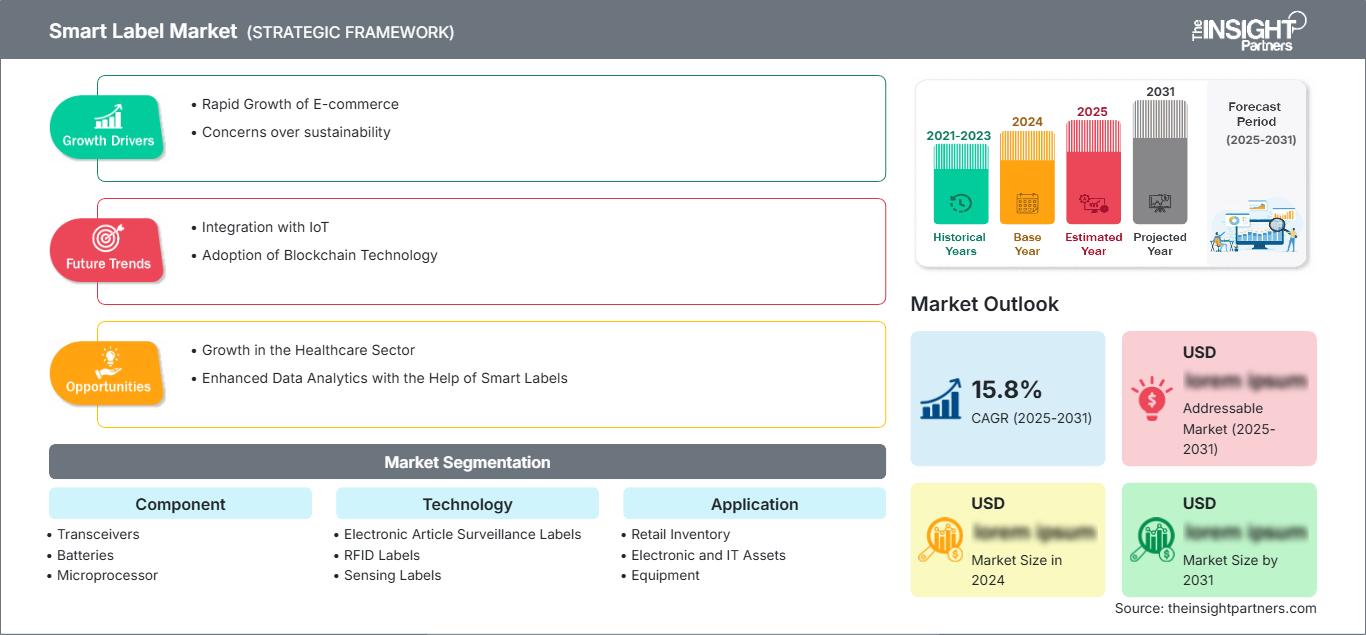
Smart Label Market: Strategic Insights
Regional Insights
North America Smart Label Market
North America Smart Label Market represents the largest regional market, accounting for an estimated 35–38% of global revenue in 2025, with a projected CAGR of 10–12% during 2026–2034. The United States serves as the primary growth engine, driven by early retail adoption and the legally binding DSCSA pharmaceutical serialization roadmap. Continued federal investment aimed at expanding domestic semiconductor capacity is expected to alleviate chip shortages that have previously constrained deployment schedules. Canada and Mexico benefit from integrated cross-border commerce as nearshoring trends accelerate, while major players are investing in regional manufacturing capacity to meet rising demand from retail and healthcare sectors.
U.S. Smart Label Market
The Smart Label Market in the U.S. accounts for approximately 85–90% of North American revenue, with a CAGR of 10–12% projected through 2034. Retail giants, including Walmart, have been systematically implementing UHF RFID programs across thousands of stock-keeping units, creating a compliance baseline that forces suppliers to invest in smart labeling infrastructure. The healthcare sector presents robust demand due to the DSCSA full enforcement requiring serialized identifier verification before product transfers. Vendor investments in blockchain-enabled traceability systems and ambient IoT sensors are converting passive labels into comprehensive data assets, supporting real-time inventory management and anti-counterfeiting efforts across the market.
Europe Smart Label Market
Europe is estimated to capture 26-30% of the global Smart Label Market share in 2025, growing at a CAGR of 11-13% through 2034. Germany leads regional adoption, driven by automotive industry implementation and battery-passport pilot programs for electric vehicles. The UK market benefits from strong retail and healthcare sector demands, with advanced supply chain digitization initiatives. France, Italy, and Spain are emerging as significant markets, supported by EU regulations, including the PPWR that mandates digital identifiers for recyclability scoring and product traceability. Konica Minolta projects the European RFID label market to approach EUR 2.5 billion by 2027, reflecting widespread adoption across consumer goods, healthcare, and industrial sectors.
APAC Smart Label Market
Asia Pacific accounted for 22–26% of global market share in 2025 and is projected to grow at the fastest CAGR of 13–15% through 2034, reflecting key Smart Label Market trends across the region. China leads regional adoption with nationwide 2D-barcode initiatives across food producers and strong electronics manufacturing capabilities. Japan's Industry 5.0 incentives and South Korea's advanced semiconductor ecosystem support large-volume deployment of battery-free sensors. India and Australia demonstrate robust growth driven by e-commerce expansion, retail modernization, and pharmaceutical serialization mandates. The growing 5G and planned 6G network coverage across the region provides essential infrastructure for ambient IoT applications, accelerating smart label adoption across supply chain and logistics applications.
Middle East & Africa Smart Label Market
The MEA region exhibits growing adoption of smart label technologies, with a projected CAGR of 11-13% through 2034. Saudi Arabia leads regional investment, driven by logistics infrastructure development under Vision 2030 and expanding cold-chain capabilities for food security initiatives. UAE adoption is accelerated by e-commerce growth and smart retail investments in Dubai and Abu Dhabi. South Africa represents the largest African market, with retail modernization programs and healthcare authentication initiatives driving demand. Infrastructure development and energy sector digitization create additional application opportunities across the region.
Segmentation Analysis
Component
The Smart Label Market component segment comprises transceivers, batteries, microprocessors, and memories. Transceivers represent the largest component category, enabling wireless communication functionality across RFID, NFC, and sensing label applications. The market component landscape is evolving toward integrated system-on-chip solutions that combine multiple functions in compact form factors, supporting cost-reduction requirements for high-volume retail and logistics deployments. Continuous miniaturization and power-efficiency improvements are extending label capabilities while reducing overall system costs, enhancing the adoption of smart labels across a wide range of end-use industries.
- Transceivers – Enable wireless communication protocols, including RFID, NFC, and cellular connectivity. Demand is driven by increasing requirements for long-range read capabilities and multi-protocol support across diverse application environments.
- Batteries – Support active and semi-passive label applications requiring extended read ranges and sensor functionality. Advancements in thin-film battery technology are enabling thinner, more flexible form factors for specialized applications.
- Microprocessors – Facilitate data processing, encryption, and control functions within smart label systems. Enhanced processing capabilities support complex applications, including secure authentication and multi-parameter sensing .
- Memories – Provide data storage for product information, supply chain records, and authentication credentials. Increasing capacity requirements reflect growing demand for detailed traceability data and digital product passports.
Technology
The technology segment includes Electronic Article Surveillance (EAS) Labels, RFID Labels, Sensing Labels, Electronic Shelf/Dynamic Display Labels, and Near Field Communication (NFC) Tags. RFID Labels dominate with approximately 35-40% market share in 2025, supported by established supply chains and proven scalability in retail inventory management. Sensing Labels represent the fastest-growing technology sub-segment with a CAGR of 14-16% through 2034, driven by cold-chain monitoring requirements in pharmaceuticals, food logistics, and healthcare applications. Electronic shelf labels are gaining momentum in retail due to dynamic pricing capabilities, while NFC Tags leverage smartphone ubiquity for tap-to-verify consumer engagement.
- Electronic Article Surveillance Labels – Primarily deployed for retail security applications. Demand remains steady in the apparel and consumer electronics categories, with innovation focused on integration with inventory tracking capabilities.
- RFID Labels – Dominate the market with broad retail, logistics, and industrial applications. Proven scalability and decreasing tag costs continue to drive adoption across supply chain visibility programs .
- Sensing Labels – Incorporate sensors for temperature, humidity, shock, and light monitoring. Fastest-growing segment driven by pharmaceutical cold-chain compliance and perishable goods logistics requirements .
- Electronic Shelf/Dynamic Display Labels – Enable real-time price updates and dynamic merchandising in retail environments. Adoption is accelerated by labor cost savings and pricing optimization benefits .
- Near Field Communication Tags – Leverage smartphone tap functionality for consumer engagement, product authentication, and interactive marketing applications. Growth is driven by anti-counterfeiting requirements and consumer demand for product transparency .
Application
The application segment encompasses Retail Inventory, Electronic and IT Assets, Equipment, and Pallets Tracking. Retail inventory management is the largest application category, driven by store-wide RFID programs and inventory accuracy requirements. Electronic and IT asset tracking addresses growing requirements for equipment management and authentication in enterprise environments. Equipment tracking applications span construction, manufacturing, and healthcare sectors, while pallet tracking supports logistics optimization and supply chain visibility.
- Retail Inventory – Largest application segment, driven by store-wide RFID programs and omnichannel fulfillment requirements. Real-time inventory visibility reduces stockouts and improves customer satisfaction .
- Electronic and IT Assets – Addresses growing requirements for tracking high-value equipment and authentication of electronic components. Healthcare and enterprise applications drive adoption.
- Equipment – Supports tracking and maintenance applications across manufacturing, construction, and healthcare sectors. Condition monitoring capabilities expand addressable use cases.
- Pallets Tracking – Enables logistics optimization and supply chain visibility. Intermodal transportation applications require robust, durable label designs with extended read ranges.
Industry
Industry is expected to register a modelled 10.9–11.5% CAGR during 2026–2034. Retail currently provides substantial scale, while healthcare, manufacturing, logistics, and food applications broaden adoption through traceability, automation, authentication, and condition monitoring.
- Healthcare: Smart labels support pharmaceutical identification, patient safety, medical inventory, specimen tracking, authentication, temperature monitoring, and device management where traceability and data integrity are particularly important.
- Automotive: RFID enables component identification, work-in-process tracking, vehicle production sequencing, reusable container management, maintenance records, and logistics visibility across complex automotive manufacturing networks.
- Retail: Retailers use RFID, EAS, NFC, and ESL technologies to integrate inventory accuracy, loss prevention, dynamic pricing, fulfillment, consumer engagement, and increasingly automated store operations.
- Manufacturing: Smart identification connects materials, components, work-in-process, tools, equipment, and finished products with digital manufacturing systems, improving traceability and production visibility.
- Logistics: RFID enables automated receiving, sorting, pallet identification, shipment verification, warehouse visibility, and traceability, reducing dependence on manual barcode scanning across high-volume operations.
- Food and Beverages: Smart labels support freshness monitoring, inventory rotation, traceability, authentication, dynamic pricing, and waste reduction across grocery, food production, cold-chain, and distribution applications.
Opportunity Snapshot
| Application | Revenue Contribution | Trend Tag | Adoption Stage |
| Retail Inventory | High | Omnichannel Visibility | Mature |
| Electronic and IT Assets | Medium | Asset Authentication | Scaling |
| Equipment | Medium | Condition Monitoring | Scaling |
| Pallets Tracking | High | Supply Chain Visibility | Mature |
Smart Label Market Growth Drivers and Impact Analysis
Regulatory Mandates Driving Serialization Compliance
Regulatory frameworks, including the FDA's Drug Supply Chain Security Act (DSCSA) in the United States and the EU's Falsified Medicines Directive, have established mandatory serialization requirements for pharmaceutical products. These regulations require trading partners to verify serialized identifiers before product transfers, creating non-negotiable demand for smart labeling solutions incorporating RFID and NFC technologies. Similar traceability mandates are expanding into food safety (FSMA 204) and consumer goods, broadening the addressable market beyond healthcare. The regulatory compliance driver creates sustained, non-discretionary investment within the Smart Label Market from industries that must achieve serialization to remain compliant and maintain market access. Manufacturers, distributors, and retailers are embedding smart labels into production and fulfillment operations, generating consistent demand growth independent of broader economic cycles.
Retail RFID Programs Driving Supply Chain Visibility
Top-tier retailers such as Walmart have demanded UHF RFID tags on many thousands of stock-keeping units, thus forcing suppliers to upgrade their production facilities and encode the items. These projects allow for continuous visibility of stock, which is used to feed information directly to manufacturing execution systems, thus ensuring fewer material shortages and scheduling based on digital twins. The trend is not limited to particular mandates, because smaller retailers implement RFID solutions in order to have inventory accuracy higher than 95% to prevent stockouts and improve customer service levels. The connection of RFID to ERP systems allows for automated replenishment and dynamic pricing and to have more efficient omnichannel solutions. With the cost of RFID tags continuously falling below $0.10 per unit in large-scale applications, the business case for RFID adoption becomes increasingly obvious.
Cold-Chain Logistics and Environmental Monitoring Requirements
The increased global trade in temperature-sensitive pharmaceutical products, fresh food products, and perishable items has made it mandatory to monitor the environment in the entire supply chain process. Smart labels that incorporate temperature sensors, humidity sensors, shock sensors, and light sensors help monitor the environmental conditions and ensure product integrity. The applications of pharmaceutical cold chain constitute one of the most difficult applications of smart labels. Vaccines and biological products need strict monitoring of the temperature conditions from the time of manufacturing till delivery. Single-use disposable sensor-enabled smart labels that have been designed specifically for single-use shipment applications are now being considered as an effective alternative to reusable sensors.
Smart Label Market Future Trends
Integration of Blockchain for Product Authentication and Traceability
Blockchain technology is becoming increasingly important in relation to smart labels that offer evidence of provenance and secure data sharing between different supply chain partners. Every single smart label acts as a marker that links to the blockchain-validated data about products, recording their origin, distribution and authentication. This approach is especially crucial when dealing with products with high value, such as luxury goods, drugs, and key parts, where counterfeiting is especially important. Combining NFC tags with the blockchain-based authentication system will allow customers to check whether products are authentic through smartphones and establish the direct link between brands and consumers while collecting data on their usage. With the growing importance of the digital product passport movement in Europe and other regions, the implementation of smart labels based on blockchain technology will be inevitable.
Ambient IoT and Battery-Free Sensor Evolution
The evolution of ambient IoT technology is paving the way for smart labels that run on energy obtained from RF signals, obviating any cost associated with changing batteries and making the deployment of these smart labels feasible even in locations where they could not be used before. The advent of 5G, and the upcoming 6G network will provide the network backbone for ambient IoT, allowing widespread deployment of passive sensors in the retail, logistics, and manufacturing sectors. With antenna miniaturization and energy harvesting innovations providing read ranges of over 10 feet, frictionless checkout areas and total warehouse visibility without manually scanning can become a reality. With Qualcomm’s program to integrate RAIN RFID into smartphones, each and every consumer device will have the capability to function as a reader, possibly negating the need for dedicated scanners and driving adoption among small retailers.
Smart Label Market Opportunities
Expansion of Digital Product Passports in Consumer Goods
Regulatory initiatives, including the EU's Packaging and Packaging Waste Regulation (PPWR), are mandating digital product passports for various consumer goods categories, creating substantial opportunities for smart label deployment. Digital product passports provide consumers and supply chain participants with comprehensive information about product composition, recyclability, and sustainability credentials. This regulatory requirement is creating demand for smart labels that serve as physical carriers for digital product passport data, enabling verification throughout product lifecycles. Manufacturers of apparel, electronics, automotive components, and consumer goods are preparing for compliance through investment in smart labeling infrastructure. The opportunity extends beyond regulatory compliance to brand differentiation and consumer engagement, as digitally enabled products can provide interactive sustainability information and enhance brand trust.
Integration with AI for Predictive Supply Chain Analytics
The wealth of data generated by smart label deployments creates opportunities for artificial intelligence applications that transform tracking information into predictive insights. AI algorithms can analyze inventory movement patterns, lead time variability, and demand signals to optimize replenishment schedules and reduce working capital requirements. Real-time condition data from sensing labels enables predictive maintenance alerts, reducing product spoilage and equipment downtime. The opportunity extends to autonomous inventory management systems that trigger automatic replenishment based on smart label data, reducing human intervention and improving responsiveness. Vendors that develop robust analytics platforms integrated with smart label infrastructure are positioned to capture significant value through software subscriptions and data-as-a-service offerings, complementing hardware revenues.
Recent Developments
- June 2026: Identiv has launched ID-Pixels 3.0, a family of Bluetooth Low Energy inlays and labels built on Wiliot's Gen3 IC, enabling continuous sensing and tracking of goods across supply chains without batteries. The self-adhesive label, measuring approximately 33mm x 60mm, harvests energy from ambient Bluetooth and UHF signals and captures location, temperature, humidity and light data in real time. Each label carries a unique digital ID and integrates with the Wiliot Physical AI platform to translate continuous sensor data into actionable insights for inventory tracking, shipment verification, asset tracking and cold-chain monitoring.
- April 2026: Reelables, the first company to produce a printable active smart label for tracking cargo and inventory, announced its Anywhere product. For the first time, logistics providers, retailers, and manufacturers can track shipments, parcels, and cargo in real time all over the world, starting at $8 per label.
- January 2025: Giesecke+Devrient (G+D) has launched the G+D Smart Label, its innovative tracking solution that transforms any package into an IoT device. Ultra-thin and only slightly larger than a credit card, the new Smart Label proposition has been jointly developed by G+D in conjunction with its hardware partner, Sensos to enable cost-effective, accurate location tracking for a range of applications. These include parcel delivery and shipping, fleet management and monitoring the movement of luxury goods.
Frequently Asked Questions

- Comprehensive Market Sizing and Forecast Analysis
- Detailed Segmentation Analysis
- In-Depth Market Dynamics Assessment
- Regional and Country-Level Insights
- Competitive Landscape and Company Benchmarking
- Strategic Business Intelligence
Recent Reports
Testimonials

The Insight Partners' SCADA System Market report is comprehensive, with valuable insights on current trends and future forecasts. The team was highly professional, responsive, and supportive throughout. We are very satisfied and highly recommend their services.
RAN KEDEM Partner, Reali Technologies LTDs
I requested a report on a very specific software market and the team produced the report in a few days. The information was very relevant and well presented. I then requested some changes and additions to the report. The team was again very responsive and I got the final report in less than a week.
JEAN-HERVE JENN Chairman, Future Analytica
We worked with The Insight Partners for an important market study and forecast. They gave us clear insights into opportunities and risks, which helped shape our plans. Their research was easy to use and based on solid data. It helped us make smart, confident decisions. We highly recommend them.
PIYUSH NAGPAL Sr. Vice President, High Beam Global
The Insight Partners delivered insightful, well-structured market research with strong domain expertise. Their team was professional and responsive throughout. The user-friendly website made accessing industry reports seamless. We highly recommend them for reliable, high-quality research services
YUKIHIKO ADACHI CEO, Deep Blue, LLC.
This is the first time I have purchased a market report from The Insight Partners.While I was unsure at first, I visited their web site and felt more comfortable to take the risk and purchase a market report.I am completely satisfied with the quality of the report and customer service. I had several questions and comments with the initial report, but after a couple of dialogs over email with their analyst I believe I have a report that I can use as input to our strategic planning process.Thank you so much for taking the extra time and making this a positive experience.I will definitely recommend your service to others and you will be my first call when we need further market data.
JOHN SUZUKI President and Chief Executive Officer, Board Director, BK Technologies
I wish to appreciate your support and the professionalism you displayed in the course of attending to my request for information regarding to infectious disease IVD market in Nigeria. I appreciate your patience, your guidance, and the fact that you were willing to offer a discount, which eventually made it possible for us to close a deal. I look forward to engaging The Insight Partners in the future, all thanks to the impression you have created in me as a result of this first encounter.
DR CHIJIOKE ONYIA MANAGING DIRECTOR, PineCrest Healthcare Ltd.Reason to Buy
- Informed Decision-Making
- Understanding Market Dynamics
- Competitive Analysis
- Identifying Emerging Markets
- Customer Insights
- Market Forecasts
- Risk Mitigation
- Boosting Operational Efficiency
- Strategic Planning
- Investment Justification
- Tracking Industry Innovations
- Aligning with Regulatory Trends





 Get Free Sample for