
Speaker Amplifier Market Trends, Demand & Growth by 2034
Coverage: By Power (Low Power, Mid Power); End-Use (Consumer Electricals, Automotive, Smart Home Devices, Others) , and Geography (North America, Europe, Asia Pacific, and South and Central America)
- Status : Data Released
- Report Code : TIPRE00019862
- Category : Electronics and Semiconductor
- No. of Pages : 150
- Available Report Formats :


- Last update date : October 26, 2026


2025 Market Size
US$ 4.97 Bn
Base year value
2034 Forecast
US$ 9.72 Bn
Projected by 2034
CAGR 2026-2034
7.75 %
Growth rate
Addressable Market
US$ 66.18 Bn
(2026-2034)
The Speaker Amplifier Market is expanding as audio functionality becomes more integrated into consumer electronics, vehicles, and connected home products. The market is projected to increase from US$ 4.97 Billion in 2025 to US$ 9.72 Billion by 2034, registering a 7.75% CAGR during 2026–2034. Demand is being shaped by higher audio quality expectations, compact electronics architectures, power-efficiency requirements, and increasing integration of amplification functions into connected devices.
North America remains an important Speaker Amplifier Market because of established consumer electronics manufacturing, automotive electronics adoption, and strong demand for connected audio experiences. The regional market is expected to register a ~7% CAGR through 2034, supported by premium vehicle audio systems, smart home deployments, and continued semiconductor innovation. Product developers are also emphasizing smaller footprints, thermal efficiency, and digitally controlled amplification to support increasingly integrated device architectures.
Speaker Amplifier Market Assessment and Insights
Regional Outlook
- North America: ~31% of the global Speaker Amplifier Market share in 2025 | ~7% CAGR through 2034. Market position: North America holds a substantial position because of advanced automotive electronics, established consumer electronics demand, premium audio adoption, and strong semiconductor design capabilities. The US represents the principal demand center within the region.
- US: ~78% of North American market revenue in 2025 | ~7% CAGR through 2034. Market position: The US is the leading country in North America, supported by large automotive and consumer electronics ecosystems, advanced semiconductor development, smart home adoption, and demand for higher-performance audio architectures in connected products.
- Europe: ~25% of the global market in 2025 | ~6% CAGR through 2034. Market position: Europe represents a mature market supported by automotive electronics and premium consumer devices. Germany is the leading country in Europe, followed by the UK, France, Italy, and Spain, with vehicle electrification reinforcing electronics demand.
- Asia Pacific: ~34% of the global market in 2025 | ~9% CAGR through 2034. Market position: Asia Pacific is the fastest-growing region, supported by large-scale electronics manufacturing, expanding vehicle production, smart device adoption, and semiconductor localization. China is the leading country in Asia Pacific, with Japan, South Korea, and India also contributing significantly.
Segment Outlook
- Power: ~60% Share in 2025 | ~7% CAGR through 2034. Market position: Power represents the larger main segment because amplification performance directly determines the ability of speakers to deliver required acoustic output. Demand spans compact consumer devices, vehicle systems, and higher-output embedded audio platforms.
- End-Use: ~40% Share in 2025 | ~9% CAGR through 2034. Market position: End-Use is the higher-growth main segment as amplification becomes embedded across connected consumer electronics, automotive platforms, and smart home devices. Increasing device connectivity and demand for immersive sound support broader deployment.
Competitive Coverage
Cirrus Logic, Analog Devices, Inc., ROHM Co., Ltd., NXP Semiconductors, STMicroelectronics, Silicon Laboratories, Inc., ICEpower A/S, onsemi, Monolithic Power Systems, Inc., Infineon Technologies AG
Methodology
The Insight Partners follows Data Collection & Secondary Research, Primary Research, Data Analysis, and Data Triangulation & Final Review to validate market estimates and insights.
Source: The Insight Partners' analysis based on proprietary research, government publications, company annual reports, investor presentations, industry databases, and expert interviews.
The market for Speaker Amplifiers has advanced from discrete amplification topologies into highly-integrated semiconductor platforms which incorporate both amplification, diagnostics, signal processing, protection, and power management. The Class-D topologies have become more significant where efficient power conversion and low heat generation are crucial, while other topologies like Class-AB and others will remain prevalent in applications with legacy audio performance and designs.
For the future, the Speaker Amplifier market will see benefits in local electronics manufacture in the Asia Pacific region, vehicle electrification, and greater use of smart home appliances. Investments in semiconductors are increasingly being made in order to increase power density, lower the bill-of-materials, and enable digital audio control topologies. Regulations promoting vehicle efficiency and electronics reliability are pushing towards designs with minimized heat dissipation and better energy efficiency.
Speaker Amplifier Market Report Scope
| Report Attribute | Details |
|---|---|
| Market size in 2025 | US$ 4.97 Billion |
| Market Size by 2034 | US$ 9.72 Billion |
| Global CAGR (2026 - 2034) | 7.75% |
| Historical Data | 2021-2024 |
| Forecast period | 2026-2034 |
Speaker Amplifier Market Analysis
Market growth in the Speaker Amplifier space will be tied directly to the continued increase in speaker inclusion in cars, smartphones, intelligent displays, TVs, handhelds, and smart home devices. Amplifiers see increased demand as additional speakers are included, there are increased output demands, improved bass capabilities, or increased channel counts. The market will include semiconductor vendors, electronics designers, original equipment manufacturers, speakers manufacturers, system integrators, and distributors. As such, there is a need for products that are easily integrable into smaller and smaller circuit board spaces.
The supply side of the equation is being driven by semiconductor manufacturing capabilities, analog and mixed signal design competencies, packaging competencies, and application specific qualification demands. In automotive use cases, thermal and electrical protection capabilities are important, while low power consumption and small packaging are key in consumer oriented devices. Those suppliers able to integrate amplifier capability with diagnostic features, digital control interfaces, and protection will provide more value.
Analysis of Speaker Amplifier Market reveals the presence of competitive market environment which involves the involvement of semiconductor companies with competitive strengths in terms of audio quality, efficiency, integration, automotive application and power management. Cirrus Logic has extended its audio product range in personal computer and professional sectors, whereas NXP Semiconductors and STMicroelectronics have vast portfolio in automotive audio sector. ROHM Co., Ltd. has audio IC capabilities along with analog and power semiconductors, whereas Infineon Technologies AG has highly efficient Class-D architectures.
More investment is being made into high-efficiency amplifiers, smaller packages, digital interfaces and integration. Silicon Laboratories, ICEpower A/S, onsemi and Monolithic Power Systems, Inc. add further competition in terms of audio and power technologies, whereas Analog Devices, Inc. and Infineon Technologies AG have extensive experience in analog and power semiconductors. Hence, competitive position will depend upon balancing acoustic performance, efficiency, thermal behavior and reliability.
● REPORT CUSTOMIZATION
Tailor This Report To Align With Your Specific Business Requirements
This report can be customized to align precisely with your business objectives, scope, and target markets. Customization options include tailored segmentation, geography, competitive analysis, and strategic insights to support informed decision-making.
Customize This Report →WHAT YOU CAN ADJUST
- ● Segmentations
- ● Geography
- ● Competitive Analysis
- ● Language Preferences
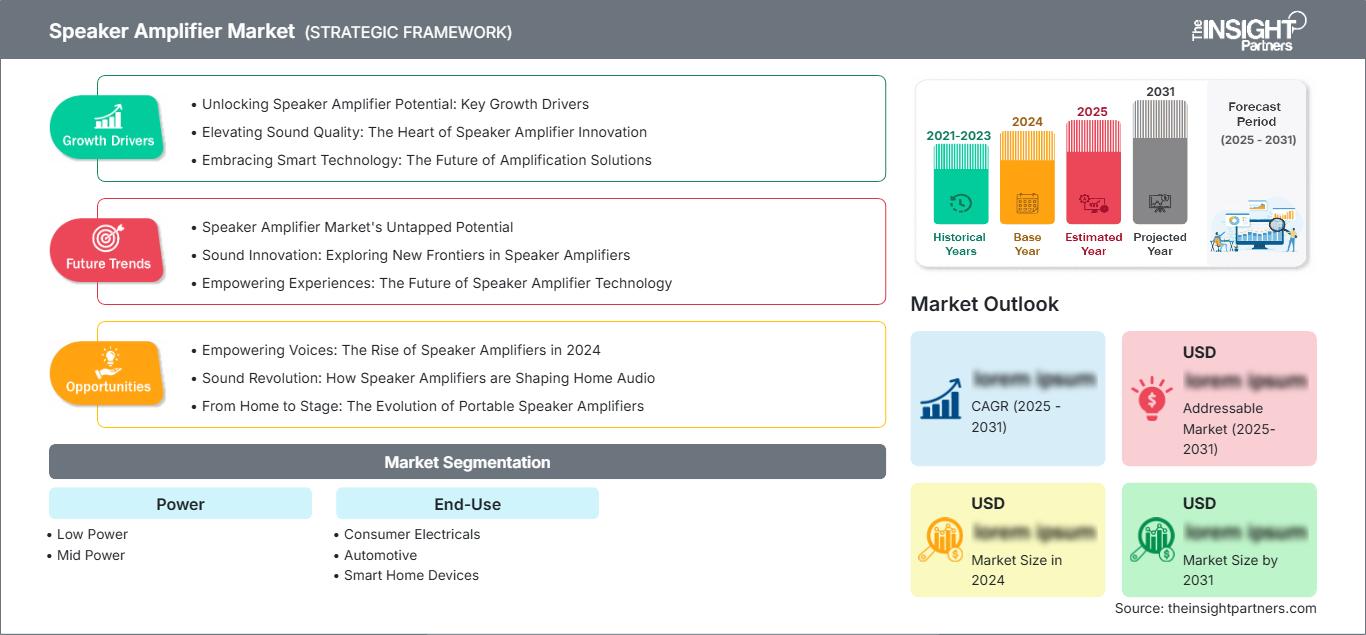
Speaker Amplifier Market: Strategic Insights
Regional Insights
North America Speaker Amplifier Market
North America accounted for an estimated ~31% of the global Speaker Amplifier Market in 2025 and is expected to expand at a ~7% CAGR through 2034. The market is characterized by a developed automotive industry, high demand for consumer electronics products, advanced design skills in the field of semiconductors, and smart home systems.
Demand is especially important in cases of integrated audio solutions when amplifier functionality should work together with other components like processors, connectivity units, sensors, and power management elements.
USA is a key demand center in the region. There is an increased level of electronics per vehicle in the automotive industry and multiple speakers and connectivity options in consumer electronics products. Companies like Cirrus Logic, Analog Devices, Inc., and Monolithic Power Systems, Inc. are helping to develop sophisticated mixed-signal and power technologies. Smart displays, connected speakers, infotainment solutions, and high-end audio solutions in vehicles offer consistent applications for the industry seeking better acoustic performance in small form-factor and power-efficient designs.
U.S. Speaker Amplifier Market
The US represented approximately ~78% of North American Speaker Amplifier Market revenue in 2025 and is projected to grow at a ~7% CAGR through 2034. The country benefits from extensive semiconductor research and development, large automotive production and technology ecosystems, and high penetration of connected consumer devices. Audio functionality is increasingly integrated into multifunctional electronic products rather than treated as a separate subsystem.
Car applications are still relevant since infotainment, hands-free communication, vehicle customization, and acoustic functionality are in need of an amplifier. There are automotive amplifier products from NXP Semiconductors and STMicroelectronics, which support multi-channel, diagnostic, and efficient design. Personal computers, smart speakers, TVs, and other household devices are consumer applications that need compact amplifier ICs. Voice interaction and high-quality audio have become increasingly expected, and thus, it is time for suppliers to include more functions in their amplifiers.
Europe Speaker Amplifier Market
Europe represented approximately ~25% of the global Speaker Amplifier Market in 2025 and is expected to register a ~6% CAGR through 2034. Germany is the leading country in Europe on the back of automotive manufacturing, industrial electronics, and the presence of premium vehicle manufacturers and suppliers. The United Kingdom provides consumer technology, engineering, and electronics development, while France maintains demand from the automotive sector, as well as from electronics for aerospace and consumer applications.
Germany has an eco-system of vehicle electronics that drives the need for efficient audio amplification in multiple channels, especially when considering the rising prevalence of electric and software-defined vehicles. Both France and Italy provide demand for automotive electronics and consumer electronics. Spain is driving demand from the automotive industry and electronics integration. Suppliers across the region focus on smaller, heat-efficient amplifier designs due to the rising need for accommodating electronics in the limited space available.
There is also another reason why the European demand for gallium nitride transistors is driven – energy efficiency and moving towards electrification. Heat-reduced amplifier solutions allow lowering the need for thermal management systems and help to balance energy consumption within the system. The presence of well-developed automotive electronics and consumer goods gives a solid basis for further development.
APAC Speaker Amplifier Market
Asia Pacific represented approximately ~34% of the global Speaker Amplifier Market in 2025 and is projected to grow at a ~9% CAGR through 2034, making it the fastest-growing region. China is the leading country in Asia Pacific, supported by extensive electronics manufacturing, automotive production, and domestic demand for connected devices. Japan and South Korea contribute through advanced electronics and semiconductor ecosystems, while India is expanding electronics manufacturing and automotive technology.
China's manufacturing scale supports broad amplifier deployment in consumer electronics, vehicles, televisions, and smart home equipment. Japan and South Korea provide technology-intensive demand, while India's expanding electronics production supports additional adoption. Australia contributes through consumer electronics and smart home deployment. Regional semiconductor localization initiatives, automotive electrification, and expanding connected-device production are strengthening the addressable application base.
Middle East & Africa Speaker Amplifier Market
The Middle East & Africa Speaker Amplifier Market is expected to register a ~6% CAGR through 2034. Saudi Arabia represents a leading country in the Middle East & Africa region, supported by infrastructure development, smart-city programs, hospitality investment, and growing deployment of connected technologies. The UAE also provides a strong market for premium consumer electronics, integrated building systems, and connected home technologies.
South Africa remains an important electronics and automotive market within Africa, while the Rest of MEA is supported by infrastructure modernization and increasing access to connected devices. Demand is influenced by residential development, commercial buildings, vehicle electronics, entertainment venues, and smart infrastructure. The expansion of connected environments creates opportunities for compact and reliable amplifier solutions that can be integrated into distributed audio systems and consumer devices.
Segmentation Analysis
Power
The Power segment represented the larger portion of the market and is projected to expand at a ~7% CAGR during 2026–2034. Power requirements differ substantially according to speaker size, acoustic output, device form factor, battery constraints, and application environment. The segment includes solutions ranging from compact amplification for portable electronics to higher-output architectures for vehicles and larger connected devices. Efficiency, thermal management, output quality, and integration are central purchasing considerations. The Speaker Amplifier Market scope within this segment therefore extends across low-power and mid-power amplification requirements.
- Low Power: Low-power amplifiers serve compact and battery-operated electronics where extended operating time and limited thermal generation are important. Demand is supported by portable consumer devices, compact smart products, wearables, and other space-constrained electronics requiring efficient audio output.
- Mid Power: Mid-power amplifiers address applications requiring stronger acoustic output without the physical and thermal requirements of very high-output systems. Automotive electronics, televisions, smart home equipment, and larger consumer devices represent important demand areas.
End-Use
The End-Use segment in the Speaker Amplifier Market is projected to record a ~9% CAGR during 2026–2034, reflecting broader deployment of audio functionality across connected products. The segment captures application environments where amplifier requirements are determined by system architecture, speaker configuration, connectivity, and user experience expectations. The expansion of smart devices and electronically intensive vehicles creates opportunities for integrated amplification solutions. Manufacturers increasingly require devices that combine efficiency, protection, diagnostics, and compact packaging while maintaining consistent audio performance across different operating conditions.
- Consumer Electricals: Consumer electrical products require compact and efficient amplification for televisions, computers, portable equipment, smart speakers, and other devices. Manufacturers increasingly integrate more speakers and connected functions, supporting demand for higher channel density and improved power efficiency.
- Automotive: Automotive applications require robust amplification that can operate under demanding voltage, temperature, electromagnetic, and reliability conditions. Increasing electronic content, premium cabin audio, electric vehicles, and connected infotainment systems support demand for multi-channel and digitally controlled amplifier solutions.
- Smart Home Devices: Smart home devices increasingly combine wireless connectivity, voice interfaces, sensing, and audio output. Amplifiers must therefore occupy limited board space while operating efficiently and supporting clear voice reproduction, alerts, entertainment, and adaptive audio functionality.
Opportunity Snapshot
| End-Use | Revenue Contribution | Trend Tag | Adoption Stage |
| Consumer Electricals | High | Connected Audio | Mature |
| Automotive | High | Cabin Audio | Scaling |
| Smart Home Devices | Medium | Voice Integration | Scaling |
Speaker Amplifier Market Growth Drivers and Impact Analysis
Expansion of Automotive Electronics Content
Automotive electronics is a significant growth mechanism because modern vehicles require amplification for infotainment, hands-free communication, cabin sound, navigation prompts, alerts, and increasingly sophisticated acoustic functions. Electric and software-defined vehicles are also increasing the importance of efficient electronics because power consumption and thermal behavior influence system architecture. NXP Semiconductors provides Class-AB and Class-D automotive amplifiers, while STMicroelectronics offers amplifier solutions with diagnostics, digital inputs, and support for hybrid and start-stop vehicle architectures. These developments increase the value of amplifier ICs beyond basic signal amplification. Suppliers that provide higher channel density, diagnostics, protection, and efficient power conversion can address the growing electronic complexity of vehicles and improve integration for automotive system designers.
Increasing Demand for Compact High-Efficiency Audio Electronics
Consumer electronics manufacturers in the Speaker Amplifier Market are under continuing pressure to reduce product size while improving audio performance. This combination increases the need for amplifiers that can deliver higher output with lower heat generation and fewer external components. Class-D architectures are particularly relevant because efficient switching can reduce power losses and simplify thermal management. Infineon Technologies AG highlights the use of efficient Class-D solutions in home, portable, and professional audio, while NXP Semiconductors provides compact amplifier technologies for portable applications. As manufacturers add more speakers, microphones, connectivity functions, and processors to compact devices, amplifier efficiency becomes a system-level consideration rather than only an audio specification.
Growth of Connected and Voice-Enabled Devices
Connected consumer electronics are creating additional applications for speaker amplifiers because audio is becoming a core interface for device interaction. Smart speakers, displays, home appliances, computers, and connected entertainment equipment increasingly rely on voice responses, notifications, calls, and media playback. Amplification must support clear output while operating alongside wireless connectivity, processors, sensors, and power-management circuits. This encourages suppliers to develop highly integrated devices with protection and digital control capabilities. The resulting demand is broader than traditional audio equipment because amplification is becoming embedded in multifunctional products. As connected-device manufacturers expand product ranges, standardized amplifier platforms can also help reduce design cycles and simplify component sourcing across multiple models.
Speaker Amplifier Market Future Trends
Intelligent Audio Integration and Adaptive Amplification
The Speaker Amplifier Market trends are expected to increasingly center on intelligent amplification in which amplifier behavior is coordinated with digital signal processing, speaker characteristics, device temperature, and operating conditions. Future architectures can combine amplification with monitoring functions that detect speaker loading, temperature, clipping, and abnormal operating conditions. Such integration allows designers to optimize output dynamically while protecting small speakers from excessive excursion or thermal stress. Automotive systems can similarly use diagnostics and digital control to manage multiple channels across increasingly software-defined vehicle architectures. The shift toward adaptive amplification is likely to increase the value of semiconductor solutions that combine power stages with control, sensing, protection, and interface functionality.
Higher Power Density Through Advanced Semiconductor Architectures
Amplifier development in the Speaker Amplifier Market is moving toward higher power density as manufacturers seek thinner consumer devices, smaller automotive modules, and more compact professional audio equipment. Advanced semiconductor technologies, optimized switching architectures, improved packaging, and wide-bandgap power devices can reduce losses and thermal requirements. Infineon Technologies AG has demonstrated the use of CoolGaN technology in a 1,500 W Class-D amplifier, illustrating how advanced power devices can contribute to smaller and more efficient audio systems. Over the longer term, power-density improvements can enable designers to increase acoustic output without proportionally increasing enclosure size, heat sinks, or board area.
Speaker Amplifier Market Opportunities
Regionalized Semiconductor and Audio Design Ecosystems
The Speaker Amplifier Market Forecasts indicate opportunities for suppliers that establish design support, manufacturing partnerships, and application engineering capabilities in high-growth electronics regions. Asia Pacific is particularly relevant because China, Japan, South Korea, and India combine electronics manufacturing with expanding automotive and connected-device demand. Localization can shorten design-support cycles and help semiconductor suppliers address region-specific product requirements. Partnerships with local manufacturers can also improve access to emerging smart home and automotive programs. Companies that combine globally scalable amplifier platforms with regional engineering resources can potentially strengthen customer engagement while reducing barriers associated with qualification, customization, and supply-chain resilience.
Integrated Amplifier Platforms for Automotive and Smart Devices
Another opportunity lies in amplifier platforms that combine multiple functions within a single semiconductor solution. Automotive designers increasingly need multi-channel output, diagnostics, protection, digital interfaces, and efficient power conversion, while smart-device manufacturers prioritize compactness and battery efficiency. A platform approach can reduce external components and simplify product development across several device variants. Suppliers can also differentiate through reference designs, software support, speaker protection algorithms, and application-specific configurations. This creates opportunities beyond component sales by allowing semiconductor companies to participate earlier in system architecture decisions and establish longer design-in relationships with original equipment manufacturers.
Recent Developments
- May 2026: Cirrus Logic, Inc. introduced nine new audio converter devices for professional and prosumer applications, including active speakers, mixing consoles, installed audio systems, and related equipment. The portfolio expansion broadens its audio component offering across mid-tier and professional designs and supports product developers seeking higher audio performance with optimized system economics.
- February 2025: Infineon Technologies AG announced that its CoolGaN power transistors were integrated by SounDigital into a 1,500 W Class-D amplifier. Infineon reported that the GaN technology improved energy efficiency by 5% and reduced energy loss by 60%, highlighting the application of wide-bandgap semiconductor technology to compact, high-output audio amplification.
- January 2025: ROHM Co., Ltd. announced its second-generation MUS-IC 32-bit D/A converter IC for high-resolution audio playback. The device extends ROHM's audio semiconductor portfolio and reflects continued development of high-performance audio components intended for premium audio equipment and demanding playback applications.
Frequently Asked Questions

- Comprehensive Market Sizing and Forecast Analysis
- Detailed Segmentation Analysis
- In-Depth Market Dynamics Assessment
- Regional and Country-Level Insights
- Competitive Landscape and Company Benchmarking
- Strategic Business Intelligence
Recent Reports
Testimonials

The Insight Partners provided valuable market intelligence that supported our global go-to-market strategy. Their team was professional, responsive, and attentive to our feedback, providing thoughtful analysis and helpful methodological clarifications throughout the project.
Junmo Kim Chief Financial Officer (CFO), Enertech Co., Ltd.
The Insight Partners' SCADA System Market report is comprehensive, with valuable insights on current trends and future forecasts. The team was highly professional, responsive, and supportive throughout. We are very satisfied and highly recommend their services.
RAN KEDEM Partner, Reali Technologies LTDs
I requested a report on a very specific software market and the team produced the report in a few days. The information was very relevant and well presented. I then requested some changes and additions to the report. The team was again very responsive and I got the final report in less than a week.
JEAN-HERVE JENN Chairman, Future Analytica
We worked with The Insight Partners for an important market study and forecast. They gave us clear insights into opportunities and risks, which helped shape our plans. Their research was easy to use and based on solid data. It helped us make smart, confident decisions. We highly recommend them.
PIYUSH NAGPAL Sr. Vice President, High Beam Global
The Insight Partners delivered insightful, well-structured market research with strong domain expertise. Their team was professional and responsive throughout. The user-friendly website made accessing industry reports seamless. We highly recommend them for reliable, high-quality research services
YUKIHIKO ADACHI CEO, Deep Blue, LLC.
This is the first time I have purchased a market report from The Insight Partners.While I was unsure at first, I visited their web site and felt more comfortable to take the risk and purchase a market report.I am completely satisfied with the quality of the report and customer service. I had several questions and comments with the initial report, but after a couple of dialogs over email with their analyst I believe I have a report that I can use as input to our strategic planning process.Thank you so much for taking the extra time and making this a positive experience.I will definitely recommend your service to others and you will be my first call when we need further market data.
JOHN SUZUKI President and Chief Executive Officer, Board Director, BK Technologies
I wish to appreciate your support and the professionalism you displayed in the course of attending to my request for information regarding to infectious disease IVD market in Nigeria. I appreciate your patience, your guidance, and the fact that you were willing to offer a discount, which eventually made it possible for us to close a deal. I look forward to engaging The Insight Partners in the future, all thanks to the impression you have created in me as a result of this first encounter.
DR CHIJIOKE ONYIA MANAGING DIRECTOR, PineCrest Healthcare Ltd.Reason to Buy
- Informed Decision-Making
- Understanding Market Dynamics
- Competitive Analysis
- Identifying Emerging Markets
- Customer Insights
- Market Forecasts
- Risk Mitigation
- Boosting Operational Efficiency
- Strategic Planning
- Investment Justification
- Tracking Industry Innovations
- Aligning with Regulatory Trends





 Get Free Sample for