
Terminal LCD Displays Market Trends, Size & Forecast by 2034
Coverage: by Type (Conventional LCD Displays, Surface-mounted LCD Displays); Technology (TFT LCD Displays, Monographic LCD Displays); Application (Medical Equipment and Diagnostic Products, Treatment Medical Devices, Detection Analyzers, HMI Industrial Products, Home Automation Products, Others) , and Geography (North America, Europe, Asia Pacific, and South and Central America)
- Status : Data Released
- Report Code : TIPRE00010970
- Category : Electronics and Semiconductor
- No. of Pages : 150
- Available Report Formats :


- Last update date : July 16, 2026


2025 Market Size
US$ 20.42 Bn
Base year value
2034 Forecast
US$ 25.67 Bn
Projected by 2034
CAGR 2026-2034
2.90 %
Growth rate
Addressable Market
US$ 212.60 Bn
(2026-2034)
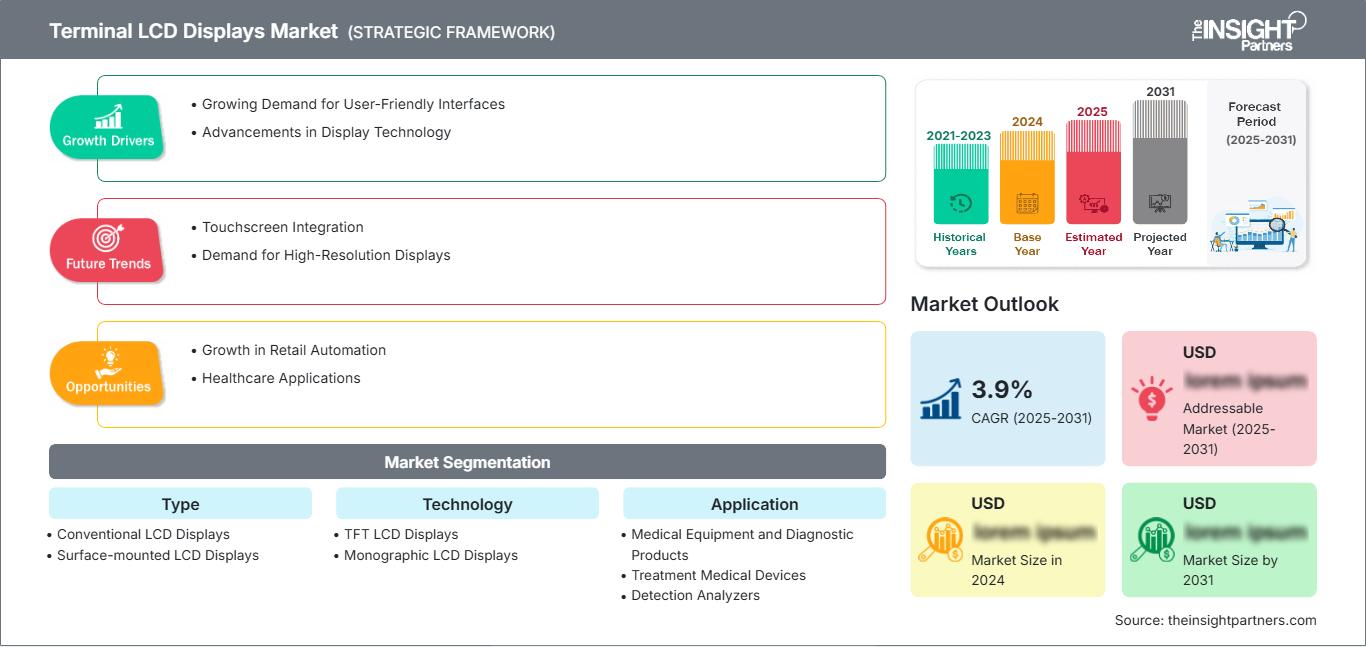
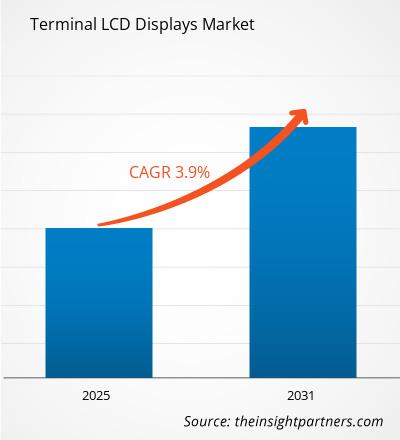
The Terminal LCD Displays Market size was valued at US$ 20.42 Billion in 2025 and is projected to reach US$ 25.67 Billion by 2034; it is expected to register a CAGR of 2.90% from 2026 to 2034. Factors influencing demand include medical devices, analytical instruments, industrial HMIs, and domestic automation terminals that require longevity, readability, and reliability of supply.
North America will grow at a rate of 2.4-2.8% CAGR up to 2034 owing to hospital replacements of monitor-based medical devices, upgrade of operator panels in industrial operations and the continued use of LCD terminals by manufacturers of building automation. Demand within the region is influenced by the FDA device ecosystems, industrial reshoring, and cyber security.
Terminal LCD Displays Market Assessment and Insights
- North America: The region accounted for 29–31% of the Terminal LCD Displays Market share in 2025 and is growing at a CAGR of 2.4–2.8% during 2026–2034, supported by medical device replacement cycles and industrial control modernization.
- US: The country represented 78–82% of North America in 2025 and is growing at a CAGR of 2.5–2.9% during 2026–2034, led by diagnostics, automation, and regulated healthcare equipment production.
- Europe: Europe held 24–26% share in 2025 and is growing at a CAGR of 2.1–2.5% during 2026–2034, with Germany, the UK, France, Italy, and Spain leading demand from automation and healthcare systems.
- Asia Pacific: Asia Pacific captured 34–36% share in 2025 and is growing at a CAGR of 3.3–3.7% during 2026–2034, driven by China, Japan, South Korea, India, and Australia across electronics, factories, and healthcare.
- Largest Segment: TFT LCD Displays held 62–66% market share in 2025 and is growing at a CAGR of 3.0–3.4% during 2026–2034 because color, response time, and integration economics remain favorable.
- High Growth Segment: HMI Industrial Products held 24–28% market share in 2025 and is growing at a CAGR of 3.6–4.0% during 2026–2034 as factories expand connected operator interfaces.
- Key companies analyzed in detail: American Industrial Systems Inc.; Bosch Rexroth AG; GE HealthCare Technologies Inc.; Honeywell International Inc.; Johnson & Johnson Services, Inc.; Koninklijke Philips N.V.; Mitsubishi Electric Corporation; Rockwell Automation, Inc.; Schneider Electric SE; Siemens AG.
Source: The Insight Partners' analysis based on proprietary research, government publications, company annual reports, investor presentations, industry databases, and expert interviews.
Requirements for terminal displays have changed from merely numeric displays to smaller, contrasty displays built into regulated equipment and equipment used in industry. LCD module with TFT display has become more popular since they allow color displays, touch screens, and consistent procurement for their lifetime, whereas monochrome modules are still applicable in analyzers and cost-conscious controls. The production trends now include panel standardization, availability of controllers, and assemblies designed for vibrations and cleaning chemicals usage in a harsh environment.
In the future, the demand for LCD terminal displays will increase in India, Southeast Asia, and the Gulf due to increasing healthcare facilities, industrial automation, and investment in energy infrastructure. The regulatory focus on usability of the medical equipment, cybersecurity, and operator safety will be in favor of those vendors who offer display hardware with a corresponding software ecosystem. The growth forecast for the Terminal LCD Displays Market is moderate and sustainable.
Terminal LCD Displays Market Report Scope
| Report Attribute | Details |
|---|---|
| Market size in 2025 | US$ 20.42 Billion |
| Market Size by 2034 | US$ 25.67 Billion |
| Global CAGR (2026 - 2034) | 2.90% |
| Historical Data | 2021-2024 |
| Forecast period | 2026-2034 |
Terminal LCD Displays Market Analysis
Demand is based on applications where the display forms an integral part of a certified device or control system. The need for medical devices and diagnostic tools calls for brightness consistency, grayscale retention, cleanable components, and component traceability. Sunlight readability, ingress protection, temperature robustness, and ability to interface with Ethernet-based HMI systems are key requirements for industrial customers due to increasing automation network adoption.
The supply chain consists of LCD panel providers, backlight providers, controller IC providers, touch sensor providers, enclosure providers, and system integrators. Supply factors continue to include Asian panel capacity, lead times for components, and customer reluctance to redesign certified devices. Thus, the size of the Terminal LCD Displays Market is much more stable compared to consumer displays, though price discipline is essential.
Competition is diverse among automation, healthcare and embedded display experts. The Terminal LCD Displays Market report highlights several key players including HMI include Siemens AG, Rockwell Automation, Inc., Schneider Electric SE, Mitsubishi Electric Corporation, Honeywell International Inc., and Bosch Rexroth AG, while GE HealthCare Technologies Inc., Koninklijke Philips N.V., and Johnson & Johnson Services, Inc. which set standards via their medical device line-ups.
Funding is directed at rugged touch terminals, embedded edge visualization technology, power saving backlight, and software defined operator interface. American Industrial Systems Inc. takes advantage of the customized industrial panel demands, whereas automation giants safeguard their Terminal LCD Displays Market share via service network and installed base advantages. Strategic positioning is based on lifecycle capabilities, cybersecurity preparedness and qualification of displays without the need for expensive equipment re-certification.
● REPORT CUSTOMIZATION
Tailor This Report To Align With Your Specific Business Requirements
This report can be customized to align precisely with your business objectives, scope, and target markets. Customization options include tailored segmentation, geography, competitive analysis, and strategic insights to support informed decision-making.
Customize This Report →WHAT YOU CAN ADJUST
- ● Segmentations
- ● Geography
- ● Competitive Analysis
- ● Language Preferences
Terminal LCD Displays Market: Strategic Insights
Regional Insights
North America Terminal LCD Displays
North America held 29–31% share in 2025 and is projected to record a 2.4–2.8% CAGR during 2026–2034. Demand is reinforced by regulated healthcare equipment, diagnostic imaging workflows, and factory automation upgrades. WHO data on chronic disease burdens supports continued diagnostic equipment use, while reshoring initiatives raise spending on operator panels and control terminals.
The regional buyer base values validated product lifecycles, documentation, and serviceability more than rapid screen technology substitution. Hospitals, laboratories, food processors, and discrete manufacturers prefer terminal displays that withstand cleaning, vibration, and software updates. The Terminal LCD Displays Market analysis indicates that replacement cycles, not greenfield projects alone, will define regional revenue stability.
U.S. Terminal LCD Displays Market
The U.S. accounted for 78–82% of North America in 2025 and is expected to grow at a 2.5–2.9% CAGR from 2026 to 2034. Application demand is concentrated in medical equipment, HMI industrial products, treatment devices, and detection analyzers. Domestic healthcare capital spending and automation upgrades sustain predictable demand for certified display terminals.
Company presence is broad, with GE HealthCare Technologies Inc., Honeywell International Inc., Rockwell Automation, Inc., and Johnson & Johnson Services, Inc. shaping procurement standards through installed systems. U.S. buyers increasingly request cybersecurity-aligned HMIs, remote diagnostics, and replacement compatibility, creating Terminal LCD Displays Market trends that favor integrated suppliers over low-cost module-only vendors.
Europe Terminal LCD Displays Market
Europe represented a 24–26% share in 2025 and the Terminal LCD Displays Market forecast is expected to register a 2.1–2.5% CAGR during 2026–2034. The UK market is supported by hospital modernization, laboratory automation, and demand for cleanable medical terminals. Procurement remains conservative, favoring certified products with service documentation, stable firmware, and predictable long-term parts availability.
Germany is the leading European country because machinery, process automation, robotics, and medical technology clusters require rugged operator interfaces. Siemens AG, Bosch Rexroth AG, and automation integrators influence specifications for panel-mounted displays. Energy-efficiency rules and factory digitization support demand for low-power LCD terminals in industrial environments.
France, Italy, and Spain provide demand through diagnostics networks, packaging machinery, building automation, and transport infrastructure. Italy’s machine builders emphasize compact surface-mounted panels, while France and Spain require durable terminals for public infrastructure and healthcare upgrades. This balanced base keeps the Terminal LCD Displays Market scope resilient despite slower macroeconomic expansion.
APAC Terminal LCD Displays Market
APAC held 34–36% share in 2025 and is projected to grow at a 3.3–3.7% CAGR during 2026–2034, making it the largest and fastest regional contributor. China leads through panel supply, medical equipment production, and factory automation scale.
Japan and South Korea support premium demand through robotics, diagnostics, semiconductor tools, and high-reliability industrial terminals. India is advancing through healthcare infrastructure, smart factories, and domestic electronics incentives.
Australia adds demand from mining, utilities, hospitals, and building management systems. Policy support for manufacturing resilience and digital health strengthens regional procurement, while cost-sensitive customers maintain LCD preference over higher-cost emerging display technologies.
Middle East & Africa Terminal LCD Displays Market
Middle East & Africa is expected to grow at a 2.6–3.0% CAGR during 2026–2034. Saudi Arabia is the leading country as energy, healthcare, logistics, and smart city projects require operator terminals, analyzers, and building automation displays.
The UAE contributes through hospitals, airports, industrial zones, and data-driven facilities management, where readable and reliable terminals remain essential. South Africa shows demand from mining, utilities, and private healthcare upgrades.
Rest of MEA adoption remains project-based, tied to infrastructure financing and equipment imports. Energy automation and water infrastructure provide durable demand because field equipment needs rugged displays that tolerate heat, dust, and long service intervals.
Segmentation Analysis
Type
The type segment is expected to grow at a 2.4–2.8% CAGR during 2026–2034 as buyers balance installation flexibility, device certification, and cost. Conventional LCD displays remain important in embedded medical and analyzer systems, while surface-mounted versions gain relevance in retrofit industrial panels, compact automation terminals, and smart building controls.
- Conventional LCD Displays maintain a strong position in embedded equipment where mechanical design, firmware compatibility, and long lifecycle sourcing outweigh the need for rapid form-factor changes.
- Surface-mounted LCD Displays are increasingly used in retrofit HMIs, compact machine panels, and home automation interfaces because they simplify installation and reduce enclosure redesign requirements.
Technology
The technology segment is forecast to grow at a 2.8–3.2% CAGR during 2026–2034. TFT LCD Displays dominate because they support color, touch integration, faster response, and broader user-interface requirements. Monographic LCD Displays remain defensible in analyzers, meters, and treatment devices where low power, simplicity, and readability matter more than rich graphics.
- TFT LCD Displays hold the strongest strategic position due to color performance, scalable panel sizes, touch compatibility, and suitability for medical, industrial, and automation interfaces.
- Monographic LCD Displays serve stable demand in diagnostic analyzers, meters, and basic treatment devices where low power draw, high contrast, and proven reliability remain decisive.
Application
The application segment is expected to grow at a 3.0–3.4% CAGR during 2026–2034, supported by healthcare digitization, machine visualization, and smart building controls. Medical equipment and diagnostic products remain steady, while HMI industrial products provide the highest incremental opportunity as manufacturers adopt connected operator stations and predictive maintenance dashboards.
- Medical Equipment and Diagnostic Products generate recurring demand because displays are embedded in imaging, monitoring, laboratory, and clinical systems requiring certified readability and stable supplier documentation.
- Treatment Medical Devices use terminal LCDs for therapy settings, monitoring, and clinician interaction, making reliability, cleaning resistance, and interface clarity central to procurement decisions.
- Detection Analyzers depend on compact displays that present test status, alarms, and results clearly, supporting laboratory workflow efficiency and equipment traceability.
- HMI Industrial Products are strategically important as factories require rugged touch panels, process visualization, alarm management, and operator guidance within connected automation architectures.
- Home Automation Products use LCD terminals in thermostats, security panels, energy controls, and room interfaces where intuitive operation and long service life are essential.
Opportunity Snapshot
| Application | Revenue Contribution | Trend Tag | Adoption Stage |
| Medical Equipment and Diagnostic Products | High | Digital Imaging | Mature |
| Treatment Medical Devices | Medium | Therapy Control | Scaling |
| Detection Analyzers | Medium | Lab Automation | Mature |
| HMI Industrial Products | High | Smart HMI | Scaling |
| Home Automation Products | Medium | Energy Control | Scaling |
| Others | Low | Custom Terminals | Emerging |
Terminal LCD Displays Market Growth Drivers and Impact Analysis
Healthcare Equipment Modernization Requires Stable Visual Interfaces
With hospitals and diagnostic centers turning toward digital solutions as opposed to using equipment fleets, there is a need for reliable embedded displays for reviewing images, monitoring the status of devices, alarming, and prompt workflows. WHO continues to emphasize the burden of diseases on patients, which leads to an increase in the use of diagnostic equipment and monitors. This results in display specification being related to patient safety, cleaning process, and validation of equipment. In this situation, the impact of the market is gradual turnover without any spike in volumes. Suppliers with extended availability periods and optics specifications as well as controller compatibility will be at an advantage.
Industrial Automation Expands Operator Visualization Demand
Manufacturing plants are using networked machines, edge controllers, and predictive maintenance technologies which mandate the viewing of alarms, status information, and machine diagnostics through screens at all times. Growth in industrial Ethernet and software-defined automation means there is an increased need for terminal screens that are the human interface in digital technology. LCD screens are still preferred due to their durability, relatively low costs, and wide range of connectivity options. This trend creates higher dependency between display hardware, automation software, and services.
Smart Buildings Increase Terminal-Based Control Points
Increasing numbers of energy management, security, HVAC, lighting, and room automation systems are integrating increased amounts of user interface points in commercial and residential buildings. In situations where the installer needs an interface, reduced power consumption and control protocol compatibility, LCD displays are the choice to be used. Emphasis by IEA on energy efficiency in buildings promotes the use of control interfaces that make the adjustments by the users easy. It is mainly seen in the home automation and facility management systems, where high volume installations at relatively low prices are seen.
Terminal LCD Displays Market Future Trends
Edge-Enabled HMI Panels Become Standard Procurement Items
Displays on terminals of the future will incorporate edge computing, remote connectivity, container capabilities, and cybersecurity tools rather than remaining as simple display devices. Automation providers have started promoting HMIs as bridges between manufacturing machines and enterprise analytics tools. During the forecast period, this will shift buying considerations, with customers now looking at processing power, ways of updating software, security and protocols along with brightness or size of the panels. This development plays well into hands of vendors having a combination of hardware and software offerings since terminal upgrades could become part of an overall digitization strategy.
Lifecycle-Certified Display Modules Gain Procurement Priority
The manufacturers will pay more attention to display modules with long-term availability guarantees, change control, and optical specifications stability. This is crucial in medical devices, analyzers, and industrial applications, where any changes in the display might entail additional expenses related to firmware change, design changes, usability studies, etc. With the continued trend towards commoditization of panels, the differentiation will be achieved through longevity of supply and engineering expertise. Thus, the Terminal LCD Displays Market development will favor vendors who can handle obsolescence, offer drop-in replacement options, and alert the customer on part changes.
Terminal LCD Displays Market Opportunities
Retrofit Programs for Industrial Control Panels
Large installed bases of older machinery still rely on push buttons, text displays, or limited monochrome terminals. Retrofit programs create an actionable opportunity for suppliers offering surface-mounted LCD displays, preconfigured HMI templates, and compatibility with common industrial protocols. The commercial case is strongest when upgrades reduce downtime, improve operator training, and allow remote diagnostics without full machine replacement. Vendors can target packaging, food processing, chemicals, water utilities, and metals facilities where production assets often remain in service for decades. Bundling display hardware with commissioning support and cybersecurity documentation can improve win rates and reduce buyer hesitation.
Localized Supply for Medical and Analyzer OEMs
Medical and laboratory equipment OEMs are seeking supply resilience after recent electronics disruptions exposed dependence on single-region component sourcing. Display suppliers can create opportunity by offering regional assembly, safety stock programs, validated second sources, and documentation packages aligned with device quality systems. This approach is particularly relevant in the U.S., Europe, India, and the Gulf, where healthcare infrastructure and domestic manufacturing policies encourage local sourcing. The investment case extends beyond panel price because OEMs value continuity, traceability, and change-management discipline. Firms that support early design-in discussions can secure long product cycles and repeat platform revenue.
Recent Developments
- October 2025: Rockwell Automation, Inc. — announced more than 30 new products for Automation Fair 2025, including OptixEdge Advanced Edge Gateway and Micro820 L20E controllers with improved Ethernet communication to HMI and SCADA software, reinforcing the role of connected visualization terminals in machine-level decision-making.
- March 2025: Schneider Electric SE — demonstrated open, software-defined automation and AI-infused industrial technologies at Hannover Messe 2025, emphasizing connected ecosystems, operational efficiency, and IT/OT integration. The announcements support higher demand for HMI terminals and industrial display infrastructure in flexible manufacturing environments.
- January 2025: Schneider Electric SE — released its HMI Product Line-up Guide 2025 covering human-machine interface panels and supported software, helping industrial customers select terminals for control, diagnostics, and operator visualization requirements. The update reflects continuing portfolio support for LCD-based HMI deployments.
Frequently Asked Questions

- Comprehensive Market Sizing and Forecast Analysis
- Detailed Segmentation Analysis
- In-Depth Market Dynamics Assessment
- Regional and Country-Level Insights
- Competitive Landscape and Company Benchmarking
- Strategic Business Intelligence
Recent Reports
Testimonials

The Insight Partners' SCADA System Market report is comprehensive, with valuable insights on current trends and future forecasts. The team was highly professional, responsive, and supportive throughout. We are very satisfied and highly recommend their services.
RAN KEDEM Partner, Reali Technologies LTDs
I requested a report on a very specific software market and the team produced the report in a few days. The information was very relevant and well presented. I then requested some changes and additions to the report. The team was again very responsive and I got the final report in less than a week.
JEAN-HERVE JENN Chairman, Future Analytica
We worked with The Insight Partners for an important market study and forecast. They gave us clear insights into opportunities and risks, which helped shape our plans. Their research was easy to use and based on solid data. It helped us make smart, confident decisions. We highly recommend them.
PIYUSH NAGPAL Sr. Vice President, High Beam Global
The Insight Partners delivered insightful, well-structured market research with strong domain expertise. Their team was professional and responsive throughout. The user-friendly website made accessing industry reports seamless. We highly recommend them for reliable, high-quality research services
YUKIHIKO ADACHI CEO, Deep Blue, LLC.
This is the first time I have purchased a market report from The Insight Partners.While I was unsure at first, I visited their web site and felt more comfortable to take the risk and purchase a market report.I am completely satisfied with the quality of the report and customer service. I had several questions and comments with the initial report, but after a couple of dialogs over email with their analyst I believe I have a report that I can use as input to our strategic planning process.Thank you so much for taking the extra time and making this a positive experience.I will definitely recommend your service to others and you will be my first call when we need further market data.
JOHN SUZUKI President and Chief Executive Officer, Board Director, BK Technologies
I wish to appreciate your support and the professionalism you displayed in the course of attending to my request for information regarding to infectious disease IVD market in Nigeria. I appreciate your patience, your guidance, and the fact that you were willing to offer a discount, which eventually made it possible for us to close a deal. I look forward to engaging The Insight Partners in the future, all thanks to the impression you have created in me as a result of this first encounter.
DR CHIJIOKE ONYIA MANAGING DIRECTOR, PineCrest Healthcare Ltd.Reason to Buy
- Informed Decision-Making
- Understanding Market Dynamics
- Competitive Analysis
- Identifying Emerging Markets
- Customer Insights
- Market Forecasts
- Risk Mitigation
- Boosting Operational Efficiency
- Strategic Planning
- Investment Justification
- Tracking Industry Innovations
- Aligning with Regulatory Trends





 Get Free Sample for