
Ultra-Secure Smartphone Market Share, Demand & Growth by 2034
Coverage: By Operating System (Android, IOS); End User (Government Agencies, Aerospace and Defense, Enterprises) , and Geography (North America, Europe, Asia Pacific, and South and Central America)
- Status : Data Released
- Report Code : TIPRE00003102
- Category : Electronics and Semiconductor
- No. of Pages : 150
- Available Report Formats :


- Last update date : October 30, 2026


2025 Market Size
US$ 4.01 Bn
Base year value
2034 Forecast
US$ 22.56 Bn
Projected by 2034
CAGR 2026-2034
21.16 %
Growth rate
Addressable Market
US$ 106.23 Bn
(2026-2034)
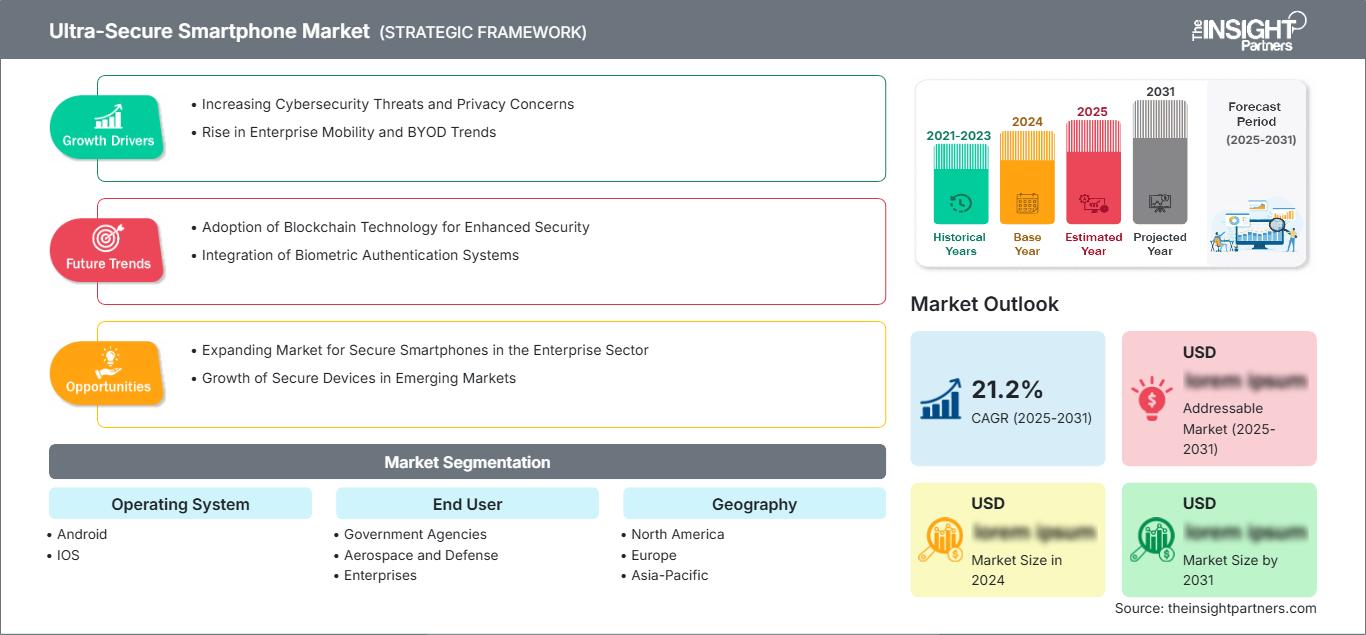
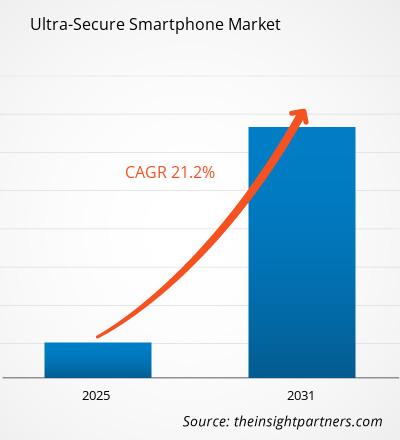
The Ultra Secure Smartphone Market describes a specialized mobile security category focused on smartphones designed to protect sensitive communications, data, identities, and device operations. The global market was valued at US$ 4.01 Billion in 2025 and is projected to reach US$ 22.56 Billion by 2034, expanding at a 21.16% CAGR from 2026 to 2034. Demand is linked to secure mobility requirements across government, defense, and enterprise environments.
North America represents a structurally important demand center, supported by government procurement, classified communications requirements, cybersecurity investment, and established enterprise security infrastructure. The region is estimated to expand at ~20% CAGR through 2034. The Ultra Secure Smartphone Market size is also influenced by increasing requirements for device-level security, sovereign control, secure application environments, and trusted supply chains as organizations move beyond conventional mobile-device management.
Ultra-Secure Smartphone Market Assessment and Insights
Regional Outlook
- North America: ~40% of the global market in 2025 | ~20% CAGR through 2034. Market position: North America holds the largest regional position, supported by substantial government and defense demand, mature enterprise security programs, classified communication requirements, and established procurement channels for certified mobile technologies.
- US: ~85% of North American market revenue in 2025 | ~20% CAGR through 2034. Market position: The US represents the principal country market within North America, supported by federal agencies, defense organizations, critical infrastructure operators, and enterprises requiring controlled mobile communications and validated security architectures.
- Europe: ~25% of the global market in 2025 | ~18% CAGR through 2034. Market position: Europe combines mature government security requirements with strong data-sovereignty priorities. Germany, France, the UK, Italy, and Spain provide important demand centers, with Germany representing the leading country in Europe.
- Asia Pacific: ~21% of the global market in 2025 | ~23% CAGR through 2034. Market position: Asia Pacific is the fastest-growing region, supported by expanding cybersecurity requirements, defense modernization, digital sovereignty initiatives, and enterprise security adoption. China, Japan, South Korea, India, and Australia form the principal demand centers.
Segment Outlook
- Operating System (Android): ~69% Share in 2025 | ~21% CAGR through 2034. Market position: Android represents the largest operating-system segment through its flexibility for hardened configurations, secure enterprise management, customized security layers, and compatibility with specialized government and defense deployment requirements.
- End User (Government Agencies): ~47% Share in 2025 | ~23% CAGR through 2034. Market position: Government agencies constitute the high-growth demand center because sensitive communications require stronger identity controls, device assurance, encryption, policy enforcement, and lifecycle management than conventional consumer smartphones generally provide.
Competitive Coverage
Atos SE, Bittium, BlackBerry Limited, Cog Systems, DarkMatter, ERCOM, Gryphon, Silent Circle, SIRIN LABS, The Boeing Company
Methodology
The Insight Partners follows Data Collection & Secondary Research, Primary Research, Data Analysis, and Data Triangulation & Final Review to validate market estimates and insights.
Source: The Insight Partners' analysis based on proprietary research, government publications, company annual reports, investor presentations, industry databases, and expert interviews.
The Ultra Secure Smartphone Market has evolved from specialized privacy-oriented handsets toward integrated security architectures combining hardened operating systems, secure elements, encrypted communications, device-management controls, application restrictions, and tamper resistance. Earlier solutions concentrated heavily on encrypted calling and messaging, while newer architectures address the device, operating system, identity, applications, network connection, and administrative layer together. Production dynamics have consequently shifted toward specialized hardware configurations, controlled software stacks, longer security-support cycles, and supply-chain assurance. This convergence increases the importance of certification, secure manufacturing, and interoperability with existing government and enterprise infrastructure.
Looking ahead, Ultra Secure Smartphone Market share is likely to broaden geographically as governments and enterprises place greater emphasis on digital sovereignty and trusted communications infrastructure. Investment is expected to favor quantum-resistant security, secure 5G connectivity, hardware-backed authentication, sovereign deployment models, and lifecycle management. Emerging demand across Asia Pacific and selected European markets can expand the addressable customer base, while North American procurement is expected to sustain high-value deployments. Regulatory requirements surrounding sensitive information, critical infrastructure, privacy, and national security should continue to influence procurement specifications and certification priorities through 2034.
Ultra-Secure Smartphone Market Report Scope
| Report Attribute | Details |
|---|---|
| Market size in 2025 | US$ 4.01 Billion |
| Market Size by 2034 | US$ 22.56 Billion |
| Global CAGR (2026 - 2034) | 21.16% |
| Historical Data | 2021-2024 |
| Forecast period | 2026-2034 |
Ultra-Secure Smartphone Market Analysis
The Ultra Secure Smartphone Market growth mechanism begins with the increasing sensitivity of mobile workflows. Government officials, defense personnel, executives, field teams, and critical-infrastructure operators increasingly use smartphones to access confidential information, coordinate operations, and authenticate into protected systems. This drives the need for encryption that is above the application level. Consumers will want to test features such as secure boot, hardware isolation, trusted execution environment, identity assurance, policies, remote management, and physical protection. This means that the supply chain will include providers of semiconductors, security components, handset producers, operating system designers, cybersecurity firms, communications platforms, certification agencies, system integrators, and governmental procurement organizations.
The supplier landscape is affected by the requirement that security be incorporated without reducing usability, connectivity, battery efficiency, application compatibility, and durability of the mobile phones. Unique suppliers can distinguish themselves through their hardened operating environment, security elements, tamper resistance, application ecosystem control, and sovereign deployment. Technology giants can leverage the existing mobile devices and enterprise management framework to meet the needs of secure mobility. The procurement process may take longer compared to normal mobile phones due to security analysis, certification, integration, and approval.
Ultra Secure Smartphone Market analysis indicates that competition is increasingly based on the completeness of the security architecture rather than handset specifications alone. While Bittium relies on hardware designed specifically for security purposes and secure mobile communications at the level of government agencies, BlackBerry concentrates more on secure communication, endpoint management, and mission-critical software. Capabilities of Atos and Eviden pertain to the field of secure communications and requirements related to specific enterprises. Some other players, including Cog Systems, ERCOM, Gryphon, Silent Circle, SIRIN LABS, and The Boeing Company, have more specialized roles in secure software, communications, defense-oriented mobility, and hardened devices.
As a result, the investment trends in the Ultra Secure Smartphone market shift towards software-defined security, post-quantum cryptography, trusted manufacturing processes, and interoperability. Companies, which are able to combine their hardware solutions with the centralized policy management system, can serve large-scale institutional deployments, while specialist vendors can serve missions that require customized security configurations. The strategic cooperation is also vital, since each vendor does not have control over all aspects from the silicon and OS level through communications and certifications to deployment and lifecycle management.
● REPORT CUSTOMIZATION
Tailor This Report To Align With Your Specific Business Requirements
This report can be customized to align precisely with your business objectives, scope, and target markets. Customization options include tailored segmentation, geography, competitive analysis, and strategic insights to support informed decision-making.
Customize This Report →WHAT YOU CAN ADJUST
- ● Segmentations
- ● Geography
- ● Competitive Analysis
- ● Language Preferences
Ultra-Secure Smartphone Market: Strategic Insights
Regional Insights
North America Ultra Secure Smartphone Market
North America accounts for ~40% of the global Ultra Secure Smartphone Market in 2025 and is estimated to expand at ~20% CAGR through 2034. Regional strength is driven by the significant need for secure government communication, defense mobility, protection of critical infrastructure, and enterprise endpoint protection. The procurement process usually focuses on certification, identity management, data separation, encryption of communications, and administration. Security architectures have become an important criterion for purchase.
The US supplies most of the regional demand, while Canada is contributing to the demand via its government, defense, regulated sectors, and critical infrastructure. The regional environment enjoys the presence of a number of strong cybersecurity providers, advanced systems integrators, established cloud and mobile infrastructure, and big institutional customers. Moreover, the demand is extending from specific devices to secure communications solutions that work across different mobile devices. It gives an opportunity for the supplier to satisfy the demands for both specific devices and commercial devices controlled through policies and identity management.
U.S. Ultra Secure Smartphone Market
The U.S. represents ~85% of North American Ultra Secure Smartphone Market revenue in 2025 and is expected to expand at ~20% CAGR through 2034. The country's demand mix is highly related to the federal government agencies, military, intelligence-related functions, security, public safety, and critical infrastructure. The buyers give great importance to validated cryptography, secure communications, device management, controlled application services, and the capability of running the device in a restricted or classified environment.
The United States market represents another valuable setting for suppliers such as BlackBerry, Bittium, Atos, Cog Systems, and other special-purpose suppliers. The demand for applications goes from secure executive communication to field operations, crisis management, secured remote access, and defense cooperation. The procurement takes into consideration the lifecycle of the device, including firmware integrity, software updates, origin of supply chain, remote management, and decommissioning at the end of the life cycle.
Europe Ultra Secure Smartphone Market
Europe represents ~25% of global Ultra Secure Smartphone Market revenue in 2025 and is projected to grow at ~18% CAGR through 2034. The region combines mature cybersecurity requirements with a strong emphasis on privacy, digital sovereignty, trusted infrastructure, and national control over sensitive information. Germany is the leading country in Europe, supported by industrial depth, government security requirements, enterprise cybersecurity demand, and a substantial ecosystem of technology and defense organizations.
The UK possesses substantial demand on behalf of its government, defense, public safety, and regulated companies, while France provides itself with robust solutions in the sphere of sovereign and government secure communications. Italy and Spain add to the European market by means of government modernization projects, defense initiatives, critical infrastructure and enterprise cyber security solutions. In all of these countries, buying decisions depend not only on the performance of the products but also on their design and manufacturing place, the company controlling security updates and administration of communications infrastructure.
The demand on the continent is also influenced by the need for interoperability in such spheres as government, alliances, and multinational corporations. Nowadays, secure mobile phones have to be compatible with traditional identity, mobile-device-management, encryption and protected network systems. The competitive situation on the market thus becomes favorable for the vendors providing such integration of hardware, software, certification and installation of the products.
APAC Ultra Secure Smartphone Market
Asia Pacific represents ~21% of the global Ultra Secure Smartphone Market in 2025 and is expected to expand at ~23% CAGR, making it the fastest-growing region. China is the leading country in Asia Pacific, while Japan, South Korea, India, and Australia provide important demand through government security programs, defense modernization, advanced manufacturing, and enterprise digitization.
The growth in industry leads to more mobile processes needing greater levels of security, while policy measures will help to push for domestic ownership of vital digital infrastructures. India is a nation that is focused on providing its growing digital services along with modernizing its cybersecurity and defense infrastructure. Japan and South Korea provide the latest in electronic and enterprise technology solutions, while Australia is a nation with strong defense and governmental needs.
Middle East & Africa Ultra Secure Smartphone Market
The Middle East & Africa Ultra Secure Smartphone Market is projected to expand at ~18% CAGR through 2034. Saudi Arabia represents the leading country in the Middle East & Africa region where demand is supported by national digital transformation, government modernization, critical infrastructure protection, and cybersecurity investment. The UAE contributes through smart-government initiatives, financial services, and technology-intensive infrastructure programs.
South Africa provides an important African demand center through government, financial services, telecommunications, mining, and critical infrastructure. The Rest of the MEA market includes public-sector modernization, defense requirements, energy operations, and secure communications for distributed field teams. Energy infrastructure is particularly relevant because mobile connectivity is increasingly embedded in remote operations, maintenance, emergency response, and asset monitoring. Secure-device procurement therefore, depends on resilience, remote administration, communications continuity, and protection of operational information in environments where infrastructure conditions can vary substantially.
Segmentation Analysis
Operating System
Operating systems are divided into Android and iOS. The segment is expected to grow at ~21% CAGR from 2026 to 2034. Android has an established role in specialized secure deployments because its architecture allows hardened configurations, customized controls, and integration with enterprise mobility systems. iOS remains relevant where organizations prioritize tightly controlled hardware and software integration. The Ultra Secure Smartphone Market scope under this segment therefore includes both hardened Android environments and security-managed iOS deployments.
- Android: Android-based secure deployments can combine commercial smartphone foundations with hardened operating configurations, enterprise mobility controls, encrypted communications, and application restrictions. Its flexibility supports government, defense, and enterprise use cases requiring customized security policies while retaining compatibility with established mobile application ecosystems.
- iOS: iOS-based deployments benefit from close hardware and software integration and strong platform-level security controls. Demand is concentrated where organizations require controlled applications, secure authentication, centralized management, and consistent software governance while maintaining access to a mature commercial smartphone ecosystem.
End User
The Ultra Secure Smartphone Market End User segment comprises Government Agencies, Aerospace and Defense, and Enterprises. The segment is projected to expand at ~23% CAGR through 2034 as organizations increasingly treat mobile endpoints as part of their core security perimeter. Procurement priorities differ by mission, but identity assurance, data protection, secure communications, device lifecycle management, and resilience remain common requirements.
- Government Agencies: Government deployments require protection for official communications, confidential documents, identities, and field operations. Demand is influenced by procurement standards, cybersecurity policies, classified information handling, secure remote access, and the need for centralized control across distributed users and agencies.
- Aerospace and Defense: Aerospace and defense organizations require secure mobility for command, coordination, logistics, intelligence, and field operations. Devices must often combine communications security with physical resilience, controlled applications, interoperability, and reliable operation across complex or contested network environments.
- Enterprises: Enterprise adoption extends beyond traditional cybersecurity into executive communications, intellectual property protection, regulated information, remote operations, and business continuity. Financial services, technology, energy, healthcare, and professional services can require stronger controls when mobile workflows involve commercially sensitive or regulated information.
Opportunity Snapshot
| End User | Revenue Contribution | Trend Tag | Adoption Stage |
|---|---|---|---|
| Government Agencies | High | Secure Mobility | Mature |
| Aerospace and Defense | High | Tactical Mobility | Scaling |
| Enterprises | Medium | Executive Security | Scaling |
Ultra-Secure Smartphone Market Growth Drivers and Impact Analysis
Expansion of Government and Defense Secure Mobility
There is an increasing reliance by governmental agencies and defense organizations on the use of mobile devices to coordinate operations, authenticate identities, facilitate remote connections, and securely communicate. Standard smartphones are inherently insecure when consumer-oriented operating systems, unsanctioned applications, or communication channels collide with classified work processes. Therefore, there is a tendency to acquire devices and platforms that offer more secure booting, stronger identity verification, encryption, compartmentalization, application controls, and central management features. There is a ripple effect of the requirements down the value chain since governments have the ability to ask for certification, secure manufacturing processes, documented security practices, and extended support from vendors. In the case of defense organizations, durability and environmental robustness are important considerations.
Growing Importance of Digital Sovereignty and Trusted Supply Chains
Digital sovereignty is emerging as an important buying factor for organizations handling critical information and infrastructure. Mobile security procurement now requires knowledge of design, software development, updates management, key management, and the legal rights of various jurisdictions regarding infrastructure access. This leads to potential business opportunities for vendors providing clear manufacturing, sovereign deployment, software repository control, and sovereign security services. Such an effect goes beyond the demand for handsets since procurement may include security-enabled operating systems, management servers, communication platforms, and certifications. Suppliers capable of providing control throughout the lifecycle of their products may satisfy customers trying to decrease dependency on foreign infrastructure. This buying mechanism is especially important for governmental and military clients with high levels of information assurance requirements.
Rising Complexity of Mobile Cybersecurity Threats
Mobile threats increasingly involve more than unauthorized access to individual applications. Attackers can target identities, network connections, communications metadata, operating systems, device configurations, and supply-chain weaknesses. This expands the addressable requirement for security technologies that operate across multiple layers. Secure smartphones can respond by integrating hardware-backed credentials, protected execution environments, tamper detection, encrypted storage, policy enforcement, and secure communications. The market impact is an increasing preference for integrated architectures rather than isolated security applications. Enterprise buyers can also demand centralized monitoring and lifecycle management so that security controls remain consistent as devices are deployed, updated, transferred, or retired. These requirements increase the strategic importance of software and services alongside specialized handset hardware.
Ultra-Secure Smartphone Market Future Trends
Post-Quantum and Hardware-Assured Mobile Security
Ultra Secure Smartphone Market trends are increasingly likely to reflect preparation for cryptographic risks associated with future quantum computing. Security-sensitive organizations are evaluating how long-lived confidential information could remain protected when current cryptographic methods eventually face new computational capabilities. Future devices can therefore incorporate cryptographic agility, post-quantum algorithms, hardware-backed key protection, secure elements, and architectures designed to support future security upgrades. Hardware assurance is also becoming more important because software-only protection can leave critical credentials exposed if the underlying platform is compromised. The combination of trusted hardware and adaptable cryptography can influence procurement specifications across government, defense, and enterprise markets. Suppliers that design security upgrades into the device lifecycle can reduce the need for complete hardware replacement when cryptographic requirements evolve.
Secure Smartphones as Managed Mission Platforms
The market is moving toward a model in which the smartphone functions as a managed security endpoint rather than an isolated handset. Future solutions are likely to integrate identity, communications, applications, endpoint management, secure connectivity, and policy enforcement into one controlled environment. This architecture can support different security profiles for personal and professional activity, while allowing administrators to enforce restrictions according to user role or mission. Interoperability will become increasingly important because organizations rarely operate a single device type or network. Secure platforms that support Android and iOS environments, private networks, commercial networks, and specialized communications systems can address more complex deployments. This trend can shift competitive value toward software, orchestration, certification, and lifecycle services.
Ultra-Secure Smartphone Market Opportunities
Expansion of Sovereign and Regional Security Platforms
Ultra Secure Smartphone Market Forecasts indicate that digital sovereignty can create opportunities for regional suppliers and technology partnerships. Governments seeking greater control over sensitive communications may prefer security architectures that provide transparent supply chains, local administration, sovereign hosting, and documented control over software updates. Suppliers can respond through partnerships with domestic systems integrators, telecommunications operators, cybersecurity companies, and certification organizations. Opportunity also exists in adapting secure platforms to national regulatory frameworks rather than offering identical deployments across all markets. Europe and Asia Pacific can provide particularly relevant environments because government procurement can intersect with industrial policy objectives and local technology development. Commercial success will depend on demonstrating measurable security assurance while retaining interoperability, usability, and manageable total cost of ownership.
Secure Mobility for Regulated Enterprise and Critical Infrastructure
Ultra Secure Smartphone Market Opportunities extend beyond government procurement into enterprises where mobile communications directly support regulated or operationally sensitive activities. Energy, telecommunications, financial services, healthcare, transportation, and industrial companies can require secure endpoints for executives, field engineers, emergency teams, and remote operators. Suppliers can create differentiated offerings by combining hardened devices with encrypted communications, identity management, remote policy control, and secure application distribution. A service-based model can also reduce the need for customers to manage every security layer independently. The opportunity is strongest where a mobile compromise could disrupt operations, expose intellectual property, or create regulatory consequences. Vendors that align device security with existing enterprise identity and endpoint-management environments can address these requirements without forcing organizations to rebuild their wider IT architecture.
Recent Developments
- July 2026: BlackBerry announced that BlackBerry AtHoc and BlackBerry SecuSUITE attained Zebra Validation status, confirming interoperability with Zebra mobile devices under real-world operating conditions. The development reinforces the company's emphasis on extending secure communications and crisis-management capabilities across specialized mobile endpoints, rather than limiting secure operations to a proprietary handset ecosystem.
- November 2025: Eviden, the Atos Group business, announced a strategic collaboration with HMD Secure to embed Eviden's Lifelink MCx Connect into the HMD Terra M rugged phone. The solution targets enterprise customers, homeland security forces, and field technicians operating in demanding environments, demonstrating the market's movement toward combining secure communications capabilities with commercially scalable rugged mobile hardware.
- September 2025: Bittium introduced the Tough Mobile 3, an Android-based 5G secure smartphone designed around government-grade security, military-grade resilience, dual operating systems, tamper-resistant hardware, and quantum-safe communications software. The company stated that the device was designed for government, defense, law-enforcement, and critical-infrastructure organizations, with customer deliveries planned during 2026.
Frequently Asked Questions

- Comprehensive Market Sizing and Forecast Analysis
- Detailed Segmentation Analysis
- In-Depth Market Dynamics Assessment
- Regional and Country-Level Insights
- Competitive Landscape and Company Benchmarking
- Strategic Business Intelligence
Recent Reports
Testimonials

The Insight Partners provided valuable market intelligence that supported our global go-to-market strategy. Their team was professional, responsive, and attentive to our feedback, providing thoughtful analysis and helpful methodological clarifications throughout the project.
Junmo Kim Chief Financial Officer (CFO), Enertech Co., Ltd.
The Insight Partners' SCADA System Market report is comprehensive, with valuable insights on current trends and future forecasts. The team was highly professional, responsive, and supportive throughout. We are very satisfied and highly recommend their services.
RAN KEDEM Partner, Reali Technologies LTDs
I requested a report on a very specific software market and the team produced the report in a few days. The information was very relevant and well presented. I then requested some changes and additions to the report. The team was again very responsive and I got the final report in less than a week.
JEAN-HERVE JENN Chairman, Future Analytica
We worked with The Insight Partners for an important market study and forecast. They gave us clear insights into opportunities and risks, which helped shape our plans. Their research was easy to use and based on solid data. It helped us make smart, confident decisions. We highly recommend them.
PIYUSH NAGPAL Sr. Vice President, High Beam Global
The Insight Partners delivered insightful, well-structured market research with strong domain expertise. Their team was professional and responsive throughout. The user-friendly website made accessing industry reports seamless. We highly recommend them for reliable, high-quality research services
YUKIHIKO ADACHI CEO, Deep Blue, LLC.
This is the first time I have purchased a market report from The Insight Partners.While I was unsure at first, I visited their web site and felt more comfortable to take the risk and purchase a market report.I am completely satisfied with the quality of the report and customer service. I had several questions and comments with the initial report, but after a couple of dialogs over email with their analyst I believe I have a report that I can use as input to our strategic planning process.Thank you so much for taking the extra time and making this a positive experience.I will definitely recommend your service to others and you will be my first call when we need further market data.
JOHN SUZUKI President and Chief Executive Officer, Board Director, BK Technologies
I wish to appreciate your support and the professionalism you displayed in the course of attending to my request for information regarding to infectious disease IVD market in Nigeria. I appreciate your patience, your guidance, and the fact that you were willing to offer a discount, which eventually made it possible for us to close a deal. I look forward to engaging The Insight Partners in the future, all thanks to the impression you have created in me as a result of this first encounter.
DR CHIJIOKE ONYIA MANAGING DIRECTOR, PineCrest Healthcare Ltd.Reason to Buy
- Informed Decision-Making
- Understanding Market Dynamics
- Competitive Analysis
- Identifying Emerging Markets
- Customer Insights
- Market Forecasts
- Risk Mitigation
- Boosting Operational Efficiency
- Strategic Planning
- Investment Justification
- Tracking Industry Innovations
- Aligning with Regulatory Trends





 Get Free Sample for