
Video Wall Market Size, Share & Demand by 2034
Coverage: by Product and Service (Video Wall Displays, Installation); Application (Indoor Advertisement, Outdoor Advertisement, Menu Board Advertisement, Billboard Advertisement); End-user (Retail, Corporate, Government, Hospitality and Transportation, Entertainment, Healthcare, Education, Retail Banking, Others) , and Geography (North America, Europe, Asia Pacific, and South and Central America)
- Status : Data Released
- Report Code : TIPRE00011153
- Category : Electronics and Semiconductor
- No. of Pages : 150
- Available Report Formats :


- Last update date : September 22, 2026


2025 Market Size
US$ 10.22 Bn
Base year value
2034 Forecast
US$ 16.42 Bn
Projected by 2034
CAGR 2026-2034
5.41 %
Growth rate
Addressable Market
US$ 120.81 Bn
(2026-2034)
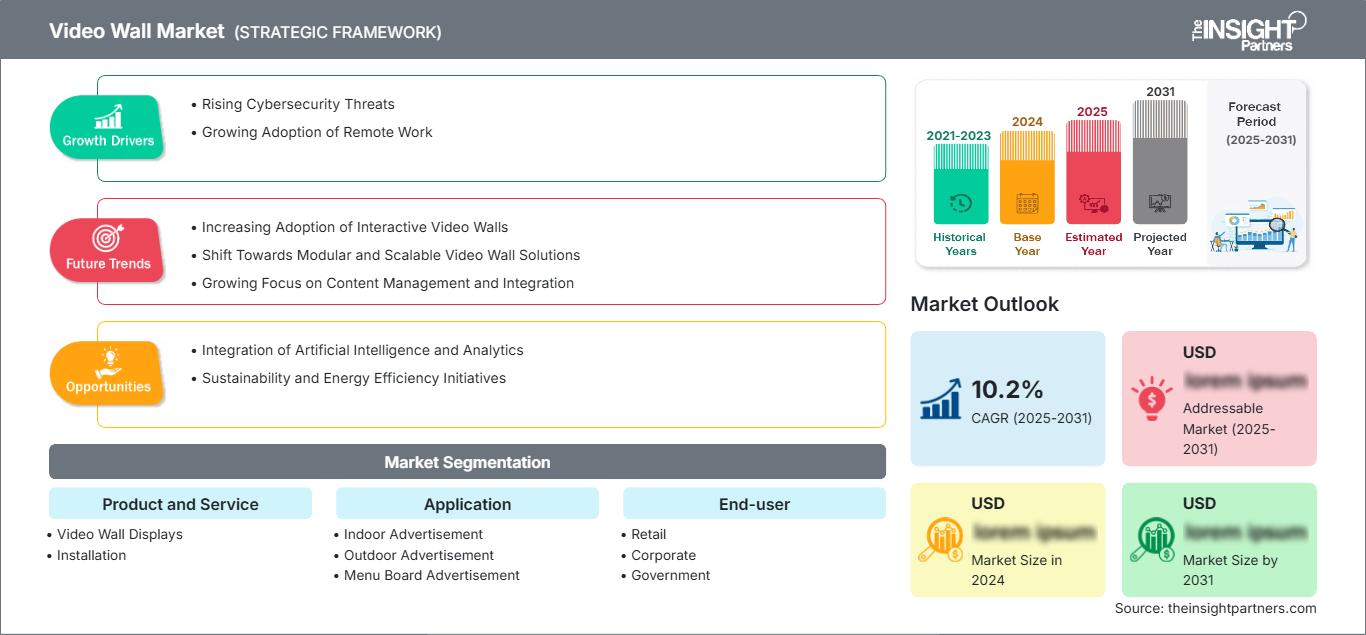
The global Video Wall market was valued at US$ 10.22 billion in 2025 and is expected to reach US$ 16.42 billion by 2034; it is estimated to record a CAGR of 5.41% during 2026-2034.
Video Wall Market Assessment and Insights
- North America: North America is expected to account for 31–35% share in 2025 and grow at a 5.5–6.5% CAGR between 2026–2034, supported by retail digitization, corporate visualization, transportation infrastructure, and sophisticated digital advertising networks.
- US: The US is estimated to represent 82–86% of North America's 2025 share, expanding at a 5.5–6.5% CAGR between 2026–2034, with demand led by enterprise, retail, entertainment, and command-center deployments.
- Europe: Europe is estimated at 24–28% share in 2025 and is expected to grow at a 5.0–6.0% CAGR between 2026–2034, with Germany, the UK, France, Italy, and Spain supporting adoption through retail modernization, transport investment, and digital signage deployment.
- Asia Pacific: Asia Pacific is estimated at 25–29% share in 2025 and is projected to expand at a 7.0–8.0% CAGR between 2026–2034, led by China, Japan, South Korea, and India as commercial construction and digital advertising infrastructure scale.
- Largest Segment: Video Wall Displays are estimated to hold a 72–76% market share in 2025, expanding at a 6.2–7.0% CAGR between 2026–2034, supported by replacement demand and direct-view LED adoption.
- High Growth Segment: Installation is estimated at 24–28% share in 2025 and is projected to grow at a 7.0–8.0% CAGR between 2026–2034, reflecting demand for customized, integrated deployments.
- Key companies analyzed in detail: Christie Digital Systems USA, Inc.; Delphi Display Systems, Inc.; Delta Electronics, Inc.; LG Electronics Inc.; Panasonic Corporation; Planar Systems, Inc.; Samsung Electronics Co., Ltd.; Sony Corporation; Toshiba Corporation; ViewSonic Corporation; Barco NV; Daktronics, Inc.
Source: The Insight Partners' analysis based on proprietary research, government publications, company annual reports, investor presentations, industry databases, and expert interviews.
The video wall market has evolved from tiled LCD configurations toward fine-pitch LED, chip-on-board LED, microLED, high-brightness displays, and software-managed visualization environments. The trend in production today is toward small bezels, low power usage, easy maintenance, adjustable installation, enhanced image uniformity, and seamless content processing. The modular system is also helping with replacement because one cabinet or tile can be replaced without redesigning the whole system.
Moving forward, more investments will be made in higher resolution indoor LEDs, immersive retail displays, transport hubs, corporate experience centers, and digital ad networks. Economies emerging in Asia Pacific and the Middle East are becoming more important with increasing commercial infrastructure. Energy efficiency and lifecycle management are becoming more influential procurement criteria, while network management, remote diagnostics, and centralized content control increasingly differentiate professional display solutions from conventional large screens, according to the Video Wall Market report.
Video Wall Market Report Scope
| Report Attribute | Details |
|---|---|
| Market size in 2025 | US$ 10.22 Billion |
| Market Size by 2034 | US$ 16.42 Billion |
| Global CAGR (2026 - 2034) | 5.41% |
| Historical Data | 2021-2024 |
| Forecast period | 2026-2034 |
Video Wall Market Analysis
Demand is increasingly connected to the need for high-impact visual communication rather than simple information display. Retailers use large-format walls for promotions and brand experiences, while enterprises deploy them for collaboration, monitoring, and visitor engagement. The video wall market growth is therefore supported by a broad ecosystem comprising panel and LED suppliers, processors, mounting specialists, integrators, content-management providers, installation contractors, and maintenance organizations.
Dynamics of supply will be driven by progress made in LED packaging, smaller pixel pitch, standardization of cabinets, and power architecture efficiency. Direct-view LED offers scale for large-scale deployments, whereas LCD technology is relevant in applications where dense pixels and known operating conditions, along with less complex initial installation requirements, matter. Quality of installation is important since calibration, heat management, alignment, signal routing, and accessibility are key factors for lifecycle performance.
Market competition will be based on the level of integration between hardware, processing capabilities, software, services, and channels. Samsung Electronics Co., Ltd., LG Electronics Inc., Sony Corporation, Panasonic Corporation, and Delta Electronics, Inc. will compete with a wide range of professional displays, whereas Christie Digital Systems USA, Inc., Planar Systems, Inc., Barco NV, and Daktronics, Inc. will focus on visualization, LED, processing, and integration.
The competitive landscape is also moving toward application-specific solutions. Planar has expanded fine-pitch LED offerings for constrained and premium indoor environments, while Christie has continued developing LED platforms emphasizing energy efficiency and modularity. LG and Samsung are strengthening managed-display and commercial signage ecosystems. These strategies indicate that vendors increasingly compete on deployment economics, serviceability, content management, and total ownership value rather than display hardware alone, reflecting trends highlighted in the Video Wall Market forecast.
● REPORT CUSTOMIZATION
Tailor This Report To Align With Your Specific Business Requirements
This report can be customized to align precisely with your business objectives, scope, and target markets. Customization options include tailored segmentation, geography, competitive analysis, and strategic insights to support informed decision-making.
Customize This Report →WHAT YOU CAN ADJUST
- ● Segmentations
- ● Geography
- ● Competitive Analysis
- ● Language Preferences
Video Wall Market: Strategic Insights
Regional Insights
North America Video Wall Market
North America is estimated to represent 31–35% share in 2025 and is projected to expand at a 5.5–6.5% CAGR through 2034. North America represents the bulk of regional demand, driven by advanced digital signage infrastructure, modern retail stores, corporate campuses, casinos, sports facilities, transportation hubs, and government sector visualization needs. Canada also plays a role with its contributions to retail, transportation, education, and business applications.
Centralized visual environments are increasingly being demanded by large businesses in the areas of security management, network management, customer interaction, and hybrid collaboration. Renewal cycles are also driving migration from old-school LCD systems to fine-pitch LED systems when smooth visuals and big screens make it worthwhile. Integrators and service providers are important since the installations, calibrations, content delivery, and life-cycle support can impact the projects. The regional video wall market share is therefore supported by both new installations and technology-led replacement spending.
U.S. Video Wall Market
The US is estimated to contribute 82–86% of North America's 2025 Video Wall Market share and is expected to grow at a 5.5–6.5% CAGR through 2034. Use of the product in retail and corporate environments, places of entertainment, transportation, government facilities, and control rooms drives demand. The leading manufacturers are available through an extensive and diverse network of channels throughout the nation.
Modern display systems increasingly include features like content management, analytics, remote monitoring, and data visualization in real time. In retail, the priority is given to brightness and fine-pitch LED displays, whereas in corporate and government facilities, the focus is placed on reliability, serviceability, security, and durability. Christie Digital Systems USA, Inc., Planar Systems, Inc., Barco NV, Samsung Electronics Co., Ltd., LG Electronics Inc., Sony Corporation, and ViewSonic Corporation operate in the professional display and visualization markets.
Europe Video Wall Market
Europe is estimated to account for 24–28% share of the Video Wall Market in 2025 and is projected to grow at a 5.0–6.0% CAGR through 2034. Among these, Germany ranks first, while others include the UK, France, Italy, and Spain. Factors driving demand in these countries include digital retail, transportation upgrade, corporate communication, museums, public facilities, and experiential commerce settings.
The UK is an important market for digital advertising, entertainment, transportation, and corporate use cases. The UK has large urban centers that require high brightness displays, together with remote monitoring capability and screen versatility. There is help in this market from already available skills in AV integration and procurement of professional displays.
Germany enjoys the advantages of manufacturing prowess, corporate spending, trade shows, transportation needs, and control room requirements. Germany is a market that likes energy-efficient systems that operate continuously.
Hospitality, retail, tourism, transportation, cultural venues, and commercial redevelopment are among the services provided by France, Italy, and Spain. These nations are more inclined towards the use of immersive installations to create distinctive environments for their customers. Europe is thus one such region where LCD video walls, direct view LED, and fine pitch installations all operate together.
APAC Video Wall Market
Asia Pacific is estimated to represent 25–29% share of the Video Wall Market in 2025 and is expected to grow at a 7.0–8.0% CAGR through 2034, making it the leading high-growth region. China is still the largest market, with Japan, South Korea, India, and Australia contributing to diversification of demand.
Construction, retail, transportation, smart city projects, and digital advertising infrastructure enable the use. China has been helped by its strong ecosystem in terms of display manufacturing, and India is leveraging retail, hospitality, airport, corporate, and entertainment projects. Japan and South Korea have focused on high-quality visual display systems and technologies, and Australia has been supportive of professional deployments in retail, infrastructure, and corporate sectors.
Middle East & Africa Video Wall Market
Middle East and Africa Video Wall Market is projected to grow at a 5.5–6.5% CAGR through 2034, with Saudi Arabia and the UAE representing leading demand centers. Large infrastructure programs, tourism developments, airports, malls, entertainment destinations, and hospitality projects create opportunities for large-format visual systems.
Destination development is highly developed in Saudi Arabia, whereas the UAE is an established center for premium retailing, hospitality, exhibitions, and transport services. The most advanced destination in the region of sub-Saharan Africa is South Africa, which requires solutions for corporate, retail, broadcast, and public-sector applications. Management of energy use, outdoor resistance, thermal performance, and accessibility to maintenance are especially critical criteria.
Segmentation Analysis
Product and Service
Product and Service remains the core segmentation framework, with the combined category expected to expand at a 6.3–7.1% CAGR from 2026–2034. Hardware continues to generate most project value, while installation captures increasing importance as systems become more sophisticated. Customers increasingly require precise calibration, mounting, signal management, commissioning, and lifecycle support, encouraging vendors and integrators to offer complete deployment packages, reflecting evolving Video Wall Market trends.
- Video Wall Displays: Video wall displays represent the principal demand category, supported by retail, corporate, transportation, entertainment, healthcare, and education deployments requiring scalable visual surfaces. Direct-view LED increasingly complements LCD in applications prioritizing seamless images, large dimensions, brightness, and flexible configuration.
- Installation: Installation services are strategically important because complex display arrays require structural assessment, mounting, calibration, power planning, signal distribution, and commissioning. Demand increases as customers seek turnkey deployments and reduced operational risk.
Application
Application is projected to grow at a 6.0–6.8% CAGR from 2026–2034, reflecting wider adoption of digital advertising and visually intensive customer experiences. Application requirements vary according to brightness, viewing distance, operating hours, content complexity, and environmental exposure, creating differentiated purchasing criteria across indoor and outdoor deployments, in line with evolving demand patterns in the Video Wall Market.
- Indoor Advertisement: Indoor advertisement applications benefit from controlled lighting, close viewing distances, and high-resolution content. Retail stores, malls, airports, hospitality venues, and corporate spaces use video walls to create dynamic brand environments and support frequent content changes.
- Outdoor Advertisement: Outdoor advertisement requires high brightness, weather resistance, robust thermal design, and dependable remote management. Large roadside displays, commercial façades, transit locations, and public venues create demand for durable LED architectures.
- Menu Board Advertisement: Menu board advertisement combines visual merchandising with frequent content updates across restaurants, food courts, and hospitality environments. Centralized management enables operators to coordinate pricing, promotions, product imagery, and localized messaging.
- Billboard Advertisement: Billboard advertisement emphasizes viewing distance, brightness, structural stability, and continuous operation. Digital billboard deployments support flexible scheduling and enable advertisers to modify campaigns without physically replacing printed materials.
End-user
End-user demand is forecast to expand at a 6.1–6.9% CAGR from 2026–2034, supported by the broadening role of large-format displays across commercial and institutional environments. Procurement increasingly considers operational continuity, content management, integration, energy consumption, and service coverage alongside image quality, reflecting evolving requirements across the Video Wall Market.
- Retail: Retailers use large-format displays to support storefront communication, product launches, promotions, immersive brand experiences, and in-store navigation. High-resolution LED is particularly relevant for flagship locations where visual impact is central to customer engagement.
- Corporate: Corporate deployments include reception areas, meeting environments, experience centers, executive briefing spaces, and command rooms. Buyers prioritize reliability, collaboration compatibility, centralized management, and integration with enterprise audiovisual infrastructure.
- Government: Government applications include public information, security operations, emergency coordination, transportation management, and administrative communication. Procurement generally emphasizes long operating life, security, redundancy, and service availability.
- Hospitality and Transportation: Hotels, airports, railway stations, and other travel facilities use displays for wayfinding, advertising, schedules, passenger communication, and guest engagement. Reliability and visibility across varying ambient conditions are key requirements.
- Entertainment: Entertainment venues deploy large displays for immersive experiences, live events, sports, gaming, attractions, and broadcast environments. High refresh rates, precise color reproduction, low latency, and flexible configurations are important purchasing criteria.
- Healthcare: Healthcare facilities use video walls for command centers, patient communication, wayfinding, clinical visualization, and public information. Reliability, ease of cleaning, system integration, and continuous operation influence deployment decisions.
- Education: Educational institutions use video walls in auditoriums, lecture halls, collaboration spaces, libraries, and campus communication networks. Procurement is increasingly linked to hybrid learning, event presentation, and centralized campus messaging.
- Retail Banking: Retail banking environments use displays for customer communication, financial education, promotional content, and branch modernization. Compact footprints and centralized content management support consistent communication across distributed branch networks.
Opportunity Snapshot
| End-user | Revenue Contribution (High/Medium/Low) | Trend Tag | Adoption Stage |
|---|---|---|---|
| Retail | High | Immersive Retail | Scaling |
| Corporate | High | Experience Centers | Scaling |
| Government | Medium | Command Centers | Mature |
| Hospitality and Transportation | High | Smart Wayfinding | Scaling |
| Entertainment | High | Immersive Venues | Scaling |
| Healthcare | Medium | Clinical Visualization | Emerging |
| Education | Medium | Campus Messaging | Scaling |
| Retail Banking | Medium | Branch Modernization | Scaling |
Video Wall Market Growth Drivers and Impact Analysis
Digital Transformation of Physical Customer Environments
Retailers, hospitality providers, transport providers, and entertainment providers have come to view the physical space as a customer environment that can be centrally controlled by digital means. This development increases the need for big-screen visual communication as the content becomes flexible to change, centralize and adjust to various campaigns and operational conditions. The increased demand goes beyond the purchase of displays to involve the need for content creation, networking, deployment, monitoring, and support. For the suppliers of such solutions, it offers the chance to combine their hardware products with services in the form of software and services while relying less on one-time hardware sales. Such developments are especially critical to multi-site customers, where centrally administered operations may increase efficiency and ease of operation.
Advancement of Fine-Pitch LED and Modular Display Architectures
Advances in technology are making it easier for fine-pitch LEDs to be adopted into environments where LCDs would traditionally have been used. Small pixel pitches, better calibration and power management, chip-on-board design, and modularity are allowing companies to overcome the challenge of indoor environments needing higher-quality images viewed at shorter distances. These advances also permit installations that are curved or irregular, as well as those that lack enough space for flat-panel designs. The business implications span premium retail, corporate visualization, broadcast, entertainment, and control room sectors. Companies that offer visual performance and thermal efficiency with front-access serviceability will make their installations and servicing less complex. With more product lineups from low to high-end, more customers can analyze LED systems using lifecycle cost analysis rather than seeing them only as premium solutions.
Expansion of Digital Out-of-Home Advertising Infrastructure
This technology has established a steady pool of demand for displays that are bright and continuously running. Advertisers are able to gain from flexible timing, fast content swapping, custom messages, and the ability to conduct several campaigns using a single physical medium. The owner/operators will then be able to treat the display systems as a source of revenue as opposed to just signage. This is possible in deployment in shopping districts, transportation hubs, storefronts, entertainment areas, and roadside settings. Suppliers will have to take into consideration such features as brightness, weatherproofing, remote monitoring, content protection, and reliability of the technology. The value chain is also extended to the providers of installation and maintenance services since outside installations need structural considerations, weather-proofing, servicing, and connectivity.
Video Wall Market Future Trends
Convergence of Displays With Intelligent Content Platforms
The next generation of development is going to see more integration between display hardware and intelligent content delivery platforms that automate scheduling, diagnostics, monitoring, and communications geared towards the audience. Instead of being standalone screens, the installations will function as manageable endpoints within the digital ecosystems as a whole. Artificial intelligence can provide solutions for content optimization, anomaly detection, equipment monitoring, and campaign optimization, while cloud platforms can manage thousands of screens throughout many locations. This trend will drive purchase decisions regarding software compatibility, security, remote manageability, and analysis options. Companies that produce open interfaces and interoperable management systems will be able to retain customers since their services will become integrated into customers’ business processes. The added value will consist of reduced administration costs and increased efficiency of the deployed equipment.
Energy-Efficient Modular Systems Become a Procurement Priority
"Performance related to energy should be more important as companies consider the overall costs of running big displays," the report said. "Manufacturers will favor designs using low-power LEDs, smart brightness control, power-efficient power supplies, good thermal management, and modularity, which increases the lifetime of the products." The buyers, in turn, will look at energy usage along with brightness, resolution, reliability, and services. "Modularity also allows for the reduction of electronic waste as only parts requiring replacement are replaced and not the whole unit," the research stated. Companies that will manage to show their product performance throughout the entire lifecycle and provide sustainable service solutions will be preferred. In the case of commercial installation of large-scale displays, even small energy savings could make a significant difference, as such systems can work continuously.
Video Wall Market Opportunities
Integrated Managed Display Services
Managed display services present an opportunity to generate ongoing revenue without being limited to the initial hardware deployment process. Vendors and integrators can bundle remote management, preventative maintenance, content scheduling, device management, reporting, analytics, and support services into monthly subscription packages. This approach is especially suitable for retailers, hotels, transport organizations, banks, and companies operating their installations across geographical locations. Differentiators can include reaction time, uptime, remote diagnostics, and consolidated reports. In addition, vendors can develop relationships with distributors by offering management tools that enable integrators to manage different brands in their installations. The greatest potential lies in situations where there is no AV engineering expertise on the customer side or where there are many installations.
Emerging-Market Deployment and Local Integration
Emerging economies present a compelling opportunity since modern retailing concepts, airport projects, hospitality developments, entertainment venues, and corporate facilities are becoming increasingly prevalent. Local integrators can add value by leveraging international display technologies alongside regional expertise in installation, content generation, maintenance, and project management. Countries such as India, Southeast Asia, the Middle East, and selected Latin American countries represent particularly suitable markets due to the presence of new infrastructure that can incorporate display technology without having to overcome the weight of legacy infrastructure. Vendors can enhance market penetration through distributor relationships, local training programs, spare parts supply, and pre-packaged installation options. Financing solutions could also drive adoption in mid-sized commercial applications that cannot afford high capital investments. The most effective approach will be based on delivering high-performance and low-installation and lifetime cost solutions.
Frequently Asked Questions

- Comprehensive Market Sizing and Forecast Analysis
- Detailed Segmentation Analysis
- In-Depth Market Dynamics Assessment
- Regional and Country-Level Insights
- Competitive Landscape and Company Benchmarking
- Strategic Business Intelligence
Recent Reports
Testimonials

The Insight Partners provided valuable market intelligence that supported our global go-to-market strategy. Their team was professional, responsive, and attentive to our feedback, providing thoughtful analysis and helpful methodological clarifications throughout the project.
Junmo Kim Chief Financial Officer (CFO), Enertech Co., Ltd.
The Insight Partners' SCADA System Market report is comprehensive, with valuable insights on current trends and future forecasts. The team was highly professional, responsive, and supportive throughout. We are very satisfied and highly recommend their services.
RAN KEDEM Partner, Reali Technologies LTDs
I requested a report on a very specific software market and the team produced the report in a few days. The information was very relevant and well presented. I then requested some changes and additions to the report. The team was again very responsive and I got the final report in less than a week.
JEAN-HERVE JENN Chairman, Future Analytica
We worked with The Insight Partners for an important market study and forecast. They gave us clear insights into opportunities and risks, which helped shape our plans. Their research was easy to use and based on solid data. It helped us make smart, confident decisions. We highly recommend them.
PIYUSH NAGPAL Sr. Vice President, High Beam Global
The Insight Partners delivered insightful, well-structured market research with strong domain expertise. Their team was professional and responsive throughout. The user-friendly website made accessing industry reports seamless. We highly recommend them for reliable, high-quality research services
YUKIHIKO ADACHI CEO, Deep Blue, LLC.
This is the first time I have purchased a market report from The Insight Partners.While I was unsure at first, I visited their web site and felt more comfortable to take the risk and purchase a market report.I am completely satisfied with the quality of the report and customer service. I had several questions and comments with the initial report, but after a couple of dialogs over email with their analyst I believe I have a report that I can use as input to our strategic planning process.Thank you so much for taking the extra time and making this a positive experience.I will definitely recommend your service to others and you will be my first call when we need further market data.
JOHN SUZUKI President and Chief Executive Officer, Board Director, BK Technologies
I wish to appreciate your support and the professionalism you displayed in the course of attending to my request for information regarding to infectious disease IVD market in Nigeria. I appreciate your patience, your guidance, and the fact that you were willing to offer a discount, which eventually made it possible for us to close a deal. I look forward to engaging The Insight Partners in the future, all thanks to the impression you have created in me as a result of this first encounter.
DR CHIJIOKE ONYIA MANAGING DIRECTOR, PineCrest Healthcare Ltd.Reason to Buy
- Informed Decision-Making
- Understanding Market Dynamics
- Competitive Analysis
- Identifying Emerging Markets
- Customer Insights
- Market Forecasts
- Risk Mitigation
- Boosting Operational Efficiency
- Strategic Planning
- Investment Justification
- Tracking Industry Innovations
- Aligning with Regulatory Trends





 Get Free Sample for